
Today’s guest post is from Elizabeth St. Dunstan. At the conclusion of the April 2017 General Conference many members expressed dismay that only one woman had been invited to speak to the general membership of the church. I shared this disappointment, and it seemed to go further than just the lack of female speakers in the lineup. It felt like women were completely absent from the four general sessions of this conference, so I decided to compile some data on the conference to see if it verified my initial observations. Here’s what I found:
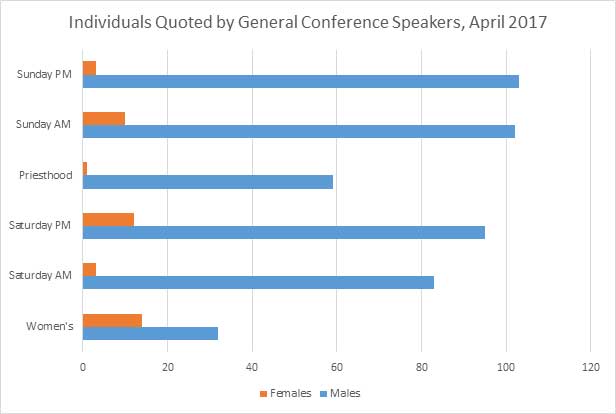
In total, men were quoted 480 times by the conference’s 32 speakers; 389 of these references occurred in the general membership sessions, 59 in the Priesthood Session, and 32 in the General Women’s Meeting. In contrast, women’s words were quoted a total of 43 times in the entire conference. Women were quoted 28 times in the four general sessions, 14 times in the General Women’s Meeting, and one woman was obliquely referenced (but not quoted) in the Priesthood Session. All told, that means that men were quoted eleven times more often than women.
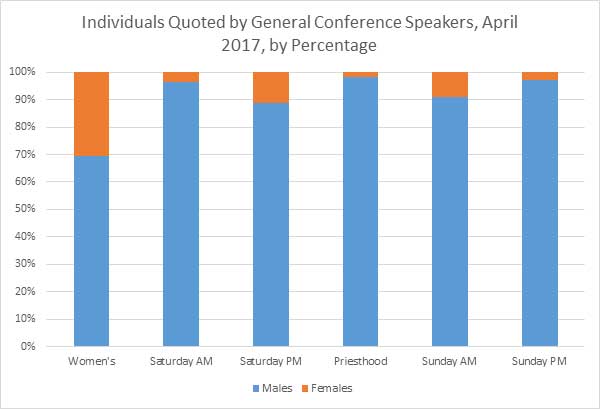
Broken down by percentage, over 99% of the quotes referenced in the Priesthood session were originally written or spoken by men, while only 30% of the quotes referenced in the Women’s Meeting originated from the females. Add in the fact that the keynote speaker of the Women’s Meeting is always male, and I think we have a clear example of gender inequality.
The representation statistics get worse when these quotations are broken down by category.
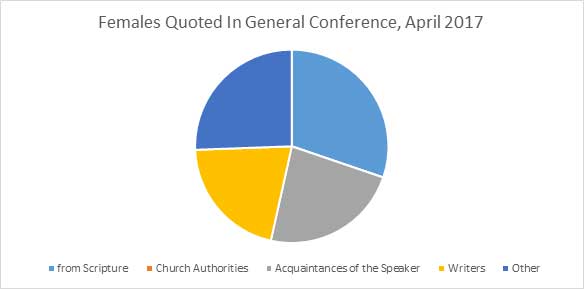
I counted any reference to a woman in scripture as a quote from her, even though these stories were all recorded by male writers. I was astounded to discover that not one current or previous General Auxiliary President was quoted in any meeting! We already have disproportionately few women in leadership in the church, so we can’t afford to ignore the words of those we do have.
Contrast the proportions of types of quotes from females to the same proportions for males:
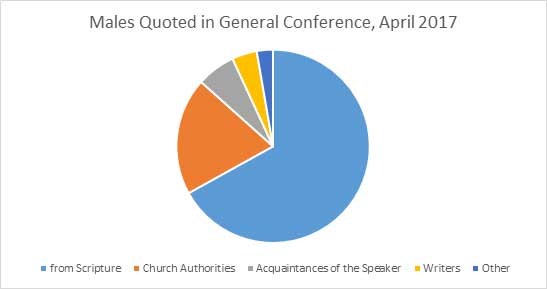
The vast majority of men referenced by other speakers were either from the scriptures, including the Doctrine and Covenants, or past and current General Authorities. An astonishing ten of the 28 male speakers quoted themselves as authorities on the subjects of their remarks. That’s more than 1 in 3 male speakers quoting themselves! None of the four female speakers indulged in the same practice.
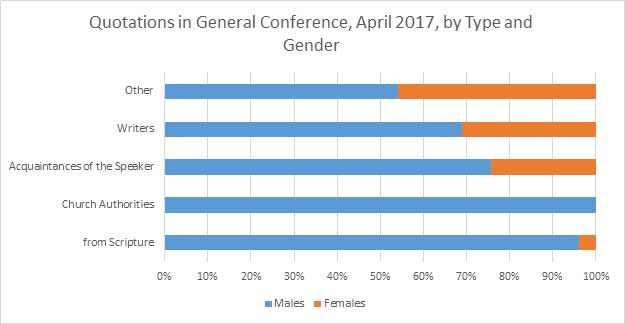
Together, these charts tell us that even when women are quoted in General Conference, they generally aren’t referenced as experts. Over half of the women quoted were either a relative of the speaker or a random woman who wrote a letter to church headquarters. Both of these scenarios were most commonly employed to introduce a topic or provide a jumping off point for the speaker’s subsequent realizations. Men, however, were generally referenced as someone who provided insight, expertise, or a pattern to follow.
Clearly, women’s words are not given the same weight in our church as men’s. To address this imbalance, we first have to admit that it exists. Many of us here on the blogs are well aware of the problem, so step two is for us to make a conscious effort to quote women at church, especially women in positions of spiritual authority. Sisters, don’t just leave the words of our gospel foremothers in Relief Society – bring them into Sunday School and Sacrament Meeting as often as you can. Brothers, you can set the example for the men in your wards and stakes by making sure you never give another talk or teach another lesson without amplifying the words of a woman in leadership. If 70% of the material in my Women’s Meeting comes from men, surely 30% of the material in your Priesthood quorums could come from us.
- Do you notice an imbalance of men’s and women’s words in your ward or stake?
- What do you suggest (aside from the obvious ordination of women) to balance this out?
Discuss.
 Wheat & Tares
Fantastic post! I think that there is a certain inertia to human behavior. Once we do things a certain way we tend to keep doing it that way again and again and again. Even if we do want change. (I’m talking specifically here about myself.) For example, I am assigned to teach Sunday school in two weeks and because I read this post I will be quoting women as authorities. It is a lesson on the word of wisdom, and given the material I shamefully probably wouldn’t have thought to quote a single female authority. Thanks for the call to repentance and the challenge to improve!
I suppose I listen differently — I listen for the message, and don’t have time to count things such as this (or time to discount the message for things such as this). Sometimes, I wish there were far fewer quotations from persons all around, and more from scriptures and testimony. Still, I’m in favor of a little variety and flavor from time to time, so if there are going to be quotations, I’m okay with broadening the pool.
All of this rests on the pretence that speaking is a privilege. Which it isn’t. If anything it’s a huge burden. I know several general authorities and they are nothing short of exhausted performing their ministerial duties. The last thing they want to do is speak in front of millions of people. So are we to interpret that the men are just so power hungry and superior that they get all the speaking opportunities, or rather that they are willing to speak so their wives do not have to. This is the same issue with women and the priesthood. If you mistakenly think that holding the preisthood is an advantage then of course you’re going to think it’s sexist. But when you understand that we all just have different roles in this life, and that the Lord has determined that it’s for the betterment of men to take on leadership positions then all of these concerns become moot.
Scott’s terrible comment is evidence that bad policies and practices are never as bad as the defenses some people employ to justify them.
Nice work Elizabeth.
I see it all the time. I go out of my way to always address the RS, WY, and Primary Presidents as “President …” when I am talking to them about something relating to their calling. And it has been 100% of the time that they are taken back when I address them this way. I have NEVER had a male “president” say anything about me addressing him with the “president” title.
I will note that I make sure that I DON’T address anybody as President when just casually talking with them casually. I figure if they are humble, they won’t care and if they are full of themselves and WANT to be called by their title even when chit-chatting then they need to be irritated.
I will say there isn’t total blindness in my ward as during the ward council the Bishop will poll anybody in the room that is kind of sitting quiet and has even said, “we need a woman’s point of view on this.” But it all feels so much of baby steps when I then move into the corporate world where I happen to have 6 levels of management above me and only one is male. It feels like I am living in 2 different worlds.
Scott, its irrelevant whether or not the individuals speaking want to be there or not (I mean, how do you know what they want?). The point is that the messages we receive are primarily from men and there is an implication that women’s voices are not as important when it comes to matters concerning the church. You seem to agree with this sentiment by stating that we all have roles to fill. In the church, the role of women is to be silent and that is the message they are getting in conference.
This is an excellent analysis! Thank you.
I went to a stake auxiliary “training” several months ago for RS YW and primary presidencies. Stake Pres spoke for 40 minutes, telling 11 stories – all 11 were about men! To this large group of women!
This is a valuable reminder to us all that we need to be conscious to include the female voice.
Scott Knudson, your comment defies logic. I’m going to assume that you are serious about what you have written though part of me is baffled by the thought that somebody could, with a straight face, say what you have said.
EJ – the thought comes to my mind of writing a short letter to the SP and thanking him, but pointing out what you just said. Tell him you realize he probably doesn’t do it on purpose, but it actually hurts many women quite deeply. It could be done anonymously via the USPS mail. If someone is never made clear of their blindspots, they will probably never work to improve.
Jason B-
Due to the structure of many church manuals and resources, it’s frighteningly easy to neglect the female voice. We’ve all been there :/. It takes a little extra effort to find the resources from women, and I’m so glad to hear you’re going to consciously do it!
Scott-
Whenever you find yourself telling someone their concern is invalid, stop rebutting and start listening. A good strategy is to rephrase the concern back to them. “I’m hearing you say that you’re concerned about….” Then if you feel differently, express that *after* you’ve identified the concern. “I see things another way. From my point of view…”
From your comment, it seems that you are under the impression that I was writing about the lack of female speakers. I did touch on that briefly in my introduction, but the bulk of the analysis rested on who the speakers were quoting, not who spoke. If you wish to discuss the matter of whose words were quoted, I would be happy to engage with you further.
Thanks. One data point from a pretty active and large stake: when the stake presidency is in charge of planning stake conference (meaning, no GA present who presides) we purposefully have an equal number of men and women as speakers (and generally if not equal, then more women). After each of those stake conferences with equal or more women, we have had many more people approach us after to thank us for the speakers and just more positive comments in general (we also try very hard to have a representative cross section of the stake as speakers). Is this necessary to have a spiritual feast and to effectively minister? Maybe, maybe not. But I can tell you it was a decision we reached after prayerful consideration and it has only been confirmed over and over.
The OP is basically arguing for affirmative action wrt to source material for talks. Things are changing in the church and women’s voices will become stronger with time. I’d say women are nearly equally represented in my ward’s sacrament meetings, and probably get 1/3 to 2/5 of the time in our stake conferences (with no GA present). But since women’s voices aren’t well-represented in the scriptures or in general conference, it seems unlikely that quotes by women are going to naturally become more common quickly. In fact, as long as the Book of Mormon is widely used, quotes from men are going to continue to dominate.
Nothing brings it home like the numbers. Thanks, Elizabeth. We have promises to keep, and miles to go before we sleep.
The status and role of women in the church remains subject to “leadership roulette.”
There are some leaders willing and wanting to giving women more equal consideration but there are still many others (who might not openly admit it) but do adhere to the “men are the priesthood holders they are the decision-makers we’ll let you know if we want/need any (female) input.”
It make take another generation or two for women’s voices to be sought out and valued.
The hardest part of this past conference for me was that mere weeks prior to it, I found myself at the RS Building on Temple Square, where the new book “Women at the Pulpit” was being released. The authors and speakers quoted sat on a panel. There was some Q &A. The overall gist of it was that women have such valuable things to say! However, when an audience member asked if the church had any plans to incorporate the words found in the book into any of the curriculum, the answer was no. In a moment where women’s voices were apparently being celebrated and valued, their words still carried no official ecclesiastical weight. To go from Women at the Pulpit to a GC where hardly any women spoke (or were quoted…sorry to sidetrack, I did get that the #’s of female speakers wasn’t the focus of the post, and yet…) it was all just truly depressing.
I love this analysis, Elizabeth, even though the conclusion is deeply depressing.
On a related point, I did an analysis a few years ago of how much of their talks Conference speakers spend on quoting someone else. I found that women speaking in Conference used noticeably more quotes than men did, which fits exactly with your conclusion that women’s words aren’t seen as authoritative. (Here’s my post: http://zelophehadsdaughters.com/2015/06/03/quote-close-quote/)
Elizabeth
Why do we have to hear from women at General Conference? I want to hear from General Authorities as I suspect most members do.
Poor Ronkonkoma, forced to sit through 1-2 women’s talks among the endless string of GAs.
Ronkonkoma, because General Conference is about listening to both General Authorities *and* General Officers of the church. You may not care about the General Officers, but many members of the church appreciate hearing from leaders of specific organizations they are part of or serve in, like Sunday School or Primary.
Mary ann
Disagree. Conference is a time to primarily hear from General Authorities.
Ronkonkoma, please explain to me why I should have more reason to be excited to hear from some random seventy than the president of the Relief Society, who leads an organization often touted as the largest women’s organization in the world.
I taught a Relief Society lesson where, coincidentally, all the quotes I used were from the women auxiliary leaders. I didn’t even realize it until an elderly sister approached me afterward to thank me and tell me how much it meant to hear from women. Years later, when I was again called to teach RS, I made a conscious effort to seek out female voices. My standard go-tos were Cheiko Okasaki, Sheri Dew, Kathleen Hughes, and Mother Teresa. My rule for myself was to include at least one quote from a female. I am picky about my quotes and will only use words I really love, but I could always come up with one, and usually more. It took me longer to prepare because of this rule because quotes from women are harder to find, but it made my lessons better. I noticed, though, that I used high-ranking male GAs to establish points I worried might be slightly controversial (by “controversial” I mean things like not treating non-LDS people like they are devil-spawn), and then female and/or non-LDS voices for the simple beauty and power of their words. If the only alternative to affirmative action is using mediocre quotes from men simply because they have more rank, I choose affirmative action.
The Daughters of MOTHER EVE
of Latter-Day Saints
1. We believe that God is a title that denotes more than one personage. Those personages are our Father and Mother in Heaven.
2. We believe Jesus Christ is the Savior of Mankind and Mother Eve the Comforter of mankind.
3. We believe that we were given the Sarahic1 Priestesshood in the pre-existence through Mother Eve.
4. We believe that the Miriamic1 Priestesshood is to help prepare women to take on the duties of the Sarahic1 Priestesshood.
5. We believe that women should lead side by side and hand in hand with our brothers, husbands, and fathers.
6. We believe that our duty and calling is separate and complimentary to the church of Jesus Christ of Latter Day Saints.
7. We believe that there should be no poor among us. To help the poor build a secure life with love and understanding.
8. We believe that poverty is instability in home ownership, food availability and job security.
9. We believe that through personal accountability and community support we can achieve the fullest measure of our creation.
10. We believe that holy script has been changed by false priests and evil transcribers to exclude and persecute those who were a different gender, race, nationality, and sexuality.
11. We believe through objective thought and careful prayer we will be able to strip prejudice from ourselves and our beliefs.
12. We believe that we are saved through Jesus Christ and we are here Because of the sacrifice of Mother Eve.
1 These names were chosen in the same manner that The Melchizedek and the Aaronic Priesthood names were chosen. Namely by calling them after Women that faithful to the Priestesshood, otherwise known as the Priestesshood after the Order of the Daughter of God.