
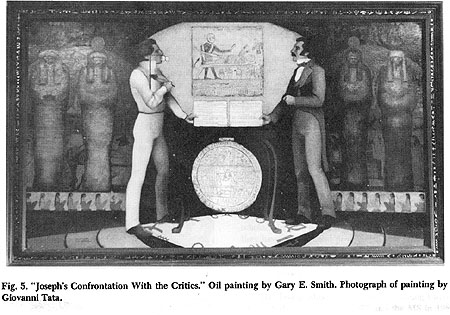
 Just this last week, the church re-emphasized the importance of its new essays in addressing thorny doctrinal topics. For many, the Book of Abraham is problematic, a real shelf-breaker. The church’s essay on this topic attempts to reconcile the problematic nature of the Book of Abraham’s origin with the doctrinal importance of its contents.
I was recently re-reading a post by Kevin Barney on this topic. Kevin’s post gives a great overview of the issues that have plagued Mormon historians’ defense of this book of scripture. He gives a historical overview of how the problems emerged, and then lists 4 usual defenses or stances apologists and Mormons in general take to explain the book’s implications.
The issue being solved for is the disconnect between the extant materials used in the translation process and the Book of Abraham itself; the recovered materials we have and the BoA aren’t directly related. The fact that they are recovered is important because the materials were lost for many decades after the translation and were later found to be in the possession of the Metropolitan Museum of Art in New York City. The church only “recovered” the materials in 1967, after over a hundred years of them being out of the church’s ownership. [1] During the time the materials were missing, an expectation developed that the materials would “prove” that Joseph’s translation was correct, if only those materials hadn’t been lost. Darn.
 The Kirtland Egyptian Papers (KEP) make it clear that Joseph believed he was translating the Book of Mormon from the Hor Book of Breathings. Before the materials were recovered, this claim was partly uncontestable because the materials used in translation were not available to be evaluated. Bear in mind that the Book of Abraham was produced in 1835 (published in 1842), 23 years before the first English translation of the Rosetta Stone. However, it was contested by scholars who saw the inconsistencies in the asserted translation of Facsimile 1:
Dr. Arthur Cruttenden Mace, Assistant Curator in the Department of Egyptian Art in New York’s Metropolitan Museum of Art, wrote the following in 1912:
I return herewith, under separate cover, the ‘Pearl of Great Price.’ The ‘Book of Abraham,’ it is hardly necessary to say, is a pure fabrication. Cuts 1 and 3 are inaccurate copies of well known scenes on funeral papyri, and cut 2 is a copy of one of the magical discs which in the late Egyptian period were placed under the heads of mummies. There were about forty of these latter known in museums and they are all very similar in character. Joseph Smith’s interpretation of these cuts is a farrago of nonsense from beginning to end. Egyptian characters can now be read almost as easily as Greek, and five minutes’ study in an Egyptian gallery of any museum should be enough to convince any educated man of the clumsiness of the imposture.
 Emotionally charged terms like “farrago of nonsense” undermine his objectivity a tad (although he’s certainly eloquent), but his criticism captures the general response of most Egyptian scholars to the book. The criticism stems from the fact that the book’s content doesn’t match the purported source material, and the “translation” of the facsimile also doesn’t match, instead fabricating an Abraham-centric story for the Book of Breathings.
The church’s essay on the Book of Abraham keeps an open mind about its apologetic approach rather than settling on any one theory. The 4 most common approaches to explaining the difference between the materials we have and the resulting book we call scripture are outlined in Kevin’s post, but two of them are mostly irrelevant:
A Mnemonic Aid. Nibley briefly preferred this approach to explaining the book, that the materials in the Book of Breathings were used as a memory trigger for stories transmitted through oral tradition. An ancient (or modern) storyteller would see the drawings in the Book of Breathings and would remember the stories about Abraham. This favor has largely grown out of favor, but you can read about it here and here. Proponents of the theory point to the fact that there is some relationship between the Egyptian and English, but that it’s not a direct translation relationship. A parallel is drawn to Aztec oral traditions using pictographic language:
An excellent example of a similar type of oral tradition was found among the Aztecs. It differed from the Hebrew oral tradition in that it was quite precise and utilized a memory aid or “mnemonic” device. This was in the form of a painting (codex), each symbol of which brought to mind a certain set of rote memorized phrases, which were passed down from one generation to another. Certain Aztec men had learned stories relating to various of these paintings. If one were to compare the oral recitation of one Aztec elder with that of another viewing the same painting, they would be substantially the same and, most often, identical renditions. (John A Tvedtnes)
No Relationship Between Papyrus and Book of Abraham. Nibley later theorized that the papyrus was valuable only in creating the temple rites, not directly in the translation of the BoA. But this still doesn’t explain away the “translation” connection within the BoA of Facsimile 1 or where the BoA originated; it just downplays the importance of the problematic papyrus.
The remaining two theories are those still favored by the church and by most LDS scholars:
The “Missing Papyrus” Theory. Nibley eventually preferred this explanation, and it is commonly used by apologists today. The one problem with this approach is that we have the Book of Breathings materials, and Joseph clearly saw a connection between that and the Book of Abraham that scholars demonstrate doesn’t exist. Because this was the original apologetic angle (while the materials were presumed lost in a fire), it’s one that ended up disappointing when the materials came to light in 1967. Apologists feeling gun shy about this one makes sense.
 “Pure Revelation” Theory. This, combined with the missing papyrus theory, is the church’s favored theory in its recent essay, the idea that the papyrus and Egyptian materials provided a catalyst for revelation but were otherwise unnecessary and unconnected to the BoA’s content.
On the downside, this is contradicted by Joseph’s understanding of how he translated, but it is actually more consistent with his other translation projects–which he also misunderstood. There were several simplistic assumptions about translation circulated among early members of the church, including the idea that the documents were penned by Abraham himself (as opposed to copies of his stories passed down through others). Given the date of the materials we have, we know that they do not date to Abraham’s time, but are from the Greco-Roman era.
Once you allow for a “Pure Revelation” theory using the materials as a touchstone or catalyst, whether the materials match or not becomes irrelevant. A great theory for apologists, one that is consistent with the Book of Mormon translation process in which Joseph seldom looked directly at the plates. Both translations were written in KJV language, another bone of contention with scholars, but this was the language familiar to the home-schooled Joseph as “scriptural.” My kingdom for a plain English translation, but that’s another post for another day!
Klaus Baer, from the Oriental Institute at the University of Chicago, was impressed by the Book of Abraham, and opined that if it had been rendered into standard modern English rather than King James idiom, it would have had every appearance of an ancient book.
The last, most obvious theory to detractors is that the Book of Abraham is utter fabrication, a work of pseudepigrapha, either a well-meaning but misguided religious devotional book, or the work of a charlatan. But this doesn’t adequately explain some of the content of the book, elements to the Abraham story that were not yet available during Joseph’s lifetime. A few of these elements:
- The attempt on young Abraham’s life
- Abraham teaching astronomy to the Egyptians
- Abraham’s father’s idolatry
- An early famine in Abraham’s homeland
- Some elements of Egyptian idolatry not found in the Bible or other existing materials at the time Joseph translated, including Elkenah as a God and the view of the heavens as an ocean.
Others can be found in the Maxwell Institute’s Traditions of the Early Life of Abraham. The church also points out the unique theological content contained in the BoA:
- Creating the earth out of pre-existing materials (meaning Mormons are not ex nihilo creationists)
- The eternal nature of spirits
- The pre-existence
- The role of earth life as a “test” or proving ground for spirits
The church’s assertion that without the book, these unique doctrines would not exist is justification for canonizing the book in 1880. The Community of Christ does not recognize the book as canonical.
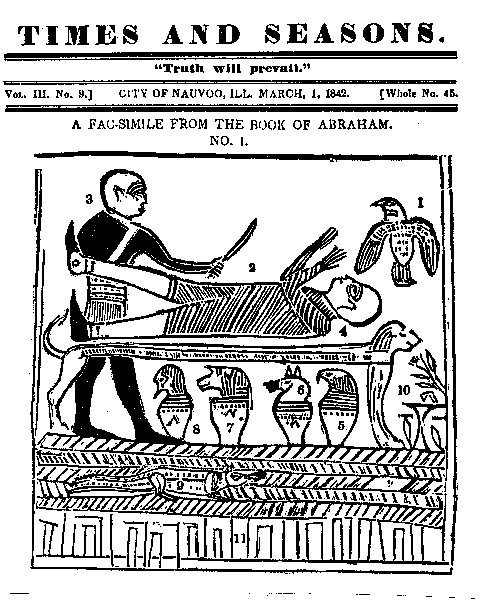 As for the problems with the “translation” of the facsimile, Kevin shares two credible explanations: 1) the facsimile is damaged, without question, and 2) historically, Jews adopted Egyptian iconography, reinterpreting it to tell Semitic stories. He cites 2 examples of the latter, including the story of Lazarus and the rich man which he traces from the Demotic Story of Setna through rabbinic splinter groups and into the book of Luke.
“In the Testament of Abraham, the vignette accompanying chapter 125 of the Egyptian Book of the Dead is reimagined in Semitic terms. Osiris sitting on the throne of judgment becomes Abel; the Egyptian gods become Semitic angels; the scribe Thoth becomes the biblical Enoch. So I posited as a possibility that, “As the vignette for chapter 125 of the Book of the Dead is to the Testament of Abraham, so are the Facsimiles to the Book of Abraham.” . . . if it was acceptable for Jews to adopt or adapt Egyptian iconography to their own purposes, making Abraham a Semitic substitute for Osiris, why would it not be acceptable for Joseph Smith to do the very same thing himself?
Interesting idea. In other words, if ancient Hebrews mistranslated Egyptian pictures and documents in storytelling, why are we so set on our modern, logical, character-for-character, single translation process? Our secular, scholarly mindset leads us to a “closed” perspective rather than keeping our options open when we deal with times not our own.
Charles Taylor, whose ideas I’ve been discussing here and here talked about a “closed” loop vs. an “open” loop, and that whether one religious or not, it’s possible to have either approach. A “closed” person seeks black and white answers, things are true or false, yes or no. An “open” person assumes there are facts unknown and that any single perspective is probably too simplistic.
Now it’s your turn to weigh in about the Book of Abraham.
Depending on your stance on the BoA, your opinion about what the church should do with it will vary. If you see it as an embarrassing fiction, debunked by Egyptian scholars, you might feel like the church should ditch it. Some are simply embarrassed by the astronomy in it and the easily mockable “Kolob.” Personally, I believe the church’s essay makes a strong case for the book’s doctrinal importance, and I have long been intrigued by the presence of non-biblical material in the BoA that wasn’t available to Joseph. There’s something to the book that can’t be easily tossed aside. Kevin’s theories are intriguing, but my own feelings about the value of the book predate my reading his thoughts. I’m not sure what the book is exactly, but ultimately, I believe it’s a valuable addition to our canon from a doctrinal perspective.
Discuss.
[1] From Kevin’s article, the ownership of the materials followed this route: Emma sold to a private buyer named Abel Combs in 1856. It was believed that he had transferred the materials to the Woods Museum in Chicago and that the materials were lost in the Great Chicago Fire of 1871; however, a part of the materials had been given to Combs’ nurse Chrlotte Benecke Weaver Huntsman. Her daughter Alice Combs Weaver Heusser inherited them and tried to sell them to the Metropolitan in 1918, but they weren’t interested. After she died, her husband successfully sold the materials to the Metropolitan Museum in NYC in 1947. The museum was aware they were associated with the Mormon religion from the beginning, but they did not inform the church until the 1960s at which point, the church undertook to acquire them.
 Wheat & Tares
“The Kirtland Egyptian Papers (KEP) make it clear that Joseph believed he was translating the Book of Mormon from the Hor Book of Breathings.”
Book of Abraham surely…. else it’s all a lot weirder than I had supposed.
I particularly like Kevin Barney’s second point.
“Just this last week, the church re-emphasized the importance of its new essays in addressing thorny doctrinal topics.” What is this referencing to?
The Book of Abraham text indeed contains many important doctrinal points. But the facsimiles that are published with it do not. They should be dropped.
lastlemming,
If Kevin Barney’s Jewish redactor theory is correct then the facsimiles are an important part of the book even if the translation is wrong.
Also, I have heard that the meaning of Egyptian pictographs was somewhat fluid and could have multiple correct interpretations but I have been unable to verify this. I am inclined to believe it is true because I recall reading a compilation of critiques by Egyptologists (maybe in an article by Nibley?) and while they all agreed that Joseph Smith’s interpretation was wrong they disagreed among themselves as to what the correct interpretation was. One said it was a priest dissecting a cadaver, another said it was a resurrection scene, etc. If that’s the case I’m not sure why we can’t keep Joseph Smith’s interpretation along with all of the other incongruous ones.
Like hawkgrrl I am also intrigued by the similarities to traditions about Abraham, but if the Book of Abraham turns out to be modern pseudopigraphica it would still fit in just fine alongside the five books of Moses, the four Gospels, the pastoral epistles, the Book of Daniel, parts of the book of Genesis, and other scriptures that are all either obvious forgeries or co-opted and adapted from pagan sources and yet are some of the most foundational and studied books of scripture in all of religion.
In my opinion the church’s essay on the Book of Abraham is the weakest one. I’ve sent people to Kevin Barney’s essay for years and will continue to do so until they beef it up some.
I tend to not give much attention to the Book of Abraham. I tend to think it is more fabrication than any type of real connection to Abraham. But at the same time, I am an artist. And the artist in me says that my own fabrications have pieces of God in them. It’s not something I do intentionally. I don’t usually even notice until after the piece is finished. When I see it though, its usually rather startling. And if it that happens to me, then it seems wrong to not allow that to happen to Joseph Smith, who does appear to have some sort of gift.
I can see for orthodox believers, the idea of JS having authority might come in as well.
I tend to see him as being honest when he says he was translating Abraham’s writings. Which doesn’t mean he actually was, but his belief in doing so falls easily into my experience in how creativity and the brain work together.
I find the Book of Abraham, and for that matter, Moses, deeply fascinating and I don’t really care if JS took them out of his big ol’ hat, they are to me great human stories about man’s interaction with God. I love the cosmic view these books offer us of humanity I tend to see most scripture these days as deep storytelling and am fairly happy to take what I need from it to inform my moral choices and relationships. This is only a problem to me when others insist on literality, seems to me there’s only one place to go with that in the long term.
So great to see this disussion though, I’ve never been aware of the alternate theories, and have consequently come to my own conclusions in relative peace it would seem.
In my opinion, the key to understanding the Book of Abraham is Freemasonry’s myths, which were available to Joseph Smith. Those myths also contain all of the items you list as story elements that were not available to Joseph at that time. Each of those elements were available to Joseph in Freemasonry’s myths (of especial interest is Royal Dutch Masonry). In fact, you can find some of them even in Josephus’s work.
Check out “Antiquities of Freemasonry” by George Oliver and I think you’ll see many correspondences with the Book of Abraham, priesthood, and Joseph’s theology.
I don’t understand the missing papyrus theory at all. Why on earth would missing fragments of the thing that has Nothing To Do With Abraham…have anything to do with Abraham?
Can you please point me to more information on this:
“But this doesn’t adequately explain some of the content of the book, elements to the Abraham story that were not yet available during Joseph’s lifetime. A few of these elements:
The attempt on young Abraham’s life
Abraham teaching astronomy to the Egyptians
Abraham’s father’s idolatry
An early famine in Abraham’s homeland
Some elements of Egyptian idolatry not found in the Bible or other existing materials at the time Joseph translated, including Elkenah as a God and the view of the heavens as an ocean.”
Ruth: Hope springs eternal?
Personally, I love the Book of Abraham and have followed the give and take with interest ever since I noticed the 29 part Improvement Era series by Nibley on a shelf at home after I got back from my mission in 1975. It’s interesting that the critics tend to over-simplify the problem of the papyrus that we have and that we don’t have, Joseph’s approach to translation for the Book of Mormon, Moses, sections of the D&C, etc., the fact that facsimiles 1 and 3 are both atypical rather than ordinary, the translation having preceded the KEP, the many striking connections to Abraham apocrypha and pseudepigrapha, interesting connections to antiquity (cited by Nibley, Robert F. Smith, Steve Ricks and others) and such. I’m personally impressed by the Kolob notion, having been prompted by a 1980 Nibley paper on the Facsimiles to read Hamlet’s Mill (page 73 is impressively relevant), and other sources on archaic astronomy. Ever since getting the first edition of Abraham in Egypt, I’ve been convinced that the Book of Abraham says nothing about race and the priesthood, and even before reading the BYU Studies review of Noah’s Curse, I’ve understood that Mormon culture inherited, rather than invented such notions. And there is even the interesting business of the Hor Book of Breathings as not the source of the Book of Abraham, but instead, an Egyptian Endowment, as well as notable connections between the Egyptian Book of the Dead and the Abraham Apocrypha. And there are several LDS scholars who have done advanced studies in Egyptian and who seem quite happy with it in the canon (Nibley, Gee, Rhodes, Muhlestein and Hauglid). We certainly don’t have all the answers, but we have some that don’t get as much credit as they deserve, and the puzzle remains interesting productive, and challenging. And yes, I very much like Kevin Barney’s approach.
orangganjil: Interesting references. You are certainly on to something. The book is from 1843, and is a defense of Free-Masonry intended to show that it has a 3000 year history, and (among other things) that Abraham practiced the principles of masonry. A link to the pdf: https://ia902607.us.archive.org/16/items/antiquitiesoffre00oliv/antiquitiesoffre00oliv.pdf
I simply searched for “Abraham” and found 97 references. Here are the ones I found that are directly related to Book of Abraham content:
– p. 63. Abraham is credited with introducing arithmetic into Egypt from whence it spread across the world. Now, arithmetic isn’t astronomy, but it’s close. p. 64 adds that the Egyptians used his geometry to study astronomy and the liberal arts, situating landmarks.
– p. 75 Abraham introduced both astronomy and arithemetic to the Egyptians (according to the historian Josephus). Also, an interesting line: “Hence, at the coining of Christ to restore the primitive religion, and with it the essence of speculative Masonry” that sounds a whole lot like our Mormon restoration.
– pp. 139-40. Terah (Abraham’s father) had his possessions wrested from him for renouncing idolatry (by the idolatrous Chaldeans).
– p. 149-150 (footnote) tells the story of Abraham chopping up his father Terah’s idols, then blaming his father’s idols for destroying each other out of jealousy. One of my favorite Abraham stories. Because his father recognized that the idols couldn’t move or speak, he himself renounced idolatry.
– p. 151 (footnote) alludes to the “ten trials of Abraham” including being thrown into fire by Nimrod, King of Babylon, for not worshiping idols, then being rescued by the angel Michael.
– p. 152 Abraham undertakes to teach the Egyptians the error of their ways. He introduced them to his scientific knowledge.
– p. 154 Abraham teaches the Persians in Egypt the absurdity of idolatry and how the light shined amidst the darkness.
– p. 158 Abimelech undertakes to marry Sarah as Abraham’s sister. God sent Abimelech a dream to warn him, and he entered into a covenant with Abraham to assist in his private & public undertakings.
– p. 235 Abraham had a vision in Canaan.
This isn’t a 100% match as a source for ALL the content, nor does it provide doctrinal basis for the pre-existence, material creation, or earth as a “test” for spirits. But as to the Abraham mythology, it’s got a plausible origin for the majority of those stories. Specifics, such as Elkenah, are not mentioned, though. As is well documented, Joseph as a freemason would have had access to these myths and a strong belief that freemasonry was ancient and part of the restoration process.
hawkgrrrl- Thanks for that info! The book does say it was published in 1843, though. Are there earlier editions of this book, or are there any others that might show that Masons knew of the various Abraham stories?
The vote results are interesting, by the way. I guess it tells us something about the demographic that reads this blog.
Niklas: In a letter dated Dec 4, 2016, bishops were told by the FP to tell their Sunday School instructors that supplemental materials (the essays) were added to the lds.org site and linked to the Gospel Doctrine lessons.
Thanks for that link to the 1840s text, which has helped me to see the part that freemasonry may have played in Joseph’s evolution of the temple ordinance as a positive influence allowing him to begin to join up the dots of God’s dealings with men throughout the ages. Probably the most useful thing I’ve ever read a bout the temple ordinance, and about Joseph’s own development as a theological thinker. Big respect HG.
Interesting.
hawkgrrrl-
Nice review of the Book of Abraham. You asked what should be done with the Book of Abraham.
To answer this question, I’ll start by drawing your attention to something I believe most of us would agree on. The more we know about and have experience with x, the greater our ability to deal with issues and perplexities about x. For example, Elder Nelson grew in his ability to perform surgery on human hearts the more he knew and experienced about the heart.
This simple algorithm is true for any endeavor we undertake. It is true for a trash collector or a heart surgeon. It is also true about faith. We can grow in knowledge and experience regarding faith. We’re taught by prophets that the Book of Mormon is the means the Lord has given mankind in our day to acquire faith (testimony) that Joseph Smith is God’s prophet. We’re promised that if we read and pray to the Father in the name of the Son about the Book of Mormon “with a sincere heart, with real intent, having faith in Christ, he will manifest the truth of it unto you, by the power of the Holy Ghost.”
For many, following the algorithm for gaining a manifestation that the Book of Mormon is true is doable. In turn, they are able to deal with the perplexities to faith challenging issues like the essays discuss, including the Book of Abraham. Those who have faith learn from the prophets that their faith will be tried, that there is opposition in all things. As they continue faithful through trials, they will have greater manifestations of the Spirit until they are like Moroni meeting the Savior and talking with Him face to face.
Brian K: I only found that book because it was linked by orangganjil above, so I don’t know.
As to the demographics, that is interesting. As I said in the post, it’s a real shelf-breaker, probably a bigger one than the BOM. In my positive assessment of the book, I know I’m out on a limb among our readership.
One thing worth noting is that the missing papyrus theory is a real non-starter. Our readers aren’t buying it. There’s a sense in the church’s essay that the more traditional apologists pushed to keep it in there or maybe even favor that approach, but it seems to me that once the Metropolitan coughed up the materials that theory became far less credible. Also, the missing papyrus theory doesn’t deal with the facsimiles at all. I love Kevin’s Jewish redactor theory, but the essay didn’t go there.
I do think that focusing on the unique doctrines of the BoA, some of which really would be hard to lose, is a wise choice. However, lots of doctrines originated without being attached to purportedly ancient documents, so it’s not necessary either. That’s the point of ongoing revelation and open canon. We’re constantly improvising.
hawkgirrrl,
Great comment as follow up on the Antiquities of Freemasonry. Keep in mind that there were a lot of these myths with which Joseph almost certainly was familiar, even before that book was published. Things such as the Enoch myth, I believe, influenced the Book of Mormon and the Enoch story in our JST Moses. Anne Taves has some very interesting material in this regard, and I think we have to take it quite seriously.
I also highly recommend the Dialogue article on Freemasonry at the following link:
“Similarity of Priesthood in Masonry” by Michael Homer
Click to access Dialogue_V27N03_15.pdf
For me, the Freemasonry connections (and thus mysticism and its myths) are quite compelling and influenced even the Book of Mormon (I do not believe it to be a historical book, but I also do not believe Joseph to be a fraud – it’s complicated). Joseph demonstrated a tendency to borrow frameworks and paradigms in order to make his teachings accessible to people, and I see so much use of Freemasonry within Joseph’s theology that it just has to be taken seriously. The Book of Abraham, along with the obvious one of the temple ceremonies (endowment, sealing, 2nd anointing, etc.), are just saturated with Masonic and Kabbalistic imagery. I mean, even the King Follett Discourse seems to have been influenced by concepts in the Zohar. Joseph almost quotes from it early in the talk.
Well, I’ve gone on long enough. Thanks for listening.
Another, more cynical view of masonry as used by JS is that it was another of his using something new and charismatic to maintain the momentum in his movement. At regular points in time he would, after the first vision, introduce something new, i.e. the BoM, move to Ohio, the Kirtland Temple, Zion in Missouri, the Nauvoo Temple with masonry based ritual, and then the PoGP/BoA. I know Greg Kearney, a believing member and mason had his opinion as to why JS adopted the ritual http://www.mormonstories.org/mormon-stories-podcast-005-masonry-and-mormonism-and-interview-with-greg-kearney/ but as a brother mason, my opinion is different. In the essays one of the reasons given to believe the truthfulness of the BoA is the gospel truths it contains but that’s pretty weak given how often “truth” comes out of things or persons that aren’t even remotely what they claim to be.
I don’t see the Book of Genesis as being in any way historical, but that diminishes its value to me not one bit. I don’t know what the authors of Genesis thought about what had actually happened, but I suspect they too believed the power of the book was not in its historical accuracy. The problem is that our Western religious culture has a really strong strain of pinning the value of scripture in its historical accuracy.
I’m thinking of Peter Enns “The Bible Tells Me So” here: the Bible wasn’t designed to be a modern historical document, and we do it a severe disservice to treat it that way. In fact, we lose our ability to read it. We should, instead, read it as the spiritual journey of people (and a nation) in search of God, through the lens of Christ’s upside-down, world-shattering messiahship.
In an ideal world, the Book of Abraham would be treated similarly by the Church, so I agree with the others on the thread who think it should stick around in the canon. We just need to start treating the canon differently (including the Bible and the Book of Mormon, for different reasons). It will take some time to make such a view popular in the Church, so for now, I’ll be OK with the Church making space for my position, which it seems to me the online essays do. Thumbs up, Church!
“The Kirtland Egyptian Papers (KEP) make it clear that Joseph believed he was translating the Book of Mormon from the Hor Book of Breathings.”
FYI I think you mean to say the Book of Abraham here, not the Book of Mormon.
Great article!
Here is my research on the issue of the Book of Abraham: http://egyptianalphabetandgrammar.blogspot.com
https://www.academia.edu/36428246/The_Principles_of_Book_of_Abraham_and_Kirtland_Egyptian_Papers_Symbolism
This is my new rough draft paper on the Book of Abraham. Thanks.