
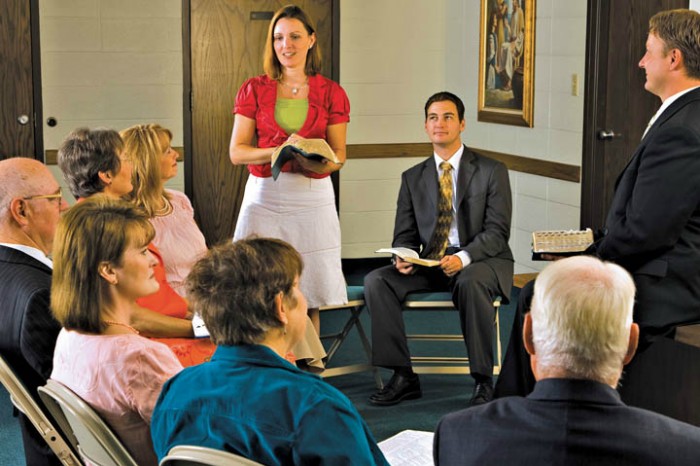
For those of you who missed the latest Church announcements, as of two weeks ago women can now be called as Sunday School Presidents (tiny baby step forward?) but all Sunday School presidencies must be single-gendered (in case people accidentally have sex while discussing substitutes I guess). Now, a hair’s-breadth after that announcement, the meeting schedule will be changing as of September to the Next Big Thing: 60 minutes for sacrament meeting, then 25 minutes for Sunday School, with 25 minutes for Relief Society / Priesthood / YW / YM after that. There are 5 minute breaks between meetings to change classrooms.
There have been a lot of changes to the meeting schedule during my lifetime, but the frequency of changing the schedule certainly has ramped up in the last 15 years. It’s like they are just shaking things up for the sake of change. I’m really unclear what the problem is that they are trying to fix. Since all I’ve got to go on is internet scuttlebutt, here are some theories of why the continual tinkering, at least in terms of this change.
- Consternation that Priesthood meeting was being sidelined due to less frequency.
- Adult learning is less important than easily-digested snippets and devotional thoughts. Several commented that this is TikTok Church.
- This is part of the ongoing dumbing down of church curriculum. After all, you don’t need much time to tell everyone to get married, have kids, and follow strict gender roles. Studying the actual scriptures (which in fact don’t say these things) is much harder. Previous versions of dumbing down the curriculum included introducing talks on talks and lessons on talks and talks on talks on talks and lessons on talks on talks. Also the entire Come Follow Me curriculum which had the same topic for an entire month. I was teaching the youth at the time and that failed hard. The Gospel Doctrine manuals already had plenty of issues since they stopped being taught by actual scholars and stopped asking interesting questions. They instead became indoctrination factories, but for adults. That’s just not going to lead to very useful discussions.
- More focus on home-based gospel study. I guess, but it’s either happening or it’s not. If it’s not happening, this is not going to make the difference.
- A precursor to bringing back the 3-hour block
- A way to keep the time commitment to 2-hours and respect that people don’t have time for more, or for more prep time.
I remember as a child having the break between the meetings. The families who lived near the church were encouraged to invite those of us with long drives over for lunch and visiting between the meetings, and I made some really good friends that way.
Much more recently I remember that we were supposed to get in a circle in Relief Society and face each other in the lessons. That was mostly OK if a little time-consuming moving all the chairs around (the same room was used for Sunday School).
I guess my fondest memories were the 3-hour block. Moving down to 2-hours might have been a nice change, or might have been cutting too much. I loved things like the Linger Longers after church. The social aspect, and not the content of the meetings, is really what church is all about. Knowing and trusting your neighbors. That’s become harder over the years, particularly due to shorter meetings with less social time, and also due to the MAGAfication of many wards. As one commenter put it, she chose the 0-0-0 block.
My first thought when I saw this announced change was “They definitely didn’t consult with the teachers in making this change.” It was already difficult to fit a lesson into the time allotted, after announcements, prayers, sharing “good news” and people shuffling in late. Now it will be basically a brief thought, and that’s all folks. That’s certainly fine in classes with bad teachers, and the lesson content took a nosedive a few decades ago, so maybe it’s not a loss. It took me less time to write this post than it would to teach a lesson with a 25 minute allotment, once all those other things are done.
- What problem do you think they are trying to fix?
- Do you like the change, feel it’s more of the same?
- How long will this change last?
- What would be your ideal church schedule?
- Which of the prior schedules did you like best?
Discuss.
 Wheat & Tares
I’m not a fan of the change. I agree that people fundamentally benefit most from the socialization at church, and I don’t think 5 minutes will be enough time to move between classes or socialize.
I think the narrative of a restored (and ongoing restoration church) relies on change to avoid the feeling of becoming “stale”. You could see how much excitement was generated when Nelson made a lot of changes early during his tenure.
Unfortunately, I think the church has moved away from the “theological” change that defined Joseph Smith’s and other early leader’s tenure and has mostly made “organizational” changes lately. Our theology is in a phase of deepening fundamentalism.
I suppose it may be a bit selfish of me, but I want a church that makes theological change. I can’t believe that God has nothing new to say to us in this chaotic and stressful time. In the light of that, organizational changes like this feel both unexciting and disappointing.
To put it another way, I’m disappointed that we are just arranging the 1950s deck chairs instead of asking why growing numbers of people no longer want to sit in them.
One could see this as actually a response to membership feedback about the very things mentioned here over the years, such as of missing the interactions between classes (yes, 5 minutes now will be too little, but E for effort), relief society being only 2x a month (ditto for priesthood), etc etc. While I too feel like it looks like rearranging deck chairs, I feel it worth pointing out that we cannot dismiss out of hand the possibility that this is, indeed, responsive to member feedback (as an alternative possibility to the ones you listed in the OP).
Interesting hypothetical: if they did go back to 3-hour church in the next few years, would my older kids who spent their formative years in 2-hour church look back at that as adults and wax nostalgic about 2-hour church, like we tend to do here about 3-hour church?
Also, FWIW, with respect to whether this is a further dumbing-down of church/tiktok church/etc., yet again I feel it is worth pointing out that there are other possible explanations beyond cynical (at least church-related cynical) ones – I don’t think that “tiktok church” is the cause, but rather the effect, of things like tiktok itself. We are, as an entire western culture, likely being dumbed down by the content – and the duration of that content – that we are consuming. If “kids these days” struggle to sit for an entire movie because it is “too long,” and if they can’t even read a full book as entrants to college (a phenomenon observed more and more by college professors, if reporting by The Atlantic is to be believed), can we really lay blame at the feet of the “church” for shorter lesson meetings? I could easily imagine us complaining about how LONG and BORING lessons would be if the church had announced an immediate shift back to 3-hour church with full second and third hour blocks.
Overall, to actually answer some of your discussion questions, I was disappointed that this is what the church feels is important enough to focus on and announce about; I wish there would be more action and policy – yes, policy – about things Christ would do if he were here. Care for the beggar; care for the stranger; that kind of thing. I acknowledge that as an international church, reacting to every policy and event of just one country (the United States) would likely be unproductive/unhelpful to members of other far-removed countries, but when that country is the United States which can screw up life for EVERYONE in the world (I’m looking at you, Donald Trump, for causing the Strait of Hormuz debacle), it certainly seems more appropriate than not to be more proactive as a church in reaffirming Christ’s (radical) teachings that we profess to follow.
I’ll try to hold my judgment about how this new arrangement of the two-hour block will fare, but I must admit I’m skeptical that it will succeed all that well with how hard it is to get stragglers and teenagers to get to class now with a 10-minute break after sacrament meeting …
I wonder if a problem they are trying to solve might be retention of young people. Maybe they are thinking young people don’t have the attention span for a 1 hour lesson so they are doing very short meetings in line with their needs?
I had roughly the same thoughts. If a Sunday School or RS/EQ instructor is mediocre or boring (which is probably the case in the majority of the Church), then shortening the lessons to 25 minutes is probably a tender mercy. But if the instructor is even halfway engaging or competent, this seriously hobbles their ability to get into any sort of depth on the lesson!
And I’m split as to whether that’s a feature or a bug; that is, whether they are cravenly surrendering to or actively encouraging the brevity of modern attention spans (can’t think about what doctrines bother you if you don’t have time to think). Perhaps six of one, half-dozen of the other, who knows.
I say “who knows” because it is utterly unclear what problem they are trying to solve here. Numerous studies have shown that the number one indicator as to whether people will stick with an organization of any sort (let alone a church) is whether or not they have close friends there. So, if retention is the Q15’s overriding concern, then cutting down on socializing time seriously undermines the ability of members to make friends that will help them stay.
This all frankly feels like a solution in search of a problem, and symptomatic of the MBA-brain that has saturated the supermajority of the GAs: a tendency to make all things more efficient for their own sakes, without any sense of what they’re making them more efficient *for*.
For example, I was a BYU-I student in the 2000s during the Kim Clark years—who was, as we were repeatedly reminded, former Dean of the Harvard Business School, tellingly. Did this result in the quality of scholarship soaring at that school? Of course not! With his business major brain, he only focused on making things more efficient: he shortened the fall and spring semester so that he could turn summer term into a full trimester, and thereby process more students faster—as though we were product, not people—which of course only rushed and worsened the quality of instruction all year round.
(He also, incidentally, was never able to get summer enrollment equal to fall and spring trimesters, cause many students assigned that track simply chose to attend college elsewhere. Clark kept forgetting we have free agency.)
More egregiously my senior year, the Clark administration noticed that the premiums for the school-funded student health insurance plans were going up, because the only students signing up for those overpriced plans were married students using it to give birth. Did the administration respond by saying that, since the youth of Zion is the future of the church, it is money well spent to help cover these broke young college students’ hospital births? Of course not! They instead imperiously required all married students to get on the same overpriced student healthcare. To bring down costs for the school, you see, not to help these broke college students.
There was mass revolt at BYU-I that year, to the point that administration was caught off guard. Because they did not actually see tuition-and-tithe paying students as fellow stake holders, but only as customers to squeeze and products to process. That’s what happens when you put a business major in charge of a school. No one would ever seriously put an education major in charge of a large business, yet we weirdly have no issue with the reverse.
It’s also what happens when you put business majors in charge of a Church: you end up treating members as customers to squeeze (pay 10% of your income but don’t ask us to cover custodial work—that would cost us money!), not people to serve. And while shortening Sunday school may not be nearly as egregious as squeezing broke college students on health insurance premiums, it is still clearly driven by that same MBA-brain impulse to maximize efficiency without any real sense of what we are maximizing *for.*
I really like your third bullet point, Hawkgrrrl. It doesn’t take much time to say the same things over and over again. Why bother pretending we need longer lessons? We’ll go from a sacrament meeting where a Conference talk is regurgitated to a Sunday School class where a scripture or two is referred to as a proof text, but interpreted through the lens of a Conference talk, to a Relief Society/Priesthood lesson where another Conference talk is regurgitated. And Conference isn’t that insightful or interesting to begin with!
I’m barely old enough to remember the pre-3-hour block version of church. Consolidating the meetings together seemed like a positive step. And shortening to two hours has been nice. But again, your point about linger longers is spot on in my mind. Connecting people and making community seems far more important (and frankly, enjoyable) than repeating again and again how we need to be sure everyone’s on the covenant path.
I also second Adam F.’s point about asking this is what the Church is going to talk about and worry about? Really? It seems like there are so many more important things going on in the world. But the Q15 is just so conservative, in the sense of not wanting to rock the boat, that they won’t say anything that’s remotely likely to irritate their Trumpified base, who got mad over masking and vaxxing, and would get mad over too much discussion of love one another even if they speak a different language from you.
1. Priesthood meeting will not suffer. Our quorum does the “counseling together” thing most weeks and that is going away. Nobody will miss it. The actual lesson time will not be reduced by very much. And that is fine, because there are very few conference talks that warrant longer lessons. When I was teaching, I used to ask for two talks to work with.
2. Sunday School could go either way. No longer will we skip discussions of controversial scriptures because they fall on an EQ/RS week. But with only 25 minutes to work with, controversial topics can still be sidetracked because it’s more important to cover the faith-promoting stuff. There is a slim chance that people will read the assignments every week now instead of every other week. If I were teaching, I would probably try to turn it into a Q&A for people to ask about stuff they read but didn’t understand. If nobody reads, nothing will happen.
3. I see no mention of 5th Sundays. Are those just going to be regular 25/25 weeks now?
As my brother said regarding the changes, I know we believe in miracles as a church, but 5 minutes between classes?
I don’t think it’s “attention span” that is causing young people to leave, though I can see how that’s a common assumption.
I think it’s a values clash.
Young people value transparency, inclusivity. And dialogue.
I think many are leaving because they run into a values conflict with the generation leading the church who value continuity, loyalty, and obedience over those values listed above.
For some reason, JB’s comment above especially resonated with me. Sad, but true.
And to be more serious, undoubtedly there will be leaders from general to local that will harp on the need to adhere to those five minute changes. So our Sunday church experience will become more regimented, more harried, and less delightful.
I think the two-hour block is here to stay. It allows more units to be crammed into one building for Sunday meetings, and that alone will make it stay. In the 21st century, three hours was just too much for many people.
Wiith the 25/25 second hour, it might be better for PH/RS (regular weekly contact). It would be better for adult Sunday School if the curriculum were actually focusing on a book of scripture, and a small percentage of teachers may teach it this way, manual be damned. But what most GD classes are is simply reinforcement of the standard LDS indoctrination themes, shoehorned into whatever the scripture text is for that week, whether that’s what the scripture section says or not.
Maybe just skip GD and have a 60 / big break / 25 schedule. Or maybe they eventually just give up on Sunday School? Addition by subtraction?
I SO agree about giving up Sunday School. Relief society is the reason I still attend. Otherwise I am PIMO for the reasons JB stated, and I am 83. Like many young people I see such a clash between stated values and actual practice. I long for the church it claims to be.
All things considered, I’m thinking that the best use for the second hour for adults is a mingle with hot chocolate and donuts. This will occupy the time while we wait for the children and youth. Maybe someone could provide a ten-minute overview of what the kids are learning that day.
In the Mormon model, Sunday School classes for teenagers seems like a superfluous beatdown for all parties, so I see this as a step in the right direction.
But not helpful for me because I am faking it until my temple recommend is no longer needed (for a family wedding) so it’s gonna be harder to duck out and tune the car radio to Bon Jovi as I drive to 7-11 on any given lovely Sunday morning.
I issue my strongest possible condemnation to this change. It will further destroy the sense of community that the Church used to have, for no discernible benefit.
This move appears to be an attempt to placate the generation of the Church that was raised on violent video games and has an attention span of mere minutes. The authorities apparently believe that 25 minutes is all that should be required.
Regardless, forcing members to rush around leaves no time for building community. And let us all be realistic, it won’t be 60-25-25. It will be 70-30-30 as every single meeting goes overtime as speakers and teachers feel determined to share what they have prepared.
This will lead to an isolated experience where members are unable to make and retain friends in the congregation. They will continue to stay home in droves where they can zoom church in their sweatpants and crocs. Many will determine that watching a hot dog eating contest provides more enlightenment.
I’ve been in primary for the last couple of years, so nothing is really changing for me. The last time I went to EQ, I waited for sacrament meeting to end, got up as casually as possible from my pew in the front third of the chapel, sauntered to the basketball court (well known to be the best teaching environment) and discovered that I was somehow the first one there. I don’t understand where everyone else was, or why it takes more than 90 seconds to make it to the next class. I’m probably doing socializing all wrong.
The key to making the new schedule work is that instructors must realize that they have to get right to the point. We’ve built a lot of muscle memory in constructing lessons with lengthy intros, stories from the week, and long personal accounts that eventually get to a point, because we were trying to fill 50 minutes. If we continue doing this, the second hour of church will be nothing more than Brother Smith’s Story Time. All gospel discussion will be lost. But there is a chance this will let instructors see they have very limited time and they must right from the jump get to their one or two salient points and focus could be restored to our rambling lessons. I’m sure church-wide there will be quite a bit of both extremes.
Count me underwhelmed. There seems less and less point to actually attending classes.
Good luck to all those parents expected to toilet their kids and drop them off at primary in 5 minutes.
I literally sit in the same seat for sacrament meeting, Sunday school and RS, so for me the length for change over is neither here nor there, but my observation is that it takes more than 5 minutes already to set up class and clear the additional people from the chapel. Now you want to set up two classes, with only 5 minutes to pack up the first and set up the second. The people making these decisions clearly have had no practical on the ground experience with any of this for a long time.
About 15ish years ago, I was in a branch that met on a military base in the southeastern US that did a Sunday schedule just like this. Because we used the all-faiths worship space on base which we shared with the Catholics and Protestants, we were only allotted 2 hours maximum to conduct Sunday worship services. So with special authorization from the stake, our branch had 1 hour sacrament meeting, followed by splitting the second hour, with Sunday School followed by PH/RS. On fast Sundays, we had no second hour classes, and instead used that hour for a potluck lunch (this was in the deep south, which already had a strong tradition of Church-related potlucks and picnics). At a time when the 3-hour block was the norm Churchwide, this schedule was quite refreshing for my family. That branch consisted mainly of young military members (average age approx. 20) with no means of off-base transportation, so the format worked well for their limited attention spans and limited weekend free time. Many of the young servicemembers we got to know in that branch were from inactive backgrounds, but chose to attend there regularly and faithfully, owing at least in part to the abbreviated schedule. Shorter church meetings seemed much more purposeful and less like a slog. A few years later when I relocated to a new area, in a large suburban family ward, it took some time, and frequent groaning complaints, to get used to 3-hour church again.
So yes, I’m in favor on the new format, based on prior personal experience. It’s better than the current 2-hour version because there is no alternating of second-hour classes, which causes confusion and breaks up continuity. At least in my current ward, nothing will be lost in cutting SS/PH meetings in half (I can’t speak for RS), since so much time is wasted in opening/closing prayers, visitor introductions, announcements/quorum business, “missionary moments”, unfocused discussions that often veer off-topic, saccharine personal testimonies and diluted, poorly prepared lessons. One thing we’ve learned from TED talks is that, with the right preparation and purposeful construction, one can get a very impactful message across in 18 minutes or less.
Don’t forget your crocs, Chet!
Some commenters have pointed to potential upsides of the new schedule, but it seems to me that those upsides will require (1) competent and prepared teachers; and (2) a robust curriculum. I wish we had both (1) and (2), but my experience suggests otherwise. Even so, I hope for the best.
Hedgehog’s last sentence above seems rather true.
I too found that JB’s comment resonated.
Adam F: I suspect that we are always going to be nostalgic for whatever our own norm was. And I certainly agree that the TikTokification of everything is a chicken and egg question. I find myself yearning for less screen time, even while I’m on my screen. I know my kids feel somewhat similarly, starting game nights with friends, going out to karaoke or just reading a physical book. I can’t personally get into the physical books anymore just because I had so many of them that I was never going to read again I switched to library apps.
I think this change is kind of like putting the chairs in a circle in RS was. It’s tinkering around the edges. I will say that while my own lessons were well prepared and yielded robust, interesting discussions, at least 65% of lessons I’ve sat through at church could have fit in a thimble and were mostly threadbare pablum. I suppose a 15 minute TED Talk could be great, so maybe there will still be some good teachers out there. And I agree with Linda above that RS was always the best of the 3 meetings, IMO. That tells you something about the real reason for church: catching up with friends.
I also think this is mostly for the youth. It helps them connect weekly with their peers. YM and YW together and separated. It also seems to be an erasing of some of RMN’s policies that, I’m sure, he saw as direct revelation. First, temples will no longer be announced in conference. The Saturday evening session was cancelled. Now the alternating church schedule is cancelled. Unlike RMN, who made these announcements as big proclamations, DHO is quietly changing them without much fanfare.
I teach in primary so my schedule isn’t changed, but my wife, a SS teacher is not happy with having to teach every week now.
I see the changes as neutral to positive. There is a small sacrifice of depth (25 vs 50 min) for continuity/breadth (weekly vs 1/2 weekly). Very seldom do I sit in either PH/RS or SS for an entire lesson and walk out thinking “I sure wish that lesson could have been 30 minutes longer”. Frequently I think “I wish the lesson was 30 minutes shorter”. To ji’s point above, I think you may see better preparation and competence in the shorter time frame. Instead of trying to cram 20 minutes of material into a 50 minute space, instructors can focus on what they feel is important.
I’m of the mindset of “Try it. If it doesn’t work, change it again.” This isn’t the kind of change to get me too excited or to warrant much handwringing from me. There’s no doctrine here, it’s just procedure of how to organize the agenda for our weekly meeting.
I’ve heard through the rumor mill that this may have been motivated by having more regular contact between youth and their leaders. I think that’s a worthy goal. I have good memories of many formative mentor figures from my ward growing up. Whether this change achieves that goal is another story. Still, of all the changes that were meant to help the youth, this one makes more sense to me than giving the bishop more responsibility for young men than before.
As with so many changes, it would be good for the church if they would talk more publicly about the thinking behind things. Let’s drop the mystique of everything being a direct message from God and just talk frankly about the concerns that motivated the change. Tell the members they will try something else if they don’t think it’s helping.
I don’t think they want to go back to 3 hours. For all the social benefits, it really did create real challenges for a lot of people, especially families with small children. I think they are trying to have the benefits of a 3 hour block in 2 hours. We’ll see if that’s possible. I think they might have been better off shortening sacrament meeting a bit. Nobody will miss dropping one talk. As weak as so many church lessons can be, the social benefits of interactive over non-interactive activities are real. Let’s go to 40-35-35. Or be realistic about the time it takes to change classes and call it 40-30-30. I suspect if the new schedule proves challenging to adhere to, that may be the next thing they attempt in the next few years.
The real challenge for getting this change to work will be imposing discipline on all the people who throw schedules off. That’s sacrament meeting speakers and sometimes bishops, teachers, and sometimes worst of all, class and quorum presidencies who spend 15 minutes on announcements. I want it to work. I’m worried it may not go smoothly.
I’m pretty happy about this. At least my wife won’t be asking me every week before class, Is it Sunday School or RS today? 🙂
I personally think there’s nothing useful that can be really taught in a meaningful way in 25 minutes so I think teaching will suffer. I think this because I have served in primary for 5 years and have three kids who without teaching at home by my husband would know nothing of the gospel despite having teachers who are dedicated. I also think a three hour block would come with major revolt especially from primary. Nursery and primary both being two hours long was usually torturous. My husband suggested a two and a half hour block. I think that could work well. I also think if churches added like- playgrounds – they could bring back the 3 hour block. However, my cynical eye says the church just wants to cram as many people in a church building as possible despite being able to just build more buildings and solve that problem. Our building has been falling apart for years (we have literally had the bathroom flood like once a month this year) and there’s no replacement building in sight.
I think the church is changing the schedule to try and retain youth and hoping that meeting as youth every week will make them want to stay but I don’t think the kids these days are fooled. They see the broader actions of the church (or lack there-of) and the devotion given by their parents and think -why would I do this? The lack of accountability for CSA, the lack of speaking up on world events (especially since there is now a Pope who does), and yes, the MAGAfication of the church, will ultimately push many (thinking USA centric here) kids out. I think the reason the church was able to retain any amount of millennials is because we still had the culture of the church when we grew up. Big activities. lots of time spent together. A true identity as MORMONS. We are now (trying to be) just any other Church. You know what everyone else does? Go to whatever church they resonate with when they move.
Maybe a small change but I think for the better. Especially for the youth.
A bug of the current system is that there can be long gaps between any class, e.g. if stake conference falls on a 2nd or 4th Sunday then the ward goes 4 weeks between having RS/EQ/YW/YM meetings. Ditto on a personal level. This change eliminates that bug.
If I could vote mine would be for a 60+35+35 schedule with 10 minutes between, 2.5 hours total.
I think a better arrangement would be 50+30+30, two hours total.
That would be a 50-minute sacrament meeting followed by two 30-minute lesson periods, with five-minute breaks.
Five extra minutes in the classes could make a big difference! And frankly, we could do with just a little less talking in sacrament meeting (but don’t cut any music!).
And maybe every fifth Sunday, the second hour can be a used for a linger-longer instead of classes?
But, no one asked for my input…
I don’t like this change. I prefer alternating weeks as we do now. I’m biased because we had an EQ president who did his own thing for lessons. Sometimes he gave his own lessons that were barely tied to a GC talk but were quite good — precisely because they weren’t actually about the GC talk, and because this guy has a brain and some original thoughts. He also assigned lessons to quorum members and let them pick their own topics. Some of these were really engaging, with a lot of participation.
All good things come to an end, though. Our ward was recently torn apart, part going to one existing ward, the other part to another (yes, membership shrinkage is real in the suburbs of the Mormon Corridor; this converted 3 wards into 2). So I’m now enduring the standard EQ lesson format: no preparation, go around the room and have each member read a paragraph of the GC talk of the week, and hope something good comes of it (which almost never happens). The good EQ lessons I experienced for several years would not have been possible with this new format. There’s just not enough time. On the other hand, the typical EQ fare will be much more tolerable since the meetings won’t last so darn long.
On the time allocation: if we’re cramming all 3 meetings into 2 hours, I’m not sure why sacrament meeting needs to be longer than, or even as long as, SS and RS/PH. Yes, there’s the sacrament ordinance itself, which typically takes 10-15 minutes. And there’s some value in a meeting where all members are together in the same room. But I don’t see why we should allocate more time to the remainder of sacrament meeting at the expense of the other two meetings. Sacrament meeting talks aren’t any more important or higher quality than the lessons in the other meetings.
My vote: 33 + 33 + 33, with two 10-minute breaks between meetings. Sacrament meeting alternates weeks. On “A” weeks, a single adult speaker gives a 10-15 minute talk following the sacrament. On “B” weeks, it’s music only: hymn singing, special musical numbers, etc. No more youth talks (the youth can be involved in their own meetings). No more F&T open mic sessions. No more monthly stake high counselor talks, either. If the stake actually has an important message to present to the entire ward (which they almost never do), they can make special arrangements to speak on an “A” week.
Jack Hughes, the reason your ward on a military base had lots of young men who grew up inactive attending had NOTHING to do with the length of the meeting and everything to do with how the military rewards church attendance. Or maybe it is punishes lack of attendance, I forget. It has been a long time since I attended a ward like that. But it sounds very much like what I attended when my husband was in officer training. I liked it because it was a chance to see him. He liked it because they got brownie points for church attendance and got out of unpleasant duties/activities. Think of the fun of church compared to running laps, then add in that they could get “merit points” for attending and even atheists attended church. We had some sisters in officer trading that admitted they were not members and were uninterested in becoming members. They just wanted a church meeting to attend and ours was at a good time. Basic training was the same, in fact I think we met with people in basic because there were not enough members to have a separate ward on the base where officer training was held seeing as there were 4 total at that time.
As to what schedule I liked best, well as an old fogey I liked when RS, primary, and YM/YW on were on weekdays, and two meetings on Sunday. That gave the best opportunity to form community because you saw other members 2 to 5 times a week. But as RSP, I hated that I had to run two RS meetings with two full sets of teachers and everything because there was Sunday Morning RS for working sisters and Tuesday morning RS for those who could attend then.
I very much doubt that it is in preparation to go back to 3 hours because we have 5 wards in every building in my city. There is no way they could do 3 hours. They accidentally got six wards in one building but then tried to schedule meeting times for six wards and when they realized, they moved one ward to the building that only had 4.
I think it is for the youth because I have heard complaints that it was harder for the young people to make friends. But I do not think it will accomplish what they want because it is not sitting in the lesson where they make friends, but the visiting before and after class and that time is now shortened and everyone will rush to class, not giving the people time to visit. They need to cancel Sacrament meeting and replace it with a potluck, only don’t make the youth sit with family.
As far as the quality of lessons and is it dumbing things down more, I didn’t think it could get worse. If the lessons are going to be as bland and just proof texting and lesson on talk that are deadly boring to begin with, I am all for shortening them. Is 30 seconds long enough? That is about my attention span for a lesson on a talk that I have already had repeated.
I really miss the days when Relief Society had lessons written by women, for women.
This discussion has been enlightening and I’ve learned a lot from the comments. I hope my comments are educational and useful.
I have some experience with this schedule. I spent six months working in a middle eastern country where the church was not recognized and I believe it was illegal for locals to convert. Attendance was small. Those attending were families with a parent working at the embassies, a handful of expat business professionals (all men), a family whose father was a teacher at an American school, several sub-Saharan African woman who worked as domestic workers, and a few Arabs from neighboring countries who converted in the US and were now working in the country. We met in a house which the church either owned or leased. I can’t remember which.
We had a 40 min sacrament meeting (usually one youth speaker and one adult speaker), a 30 minute Sunday school, and a 40 minute RS/EQ/YW/YM. The format worked great for such a small branch. I’d guess attendance was 30-40 most weeks though over the holidays it would be as low as 10-15.
I am quite confused by this new announcement. My first thoughts were contradictory. This was either a concession to the fact attention spans are shorter than a gnat and the church bowed to the inevitable by shortening classes….or this was a preparatory step towards going back to a three hour block.
However after reading the comments about the number of wards in a building, it seems the church couldn’t go back to a three hour block without a lot of expense to build additional wards.
I think it would be very challenging to cut sacrament meeting to less than an hour due to big wards. While I live in a small ward/branch, I’ve heard of wards in Utah, Texas, and NW Arkansas which have 300+ attendees. While I’ve never attended such a ward, I’m guessing you need 25-30 minutes to get from opening the meeting to conclusion of the sacrament. Anything shorter than 50 minutes means you couldn’t have more than 10-15 min talk given the time required to wrap up the meeting.
On the other hand, I live in a ward which has recently upgraded to a branch despite only having attendance hovering between 80-90 on a weekly basis. We start 10 minutes late every week and the now bishop clearly tries to fill time every week by giving an impromptu talk/testimony to get us to 60 minutes. I’ve heard some of his stories 3-4 times in the past year alone. Our ward could clearly get by with a shorter sacrament meeting due to how quickly we can pass the sacrament.
The solution is simple but one the church will never do. Have several formats of the same length. Larger wards can have a 60 minute sacrament meeting and alternate the second hour each week. Smaller wards can follow that approach or go with a 40 minute sacrament meeting and 40 minutes for SS and 40 minutes for RS/EQ/YM/YW. Let local leaders either at the ward/branch level or stake level decide what’s appropriate based on the size and needs of the congregation.
The church would never grant such local autonomy. I don’t know why they wouldn’t but, for some reason, they insist one size fits all. It clearly doesn’t as the comments in this thread illustrates.
The Church adopted the alternating week format in January 2019 (so says Google). Just about every week at the end of sacrament meeting I did not know what the next meeting was. Inexplicably, there wasn’t a standard reminder from the pulpit at the end of the meeting whether it was PH/RS or Sunday School. Maybe not a big deal, just annoying. And making 5th Sunday a more or less mandatory Linger Longer is better than any idea for meeting format the Church has ever come up with.
Anna, in regards to the military branch I mentioned earlier, your assessment of the situation is not entirely correct. This base was not an initial training site (boot camp/basic/officer training school), but a location for many military technical schools, and despite these trainees being in very intense technical programs M-F, they had their weekends off. Most were restricted to base in early phases of training, and almost none had their own transportation to go out into town on weekends. During my time stationed there, I got to know many who enjoyed coming to the on-base LDS services, completely at their own accord, despite coming from inactive families or having lapsed from activity themselves, but appreciated the shortened meetings, concise to-the-point gospel messages, convenient location, and not having to get dressed up in traditional Sunday clothes (most wore uniforms or casual civilian attire, as they had nothing else), along with the camaraderie of worshipping with their fellow servicemembers.
By contrast, I know exactly what you mean when you say the military “rewards” church attendance at basic/officer training, having gone through that myself more than once, but that’s a completely different thing. And while the situation I described is somewhat unique, I see much potential value in adopting the 60-25-25 Sunday meeting schedule church-wide. I agree that with the lack of substance in classes, cutting them in half won’t take anything valuable away. For teachers that care, this may actually force a more focused approach to preparation and delivery. And there are plenty of teachers that don’t care, but it’s easier to endure a bad lesson if it’s only half as long.
Explorer’s comment about the size of larger congregations being much slower to get the sacrament passed is spot on. We live in a vacation area half the year where thousands of tourists from the Mormon Corridor come during the summer. It is close enough for them to come up for the weekend. Drive 2-4 hours on Friday evening, hit the beach, play Saturday, one hour of church in a t-shirt and shorts over the swim suit, hit the beach, return home Sunday evening. One special building has recently been made JUST for tourists and runs three or four huge sacrament meetings on the big weekends. It is a building with only a chapel and the room for preparing sacrament. They have over 400 for average meetings and 500 at capacity for big weekends. They turn many away from the first meeting for lack of room. My husband discovered you have to come 40 minutes early to get a seat or you wait for the next meeting. Some snowbirds are attending local wards, because they do not like the tourist ward, (my husband) but are not members of the local ward. They don’t hold calling or help with the ward at all, but still attend all meetings. Those wards run 500-1,000 people on the big weekends. I attended once because we had company, and the cultural hall and RS room and primary room were all filled to max. Of course, out of town visitors of local members or snowbirds are not discouraged from attending the local ward either.
Those local wards REALLY struggle to provide church for tourists and snowbirds. People are pulled from local wards to run the tourist branch, with members who give talks having to speak in all four meetings. The youth get lots of experience giving talks. There are two local wards in the town with the tourist branch. They use tourists for passing the sacrament, but have to have locals prepare it. The bishopric and music people are pulled from local wards. All they have to do really is put on Sacrament meeting, because they don’t provide the other meetings, but because the tourists cannot be contacted ahead of time, they can only help pass the sacrament.
But when there are 500 to 1,000 to pass the sacrament to, it takes a while. It is not lack of people passing, but things like running out of water because they just do not have enough trays or the amount of time to make sure everyone in the primary and RS room get it that takes up the time. A 40 minute Sacrament meeting would not get through the sacrament. They are already at two songs and two short talks because just the sacraments tokes 40 minutes. So, I do know of about 4 wards and 4 branches that cannot do Sacrament meeting shorter than the one hour, simply because of the amount of time it takes to pass the sacrament to one thousand or more people.
I think the best solution is for Salt Lake City to give up on keeping things exactly the same all over and tell wards with extreme situations like small congregations or huge congregations to do their own thing as needed. They could tell the wards to do 30 minutes excluding the time for the sacrament. Then the building could just figure out what is needed and schedule accordingly. The wards that have to accommodate tourists could still have the 40 minute sacrament, then the 30 minutes of everything else and just plan to get done when they get done on those huge weekends. I mean as it is, my husband comes home with reports of running 15 minutes late because the bishop did not dare cut the returned missionary’s talk completely and often says, we had to cancel two speakers, so the poor 12 year old who sat sweating the whole meeting only to have her talk canceled has to go through it again next week. Why not make it flexible. Two wards in the building, in one town and only one ward in the building where hubby attends, but meetings over 1,000 once or twice a year (three day weekends mostly.) That ward is only predictable during the winter…..except when it snows and half the ward can’t make it to church until the county can plow miles of country roads then it is still unpredictable.
I’m tired of the micromanaging. I suppose the older I get the more “old man, get off my lawn” I will become and this includes dealing with a church that seemingly has to constantly tinker at the program, all while the quality of the program stagnates.
My ward has an excellent Sunday School. We have a fantastic Gospel Doctrine and excellent youth teachers. Now that success is being blown up – I truly wonder what the Gospel Doctrine teachers will do knowing their typical lesson will now be 20 minutes long instead of 40.
On the other hand, my ward as a weak youth program. These changes may help that youth program. I believe it was a mistake of enormous consequences to implement the every other week Sunday meeting for YM and YW. Observe that in this latest change there will be no acknowledgment of a mistake. LDS leaders don’t make mistakes and they certainly never admit to making them.
As for RS and EQ I don’t see how a lesson ever gets taught again. Maybe that is a good thing. But seriously, with announcements and all the preamble that happens (and this preamble conversation is absolutely necessary for the community of the members) there will be ZERO time for a lesson. Does the LDS leadership know this? Why don’t they acknowledge it?
As has been mentioned by others, LDS Corp needs to backoff from the top-down, cookie cutter, method of dictating how the church program operates. They are creating confusion and they are being annoying and fake with their constant meddling that never includes a discussion of why the previous changes failed to produce desired results.
In the winter we visit a place with a lot of tourists. That ward does at testimony-only (no talks as such)meeting for one hour for the tourists. Then the local ward meets. That works very well.
The complete lack of autonomy at an individual level and at a ward level is one of the most baffling things about this church. Whether we need 5 or 10 minutes between meetings is apparently not something that bishops can decide. Nor whether we should have RS/EQ every week or not. Or if someone should talk before we have the sacrament or after we have the sacrament. The church simply doesn’t believe people should be thinking for themselves about anything.
My stake just changed some ward boundaries. It’s a Utah stake, so no homes in the stake are more than 1.03 miles apart. I checked. We have 2 buildings in the stake. After one week of the ward changes it was clear that we now had a bigger ward attending the smaller building, and a smaller ward attending the bigger building. Also, after the boundaries, a lot of the new bigger ward lives closer to the bigger building, and the smaller ward lives closer to the smaller building, on average. (It is unclear why this wasn’t obvious that this would be the result before they made the changes.) So, post-change we attended for 1 week and they announced that two of the wards would be switching buildings. The announcement from the stake president included the explanation that they “only moved forward after receiving confirmation from Heaven and approval from the First Presidency.” Why either the first presidency or heaven would be involved in this change is beyond me. They want to be the True church, and apparently these are the eternal truths they spend their time on.
The direction to change schedules without bothering to explain the idea behind the change, or the goals moving forward indicates poor leadership. Good leaders want people to understand why changes are made and communicate how we’ll know if they’ve been effective. Good leaders would be honest about why we’ve done church the way we have for the last 8 years and why that didn’t achieve what they wanted.