
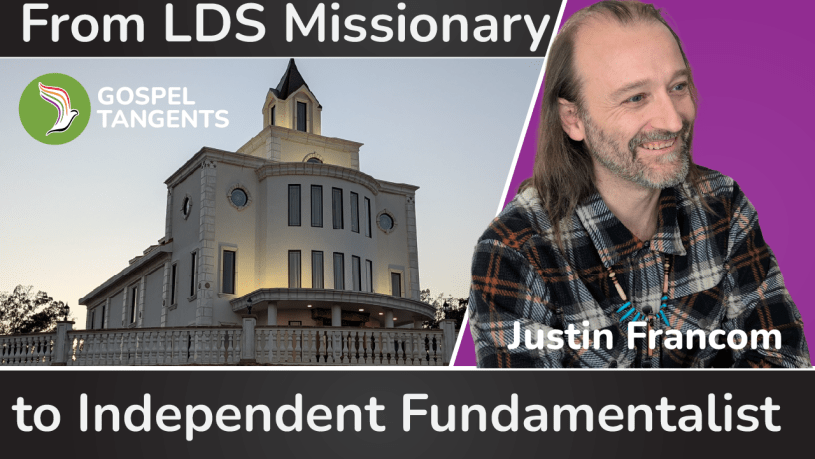
I sat down with Justin Francom, an independent Mormon fundamentalist living in Missouri, to discuss his journey from a traditional LDS background to an Independent Mormon fundamentalist. Francom’s story is a compelling look at how his search for deeper doctrine can lead a “Jack Mormon” turned missionary into the world of independent fundamentalist.
Path to a Faith Crisis
After serving an LDS mission in South Korea and marrying in the temple, Francom experienced a profound “culture shock” within the mainstream LDS Church in Utah. This feeling was exacerbated by changes to the temple ceremony, which left him spiritually unsatisfied. His search for answers led him to the writings of Denver Snuffer, specifically Passing of the Heavenly Gift. However, Snuffer’s thesis—that the Restoration had essentially failed—left Francom feeling cynical and depressed.
Finding Light in “Lost” Doctrines
Francom’s path took a turn when he discovered the works of fundamentalist author Ogden Kraut. Unlike Snuffer’s work, Kraut’s writings on “lost” history and doctrines, such as prayer circles in the home and the Adam-God doctrine, rebolstered his faith and testimony. Francom describes receiving a personal spiritual witness of these doctrines, which created a wedge between him and mainstream LDS leadership, whom he felt had been untruthful about Church history.
Rejecting “One-Manism”
A central theme of Francom’s transition is his rejection of “one-man doctrines“—the belief that priesthood authority is a rigid control structure funneled through a single living prophet. After investigating various groups like the AUB and the Peterson group, Francom found that they often emulated the same authoritarian behaviors he found troubling in the LDS Church. This led him to remain an independent Mormon fundamentalist, believing that the true vision of the Restoration was to create a “nation of prophets and priests.“
Reimagining Priesthood Authority as Mormon Fundamentalist
The summary of Francom’s theological shift concludes with his introduction to a new interpretation of Section 132 via Sean Anderson. He argues that the “one man” referred to in scripture relates to the serial nature of conferring the fullness of the priesthood (the second anointing) rather than a restriction on how many people can hold the authority at once. By viewing priesthood as something to be perpetuated and shared rather than controlled, Francom finds a way to maintain his testimony of Joseph Smith and the temple while remaining outside of traditional institutional boundaries.
Thompsonite Connection
How did this specific priesthood authority reach the independent believers in Missouri? The lineage traces back to Joe Thompson, a former council member of the Apostolic United Brethren (AUB.) Thompson strongly believed in perpetuating the fullness of the priesthood and building temples, which clashed with the leadership style of Owen Allred, who wanted to consolidate power and close temples.
After being excommunicated from the AUB under allegedly spurious charges, Thompson relocated to Arizona, continuing to administer these ordinances to aligned families. Decades later, a man named Robert LeFever brought this “Thompsonite” priesthood authority from Arizona to a group of independent families gathering in Missouri.
The Missouri “Not Group”
The community in Missouri playfully refers to itself as a “not-group” made up of “spiritually libertarians.” They are a hodgepodge of fundamentalist refugees—exiles from the AUB, Centennial Park, and even former mainstream LDS converts. Having witnessed the rampant abuse of centralized power in other sects, they prefer to operate as independent families working together without a singular boss.
Driven by a 40-year-old prophetic vision, these independent families successfully built and dedicated a beautiful temple in Missouri, complete with a stunning echoing star dome in the Celestial room. Their temple work truly flourished once LeFever arrived to administer the fullness of the priesthood.
The “Application Layer” of Faith
As a computer scientist, Francom beautifully summarizes this decentralized theology by comparing church organization to software. He views worship culture as the “application layer” of faith. Just as the various branches of the Eastern Orthodox Church operate independently with different styles but maintain the same core authority, Mormon factions can worship differently too.
Whether a congregation allows spontaneous scripture commentary, uses a tea kettle for the sacrament, or practices loud Pentecostal-style worship, Francom believes it is all perfectly valid—as long as the core priesthood ordinances remain pure and intact. Ultimately, this community proves that for some, faith isn’t about swearing allegiance to one man, but rather preserving sacred ordinances and working together as equals.
Universalist View of True Church
Francom holds a radically universalist view of the priesthood, believing that the mainstream LDS Church, the AUB, the FLDS, Centennial Park, and the Peterson Group all possess valid priesthood authority. When asked if these groups are apostate, he frankly notes that “we’re all apostate to a certain degree.” He asserts that no single church is perfectly true or completely false; rather, God respects human agency and expects mortals to make mistakes as they figure things out.
Drawing on his deep love for both American and South Korean cultures, Francom argues that God loves diversity and that heaven itself will feature a rich diversity of cultures. Therefore, different worship styles and branches of Mormonism should be able to coexist as long as they are coming unto Christ.
Missouri Temple Community
Francom also elaborates on the independent fundamentalist community out in Missouri. They hold regular Sunday meetings, separating for Priesthood instruction and coming together for a unified Sacrament meeting. In a beautiful display of peace, they even hold shared meetings on fifth Sundays with the local mainstream LDS congregation and other fundamentalist factions. To avoid theological conflict, they simply omit the physical sacrament ordinance during these shared gatherings.
The community operates strictly on a voluntary basis, with no mandated tithing, even when it comes to funding and maintaining their newly built temple. To prevent the rise of authoritarian “kings” or a “one man” leader, the temple council is a rotating body where members serve two-year terms before being replaced by a priesthood vote. Remarkably, the temple is open to individuals from other Mormon branches—including mainstream LDS members—who wish to experience the original 1840s endowment, provided they are there for sincere religious reasons rather than just “temple tourism.”
Bridging the Gap: Mormon Legacy Ministries
Recognizing that many Latter-day Saints are losing their faith over modern policy issues and discarding their testimonies entirely, Francom helped launch a brand-new initiative: Mormon Legacy Ministries (MLM).
Francom observed that the mainstream LDS Church excels at missionary work and discipling members, while fundamentalists have successfully preserved early doctrines like plural marriage and the Adam-God theory. MLM seeks to bring the best of both worlds together. Described as an “ecumenical Mormon church,” MLM serves as a floating organization or waypoint for independent Mormons.
Currently operating primarily over Zoom with Joshua Erickson serving as bishop, MLM is designed as a safe haven where individuals don’t have to swear loyalty to “one man” or strict dogmas. It bridges the gap for those who feel the mainstream LDS Church is no longer working for them, but who still want to hold onto core restoration truths without the intense leap of joining an insular fundamentalist compound.
There is a seismic shift on the priesthood ban in Mormon fundamentalism. It’s happening within independent Mormon group. Justin Francom shares the inside story of how the independent fundamentalist group in Missouri recently made a historic decision to officially abandon the racial priesthood ban and open their temple to people of all racial backgrounds.
Acknowledging “Brigham’s Mistake”
For decades, many fundamentalist groups have strictly enforced a ban on Black individuals holding the priesthood or entering the temple. Some even consider it one of the core “pillars” of fundamentalism. However, Francom completely disagrees, boldly stating his belief that the original priesthood ban was simply a mistake. While he respects Brigham Young’s vital role in the restoration, Francom argues that modern believers tend to over-idolize early leaders, forgetting that they were mortal men entirely capable of making errors.
All-Night Prayer Meeting
The turning point for the Missouri group occurred as their new temple was nearing completion. A serious debate arose among the men regarding whether they would allow people of Black ancestry to use the temple. To resolve the heavily polarizing issue, about 25 men gathered in the unfinished celestial room for a special, all-night prayer meeting.
The room was sharply divided. Some men strongly advocated for abolishing the ban, while others felt a duty to protect a doctrine their grandfathers had fought for. Realizing the tension, Tom Zitting suggested that every man symbolically place his personal biases and deeply held convictions on the altar, covenanting to accept God’s will above their own.
A Vision of Sacrifice
Following this covenant, the men engaged in a true order of prayer. As Francom led one of the prayer circles, he was suddenly struck by a vivid, visceral vision. He saw himself and the other brethren literally tear their living hearts out of their chests and place them on a stone altar as a token of sacrifice.
Looking up, Francom saw Jesus Christ in white robes, smiling and accepting their offering. The stone altar then began to rapidly grow, transforming into the Missouri temple itself. Looking down from above, Francom watched as “pinpricks of light” representing believers gathered to the temple from the local community, the nation, and eventually the entire world. He understood this as a conditional prophecy: if the men were willing to sacrifice their personal traditions, the Lord would bless their temple to be a beacon of light.
A Unanimous Resolution and a Historic Milestone
Despite powerful visions and shared revelations, the men continued to debate until the morning sun began to rise. Finally, a quiet, non-confrontational brother stood up, declaring that they all knew what was right and it was time to stop wasting time. Moved by the Spirit, the men unanimously agreed to put the priesthood ban aside forever.
Because of this decision, a person of Black ancestry has since received their ordinances in the Missouri temple. Francom points out the monumental historical significance of this event: it marks the very first time in this dispensation that a Black individual has received the original, unedited 1800s endowment (including early teachings like Adam-God).
Priesthood Ban in Mormon Fundamentalism
Francom also shares his unique perspectives on gender and the priesthood, arguing that women hold the fullness of the priesthood upon receiving their second anointing, and can exercise their husband’s priesthood once sealed.
Ultimately, Francom hopes these progressive steps will help independent believers find peace. Through his newly launched Mormon Legacy Ministries, he hopes to provide a “halfway house” for those who feel alienated by mainstream LDS policies or rigid fundamentalist dogmas. By embracing a willingness to correct the mistakes of the past, Francom’s community is carving out a brand new, inclusive path forward for the Mormon restoration.
What are your reactions to independent fundamentalism? Are you glad there is a group rejecting the race ban?
 Wheat & Tares