
(This is another guest post from frequent commenter Margie)
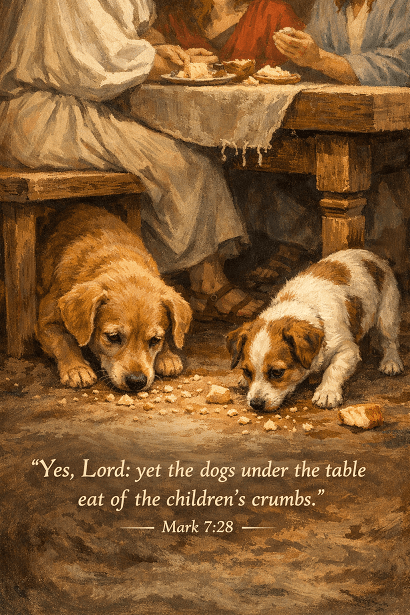
“And she answered and said unto him, Yes, Lord: yet the dogs under the table eat of the children’s crumbs.” (Mark 7:28)
One of the things, as I’ve aged, that I have often wondered at is how infrequently I argue with Jesus of the New Testament. I see questioning and doubt as healthy things. When a story or text makes me uncomfortable, when I don’t like it, that is my own internal cue to pay careful attention. And yet very few things that Jesus of Nazareth said or did as recorded in scripture give me much pause. I am not claiming that I understand them all. Many of the parables are full of nuances that I am sure escape me. And the older I get, the less I understand the Atonement. But I read very little of what Jesus said or did in the New Testament and think, “But wait! That is wrong.”
The story of the woman and her daughter in Matthew 15 and Mark 7 is one of the exceptions for me. Here it is in Matthew:
22 And, behold, a woman of Canaan came out of the same coasts, and cried unto him, saying, Have mercy on me, O Lord, thou Son of David; my daughter is grievously vexed with a devil.
23 But he answered her not a word. And his disciples came and besought him, saying, Send her away; for she crieth after us.
24 But he answered and said, I am not sent but unto the lost sheep of the house of Israel.
25 Then came she and worshipped him, saying, Lord, help me.
26 But he answered and said, It is not meet to take the children’s bread, and to cast it to dogs.
27 And she said, Truth, Lord: yet the dogs eat of the crumbs which fall from their masters’ table.
28 Then Jesus answered and said unto her, O woman, great is thy faith: be it unto thee even as thou wilt. And her daughter was made whole from that very hour.
And here is the story in Mark:
24 And from thence he arose, and went into the borders of Tyre and Sidon, and entered into an house, and would have no man know it: but he could not be hid.
25 For a certain woman, whose young daughter had an unclean spirit, heard of him, and came and fell at his feet:
26 The woman was a Greek, a Syrophenician by nation; and she besought him that he would cast forth the devil out of her daughter.
27 But Jesus said unto her, Let the children first be filled: for it is not meet to take the children’s bread, and to cast it unto the dogs.
28 And she answered and said unto him, Yes, Lord: yet the dogs under the table eat of the children’s crumbs.
29 And he said unto her, For this saying go thy way; the devil is gone out of thy daughter.
30 And when she was come to her house, she found the devil gone out, and her daughter laid upon the bed.
It is, to me, an ugly way to convey a message; even the message itself, depending on how you read the text, is ugly. It is one of the rare times I read and think, “Well, Lord, whatever the context, whatever it is You were trying to teach us about timing, or humility, or the immorality of our own preconceptions, this was badly done of You. You should not have made this desperate, canny woman and her daughter into an object lesson for our benefit, or forced her to depict herself and her child as less-than. Not cool.”
I have heard many apologists make many claims about why I should really be okay with this story. None of them work for me.
A perfect, all-loving, omnipotent God should do better. (Says this flawed, selectively-loving, limited mortal.)
Yesterday, I went to the baptism of an eight-year-old in our ward–a really great kiddo. I’m the Primary President, and they needed a pianist, so off I did go. This boy’s large extended family were all in attendance, so the event began in the chapel. I looked out at the congregation and noted the boy’s mom, who is a counselor in Primary and a friend, looking lovely in a new dress. Her son and husband were in their very weird white jumpsuits sitting right next to her with the other kids in the family. And I smiled remembering my own baptism at eight and how weird my own dad and I looked, and how excited I felt to be making this commitment to a Savior I deeply believed in. My extended family was all there too.
We sang the opening hymn, heard a cousin speak about the importance of baptism, and then proceeded to the Young Women’s room, which is where the font is in our meetinghouse. Neither of my own two daughters, who are still in their elementary school years, wanted to be baptized, and there aren’t many children in our ward. So I haven’t been to many baptisms in the last few years.
As the boy and his father walked down to the center of the font, my friend and her mother came forward and stood at either side. I realized it was the first time I had ever been present for a Priesthood ordinance witnessed by two adult women. The father performed the ordinance and then looked up to his wife and mother-in-law, who both nodded, beaming.
Reader, I was profoundly moved. This crumb, this peripheral participation, which now can be performed by even a child, should not have meant to me what it did.
It was my grandfather and my stake president who witnessed my own baptism. I loved those men. But what would it have meant to me if my mother and my grandmother, who were seated in the crowd, had instead been the ones standing beside the font? If I could have seen my own father looking to them for confirmation that the ordinance had been properly performed? If it had been their joyful smiles, instead of the rather curt nods of the men, that greeted me as I emerged from the water?
“Mama,” my then-eight-year-old said a few years ago, “if you could baptize me, I’d probably want to get baptized. But if you can’t do it, then I don’t want to.” By rights, women and their daughters should have a place at the feast. In a world that worked anything like it should, this would not be a point of debate. Many people make all sorts of arguments about why I should really be okay with this state of affairs. None of them work for me. A Church that purports to speak for a perfect, all-loving omnipotent God should do better.
But like that other mother from so long ago, I know this too: the crumbs matter.
What do you think? Do the crumbs matter? Do they matter enough? Can you think of any examples?
Are there stories in scripture that you dislike but still find value in? Which and why?
 Wheat & Tares
Lovely post. Beautiful insight. While rereading the scriptural story just now in your post (and thank you for pasting in the full text), I thought of another way to interpret it. Jesus is setting an example about changing his mind. We assume that if you’re perfect enough, you do everything right the first time around. Yet here, we have perfect Jesus listening to someone challenge his assumptions and then say, “you’re right; I’m wrong; I’ll change.”
This story should be the story the Church leaders use to change their entire approach to the LGBTQ population. They’ve got the first part of the story down pat — icily ignoring a group of people who want to be included. If only they would listen and then admit that LGBTQ people are also as human as anyone else and nothing should be withheld just because a Church leader’s first inclination is to see them as the ‘other’.
I loved the way you applied it too. Extending some of these duties to women helps. It’s too little, too late for some. Yet for others, this progress matters and is meaningful. Acknowledging the progress is important. The Church outsiders are women, and priesthood leaders have long turned away from pleas for inclusion. A crumb is progress.
Addicted to translations compares cleaning the butts of old people forced to wear diapers! The 5th Book of the Torah has two names: D’varim and Mishna Torah. The latter name classifies Torah law, which your apostle Paul slandered; common law – court rulings do not compare to Roman Senate statute law. Yet Paul blurred over this obvious distinction and shit all over his writings. Mishna Torah means “Common Law”.
I kind of like Janey’s idea that Jesus changed his mind because of this woman. In his society, he probably grew up with the idea that all people who were not Jewish were less worthy of God’s love. I mean, the whole “covenant people” was exactly the teaching that God loves them the most. So, everybody who was not “covenant people” was unworthy of God’s love. Peter later struggled with the same idea. Could people who were not Jews even be baptized? Or were they unworthy until they first became “covenant people” by converting first to Judaism, then to Christianity. Could these unclean people worship Jesus? That was what Jesus was taught be his society. So, this woman showed him that “lesser” people could have strong faith, and he realized that maybe the assumption that they are unworthy is wrong because they can have just as strong of faith.
Personally, I got tired of watching the men feast, while only getting a few crumbs. Crumbs feel nice when you are starving, but they are not really enough. Not long term. And fighting over the crumbs with others who are near starving is no fun either. I want to be the child at the table, not a dog. And why not? I am human and supposedly a child of God. So, why am I always “less”?
My lesbian daughter left the church because of how women were treated before she even recognized that she just was not attracted to men. But when the church decided her marriage was an excommunication worthy offense is when she and her wife had their record removed. It was just formality at that point.
How often do LDS ever consider the fact that Jesus was misquoted decades later by male only scribes and male authorities of the church as they saw fit.
I cannot consider these scriptures to be authoritative or authentic in any way. Certainly some verses may be considered personally meaningful when they conform to the reader’s own ethical & moral standards.
“When you’ve been starving, a breadcrumb can look like a feast. But if you are feasting on breadcrumbs, you’re still starving.”
– Mindy Gledhill, showing her chiasmus chops
I have always liked this story. Yes, as Janey pointed out, Jesus changed his mind — but more than that — Jesus said, “I am not sent…” and we have to understand that he was sent by his Father — Jesus did not dogmatically and legalistically obey his instruction from his Father, but he let love temper the rule in this case. I think sometimes we should also be cautious of dogmatism and legalism in our exact obedience, and we can follow the Savior’s example when needed by occasionally and appropriately tempering the rule..
Another thing I like about the story is that the woman bargained, so to speak, with the Lord — Abraham and Jacob also found occasion to bargain or wrestle with God. That tells me that maybe I can occasionally and appropriately bargain with God, and maybe dogmatic and legalistic exact obedience isn’t always the right answer. Indeed, I think dogmatism and legalism are almost never the right answer.
So, for these reasons, I really like this story.
Good morning, all! I have loved reading your comments. Janey, thank you for your generosity! I am such a fan. I get excited every time you post. And I love your reading of the story. It only, works, though if you’re willing to admit a slightly-less than all-knowing, perfect deity–at least in the sense that Mormonism and plenty of other faith traditions teach the concept. Do you think that’s right/fair? Personally, I think that your way would probably be a much healthier way to think about God, particularly for Latter-day Saints who believe in the idea of a God who is capable of growth and even change. I do not need or want Jesus to be “perfect” in the way I learned perfection from my LDS upbringing. And the scriptures themselves make it clear that He grew into who He became. He made the wrong call, realized He was wrong, then got it right. We desperately need that kind of example desperately at every level of leadership everywhere, including the Church. x1000 on the LGBTQ+ issues. My oldest daughter, who is starting the whole puberty thing, is pretty sure she’s bi. She no longer wants to attend church, and I think that’s the right call. And a damn shame. For the Church.
mosckerr, not sure how to read your comment, and at risk of derailing the conversation, I will say that translation studies, particularly of old texts, has long been a scholarly/professional interest of mine. Which gets a bit to LoudlySublime’s comment. The accuracy of scripture, which is always filtered through fallible mortal hands, is a real question. However, most of the evidence I’ve seen suggests that people over the centuries took the charge of preserving and transmitting scripture very seriously and acted in good faith. Doesn’t mean mistakes didn’t happen, and there was also quite a bit of reticence about making scripture available to everyone. Anybody who’s even given scripture any serious thought at all knows that these stories are far from tidy.
Anna, it’s always so good to read your comments. To your point about the culture Jesus lived in and was a product of–that is so wise. In even speaking to the woman, he was committing a radical act. I wonder all of the time what injustices I countenance because it’s simply the water I swim in. If we read the text like you and like Janey, this woman forced a paradigm shift for Jesus. I know I had my own paradigm-shifting moments in my late teens and early twenties on the question of LGBTQ+ people and issues. And it was brave, smart people like the woman in the story. Christian legend tells us her name is Justa, and her daughter is Bernice. What I love about Jesus in this story is that when He recognized Justa and Bernice’s full humanity, He didn’t make them settle for crumbs. He gave Justa what she asked for. That is how to do it. Still, there is just a tiny part of me who wants to continue to hero-worship Jesus and to believe He would have been above the need for such a paradigm shift. But that is the child in me. Ultimately, I think I prefer I would prefer a God who gets it wrong sometimes and is humble enough to change.
On the question of crumbs that both Robert and Anna raise: I agree. Ultimately, subsisting off crumbs kills people. People need to find real food. Too often, there is none to be had for them at church.
ji, thank you for the thoughtful comment. I am no fan of a Father who sends sons to help some people but not others. I do understand that a finite mortal being, as Jesus was at the time, could not do everything. Couldn’t the Father have found some other way to narrow the scope of this mission without saying, “But don’t help THOSE people”? Still I wholeheartedly agree with your conclusion. For my money, dogmatic legalism is at least as damaging as free-love anarchy.
I could have been a witness for my youngest daughter’s baptism, but I chose not to. It would have been too emotionally complicated. When my daughter was three, she repeatedly asked me to baptize her when she was old enough. This lasted for months. I couldn’t explain to her in a way that she could understand why I couldn’t do it. One time she even showed me how by pretending to baptize me! So when the time came, her older sisters were the witnesses. It’s a crumb, but it’s one I choked on.
I’ve also read the story of the Syrophoenician woman as one where Jesus learns to do better. I think you’d like my thoughts:
https://exponentii.org/blog/guest-post-the-syrophoenician-woman-is-my-hero/
While the story is about the Syro-Phoenician woman who spoke with Jesus, I do not see Jesus’ initial refusal to respond to her petition to have anything to do with her gender. She was a Gentile, and I think that this is what matters. The gospel was not yet intended for the Gentiles; it had to be offered to the Jews first, and they rejected it by crucifying him (or sending him to the Romans for execution, which Peter makes clear in Acts is the same thing). It would not take too long for Peter to receive his vision about Cornelius, another Gentile, and while it was a struggle, the Gentiles were more fully allowed the gospel after the Jerusalem conference. Salvation at the time of Jesus’ encounter was to the descendants of Abraham only, but that would soon change as Jesus knew. Part of the story does have to do with her being a woman: the fact that Jesus spoke with her at all is a great testimony to his decency, because “orthodox” and correct-living Jews would not have given her the time of day. In other words, as has been mentioned, the problem here was dogmatic legalism that the Pharisees taught the people, and that became their real religion. Jesus was part of that religion, but he decried the Pharisee’ legalism a number of times.
Some argue that the centurion who beseeched Jesus to heal his servant was a Gentile, a Roman specifically, but I am not sure (and even a Roman officer could have had a Jewish servant or slave). The story of Jesus healing the centurion’s servant happened in Capernaum, which was not part of the territory ruled directly by Pilate from Cesarea (Jerusalem, Jericho, and Bethlehem in Judaea were under direct Roman control, although Pilate used local institutions to keep the peace when possible, a very Roman practice). Capernaum was in the tetrarchy of Herod Antipas, very close to the border with Gaulanitis, which was ruled by Herod’s brother Philip. The centurion could well have been a soldier of Herod’s or Philip’s army, for both of these men had an army, and it was Herod’s and Philip’s men (and not Roman soldiers) who kept the peace, enforced the laws, and collected the taxes in their territories, where they were sovereign (although still Roman puppets). It was Herod’s sovereignty (albeit granted by the Roman emperors) that allowed him to lawfully execute John the Baptist, a privilege that Roman governors maintained personally–that’s why the Sanhedrin had to go to Pilate to get Jesus executed. Herod and Philip were puppets to the emperor Tiberius in Rome (well, Capri actually), and not to the Roman governors in Caesarea or in Antioch (or Rome, as Lucius Aelius Lamia was retained in Rome by the emperor and he never traveled to Antioch).
Kaylee, thanks for sharing your experience and your blog post. You’re right. I enjoyed it, and I like and dislike many of the same parts of this story as you do. As I wrote above, the one thing I can’t quite settle with myself in the interpretation that goes “Jesus realized He was wrong and He did better,” is that a part of me really wants to believe in a Jesus that isn’t ever wrong and always does best. But also I am not sure that belief or even the desire to believe that is healthy. Your interpretation (also Janey’s and Anna’s) is the interpretation of the story I can most live with. I still don’t like and therefore really value this story. It teaches me important things about my own values. Thanks again for the link and the experience with your daughter. I have never particularly wanted the Priesthood. But it was a gut check to tell my own daughter I couldn’t baptize her. And then when she wanted to know why? Trying to answer that question was incredibly clarifying.
Georgis, my understanding is that there were social norms in place that made communication between unrelated men and women not exactly taboo, but let’s say, socially bold shading to risky. I think there were even some rabbis who tried to avoid it in public (like a first century Mike Pence rule). It’s part of the reason why John 4:27 is phrased the way it is. But you’re right–in both Justa’s story and the story of the Samaritan woman at the well, the compounding factor is the fact that these women are outsiders. (Photini is the name tradition gives to the Samaritan woman.) And maybe the fact that they were women wasn’t even something Jesus considered.
One thing I learned recently from some Jewish people is that the Pharisees are seen by modern Jews as a moderating influence on the religion. The traditions that Christians so casually ascribe to them are actually hundreds if not thousands of years older.
Former Nonbinary Sunbeam is correct. The criticisms of Pharisees reflected in many of the comments are often inaccurate and reflect an erroneous historical depiction of Jews. A fair examination of history and context will correct that. The vast majority of Jews never rejected Jesus. A detailed examination of the New Testament reveals a Jesus who was gaining in popularity within First Century AD Judaism, which is one reason why a few Jewish leaders (and Roman officials) feared him.
Margie, thank you for a wonderful and thoughtful piece, as well as sparking other moving thoughts from humans here at Wheat & Tares I really enjoy hearing from. This story, as you stated, feels remarkably misplaced, but for me, it’s not the story itself, but the insane interpretations peddled by modern Christianity. With that, I wanted to add my take.
The encounter between Jesus and the Canaanite woman in the Gospel of Matthew (15:21–28) and the parallel account in the Gospel of Mark (7:24–30) is one of the most unsettling scenes in the gospels. Jesus seems abrupt, even dismissive. When the desperate woman asks for help, he responds:
“I was sent only to the lost sheep of the house of Israel.”
The line is typically read as exclusionary. She is a Canaanite, a Gentile—an outsider. The assumption is simple: she is not among those to whom Jesus was sent.
But is she really outside the “house of Israel”?
We often hear the phrase through the narrow lens of religious identity. Israel becomes synonymous with Jewishness alone, a closed ethnic or covenantal circle. Yet the biblical imagination surrounding Israel is far larger and stranger than that. Israel is not merely a tribe or a boundary marker; it is a story about humanity’s struggle with God.
So perhaps the question is worth asking: Who actually belongs to the house of Israel?
Is it only those who carry the proper lineage? Or could it be anyone who wrestles with God, anyone who cries out for mercy, anyone who refuses to walk away from the divine silence? If that is the case, the Canaanite woman may not be outside the house of Israel at all.
This story becomes even more puzzling when read in the context of the surrounding chapters of the Gospel of Matthew. Jesus repeatedly crosses boundaries that others considered sacred.
He touches the unclean.
He eats with sinners.
He heals the servant of a Roman centurion.
He forgives those whose lives have fallen apart.
Again and again, the story pushes outward. And yet here, suddenly, the language feels tribal again: “It is not right to take the children’s bread and throw it to the dogs.”
The woman’s reply is astonishing: “Yes, Lord, yet even the dogs eat the crumbs that fall from their masters’ table.” Her answer carries the sharp edge of irony. It is clever, perhaps even sarcastic. She refuses the role assigned to her.
She does not grovel.
She does not retreat.
She does not accept the hierarchy implied in the moment.
She pushes back.
Refusing the Story
The woman’s response exposes the absurdity of the boundary being drawn. Even within the metaphor itself, there is abundance. If there is bread on the table, crumbs inevitably fall. Grace, once present, cannot be contained. And she knows something deeper.
She is not a dog.
She may be a Canaanite, but she is also a human being. She is a mother pleading for her daughter. She stands before Jesus not as a lesser creature but as someone demanding dignity. Her courage transforms the moment. Jesus responds: “Woman, great is your faith.”
Her daughter is healed.
It is striking that throughout the gospels outsiders often display the greatest faith. Roman soldiers, tax collectors, and unnamed women repeatedly recognize something that the insiders struggle to see.The Canaanite woman belongs in this strange company. She stands as a mirror—perhaps not only to Jesus in the narrative, but to the reader as well. Her boldness confronts the instinct within every religious tradition to narrow the circle, to imagine that God reserves his best for a chosen few.
If we believe that God’s favor is scarce, limited to our tribe, what does that belief authorize within us? History suggests the answer is not comforting. Tribal visions of God easily become the justification for exclusion, indifference, and even cruelty. When divine love is imagined as selective, human compassion often follows the same pattern. But this woman refuses that story. Her persistence cracks open the boundary.
Again and again, the biblical narrative moves forward because someone refuses to accept the limitations imposed by the faithful.
The prophets confront kings.
Foreigners show unexpected loyalty.
Women speak when they are told to remain silent.
These outsiders often become the catalysts that reveal the deeper truth hidden within the tradition itself. The Canaanite woman stands among them. Without her defiance, the moment would have ended with silence. Without her insistence, the boundary might have remained intact.
Instead, the story opens.
Perhaps the deeper question this passage leaves us with is not about the woman’s identity, but about ours. Who actually belongs to the house of Israel? If Israel is simply a tribe, the circle is small. But if Israel is the name given to those who wrestle with God, who refuse silence, who insist on mercy—then the house becomes far larger than we imagined. In that sense, the Canaanite woman may belong there more fully than anyone else in the story.
She wrestles.
She refuses.
She demands that grace be as large as God himself.
And perhaps that is the faith Jesus ultimately recognizes.
Former Nonbinary Sunbeam, I have read that misogyny was far worse in the Hellenistic and Roman culture of the period than in first-century Judaism. I also think Anon is right to draw our attention to the antisemitism inherent in Christianity’s criticism of the Pharisees as a group.
Todd S, your reading brought to mind Matthew 3:9. If God can make stones into covenant children, then what does it even mean to be chosen anyway? I like your insight: it means you don’t take “no” for an answer. That’s it. That’s the whole requirement. And so much easier said than done.