

While I believe it is important, quality training is more important than the mere existence of training programs which I learned from seeing chaplains in action.
My first discussions of chaplains had to do with some we went to church with. The kind that, since he was an officer, had the enlisted personnel he interacted with stand at attention and answer “yes sir” or “no sir” while he counseled with them.
I really did not deal much more with people who had training for the ministry until I was in the hospital with my oldest child. I was assigned a chaplain with experience as a pastor who had a PhD as a part of preparing to be a pastor. Mostly I held space for him and listened as he vented about how unprepared his PhD had left him, something he was hoping to remedy with chaplaincy training.
I saw him last when he was assigned to prepare me for a meeting with the doctors for them to tell us that our daughter Jessica was not expected to make it.
His preparation for me consisted of “you’ve dealt with everything really well. I think I could learn a lot from watching how you cope with getting bad news. Would you mind letting me observe and learn from you as you are told your daughter is expected to die?”
Guess that is the way that everyone would want to have that news broken to them – and I really think he didn’t realize that he had broken the news to me with the way he asked the question.

Later, when our youngest Robin was in the hospital I wandered down to the hospital chapel. The chaplain in charge (and the person in charge of the hospital’s chaplaincy program) let me know that I was really in the way as they were preparing the space for something and that there were much more important things for her to do than talk to me or even let me sit in the space.
I still don’t know what religious observances are around July 9th, but I got out of her way. That was my last time in Dallas Children’s Hospital.
So, forgive me if my experience of people who have been trained for the ministry does not necessarily give me confidence in their superiority. Or if assertions of same do not bring out my unabashed support instead of memories, like the ones above.
 Wheat & Tares
I am so so sorry this happened to you. So brutal. All the training in the world may not give a person a compassionate and humble heart. Sometimes training just puffs up their egos. Again, I am so sorry.
As a social worker, I saw it from the other side. One lady who was LDS was in my graduate program. I didn’t like her kind of instantly after a comment in class. I don’t remember what she said, but it lacked compassion. So after we completed the Master’s degree, she went to work and some bishops decided she was who they needed to recommend because LDS of course makes a better counselor than any nonmember, because nonmembers might interfere with religion. Well, not if they are a competent counselor they won’t. So, from some friends in my ward, I start hearing about their experiences with her. She was not a competent counselor. She was judgemental, preachy, pushed her opinion onto clients as if she knows what their life is about better than they do.
One example. I also worked with some people that were not good at what they were doing.
So, about clergy. Some of them are like this woman. They are arrogant, judgemental, self righteous, and no, an education won’t help them until they repent of pride. But uneducated bishops is NOT the answer. Because being uneducated does not cure pride either. Then you just have an arrogant, self righteous, judgmental, jerk, who also has no clue what he is doing.
And all of us have had bishops that lacked any compassion, were incompetent, or were too busy to help those with emotional needs so pushed them away.
Hey, professionals can also be too busy to notice someone who comes into a chapel for comfort. Just like a bishop can be too busy to take the time for some ward needs.
So, until the church knows how to screen out the self righteous, arrogant guys who think they are so great that they deserve to be bishop as the most righteous guy in the ward, we just deal as best we can or go find a professional. With a professional, you at least have them trained, and at least you can go find someone who can help. You are not stuck with one bishop, but could switch counselors or ask for a different chaplain. I even advise people to switch counselors if they are uncomfortable or feel the person is not helping.
Mormon bishops are not competent counselors. They have all the problems of attitude of your trained clergy, besides not being trained. The worst case. And they do not have time for even half the needs in the ward.
And just like any occupation, there are incompetent counselors of all stripes. From marriage and family counselors, to psychologists, to social workers, to psychiatrists anyone can be a bad apple. Some are competent, compassionate, and effective. Others are idiots. Just like any occupation. Some are more competent than others.
So, with a counselor, or any training, your comfort with them, the ability to talk to them, is actually the most important aspect. Personality matters more in the whole field of mental health than anything else. That is why some bar tenders or hair stylists are great to help you solve life’s problems. But untrained counselors can also screw you up, just like lots of people might be able to cut the wires on a bomb timer. But they can also get you killed. I want the trained guy over the untrained guy all other things being equal.
Of course, I could give my personal experience with untrained bishops and I promise it is worse than your bad experience with trained clergy. One pushed me so much closer to suicide that, yes, he was cutting the wrong wires on that bomb. It wasn’t that he wasn’t compassionate. It was he lacked knowledge.
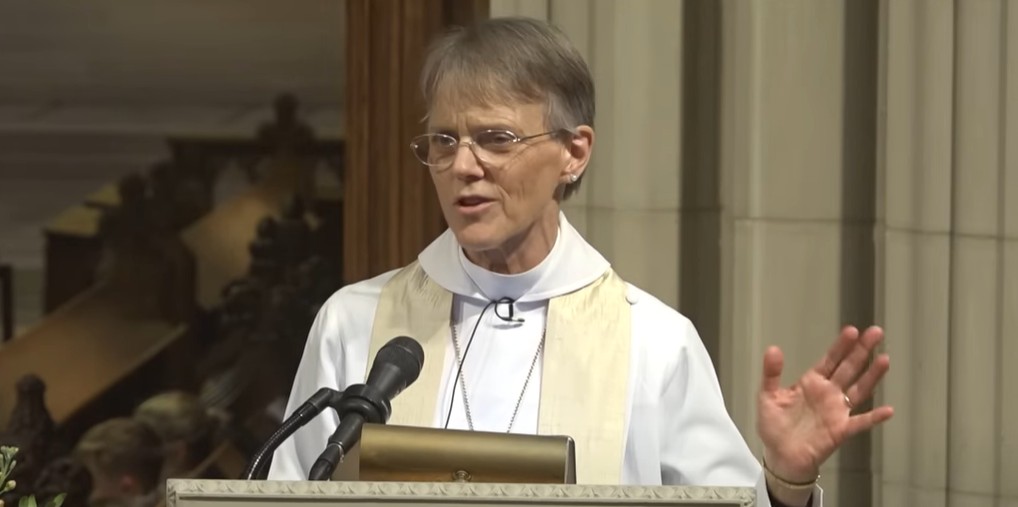
I think pastoral care requires deep empathy and courage. I am not sure that those things can be taught. Part of what makes Bishop Budde so effective is that she clearly has both of those qualities. I am sure her training and her ministry have deepened them, but I have to believe she had them–and more than most–before her training.
My experience with trained clergy comes mostly from the Jesuits I’ve had the chance to know. One of the things their order requires is quite a bit of secular training, and I think that this, maybe, is a very valuable dimension to their ministry. To a man, the Jesuits I’ve known were nuanced, critical thinkers, and I think that ability is really important in pastoral care.
Being an orthodontist or a contractor or whatever your LDS bishop or stake president is, certainly doesn’t guarantee anything, but depending on the stake president, seventy, or apostle making the call, they’re often (though not always) looking for men with empathy.
All things equal, rather receive pastoral care from a contractor with deep empathy but no formal training than a chaplain with all the training in the world but no empathy.
And Stephen, I am so very sorry for your losses and for the lack of decency, let alone care, you received.
They are not looking for men with the most empathy. They are looking for men with the most money.
No, empathy and compassion are not emphasized for leaders. In fact, one area authority I know discourages such emoptions. Absolute institutional loyalty is the emphasis. The trend is towards shepherds who sacrifice lambs, physicians who abhor the use of anesthesia, judges in Israel who are more prosecuting attorney. If you want compassion, go chat with a Buddhist. You may run into an Uchtdorf or Eyring type of leader once or twice in a lifetime. Cherish those moments.
True North….they are only promoting the non-empathetic, non-compessionate, rich…..but especially the brownest of noses.
I’m sorry to hear about your terrible experiences. I won’t make excuses for them, the people that interacted with you were thoughtless at best. I wanted to preface my comment with this because I certainly don’t want to come off like I’m trying to invalidate your experiences by sharing my own.
My experience is with a few people that were trained in the ministry that came from a non-LDS background. My interaction with them came as a result of a time when my family was taking care of my grandmother in our home. She was bedridden and had dementia, so someone had to be at home with her 24 hours a day, 7 days a week.
The first person was my grandmother’s Presbyterian pastor. She would regularly visit but given the state of my grandmother, the visits were more focused on checking up on my wife and I to see if there was anything she could do to support us. Members of their church did bring meals in the beginning and the visits from the Presbyterian pastor continued until my grandmother passed away.
I did some digging and found that her education was a Masters in Religious Education and a Master of Divinity.
Perhaps relevant to the story, this was a pastor from the same Presbyterian church (physical location) where I was once forcefully told by one of their pastors that I’d never be allowed to join their church because I was preparing to serve a mission for the LDS church. This didn’t come from the same pastor that visited us while we were taking care of my grandmother, it came from a different pastor several decades prior.
I’m a convert to the church and a few years after baptism I decided to serve a mission. I think my grandparents must have talked their pastor into cornering me and trying to scare me out of serving a mission (didn’t work). My only point, two trained ministers, two very different approaches, two very different experiences, same church.
The last person I waned to mention was the hospice counselor that would come over to visit us often. I’m not sure about their qualifications but they had a lot of experience supporting people in very specific circumstances.
Both the Presbyterian pastor and the hospice counselor were godsends. Now I’ll contrast this against my experience with people in my ward.
First and foremost, there was a sister that reached out and helped us. She’d come over to visit every once in a while, which allowed my wife and I to get out of the home. Again, my grandmother required someone be present with her 24/7. Either my wife could go out or I could go out but never the both of us. That sister’s help allowed my wife and I to leave the home together once a month or so.
That was it. The Bishop never visited. The Relief Society President never visited. No EQP. No minister. No meals. Just a sister from the ward that saw a need and reached out.
I can’t lay any of that at the Bishop or Relief Society President’s feet. We didn’t exactly reach out for help. Reflecting back, I don’t even think we knew how to ask for help, but the contrast here is that the Presbyterian pastor and the hospice counselor didn’t sit back and wait to be asked, they proactively took point and tried to help even when we were in a position to be too ignorant or too proud to ask for it.
My wife and I even had to take turns attending church. One Sunday she’d attend, the next Sunday I’d attend, but never the both of us at the same time. One of us had to be home.
This went on for a period of two years. Most people in the ward assumed we were lazy, inactive, getting a divorce, etc. Still no contact from the Bishop or anyone else from the ward. Not even a hello in the hallway.
I think my takeaway after having interacted with a trained clergy was that they’re in a better position to be more proactive. They can recognize when people need help and get out there and do the work even when the people they’re helping are blind to the ways in which they need support. They can do it because they have the time, they have the experience, and they have the training. Meanwhile in our church the ministry comes on top of juggling a career and time with our own families. It’s an afterthought and addendum to an already busy life.