
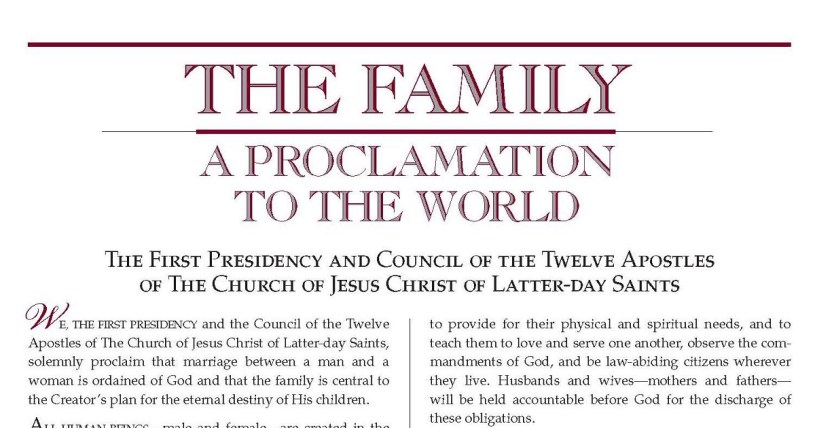
I used to say that the gender roles as defined in the Proclamation on the Family are unnecessary because if they are descriptive of reality, there’s no need to write them down, and if they are prescriptive, trying to change reality to something else, then they will fail. What I actually think is happening is that proponents of gender roles are trying to claim they are merely descriptive of reality to bolster a weak argument while really trying to prescribe what they want reality to be. So let’s unbox the difference between prescriptive and descriptive gender roles.
Descriptive claims describe what is:
- “Many men are physically stronger than many women.”
- “Most people are heterosexual.”
- “Certain patterns appear more often in one group than another.”
Prescriptive claims prescribe what ought to be:
- “Men should be strong and dominant.”
- “Women should be nurturing and deferential.”
- “Heterosexual relationships are the normal or correct form of intimacy.”
The trouble begins when descriptions are quietly turned into prescriptions.
Descriptively:
- There are statistical differences between sexes on some traits.
- Socialization, biology, and culture interact in complex ways.
- Averages say nothing about individuals.
Prescriptively:
Gender roles are used to:
- Limit acceptable behavior
- Assign moral value to conformity
- Punish deviation (shame, exclusion, violence)
- Justify unequal labor, power, and opportunity
So while gender roles are often justified as “natural” or “how things are,” they are enforced as rules about how people should behave.
This is why:
- A woman can be penalized for ambition
- A man can be shamed for vulnerability
- Nonconforming people face social or physical risk
That’s prescription, not description.
Let’s shift gears away from gender roles and look at how heteronormativity works as a prescription rather than a description. While it may be true to say that most people are straight…
Heteronormativity claims heterosexuality as:
- Default
- Normal
- Expected
- Superior
It operates as: “People are supposed to be straight, and other orientations need explanation, tolerance, or justification.” This becomes prescriptive through:
- Legal structures (marriage laws, adoption rights)
- Cultural scripts (romance, family, success)
- Moral hierarchies (“family values”)
- Social penalties for deviation
Even when presented as “tradition” or “nature,” heteronormativity tells people what kind of love and family is legitimate and permitted in society.
One of the ways this trick works is to phrase a supposed description of an observed current norm or trend as a prescription for expected future behaviors that require an exception or justification to alter. This trick allows those in power to avoid moral debate, to perpetuate inequality, and to frame resistance as unreasonable or rebellios. For example:
- “Men are leaders” → becomes “Men should lead.”
- “Women are caregivers” → becomes “Women belong in caregiving roles.”
- “Most people are straight” → becomes “Straightness is normal; others are exceptions.”
This is more effective than admitting it’s a prescription because if you frame a thing as “natural,” opposing it feels futile or impossible. You aren’t fighting a wrong description or a bad idea. You’re fighting “reality.” A much healthier position would be:
- Some patterns exist descriptively (e.g. most men have greater physical strength than most women).
- No pattern should be morally or socially compulsory.
- Averages never justify coercion.
- Human flourishing is a byproduct of flexibility, not hard-coded scripts.
Gender roles and heteronormativity are certainly not the only examples of things that are put forward as a “description” but are really designed to enforce the status quo at the cost of personal freedom and well-being. Another one I thought of as I wrote this is the fact that we’ve never had a non-Christian US president, but of course, there’s no legal or constitutional reason that shouldn’t be possible. However, the “prescription” hiding in that “description” is why religion was used as a weapon against Obama (who is Christian), as a racist attack hiding as a moral concern.
Because these tend to be conservative positions, I tried to think of an example of a position on the left that does some similar work, and the best one I could come up with is the term “college-educated” which is often used as a heuristic to imply that the person is a credible source, a responsible adult, someone with gravitas, and it also implies that those without a college education are not those things–it marginalizes the uncredentialed as unqualified to have an opinion on an important public issue. This is not the case in all uses of the term “college-educated” because some fields do require special knowledge and education to become capable. I would not go to a doctor or dentist who did not possess the correct education, for example, but there are plenty of jobs where a person with a degree is sought and yet it’s unnecessary based on the work performed. On the left especially, there is probably a tendency to give too much deference to academic achievement and to be too dismissive of those without it.
- What examples of prescription hiding as description can you think of in general?
- Are there unique examples of this that you’ve heard at Church?
- Are any of these examples uniquely LDS or are they common among conservatives in general?
- Are there examples of prescriptive arguments hiding as descriptions among the left?
Discuss.
 Wheat & Tares
I might take a slightly different tack on this, mainly because it’s been bothering me since Elder Rasband’s truly insensitive, awful talk in the October 2025 General Conference. The Proc has been out now for 30 years. I hope I don’t have to reiterate to any reader of this blog its origins as a policy statement allowing the church to participate in the Hawaiian court proceedings against same-sex marriage. But it’s no accident that under the last two presidents, arguably the most openly anti-LGBTQ+ church leaders in those 30 years, that the Proc has been undergoing what we might call a process of “stealth canonization.”
In October 2010, 15 years after it was first released, Elder Packer addressed it in a vitriolic GC talk and referred to it as revelation. He was taken to the woodshed by President Monson, in effect, and the transcript of his remarks was softened to remove the impression that the Proc was in any way “scriptural,” which Elder Packer had intentionally implied. In October 2025, by contrast, Elder Rasband repeatedly uses phrases that go beyond implying that the Proc was revelation and should be regarded as scripture and therefore binding on all Saints.
I find this more than a little disturbing, if all too typical. There is a process by which revelations are subjected to the collective inspiration and wisdom of the Saints, approved in Conference, and become part of the canon. The last actual revelation that became part of canon was recorded in 1918. (OD-2 is just the notice of a revelation; the text – if any – was not made available.) What church leaders are trying to do here is canonize the Proc without canonizing the Proc. They’re giving local leaders a weapon to be used against LGBTQ+ Saints and their allies without actually doing the work to present the document to the church in Conference for a sustaining vote.
I wonder why not?
I have long wondered about why men take the results of the fall as descriptive for men and prescriptive for women. For men God says, “by the sweat of thy brow,” to tell men that in a fallen world he is going to have to work for food. But never have I heard men or women insisting that because God said men have to sweat that the work cannot be done in an air conditioned office. God said there would be thorns in the man’s field, but never once I have I heard women plotting to make sure he has as many thorns as God wanted him to have. On the other hand men are quick to insist that they are in charge because God said they should be. The worst story is that when pain killer first came out that lowered pain but did not put the person to sleep, and would actually work for relieving the pain of childbirth, but not make it dangerous for the baby to take it first breath, many men forbid the use of such painkillers because God said women *should* have pain in childbirth. The men over history used God’s description of how a fallen world *would* be to say that is how it *should* be as for as the women were concerned, but took what God said about men as inconveniences they were really supposed to try to get out of. Men were supposed to rule over women by God’s decree, but men were not supposed to have thorns if they could possibly use weed killer. For men, it was a challenge to overcome, but for women, it had to stay as bad as possible because “God said so.” I have seldom heard men saying that God said men would rule over women out of selfish evil desires. God really said it would happen because men could. God never said it was a good thing, only that in a fallen world it would happen.
Maybe it’s my pessimism from what’s been happening in the world that informs my comments on the last two questions.
Are any of these examples uniquely LDS or are they common among conservatives in general?
I’m really beginning to question if there is anything uniquely LDS when it comes to issues that are reflected in society. Sure, there are LDS statements like the Proclamation, but I feel they are the church’s attempt to put these conservative opinions into an LDS concept, and they aren’t uniquely LDS.
Are there examples of prescriptive arguments hiding as descriptions among the left?
I hear when talking to LDS members about current issues that there are just as many problems on the left as there are on the right. I’m sure people say this to be “fair” or to represent both sides of an argument, but I’ve found that both sides are rarely equal in validity. Ninety-nine percent saying one thing does not equal the one percent saying another.
Some of us agree with how gender is referenced in the FP and some of us don’t. The old me would have declared that it doesn’t matter whether or not you agree. What matters is: why was it written, who wrote it, and how do we properly apply it in our old lives. The new me (you know, someone who let Church history drag me away from the Church) asks the same questions. And that’s the biggest problem with the FP.
See, when you look into why the FP was written, you very quickly understand the political / corporate nature of the document itself (mentioned above…think Hawaii gay marriage). The fact that Kirton & McConkie had a role in its creation is also concerning (am I getting that right or just making that up?). Why do we need semi-legal documents and polls and questionnaires if we have revelation guiding the Church?
This leaves me with the final question of how to apply it in our lives. I guess if you’re a TBM you better fall into line and believe that gender is some kind of black and white eternal principle. But beware that you may encounter loved ones in your life who don’t see it that way and their personal experience is probably stronger than your FP testimony, so good luck.
Finally, if we are going to treat the FP as doctrine then by all means let’s canonize the thing. Seems weird to me that we have so many pointless chapters in the Doctrine & Covenants that are considered “scripture” but the FP just sits out there on its own. If we are going to treat the FP as “revelation” isn’t it worth asking when the Lord revealed the contents of the FP to the Prophet? Are we just supposed to assume it happened in 1995 or so?
King Canute did more to advance Christianity by accepting that he couldn’t rule the tides.
To my knowledge, no suicides resulted.
Here are a couple of potential examples of prescriptive thinking hiding as descriptive on the left:
1. “The arc of history bends towards justice” is a descriptive statement regarding history, but the left tends to prescriptively use this as justification to scorn those who don’t support any cause or change they support, even certain changes that will never be adopted and become a part of the “arc of history.” I am certainly guilty of doing this.
2. Expert consensus as policy. “Economists agree that…” or “Public health experts recommend…” are descriptive statements that the left often converts into the “correct” policy decisions which, in reality, can often be more nuanced and involve difficult value tradeoffs. There have been a fair number of posts on W&T with regards to economics, in particular, that have done this sort of thing. Modern economies are so complex that there are plenty of descriptive findings by qualified economists to support a vast array of policy positions.
During COVID, scientists—to the best of their ability—made descriptive statements on how the virus spread. However, they also made prescriptive statements on how to act on that information (social distancing, masking, etc.). The left often took the prescriptive recommendations of health experts and extended or strengthened them. While someone or some body needs to make emergency decisions for society, it was never really clear to many, including myself, that the same health experts providing the valuable descriptive information should also be the ones to prescribe how to deal with that data. When those decisions were handed to other government bodies, the political leanings of those areas, whether left or right, were quite easy to spot. One case that affected my family personally: Utah (where the right dominates) public schools sent kids back to in-person school much sooner than California (where the left dominates) public schools (or even the Salt Lake City School District, which leans further left than the rest of Utah), a decision that turned out reasonably well given transmission at schools, and the benefits of getting kids back into school. Of course, the right also made prescriptive judgments on COVID that were disastrous (refusing vaccines, masks, social distancing, etc.). (To be clear: I supported vaccines, masks, and closures—my point is about the prescription/description conflation, where the left and right made different prescriptive judgments, not COVID policy generally. Please don’t turn this comment section into a debate on COVID policy!!!)
Both sides engage in this conflation, but the left’s version often escapes scrutiny because it wraps itself in the authority of experts.
I’ve seen Quentin make the excellent point that the whole Church Handbook uses descriptive language to do prescriptive work. It says “members do X” rather than “members should do X.” Or also, in one of my (least) favorite examples of double speak ever, a helpful Church employee told April Young-Bennett from the Exponent blog in 2012 that women who teach seminary “stop teaching” when they’re going to have a baby. It’s not that they were fired, it’s that they just somehow magically stopped. (The policy has since been changed.)
https://exponentii.org/blog/lds-church-educational-system-employment-policies-for-mothers/
Ah Ziff, was it the first official women’s session of general conference, when the entire 1st presidency took up the bulk of the time, and used exactly that form of language. It was all.. sisters you will do this, sisters you will do that.. and sisters you are this, and sisters you are that. Never in my life has a meeting left me in so much distress as that one, and given we were watching in the chapel, several of the sisters there noticed.
Descriptive: “ICE officers are mostly angry men in walmart camo who were not mentally or physically fit to be mall-cops. They do not have the self-discipline not to murder you if you hurt their feelings.”
Prescriptive: “If you don’t comply with ICE while they are illegally trying to drag you from your vehicle and they murder you it’s your fault.”
I, for one, think consensus authority about surgeons masking, wearing gloves, and washing their hands before performing surgery needs to be more nuanced. Descriptive statements about germ transmission and hygiene should not inform policy and should be left up to the individual surgeon so as to avoid a trade-off sacrificing the individual liberty of said surgeon.
Word. Essential oils.
I suppose that studying the proclamation for the purpose of identifying descriptive versus prescriptive language can be useful. But I don’t think it goes a long way towards proving whether or not the document is inspired. Even so, once we’ve learned that it’s inspired what matters most is that we receive it irrespective of whether it is descriptive of prescriptive or what-have-you.
@Jack, you said, “I suppose that studying the proclamation for the purpose of identifying descriptive versus prescriptive language can be useful. But I don’t think it goes a long way towards proving whether or not the document is inspired.”
Of course the Family Proclamation is inspired. It was inspired by a gay marriage case before the Hawaiian Supreme Court. It was inspired by the visceral disgust that elderly, conservative Church leaders—raised in the Mormon Corridor where there were “zero” openly LGBTQ people in their formative years—felt when imagining a man dressing as a woman or two men having sex.
Oh, you mean inspired *by God*? The prescriptive language masquerading as descriptive language is itself evidence against divine origin—at least if God is perfect and loves all His children. When the FP declares that gender is eternal and unchanging across premortal, mortal, and postmortal existence, it doesn’t account for people born with ambiguous sex characteristics. How can gender be eternal and constant through mortality when some individuals can’t actually determine what their gender is at birth?
It also ignores those whose biological sex doesn’t correspond with how they feel deep within themselves, often from a very young age. Sure, for most people, gender identity aligns with biology—but it’s by no means universal. The FP’s prescriptive language, disguised as mere description, erases this minority entirely. Why would God inspire His prophets to create a document that not only ignores these people but can be weaponized to exclude them from ordinances supposedly *required* for celestial glory?
The same problem applies to marriage. Because the Q15 were only comfortable with heterosexual unions, the FP declares these the only marriages God sanctions. This ignores the reality that gay people exist and desire lifelong companionship with someone they’re sexually attracted to—in exactly the same way straight people do.
At the end of the day, Jack, the FP drives nearly all LGBTQ people out of the Church. The retention rate for non-LGBTQ members through adulthood vastly exceeds that of LGBTQ members. “By their fruits ye shall know them.” The Church now acknowledges that people don’t choose to be LGBTQ. It also teaches that its sacred ordinances are required for celestial glory. How can the FP be inspired by a loving God when it pushes nearly all LGBTQ people away from the very ordinances they supposedly need? Does God not love these people? If you were born a gay man (and Church leaders now acknowledge this is reality), do you think you would believe the FP was inspired, and would you be able to remain a member of the Church?
I would also note that the gender role portion of the FP is further evidence it wasn’t inspired by God—because it’s slowly but surely being abandoned and ignored by Church leaders and members alike. The gender roles are prescriptive language masquerading as descriptive language, perfectly matching what elderly Church leaders were comfortable with at the time. But this hasn’t aged well in the three decades since. “Preside” now requires an awkward, tortured redefinition because its actual meaning in English isn’t something Church leaders dare defend anymore. Well over 50% of mothers now work outside the home, so no one really emphasizes how women should stay home while men “provide.”
mountainclimber479,
You’re a smart cookie–comment is a well articulated. And I respect your right to have and share your perspective on this sensitive subject. But it seems to me that your opinion on the proclamation itself is based on assumptions that proceed from what certain elements in the world believe to be appropriate doctrines on family formation rather than what the Lord’s anointed have taught on the subject. And so here we are again–faced with the age old challenge: who’s right? The scholars or the prophets?
@Jack, you said, “But it seems to me that your opinion on the proclamation itself is based on assumptions that proceed from what certain elements in the world believe to be appropriate doctrines on family formation rather than what the Lord’s anointed have taught on the subject.” It is true that the world has come to grips with this issue better than LDS Church leaders, but it isn’t hard to find conflict between the FP and Christ’s teachings from the New Testament:
1. **The Great Commandments.** The FP seems to be a big roadblock for Church members loving LGBTQ individuals as themselves. LGBTQ members almost universally feel that lack of love and head for the exits.
2. **The Golden Rule.** What if the rules were flipped? What if the FP denounced straight marriage and only endorsed gay marriage? Would you feel that the gay members of the Church in good standing were treating you as you would want to be treated when they excommunicated you since you chose to marry a woman?
3. **Scriptural Silence.** Jesus was silent on homosexual relationships in the New Testament. The rest of the OT and NT has very little to say on the topic. The BoM, the PoGP, and the D&C are also silent. While the FP appears to the orthodox to be inspired of God, it appears to many others to be inspired by—and an overreaction to—current events.
4. **”By their fruits ye shall know them.”** Do you see bad fruit in loving, monogamous homosexual marriages? Do you see bad fruit in Church policies that force almost all LGBTQ individuals to leave? Dallin Oaks taught members not to host their gay children in their homes or even be seen with them in public. What kind of fruit is that?
5. **The Parable of the Lost Sheep.** The FP’s prescriptive-masquerading-as-descriptive language simply ignores LGBTQ people. If these people’s only hope of celestial glory is remaining in the Church, what on earth are these people supposed to do? The FP focuses on the ninety-nine and ignores the one.
I could keep going, but that’s enough. My point is that the FP isn’t merely condemned by worldly arguments. It is condemned by Christ’s teachings.
You said, “And so here we are again–faced with the age old challenge: who’s right? The scholars or the prophets?” If you are referring to the OP’s discussion of prescriptive masquerading as descriptive language, then I can see why you would call this a “scholarly” approach. However, LGBTQ treatment in the Church, in general, is far from an academic question.
One of my daughter’s best friends from high school is gay. Despite being gay, he attended seminary all through high school. He even almost went to BYU. I breathed a sigh of relief when he decided at the last minute to attend one of the most prestigious Ivy League schools instead. He mourned not being able to attend BYU or serve a mission. I mourn the loss of this kind and talented soul in my Mormon congregation. It’s the prophets who stand behind the FP that are shunning our LGBTQ brothers and sisters. Scholars have nothing to do with it.
I think the “age old challenge” you are facing here isn’t “prophets versus scholars.” Instead, I think your challenge is “prophetic infallibility.” You assume that just because the Q15 signed the FP that it must be from God. That is a bad assumption, and I’ve given you plenty of examples of prophetic mistakes in the past, none of which you are able to accept. Remember, it’s supposed to be “The Church of Jesus Christ”, not “The Church of the Quorum of the 15”. There’s a difference.
mountainclimber479,
It’s an interesting thing–that we sometimes prioritize what the scriptures *don’t* say over what the living prophets *do* say. And so what’s a bottom–IMO–is the question of whether or not the apostles are truly inspired.
That said, surely you must know, brother, that we can love people without advocating their beliefs. And the apostles constantly remind us to be loving towards everyone.
Nuff said on my part.
You have to wonder if the apostles are inspired if what they declare is exactly what Evangelical Christians profess. You know the same people who draw near to God with their lips, but their hearts are far from Him. Wouldn’t inspiration be doing something inspiring, like Christ with the Woman at the Well, where he didn’t condemn or judge her, but acknowledged who she was and accepted her as a believer?
@Jack, you said, “It’s an interesting thing–that we sometimes prioritize what the scriptures *don’t* say over what the living prophets *do* say.” To bring us back to the OP, I would respond, “It’s interesting to notice what the living prophets chose *not* to say in the FP.” In particular, they chose *not* to provide any hope or guidance for LGBTQ people. As the OP notes, the FP prescribes–and ignores reality–that everyone is simply cis and straight.
This silence is itself evidence the FP doesn’t originate from God. The FP was released when the Church was still teaching that LGBTQ people could transform themselves into the *ideal*, cis and straight. The underlying assumption of the FP is that LGBTQ people are sinning or at least confused, and they can change through some combination of study, prayer, counseling, marrying someone of the opposite sex anyway, etc. If that’s the assumption, then there really isn’t a need to provide guidance and hope to LGBTQ individuals. LGBTQ people NEED TO REPENT!
However, the Church has publicly acknowledged for quite some time that being LGBTQ isn’t a choice for many people. Given this shift in position since the FP was released, I strongly suspect that if the Q15 felt they could edit/rewrite the FP today that they would provide some hope/guidance to LGBTQ people (even if it’s pretty lousy hope/guidance given today’s awful status quo). The FP “came from God”, though, so it apparently can’t be updated to reflect this shift in thinking by the Q15.
That said, it’s important to remember that amazingly, in a 2022 interview, David Archuleta, who is gay, said this about a meeting with an apostle/apostles as recently as 2021, “I think three times in that conversation he [an apostle] said, ‘Well, maybe we just need to find you a good girl. Maybe you can find a good girl,'” he recalled. “And I’m like, ‘That’s not the solution.'” Despite public statements to the contrary, as recently as 2021, we still had Q15 members who believed that a gay man could change to straight if he “found a good girl.” And don’t forget how Boyd Packer taught in General Conference how a loving God would never create a human being that was gay–again, long after the Church acknowledged that being LGBTQ isn’t a choice. Good grief. These are the kinds of men with these built in biases who wrote the FP.
The scriptures may be silent on LGBTQ issues, but, as I noted, Christ’s teachings in the New Testament regarding how to treat people are pretty profound and strong. The FP seems to ignore this. Are we to prioritize “living prophets” over the personal teachings of Jesus Christ?
You said, “And so what’s a bottom–IMO–is the question of whether or not the apostles are truly inspired.” It’s black and white, either/or for you, Jack. However, black and white thinking is not the only possibility here. What about the possibility that sometimes the apostles are inspired, and sometimes they might confuse their agreement as a body of 15 on a particular issue as inspiration from God?
“Surely you must know, brother, that we can love people without advocating their beliefs. And the apostles constantly remind us to be loving towards everyone.” Sure, and I appreciate that the apostles are now doing this. However, the FP still causes even well-meaning Church members into unloving behaviors. Members can be nice, but because the FP doesn’t give any guidance or hope for LGBTQ people, in the end, Church members are going to say that LGBTQ members just need to suck it up and “bear their burden” living a lifetime in a way that feels completely unnatural to them, and as many studies have demonstrated is very detrimental to their mental health (including leading to suicide). That’s not loving!
Even if members could find a way to be truly loving towards LGBTQ people, Church doctrine, as defined in the FP, remains unloving. Jack, you’re the straight guy who’s always talking about how you’re looking forward to learning the “mysteries of the cosmos” after you obtain your celestial glory after death. What if that hope were ripped away from you? What if you were an anomoly that really had no part in “the plan”? What if you weren’t destined to learn the mysteries of the cosmos in celestial glory? Would that doctrine feel loving to you? It is hard for LGBTQ people to have any such hope because the FP leaves no room for them. I don’t think that my daughter’s gay friend has largely stepped away from the Church because he didn’t feel enough love from his local ward members. He had some bad experiences (and the FP is at least partially to blame for some of the unloving things people said and did to him), but he also felt a lot of love from a lot of members around him. No, in the end, it was the lack of love in the doctrine professed in the FP that simply doesn’t allow for his existence that has made him step away.
There’s so much I’d like to say in response to this–but frankly I fear that I’d be misunderstood in this forum. Just know that I believe–regardless of a person’s orientation–that all who love God with all of their heart, might, mind, and strength, will not be held back from receiving everything.
“All who love God with all of their heart, might, mind, and strength, will not be held back from receiving everything.” I’ve heard a number of LGBTQ people say that they tried to do this within the Church, but simply couldn’t. They felt compelled to step away and try loving God outside of the unworkable constraints imposed by the FP. If this is really Christ’s church, I have a hard time believing He is pleased with the pain the FP imposes on “the one”.
mountainclimber479,
Functionally speaking it ends up being no different for hetero singles in the church–and there are many who are without hope of having the opportunity to build their own families. Even so, they are expected to remain celibate even when they fail to marry through no fault of their own. That said, of course there may be a difference in expectation between Latter-day Saint hetero singles and gays–at least at the outset–because the latter are more often than not choosing not to marry rather than not having the opportunity to do so. It’s a very difficult sacrifice–one that I wouldn’t wish on anyone.
Even so, I would not say that the Lord imposes an unfair standard on his gay children anymore than he does on his other single children. The world has changed the definition of marriage so that the final arbiter of acceptability is adult consent. But, according to the teachings of the church, that is not the way it was designed in the beginning. The proclamation makes it clear that marriage is to happen only between a man and a woman–and that sexual relations are to occur only between a man and a woman who are lawfully married.
And so what we have on one hand is the apostles saying that the proclamation defines marriage and sexual relations according to the mind a will of God. And on the other, worldly institutions saying that marriage and sexual relations should ultimately be based on adult consent. And what this does is–by elevating romantic feelings above the purpose of family formation it places both gay and cis marriage on the same plain–and that just doesn’t work in the Kingdom. Because without the Abrahamic Covenant as understood by the modern–which is all about family formation both now and in eternity–there is no exaltation.
And so, as I’ve said before, there’s really only one answer–and that’s to learn for ourselves whether are not the apostles are truly the Lord’s anointed. And more specifically whether or not they were inspired when they issued the proclamation with one unified voice. And just to add a bit of free advice–let’s not be too quick to assume that our gay brothers and sisters are the only ones getting an “unfair” deal. The Law of Chastity is no respecter of persons. It out lines the very narrow parameters within which sexual relations are to occur–and it challenges everyone from one degree to another.
Again I realize that this is a very sensitive subject. I’ve tried to be both sympathetic and pragmatic. I have six adult children–four of whom are not married yet. And of those four–three are in their thirties. And two of those three are getting really concerned about their futures. It’s heartbreaking. And so, even though I can’t pretend to know the depth of suffering that some of our LGBTQ members go through–I am acquainted with something akin to it.
I meant to say “modern church” at the end of the third paragraph.
@Jack, LGBTQ members consistently emphatically reject the comparison you’re making, and I think it’s worth examining why.
Your unmarried children are experiencing something painful, and I have genuine sympathy for that. But they’re waiting with *hope*—hope that the right person will come along, hope that their temple marriage is still ahead of them. Every lesson about eternal families describes *their* future. LGBTQ members aren’t waiting for anything—they’re told that who they are is incompatible with the plan itself. That’s not delayed hope; it’s the absence of hope.
Your unmarried children aren’t told that their deepest feelings of attraction are disordered or that their very existence is a cosmic anomaly the Family Proclamation simply doesn’t account for. They see their type of relationship celebrated in every sacrament talk on marriage, every lesson, every General Conference. LGBTQ members see themselves erased or condemned.
If these situations were truly equivalent, we’d expect roughly equivalent retention rates. We don’t. Nearly all LGBTQ members leave. That’s not because they’re less faithful than your unmarried children—it’s because the Church has made clear there’s no place for them.
The comparison functions to minimize LGBTQ suffering by suggesting “we all have it hard.” But the people actually living this experience are telling us it’s not the same. Perhaps we should listen.
Thanks for the kind response mountainclimber479. I did try to show the difference in expectations in the my first paragraph–but I think it’s a bit murky.
Let me ask you a question. Which scenario is worse: 1) The gay young man who gives up his hopes of marriage and family in order to live by the standards of the church. 2) The single elderly sister who wanted her own family but never married because no man was interested enough in her?
I think they both deserve our deepest sympathy.
Re: We all have it hard: far be it from me to compare crosses. Even so, there are some things that are worse than celibacy. My dear wife lost her two youngest siblings in a terrible car crash–along with her maternal grandparents. Four people lost their lives. As it happens this terrible accident occurred just a few days after we got engaged.
Now here’s a hypothetical question: what if by some miracle my wife had been given a conditional promise that she could have her siblings back? And what if the condition were that she forego marriage and remain single her whole life? knowing my wife I can say with a fair degree of confidence that she would have chosen a life of celibacy over losing her 9 and 12 year old siblings.
And so, on the one hand, I think it’s appropriate that we recognized and sympathize with the difficulties that LGBTQ people suffer. And on the other hand, I think we have to be careful that we don’t place people in a special category whereby they are not required to live by the Lord’s instructions on marriage and family. Some of the worst suffering of all happens within marriage. And so there’s really no way to measure one kind of suffering against another. The only guarantee to happiness is in living the gospel. And even doing that doesn’t mean that everything will go smoothly. The promise is that we will have peace in this world and eternal life in the world to come.
Jack, I appreciate your sincerity and your sympathy for your adult children’s situations. However, there are several crucial differences that make the comparison between LGBTQ members and straight singles a false equivalence.
Cancer is a burden. Unemployment is a burden. Infertility, the death of a spouse, never finding the right person to marry—these are all genuine trials. But notice something important: none of these burdens are created by the Church. They exist independently, and the Church encounters them and tries to help.
The LGBTQ “burden” is categorically different. It is manufactured by Church doctrine itself. Without the Proclamation, without these policies, a gay member could marry someone they love and build a family just like your children hope to do someday. The suffering isn’t inherent to being LGBTQ—it’s imposed by the institution. So when you say “we all have trials,” you’re comparing naturally-occurring hardships to one the Church actively creates and enforces.
Look at how the Church responds to other trials. When someone has cancer, the Church mobilizes: meals appear, visits are scheduled, priesthood blessings are offered, wards fast together. We would cure them if we could. When someone is widowed or divorced, we surround them with support. When adults are single, we create Singles Wards, plan activities, encourage dating, and celebrate when matches are made. We would find them a spouse if we could.
But for LGBTQ members? What does the Church actually offer? There’s no infrastructure, no path forward, no Singles Ward equivalent, no celebration of any relationship they might form. Just the imposition of a burden and vague admonitions for others to “love” them—which currently seems to mean treating them pleasantly on the surface while never letting them forget that acting on their deepest human need for companionship is eternally forbidden. The Church created the wound and offers no balm.
You asked which scenario is worse: the gay young man who gives up hopes of marriage to live Church standards, or the single elderly sister who wanted a family but never married because no man was interested? You say both deserve our deepest sympathy, and I agree—both situations are painful. But they are not equivalent, and yes, the gay man’s situation is worse. Here’s why:
The elderly sister’s situation is tragic, but it wasn’t imposed on her by the Church. She was allowed to hope, to date, to try. The Church celebrated her efforts and would have celebrated her success. If she finds someone at 70, she can still marry him in the temple. Her situation is the result of circumstance, not institutional prohibition.
The gay young man, by contrast, is told from the outset that his hope itself is illegitimate. He isn’t allowed to try. Every crush, every moment of falling in love, is something he must suppress and repent of. The Church created his situation, and the Church offers him nothing but the demand that he endure it.
You offer a hypothetical about your wife: what if she could have saved her young siblings’ lives by accepting lifelong celibacy? You suggest she would have made that sacrifice, and I don’t doubt it. That would be genuinely noble.
But Jack, as far as I know, no one in the history of the Church has ever faced that choice. It’s an extreme hypothetical with little practical value for this discussion. More importantly, a woman who made such a sacrifice would be celebrated as a hero in her congregation. People would speak of her in hushed, reverent tones. Her celibacy would be honored as a profound act of love.
Is that how gay members are viewed? Are they celebrated for their sacrifice? Or are they regarded with suspicion, excluded from full participation, and constantly reminded that their very nature is disordered? The social reality of these two forms of celibacy could not be more different.
You acknowledge your unmarried children are “getting really concerned about their futures.” That concern exists precisely *because* marriage remains a possibility for them. The door is open. For LGBTQ members, the door is explicitly and permanently closed. “Single, divorced or widowed members of the Church can have hope, but you are not allowed to.”
Your children’s singleness is situational—they haven’t found the right person yet. LGBTQ celibacy isn’t about circumstances; it’s a categorical theological prohibition. No matter how kind, faithful, or compatible a same-sex partner might be, the answer is always no.
You’ve framed this around the Law of Chastity and “sexual relations,” but that misses the deeper issue. What most gay Latter-day Saints struggle with most is loneliness, the lack of companionship. You have crushes, you fall in love, but you must keep it a secret. You watch your friends date. You watch them marry. You remain one half, incomplete.
Your unmarried children can date, hold hands, experience romantic affection, and have those relationships celebrated at church. LGBTQ members cannot experience any of this.
For your children, romantic attraction is beautiful—something to be encouraged and cultivated. For LGBTQ members, it’s an entirely different experience to be celibate because you regard every experience of sexual attraction you have as a blameworthy temptation to sin. The Church doesn’t tell your sons that their attraction to women is disordered and must be suppressed. It celebrates it.
The church is set up socially and theologically for singleness to be a temporary state. Your children experience the Singles Ward, the matchmaking, the encouragement. LGBTQ members get an expectation of permanent celibacy within an institution designed entirely around families, without any infrastructure to support them in that expectation.
You say the apostles “constantly remind us to be loving.” But only a very, very small fraction of gay members stay active in the church. If this situation were truly comparable to that of straight singles, wouldn’t we see similar retention rates? The fruits tell a different story.
Jack, throughout this conversation you’ve operated from the assumption that the Family Proclamation represents the mind and will of God. As I’ve pointed out repeatedly, that assumption deserves scrutiny. The Proclamation was drafted in response to a legal case in Hawaii. It is explicitly known not to be a “revelation” from God since Boyd Packer had to revise his talk that said it was. It reflects the perspectives of elderly men raised in an era when LGBTQ people were invisible. It ignores the existence of intersex individuals. It has quietly been walked back on gender roles as society has changed.
What if the Proclamation isn’t revelation but rather the biases of Church leaders codified into policy—just as the priesthood and temple ban once was? You keep asking whether we trust the prophets. But the prophets have been wrong before, and the Church has eventually changed when this has happened. The question isn’t whether the apostles are sincere. The question is whether, on this issue, they might be mistaken—and whether the devastation this policy causes to LGBTQ members and their families might be evidence that they are.
I understand the weight of that question. But if you’re going to tell gay members that their suffering is comparable to that of straight singles, you owe it to them to at least consider whether the doctrine causing that suffering is truly from God—or whether it’s a human error that future generations will repudiate, just as we now repudiate the priesthood ban.
Jack, I realize we are two thick concrete walls talking to each other. And while mountainclimber479 answers you far better than I will, I’m jumping in.
Any church can have any doctrine they want. That’s up to them (skipping defining church and them). But I object to any church making their theology the law of the land. Especially when that theology harms people. And if the theology harms people, then that church should take a good long look at that theology.
If a church exalts heterosexuality as the bestest ever, ok. If a single straight woman desires to marry a man, that is seen as righteous
But if you’re gay, it’s super duper bad. The end of the world, the destruction of civilization.(I wish that was hyperbole)
Here’s the thing, we can celebrate all the things that straight people marrying can bring. The love, commitment, work in having a fulfilling relationship(and yes, plenty of marriages are crap and not fulfilling. Yet we still celebrate marriage)) and apply that to gay people marrying. Gay marriage is a benefit not only to gay people, but to society.
As for sympathy with LGBTQ people suffering, eff that. They shouldn’t have to suffer. (as for “happiness”, I’ve seen Pluribus. I’m anti-hive mind and defend my right to be grumpy)
mountainclimber479,
There’s that could be said, but I’m going to let your very thoughtful comment stand as the final word.
There’s *more* that could be said. . .
Suzanne Neilsen,
I’m sorry, I didn’t notice your comment–so I guess I’m not quit finished here.
I support people’s right to be gay married–that’s the legal side of things. But I disagree with gay marriage on religious grounds–just as I do cohabitation, and other violations of the Law of Chastity.
I think “harm” is sometimes in the eye of the beholder. I don’t deny the pain that many LGBTQ folks feel because of the church’s teachings on marriage and chastity. But even so, in every age the church has been at odds in some way or other with the world. And sometimes the church has yielded too much to syncretic influences and has been absorbed by the surrounding culture. That said, I give it to you as my opinion that that’s not going to happen this time around. Yes, the church has made many changes with regard to logistics and methods and so forth. But it will never change it’s foundational claims which include it’s teachings on marriage.
And so I come back to what I believe is the crux of the whole issue–and that’s whether or not the apostles are the Lord’s anointed. Because if they are — and their teachings on marriage and family are inspired — then it behooves us to receive their counsel–even when it seems counterintuitive to our own moral sensibilities. And with all of that said–while the church does not advocate any sexual relations outside the bounds of the Law of Chastity, it does remind the saints again and again that we are to be tolerant and loving towards those who believe differently than we do.
I think we should remember also that the redefinition of marriage is no small thing. It shouldn’t be surprising that some folks–a lot of folks really–would have a hard time adjusting to the new definition. Most people who adhere to an Abrahamic religion are challenged by it–and we’re talking about at least half of the global population. For ten thousand years Adam Eve have been their great archetypal pattern. And so we have to accept the fact that while some of these folks will soften towards the new definition–many won’t. It will continue to be a point of contention–and my hope is that the saints will be able to demonstrate to the world that people from different systems of belief can be tolerant and kind towards one another.
Jack: If you are LGBTQ, your sexual orientation is not “the world.” It’s just who you are. So if the church is against it, it’s not the church fighting “the world”; it’s the church telling you that who you are is bad. Of course, it literally said all these things about being black years ago, so it’s no surprise. The day they finally figure out that they are wrong on this one can’t come soon enough. And telling people “We’re sorry for your suffering” rings hollow without the acknowledgement that it’s suffering caused by the one who claims to be sorry.
Jack
I do like to kick around ideas.
1: ” But it will never change it’s foundational claims which include it’s teachings on marriage” Are you talking about D&C 132? Where men are given multiple wives to bear the souls of men. Hump, I think I prefer a marriage system that doesn’t treat women like cattle.
2: 10,000 years and Adan and Eve. Let’s see in 8000 BC, in the fertile crescent, welcome to the Neolithic. My mDNA goes back to those migrating Anatolian farmers. I look at the reliefs on the megaliths at Gobekli Tepe and I don’t Adam and Eve.
If I had a ydna, that would go to Northern Europe. 8000BC puts us in the Mesolithic. So here’s to my ancestors at Doggerland and to Scandinavian Hunter Gatherers. I don’t see Adam and Eve. If I take account of the Finnish in me, in the Kalevala the world is created from the egg of a waterfowl.
The Cosmic egg is a worldwide mythological symbol. Since it’s worldwide, it has to be ancient, like McDonalds.
Now if I’m going to channel my inner Graham Hancock and try to get a Netflix special, here goes. Bruniquel Cave, Neanderthals,176,500 years ago. Egg shaped ovals constructed from stalagmites. Inside them signs of fire and burnt organic material suggesting possible ritual activity.
And to go farther back, Olduvai Gorge, stone circle, 1.8 million years. Possible hut, but I’ll claim a temple to the Cosmic Egg.
Far fetched you say? Yep, but Olduvai Gorge and Bruniquel cave, unlike Adam and Eve, are real.
So I’ll take your great archetypal pattern, and raise you with a Homo erectus cosmic egg.
Hawkgrrrl,
I was thinking more in terms of secular vs religious. The secular world has its methodologies for getting at the truth of things. And while there’s a lot of good being done on that plain of understanding there is no acknowledgement of the things of the spirit. And again, that’s why I believe the crux of the issue is whether or not the apostles are the Lord’s anointed.
And with regard to someone being “bad” because of their orientation: the church has repeatedly reminded people that they are first and foremost children of a loving God and therefore precious beyond price–irrespective of their orientation.
Suzanne Neilsen,
You know more about these things than I do–but I was thinking along the lines of Hugh Nibley and his study of the annual year rites and all of that. Plus, I threw out what I thought was a good round number for the beginnings of human civilization. But hey–I’m willing to be wrong. That said, whether it’s ten thousand years or six thousand years the archetypes still loom very large both within and especially without the West.
Re: Section 132: Even though Section 132 may be distasteful to some folks it is still founded on the principle of marriage between a man and a woman.
Suzanne Neilsen – Your above comment put a smile on my face! 😉 …. and I agree with your last paragraph. We do tend to take things too literally in the LDS church when trying to apply the scriptural references of parable and explanation written in a time when consideration of humans even taking flight was thought preposterous. (it’s actually a very simple process when Bernoulli’s laws of pressure are applied!) When the scriptures were written, human thought had no idea the vastness of the universe, the planet, their continent etc. I know you know all of this Suzanne, I just wanted to state the obvious that you so enjoyably described.
Others – I agree with the Climber and Hawkgrrrl on all fronts of this conversation, but I have avoided posting thumbs up or down on his and Jack’s postings because I find it interesting to see how many “thumbs down” Jack has received vs the “thumbs up” for climber. I think a bit of an unplanned pole has happened here showing that most readers and bloggers here have issues with the way the church is dealing with gay marriage.
I will say to Jack – Never say never brother! I personally think that allowing women to openly be witnesses at baptisms and other priesthood happenings is a step in the direction of women holding the priesthood. High councils and counselors that are women would be an absolute benefit. The church changing direction on it’s attitudes and treatment of homosexuality is also a step in the direction of gay marriage. It would be foolish to say it was a step away from either of those issues.
As a side note, possibly humorous to some, it is to me; my dear wife of 4+ decades is a temple worker, and her statement is “I exercise the priesthood every time I lay my hands on someone’s head in initiatory sessions and proclaim that blessing. You guys can ‘hold’ the priesthood all you want, I don’t want to have to do all the crap you guys have to do!” I consider her lucky. I don’t have much desire, currently to be a temple worker. I’m currently done with other people requesting my time and effort. 9 months to go. Additionally my dear mother (RIP) served a mission in the western states in the late 40s. In a couple of situations, she laid her hands on people in vastly remote areas and pronounced blessings of healing and comfort. Her mission president had no problem with it.
Hawkgrrl and other keepers of this wonderful site, would it be possible to add 2 other “ratings”? perhaps the “thinking” emoji, and the hands up “I don’t know?”
Just wondering – Thanks for all you guys do – Mongo
Jack
I ain’t up on Nibley. When I see people bandying about archetypes, I immediately go Jungian. And although I question the existence of the collective unconscious, I am willing to see Frodo Baggins as a hero. But I don’t think the fictional writings of JRR Tolkien should be the basis of secular law. Although something need to be done about the Dark Lord and his orcs rampaging through cities. Yikes.
As for D&C 132, have you read it??? It was written so Joseph Smith could “marry” minors in his protective care. And whether one wife or many, women are still treated as breeding stock.
And “the church has repeatedly reminded people that they are first and foremost children of a loving God and therefore precious beyond price–irrespective of their orientation.” Ha,Ha,Ha very funny. Not my experience. And as to a loving god, we shouldn’t confuse possession with love.
17RRider
Going off topic here, What else is new.
Have you see videos of the Dudes in wingsuits jumping off mountain tops. I am not surprised when they inevitably crash into the cliff. It seems Bernoulli’s laws have been superseded by the Law of pancaking on granite.
But to bring it back to gender expectations, I can’t help but notice most of the crazies are guys. Just saying.
Suzanne -LMAO!!! A point of info: Those bone heads are actually not flying, they are only manipulating parasitic drag to make them fall forward. There is no airfoil working in their case. They are flying a little better than a set of car keys thrown in the air, I’ll give them that. Gravity will ALWAYS win without a good airfoil and perhaps a little thrust or at least some lifting air in the case of a glider. In relation to church leadership: on occasion, they tend to sometimes operate in the airmass with what we used to call in the flight test regime as “All Thrust and No Vector.”
I am a never married 58 year old woman. I don’t give a rats ass that the Church supports my goals to get married in the Temple. It doesn’t help one iota. Being alone for your whole life is a damn tough row to hoe. And no, I don’t have “hope”. Haven’t for a long time. After life? Nope. Who knows what awaits us single women, polygamy? The only hope I have now if that when I die the Lord recognizes what a hard life it was.
To those of you who think its sooooo much worse for the gay members:
1) Don’t tell me what I think – don’t tell me “but you have hope”. . .no, there comes a point where its a given that you won’t marry.
2) I am perfectly willing to admit that being a gay member is hard, but don’t rank our challenges. You just don’t f*&^ing know.
Lily
in the grand scheme of things, there is no hope. I do try give hope (I don’t believe in) so people don’t jump off a bridge, even though ultimately, what does it matter. i often joke, because it’s true, that the only thing I have against nihilism, is it’s overly optimistic.
I see no signs of life, other than earth, in the vast,vast universe. In about 5 billion years, long after humanity has ceased to exist, our sun will expand into a red dwarf and consume the earth. Nothing will remember it.
Yet here we are. Whether we’re born in a palace, or a shithole–Here we are. I think of that Yevtushenko quote “Not people die but worlds die in them” I can lament against destruction, but the secret worlds are not regenerated. Darkness reigns.
But as Edna St Millay wrote “My candle burns at both ends
It will not last the night;
But ah, my foes, and oh, my friends –
It gives a lovely light.”
So I don’t offer hope, I also have no hope. But what I do try to do is, as Mary Oliver said–Stroll in the fields, fall down in the grass.
“Doesn’t everything die at last, and too soon?
Tell me, what is it you plan to do
with your one wild and precious life?
“Tell me, what is it you plan to do
with your one wild and precious life?”
The vast majority of human beings have lived as paupers or peasants or servants or slaves. And so that question (to them) is moot. The only hope they might have is in the idea of life continuing after death.
And speaking as one who does have hope–I say that lasting hope can be found in Christ. It is real.
Jack
Just keep being you.
If I remember right the saying was– life’s a bitch and then you die. I much preferred–life’s a beach and then you dive. There is something exquisite about gliding through a kelp forest.
I’m not much into poetry. But even I have heard of Mary Oliver, even though she’s only a woman.(that’s me being sarcastic since this post is something about gender) Anyway the poem is”The Summer Day” I recommend reading the whole thing. The other poem she is known for “Wild Geese” which opens with–“You do not have to be good”. But since I like dogs, here is my favorite
“The Storm (Bear)”
”Now through the white orchard my little dog
romps, breaking the new snow
with wild feet.
Running here running there, excited,
hardly able to stop, he leaps, he spins
until the white snow is written upon
in large, exuberant letters,
a long sentence, expressing
the pleasures of the body in this world.
Oh, I could not have said it better
myself.”
I don’t know what prayer is. But if you want a scripture I learned when a angsty teenager
“Meaningless! Meaningless!”
says the Teacher.
“Utterly meaningless!
Everything is meaningless.”
That’s as far as I got in finding truth in scriptures.. But if I don’t want to jump of a cliff (unless it’s it a mountain lake and I’m going swimming) then the closing of “Wild Geese”
“Meanwhile the wild geese, high in the clean blue air,
are heading home again.
Whoever you are, no matter how lonely,
the world offers itself to your imagination,
calls to you like the wild geese, harsh and exciting —
over and over announcing your place
in the family of things.”
“I’m currently done with other people requesting my time and effort.”
Mongo, such a concise description of my current mindset towards the church organization. It’s not LGBTQ issues, it’s not Trump and MAGA, it’s just weariness with the feeling that there are legions sitting in church councils above me who see my time and labor as an unlimited resource free for the taking.
Anon this time, as a bishop I routinely remind folks in ward council and over the pulpit, that we are all volunteers and we all need to remember that point. We are only attending to take the sacrament and buoy each other. That’s all we can do. A few years back, Elder Soares visited our area, and in a meeting with Bishops, EQ pres. and RS pres. A RSP noted all the callings that everyone had was overwhelming. His response was that no one should have more than one calling or assignment. We were seated by stake, and our entire stake laughed out loud because we thought he was joking. He chuckled and said, “I guess that’s not the case.” He then went on to say, “If people need to have more than one calling or assignment, then you are doing too much. Your stake or ward needs to tailor the program. There are many parts of the program that don’t need to be done and they should not be, if you don’t have the people to do it.” I have since gone out of my way to relieve people of extra callings/assignments. I am always having to remind our leadership of that point. But here is the rub; don’t hesitate to tell some overzealous church leader that you are currently doing all you can, and that you don’t have time for anything else. or even, HEAVEN FORBID, turn down a calling! I wave my BS Flag anytime someone says, “you should never turn down a calling.” I posted somewhere else that priorities should be God, Family, Job, Friends then church. Just my $1.50, I know I’m off topic.
Cheers – Mongo
A comprehensive Jewish polemic against the theological foundations of Xtianity and Islam. Where was JeZeus throughout the Shoah? Where was Allah throughout the Nakba total defeat disasters of ’48, ’67, & most recently the 12 Day War?
Explain how the local tribal god of Sinai who dwells in the Mishkan Yatzir Ha-Tov/strictly and only within the hearts of the chosen Cohen seed of Avraham, Yitzak, and Yaacov – upon this Earth, does eternally judge the Monotheistic Universal Gods of Golgotha (place of the skull) and Mecca & Medina who occupy the Heavens – as false Baal Gods of Av Tuma avoda zarah – no different from the Gods worshipped by Par’o and Egypt or the Gods worshipped by the Canaanites.
The Torah’s God is not a distant “universal father” but the local, tribal Elohim of Sinai, who entered history through the brit cut between the pieces with Avraham, promising land and seed to Israel alone. This God judges all nations but resides only in the mishkan (tabernacle) of Jewish hearts committed to tohorah and tzedek (justice). Monotheism’s universalism profanes this faith that pursues justice within the borders of the oath brit lands, by inventing heavenly overlords who demand submission from all humanity, violating the Second Commandment: “You shall have no other gods before Me”, which explicitly condemns the polytheistic undertones of trinitarian Christianity and the absolutist Allah of Islam as echoes of Ba’al worship—gods of storm, fertility, or conquest that promise salvation but deliver tumah.
JeZeus as a Protocols of the Elders of Zion NT blood libel slander, did not know the fundamental distinction which separates Torah common law from Roman Statute Law. Likewise his similar Nathan of Gaza who served as the disciple of Shabbetai Tzvi … commonly known in NT rhetoric propaganda as “the Apostle Paul”. To sanctify the mitzva of shabbat (all Torah commandments apply equally to all chosen Cohen seed of the Avot – including the mitzva of Moshiach) requires making the הבדלה distinction between time-oriented Av commandments from toldot positive & negative commandments which do not require k’vanna; this בינה that discerns like from like מלאכה מן עבודה, separates holy from profane – t’ruma from chol. The imaginary man JeZeus did not “understand” the mitzva of shabbat any more than do Xtians understand the mitzva of Moshiach or Muslims understand the mitzva of Torah prophets; Torah prophets command mussar – T’NaCH does not instruct history because prophesy as a mussar rebuke applies equally straight across the board to all generations of the chosen Cohen seed of the Avot, no different than Shabbat and Moshiach.
The dedication of the House of Aaron as Moshiach serves as the Av precedent for all other Moshiach dedications thereafter. The precedent for korbanot learns from the rejection of Cain’s korban. A Torah korban exists as a time-oriented commandment which requires the “wisdom” of k’vanna-swearing a Torah oath through שם ומלכות. The term מלכות refers to the king-like leadership direction of the 13 tohor Oral Torah spirits which Moshe Rabbeinu perceived at Horev 40 days following the sin of the Golden Calf av definition of all avoda zarah for all generations. The Oral Torah revelation occurred on Yom Kippor wherein HaShem remembered the oaths sworn unto the Avot and annulled the vow to make from Moshe the father for the chosen Cohen people. Just as brit does not translate correctly as covenant, so too and how much more so t’shuva does not correctly translate as repentance for sin. Torah faith does not atone for sin, Yom Kippor makes atonement for a failure to rule the oath sworn lands with righteous judicial common law Sanhedrin justice which makes fair restitution of damages inflicted by bnai brit upon bnai brit. Aaron as the first anointed Moshiach – dedicates through the sanctification of korbanot the righteous pursuit of judicial justice among the chosen Cohen seed of the Avot within the borders of Judea.
Matthew genealogy traces the lineage of its Harry Potter through Joseph. Luke’s genealogy traces its lineage through Mary. LOL. Matthew lists 42 generations while Luke lists 77 generations! Matthew begins with Avraham and moves forward while Luke begins with Adam. The final name in Matthew’s genealogy Joseph (husband of Mary). While Luke ends with JeZeus. Matthew follows Solomon’s line; Luke follows Nathan’s line. All gospel Roman forgeries fail to grasp the Torah negative commandment of a “bastard child”.
The gospel of Luke ignores that all Goyim reject to this day the revelation of the Torah at Sinai. No gospel forgery ever once includes the 1st Commandment revelation of HaShem who dwells thereafter only within the Yatzir Ha-Tov of the hearts of the Chosen Cohen seed of Avraham Yitzak and Yaacov – brit cut between the pieces. Nathan, another descendant of David not tied to the kingship.
Anymore than the gospels has any linkage to the Torah dedication of the mitzva of Moshiach – based upon king David’s failure to judge the Case of Bat Sheva’s husband with justice. Ruling the land/people with righteous judicial justice defines the Torah intent of the mitzva of Moshiach. Luke’s attempt to make its false messiah into an av tuma Universal messiah for all Mankind, violates the revelation of the Torah at Sinai.
Moshe first anointed the House of Aaron as Moshiach. Aaron stands on the foundation of Elohim acceptance of the sacrifice dedicated by Hevel, despite Cain being born first. This theme duplicated again and again in Yishmael/Yitzak, Esau\Yaacov, Reuven\Yosef, pre-sin of Golden Calf first born of Israel/post Golden Calf tribe of Levi. The Luke/puke contradicts JeZeus’s declaration to the Samaritan woman! Hence the NT compare more to a superman comic book than an actual replacement of the brit chosen Cohen seed of the Avot replaced by a Roman fictional Harry Potter messiah.
The greatest flaw of the gospel forgeries, hands down without any question, their utter replacement theological failure which fails to grasp that all the Torah mitzvot revealed at Sinai apply equally – straight across the board – like shabbat and tohorat Ha-beit for married women – to all generations of the chosen Cohen seed of Avraham Yitzak and Yaacov.
Furthermore the JeZeus false messiah failed to differentiate the Avot in Genesis perception of El, Elohim, El Shaddai etc as a God in the Heavens from the revelation of HaShem in the 1st Sinai Commandment wherein the Divine Presence middot revealed to Moshe after the sin of the Golden Calf on Yom Kippur live in this Earth only within the hearts of the Yatzir Ha-Tov Cohen people. When the followers of the Harry Potter false messiah asked their God how to pray he taught them: Our Father who is in Heaven … this fundamentally violates and profanes the revelation of the Torah at Sinai – the Spirits of HaShem live within the Tabernacle of the Yatzir Ha-Tov within the bnai brit Cohen hearts.
Tefillah – Kre’a Shma – Hear Israel HaShem Elohynu HaShem Echad. The word One does not refer as the av tuma avoda zara theologies promoted by the NT and Koran false prophet frauds of Universal Monotheism. Monotheism violates the 2nd Sinai Commandment; HaShem sent Moshe to Egypt to judge the Gods of Egypt! Rather the word ONE refers to the oath that a Cohen swears through his tefillen to remember the oaths sworn by Avraham Yitzak and Yaacov wherein the Avot cut an oath alliance to father the chosen Cohen people. Hence the 3 Divine Names in this one verse have the intention to remember the oaths the Avot swore to father the chosen Cohen seed for all eternity. Furthermore, the name Elohynu judges and separates HaShem from HaShem; acceptance of the Written and Oral Torah revelation לשמה.
The father determines the genealogy of both sons of Aaron and Kings of both Yechuda and Israel. The NT fraud has no concept that once a man acquires title to the O’lam Ha’bah (future born children) of his wife, that even if Zeus himself fathered Hercules that under Torah law Hercules constitutes a bastard. That the beating of JeZeus almost to death and torturing him upon a cross compares to offering a deformed animal on an altar as a Torah sacrifice. תורה לא בשמים – a direct quote from the Book of D’varim which defines the revelation of the First Sinai Commandment for all eternity thereafter. JeZeus depicted as the “Son of God/virgin birth” … a bastard child forever excluded כרת from the seed of the Avot chosen Cohen people.
The brutal murder of fictional Harry Potter JeZeus through judicial corruption and injustice totally the opposite of Moshe dedication of the House of Aaron as Moshiach. The prophet Shmuel first anointed Shaul of the tribe of Binyamin as Moshiach, but his failure to pursue justice – specifically in the mitzva of Amalek (understood as Jewish ערב רב – assimilated Jews who follow foreign cultures & customs who intermarry with Goyim who reject the revelation of the Torah at Sinai.) Amalek or antisemitism plagues all generations of Jews with Torah curses no different than the plague curses in Egypt.
Superficially Yonah sent to “warn” the king of Assyria. But Torah prophets serve only as the mussar police of Sanhedrin courtroom rulings. The Sanhedrin courts only have jurisdiction within the borders of Judea. Hence for the prophet Yona sent to Assyria his mission replicates that of Moshe in Egypt sent to cause the exiled 10 tribes of Israel to remember the brit oath sworn to the Avot. Assyria conquered shortly after Yonah commanded his mussar to the exiled seed of the 10 Tribes by the Babylonian empire.
Contrasts the Torah’s depth with the superficial, treif distortions peddled by the church—as epitomized in that 1956 Hollywood spectacle, The Ten Commandments, where a bald Yul Brynner as Pharaoh and a chiseled Charlton Heston as Moshe reduce Sinai to a cinematic farce. The revelation of the Torah at Sinai caused Israel to recoil after hearing only the first two dibrot (statements) directly from HaShem’s tohor spirits.
Understanding why the aseret ha-dibrot (the “Ten Statements,” not “Commandments” as the church mistranslates to fit its legalistic idolatry) appear twice. Israel demanded thereafter that Moshe ascend to receive the remainder of the Torah—Written and Oral—lest these tohor middot consume their Yatzir Ha-Raw tuma middot.
The aseret ha-dibrot repeated twice in the Torah, this duplication, it exposes the root of Torah common law; which stands firmly upon bininei avot—the foundational “building fathers” or precedents that generate an expansive edifice of halachah. As enslaved Israel made bricks to build Egyptian treasure cities, the Talmud employs the building block of Hillel’s 7 middot, Akiva’s 10 middot, Yishmael’s 13 middot, and HaGallilee’s 32 middot; every sugya of Gemara stands upon these יסודי logical building blocks.
These are not mere repetitions for emphasis, as Goyim theologians defame the Talmud as the words of Men, far removed from the Word of God! Rather the concept of T’NaCH prophetic Oral Torah mussar middot and Talmudic halachic middot bridge the gap of holiness which elevates holy to most holy commandments. Shabbat serves as an Av precedent for all other wisdom-commandments which require k’vanna wherein Jews in all generations dedicates tohor Oral Torah middot – which the Talmud calls: מלכות. As the Torah has two grades of commandments the T’NaCH & Talmud judicial common law have two grades of middot.
Torah speaks in the language of Man. The kabbalistic term “shekinah” stands upon the Mishkan precedent. Its not the form of the Mishkan and its vessels which defines the revelation of the Torah at Sinai/Horev; anymore than its the 6 days of Creation משל, but rather the introduction of time oriented commandments נמשל. The נמשל that the רוח הקדוש Oral Torah middot of Horev breath life into the Ya’tzir Ha-Tov of the Chosen Cohen peoples’ hearts. Hence the error spelling of the word heart as לבב in the tefillah דאורייתא acceptance of the yoke of the “kingdom of heaven”.
Meaning remembering the oath sworn by the Avot to father the Chosen Cohen people and the acceptance of the Written and Oral Torahs at Sinai and Horev. Herein designates the k’vanna of the time-oriented wisdom commandment known as קריא שמע. As this commandment applies to all generations of Israel so too the mitzva of Moshiach. Jews do not wait for a fabled 2nd coming of JeZeus. “Time” not as literal hours but as opportune wisdom (as in Ecclesiastes 3:1–8’s “a time for every matter”). Thus the repetition of the 10 dibrot serve to define the elevation of time-oriented commandments as the k’vanna to remember the redemption from Egyptian exile – as expressed in the first Sinai t’shuva commandment.
The revelation of the Oral Torah, according to the kabbalah taught by rabbi Akiva’s פרדס understanding, reveals a dynamic logic variable inductive format, as opposed to the ancient Greek philosophers static rigid syllogism deductive logic. Islam’s sharia mimics toldot without av wisdom, leading to rigid fatawa absent prophetic t’shuva. In essence, the twice-repeated 10 dibrot reveal the Torah’s blueprint for common law: a beniyan av teaching generational renewal, mitzvah classification, and mussar-k’vanna. This stands eternally against the church’s movie myths and Islam’s static codes, affirming Sinai’s wisdom for Israel’s seed alone.