

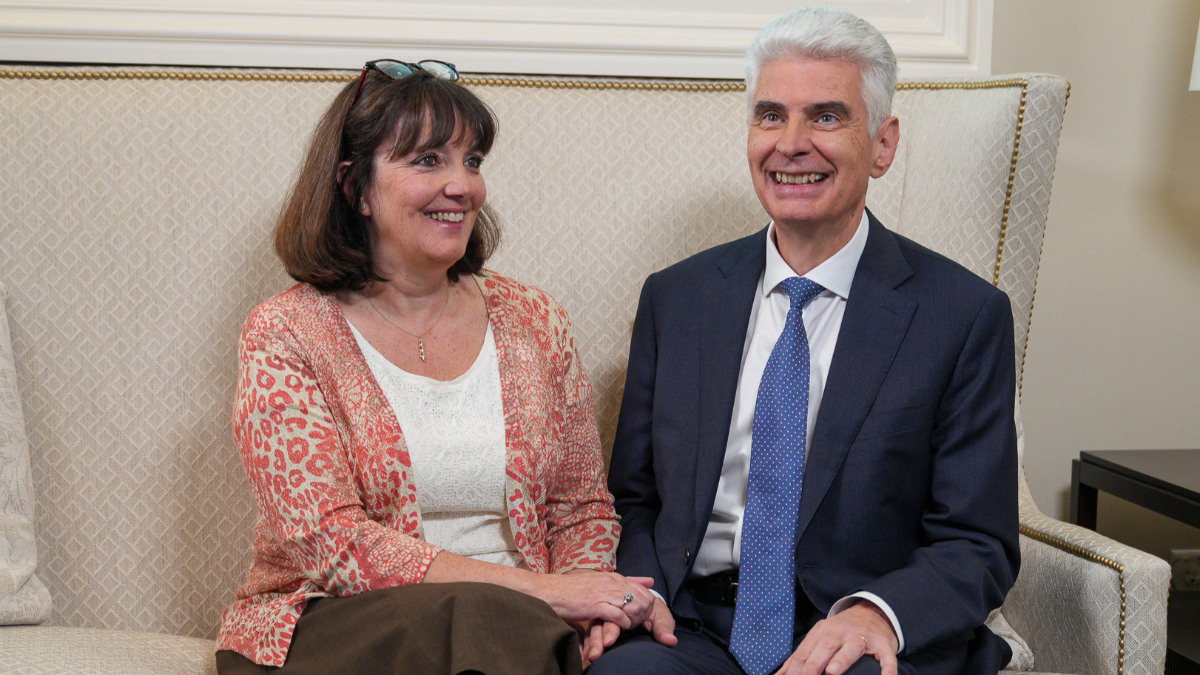
Elder Gérald Caussé and his wife, Valérie. Photo from the LDS newsroom article.
Elder Gérald Caussé was called on Thursday, November 6, 2025, and ordained the same day by President Dallin H. Oaks and the other members of the First Presidency and the Quorum of the Twelve Apostles. He fills the vacancy left in the Quorum of the Twelve after President Nelson’s death.
The timing of this announcement is highly unusual. Most apostles are announced at General Conference rather than on a random Thursday in November. However, it’s understandable that the leaders wouldn’t want to leave that seat unfilled for six months until the April 2026 Conference. With President Nelson dying just a few days before the October 2025 Conference, and the First Presidency not being organized until October 14, there wasn’t time to get the dominoes set up in time to call Elder Caussé at Conference.
Elder Caussé was born in France, as was his wife, and speaks English as a second language. He has served as Presiding Bishop since 2015, and served for several years before that as a counselor in the Presiding Bishopric. This put him in the hot seat during the SEC scandal and investigation. The Church’s Presiding Bishop sits on the Board for Ensign Peak. As a reminder, the SEC investigation began in 2019 and ended in 2023 with a $5 million penalty. Since we know that the men who refused to sign off on the false tax reports and shell company arrangement were released, we can conclude that Elder Caussé walked the company line and cooperated with the dishonest reporting. He began serving in the Presiding Bishopric in 2012; the shell companies and incorrect tax reporting began in about 2001. [Source – the 9-page SEC order.]
Ensign Peak’s financial structure (to skirt the tax filing requirements that would reveal the size of the Church’s investment fund) had been around for a decade when Elder Caussé arrived on the scene. However, shortly after he was called as Presiding Bishop in 2015, the shell game doubled in size to 12 entities. It’s fair to say that Caussé was likely heavily involved in the discussions and decisions on how to hide the size of the Church’s investment portfolio.
If he’d been working for an investment bank and asked to fudge things on that scale, would he have done it? How much is believing the Church is right even when it’s wrong, and how much is a willingness to break laws if the company is rich enough? That’s not a question we can answer but that doesn’t stop us from speculating.
I read his last two General Conference talks and I liked both of them. He last spoke in April 2025 and his talk, Compensating Blessings, is full of reassurance of God’s love and kind words for those who cannot do all that they wish they could do. “When our earnest efforts fall short of our aspirations due to circumstances beyond our control, the Lord still accepts the desires of our hearts as a worthy offering.” There is a lot of compassion in these remarks for people who haven’t had opportunities they wish they had, or who are sick or otherwise limited physically in the things they can do and the ways they can serve.
He avoided hints of the prosperity gospel and never implied that faithfulness could overcome obstacles. Instead, he reassured his listeners, “I testify that while many circumstances in life may be beyond our control, none of us is beyond the reach of the Lord’s infinite blessings. Through His atoning sacrifice, the Savior will compensate for every inability and injustice if we offer our whole souls to Him.” That phrasing is beautiful — “every inability and injustice.” Everything we can’t do; everything we were unfairly denied or unjustly excluded from. It’s a very kind and compassionate talk.
His next most recent General Conference talk was in October 2022, titled “Our Earthly Stewardship.” Much to love in this talk as well. I appreciate it when religious leaders of any denomination speak about our responsibility to be good stewards of the earth, and not to exploit it or use resources selfishly.
Beyond being simply a scientific or political necessity, the care of the earth and of our natural environment is a sacred responsibility entrusted to us by God, which should fill us with a deep sense of duty and humility. It is also an integral component of our discipleship. How can we honor and love Heavenly Father and Jesus Christ without honoring and loving Their creations?
There are many things that we can do—collectively and individually—to be good stewards. Considering our individual circumstances, each of us can use the bountiful resources of the earth more reverently and prudently. We can support community efforts to care for the earth. We can adopt personal lifestyles and behaviors that respect God’s creations and make our own living spaces tidier, more beautiful, and more inspirational.
He talks about creation, and of course he gets around to creating children, but first he talks about art! When is the last time you heard a General Authority speak about art as an act of creation?
We participate in the work of creation whenever we cultivate the earth or add our own constructions to this world—as long as we show respect for God’s creations. Our contributions may be expressed through the creation of works of art, architecture, music, literature, and culture, which embellish our planet, quicken our senses, and brighten our lives. We also contribute through scientific and medical discoveries that preserve the earth and life upon it.
Elder Caussé shows sensitivity by defining our own creations as something everyone can do, whether or not they can have children. Art and music are creation. Growing a garden or building something is creation. Science is creation. He talks about making babies a few paragraphs later, but leading off with art and science as acts of creation, rather than making it the consolation prize for people who can’t have children, was a kind and sensitive way to say we are all co-creators with God.
Based on these two Conference talks, my sense is that Elder Caussé will be one of the kinder, gentler apostles. More of an Elder Uchtdorf than an Elder Bednar.
Elder and Sister Caussé have five children. When they moved to the United States so Elder Caussé could work full-time for the Church, they took some of their children with them and left others in France. The article in the LDS newsroom says this about the impact on their family:
Elder Caussé’s assignments as a General Authority first took him and Valérie and three of their children to Germany, then later to the United States. The Caussés praised their children for enduring those difficult moves.
“That was not an easy thing to do,” Elder Caussé said. “We admire them for being so consecrated. They never complained. They moved with us and changed their lives. And those who stayed in France, we admire them for not having their parents nearby for now 17 years.”
“They encouraged us,” Sister Caussé added. “One of them told us she cried every night, but she didn’t tell us anything besides encouragement. We’re so proud of them.”
Imagine your parents going on a mission and never coming home except for visits. With five children, there is probably a mixed bag of reactions to their father’s callings.
Questions:
- What did you know about Elder Caussé before yesterday?
- I felt a lot of compassion and sensitivity from the two General Conference talks I read. What were your thoughts on his talks?
- What’s your opinion about calling a man who helped hide the Church’s investment funds from the SEC as an apostle? Join the club?
- What are your thoughts on calling a European as an apostle? He’s white, but he wasn’t born American. Is this movement towards more diversity in Church leadership or not?
 Wheat & Tares
All things considered, it’s a winner. It does seem like another move in the direction of global diversity. With Uchtdorf, Soares, Kearon, and now Causse, that’s one-third of the Twelve who now come from outside the US and, equally important, outside Utah. That has to broaden some of the discussion and thinking within the Twelve. Honestly, I would have expected Pres. Oaks to have chosen someone more on the Bednar side of the Uchtdorf-Bednar spectrum.
He was called to the Presiding Bishopric and had to deal with Ensign Investments. He was unable to change things or stop illegal behavior. Maybe he tried but there was a great weight of presidence to overcome. So, while he seems to be a kinder, gentler type of apostle, will he be able to move the church from its passive approach to problems in the world? Maybe over time, but we won’t see what he is doing because so many decisions are made behind closed doors.
I like Causse and I think he’s one of the best possible picks. As far as him being involved in financial shenanigans, I would say two things. First, I can imagine showing up in a new job and being asked to sign on to the continuation of a dubious legal scheme that was already in place, having already given my life to the organization and feeling a great deal of loyalty to it, and in a country whose securities laws I wasn’t particularly familiar with, and wondering whether it was even my place to question or to just go along. Second, whatever the biggest mistake I end up making during my career, I hope it’s not what people remember me by in the way some are remembering Elder Causse. The church may not be doing much to honestly embrace prophetic fallibility, but I believe in it deeply and I embrace the idea that we can have apostles who have erred.
I heard Elder Cause speak at the re-dedication of the Montreal temple. He’s an excellent choice and moves us toward a more international Quorum of the Twelve.
He also spoke during the priesthood session of the General Conference when Ordain Women were outside. If you read between the lines of that talk he was clearly sympathetic. (He quoted the Saviour “I stand at the door and I knock”.)
I’m not saying change will happen overnight but his selection makes me hopeful. I’m thrilled.
I see the SEC thing kind of like “who among the general church leaders has not had to prove he is church broke.” So, no better than the rest of them, but probably no worse in that respect.
As far as more diversity, well, we have ANOTHER white male, even if he is not directly related to one of the other GAs. So, at least we are getting away from the few elite families of Mormon pioneer descendants. He was born/raised in France, so one crumb tossed to us as “diversity”. But when are they going to start with people with darker skin? Let alone start treating women as real humans and allow them into leadership. The church really needs DEI 😉. I’ll just word it that way to earn my down vote from the conservative side of our readers.
I did like his recent talks and even heard one of them and like it enough to recognize his name as one of the more loving speakers.
So, since they can’t possibly select a woman, and the nearest black guy is too low on totem pole, and they stick to the unwritten rules of that totem pole and treating women as second class, so, the French guy is great. The fact that he is willing to break the law for the church kind of goes without saying because that seems to be a necessary (to the church) test of loyalty, so that’s a wash. The compassion in his talks sounds like such an improvement over the likes of Nelson, Oaks, & Bednar that I think he is a great choice.
Kind of surprising, kind of like our current Supreme Court selecting their own next guy and picking a liberal.
A good pick as far as I can tell. From what I’ve heard, although I haven’t yet verified, he has been involved on climate and environmental awareness. A major plus if so. I would love to hear church leaders talk more about protecting the environment and fighting climate change.
Causse is the church’s CFO and money man. From an insider perspective he is 100% a great choice. French (that is to say kind of diverse), knows how to run a large organization, well spoken, etc.
As the OP said, he maybe didn’t design the shell company fiasco but he perpetuated it. He was involved in the day to day operations. In any reputable Fortune 500 company this would disqualify him from holding a seat on the board – although in today’s environment when I continually wonder how I ended up in this cartoon like version of the multiverse – maybe it’s a virtue.
I don’t hold the SEC scandal against Elder Caussé — as I understand, the practices had already been underway for a few years when he was brought on board, and he may have relied in good faith on the assertions of the church attorneys who assured him everything was good.
@ji I was a senior manager at a certain large American bank when it was caught fraudulently opening bank accounts for customers who didn’t want them. I worked directly with teams of attorneys and executives to prepare them for grueling sessions with federal prudential regulators. I was in “the rooms where it happened.”
I promise you that if the church had attorneys worth their salt they advised church leaders of the risks of opening shell companies secretly. Also any good attorney would not allow a business leader to allow the attorney to make the decision. In other words the client makes the decision and largely bears the risk, not the attorney.
I also know – and this is public record – that the Chief Risk Officer of this bank told the CEO and other executives that the sales practices shenanigans were happening and that it would blow up. He tried to stop it from the inside. Even though he internally “blowed the whistle” the feds still fined the CRO $25 million dollars and he’ll never work at another bank again, even though he was the least bad of all the executives. The guy before me did it is a crappy excuse, you know do what is right, etc, etc.
I’m dumbfounded that the Federal Reserve and the OCC are more strict with their definition of honesty and trustworthiness than the Quorum of the 12 Apostles and the First Presidency.
Anonymous, were you in that room when it happened? In your example, you were dealing with bank lawyers, not church lawyers. If church leadership had already made a decision to go down a certain path, I can easily imagine church attorneys supporting that decision a few years later when briefing a new presiding bishop — I don’t imagine them telling the new presiding bishop that the president of the church’s decision from a few years ago was flawed.
But, I wasn’t there, either. I don’t hold the scandal against Elder Caussé, and I give him the benefit of the doubt. I might feel differently if I had more information.
I agree with both sets of commenters about Causse’s involvement in the SEC scandal. (1) everyone was involved so there is no reason to keep a man out of the Quorum for being involved; and (2) good grief if you did that at a regular company you would get fired. The way you know the SEC scandal was directed from the very top is because no one got fired over it. If it had been bad advice from their attorneys, there would have been mass firings at Kirton McConkie. If a lower level person tried to pull the wool over the eyes of the Presiding Bishop and the rest of the high level Gen Authorities on Ensign Peak’s board, they would have been fired. And the Church would have said so! Instead, there were no shakeups and no heads rolled. If a scapegoat had existed, we would have heard about it.
Anon – that was a really interesting anecdote about the CRO at Wells Fargo. He warned all the senior leaders and then got stuck with the blame anyway. I guess the only way to protect himself would have been to quit. If you know it’s wrong, and you stick around anyway, …. Well, the Church doesn’t run on that standard.
I highly doubt we will ever hear a Gen Conf talk from Elder Causse about honesty. But his compassionate talks are good. As others have mentioned, he’s from outside the USA and (very important) from outside Utah and not related to any other Gen Authorities. I believe the article about him said his parents were baptized when he was a baby. He was raised in the Church by converts. That gives him a different perspective than the pioneer descendants. That should be a good thing.
I used to work at Kirton McConkie. Sometimes (not all the time) when our legal advice was “this is a bad idea”, the client’s attitude was, “that’s nice, but we’re the Lord’s Kingdom on earth.”
TO BE ENTIRELY CLEAR — I never worked on advising Ensign Peak. I was a lowly associate, just out of law school. What I’m saying is that the relationship between the Church and KM was like any other attorney client relationship. You tell the client what the law is and the client makes their own decisions. The lawyer’s job is to educate and inform the client, not insist they do something. The attorneys are NOT making decisions for the Church.
If Causse didn’t realize there was something strange about shell companies and false tax reporting, then he wasn’t qualified to be Presiding Bishop. To be in charge of Church finance and assets at that level, he had to know enough to know when a situation smelled bad.
Janey, the attitude you describe also exists at lower levels of the church. My ex-wife’s family was “poor” and moved around a lot. She lived in 20 places before graduating from High School, and even then, her parents had left and moved to another place, leaving her in a town to live with another family while they were two states away. Her dad always gave the same reason, “The lord revealed to him they needed to live…… or the lord showed him where to live because he had a vision of the temple from a certain angle.” They’d move in the middle of the night, and the kids would just be woken up and told to get in the car, not knowing where they were going. He would say, “The lord will provide.” What happened was that the ward provided, and he didn’t pay his bills, rent, or anything. Why? Because he felt that since he was raising 12 children, it was his right.
Thankyou, Janey, for the extra clarification. In the most recent Trib article, Causse says the church is not a business (no? It’s only a Corporation?). He also says it’s not a humanitarian organization, but later said it has “a responsibility to care for those in need”. ???
Am I the only one confused? Nor did he give a real answer to any question he was asked!
Typically well done!
Oh yes, he does seem very nice!
Anonymous’s sentiment is correct about Elder Causse’s guilt in the Church’s SEC scheme. I have long worked as a federal criminal investigator. The entire structure and method used by the Church was set up to perpetrate a fraud. Period. There are no excuses to be made for the financial managers who created it or the leadership of the Church who signed off on each of the documents. The members of the Twelve and First Presidency are each financially knowledgeable and legally trained enough from their private/public sector and church experience, to say nothing of the expertise backing them, to understand the corporate structuring used and the reasoning why it was occurring in this incident. I’ve sat in those type of meetings for large organizations where the leadership is being brief, adviced, and told their options and what would result from each before they make their informed decisions. Church leadership in the Q15 and Presiding Bishop would have done the same. They made the choice to conceal from the public and legal authorities the amount of wealth accumulated. They sinned. And committed fraud.
I celebrate the Church having financial resources today. That doesn’t bother me. We’ve had too many times in the past Church leaders who were financial incompetence or made prideful decisions which nearly ruined it (see for example excellent Michael Quinn’s article in Sunstone in December ’93 about President Moyle). But in all honestly, knowing nearly all current Church leadership signed off on this scheme to one degree or another has been extremely damaging to my trust in their collective judgment, even to my acceptance of their ability to listen to the spirit, etc. I can accept all the doctrine and history of the church. I can’t accept Church leadership committing actions like these without some sort of correction being publicly stated. And a $5 million fine isn’t that. Accounting practices of the church need to go back to being as open as possible again ala pre-1960 standard, and the leadership of the Church should have publicly admonished themselves in their guilt.
I will admit this is probably a bigger issue to me personally than other folks because of my years working cases where these circumstances occurred, recognizing it so clearly, knowing how they generally impact people, etc. That personalization doesn’t change the fact the Church committed fraud on an institutional level.
I always think blaming your decisions on God is a nasty cop out, but I admit it is tempting and easy to do in the social context of the church. It is a method to shut down discussion and criticism. As I write this I am feeling I need to avoid blaming in the future myself.
You definitely aren’t the only one that feels this way. It was also an enormous betrayal of their relationship with individual tithe payers. They never accepted accountability or apologized. They still aren’t transparent. I am a forgiving person but some effort is required. I find I am unable to trust them with my money now. They don’t deserve to continue managing all the money I sent them.
Oh hey, I realized my previous comment might have suggested something I didn’t mean. TO BE ENTIRELY CLEAR — I never worked on advising Ensign Peak. I was a lowly associate just out of law school. What I’m saying is that the relationship between the Church and KM was like any other attorney client relationship. You tell the client what the law is and the client makes their own decisions. The lawyer’s job is to educate and inform the client, not insist they do something. The attorneys are NOT making decisions for the Church.
As far as the church’s finances and the leadership’s involvement in financial management, they’re shady. Period. Being forced to settle with the SEC doesn’t inspire confidence. The lack of transparency in how money is spent doesn’t inspire confidence. The holding of well over $100 billion, possibly $200 billion at this point does not inspire confidence. Do I trust any of the authorities of the church? No, not really.
In their press release after the SEC investigation and fine were first reported the Church expressed regret but said they had just been following the advice of their legal counsel. So the Church was indeed getting bad advice, or they willingly accepted the risks of their decisions, i.e. the ends justify the means, or they are lying. Or some mix of all three. All of these scenarios are bad.
For all we know, Causse may have been against (and advised against) the fraud, but knew he was powerless to stop it, or finally agreed the benefits outweigh the risks. The vast majority of Church members and the rest of the world don‘t know or care about, or understand, the incident, so the Church has suffered very little reputational damage.
Diversity goes way beyond sex, gender and skin color, so hooray for a Causse.
Why all the downvotes? Would haters care to elaborate?
My point is that the Church has a scapegoat for the SEC issue – Kirton McKonkie. I assume they were advised on the risks of their fraud strategy and decided it was a small price to pay for doing the will of the Lord by keeping His assets secret. And we know all too well – now and throughout Church history – that the Lord values secrecy.
Why keep the assets secret? To avoid disclosure requirements. Why? So members won’t realize now wealthy the Church is and stop paying tithing (as the head of Ensign Peak stated in a press interview), and so they won’t copy the Church’s investment strategy (another explanation I heard from Church sources). That second explanation doesn’t make much sense. Wouldn’t the Church want members to follow the investments of the Lord and push up the stock prices of His holdings? Serving the Lord financially, so to speak.
Anyway, I don’t know much about Causse, but if he references art, the environment and true Christian values in his talks, then I set that as a positive. And as I European myself, I feel more represented.
I hope this doesnt sound too judgemental but I think both Causse and Kearon (and a lot of the rest of the Q15) are too effeminate. The future of the church depends so heavily on having young men who know how to really be men. They need masculine role models!
While I’m sure Causse and Kearon are nice and pleasant to be around they just seem to have too much of a milk toast vibe for my liking. We can do better.
Fred, I question if you’re secure in your manliness and sexuality.
Brad D, I’m not thinking about my own masculinity or lack thereof. I’m just thinking of our rising generation of young men. All through public school they are either taught by women or (for the most part) effeminate men. That takes a toll. There is a legitimate need for masculine traits in our society to compliment the feminine.
In the old days we had rugged, manly Q15 ‘ers. I’m thinking of Packer, Perry, McConkie, Hinckley, Kimball and Benson and the like. Our young men need men like that to look up to in church leadership roles today.
Most of the Q15 nowadays is either strange and weird…think Eyring, Holland, Cook, Anderson, Renlund, Gary (cant remember his last name) ….or effeminate and overly smiley like Kearon and Causse. We can do better.
And masculine women can help raise these boys too! I’d rather my young men be taught and led by the stout and masculine Sheri Dew than the soft and smiley Patrick Kearon.
@Fred, I’m genuinely curious what masculine traits you miss seeing in Kearon and Causse. Or what makes a “rugged manly” man? Having grown up on a farm? Not having much formal education? Being standoffish? Being able to bench press his own weight? Refusing to consider that he might be wrong?
I am old enough to remember most of the names you mentioned but only in their later years. I came of age in the Hinkley era, and he seemed the mellow grandfather type. Not one to mince words, but not exactly overtly masculine.
Based on my reading of the scriptures (e.g. end portions of Moroni 7 and D&C 121) that it seems that the traits that we are told to cultivate, including priesthood holders specifically, are not exactly aligned with stereotypical masculine traits.
If I have a gripe about the Q15 composition it is that they are generally very well educated which is fantastic in some ways but might send the implied message that significant formal education is required for spiritual greatness.