
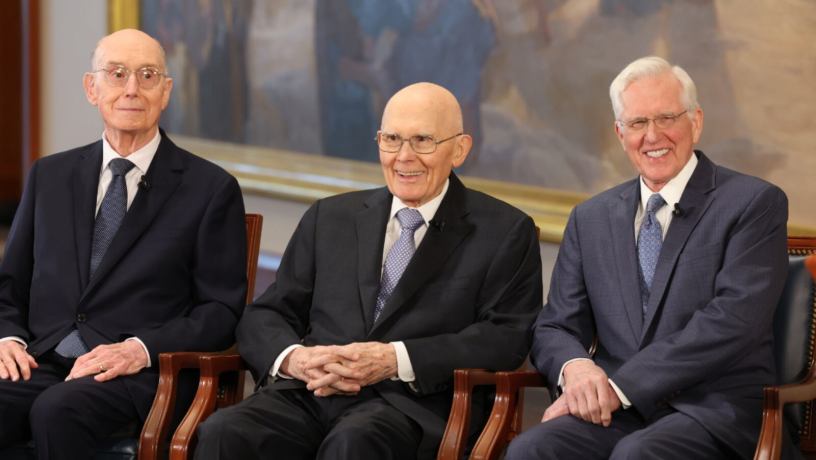
Update: At 1 pm Mountain Time today, a special announcement presentation was held at the Conference Center and livestreamed for all to watch. A new First Presidency was presented: President Dallin H. Oaks, First Counselor Henry B. Eyring, and Second Counselor Christofferson. Elder Holland is now the President of the Twelve (previously, he was the acting president of the quorum). FYI, the seniority ladder of the apostles is now Oaks, Holland, Eyring, Uchtdorf, and Bednar. Elder Bednar is roughly ten years younger than Elders Holland and Uchtdorf, who are in turn roughly ten years younger than Presidents Oaks and Eyring.
Below is my original post which went up this morning, about five hours before the special 1 pm presentation was held and about one hour before it was announced.
Original Post: We’re into the third week since Pres. Nelson’s passing, General Conference is over, Pres. Nelson’s viewing and funeral services are over … and still no new First Presidency. Everyone expects President Oaks, First Counselor — now serving as President Oaks, President of the Twelve — will soon become President Oaks, President of the Church. If the “apostolic interregnum” drags on another week or two, then we’ll know something is up. But there’s a 99% chance an announcement of the new First Presidency will be made in the next 24 or 48 hours, in which case I will update the post title and the discussion in the comments will take on new life. In the meantime, here are a few ideas about leadership succession in the LDS Church.
Joseph Smith didn’t have a succession plan. It might have been for the apostles to run the Church. It might have been his brother Hyrum. It might have been the remaining First Presidency members to reorganize that leading quorum, which was *not* just a central committee of three apostles as originally organized and run by Joseph. The emergence of leadership by the apostles was where things ended up, not what was intended because nothing in particular was ever specifically intended. I don’t trust the later quotes and memories that appeared (conveniently, from apostles) that claim there was a secret, non-public plan for apostles to run the Church if Joseph was no longer around. On the whole, it has worked fairly well, it’s just important to get the history right.
It’s an algorithm, not an election … is that good or bad? The advantage of a true election is that a body of leaders with the best intentions for the institution and the membership can select the best man or woman for the job, the person that is right for the job at that time. That’s how the Catholics do it and it seems to work well in the modern era. The advantage of an algorithm is there is no politicking or conflict in the choice of the next leader, which does count for something. The current LDS succession algorithm is that the longest-tenured living apostle succeeds to the Presidency, then picks his own counselors. Another algorithm which would avoid politics and conflict would be for the current leader to select his own successor. In the LDS context, say the First Counselor in the FP, who would then automatically (or as ratified by the other apostles) succeed to the Presidency.
An alternative algorithm? There are other options to change the LDS algorithm. What if you chose to retain a seniority system but skipped the next three oldest (because of likely age and health concerns) and picked Number Four? Currently, that would be Elder Bednar, and it’s likely he will eventually accede to the Presidency anyway. Or what if you listed the Big 15, including the recently deceased President, and picked the middle guy, Number Eight? Currently, that would be Elder Christofferson. Or just pick the richest guy in the Quorum? (That seems to be how it is often done for local leadership selections.) According to my Internet sources, that would be Elder Stevenson. Any of these alternative algorithms would retain the advantage of “no conflict or politics” but give the Church younger and more energetic leadership — but still quite capable. If, as many LDS now believe, God actually chooses the next President by controlling who lives or dies among the apostles, and that’s really important — well, that way of thinking still works for the Number Four and Number Eight algorithms, doesn’t it?
A few guesses. Because why not? Both Elder Eyring and Elder Holland seem less than fully capable of handling the many duties of a FP Counselor at this point. Please let them remain in the Twelve with appropriately scaled back travel but where they can share their testimony, mingled with wisdom and experience, from time to time. Good candidates: Pres. Uchtdorf has served in the FP previously and is a possible next successor. Elder Bednar is another possible next successor and very likely an eventual successor, so putting him in the FP now makes sense. I believe one of those two will be the new FP First Counselor. Further down the list, Elder Gong and Elder Soares strike me as the sort of (relatively) young, likeable, bright, and energetic types that were, in prior years, often chosen as second counselors. Elder Uchtdorf was 67 when he became Second Counselor. Gordon B. Hinckley was 71 when he was appointed Second Counselor (he was originally appointed Third Counselor, and became Second Counselor when Pres. Tanner passed away). Elder Gong is 71. Elder Soares is 66. I believe one of those two will be the new FP Second Counselor.
If an announcement is made in the next day or two, I will edit the title and add an update paragraph. Until then, feel free to respond to my various thoughts above.
.
 Wheat & Tares
My vote doesn’t count, but my wishful thinking is for Pres. Uchtdorf. He has tried at times to promote a “big tent” church but has been held back and maybe rebuffed by other leaders who favor a more dogmatic, boundary maintenance stance. See Elder Holland’s musket speech at BYU for example. One of our sacrament hymns speaks of “tolerance and love.” Which apostle can best fulfill that if he were to become the next President?
Less than half an hour after you posted this, the Church’s Newsroom posted an announcement: https://newsroom.churchofjesuschrist.org/article/special-announcement-new-first-presidency
“All are invited to a live worldwide announcement on Tuesday, October 14, 2025, at 1 p.m. Mountain Daylight Time.”
You might have just forced their hand. 😉
I thought Uchtdorf was #4 and Bednar #5 in seniority.
I was never persuaded by all the speculation about what Uchtdorf might have said or done to get himself dropped from the presidency. It could have simply been that Nelson just really wanted Oaks more than Uchtdorf, and I think that should be OK, and maybe normalized. We all got used to thinking of service in the first presidency as a lifetime assignment, but clearly it need not be. It would be helpful to reinforce this if Oaks were to drop Eyring from the presidency for health reasons.
I agree Bednar and/or Uchtdorf will be in the first presidency. The question is whether it’s both of them or only one of them. If only one of them, is the other one Eyring still, or someone younger? If someone younger, I don’t have any good guesses. I could see Stevenson.
Building a little on what Quentin said, I also was confused by the speculation around Uchtdorf being released from the First Presidency (and Eyring being moves from First to Second Counselor). I have been in many a Ward or Stake where at one point or another a First Counselor is released and then called as Second Counselor in the new Bishopric or Presidency. No one complains about them being “demoted”, or the released counselor returning to the High Priests Group (or Elders Quorum, now).
As we’ve seen at this last General Conference, when the President dies, the First Presidency is dissolved. The Counselors are automatically released and return to the Quorum of the Twelve. President Nelson didn’t release Elder Uchtdorf from the First Presidency. That happened by virtue of President Monson’s death. President Nelson simply called two Counselors from among the Quorum of the Twelve. (Technically, someone can be called directly into the First Presidency, such as J. Reuben Clark, Alvin R. Dyer, and then ordained as an Apostle. Charles W. Nibley and John R. Winder both served in the First Presidency without even being ordained as Apostles.)
The current leader picking his successor would not be an apolitical algorithm. It would be an invitation to suck up as much as possible to the current leader. Just imagine how many more Nelson quotes we would have been subjected to.
My minimum preferred change to the system would be to have someone start the trend of voluntary emeritus apostles. Oaks, Eyring and Holland would seem obvious choices currently because of their age and health. I am in favor of letting these men retire and enjoy what time they have left with their families and friends. They’ve spent decades serving in the church. Let them rest. The addition of younger, more energetic members to the Q15 is an added bonus here.
The real change I’d prefer is a mandatory retirement age for apostles. Even something as conservative as 85 years old would have a pretty dramatic impact. Oaks, Holland, Eyring and Uchtdorf and Cook would immediately be gone. (Maybe they could ease into over a few years if they don’t want to replace a third of the apostles all at once.) The last 3 apostles to die before 85 were Maxwell (78), Ashton (78) and McConkie (69), so losing apostles to death would instantly be a very rare occurrence. Then let them pick each new president by a true vote among the remaining members for whoever they feel is the right choice. Politicking is much more complicated if you have to try and suck up to everyone else rather than just the guy at the top.
I don’t really have much interest in the succession, other than that which comes as a result of habit as a member for most my life. Or maybe a kind of morbid curiosity?
I would lean toward Uchtdorf over Bednar personally. I’m much more a fan of the love and compassion Uchtdorf expresses, rather than the (to my view) harsh letter of the law view Bednar represents.
Thinking out of the box (and not seriously at all), perhaps the church could borrow from the Skeksis in Dark Crystal and have succession be determined by a trial of strength? Whoever can chop a log (fastest or at all) becomes president. From my cynical side: the church is so obsessed with amassing riches they could televise the trial by strength via pay-per-view.
Oh, and for comparison, once we quit taking multiple years to select new presidents, we’ve been consistently pretty quick about it, but we’re trending up in recent years.
Snow: 12 days
JF Smith: 8 days
Grant: 5 days
GA Smith: 8 days
McKay: 6 days
J Field. Smith: 6 days
Lee: 6 days
Kimball: 5 days
Benson: 6 days
Hunter: 7 days
Hinckley: 10 days
Monson: 8 days
Nelson: 13 days
Oaks(?): 17 days
As long as we are wishful thinking about a different algorithm for church president, how about the newest apostle as being God’s most recent pick for our times. This would have several advantages. Picking a new apostle would be given more thought because there is a chance of him being the next prophet. But it would not be any guarantee that he IS the next prophet because any of the 12 dying means a new apostle would be picked. It would always give a younger man as prophet, so we would have a few good years before senility or infirmity make a less effective prophet. And God would still get to “control” it by killing off apostles or not as God sees fit. And apostles could be selected more for their fitness to lead in the world’s current conditions and it would give us more diversity sooner and get us away from an “old white man from Utah” as prophet sooner.
And add to that it would make it possible to have a mandatory retirement age for all.
Eyring, Uchtdorf, and Stevenson should be disqualified based on their signing off on the scheme to evade the SEC. Bednar feels like an inevitability, so I’ll guess him as first counselor. As second counselor, I’ll guess Gong, with Cook as a darkhorse.
One other pattern to note and expect: generally, the more senior Apostle is made the First Counselor, and the more junior is Second Counselor. The only significant exception to this in the past 100 years was when J. Reuben Clark served as First Counselor and David O. McKay was Second Counselor under both Heber J. Grant and George Albert Smith, before David O. McKay became President and made J. Reuben Clark Second Counselor in 1951.
Will likely be Eyring/Bednar. Should be Uchtdorf/Bednar. Would be amazing Uchtdorf/Gong.
Presidents Eyring and Christofferson
whoa
Thanks for the comments, everyone.
I have updated the post for the announcement of President Oaks (no surprise) and his two counselors, Pres. Eyring and Pres. Christofferson. No mention was made of filling the opening in the Twelve, which will likely happen in the next few weeks.
No Bednar.
More stories about ironing and how men and boys can’t learn to iron their own clothes I guess.
Sheesh, Elder Uchtdorf, what in the world did you do to get put in time out for so long?
Who would have thought Christofferson? Choosing him is a big sign for the direction of his administration.
Christifferson reiterated in his talk “Look to God and Live” that all relationships outside a marriage between and man and woman are in violation of the law of chastity. Consequently all LGBT marriages are a violation of the Law of Chastity, not merely premarital or extramarital relations. It’s doubling down and drawing a firm line to guard boundaries. (Someone educate me, is this currently church policy? I thought that the temple just said no relations outside lawful marriage. But, didn’t define marriage between and man and woman. That was before the most recent updates.) Either way, both Oaks and Christofferson are entrenching the definition of marriage to be man and woman (women) as in Oaks’ case.
So we have two lawyers now in the first presidency. That’s one thing.
The other is that when the POX first became public, Christofferson was assigned to be the point man with the media, presumably because he has a publicly gay brother. He will be paraded as the example of how to “love” your gay family members while toeing the line on excluding gay members from full participation in the church.
Wouldn’t it be paradigm-shattering if one or two, or even all three, members of the new first presidency stopped by the SLC No Kings rally on Saturday? Not to raise fists, not to chant, and not to carry banners, but simply to be out among and shake hands with the people?
JLM, can I just say thank you for saying “toeing the line” correctly? One of my pet peeves….