
Behold the boy imprisoned
inside the man he became—
mind and heart shackled
inside a body cankering;
dreams and wishes crushed
inside muscles cramping;
champion soul flagging,
propped up by creaky bones.
See the man driven upward
by the restless boy within—
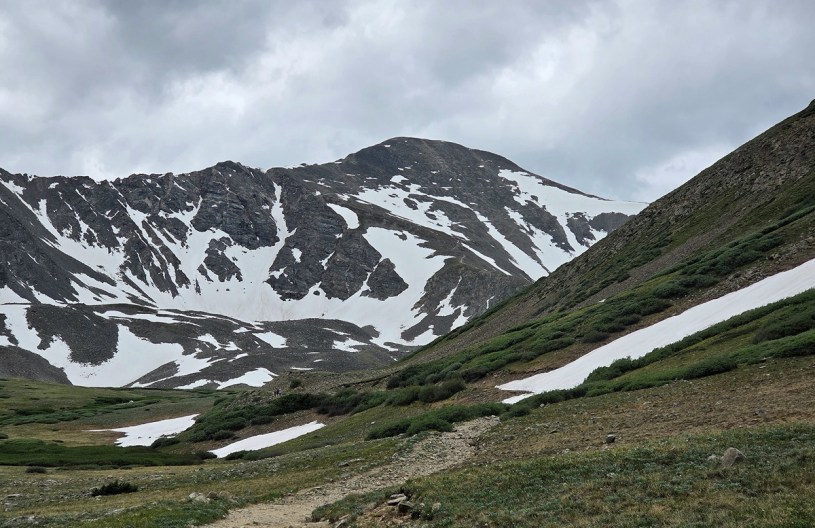
ascending a curved glacier
valley wasting its mass.
See the man hastened on
by the eager boy inside—
scrambling over wet talus
tumbling down the mountain,
dying as a river is born.
See the man slip, tripped
by the impatient boy’s steps—
toeing ledges above tree line,
tromping a snow-spackled ridge.
See the man slump and falter;
see the boy lurch, then recover.
They rise and bond, clamber up
the rocky pyramid, becoming
each other’s champions.
They bring each other home
atop the summit, freed.
Notes and Questions
What lines or images stood out to you in the poem? Why? What is your experience contemplating your past self? What do you like and miss? What are you glad is past?
This poem treats my experience of hiking a Colorado 14er mountain for the first time. On June 24th, accompanied by my cousin, I hiked to the top of Grays Peak (elevation 14,275 ft). From there we hiked down into a saddle and immediately up neighboring Torreys Peak (14,272 ft). The round trip route was about 8.3 miles, with a total elevation gain of about 3,600 feet. For a 90-second video which treats the same boy-man theme, including footage on the mountain, go here. Here is a link to last year’s mountain post: Ben Lomond and Worthy Goals. As always, thank you for reading!
 Wheat & Tares
I liked the verb choices about the interactions between the man and the boy — imprisoned, driven upward, hastened on. There is so much emotion in each word.
Especially this line: See the man slip, tripped
by the impatient boy’s steps
I’ve been affected by the girl I imprisoned as I grew up. Your first stanza is a vivid description of the pain of trying to stifle the girl rather than live with her and find a way for her to thrive too. When I was reading self-help books, I learned about ‘parenting your inner child.’ (Yes, I know how easy it is to mock that line; stop it.) That concept really helped me. I started treating my inner child the same way I treated my actual children. If they found joy in an activity, I would go to great lengths to make sure they could do that activity. So why not do the same thing for myself? That gave me permission to prioritize my art. I was an artist as a child. Then I wasn’t for a lot of years. And now I am again.
This poem is a beautiful conversation between a man and a boy, learning from each other and helping each other.
Also, that picture is beautiful. I was struck by how flat the whites are. The snow has no depth, no shadows. You could paint the rest of that image, and cut out the parts with the snow and put the painting over a white canvas. Let the snow be the absence.
This resonates with me on the deepest levels, Jake. The Jungian integration between the young and the old has been very difficult for me–and is at the heart of my struggles with mental illness. For me personally, the imagery you use about climbing a mountain is very meaningful–because it is in ascending the “mountain of the Lord” that I have had the most success in integrating the boy and the man. And your use of “pyramid” as the final descriptor of the mountain they are climbing is brilliant. It is there at the pinnacle of the primordial mound–after a long and difficult ascent–that they finally become one.
Thank you.
Love it!