
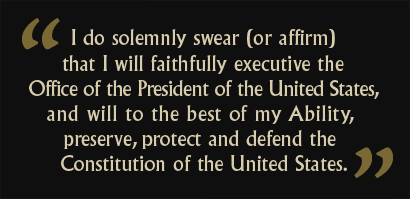
This is not a political post, but we need to start the discussion with the best-known oath in America, the presidential oath. Which Trump took yesterday, 35 words specifically laid out in the US Constitution, as follows:
I do solemnly swear that I will faithfully execute the Office of President of the United States, and will to the best of my ability, preserve, protect and defend the Constitution of the United States
It’s the same oath he took eight years ago. The promise to “preserve, protect and defend” didn’t mean much to him then and likely means even less now. As if to underline this fact, shortly upon taking office Trump issued an Executive Order (that’s how Hitler governed Germany, by decree, after sidelining the German Reichstag) pretending to revoke birthright citizenship. Which is clearly granted under the 14th Amendment, so the Order is plainly unconstitutional. A lower federal court will no doubt issue a stay within days, followed by Trump whining about “the deep state,” then sending out fundraising letters on this issue for his endless campaign (basically a legal defense fund in disguise, and he’s probably going to need it). It might be one of the first Trump cases from the second term to make it to the US Supreme Court.
And what is the penalty for violating the presidential oath of office? Basically nothing, as made evident at the end of Trump’s first term when he made every effort to sabotage the Constitution’s provisions for counting and formally entering of the results of the presidential election he lost by a wide margin. He did successfully terminate the longstanding United States tradition of a peaceful transfer of power. Yes, power was transferred to Biden, but it wasn’t peaceful. In the ensuing four years, he suffered little or no consequence. That’s the problem with oaths: they seem to be all show but with no enforcement.
We might as well list the oath the Vice President takes as well (by statute, the same oath administered to members of Congress and Cabinet officials):
I do solemnly swear (or affirm) that I will support and defend the Constitution of the United States against all enemies, foreign and domestic; that I will bear true faith and allegiance to the same; that I take this obligation freely, without any mental reservation or purpose of evasion; and that I will well and faithfully discharge the duties of the office on which I am about to enter. So help me God.
Religious Oaths
Secular oaths like the presidential oath emerged from religious oaths. Notice the “so help me God” at the end of the VP oath. Notice how US presidents generally put their hand on a Bible when swearing the oath (Trump did not do so yesterday, although Melania gamely held a Bible or two by his side during the event). So let’s talk about religious oaths and vows, and then LDS oaths and vows. What are they?
They appear frequently in the Old Testament. “When a man makes a vow to the Lord or takes an oath to obligate himself by a pledge, he must not break his word but must do everything he said” (Numbers 30:2 NIV). Even more emphatically in Deuteronomy:
If you make a vow to the Lord your God, do not be slow to pay it, for the Lord your God will certainly demand it of you and you will be guilty of sin. But if you refrain from making a vow, you will not be guilty. Whatever your lips utter you must be sure to do, because you made your vow freely to the Lord your God with your own mouth. (Deut. 23:21-23 NIV)
That passage makes the claim that if you break an oath or vow, you are committing sin. Of course, to have any bite, it has to be a public oath. If you make an oath in your own head, with no words spoken publicly, you can just change your mind later and no one will be any wiser. So an oath is really a public commitment device, with various, possibly ambiguous, penalties associated with it. Violate the oath of office for public office in the US, you might in theory be removed from office, but in practice that is a very rare outcome, even in egregious cases (see: Trump). Violate the oath you take as a witness in a court proceeding, you might in theory be charged with perjury, but again that is a rare consequence, despite a fair amount of dishonesty, in varying degrees, practiced by many in the courtroom. I can’t think of any similar biblical examples, but plainly (as noted in Deuteronomy, above) the implication is God will not be happy if a religious oath or vow is broken.
How about the New Testament? Not so keen on oaths.
Again, ye have heard that it hath been said by them of old time, Thou shalt not forswear thyself, but shalt perform unto the Lord thine oaths: But I say unto you, Swear not at all; neither by heaven; for it is God’s throne: Nor by the earth; for it is his footstool: neither by Jerusalem; for it is the city of the great King. Neither shalt thou swear by thy head, because you canst not make one hear white or black. But let your communication by, Yea, yea; Nay, nay: for whatsoever is more than these cometh of evil. (Matt. 5:33-37, KJV)
Two things are quite clear from this passage. First, there was a lot of swearing and oath-making going on, with God, heaven, earth, Jerusalem, and your own head noted as popular tokens invoked to secure the oath. Today we say “swear on a stack of Bibles” or “swear on my mother’s grave,” but these are more like casual claims of stating the truth, even lighthearted claims, rather than formal oaths.
Second, you would think that with this clear declaration there would be no Christian oaths and vows, just simple responses like yes and no. You would think.
LDS Oaths
How about in the LDS Church? Here’s from the LDS Guide to the Scriptures, what comes up when you search “oath” at LDS.org: “As used in the scriptures, usually a sacred covenant or promise. … In Old Testament times, oaths were acceptable; however, Jesus Christ taught that people should not swear in the name of God or His creations.” Notice how the word “covenant” slips in there. That is unfounded, I think. Covenants (see below) and oaths are quite different.
If you are an LDS guy, you have probably heard the term “oath and covenant of the priesthood.” That refers to the passage at D&C 84:33-38, followed by serious admonitions (v. 39-42) about breaking this oath or covenant: “whoso breaketh this covenant after he hath received it, and altogether turneth therefrom, shall not have forgiveness of sins in this world nor in the world to come.” So, not just sin but unforgiveable sin.
But is being ordained to the LDS priesthood an oath or a covenant? It can hardly be an oath: the one being ordained does not speak or say anything. What are you swearing to? There’s an implicit agreement to do priesthood things (pass the sacrament, give blessings, go to priesthood meetings) but that’s it. One is already subject to the commandments, that isn’t really part of the priesthood ordination. It’s an ordinance, not an oath.
Nor is it really a covenant, for similar reasons. The parallel legal term is “contract.” A contract requires two parties and there have to be fairly clear terms that the parties agree to. It doesn’t have to be a written document. It’s more than just a promise: it’s a promise (between two parties) that a court will enforce. That’s why there have to be fairly clear terms to the agreement, so the court has something to enforce. If ordination is a covenant, who are the parties? You, and … God? The Church? And what are the terms?
This becomes clearer if you try to specify what exactly it would be to break this covenant of the priesthood. Say no to passing the sacrament? Skip a priesthood meeting or two? Not really. Skip three priesthood meetings, no EQP is going to call you up and say, “You broke the priesthood covenant. No more priesthood for you, slacker.” Skip three car payments and you have, indeed, broken a contract. You might get a call so informing you, or the repo man might make a midnight visit and your car is gone in the morning. So it seems clear that ordination is an ordinance, not an oath or a covenant.
Likewise with baptism, often referred to in the Church as a covenant, generally as “the baptismal covenant.” As if there is a list of terms you agree to when baptized. But in the LDS ordinance, the baptizee, whether eight years old or fully adult, says nothing. There is a short, scripted prayer pronounced by the one doing the baptizing, as follows: “Having been commissioned of Jesus Christ, I baptize you in the name of the Father, and of the Son, and of the Holy Ghost. Amen.” No terms are stated. There is no agreement to do anything. It’s an ordinance, a formal entry into membership in the Church and an ordinance that, in LDS doctrine, makes the recipient eligible for forgiveness of sin(s) through the Atonement. It’s an ordinance, not a covenant or an oath. Sure, you are supposed to keep the commandments, but so is everyone.
So why the practice by LDS leadership to make everything into a covenant? I welcome your opinion. Cynical me, I think it’s just an institutional device to promote social control and obedience discourse. Like when a ten-year-old objects, “but you promised!” Well, maybe you did and maybe you didn’t.
Consider some examples, and you can add some from your own experience. You say no to a calling. Bishop replies: “When you were baptized, you made a covenant to follow your leaders, which means accepting callings from the bishop.” Did you? You wear non-white shirts to church. Bishop advises: “As a priesthood holder, you covenanted to be a good example to others, to the young men.” Did you? And of course there are those premortal covenants that sometimes get invoked. “You were born in the Church, so you obviously covenanted in the Pre-existence to stay in the Church and keep the commandments.” Really? Did I? How convenient, that LDS leaders or really any LDS person can call on some sort of agreement you supposedly made — that you don’t remember, for which no specific terms are available, and that might just be totally metaphorical or simply fictional — to tell you that you must (you agreed to it! you promised!) do this or that, whatever they want you to do in the moment.
It’s not like there are not modern examples of binding covenants apart from legal contracts between two parties. I’ll quickly note marriage vows and parental duties. “To have and to hold, in good times and bad” is somewhat ambiguous, but when two parties get married, there really are some generally accepted and well understood things being agreed to. Cheat on a spouse or hide away big chunks of money and the aggrieved party may very well file for divorce. [Caveat: these transgressions are not required legal grounds for filing for divorce, but they may affect the settlement terms imposed by the court. They certainly affect the decision of the aggrieved spouse to file for divorce.] Likewise with parenting, there are legal duties imposed on you. As a parent, you are legally obliged to provide food and shelter and schooling and medical care for your kids. If you don’t, you may get a visit from Child Protective Services, face legal charges, and possibly lose custody of your kids. Or you might get a visit from Child Protective Services who proceed to offer assistance in finding housing, employment, and local programs to help buy groceries.
Back to oaths, vows, and covenants. You should pay more attention to how these terms are used in LDS discourse, what they mean, and whether they really apply to you or not. Hey, members of the LDS Church do a lot of helpful service of their own free will and choice, whether in callings or on their own initiative. That really is one of the most impressive things about the Church (well, about the membership, let’s give the individual members the credit before the institution). But when there is a situation where oaths or covenants or agreements you supposedly made are invoked, don’t be bamboozled by fast talking leaders or manipulative members. Did you make an oath or a covenant? Maybe you did and maybe you didn’t. Think about it. Stand your ground. Do the right thing.
Conclusion
Time to hear from the patient readers who have persevered to the end of a longish post. I’ll bet you have a thing or two to say.
- Did you watch the Inauguration and see the VP and P take their oaths of office? I did, and here is what I noticed. Barron Trump is very tall. And he made a dignified gesture by giving friendly handshakes to President Biden and First Lady Biden. Also, Sen. Amy Kloburchar (D-Minn) gave a five-minute address that hit all the right notes (everything that should be said in a presidential inauguration speech but wasn’t in Trump’s). I was impressed. She is twice the man Trump is.
- Have you taken any oaths? I have taken two oaths of admission in different states to practice law. Do doctors take oaths? Joining the military? Working for Apple (notoriously secretive)? Are the Danites still a thing? They had oaths.
- Has a bishop or other LDS leader ever appealed to your “baptismal covenant” or your “oath of the priesthood” to get you to do something you maybe didn’t do or didn’t want to do?
- What about other casual or social commitments you might make? Maybe you try out being a vegetarian for a month, and you tell a spouse as a way to secure your own commitment (by making a public pledge) and get some support from the wife. Is there any positive role for commitment, promises, or vows in your personal life that has worked out well for you?
 Wheat & Tares
When I turned 8 I was baptized and I was told that I was making a covenant to remember Christ every day. Now we have leaders like Bednar and Pearson saying that we have no choice but to serve missions once we (boys) agreed to be baptized (at 8 years old!!!!). That tells you how desperate they are.
If there is one point John Dehlin makes over and over on Mormon Stories that I 100% agree with is that we need informed consent. And I think that would basically mean we stop baptizing kids since they really are completely unable to understand everything involved in what we say we covenant to do.
I didn’t watch the Inauguration. I figured we had four more years of listening to his fabrications, supplications, and misrepresentations and I just couldn’t do it. I saw enough on the news, Late Night with Cobbert, and heard on NPR to know that for my anxiety’s sake, I made the right decision. To make an oath to protect and serve the Constitution and then an hour later sign a presidential decree denying children their birthright if they are born in this country protected by the 14th amendment, even if their parents are “illegal,” shows how oath-taking doesn’t mean anything. It’s the same thing for our state legislators who seek to take away teachers’ free speech and right to assemble by shacking their union or separation of church and state as stated in the Utah Constitution and funding vouchers.
I personally don’t really consider any oaths or covenants that I made to the Church to really be valid for the following reasons:
1. I pretty much made all of the oaths/covenants when I was very young. I was 8 years old when I was baptized, I was 12 years old when I received the Aaronic priesthood, I was 18 years old when I received the Melchizidec Priesthood, and I was 19 years old when I was endowed. I don’t think I was old enough to covenant to anything for the rest of my life at those ages. I do feel bound my my “marriage covenant” which I made in my mid-20s, but that is purely a feeling that I have that a made a commitment to my wife, not the Church.
2. I feel like all of the oaths/covenants I made at 8 (baptism), 12 (Aaronic priesthood), 18 (Melchizidec Priesthood), and 19 (endowment) were all made under duress. I don’t feel that I was under duress to marry my wife in my mid-twenties, but I certainly felt a lot of pressure to be married in the temple. Sure, I felt at the time that I was doing the right thing in all of these cases. However, I also really felt like I needed to do these things to remain in good standing in my family and religious community. Did I really have a choice to not make these oaths/covenants? Maybe, but there were sure a lot of people in my family and religious community that would have been disappointed and that would have tried to apply pressure to get me to make these oaths/covenants. Since I was going to be somewhat of an outcast if I didn’t make these oaths/covenants, I feel like these oaths/covenants aren’t really valid.
3. As @chrisdrobison mentioned, I don’t feel like I made any of these oaths/covenants, except my marriage, with real informed consent. Informed consent is simply impossible at 8 years old and 12 years old. Perhaps at 18 years old, I was in a better position to be proceed with informed consent, but my Church experience didn’t really provide that to me at all. Years of church lessons, seminary, BYU religion classes, etc. just completely whitewashed Church history and sensitive Church topics. This was pre-internet, so it really would have been very difficult for me to truly become informed on these issues on my own.
4. The scriptures and the Church itself repeatedly acknowledge that faith is distinct from knowledge. We “see through a glass darkly” and all that. To require anyone at any age to covenant lifelong commitment to God/the Church/Church leaders is asking too much in light of the changes in a person’s faith that are certain to happen over the course of a lifetime. For example, I was much more comfortable with the idea of covenanting to consecrate my life to the Church when I was much younger and actually believed that God was very directly guiding top Church leaders. I no longer feel that way. Therefore, I have largely replaced Church/priesthood leaders with my own personal spirituality as the best source of guidance and truth for me. In light of this change in my faith, my previous covenant(s) to the Church no longer make sense, and I wouldn’t make them any longer. A person’s faith is different than a piece of real estate. There is no disputing the existence and nature of a piece of real estate. That piece of real estate will remain in exactly the same place over the course of 30 years. Therefore, it makes perfect sense to require someone who covenants by signing a mortgage to make payments on that piece of real estate over the course of 30 years to actually make those payments. A person’s faith, on the other hand, is an entirely different matter. Many people’s faith changes quite a bit from their 20s to their 50s. To require (guilt) someone in their 50s to live by religious covenants they made in their 20s is simply ridiculous. Church leaders today are repeatedly telling members to “remember their covenants” as a way to get them in line. Maybe this works for some people, but it’s completely counterproductive with me. The more Church leaders try to guilt me into following them, the less interested I am in even hearing their messages. What would be better? Instead of guilting people into “keeping their covenants”, providing messages of Christlike love and charity and facilitating opportunities to serve in Christlike ways would be much more enticing to me.
Minor correction. Hitler didn’t govern Germany by decree after sidelining Reichstag. The Reichstag sidelined itself in 1933 by passing the Enabling Act, by a vote of 444-94 (with 104 absent) in the lower house and 66-0 in the upper house. This legislative action gave the chancellor (Hitler) and the cabinet legislative power, and this Hitler became dictator quite legally.
I agree that there is no covenant in baptism, and if there is, it is only to take Christ’s name upon ourselves. It is a sign, or an outward symbol, of a commitment to follow Jesus. One problem with making everything a covenant is it restricts agency, because other people get to dictate what you supposedly agreed to. I think that one can follow Jesus, and I can do it differently than you, and you can do it differently from me. I might do more family history, and you might give more referrals to the missionaries, and another person might visit the sick and afflicted more than either of us. There is not, or should not be, one cookie-cutter way to live the gospel that someone else gets to put on people by means of guilt and making people feel inadequate. Since the baptisee speaks no words at his or her baptism, and since the ordainee speaks no words at his ordination, no one knows that promises were made except the baptisees or ordainees, if any promises were made at all in their hearts. I think most of the time there are no promises made: people simply agree to try to follow Christ starting at that point, and they don’t have a clue where their feet will take them on their journey. Since they don’t know what lies ahead on the journey, they can’t very well commit to what they will or won’t do.
Thanks for the comments, everyone.
Georgis, I enjoy your comments and I’m glad you followed up with the German episode. It should get more attention over the next few weeks. Hitler was appointed chancellor at the end of January 1933, with many parties having representation in the Reichstag. Over the next few weeks, he managed to outlaw the Communist Party in Germany (so they could not vote against him in the Reichstag, where they had about a hundred seats). Nazi militias also ran wild for the weeks, intimidating any opposition. In March there were new elections and on March 23 the Enabling Act was passed, allowing HItler to rule by decree. So it wasn’t a free and fair vote in the Reichstag that gave Hitler decree power. It was only obtained by extra-legal measures and thuggery. He used legal institutions to achieve his desired outcome, but it can hardly be called a legal process. He undermined rather than supported those legal institutions. Germany did not have free elections again until after WW2.
I’m sure you would enjoy reading this recent article at the Atlantic:
How Hitler Dismantled a Democracy in 53 Days – The Atlantic
Bednar and Pearson are just wrong in linking baptism to an obligation to serve a mission. I don’t necessarily disagree with the reasons provided in other comments, but my reasoning is quite different.
Baptism, like other ordinances performed outside of the temple, is an ordinance of salvation. President Nelson has said (and others have more recently repeated) that salvation is an individual matter but exaltation is a family matter. Since there is really only one family, I think it is clearer to refer to exaltation as a collective matter. And what could be a more “collective” matter than missionary work? Its whole purpose is to create the collective. But baptism does not address collective matters–only individual matters (like sinning and repenting).
So what ordinance does address collective matters? That would be the covenants made by “you [collectively] and each of you [individually].” The law of consecration meets that definition (not every covenant made in the temple does) and I would submit that it is the only covenant that should be considered in any way binding with regard to missionary service. (Note that the vast majority of missionaries make the decision to serve a mission before making that covenant.)
I work in real estate and deal with covenants all the time. I can tell you this. In real estate contracts, it is all spelled out. There is nothing implied. If it is not clear what you promised to do, then you can hold them to that in court. But if is clear, then you can. I would really like to know what the baptismal covenant even is. It is not at all spelled out during the actual ceremony. I’ve heard apologists say that it is actually during the bishop’s interview where the covenant is made. Ok, so the person making the covenant does so to undetermined, arbitrary questions that seem to be different for each bishop and even each interview, without knowing beforehand what will be asked, and without anyone witnessing what the covenant-maker is covenanting to. Real covenants don’t work that way. As for temple covenants, there you have something appearing more like a real covenant. The problem is that the initiate is not supposed to know beforehand what is to be covenanted to, and takes the covenant in a situation where there is arguable duress to do so. Still, if God is not what the Mormon church is saying God is, or if God does not see the covenants as representative of what God wants, then the covenants are meaningless and unenforceable. Of course that doesn’t stop the church leaders and members from pretending that the covenant was made between members and the church (it is not, the church simply claims to arrange a covenant between individuals and God) and trying to shame and blame suspected covenant-breakers. Look if you can’t establish what the covenant is, who it is between, and who enforces is, them there is no covenant path. To that I say judge not lest ye be judged. Couldn’t have been said better by the supreme judge himself.
I have a strong distaste for our spiritual relationships with God and with each other being reduced to legalistic contractual agreements. The notion of a spiritual contract feels like a human-contrived system with no room for atonement or grace, and doesn’t ring true to my understanding of Christ’s teaching. If we decide that we love the word ‘covenant,’ then it should be defined as something different. Something more like a bond, a relationship, a family tie, which drives us to act not because we promised a list of actions but because we have a new identity, a new family, and a new desire to emulate Christ.
Did you watch the Inauguration and see the VP and P take their oaths of office? *I chose not to watch or listen as I knew it would send me over the edge. I would like to have seen and listened to Klobuchar, however. She is more than twice the man T is; she’s twice the human. I wore black and spent the day edifying my teenage grandchildren who are appalled at the re-elected president and his executive orders. I, too, watched Stephen Colbert’s two-part monolog to get a summary of the day. – *Have you taken any oaths? I have taken oaths when accepting employment in public education and in working for a couple of cities in California, and when completing CERT training. – Has a bishop or other LDS leader ever appealed to your “baptismal covenant” or your “oath of the priesthood” to get you to do something you maybe didn’t do or didn’t want to do? No, I’ve dodged that bullet. Perhaps men are pressured more because of the priesthood thing? No, wait: I had a RS Pres go all shame attack when I refused a VT assignment I knew I wouldn’t really fulfill. – *What about other casual or social commitments you might make? *As a staunch introvert, I’m fairly selective about what commitments I make known publicly. And I don’t take commitments lightly.
When I was baptized at age 8, many decades ago, I was taught that we needed to be baptized like Jesus was, to follow His commandment and to become members of His Church. That was it. Follow His commandment (and be washed clean as a bonus), become an official member. All this other stuff has accumulated over the years, and has been somewhat confusing (like, did I just not pay attention to a bunch of promises I don’t remember making)?
Thanks for the comments, everyone.
As predicted:
Birthright citizenship: 24 Democratic states and cities sue over Trump’s bid to end birthright citizenship | CNN Politics
In as much as covenants are made between myself and God, I’m content with Him judging me based on my knowledge and intent both at the time I made the covenant and all the days afterwards. I like to think of all these covenants as between the individual and God. The church may provide a framework for them, complete with priesthood, record keeping and protocols, but in the end it’s one person and one God making a relationship.
It gets much trickier/ickier when The Church inserts itself in the middle of covenants. Unfortunately, that is exactly the case with the law of consecration in the temple where people pledge their times, talents and all that other stuff to the Church, and not to God. Now, church leaders seem lately to be keen to conflate The Church with Jesus in all instances, but I think most of us (particularly at W&T) still see a distinction there.
The Q15, and their predecessors, have made serious mistakes which has caused some of us to lose confidence in them. Rather that admit fault, RMN seems inclined to use disingenuous messages such as, “think Celestial, avoid sad heaven, help gather Israel on both sides of the veil, the second coming is near, and you made covenants.” Maybe this will scare some members back into full activity, but others will see it as manipulative and put more distance between themselves and the Church.
This is a bit of a tangent, but has anyone noticed the verbiage in the endowment that lumps God with “angels and these witnesses” as someone we are covenanting “before?” (As in, covenanting in front of?) But who, exactly, are we covenanting WITH? Upon some reflection, I have realized we are (if we are to imagine ourselves as respectively Adam and Eve) covenanting WITH a theoretical Peter. In other words, the five temple covenants we commit to are made with not God, but church leaders. Correct me if I’m wrong, but…
Let me ay something heavy on you…
There is neither covenant nor oath in baptism. There is also neither covenant nor oath in the sacrament.
Yes, I hear other saints of low and high status talk about the baptismal covenant and renewing that covenant at the sacrament, but it simply isn’t true.
Baptism and sacrament are ordinances, and there are no covenants made there. We err when we conflate ordinances and covenants.
Regarding child baptism at age eight, the Lord does not command children to be baptized at age eight — rather, the Lord commands faithful parents to baptize their children at age eight — please read D&C 68:25-30. Baptizing children at age eight is a decision of the parents, not the child — it is the parents who obey the commandment, not the child. The child is not the decision-maker, and, as I mentioned above, no covenant is made at baptism (either for a child or for an adult).
Oops! Let me [l]ay something heavy on you…
Jenny, good point!
The ordinances themselves may not mention an oath or covenant of sorts–but they are certainly built upon a premise of covenant making. By being baptized and partaking of the sacrament thereafter we demonstrate our willingness to follow the Savior–and the sacrament prayers lay out specifically what it is that we are willing to do in that effort.
That’s why I think it’s right to link serving a mission with the baptismal covenant. We’re not talking about eight year old children–as such. Were talking about youth who have been taking the sacrament for ten years or so–renewing themselves in the gospel covenant over and over as they grow in their understanding of what it means to take upon themselves the name of the Savior, keep his commandments, and always remember him.
I took an oath upon joining the military many years ago. Notably, that pledge is to the U.S. Constitution, not to any person or party or organization. I’ve come to understand it as an affirmation of the living foundational doctrine of the American Experiment, which is an idea greater than any one person, and God willing, will be around long after the current Commander in Chief leaves office. It’s an oath I’m proud to take.
I have a different relationship with Church covenants. Like some of you, I find the idea that we are expected to have a transactional, business-like relationship with God quite unappealing. The very existence of formal contracts assumes that the parties involved cannot implicitly trust one another, which doesn’t square with a loving Eternal Father. We grow up in the LDS Church being taught about Jesus, that we should try to be like Him, and follow His teachings and example. But then we come of age and go to the temple to receive our endowment, only to find that Christ is almost completely absent from the narrative (an NPC, as my kids would say), and it turns out that our salvation and exaltation are contingent upon entering into severe contracts made under duress to essentially “do as we say, or else”. Nothing in there about love, charity, compassion or forgiveness that Jesus taught, only the consequences for non-compliance. We don’t even make covenants directly with God, but with an unseen voice actor in a recording, playing the role of an ancient biblical apostle, who claims to act as an authorized agent for God’s deal-making. The whole thing feels like a bait-and-switch.
I remember as a young adult preparing to be ordained an elder, and being directed by my bishop to study the so-called oath and covenant in D&C 84. The passage about not being forgiven for breaking the covenant caused me a lot of anxiety and trepidation (I had scrupulous tendencies, which I did not fully understand at the time). The stake presidency counselor I interviewed with knew of my concerns, and said, somewhat dismissively that “oh, that’s what the Atonement is for, don’t worry too much about that, just try and be a good as you can be” as if that were self-evident in the text. Again, Christ and His Atonement are just footnotes to the true Mormon Doctrine of obedience, and covenants (in their various forms) are a primary means of enforcement.
I get the informed consent/bait-and-switch arguments with regard to the temple. I was completely clueless when I first went in 1976. But it’s all in the Handbook now (Section 27.2). You can read it and you can talk about it. The stuff that is not in the Handbook and that you can’t talk about is not actually important. It commits you to nothing but keeping your mouth shut about it. It is unfortunate and entirely unnecessary that people still apply the “don’t talk about it” to the whole ceremony, including the portions that the Handbook explicitly does talk about.
Good discussion, and thanks Georgia and LHCA for sharing thoughts that make me feel less crazy. I also remember being taught about baptism the same way.
I also feel like using the term “covenant” so much is hurting teaching and growth. The word is thrown into talks frequently “keep your covenants”, “stay on the covenant path”, “covenant (insert word of the day here)” but the actions of living a Christ like life or being a better person are not mentioned. They are not reaching the heart of the gospel which is God’s love. What does that look like in your life? How can you feel it? How does it change you actions? What does it inspire you to do? How does it cause you to see others differently?
I see it in my teen daughter who feels like she has a “covenant” checklist to complete that gives her anxiety – serve a mission, go to the temple then keep going, get married. But it is rarely broken down into living in the day to day in this difficult world.
Well, I for one can testify that 8 year old children do not always get to choose to be baptized or not, because I kept saying no to being baptized by a stranger and asking my grandfather if he would take that one Saturday a month off work so he could baptize me. Well, right before I turned 9 people around me had a hissy fit about what if I turned 9 before being baptized. I would apparently rot in hell for being labeled on the church records as a convert. The *&$$&&* church records were more important than a scared child. So, I was dunked in water against my will because the adults (not my parents but others) just couldn’t have it any other way.
So, no, 8 year old children do not even start to make any kind of covenant because it is not their choice. 60 years later, I still resent the way I was forced into baptism when all I wanted was to feel safe having someone I trusted do the putting me underwater thing. But nobody respected my needs. But that is how kids with semi active parents are treated.
The endowment is also an unfair and coercive. When I heard the totally unexpected requirement that we promise to give everything to the *church* I balked. But I couldn’t let my lack of cooperation show. Outwardly, I went through with it, but in my mind, I was saying, “*if* and only *if* this really is the church of Jesus Christ, which after this endowment I don’t believe, then yes, but….” There was no ability to say, “wait, stop, I don’t understand.” It is absolutely unfair to put people in the position of not knowing what they will be required to promise and at a moment when their whole life and social standing depends on it. The church of the real Jesus Christ would not do that to people.
As far as the endowment, bait and switch is the best word for telling people nothing about what really goes on or what they will be asked to promise, and then to not go through with the endowment means that I do not get married that day. That was just as coercive as my baptism. What they do would not stand up in any court of law as a valid contract entered into by informed consent.
I do not like the overemphasis of the word covenant. Could we emphasize the word relationship instead? We acknowledge our relationship with Jesus and His atoning and healing power through symbolic ordinances. The overuse of the term covenant is too mechanistic and legalistic for me.
“Not a Political Post”…..ROFL! Dave B you’re not fooling anyone. Same old worn out narrative….and banal liberal talking points. Honestly, do you have a life outside of this political garbage? Do you find any joy in anything other than online virtue signalling?
“This is not a political post, but we need to start the discussion with the best-known oath in America, the presidential oath. Which Trump took yesterday, 35 words specifically laid out in the US Constitution, as follows:
It’s the same oath he took eight years ago. The promise to “preserve, protect and defend” didn’t mean much to him then and likely means even less now. As if to underline this fact, shortly upon taking office Trump issued an Executive Order (that’s how Hitler governed Germany, by decree, after sidelining the German Reichstag) pretending to revoke birthright citizenship. Which is clearly granted under the 14th Amendment, so the Order is plainly unconstitutional. A lower federal court will no doubt issue a stay within days, followed by Trump whining about “the deep state,” then sending out fundraising letters on this issue for his endless campaign (basically a legal defense fund in disguise, and he’s probably going to need it). It might be one of the first Trump cases from the second term to make it to the US Supreme Court.
And what is the penalty for violating the presidential oath of office? Basically nothing, as made evident at the end of Trump’s first term when he made every effort to sabotage the Constitution’s provisions for counting and formally entering of the results of the presidential election he lost by a wide margin. He did successfully terminate the longstanding United States tradition of a peaceful transfer of power. Yes, power was transferred to Biden, but it wasn’t peaceful. In the ensuing four years, he suffered little or no consequence. That’s the problem with oaths: they seem to be all show but with no enforcement.
We might as well list the oath the Vice President takes as well (by statute, the same oath administered to members of Congress and Cabinet officials): “
Nah….there’s absolutely NOTHING political about Dave’s narrative shown above; just dripping with sarcasm and contempt…..I think this is a perfect example of becoming nothing but a political schill.
lastlemming – thanks for that link. I didn’t know the Endowment was summarized in the handbook.
grizzerbear55 – You know you could just stop clicking on the link to read Dave B’s posts, right? They all seem to bother you and I can’t understand why you make an effort to read something you know will annoy you. Your comments are also rude and sneery. The personal attacks on Dave B are unwarranted.
What Janey said, grizzerbear55, but also: Why criticize Dave B for a political post but then go on an anti-Trump tirade that basically agrees with Dave B’s perspective? Is it the political posts that bug you or just the political posts that YOU didn’t write?
ji, “Regarding child baptism at age eight, the Lord does not command children to be baptized at age eight — rather, the Lord commands faithful parents to baptize their children at age eight — please read D&C 68:25-30. Baptizing children at age eight is a decision of the parents, not the child — it is the parents who obey the commandment, not the child. The child is not the decision-maker, and, as I mentioned above, no covenant is made at baptism (either for a child or for an adult).”
Honestly I had never realized this before. Brilliant observation. I really am so tired of members saying how proud they are that their 8-year-old son or daughter chose to be baptized. Please. Did you take them around to different churches and religions when they were seven and tell them that they could choose to be a member of any one of those, and you’re pleased as punch that they just so happened to choose your religion? What major choices do 8-year-olds even make exactly? They’re not even sentient or experienced enough to really choose all that much.
I’ll never forget some comment one member made in Sunday School about teenagers deciding to leave the church. “You made a decision,” he said gruffly. The idea of 8-year-olds choosing a belief system and making informed conscious decisions about it is nothing more than a manipulation that gets foisted upon them later in life.
I find it ironic that the commenters who criticize the bloggers on here for making political posts (there are a few) are the ones who have a tendency to make the most incendiary and hypercharged political comments. It is almost as if they don’t like the political posts because the can’t help but read the blog, get hella triggered, and then write something hyper defensive and angry in the comments. Why spend so much time in environments that trigger you? Stop going to those environments. Enjoy life.
jaredsbrother, I was similarly confused at first until I realized that the reason his tirade appeared to basically agree with Dave B.’s perspective is that the whole long comment, apart from the last sentence, is a quote from the original post. For a minute there grizzerbear was sounding reasonable, if a little cognitively dissonant.
If we believe the Book of Mormon and take it as the fullness of the Gospel and the cornerstone of our religion, you can say that Mosiah 18:8-10 sets baptism as a covenant. But it’s a covenant of being willing and desirous to follow Jesus and do all those things Alma mentions. As such it feels like a covenant of a willing heart and not so much of a checklist.
There are a handulf of consistent, conservative, and coridal commenters here at W&T. What’s the reason, then, for grizzerbear55’s rote responses, reeking of rancour? Such silly stuff.
“If ordination is a covenant, who are the parties? You, and … God? The Church? And what are the terms?”
I would love to see more discussion around this because somebody close to me has been accused of violating their temple marriage covenant by wanting to have their name removed. This person has not been unfaithful to spouse nor broken any commandments. They are wanting to have their name removed but leaders say such action is akin to having an affair and would qualify the templeworthy spouse for a divorce.
People are taking sides because nobody seems to agree on the terms of that covenant nor the contracting parties. The doubting spouse still believes in God and Jesus and plans to remain a devout Christian who doesn’t believe in the Book of Mormon nor it’s associated religion.
Stake president says that the marriage covenant parties binds the couple to one party made up of god, Christ, and church who are all one and the same. This mesns that the spouses promised equal fidelity to Church/Christ/God in their sealing ordinance. What does that look like in contract law?
Do legally binding contracts ever lump multiple people and an institution into one party and require the signatory to honor the contract for all three as if they were one being? This concept has caused a lot of confusion that is deeply testing their ward and family. Some clarification might help restore peace.
WrySauce, both Peter and Paul might disagree with what the stake president there is saying. Both tell believing spouses to remain with their unbelieving spouses. Paul in 1 Cor 7:12-16 and Peter in 1 Pet 3:1-2. If the unbelieving party wants to leave, let him or her leave, but keep him or her if he’s willing to stay. At least that is how I read those two verses. A partner’s lack of belief is not grounds for divorce, if we read the NT correctly. Paul makes it clear that a man should keep an unbelieving wife and that a wife should keep a unbelieving husband, so there is perfect equality there. Wanting to have one’s name removed–that sounds like the spouse has become unbelieving. Both Paul and Peter invite the believing spouse to keep the unbelieving spouse. No, having one’s name removed doesn’t annul any marriage.
We had a discussion not too long ago in EQ about tracking down inactive members, endemic out here well beyond the BoM Belt. I was of the opinion that once someone has told us not to contact him, we should stop trying to contact him; that we’re not “doing our duty,” we’re disrespecting that person’s agency and autonomy. There was a brisk discussion, resulting in one seasoned member declaring that “they signed up for that when they were baptized!”
Really? They signed up for a lifetime of harassment by the local EQ, with no right of revocation? Where is <I>that</i> in Mosiah 18? *Sigh* That guy is now a counselor in our new stake presidency.
I took an oath when I joined the military, way back when President Lincoln called for volunteers (or so it feels). It was to the Constitution, not to any king, prince, or ruler, a point which was brought home forcefully to Trump during term 1 when he wanted senior military chiefs to swear allegiance to him personally. I’m not sure there are any moderating influences like James Mattis available in the second Trump Circus to cushion his weirder impulses.
I am preparing one of my kids for baptism later this year using Mosiah 18:8-10 as my primary reference text. I want her to understand that our desire to bear one another’s burdens, to mourn with each other, to comfort each other, and to stand as witnesses of God is the natural outgrowth of our baptismal covenant to serve God and keep his commandments (see verse 10). Simple as that. Easy enough for an 8-year old to understand. Nothing legalistic. Nothing transactional. No celestial Konami code. In addition I will teach her that we retain a remission of our sins by following the teachings of King Benjamin in Mosiah 4, with special emphasis on serving and ministering to the poor (a point emphasized by Amulek in Alma 34). That’s it. God’s part of the covenant is salvation through Christ’s atonement. The sacrament prayers focus on our willingness to do three things (bread) and that we do always remember Jesus (water), for which we are promised to always have his spirit to be with us. I intend to do the same re priesthood ordinations for my sons and in preparing all my kids for the temple ordinances. I will not overcomplicate it nor use it to browbeat them into guilt-driven overly-scrupulous obedience.