
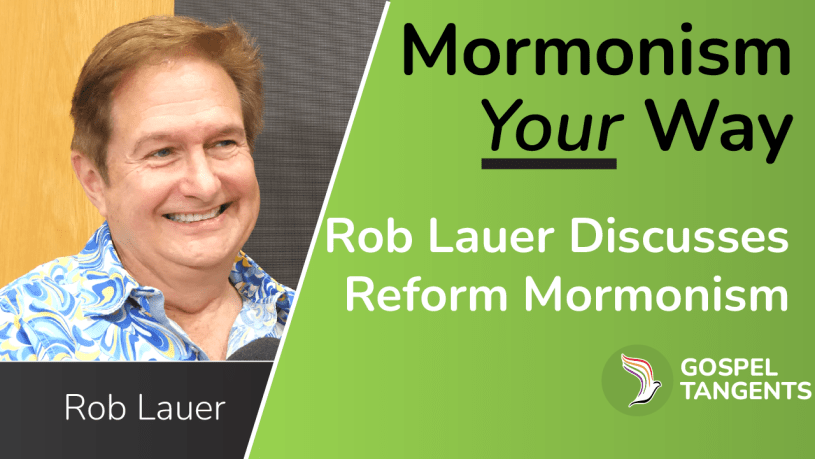
Are there things you would like to add or remove to the Mormon Church? Reform Mormonism may be your answer! Rob Lauer discusses the Reform Mormon Movement, a group so liberal that they think the Community of Christ is conservative! We’ll find out how Rob converted & left the LDS Church, his love for Joseph Smith’s theology, and what it’s like to be a Reform Mormon! Check out our conversation…
Rob Lauer’s Introduction and Background
Rob Lauer introduces himself as a Reform Mormon and a playwright. He lives in Smithfield, Virginia, the birthplace of Emma Smith’s second husband, Lewis Bidamon. Rob explains his involvement in Reform Mormonism, describing it as a liberal, progressive movement rooted in Joseph Smith’s era.
Reform Mormonism and Its Origins
Rob elaborates on the origins of Reform Mormonism, started by Mike Richan, who left the LDS Church and rediscovered new Mormon history. The movement was registered as a nonprofit in Seattle and does not have a hierarchy. Rob compares Reform Mormonism to liberal Judaism, emphasizing its progressive theology and rejection of fundamentalism. He discusses his transition from United Methodist to Mormonism, highlighting the differences between the two denominations.
Rob’s Journey into Mormonism
Rob recounts his discovery of Mormonism in an American history class and his initial interest in Joseph Smith’s visions. He describes his reading of various Mormon texts and his fascination with Joseph Smith’s history. Rob shares his personal beliefs and spiritual experiences that led him to Mormonism, despite not accepting all traditional Christian theology. He mentions his use of the World Book Encyclopedia and local library resources to learn more about Mormonism. He was actually converted to Mormonism through the writings of the Jerald & Sandra Tanner, as well as Fawn Brodie. He didn’t expect historians to venerate the people they wrote about.
Rob’s Conversion and Early Experiences in the LDS Church
Rob recalls writing to Salt Lake City to learn more about the LDS Church and being visited by two sister missionaries. He describes his first sacrament meeting and being asked to speak, which he found surprising but welcomed. He discusses his baptism and early experiences in the Church, including his first talk at his first sacrament meeting.
Challenges and Adjustments in the LDS Church
Rob talks about the social conservatism in the LDS Church and the paternalistic attitude towards young members, which he didn’t like as a college student at BYU. He shares his struggles with the Church’s expectations regarding missionary service. He describes his deep dive into Mormon history and his desire to dramatize Mormon characters and events.
Rob’s Playwriting and Dramatizing Mormon History
Rob discusses his play “Digger,” which he wrote. It tells the story of Joseph Smith and Emma’s relationship, and was well-received at at BYU, despite its uncorrelated history. He recounts the challenges of writing about polygamy at BYU (which was denied by the faculty) and the support he received from faculty members like Orson Scott Card. He mentions that the play “Digger” won the Mayhew Award. Many who watched the play remarked how well they liked the play’s portrayal of Joseph & Emma’s relationship.
Rob’s Departure and Return to the LDS Church
Rob explains his reasons for leaving the LDS Church, including differences in church culture. He describes his return to the Church after nine years, living in New York, and his renewed commitment to Mormonism. He taught temple prep class there, and was in Richard & Claudia Bushman’s ward. Rob highlights the emphasis on good works in Mormon theology and his desire to align with those values such as faith, forgiveness, charity, etc. He had a harder time with home teaching, missionary service, and other works encouraged by the Church. He shares his experiences of being welcomed back into the Church and the changes he observed during his absence. However, being a gay man, he could no longer stay in the Church and left a second time.
Rob’s Reflections on Mormonism and Reform Mormonism
Rob reflects on the differences between his progressive views and the more conservative elements in the LDS Church. He discusses the importance of compassion and grace in portraying Mormon characters and history. Rob shares his ongoing interest in Mormon history and his efforts to dramatize it in a way that resonates with both Mormons and non-Mormons.
He emphasizes the need for honesty and authenticity in understanding and presenting Mormon theology.
Reform Mormonism: Origins and Founder
Rob Lauer mentions Michael Richan as the founder of Reform Mormonism, who started writing online essays around 2000-2002. Michael left the LDS Church for 10 years, re-engaged with Mormon history, and realized he could reclaim his heritage without accepting the LDS Church’s truth claims. Rob discusses the concept of Mormonism as an ethno-religion, similar to Judaism and the Amish, and the struggle some people face when leaving the Church and losing their cultural identity.
Personal Experiences and Family Reactions
Rob shares his personal story, mentioning that his family was not opposed to his joining the church, and he did not have to distance himself from his family or childhood values. Rob describes his mother’s positive experiences with the LDS Church and the people she met there. He says that most LDS people are kind and decent, despite the church’s official policies on LGBTQ issues. Rob doesn’t like the authoritarianism in the LDS Church. He preferes the loose priesthood structures in Reform Mormonism.
Church Structure and Priesthood
Reform Mormonism views “the church” as a personal pronoun, similar to the Greek word “ecclesia,” which means a community gathering. He contrasts the Reform Mormon view of “the church” with the LDS and Protestant views, emphasizing that the church is the people, not the buildings or organization. He enjoys the Protestant emphasis on personal relationship with God and the ceremonial aspects of ordinances and sacraments. After Rob left the LDS Church the first time, he did not have to get re-ordained into the LDS Church, since he had previously been ordained. Instead, he was simply set apart to a priesthood office. This has huge implications for fundamentalist Mormonism. Once priesthood is bestowed, it cannot be taken away.
Reform Mormon Endowment and Ordinances
Rob describes the Reform Mormon endowment, which includes a washing and anointing ceremony without the Satan character and without need for a temple recommend. The Reform Mormon endowment is set up in a home or other suitable space with a veil and involves characters representing humanity, God, and other elements. He discusses the theological differences in the Reform Mormon endowment, including the absence of Satan and the focus on personal progression and eternal life. The Reform Mormon endowment has connections to early Mormon theology.
Joseph Smith’s Theology and Reform Mormonism
Rob shares his views on Joseph Smith’s theology, emphasizing that Smith was a deist and universalist who believed in the primacy of existence and the eternal nature of the elements. He discusses the influence of early Hebraic myths and the concept of humans as diamorphic beings in Mormon theology. Reform Mormonism holds onto the principles of Joseph Smith’s theology while rejecting the authoritarian structures of the LDS Church. He emphasizes the importance of personal integrity, honesty, and love in Reform Mormonism, and the rejection of the idea of a literal devil.
Ordinances and Sacraments in Reform Mormonism
Reform Mormonism does not require home teaching or visiting teaching but encourages communal gatherings for discussions and support. The Reform Mormon approach to ordinances and sacraments emphasizes personal commitment and the importance of internalizing the divine. While Rob believes everyone has priesthood (the power to bless people), he shares a story about ordaining a former LDS member to the Melchizedek priesthood, highlighting the personal significance of such ceremonies. He discusses the flexibility and inclusivity of Reform Mormonism, allowing individuals to adapt ceremonies to their personal beliefs and needs.
Reform Mormonism and Personal Identity
Rob emphasizes that Reform Mormonism is not a new religion but a return to the original principles of Mormon theology. He discusses the importance of seeing the divine in others and the potential for everyone to progress and change. He shares his belief that human beings are inherently good and that the best way to see God is in the actions and character of kind and just individuals. The communal aspect of Reform Mormonism is very important and guides in creating a supportive and inclusive community.
Reform Mormonism and the Future
Reform Mormonism is not a formal organization but a group of individuals who share a common theological perspective. The group emphasizes the importance of personal freedom and the ability to adapt ceremonies and theology to individual needs and beliefs. It has potential to attract individuals seeking a more inclusive and rational approach to Mormon theology. The group really has no leaders, so an individual can believe whatever they want.
Have you heard of Reform Mormonism before? What are your thoughts?
 Wheat & Tares
Reform Mormonism sounds like a return to the Restoration theology of early Mormonism. No creeds, just baptism and communion, and very little else structurally. A Cane Ridge revival church.
No doctrines and covenants whatsoever. No temples with bulls in the basement. If it wasn’t in the Book of Acts Restoration theology discards it.
Joseph Smith didn’t stick to Restoration theology for more than a couple years. He constructed a byzantine theology that makes Calvinism and Catholicism look simple in comparison.
I’m currently rereading D Michael Quinn’s wonderful and very informative book “The Mormon Hierarchy: Origins of Power” and plan to also reread book 2 “The Mormon Hierarchy: Extensions of Power”. Quinn shows that before and after the day the church was officially founded in 1830 it was a just body of believers. “…although inconceivable to modern Mormons, the concept of a latter-day”church” existed at first without being linked to a religious organization or for specific religious ordinances.” In revelations God spoke to “my people” before talking about “my church”.
In Kirtland, where Joseph began to equate the Priesthood with hierarchical power structures there was a massive defection from the church by many people who had joined the church precisely BECAUSE the members were treated equally and everyone was considered to be a valued member of “the body of Christ” just as it had been in the very early church right after Pentecost. By the time Joseph died 14 years later the church now had 5 different hierarchical quorums/callings that were given almost exclusively to his family members and closest friends. Much of the work that the members of the hierarchy were involved in were secret doings such as polygamy, the Quorum of the Anointed, the Danites, the Council of Fifty, receiving the second anointing, making political deals with various state and federal politicians and government officials in return for promising them that the Mormon men who could vote voted in a single block for whom ever Joseph instructed them to vote for and much, much more. This had short and long time consequences some of which are still are being played out nearly 200 years later.
Knowing this info now makes me yearn for a church that is egalitarian in nature and which only preaches Jesus, his words and teachings only. The problem with hierarchies is that unless you are a friend, family member, wealthy or a member of a special group (Masonry) or a business acquaintance you have very little real say in the overall governance of the group. Because you have no voice a variety of problems arise from your lack of representation. You would think that at least one person in the Q15, Quorums of the Seventy, Presiding Bishopric or the managers at the COB would recognize this as a serious issue which negatively impacts everyone who isn’t already cocooned from the real world. (I didn’t recognize the women leaders because they wouldn’t be listened to by all of those alpha males running the church.)
When I was seriously investigating various Mormon denominations (i.e., as a prelude to conversion), the one that resonated most strongly with me was the Church of Jesus Christ in Christian Fellowship. But this is pretty interesting as well.
Steven L. Shields’s book Divergent Paths of the Restoration has an entry for Reform Mormonism, but it lists a website (reformmormonism.org) that doesn’t seem to work anymore. Rick, do you know if there’s a different website in use by the Reform Mormon Movement?
Yes Tygan, you’re right. THe correct website is https://reformmormonismorg.wordpress.com/
Dylan, I asked Rob if there was a tie between The Fellowship and Reform Mormonism, and he said David Ferriman used to be a Reform Mormon before he started the Fellowship.
So why not just join CofC? Why a new group?
Community of Christ isn’t liberal enough.