
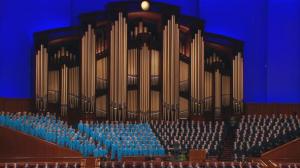
Hello, friends. I’m watching Conference so you don’t have to. MAGA leadership talking to MAGA Mormons about how to be better MAGA Christians. God save us all. There are a few topics I will be watching for in particular: references to politics and the election; mentions of LDS garments, part of the new retrenchment focus of the leadership; and mentions of excommunication and discipline, another feature of the new retrenchment agenda.
I should be able to swing real-time updates after each speaker. Words in quotes only when I’m pretty sure I caught the exact words on the fly. If I add my own comments, they will be in brackets and italics.
Saturday Morning
Conducting: Pres. Eyring (while seated), noting that Pres. Nelson in not attending in person. He starts off Conference by presenting LDS senior leaders for the usual sustaining vote. If you have objections, contact your local Stake President, who, I am fairly sure, will listen attentively and pass along your objections to senior leaders.
Elder Neil L. Anderson — on hope. Our hope of eternal life is based on Jesus Christ and our own righteous conduct. Hope brightens our darkened world. “The temple testifies of the empty tomb …” May we nurture our precious faith in the God of hope.
YW President Emily Belle Freeman — on priesthood and covenants and Emma. Make covenants … and keep them! Emma got a revelation, D&C 25, to expound scripture and exhort the Church. Liken it unto you. Live up to your privileges. Wear the garment of the priesthood daily. [Strong delivery: no Primary voice here!]
Elder Karl D. Hirst, a Seventy — on heavenly love. Every one of our six children thinks he/she is the favorite. Focus on love. God’s love extends to all of us (like we’re all his favorites). Perfect love for broken people. Avoid self-loathing and self-condemnation. Experiment with different ways to feel God’s love. Put some sunshine in your soul.
Elder Dale G. Renlund — on the Restored Church. Dynamite is to black power (a weaker explosive compound) as the LDS gospel is to … ? [Other churches? Secular daily life? I missed something.] The body of the Church helps God accomplish His purposes. [‘Cause I’m TNT, I’m dynamite.]
David P. Homer, a Seventy — on trusting God. If you disagree with the gospel or the leadership, you are wrong. Just like Satan and his rebellious followers before this life. Choose carefully who you trust. If you disagree with the Lord’s prophet, you are wrong. If you trust your own judgment, you are wrong. Doubt will separate you from God’s love and blessings. Blessings are for those who stay. [This was a my way or the highway talk.]
Gregorio E. Casillas, a Seventy — on something. A Gospel-oriented word salad. I couldn’t quite discern a central topic. Lighten their burdens? Make a positive contribution to the world? Be good neighbors? Don’t deviate from the path?
Pres. Dallin Oaks — on commandments and peaceable civil discourse. First commandment: Love God with all thy heart. Second: Love thy neighbor. Covenants and commandments connect us to God. Two kinds of commandments: permanent and temporary. Example: commanding early Saints to move to Ohio, then Nauvoo, then the Salt Lake Valley was temporary, tithing is permanent. Sometimes leaders re-emphasize permanent commandments, as in issuing the Proclamation on the Family or Pres. Nelson’s recent emphasis on full name of the Church.
Cut out the nasty public dialogue! Avoid toxic communications! Avoid the spirit of contention in politics, public policy, and family relations! Avoid contention, be peacemakers. But don’t compromise your principles, just avoid attacking others for theirs. Avoid what is harsh and hateful. [His new distinction between permanent and temporary commandments is going to have a long life in LDS discourse. I suspect his direct counsel against nasty dialogue and toxic communications will fall on deaf MAGA ears, but at least he tried.]
Saturday Afternoon
Conducting: Elder Garrett W. Gong of the Twelve. Pres. Nelson attended in a wheelchair, but did not speak. A children’s choir will perform the music.
Elder D. Todd Christofferson — on rebellion. Lay down your (metaphorical) weapons of disobedience and rebellion. Willful, active rebellion: like Satan and his followers before this life or the three antichrists (Sherem, Nehor, Korihor) in the Book of Mormon. Passive rebellion: just quietly pursuing your own path. Neutral or even good things can sometimes be passively rebellious. Beware malicious and mean-spirited public discourse! Don’t pass on church callings because of a busy job or career! No tattoos! Don’t get too focused on fitness and good appearance. [This talk empowers the thousands of passive-aggressive LDS zealots to accuse most of their co-religionists of being passively rebellious.]
Jose A. Teixeira, a President of the Seventy — on the virtues of salt. Praises salt workers. Praises salt, both seasoning and preservative. Be like salt. [Power of suggestion: I had to start munching some salty chips during this talk.]
Juan Pablo Villar, a seventy — on something. Tells a story about swimming in the ocean with his brother and links it to the phrase “Think Celestial.” [Hint: We could do Conference in one day if we dropped all the Seventies and went with just apostles and a woman or two. I’m still thinking about salt. Need. More. Chips.]
Elder Patrick Kearon of the Twelve — on joy and the sacrament. Welcome to the Church of Joy. God is the source of all joy. Sacrament reverence is more than just folding your arms tightly and saying nothing. Do joyful reverence. Bring positive joy into your Sunday worship. Worship the victorious Christ of glory, not the suffering Jesus. [I like this guy. The new Uchtdorf. If you close your eyes and just listen, he sounds like Tom Hiddleston. You’re welcome.]
Three more Seventies — [Sorry, I have exceeded my quota of Seventies for the day.]
Elder Ulisses Soares — against leisure activities. “Set aside all self-centered pursuits.” Don’t strive to be your authentic self. Instead, you should strive to be centered on Jesus Christ. Do it God’s way. [No more golfing or camping. Get rid of Netflix. Cancel your gym membership. Let’s all join a monastery.]
[Summary of the day: In the morning session, I liked — and I can’t believe I’m saying this — Pres. Oaks’ talk speaking strongly against nastiness in public dialogue and contention in political and public policy discussions. In the afternoon session, I liked Elder Kearon’s talk on joy and joyful reverence. I might pass on the evening session. Have a great day, everyone.]
 Wheat & Tares
Can someone explain to me what retrenchment means? I can’t seem to find a definition that makes sense in all the places it is used (in a Mormon context).
Dave W: Read this.
Retrenchment, Masquerading as Assimilation – Wheat & Tares (wheatandtares.org)
This is exactly the kind of summary I need. Thanks, Dave!
As I understand it, and I certainly could be wrong, it is the attempt to pull in from any deviance from the RULES and any attempt at nuance or expansion of practice to be more inclusive. More follow the prophet and less Jesus loves me?
First of all, thank you for doing this. With a daughter full-in, I like to know what is being said.
I already have a question – “The temple testifies of the empty tomb …” What does that mean as I’ve never heard this one before? Do they just make up new things then act like everyone knows this?
And I called it on conference bingo: ” Wear the garment of the priesthood daily”. Since women don’t have the priesthood, does that mean they don’t have to wear them? Just kidding, please cover the women more!!
DaveW – see the summary of David P Homer, a Seventy. This is an excellent example of retrenchment, with some threats thrown in (NO blessings for you). Only those who are blindly obedient are welcome, the rest of you better shape up.
I suspect his direct counsel against nasty dialogue and toxic communications will fall on deaf MAGA ears, but at least he tried.
Accompanying that counsel with a picture of what looked like a very angry JD Vance, however, might open some MAGA eyes. Or maybe not. But yeah, at least he tried.
The temporary commandments thing very neatly removes the need to distinguish whether or not prior prophets and leaders were “speaking as a man.” I think you’re right that that part of this talk will be around for a long time. And unfortunately, those who could benefit from the second portion of his talk are sure to be already convinced it applies to”those” people and not to them.
A few other comments:
A few of my thoughts during the session:
Re: Sr. Freeman and Emma and Priesthood: I think it is interesting that we are just fine holding Emma up as an example of a good, strong, faithful woman, but we then don’t mention her objections and otherwise difficult relationship to polygamy. Not to mention that she was arguably the major motivating force behind the reorganization — the 2nd largest schismatic branch of the restoration. Speaking of which, D&C 156 frequently came to mind during her talk.
Re: Elder Homer: Going to have to just set this one aside.
Re: Pres. Oaks and permanent vs. temporary commandments: I don’t think I entirely object to the idea of permanent commandments rooted in eternal law or temporary commandments that reflect pragmatic concerns. The problem might be that we don’t always know which is which. When I read Elder Petersen’s ’54 talk about race issues, I see someone who believes that the priesthood and temple ban is a permanent commandment from God and not a temporary policy (I disbelieve that it came from God, but the church seems substantially divided on that question). As one of the apostles would need to sign off on lifting the ban, it seems really problematic to me that one of our apostles seemed to incorrectly understand the nature of that commandment. If an apostle can make that mistake once, what temporary commandments are mistakenly calling permanent? A lot more could be said, but that should be enough to introduce the idea.
Overall I found Sat AM session to be disappointing and problematic. A few bright spots speaking of hope and God’s universal, unconditional love.
The Proclamation on the Family didn’t really need to be a part of Oaks’ talk. It was just used as an example of one of his “permanent commandments” that had recently been “recently reemphasized” (I think that’s close to the terminology he used?) by Church leaders. He could have chosen from a number of things (repentance, “mourning with those that mourn”, etc.). I suspect that he’s been banned (or maybe he has enough sense to restrict himself) from giving any more talks on how he hates LGBTQ people. However, he found a way to sneak a reference to the Proclamation into this talk on civil civic discourse. I suspect he is trying to make things harder for the Q15 to back away from the Proclamation when he passes on. In reality, he is likely just providing even more evidence of the fallibility of “prophets, seers, and revelators”. Just as Brigham Young and his successors’ now disavowed quotes regarding the priesthood and temple ban demonstrate their fallibility, every mention of the Proclamation today only provides more evidence of prophetic fallibility once the Church is finally forced to move towards more inclusion of LGBTQ people.
Oaks’ talk was about reducing contention in public discourse, yet he is the one continuing to champion a document whose purpose is literally to exclude a group of God’s children from participating in what is supposedly the Church of Jesus Christ. Of course, Oaks gave himself an out by stating that it’s still important to stand by one’s principles. Hate speech, in the form of the Proclamation, is still hate speech, even when presented in a calm, lawyerly manner from the pulpit of General Conference. And hate speech, no matter how it is delivered, is still contentious and not civil at all.
I also find it curious that Oaks claimed that the Proclamation on the Family was simply a “reemphasis” of previously given commandments. In other words, according to Oaks, the Proclamation isn’t something new–it’s just a reemphasis of eternal, “permanent” commandments. Really? Where did God give His previous commandments on LGBTQ people in the Book of Mormon (a book written “for our day”), the Doctrine and Covenants, and the Bible? If the Proclamation is a reemphasis of God’s permanent views on marriage and family, then why doesn’t it contain anything regarding the eternal law of polygamy? Sure, we can’t practice it now, but by Oaks’ logic, it sure seems like it should be mentioned.
Clever! Temporary commandments. So much potential with that concept.
Thanks for the summary. Lots of the same ol’ stuff I’ve heard for my whole life repackaged in a slightly different way here and there.
Thank
”Passive rebellion?” Oh great. They found a way to demonize minding your own business.
Seems to me like the new Oaks catchphrases of “temporary commandments” and “permanent commandments” are just another way to say “policy” and “doctrine”. Nothing new there. The new phrases will be used by apologists and in Sunday School and sacrament meeting for a few years and then they’ll be left behind for yet another way to say the exact same thing.
Hurray for summaries – even those done by the Deseret News!
Six months ago I realized I can’t stand the brainwashing anymore – I went for a glorious walk with my dog this afternoon!
Conference so far seems to have confirmed that what’s good in Mormonism is not unique and what’s unique in Mormonism is not good.
I too liked Oaks’s talk. But he’s not the only one advocating civility in public discourse and dialogue.
thanks for the summaries! I forgot this weekend was Gen Conf.
Agree with familywomen that “the temple testifies of the empty tomb” isn’t a familiar teaching. The temple ceremony stops after the Fall. It doesn’t get as far as the atonement and resurrection. Unless the ceremony changed radically since the last time I went. If the speaker said, “the temple testifies of Christ’s foreordination to redeem all humanity” that would make more sense.
Temporary and permanent commandments. Huh. Oaks is saying the Proc on the Fam is a permanent commandment? So the POX was a temporary commandment? Sure, let’s go with that.
Elder Kearon is a refreshing antidote to the culture engendered by Packer et al. Our sacrament meeting services are for joyful worship. We’re allowed to sing joyfully. Hooray. Not in that weird tortured way that sounds like we aren’t really enjoying ourselves because we might be making a show of ourselves. We have permission to stop worrying about ourselves and actually worship our God wholeheartedly. About time.
I would be interested in a total count of the number of times RMN is mentioned compared to Jesus during the talks throughout the entire conference..
hnorth1, Nemo will tell you that.
I swear my comment vanished…
hnorth1 Nemo keeps a running tally
Oaks may insist on the existence of “permanent commandments”, but the part he left unsaid is that all apostles and prophets are temporary. He must be keenly aware of this though, which is why he is making another desperate attempt to shoehorn the Family Proclamation into the discourse, trying to cement his legacy. I don’t think its working too well. Even most faithful TBMs I know have largely moved on from the FamProc, and its few remaining signatories are not long for this world.
“Temporary commandments”? This feels like a perpetual Get Out of Jail Free card…
I think we can agree that permanent commandments are like the 10 Ten Commandments or the two like unto it that Christ said about loving god and your neighbor. Every commandment after those is a temporary commandment. Polygamy, the word of wisdom, drinking Coke, the priesthood commandment, or not letting the children of same-sex marriages get baptized. When Pres. Oaks said that the family proclamation is permanent; will that replace the saving and redemption of the Savior on which the church was founded? As for not calling ourselves Mormon but members of the Church of Jesus Christ of Latter-day Saints, it’s nothing more than branding. It’s kind of like changing home teaching to ministering. It seems the more you talk about temporary vs permanent commandments, the easier it is to get away from the truly permanent commandments. Just push the legislature to post the 10 Commandments in schools instead of the beatitudes, and you’ve done your job.
What about what Christ said in Luke 14:25-27:
25 Many people were traveling with Jesus. He said to them, 26 “If you come to me but will not leave your family, you cannot be my follower. You must love me more than your father, mother, wife, children, brothers, and sisters—even more than your own life! 27 Whoever will not carry the cross that is given to them when they follow me cannot be my follower.
When you have to look to your leaders to define what permanent vs temporary commandments are, we’ve become a cult of personality, not a group of followers striving to live the gospel of Christ.
Elder Kearon was my favorite speaker. I commented to my husband that we need more of the him.