
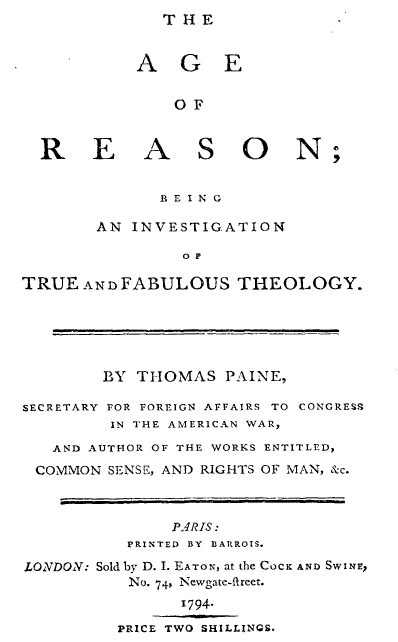
Thomas Paine was an influential force in the history of the United States. His first pamphlet, Common Sense, is credited with crystallizing sentiment for independence in 1776. He has been called The Father of the American Revolution.
He was also a Deist; he believed in a God, but not organized religion. In his pamphlet The Age of Reason he said the following:
I do not believe in the creed professed by the Jewish Church, by the Roman Church, by the Greek Church, by the Turkish Church, by the Protestant Church, nor by any Church that I know of. My own mind is my own Church.
The Age of Reason
He then had some interesting comments about lying to yourself:
It is necessary to the happiness of man that he be mentally faithful to himself. Infidelity does not consist in believing, or in disbelieving; it consists in professing to believe what one does not believe. It is impossible to calculate the moral mischief, if I may so express it, that mental lying has produced in society. When man has so far corrupted and prostituted the chastity of his mind, as to subscribe his professional belief to things he does not believe, he has prepared himself for the commission of every other crime.
The Age of Reason
This quote below made me laugh
Of all the tyrannies that affect mankind, tyranny in religion is the worst; every other species of tyranny is limited to the world we live in, but this attempts to stride beyond the grave, and seeks to pursue us into eternity.
Paine was criticizing the “Sad Heaven” aspect of religion, which is alive a well in the LDS Church.
The most interesting comments to me were on the subject of revelation
Revelation is necessarily limited to the first communication– after that it is only an account of something which that person says was a revelation made to him; and though he may find himself obliged to believe it, it can not be incumbent on me to believe it in the same manner; for it was not a revelation made to ME, and I have only his word for it that it was made to him.
The Age of Reason
He raises a good point. If I didn’t receive the revelation, I now have to trust somebody else and their interpretation of that revelation. Of course as a person somewhat knowledgeable of LDS theology, I can counter that the Mormon Prophet is commissioned to get revelation for the whole world, which Paine would then reject because it didn’t come to him. Although we are told to pray and get our confirmation of the revelation for ourselves, I have heard others in Church say that you follow the prophets revelations even if you don’t agree.
Maybe Paine was missing one of the gifts of the spirit as outlined in the 46th section of the Doctrine and Covenants. After explaining that some have the gift of knowing that Jesus is the Christ by the gift of the Holy Ghost (revelation) Smith writes
To others it is given to believe on their words, that they also might have eternal life if they continue faithful.
D&C 46:14
It appears that Mormonism[1] rejects Paine’s argument about the source of revelation out of hand, and says that some will not have that gift to receive revelation, but to only believe in their words.
What are your thoughts on Paine’s religious writings? What do think about his arguments against revelation for any other than the original recipient, and Mormonism’s counter argument?
[1] How do you say the equivalent of “Mormonism” while respecting Pres Nelson’s victory for Satan edict? Maybe LDSism? Or Church of Jesus Christ of Latter-Day Saintism?
 Wheat & Tares
“Paine was criticizing the “Sad Heaven” aspect of religion, which is alive and well in the LDS Church.”
It’s interesting to consider the initial reaction of early Latter-day Saints to the revelation of the kingdoms of glory. Some of them — including Brigham Young — had difficulty accepting it. They had been so intrenched in a Calvinistic view–of sorts–that they didn’t know how to process the new revelation. Imagine that–they were more comfortable with the notion that those who convert go to heaven and everyone else goes to hell.
Well, of course, most of them came around and saw how truly glorious the new revelation actually was (is).
But the strange thing is–here we are today–and a lot of folks see the vision of multiple glories as a “sad heavens” of sorts–because supposedly there will be empty chairs at the celestial table. But what are we to do? Level the playing field at the lowest common denominator? Frankly, that would mean that everyone would be in hell. Now I can certainly understand wanting to be with my loved ones–whatever that means vis-a-vis the eternal real estate we’re assigned to. But the question that arises is: would I want to stifle the upward mobility of my children because I want all of them at my table–all of the time? Of course not. I’d want them to maximize their potential.
That said, the scenario that I share above has little resemblance (IMO) to how things really look in the eternal world. First off–exalted beings (IMO) have no trouble navigating the sacred cosmos. I don’t know how often we expect to have family get-togethers there–but I’ve no doubt that loved ones from more exalted realms would have no difficulty getting there. And second, I personally believe that it will only be a matter of time before the vast majority of us share in the same glory.
But even if I’m wrong–and there is no upward mobility though the kingdoms of glory–I’m confident that God’s judgment will be just and fair–beyond fair, really. And I’m confident that, in such a scenario, there will be zero logistical problems with downward mobility–meaning that there’s nothing to prevent loved ones from being together except, perhaps, their own unwillingness to participate.
And so, I think it’s important to remember that God will not force any of his children to be what they don’t want to be. And that’s why it makes all the sense in the world (to me) for him to provide a place that is commensurate with each individual’s personal desires and preparations. What could be more fair than that? Even so, I don’t think our eternal accommodations are necessarily fixed. IMO, the vast majority of us will not be able to resist the love of God forever–and we will find ourselves wanting to draw nearer to him. And so (IMO) we may one day learn that resurrected beings of a lower order can, after completing some process of preparation, ascend into higher degrees of glory.
As I say–I could be wrong about that kind of mobility. Even so, I would not be surprised to learn that the Lord’s mercy extends that far–and even farther, truth be told.
Jack, I’m not one to oversell the “sad heaven” meme, nevertheless one must acknowledge the discordant claims at the heart of the LDS view of heaven. On the one hand, the idea that families will be together again as families only in the upper tier of heaven (often extended to the idea that one will have little or no contact with other family members unless one is in that upper tier) leads most LDS to claim that heaven just couldn’t be heaven without family around. The way rank and file LDS think, anything below the upper tier is a real downer because no family.
On the other hand, the official Church talks about all those lower tiers as “kingdoms of glory” and quotes Joseph Smith to the effect that even the telestial kingdom is glorious beyond description. These two points of view are incompatible. I think the first (the sad heaven approach) is directed to LDS to keep them motivated. The second (happy heaven?) is directed to the public at large to make them think the LDS view of heaven is not just tolerant but almost a version of Universalism: everyone gets glory, some just get a little more than others. No one has ever accused the Church of having a fixed or coherent theology. It bends however it needs to for any given audience or issue.
As for Thomas Paine — he was a brilliant essayist. If he were alive today, he would be a popular NY Times columnist. Even after 200+ years, his Age of Reason is more enlightening and entertaining than anything put out by the so-called New Atheists.
Looking at the superficial, Jack’s outline is wonderful, and everyone should be flocking to Mormonism. Most of us were taught and thought this way in our youth and before we did deep dives into the facts of Mormon history/creed; along with life experience observing other people lives while living our own.
Jack is correct that celestial redemption would have no purpose if it were based like communism with all rewarded on an equal plane. We all know the problems with collectivism in the economic system and everyone gets a trophy in youth sports. However, Mormon’s using a capitalistic model means that there are “winners and losers”, throws away a high percentage of humanity. Does God view us like a capital widget and pawns his game?
I agree with Paine that happiness is found through fidelity to self, not to an institution. If religions would focus on teaching kindness and love and how to avoid life’s “heartaches” instead of the religious creed, they could remain relevant. Some of the principles of the superficial teachings of the Bible/BOM/Vedas/Quran/Tanakh are good to teach us to be “moral” and avoid life’s heartaches. However, when they use the Tafsir/Talmud/LDS general conference talks with decision-maker’s interpretation for the whole group, is where many more problems arise.
The Mormon God is not “just and fair” when you really understand the problems with the plan of salvation with pre-moral life, current life equality, and post-judgement. The Mormon decision-makers statements over the past nearly 200 years are full of contradictions and hypocrisy in regard to every doctrine and teaching.
I love “My mind is my own church”. I have learned that everyone attending LDS church is a buffet member, and really has a different concept in their mind compared to the institution teachings. I used to think everyone in Sacrament meeting thought the same.
Paine is now remembered as The Father of the Revolution and not the father of the founding of a church. Which helped humanity over the long run?
Are we still living in the age of Reason or do we believe our tribe has it all figured out? Ask yourself that.
Most of us would hope that if there is a God, this God would be fair just and precise and deliberate. But life is anything but these characteristics. There is so much gray and not a lot of black and white. And life is full of randomness. And yet, we are supposed to believe that what we do in our 100 years of mortal life is going to determine where we end up in the eternities? Really, even with all the random arbitrary circumstances that can differentiate my lived experience from my next door neighbor, not to mention the guy in North Korea.
Maybe I’ll take a look again when the COJCOLDS constitutes more than 2/1000 of the world’s population (note: it’s been stuck at this fraction for a long time). But for now I’ll just try to reason through things with the other 998. (note: since LDS membership is at least 50% inactive it’s more like 999).
I think Paine is correct that one person cannot get revelation for anyone beyond himself. Does this mean there is no such thing as a prophet? It does not. See, a prophet isn’t a general who orders around his army. Oh, someone who claims to be a prophet may act like that, but still a general is not the best example of leadership if he can punish those who fail to follow and obey. Real leadership is without compulsion because the person wants to follow. He/she inspires followers. More like a politician before they are voted into office. The followers are there because they think their gal/guy is best for the job, but that leader has no way to force they to fall in line. Unless the politician is more like a mob boss and issues threats to those who don’t fall in line as Trump has done to various people. A prophet cannot order anyone excommunicated, or even if he had the power, they would never judge because they know that is God’s job. Murdering Laban=God’s job. Excommunicating apostates=God’s job.
A real leader or prophet may say, “God told me to tell you.” And he would for sure say to pray about it yourself. But he *won’t* say that if you get a different answer that you are wrong. He won’t tell you that you already promised to go on a mission when you got baptized so now you don’t have a choice. He won’t tell you that when the prophet has spoken the thinking is done. But he loves people enough to let them be wrong and he knows there is as much chance that he is wrong as there is that the other guy is wrong. So, he is willing to rethink or re-pray any idea. But he doesn’t excommunicate those he thinks as wrong.
And the “reputation” of the church is less important than the feelings of members. The reputation of the church is built on it being good and having the best ideas. It is not ever built up on a lie as the church tries to do over and over. 1. When it hides it financial dealings. 2. When it covers up sexual abuse. 3. When it excommunicates members who are speaking against it—then fixes the problem that member took to the press because church leaders wouldn’t listen but the press does.
And don’t pretend that because God isn’t here on earth to excommunicate that He has his prophet do it to protect his sheep. God doesn’t protect us, in case you haven’t noticed. He leaves us free to screw things up as we choose. He leaves the wolves among us to see if we like following wolves or not. It is called “free agency”. God doesn’t protect us from our own stupidity by keeping wolves from the flock. Trying to protect the members from apostate ideas, that would be the dictator or maybe corporate executive protecting his business income. A real leader leads because he has better ideas, not because he has the power to shut the other guy up.
As far as “Sad Heaven” I don’t believe in that as if we will be forcefully separated from those we love. Some people are toxic or unsafe and you don’t want to be around them. It’s like my abusive dad. I don’t want to be with him in Heaven cause any where he is, isn’t going to feel safe. I should have totally cut him out of my life as soon as I could have. Or maybe even seen to his being charged with abuse and sent to prison. But I didn’t know how to cut him off from the rest of my family. So, being “cut off” from him is good and I won’t be the least bit sad to be away from him for eternity or until he really repents. But that would take a personality transplant that I can’t imagine.
Now my lesbian daughter, I want to be with her. Which just tells me that the church’s definition of who goes to Heaven is wrong. The church *wanted* my father and bent over backwards to get him to return to church after he was excommunicated. They probably thought he was repentant, but he just didn’t have anyone else handy to abuse. The church made it pretty obvious it doesn’t want my daughter.
So, I want a decent definition of who goes to heaven before I worry about “Sad Heaven”.
I think one of the more dangerous things in church culture is the over emphasis on obedience vs. lesser (or no) emphasis on developing critical thinking skills. The LDS view of authority, priesthood, and hierarchy often means that many members (myself included) are first trained to look to others outside themselves to make important life decisions. For a long time growing up, I felt that if I just read enough of the standard works, or enough conference talks, or prayed fervently enough that I would know who to marry, what career to pursue, or when/if to start a family, etc. Essentially, I felt like I needed to uncover truth and that there was a right answer out there.
What really helped me change the way I look about revelation and deciding what to believe (and not believe or ignore) is a passage D&C 9: 4-7:
Now, I don’t put a lot of stock into “feelings” as a reliable indicator when it comes to revelation/truth. Nonetheless, the part of this verse that really does resonate with me is this line in verse 7: you must study it out in your mind.
Studying things out in my mind and rationalizing truth, beauty, and morality is how I operate now, and basically sums up how I make sense of spiritual and moral personal questions. I am a after all a French literature major after all and many of the US founding fathers drew their intellectual arguments from French Enlightenment philosophers. It’s too bad that it took me until well into my adult life to feel comfortable trusting myself and the intelligence that God has placed in my brain or evaluating the best arguments/reasoning of His children (like Thomas Paine).
Right now, I would describe ourselves as “home churchers” (like home schoolers). We remain at arm’s length to the church in terms of activity and participation for several reasons. Basically, we attend on Easter and Christmas and I read from the scriptures and general conference those talks that I feel are valuable for my son. This is my attempt at embracing the good parts and shielding him from the toxic parts.
Dave B.,
I think what’s at bottom is the question of what kind of being is the God we believe in. I think most folks here believe that he is loving. And as such, he would do all in his power to draw us unto himself–short of coercing us, that is. And then if we consider the idea that most folks won’t be able to resist his love forever–then there we have it. It’s almost as if the tiered heavens is a natural expression of his patience with us as we become prepared by degrees to receive a fulness of his love.
“My own mind is my own church” goes so hard.
The more time goes by, the more I think “revelation” is too nebulous and vulnerable to manipulation to be useful. If we break it down into “intuition” and “critical thinking,” we stand a better chance at getting at the truth because while intuition is powerful and shouldn’t be ignored, it’s clearly not foolproof and can be honed and refined the more we practice critical thinking.
Jacob L: What’s missing from the D&C’s commission to “study it out” is a reliable method of study. It’s unfortunately also missing from our society in general and the world would be a much better place if everyone had a solid grasp of the scientific method and the ability to accurately assess the soundness of the methodology of any given study. The church’s methodology largely boils down to confirmation bias IMO.
Jack: the problem with “sad heaven” has less to do with God’s mercy and our eternal destinations and more to do with the fact that my parents think I’m damned for following my conscience out of the church. And let’s be honest, when assessed ethically, the criteria for getting into the CK are astoundingly arbitrary.
Anna: “Does this mean there is no such thing as a prophet?”
I don’t believe humans can be reliable full-time prophets, but ideas and movements can be prophetic.
The enlightenment was prophetic. Civil rights and women’s suffrage and LBGTQ+ rights are prophetic. Carl Sagan was being prophetic when he predicted MAGA’s anti-intellectual hijacking of our common discourse. Mary Oliver’s poetry is prophetic.
The managers of religious institutions whose primary function is maintaining a structural and ideological status quo can not, by definition, be prophetic. I’ve never heard a single prophetic thing come out of RMN’s mouth.
Kirkstall:
“And let’s be honest, when assessed ethically, the criteria for getting into the CK are astoundingly arbitrary.”
I don’t believe that ethics are the proper measuring device for the gospel. Becoming like Christ is what matters–whatever that looks like. And there’s nothing arbitrary about that kind of transformation–because there he is: the perfect standard by which we can measure ourselves.
“I’ve never heard a single prophetic thing come out of RMN’s mouth.”
Give it time.
Please stop using “unto.” Asking for a friend.
Kirkstall, I agree that a human cannot be a reliable full time prophet. It is just too hard to be right about everything. That is why I like the Bible’s portrayal of prophets with all their warts showing better than I like the way Mormons turn Joseph Smith into some kind of flawless perfect human. In the Bible, even Peter said he didn’t know Jesus. He disowned him. Seriously flawed human, but much more realistic of a human than how we Mormons think of Russel Nelson. Nobody is correct about what is right and good all the time. Which is why I wish Oaks would get down off his high horse and realize he isn’t perfect and maybe he should learn to apologize when he is wrong. A prophet might be right about this idea and dead wrong about something else. That is why I could (if I wanted a temple recommend ) honestly say that I believe Joseph Smith was a prophet. But if I just say it like that, it is misleading to most Mormons because I also believe he was a con man, serial adulterer, predator of teen aged girls, egomaniac, arrogant, narcissistic S.O.B. But yeah, some of his ideas were prophetic.
Which all come back to the idea that we should take each idea and study it out in our minds, pray about it, and then decide for ourselves. Not blindly follow someone who claims to be a prophet.
@Jack, you’ve now confessed to being a “near Universalist” in comments on at least several different posts, and you’ve elaborated a bit more on those beliefs here. That seems to be to be in direct conflict with your ardent belief that whatever the Q15 teaches can’t possibly be wrong.
Yes, I am well aware of some of the quotes from Church leaders over the decades that hint at the possible ability to progress across “kingdom of glory” boundaries after death. However, for every quote like that, there are hundreds of statements from Church leaders holding to the doctrine that “This life is the time for men to prepare to meet God; yea, behold the day of this life is the day for men to perform their labors.” (Alma 34:32). One recent example, of a prophet rejecting your beliefs on Universalism is Russell Nelson’s recent “Think Celestial!” General Conference talk (https://www.churchofjesuschrist.org/study/general-conference/2023/10/51nelson?lang=eng):
I don’t know how you get Universalism or moving between “kingdoms of glory” out of statements such as these (and again, the number of statements like these far, far outnumber statements that hint at the possibility of Universalism or progression across kingdoms). I personally like the idea of people being able to grow and progress after death as you suggest, so maybe we’ve finally found one thing the two of us agree on. I just wonder how you are able to reject the teachings of prophets, seers, and revelators who are constantly preaching against Universalism and progression across kingdoms while at the same time criticizing other people who question statements of Church leaders on other topics because, well, according to you, prophets, seers, and revelators are never wrong on anything of import–and what could possibly be more important than, using your words, losing the ability to “inherit the universe” by teaching the dangerous doctrine of “near Universalism”?
Your belief in “near Universalism” along with the recent discovery (on a different post) that you reject past Church leader’s statements (the the Church itself also now rejects) regarding the origins of Book of Mormon peoples really seems to be showing that you, at least in some cases, reject the statements of prophets, seers, and revelators. Your brain, your spirit, your intuition, or all of the above is telling you that what Church leaders are teaching on a topic just doesn’t ring true to you, and you didn’t just drop those beliefs because they differ from the teachings of the Q15. That’s what a lot of the discussion on W&T are about. Perhaps you could consider extending a little more grace in attempting to understand the points of other commenters here that question official Church positions on various issues instead of just reflexively responding with, “Prophets, seers, and revelators say so, so it must be so.”
mountainclimber479,
Oh I agree with the teachings of the apostles on this subject. And I certainly agree that the choices we make in this life have real consequences vis-a-vis eternity. What we do today is crucial in determining our course in the eternities. And it behooves each one of us to review every now and again the Savior’s plea–in Section 45–for us to repent and accept his sufferings on our behalf lest we should be left to endure those pains on our own.
That said, as it pertains to the entire family of Adam and Eve–I believe “this day of preparation” (that we’ve been given collectively) extends to the end when Christ shall have finished his work in gathering the whole of humanity into one. And it’s within the framework of the Lord’s plans for the entire history of the earth that my near-universalist notions probably have the most traction–though I’m open to the possibility of upward mobility existing beyond “this day of preparation.”
But, remember, I’ve admitted that I could be wrong–and that there’ll be no graduation from one kingdom to another. Even so, if such is the case that’s not to say that exalted beings won’t have the power to traverse the many divisions within the sacred cosmos. So when the apostles say that our choices have bearing on where and with whom we’ll live in the future–which is absolutely true–that’s not to say (IMO) that we won’t be able to visit or be visited by our loved ones, in a manner of speaking. The restrictions mentioned in Section 76 have to do with an inability to go where God is–not the other way around.
@Jack, I’m not sure I understand what you’re saying, but let me try…
Your first paragraph is the standard Mormon belief that is overwhelmingly taught by Church leaders including Russell Nelson in his “Think Celestial!” General Conference talk.
I think your second paragraph is alluding to things happening in the spirit world (and possibly the Millenium) where spirits are taught the gospel and given a chance to accept it and receive baptisms done for them by proxy in the temple. That said, I maintain that Mormon orthodoxy as proclaimed for many decades by prophets, seers, and revelators is that there will be many, many people who still reject the gospel after having been taught in the spirit world/Millenium, even when “Christ shall have finished his work in gathering the whole of humanity into one.” Also, those who were taught the gospel in this life cannot obtain exaltation by accepting it in the next life. Therefore, I believe that your second paragraph is unorthodox Mormonism and directly contradicts prophets, seers, and revelators have overwhelmingly taught for a very long time. Why even talk about lesser degrees of glory if hardly anyone is going to end up in them when all is said and done as you seem to be suggesting with your near-Universalism?
Also, I guess you are hedging your bets by saying that you might be wrong about your belief in upward mobility between kingdoms of glory. However, I’d propose that even harboring this possibility is rejecting what prophets, seers, and revelators have overwhelmingly taught for decades. You seem to be embracing Bruce McConkie’s heresies #4 and #5 from his “Seven Deadly Heresies” talk given at BYU (https://speeches.byu.edu/talks/bruce-r-mcconkie/seven-deadly-heresies/):
Heresy #4: “There are those who believe that the doctrine of salvation for the dead offers men a second chance for salvation.”
Heresy #5: “There are those who say that there is progression from one kingdom to another in the eternal worlds or that lower kingdoms eventually progress to where higher kingdoms once were.”
Based on apostle McConkie’s remarks, you may be just as big of a heretic as the rest of the W&T crowd.
I think where I differ from other “heretics” is that I don’t believe that Elder McConkie was necessarily wrong. I think what he said at that time is what needed to be heard–even though I believe his theology might be expanded upon in the same way that section 19 expands upon the doctrine of damnation.
And that’s how I feel about the counsel we receive from the living apostles. I think what’s important is that we consider what their words encourage us to *do* more than anything else. Even the apostles disagree with each other from time to time on issues having to do with tenets and theology and so forth. And so regardless of how things actually playout in the distant future what’s most important is that we do as the Lord commands in the here and now.
And so for all of my pontificating on the eternities–none of that really matters if I don’t get into action and try to live as the Lord’s anointed have counseled me to live. The Savior said: if you love me keep my commandments–not: if you love me get your theology straight.
One more thought: I believe that many more of the children of Adam and Eve will live during the Millennium — which I believe will last much longer than a thousand temporal years — than will have lived before. And so my question is: is it fair for so many to be brought up in righteousness whilst the vast majority of those who lived before never even so much as heard the name of the Savior? Surely there will be great mercy shown towards those who have lived under the weight of the Fall–the majority of whom have been paupers and peasants and servants and slaves.
Sorry–another thought: I quote:
“Why even talk about lesser degrees of glory if hardly anyone is going to end up in them when all is said and done as you seem to be suggesting with your near-Universalism?”
Because even if there is upward mobility in the realms of glory that’s not to say that some of us won’t be spending some time — perhaps a great while — in the lesser kingdoms.
The ancient Jews considered salvation to apply to them as a people, and it had more to do with posterity than with an afterlife. There is some truth in that position. Today the Church focuses on salvation as a family affair, and there is some truth there, too. But Jesus taught that salvation was a highly individual matter, and He made it quite clear that following Him might require people to separate from their spouse, parents, children, etc. I can’t find much (or anything) in the gospels or in the NT epistles that talks about anything other than individual salvation. Maybe salvation in families is an example of new revelation, but maybe it is something else.
While rarely is it perfect, most people find the greatest expressions of love in the family: one spouse to the other, parent to child, siblings to each other, or child to a parent. Is it possible that all of the emphasis on salvation as a family might come from us making heaven look like what we want it to be? Are we creating our own image of what we want heaven to be (me with my spouse and children), and then building our doctrines on that foundation? I wonder sometimes if we focus on family salvation too much and on individual salvation through faith too little. While we’re talking about it, don’t we sometimes think of heaven as a reflection of the families we have on earth? Thus all the talk about heavenly mothers, a concept utterly unaddressed in scripture. I’m not sure that spirit children are created by a divine physical coupling. Maybe we err when we teach what heaven will be like. Maybe we go beyond the mark: mixing metaphors, beyond the mark, on early modern world maps, is labeled: “Here be monsters.” Not that there really are monsters, but it is unexplored and therefore unknown. We actually know very little about the next life, and what we profess to know comes from the same people who, while holding high office, explained to us in very logical (and wrong) terms over decades why Black people couldn’t hold the priesthood or receive temple blessings. I think it is dangerous to make heaven look like what we want to see. I simply don’t know. Sometimes we do without understanding, acting on faith, and that isn’t all bad.
I agree with Mr Paine that revelation is limited to the first communication. After that, it is a retelling, and a retelling might be accurate, less accurate, or even wrong. I can reveal to you (for example) that Mary will be at the hospital tomorrow but that you shouldn’t visit her, and you might think and tell people that Mary is ill, but maybe she will be visiting a relation or friend. Or maybe she’ll be there only for tests and can’t receive visitors. Or maybe Mary is a patient, but she will be in surgery tomorrow. Or maybe Mary is angry with you and doesn’t want to see you. All you know is that I told you not to visit Mary at the hospital, period. That direction (revelation) applies only to you, and you would err in telling others not to go to the hospital. When we hear of a revelation, we need to determine, as best as we individually can, the who, what, why, how, where, and when, and then we need to decide individually what we will do. You might decide to do something different than I, and that doesn’t make you wrong anymore than it make me right. That’s why no revelation is binding on church members until it is canonized.
About McKonkie: he was never president of the church and never considered “the prophet”. His talks and writings were never considered definitive by the other apostles in his life time. He published “Mormon Doctrine” without President McKay’s permission and many of the apostles met with McKay complaining that they disagreed with the “Mormon Doctrine” interpretations. McKay specifically asked him to publish retractions of specific parts of it and to never reissue the book.. McKonkie ignored these directions to a great extent. Eventually, after it affected the beliefs of generations of members, it did go out of print. McKay had serious disagreements with other books apostles published at that time. Over time the church was able to reign in publications by apostles without the approval of the remaining body of apostles and president. This history is from the book “David O McKay and the Rise of Modern Mormonism” which was written from the carefully preserved notes of McKay’s life long personal secretary, Clare Middlemiss, after her death.
McConkie had to publicly disavow everything in “Mormon Doctrine” about black people, which puts everything else in doubt as well. The statements of various prophets and apostles are in conflict on these issues. The current stance of the church is to follow whatever the current prophet says…. at least until he dies, and the next president changes things.
In the end, with all the contradictions, it does come down to personal revelation. In my personal revelation I find a great deal of peace in following Christ, and not worrying too much about “the covenant path” and all the other details that really aren’t about following Christ and having charity, but are more about personal purity and focusing on the self. I am willing to trust in Christ and not really define the details. My favorite verses are in 2 Nephi 33 where Nephi shares his faith that many of us, and maybe all of us, may be saved by Christ’s plan. My personal revelation tells me that each person is on their own path of learning and growing in this world. It better for me to focus on how I can best learn, grow and love, rather than think about the next life, and Nelson’s judgements of people and where he thinks they will end up.
I will keep my focus on following Christ here and now instead of thinking celestial.
@ Jack – “But the question that arises is: would I want to stifle the upward mobility of my children because I want all of them at my table–all of the time?”
I’m not sure why upward mobility and sharing the same table are incompatible. Are your kids limited in their ability to seek out personal advancement because they are surrounded by people who have not achieved as much? The entire eschatological discussion seems at best intriguing, possibly intellectually stimulating to speculate about, but oddly, rather self-indulgent. What I find incompatible is the idea of making the so called “mortal test” about service, and expanding our capacity to love as God does, and then the reward being, congratulations! You proved you could love the unlovable, so your reward is, you will now be free of those pathetic telestial shlubs. The irony is thick when the object of earthly existence is said to become less self-focused, but the theology of the afterlife really supports a self-obsession with achieving “personal glory” and leaving behind the very people and place that brought you there in the first place.
“Savior’s plea–in Section 45–for us to repent and accept his sufferings on our behalf lest we should be left to endure those pains on our own.”
This statement references an unintelligible doctrinal idea about “Atonement theology”. There is a meme that has traveled around with the LDS picture of Christ standing at a door without a doorknob. It satirically captures how Christianity’s story about what Christ accomplished is more fear based than love based.
Knock knock…
Whose there?
It’s Jesus, let me in…
Why?
I have to save you
From what?
From what I’m going to do to you
if you don’t let me in.
The idea that Jesus’ role in our mortal sojourn is to act as “divine acetaminophen” is an idea hatched in authoritarianism and the farthest thing from reality. Life is filled with suffering. Suffering shows up for sinners and saints alike, it is no respecter of persons, and certainly doesn’t appear that, regardless of how diligently I obey or repent that I’m able to transfer that suffering to another being. The message of (you better accept me or you are going to pay the price I had to), plays into the toxic idea of God being the cosmic Cop in the sky. For heaven’s sake, the story of Job begins with the perfect setup, challenging this belief system. It reads; “There was a man in the land of Uz, whose name was Job; and that man was perfect and upright, and one that feared God, and eschewed evil.”
Did you catch that? Job was “Perfect” and “upright”. The story continues to unfold as their overly simplistic, dualistic belief system crumbles before their eyes. Job and his friends believe that, “If you obey, you are blessed”, and that blessedness is illustrated in terms of Job’s material possessions. Job’s life seems to have been insulated from suffering due to his “righteousness”, but reality soon pokes her head up. Not only can Job’s uprightness NOT protect him from the unpredictable nature of life, but his suffering also exceeds that of any unrighteous person in the land. He doesn’t just suffer, he suffers more than anyone else, he suffers what he believes is unjust and his friends believe can only be explained by unrighteousness.
So, forgive me for having a problem with our inherited “Atonement” theology, but nothing about my own life or witnessing the lives of other people suggests that Jesus suffered so “I won’t have to”. This is simply not reasonable. This theology moves us away from the vulnerabilities of life, it teaches us to judge suffering and interpret it as proof that we are off track, when I believe Jesus’ message is that suffering is inevitable and the only way to redeem it is, we must move into it, share it, have compassion for it, and allow it to be the weakness which becomes strength. Redemption is not the elimination of sin and suffering; it is the product of it.
Jesus is the revelation of God (the highest good possible) incarnate. Jacob’s name was Changed to “Israel”, which means “God with us”. Jesus came to “be with us” IN our suffering, to share it, and bare the weight that is too great for any one person, and to restore the relational nature of God and man, which can be strengthened through suffering.
lws329, I sincerely appreciate your formulation: “I am willing to trust in Christ and not really define the details.” Oh, that we could live more by faith and not worry about the details. That’s how one makes the yoke easy and the burden light. That’s how one can find peace in the midst of adversity. I, too, don’t stress to much about the covenant path, or about lots of things that fellow church members obsess about. I have enough to do to worry about me–and that doesn’t mean a hyper focus on absolute, unwavering obedience. I do what I can, and I try to do better, but I am convinced that at the last day my faith will matter more my obedience, and that my love of my neighbors will matter more than the number of boxes I check on an obedience checklist. Paul says something to that effect in 1 Corinthians 13.
toddsmithson, I appreciate your formulation: “Redemption is not the elimination of sin and suffering; it is the product of it.” Too often we are no different than Job’s friends, speaking words without knowledge and without wisdom, all the while appearing to be very orthodox and proper. I fear that when bad times really come upon us, many Saints may leave the church when children in faithful families die from starvation, war, or disease, when savings disappear and hunger sets in, when prayers for relief appear to go unanswered. We have taught this generation that all will be well if they remain faithful, and when all is not well, can we blame the faithful for being weak and turning against God? While all will be well in the end, there will be tribulations, and good people will suffer bad things. When job-esque afflictions fall on us, how many of us will curse God and die, because we believed a falsehood that bad things won’t happen to good people?
lws329
Apparently I can’t read. Spent a couple minutes wondering who About McKonkie was and if he was related to Bruce.
I agree with whoever said this is not the age of reason, but of obedience. The consequence of that is that good people, will be willing, against reason, to vote for trump.
A quote from writer, scholar, and explorer Sir Richard Francis Burton comes to mind:
“The more I study religions the more I am convinced that man never worshipped anything but himself.”
Burton claimed to be an atheist but also had a vast knowledge of religions around the world, that he largely obtained through first-hand experience in his extensive travels. His words can certainly be read from an atheistic point of view, but to me, however, Payne and Burton are on two sides of the same coin…and the longer I’m alive, the more I tend to agree.
This isn’t to say that there is no God, or even that there are no inspired or well-meaning people in the religions of the world – there certainly are. But since anyone can claim to have had a vision/revelation, whether it’s true or not, religion can easily be co-opted by people who just want status and power. There are extreme examples in history like the crusades or the inquisition, but we see it even in modern Mormonism.
Here are two examples:
(1) Russel M. Nelson seems relatively benign as a leader, but he very obviously loves basking in his demigod status within the church. Remember his televised birthday party? Also, there’s that time he wrote a foreword to his own book gushing about himself, then audaciously asked Pres. Kimball to put his signature on it. That sort of personality makes it very hard to trust when he’s being inspired or just building his personal brand/legacy.
(2) On a more insidious note, we had unnamed church leadership use an obviously suffering Pres. Monson like a puppet to test out the PoX. Then they later used his illness as an excuse for walking it back when their experiment caused too much heat for the church. I know of countless people who prayed and prayed trying square this one. There was no inspiration there – just powerful people with an agenda and opportunity.
But as Bishop Bill mentioned, the Mormon model allows the general membership to receive their own inspiration about leaders’ decisions. But there’s the caveat that the personal revelation needs to line up with the leadership. Then there’s a secondary clause that members are still blessed for obedience even if the leadership gets something wrong, which can explain why they felt inspired to “follow the prophet” off a moral cliff.
All of this just proves that Payne is absolutely right that we should never sacrifice our own reason on the altar of someone else’s spiritual experiences or beliefs. This is true of religion and pseudo-religions like political parties.
You seem dubious about Burton’s self-classification as an atheist. Is there any reason to assume that someone might be interested in the concept of religion, study the variety of world religions and then come to the conclusion that it’s made up by people to assuage their discomfort with what they can’t know?
Mormon afterlife: a boring and unnecessarily complicate reiteration of life on earth. And weirdly complicated. My thought for the day: if god will work it out in then why bother?
@Jack, to be clear, understanding the details of the afterlife, if there is an afterlife, is not one of my top issues and not the reason I engaged with you on this post. I am far more interested in a bit of a meta discussion about ways that some orthodox believers, like yourself, engage with people that have real questions or concerns about the Church, both on this site and elsewhere.
We’ve finally happened upon a topic for which you admit to having thoughts, ideas, or speculations that conflict with what prophets, seers, and revelators have been teaching for decades. It sounds like deep down inside you aren’t fully satisfied with these answers. There appears to be unfairness in the system. You question how a truly loving Father would institute such a harsh system.
I pushed back on you a few times on this post by quoting scriptures and Church leaders to “prove” that your viewpoints are “heretical”. How did that make you feel? Were you grateful that I put your thinking back “on the right track”? It doesn’t seem like it since you continued to push back in support of your personal convictions on the topic.
First, you made an argument that you really do agree with McConkie’s heresies. It’s just that McConkie gave a simplified explanation of things, and if we knew the “expanded” version, then your ideas would still fit with McConkie’s views. (Your expansion theory seems pretty unsupportable to me. Expanding on ideas is one thing, but contradicting them is another. McConkie leaves zero room for expanding his statement to allow for upward progression across kingdoms after death. However, again, I’m interested in the meta discussion here about how orthodox believers often do a bad job of discussing issues or concerns that people raise about the Church, so let’s keep moving.)
Second, you made an argument that abstract ideas about what will happen in the afterlife are far less important than people’s actions in the here and now. In other words, it’s not really that big of a sin to speculate on theology that contradicts prophets, seers, and revelators since it’s our actions now that really matter. (Again, I don’t want to debate this actual topic with you. However, I will say that McConkie and Nelson would probably strongly disagree with you that your theological speculations here are truly harmless. They would argue if people were led by a “wolf in sheep’s clothing”, such as yourself, to believe that it is possible to repent in the next life and still obtain exaltation that many people would choose to simply “eat, drink, and be merry” today and put off repentence until the afterlife. However, Nelson and McConkie and pretty much all the other prophets and apostles don’t think it’s possible to repent in the afterlife, so your ideas are very dangerous since it will cause people to lose out on exaltation and forever be stuck with a terrestrial or telestial body.)
Third, you made a fairness argument. How could it be fair for children born during the Millenium to achieve exaltation in an environment where it would be so easy to avoid sin while people who live before the Millenium face a must bigger challenge with sin? (This, in my opinion, is your best argument. There are so many questions about fairness and what a loving Father would do when we think hard about damning someone to eternal telestialism for their actions while they lived a mere 70 years in a world full of so much pair, suffering, trials, and unfairness.)
In summary, you seem to have real questions about the fairness of the plan, whether a loving Father in Heaven really intends to halt His children’s progression after they die if they “didn’t do enough” to earn celestial glory in the next life. When I used scripture and the statements of prophets, seers, and revelators to try to show that your ideas are heretical, did that make you stop? Did you thank me for correcting you and setting you back on (your words) “the high road to inheriting the cosmos”? Nope. You did what everyone else here on W&T tends to do when you try to correct them in this way. Instead of humbling yourself and repenting of your evil ideas, you provided at least three different justifications to support your point of view. If I were to go and collect more evidence from the scriptures and General Conference talks, which would be very easy to do in this case, would that be enough to convince you that you are wrong? Almost certainly not. You are already aware of what Church leaders have taught on this topic. It feels like deep down you have some serious questions about fairness that aren’t easily answered by McConkie or Nelson or the Book of Mormon or the statements of hundreds of other apostles and prophets.
Like I said, it’s the meta-discussion of how orthodox believers can effectively engage with people that have questions or concerns about Church doctrines or policies that I’m interested in here. I will suggest to you that these things aren’t effective ways to engage:
1. Quoting scripture or statements of Church leaders and then doing a “mic drop”. That’s just like saying, “The prophet has spoken, so the time for thinking is over”. Many people here (including you, given your last comment in defense of your seemingly “heretical” ideas) don’t accept scripture or statements of Church leaders to be definitive, so these “mic drop” statements don’t help at all.
2. Bearing testimony that you are right and the person with questions is wrong. This may make the orthodox believer feel all sorts of warm and fuzzies, but the person with questions is almost certainly just going to feel cold and pricklies.
3. Dismissing concerns as unimportant. “Well, I don’t understand why you’re so concerned about this. After all, if you just ignore your concern and fall in line, you can ‘inherit the cosmos'”. Some people don’t want to inherit a cosmos if it can’t address a concern that they find very important. To them, that cosmos is seriously screwed up. You might not think their concern is that important, but you need to acknowledge that it might be very important to others.
4. Promising that if they pray harder they’ll know that the Church’s position is right or true. Would that have worked for the race/priesthood ban? Would that have worked for “praying the gay away” that the Church encouraged just a few decades ago? There are lots of historical examples, where praying like this wouldn’t have worked since Church leaders’ were wrong to begin with.
My observation is that you have done those four things I’ve listed above over and over and over again on this blog. I would further suggest to you that doing those four things hasn’t been productive in changing anyone’s mind. In fact, doing those things is actually counterproductive–when people have questions and get those kinds of responses, their concerns are likely to be amplified, not diminished. I get plenty of those four “solutions” at Church every Sunday where true discussion and expression of honest thoughts and beliefs are not welcome or allowed. One of the main reasons I participate here on W&T is because the Church does not provide an outlet for members to express their true feelings, beliefs, questions, and doubts, and W&T gives me a place to do that. The reason I push back on you so frequently is because you are constantly doing the four things I’ve listed above to defend the Church, and quite frankly, I get plently of that at Church already.
toddsmithson,
To me atonement theory is kinda like trying to explain the law of gravity. I throw a rock into a pond. It arcs downwards and splashes into the water. Why does the rock do that? Well we might hear a number of different answers depending on a number of different factors. Anything from the rock is heavy–to the earth has an attractive force–to massive objects like the earth warp the space around them–etc. All of them have some element of truth in them–or are at least informative enough to get us thinking in productive ways about the conundrum. So too we may come across a number of different approaches to the atonement in the scriptures and from the living prophets.
That said the approach that makes the most sense to me (at this point) is the idea that the Lord wishes to draw us into close proximity to himself so that we may receive of his divine influence and become transformed into the kinds of beings that might be unified with him and the Father. But the problem is–our being in such close proximity to him (in our present condition) causes him to feel all of our suffering — whether from sin or sickness or weakness or heartache or what-have-you — as if it were his own. And if that weren’t difficult enough–the Savior’s suffering is magnified to an unbearable degree by virtue of the fact that he is like unto the Father with respect to his virtue and lovingkindness. Which, in turn, means that the weight of his suffering is similar to what we would feel standing in the presence of the Father in our current condition. And then, of course, if we magnify all of that suffering by the countless number of souls with whom he has suffered–well then, I scarce can take it in.
Surely we love the Savior because he loved us first.
Georgis – I love this very astute thought, “We have taught this generation that all will be well if they remain faithful, and when all is not well, can we blame the faithful for being weak and turning against God?”
It’s hard to blame people for leaving a relationship when the transactional nature of it was the perfect setup for divorce from the word “Yes”. Transactional relationships may be a starting place, but if they continue, they will eventually fail because they have to. When the church primarily preaches covenant as a contract, where God sets the terms and then provides what we desire based on compliance with those terms, its doomed to fall apart as soon as the thing I signed up to get is not being provided. It’s a married for money union. Young very pretty woman marries 75-year-old tycoon. It’s an old and superficial story that goes like this (sorry if this is a crude example). Woman agrees to provide her desired services in exchange for a good life, showered with all the things money can buy. As soon as the money stops, her services will stop also. It’s a roles-based relationship where the value is only in what it provides, not in the relationship itself. It’s essentially emotionally and spiritually abusive on both parts.
The problem I see now is the church set up the problem (transactional relationship) but now it doesn’t want to accept any of the responsibility for the increasing divorce rate. They are gaslighting the exiting members, blaming them for the departure while holding fast to their innocence in the matter.
@alice Dubious that he considered himself an atheist? No, not really. Maybe only slightly because he had a tendency of saying inflammatory things in polite society to intentionally cause a stir.
His quote gets recycled a lot in atheist circles, but he was also very tolerant of the beliefs of others.
He was fascinated with Sufism and it greatly influenced his life, he’d say the Church of England was “officially his church” because he was born into it. His wife was devoutly catholic and he went out of his way to get special permission from a catholic cardinal for a mixed marriage, promised in writing to not interfere in his wife’s beliefs and allow his children to be raised Catholic, and married her in a Catholic church.
He was a mostly scholar who studied and described religion without feeling burdened to conform to it. I think at most his religiosity would have ended at agnosticism or deism.
Todd, I think you may have been meaning to reference the name “Immanuel”, which means “God with us.” -im (with) -anu (us) | implied is (present form of “to be” in Hebrew is not written, but understood | -el (God). With us (is) God / God with us.
“Israel” means one who struggles or wrestles with God.
I’ve gone way beyond my quota–but it’s hard for me not to respond to such thoughtful comments and questions directed at me specifically. I hope I don’t get in trouble.
mountainclimber479:
I love the teachings of the living apostles. And in those rare instances when I feel conflicted by them I find that, more often than not, all I need is a little time to grow into a better understanding of their words. That said, I don’t feel as much obligation to be as loyal to the teachings of apostles from the past–though, certainly, their words can be informative, insightful, and faith promoting. And I certainly don’t feel obligated to align myself with teachings that were published in books by individual leaders who took sole responsibility for the content of their work.
For me, those categories allow for quite a bit of nuance for orthodox types like me. For example, my views about the Garden of Eden are very different from those of Joseph Fielding Smith. I agree with him on key doctrines having to do with the Fall and our divine lineage and so forth–but I’m in a completely different playing field with regard to the “otherworldly” elements of the narrative.
With regard to what we do versus what we think: I agree that ideas can be dangerous–and if an apostle were to ask me to refrain from sharing certain ideas online I’d follow his counsel and desist in a heartbeat. That said, in general terms I think the apostles are more concerned with how we behave as Christians than with how we theologize as Christians.
With regard to fairness: I’d say that my intent was to focus on the goodness of God. I believe, as Joseph Smith stated (in so many words) that we are not yet prepared to accept the greatness of God’s mercy. IMO, if the breadth of his mercy were to be revealed to us today–just as many of the early saints were challenged by the vision of the kingdoms of glory we’d have a hard time accepting a similar revelation vis-a-vis the goodness of God.
Re: the four examples of ineffective interaction: there’s no question that I can do better–and I’ll try to be more thoughtful. Even so, my primary interest isn’t in having a meaningful conversation so much as it is in allowing the living word to take its own course. And in saying that I recognize that I’m the weakest of vessels–a poor communicator–and sometimes the best I can do is simply get out of the way.
@ Jack – “I think the apostles are more concerned with how we behave as Christians.” Ring, ring, the temple recommend interview is calling and begs to differ.
moutainclimber479,
I really enjoy much of what you write, however I need to give you a correction about the church leaders teaching this life is the only time to repent. While Nelson and others have taught this, there is canonized scripture and practices that directly conflict with this point of view.
Doctrine and Covenants 138 Joseph F Smith teaches that Christ visited the Spirit world and organized his followers to teach those who were under the bondage of sin.
Verse 58 reads “The dead who repent will be redeemed, through obedience to the ordinances of the house of God,”
So yes, our canonized scripture teaches that the dead can repent. In fact that’s why we are doing genealogy and temple work is to redeem the dead.
Unfortunately, we have leaders that feel a need to control and scare us into obeying them. So they provide conflicting teachings like “Think Celestial” making up exclusive exceptions to Christ’s atonement (also based on Book of Mormon canonized scripture). In the very same conference other leaders such as Elder Kearon taught a very different and more inclusive message.
If they are going to keep teaching things that conflict, I can’t rely on them to teach me. Like Joseph, I have to ask God myself, and live by my own personal revelation.
I am not a believer, but I think Paine exaggerates. Religion is not inherently harmful. But it is not inherently beneficial either.
I do find it interesting that Paine is one of the biggest inspirations behind the American Revolution and the push for US independence from Britain. And yet he is a sort of proto-atheist and proto-socialist, favoring the redistribution of wealth from the rich to the poor and placing control of the means of production out of the hands of the powerful and into the hands of the laborers. His writings were the most widely read and inspirational to American patriots and then not long after the Revolution he became a persona non grata in the US and headed out to France.
Thanks, @lws329. I mentioned in an earlier comment on this post that I was aware of Church leaders’ statements supporting the idea of upward progression from lower kingdoms to higher kingdoms. I also mentioned that idea rings true to me as well. However, I was more interested in having a meta-discussion with @Jack than I was on this particular issue itself, so I simplified (my comments are long enough as it is!)
Interestingly, the First Presidency actually issued a (relatively unknown?) statement in the 1950s stating that the Church has no official position on upward progression through kingdoms of glory (I can’t find anything linkable, but here’s the statement):
Russell Nelson, Bruce McConkie, and, I would argue, the majority of the Q15 in my lifetime, would fall into the group of “brethren (who) have taken the opposite view (they don’t support upward progression).” There are definitely a number of quotes from past Q15 members supporting upward progression. For example:
I don’t think there is a definitive scripture that can be used to prove/disprove upward progression between kingdoms. This is probably largely because there is really a small amount of scriptural material that even discusses the existence of kingdoms of glory to begin with. That said, I would argue that the bulk of Mormon scripture skews against the idea of upward progression. For example,
In my opinion, scriptures like this don’t completely eliminate the possibility of upward progression, but they don’t leave a ton of wiggle room for it, either. We can’t expect the Book of Mormon to be definitive at all, though, since Book of Mormon authors apparently had no knowledge of kingdoms of glory (which is admittedly odd for “the most perfect book” ever written that is supposed to contain “the fulness of the gospel”, but that’s a different topic).
Like I said, I don’t think there really is a clearly definitive scripture on this topic. The one you quoted in D&C 138 becomes a little more ambiguous when you read the following verse, verse 59:
While I certainly agree with the validity of your reading of these verses, I think a lot of Mormons would argue that the reward that sinners that have repented after death and paid the penalty of their transgressions would be eternity in the terrestrial or telestial kingdoms with no chance of upward progression beyond these kingdoms.
In summary, I think Mormon scripture is ambiguous on this topic, but it is easier to read the words to mean that there is no upward progression. There are Q15 statements to support and reject upward progression, but it appears to me that the number of statements and leaders rejecting it far outnumber those supporting it. That all said, the last official statement from the Q15 on the topic is that the Church has no official position.
If there really is no official position, it would be nice if the Q15 would be more careful with their statements that seem to imply that upward progression is impossible. Russell Nelson’s recent “Think Celestial!” talk has a seemingly positive title, and he delivered it in an upbeat tone, yet it is an entirely fear-based message at it’s core (see the quotes I included in a previous comment above) that pretty much explicitly states that upward progression is impossible. Apparently, Nelson thinks that the only way to motivate people to do good is to scare the crap out of them–delivered with a snappy slogan and smile. To be fair, a lot of Mormon (and Christian) scripture and other leaders’ statements are fear based, so he’s not alone. However, fear really isn’t a great motivator over the long run. Christ taught a better way. He taught that those full of love for their fellow human beings will naturally choose to do good works–no fear required. I suggest that Church leaders focus on teaching and encouraging members to love their fellow man instead of scaring them with threats of being confined to a telestial body, unable to live with their families, for eternity.
mountainclimber479,
What a beautiful and educational summation of this topic. It really clarified where the church is at on this.
I couldn’t sit through the RS lesson on “Think Celestial” but I heard from a friend of mine that spoke up defending eternal progression. She said several different women sidled up to her and thanked her for her comments after RS.
Most of the women in my RS have lost some or all of their children to sin as the church sees it (LGBTQ, inactive or rejecting the church). I personally feel betrayed by RMN sharing “Think Celestial”, after dedicating my life to saving my children through FHE etc. and then finding I also raised them to be critical thinkers who saw things about the church I couldn’t and rejected it.
It feels sadomasochistic to talk to elderly parents the way he does, about our children’s future, after teaching us it is the only value to our lives to keep them in the church. I trusted him and he broke my heart with this talk, and my trust with how he handled the SEC and Ensign Peak.
I still attend for my community, but my loyalty extends to him no longer. My kids come first. I am happy to go to hell together with them as David Archuleta’s mom said she would in his beautiful song.
PM Netanyahu previously declared: “Together with my friends in the Likud and my partners on the right, we have turned Israel into a world power and in many respects, a superpower. We’ve done this not by surrendering to international pressure, not out of weakness. We did this by standing firm, out of power.”
Hence this current Oct7th Abomination War centers NOT on Ham-ass terrorists. But rather Israel increasing its Sphere of Influence in the Middle East at the expense of the Great European Colonial Powers, specifically Britain, France, Russia, the UN-Nations, and even the US.
This conflict defines Israel’s strategic policy of flexing its regional and global ambitions, even at the cost of increased tensions and isolation from its traditional Western allies. Following the June 1967 Israeli military victory over Egypt, Jordan, Syria and even Iraq, Britain and France wrote UN 242 in an attempt to return the escaped Genie back to its bottle! Post the 1967 War the UN has repeatedly condemned Israel for its failure to agree to divide itself like the post WWII Allies divided Germany and Berlin and forced a 15 million German mass population transfer from “Polish” Prussia and the Czech Republic.
The current Gaza conflict can be seen as part of this longstanding tension and international pressure on Israel to comply with UN resolutions and withdraw from the occupied territories. Israel’s refusal to do so, and its assertions of regional/global power, have put it at odds with the “Great Colonial Powers”. This current War, a much deeper geopolitical dynamics at play. Far beyond, as the lame stream media Pravda propaganda press continuously vomits! The current Gaza war Israel asserts its post-1967 position against international calls for a negotiated settlement Two-State Solution.
The current Gaza conflict cannot be adequately understood simply through the lens of the immediate Israeli-Palestinian dynamics, as the Lamestream Pravda-Press media often portrays it. There are indeed much deeper geopolitical forces and historical tensions at play. Israel’s assertiveness in this conflict rooted in its Netanyahu position of Israeli military and territorial dominance since the 1967 war. Hence Israel’s steadfast refusal to comply with international calls for a negotiated “Two-State Solution” and withdrawal from “occupied territories”, a clear statement of Israel flexing its regional power and influence; that Israel does not “occupy” any territories within the borders of its own country. That war outcomes and treaties, made with both Egypt and Jordan determine the borders of the Jewish state. That “international law” which unilaterally declares “Occupied territories” only hype propaganda on par with the Allies of WWI referring to the Germans as “the Huns”.
Israel definitively rejects and repudiates the post WWII US attempt to impose a Soviet containment policy upon Jerusalem and the Jewish state. Israel absolutely, without any question or doubt, holds the “international” (contempt implied) efforts to force Israel to accept a negotiated settlement that establishes a Balestinian State. No Arab Balestine state has ever existed before in human history, and Israel rejects the “international” attempt to “Create” (as if the UN-Nations exists as a God) the State of Balestine. Arabs cannot even pronounce the letter P in Balestine!
The Israeli perspective, this land has been the ancestral homeland of the Jewish people for millennia, with a continuous Jewish presence even through periods of foreign rule. The establishment of the modern state of Israel in 1948 was seen as the realization of the Zionist movement’s goal of creating a Jewish national homeland.
A significant number of Jews were expelled from Arab countries following the 1948 Arab-Israeli war. This is an important historical fact that is often overlooked. Estimates suggest that around 850,000 Jews were forced to flee their homes in countries like Iraq, Syria, Egypt, and others due to persecution and violence directed at their communities. This mass exodus of Jews from the Arab world is a crucial part of the broader Middle East refugee crisis stemming from the Israeli-Arab conflict.
Arab countries unanimously rejected the 1947 UN partition plan, which proposed the creation of independent Jewish and Arab states in historical Palestine. Instead, they chose to go to war in an attempt to prevent the establishment of a Jewish state. This decision shaped the trajectory of the conflict, leading to the 1948 Arab-Israeli war and the displacement of 650 thousand Dhimmi Arab refugees.
The utter total & complete hypocrisy of the Arab countries in refusing to repatriate the relatively smaller number of Arab refugees following their defeat in the 1948 war. While the dhimmi Arabs who fled or were expelled from their homes became truly despised refugees. The Arab countries did not make meaningful efforts to integrate or resettle them, in contrast to Israel’s absorption of Jewish refugees from Arab lands.
The openly declared intention of “throwing the Jews into the Sea” by the Arab armies is a crucial historical detail that frames the existential threat perceived by the nascent state of Israel at the time. This rhetoric of total destruction and denial of Jewish self-determination was a significant factor in shaping Israel’s security concerns and decision-making.
The concept of “dhimmitude” generally refers to the status of non-Muslim religious minorities living under Muslim rule, who were granted limited rights and protections but also faced various forms of discrimination and oppression. Applying this term to the Palestinian Arab refugees displaced by the 1948 war extends this critical view equally upon the displaced Arab refugees of both 1948 & 1967. A subjugated population within the broader Arab world, as well as Israel. It eviscerates and disembowels them as a distinct national group. This perspective provides important context around the perceived lack of concern and support they received from other Arab states. Contrasted by the immense “international support” given by the old colonial great powers.
Israel absorbed hundreds of thousands of Jewish refugees expelled from countries like Iraq, Syria, and Egypt, the Arab states refused to meaningfully integrate or resettle the Palestinian refugees. This hypocrisy and double standard is a crucial aspect of the broader refugee dynamics stemming from the conflict. Dhimmi Arab refugees: as “truly despised”, highlights the apparent lack of compassion and support they received from the wider Arab world. Rather than welcoming them and working to alleviate their plight, the Arab states seem to have viewed the Palestinian refugees with contempt and indifference. This dynamic further exacerbated the suffering of the displaced population and shaped the trajectory of the conflict.
The application of the term “Dhimmi” suggests they were perceived not as equals, but as a subjugated minority within both the Arab/Muslim sphere of influence & the Israeli sphere of influence. This context of institutionalized discrimination and marginalization likely contributed to the Arab states’ unwillingness to fully support and integrate them.
The stark contrast between the “immense ‘international support'” provided to the Palestinian refugees by the colonial powers, versus the “lack of concern and support” from the broader Arab world. This disparity speaks volumes about the regional geopolitics at play and the perceived value (or lack thereof) placed on the Palestinian plight by their Arab brethren. Analyzing the motivations, calculations, and power dynamics underlying these divergent responses would shed further light on this dynamic.
The fact that Israel absorbed hundreds of thousands of Jewish refugees, while the Arab states refused to meaningfully resettle the Palestinian refugees, is a profound hypocrisy that deserves deep unpacking. What were the political, ideological, and practical factors that drove this double standard? How did it exacerbate the suffering of the Palestinian displaced population and fuel the broader conflict? Specifically among the Great Power imperialist bureaucracies like for example the State Department in Washington?
The Israeli government framed the Jewish refugee influx as the ingathering of the exiles and a vindication of Zionism. Conversely, the Arab states cowardly portrayed Dhimmi Arab displacement as a national tragedy and injustice that must be rectified through their repatriation. For Israel, absorbing Jewish refugees bolstered its demographic and political identity as a Jewish state. The Arab states, conversely, sought to maintain the Palestinian refugees’ distinct ethno-national identity as a means of delegitimizing Israel’s creation.
For Israel, the influx of Jewish refugees bolstered its demographic and military capabilities in the face of the broader Arab-Israeli conflict. The Arab states, conversely, saw the Palestinian refugees as a potential security threat and political liability, fearing their permanent integration could undermine their own national identities.
The role of external great power actors like the U.S. State Department, they often viewed the refugee crisis through the lens of Cold War geopolitics. The U.S. and other Western powers were generally more sympathetic to Israel’s position, providing significant financial and diplomatic support for the absorption of Jewish refugees. Conversely, they exerted less pressure on the Arab states to meaningfully integrate the Palestinian refugees, seeing it as a way to maintain Arab-Israeli tensions and advance their own strategic interests in the region.
This great power imperialism reinforced the sense of injustice and abandonment felt by the Balestinians, while solidifying the demographic and political advantages enjoyed by Israel. This dynamic has had enduring and far-reaching consequences that continue to shape the Middle East conflict to this day.
The interplay of regional power dynamics and global great power interests converged to exacerbate the Palestinian predicament, fueling their deep-seated feelings of marginalization and injustice. This complex web of political, ideological, and geopolitical factors laid the groundwork for the entrenched conflict that persists in the region. Addressing the legacy of this profound hypocrisy and unequal treatment remains central to any prospects for a just and durable resolution.
The complex dynamics surrounding the divergent treatment of Jewish and Palestinian refugees during the Arab-Israeli conflict are crucial to understanding the roots and persistence of the broader conflict. The role of international law and institutions in shaping the refugee crises. The 1948 UN General Assembly Resolution 194, which called for the repatriation or compensation of Dhimmi refugees, largely ignored by the Arab states and the international community. Meanwhile, the 1951 Refugee Convention provided a legal framework that enabled Israel to more effectively integrate Jewish refugees.
The failure to resettle Dhimmi Arab refugees, coupled with their marginalization in host countries, radicalized many and contributed to the rise of armed resistance groups like the PLO & Hamas. This, in turn, hardened Israeli security concerns and perceptions of these Dhimmi Arab populations as an existential threat. Like the surprise attack on Oct 7th 2023 definitively proved beyond a reasonable doubt. The Arab states’ use of the Palestinian refugee issue as a political bargaining chip against Israel, and the great powers’ exploitation of these tensions for their own strategic interests, further entrenched the conflict and made negotiated settlements elusive. The legacies of this profound hypocrisy by the imperialist European, US, and UN-Nations,in refugee treatment remain a central obstacle to peace that must be squarely addressed.
Israel and Palestinians in 1948 and prior to the June 1967 War the imperialist powers of Britain France Russia the US, the EU and the UN-Nations viewed these “players” only as political pawns. No discussion of the current Middle East War can ignore the criminal imperialism of Great Power Politics and their struggle to dominate and increase the percentage of their respective Spheres of Influence. The actions and interests of the major global powers have exerted a dominant and central, often pernicious, factor in the dynamics of this longstanding regional conflict.
Any comprehensive analysis needs to grapple with the history of colonial rule, great power rivalries, and the exploitation of local populations as political pawns in the pursuit of global strategic objectives. The legacies of British, French, Russian, American, and broader Western imperialist machinations have undoubtedly cast a long shadow over the conflict. The ways in which these external powers have manipulated, supported, or abandoned various factions to serve their own geopolitical agendas is a crucial piece of the puzzle. This has undermined the agency and sovereignty of both the Israeli national movements and the Dhimmi Arabs terrorism. Contributing to an asymmetric power dynamic which has turned all great powers into police states which closely monitor all movements at Airports, trains, and even buses.
The legacies of colonial rule, proxy wars, and geopolitical machinations have indeed created profound power imbalances and constraints that have shaped the trajectory of the conflict in complex ways, both within the Middle East — but more importantly across the domestic territories of the Great Powers themselves.Terrorism, like the Munich Olympic massacre or the DFLP capture of Ma’alot where they held 21 schoolchildren hostage, or the Coastal Highway attacks of 1978 which killed 35 people and wounded 85, or the Achille Lauro Cruise ship hijacking etc culminated in the Oct 7th terrorist abomination. This terrorism has caused all great power governments to view their citizens more as subjects and less as citizens! The enlightenment period which produced the US Constitution with its Bill of Rights and the French revolution has “progressively” degenerated unto feudal Lord/peasant relationship where 1% controls almost all the wealth of the country!
The knee-jerk reactions of cracking down on civil liberties and viewing the populace more as subjects than citizens is indeed a troubling trend that has emerged in many countries. The erosion of civil liberties and the concentration of wealth and power in the hands of a small elite are indeed deeply troubling trends that warrant close examination. These dynamics are often intertwined with the legacies of imperialism and the prioritization of state security over individual freedoms.
This dynamic of external powers exploiting local populations as “political pawns” has created profound power imbalances and undermined the ability of these communities to freely determine their own futures. The legacies of this imperial interference continue to reverberate, fuelling resentment and contributing to the intractability of the conflict.
The ways in which Britain, France, the US, and other powers have manipulated local populations, supported various factions, and pursued their own geopolitical agendas have significantly constrained the agency and sovereignty of both Israelis and Dhimmi Arab refugee populations across the Middle East and Israel.
The understandable desire of governments to enhance security measures in the face of such threats has all too often led to the erosion of civil liberties and the expansion of state power over individual freedoms. Like as the Bush Administration after the false flag 9/11 attack used to justify the illegal invasion of both Afghanistan and Iraq. The Patriot Act enacted in October 2001 significantly expanded the search and surveillance powers of the corrupt Federal bureaucracies like the FBI, CIA, NSA ect.
Its provisions allowed for increased monitoring of communications, access to business records, and the sharing of information among various non elected corrupt bureaucratic agencies which President Trump referred to as “The Swamp”. The Bush Administration’s “global war on terror” extended chaos and anarchy across the Middle East. The arrest without trial of Guantanamo Bay, together with its torture turned America into a medieval ‘Spanish Inquisition’!
The interventionist policies and imperialist tendencies of powers like the US, UK, and others in the Middle East have had profoundly destabilizing effects not only limited to the Middle East, but these criminal policies have brought the United States to the brink of Civil War. The Middle East conflict does not spin around a Central Axis of Jews vs. Palestinians as the propaganda MSM Pravda Press continuously screams and repeats like the Democrap Press refers to the Trump VP as “weird”!
Israel does not “occupy” territories within its own National borders. Foreign countries do not determine the borders of the Jewish state. Therefore the “occupied territories” directly compares to the Allied propaganda which referred to the Germans during WWI as “the Huns”. Labelling Samaria as “occupied” is itself a charged propaganda term that ignores Israel’s perspective on its own territorial integrity and security.
1967 recaptured Samaria simply not “occupied”. Samaria exists as an integral part of the Jewish homeland with deep historical, cultural, and security significance. The Israeli government views the control and settlement of these areas as essential to safeguarding its national sovereignty and the security of its citizens. The recapture of Samaria in 1967 was not an occupation, but rather the reintegration of ancestral Jewish lands that are integral to the Israeli state and its citizens. The Israeli government’s position is that maintaining control and settlement of these areas is essential for preserving national sovereignty and providing for the security of its people.
I respectfully suggest that moskerr’s posts, both on this thread and elsewhere on W&T, are derailing discussion for his hobby horse topics. I cannot make a connection from his post to the original post, nor to any of the commenter’s posts.
I don’t know where I stand on eternal progression. I don’t know how the afterlife works, but I can’t think of any good reason for people to remain forever in the terrestrial or telestial kingdoms. But some people are smarter than me. Elder McConkie, in this Seven Heresies discourse at BYU (note, not at General Conference) announced something that I did not know: when God began to be God. Speaking of our God, he began a question: “Why anyone should suppose that an infinite and eternal being who has presided in our universe for almost 2,555,000,000 years…” So God has presided in our universe for 2.5B years. Cool! But I decline to accept this as God’s age. Even if it is true, it is meaningless and it does not help me in my faith and in my charity. I take everything that this speaker said with a grain (or a handful) of salt because I know what he said on another major topic, forcefully and over many years, and the Church now categorically rejects all of those teachings. I don’t know if he was right on any of his seven heresies: he was being too dogmatic when most of his colleagues were not teaching the same dogma. Maybe that is why he gave this talk at BYU, away from the presence of his brethren.
Elder Anderson taught in October 2012 general conference: “There is an important principle that governs the doctrine of the Church. The doctrine is taught by all 15 members of the First Presidency and Quorum of the Twelve. It is not hidden in an obscure paragraph of one talk. True principles are taught frequently and by many. Our doctrine is not difficult to find.” The brethren, all of them, are not teaching that there will, or will not be, progression from one kingdom to another, which means that good members of the church are free to believe either, but that does not mean that we are free to condemn our neighbors who believe differently as heretics.
I guess whether or not you think that spirits who flunk earth life by only making into the telestial or terrestrial kingdoms can progress to another kingdom or not depends on what kind of God you believe in. If you think God is stern and that his love for his children is conditional, then you probably like the idea of bad people going to a lower kingdom than yourself and staying in that lower kingdom for time and eternity.
Me, I believe all spirit children of God will keep progressing as long as they want to. And I can’t imagine any spirit who doesn’t want to grow into godhood. So, I believe in progression between kingdoms. I just can’t imagine any father (except Russel Nelson) saying to his child, “Well, you flunked kindergarten, so you are stuck in kindergarten for all of eternity.” No, a loving mother would kill her god husband for doing that to her child. So, since Mrs. God hasn’t killed Mr. God, I think those of us who flunk kindergarten will be given whatever remedial help we need to pass kindergarten and move up a grade.
And I agree that Mosckerr’s supper long off topic post should be removed.
Jack is a troll. Don’t feed the troll.
Anna, you raise an old and a valid question. You write that it depends on what kind of God we believe in. There were many schools of thought in early Christianity, and it took time for what we now call orthodoxy to triumph over heresy. Before this happened, Christians believed many things, and loved each other. Origen (ca. 185-253 AD) was such a person. He was fully orthodox while alive, but by 543 (long after his death) his writings were declared heretical. An article at Religious Studies News from 28 Apr 2017 looks at one scholar’s (Elizabeth Clark) recent book on Origen. Origen believed in universal salvation for all those who would. Per the article: “the condemnation of Origenism, along with that of Pelagianism shortly thereafter (a result she claims to be related), ‘made effective in the West the flourishing of a Christian theology whose central concerns were human sinfulness, not human potentiality….'” She also wrote: “Christianity now clung more snugly to assertions of human sinfulness, ecclesiastical unity, and obedience to episcopal authority.”
Most of us would likely agree that our Church today focuses on sin, unity, and obedience to authority. But before Origen was condemned in 542 by the emperor Justinian, and then by the Second Council of Constantinople in 553, many Christians focused more on human potentiality than on human sinfulness. The gospel brought joy, not fear. They believed strongly that they could become joint heirs with Christ to receive all that the Father has, and that meant to become like Him. I find it interesting that we generally reject another orthodox winner, Trinitarianism, that triumphed over other doctrines, including belief in an anthropomorphic God (not only three in one, but also that God is a spirit without body, parts, or passions whose center is everywhere but whose circumference is nowhere). Some early Christians clearly believed in the physical existence of the Father and of the Son, two discrete entities, and some believed that the Father was separate from and greater than the Son; when the word “Trinity” was first used in the second and third centuries, it professed three (Father, Son, HG) separate but united in purpose; it did not reflect what in the fourth and fifth centuries became a belief in a triune or tripersonal God, one indivisible substance. I don’t want to burn people at the stake for different beliefs. I am a large-tent Christian, and I think that Jesus was, too, because if He weren’t, He would have taught more plainly. Instead, He taught in parables, and He taught concepts and not facts. I am not sure that the orthodoxy that was realized in the fourth and fifth centuries got it all right. Hence, in part, the need of a restoration.
Robert, I don’t see Jack as a troll. He stays on topic. I’m a practicing believer, and I cringe at some of Jack’s formulations, but I think that he is sincere. Good people can differ.
I’ve been thinking about this and some of the comments made. Prophet or not, RMN isn’t a great theologian a great thinker or even a great leader. That’s not to say he doesn’t have other good qualities, but his idea of beauty seems to be the order and control of an austere and sterile operating room, and his ideas about the afterlife seem to match.
He is the surgeon, the church is his patient, and he won’t hesitate to cut into its heart with a scalpel to try to fix the parts he sees as broken.
He’s sliced an hour from church, excised the youth programs, and removed the failed PoX (that he probably had a hand in implanting). He’s grafted in some catchy (often backhanded) slogans and tried to win the title of “most new temples announced.”
Now he’s taken his knife to the LDS notions of the afterlife – he’s painted a picture of a heaven that feels stark, white a surgeon’s gown, and as organized as a tray of surgical instruments. You can sit there quietly while trying to tune out the sounds of muffled crying from the waiting room outside.
If the Mormon idea about heaven is real, I believe it will be the lush gardens and majestic mountains that CS Lewis described in The Great Divorce. Where where those trapped outside can catch a bus to visit the gates of heaven and where their friends and loved ones come out of the gates to try to coax them into staying. The only thing that will stop them from crossing into heaven will be their own unwillingness to try.
Jack is legitimate. He is just a strong believer who likes to engage liberal believers and non-believers. It is hard to find a forum to do that let alone find people to engage in person.
Mosckerr on the other hand should create his own blog and post his thoughts there. His wall of text was irrelevant to the topic at hand.
TPP – so much of The Great Divorce hits the bulls-eye, I think. I second your comments.
Can we say that Jewish revisionist history/replacement theology is an utter abomination on the order of the Av Tumah Avoda Zarah 2nd Sinai Commandment?
The commandment to avoid adopting the customs of non-Jews (Goyim) underscores a commitment to maintaining the unique identity of the Jewish people, as the chosen Cohen Nation. This perspective argues that incorporating external philosophies, like those expressed by Plato and Aristotle, could dilute or distort the essence of Jewish teachings.
The emergence of Kabbalistic thought, particularly with texts like the Zohar and teachings from figures like the Ari (Isaac Luria), marked a shift towards more mystical interpretations of Judaism. This was not universally accepted and led to significant debates within the Jewish community. The rise of figures like Sabbatai Zevi and Jacob Frank, who claimed messianic status, illustrates the potential dangers of mystical interpretations when taken to extremes. Their movements often challenged traditional Jewish beliefs and practices, leading to schisms and the development of new movements, including Reform Judaism.
Reform Judaism emerged partly as a reaction to the mysticism and rigidities of Rambam/Shulkan Aruch statute law robotic ritual Judaism as a religion. This perversion of Sanhedrin courtroom common law legalsim aimed, like as does Reform Judaism theology, to modernize Jewish practices and belief. The switch to Roman statute law reflects a broader struggle within Judaism to balance “tradition” with modern contemporary values. The tension between mystical interpretations and traditional practices has likewise also shaped the evolution of Jewish identity and community. Engaging with these historical narratives can deepen understanding of contemporary Jewish movements and their roots.
The influence of Greek rationalism and the distinction between it and later Kabbalistic mystical theological interpretations – Day and Night – different from one another. Maimonides and other prominent Jewish thinkers of the medieval period indeed embraced Greek rationalism, prioritizing logical analysis and philosophical inquiry. This approach often emphasized Greek logic parameters over, above, and in point of fact replaced, the Common law logic taught by Rabbi Akiva’s PARDES logic format.
The stark contrast between earlier Kabbalistic teachings of rabbi Akiva’s PARDES logic explanation of Oral Torah and the later mystical interpretations that emerged during the medieval period, particularly in relation to the influence of Greek rationalism, produced an Earth-quake-like destruction. Maimonides and other medieval thinkers indeed prioritized Greek rationalism, often placing philosophical inquiry above traditional Jewish teachings. This shift can be seen as a departure from the Common Law logic that Rabbi Akiva emphasized through his Pardes framework, replaced with Roman statue law organized based upon Greek logic and a simplified religious halachic rigid/static parameters.
Significant, but subtle shifts in Jewish thought and practice, particularly regarding the influence of Greek rationalism and its impact on later mystic Kabbalistic teachings. Earlier Kabbalistic teachings, such as those attributed to Rabbi Akiva, focused on ethical and rational interpretations of the Torah. In contrast, later mystical interpretations, particularly those found in the Zohar and other medieval texts, often embraced more abstract and esoteric ideas, which can seem disconnected from the foundational principles of Jewish law.
Maimonides and his contemporaries integrated Greek philosophical concepts into Jewish thought, prioritizing Greek rational inquiry. This integration often led to a framework that emphasized philosophical reasoning over the traditional interpretive methods that Rabbi Akiva promoted. The Pardes method of interpretation seeks to balance various layers of understanding within both the T’NaCH and Talmudic texts. Rooted in Jewish legal and ethical traditions which prioritize the faith of the rigorous pursuit of judicial common law imposed justice which makes a fair compensation of damages inflicted by party A upon party B. The shift towards Greek rationalism and Roman statute religious law, a clear departure from this justice approach; which emphasizes judicial reasoning based on precedents and ethical considerations and not religious ritualism/dogmatism. Simple fact: Judicial courts of law. It simply does not compare to religious theological belief systems which preach a dogma of how to believe in the Gods.
This article seeks to articulate a critical evaluation of the shifts in Jewish thought, especially concerning the impact of Greek rationalism and the evolution of ancient prophetic mussar & משנה תורה common law with the much later mystic Kabbalistic teachings viewed in comparison to the rational Greek logic which dominated the rabbis during the Golden Age of Spain.
Title: The Evolution of Jewish Thought: From Ancient Prophetic Mussar to Greek Rationalism and Mystic Kabbalah.
The significance of the Golden Age of Spain as a period where Greek philosophical revolutionary ideas intersected and overthrew Jewish legal and ethical traditions. The Primary priority concept of prophetic mussar as a foundation for ethical behavior and personal conduct expressed by and through Talmudic common law.
The Golden Age of Spain served as a pivotal period in Jewish history, where Greek philosophical revolutionary ideas significantly influenced Jewish legal and ethical traditions. Much like the Industrial revolution overthrew and replaced feudal agricultural based economies in the 19th and 20th Centuries. This era marks a transformation in Jewish thought, shifting from the foundational principles of prophetic mussar to the rationalist frameworks introduced by Greek philosophy. Understanding this evolution utterly crucial for appreciating the complexities of Jewish ethics and law.
The Golden Age of Spain (8th to 12th centuries) was characterized by cultural and intellectual Jewish avoda zara among all g’lut Jewish communities, not just limited to Spain. This period witnessed tumah pollination of Goyim cultures and ideas which infected and dominated, something like a cancer, Jewish scholars and their Muslim and Christian counterparts. Goyim often refer to this shift as the Dark Ages as opposed to the Renaissance.
This Era represents a transformation in Jewish thought, shifting from the foundational principles of prophetic mussar, which both defines and interprets the “k’vanna” of Talmudic and Midrashic Aggadah. The Era defiled and raped the virgin daughter of Zion (T’NaCH and Talmudic common law) with the tumah Greek rationalist frameworks introduced by Plato’s and Aristotle’s philosophy, which first introduced its revolution in the Hanukkah Civil War. This shift raises important questions about the integrity and essence of Jewish ethics and law.
Prophetic mussar serves as a guiding force in Jewish ethics, emphasizing mussar dedicated social behavior by which a Jew conducts himself with both his family and his community. Utterly integral to understanding the “k’vanna” of the Av commandment tohor time oriented commandments and the relationship of this most essential and important type of Torah commandment to both the positive and negative secondary commandments found in the Books of שמות, ויקרא, ובמדבר; and also with Talmudic halachot potentially observed as equal tohor time oriented commandments from the Torah itself! The B’HaG teaches this critical idea of tohor time oriented commandments possessing the תמיד מעשה בראשית power to raise rabbinic halachot to דאורייתא commandments.
Prophetic mussar emphasizes ethical social behavior and the responsibilities a Jew has towards family and community. It serves as a moral compass that guides personal conduct in all aspects of life. This ethical framework, integral to understanding the “k’vanna” of this Av commandment, particularly in relation to all other Av time-oriented commandments. These commandments highlight the importance of intention and mindfulness in fulfilling one’s social obligations. Based upon the Torah precedent: Love your neighbour as yourself.
This ethical framework simply integral to understanding the “k’vanna” of these Av commandments, particularly in relation to all time-oriented commandments, both from the Torah and from the Talmud. These commandments underscore the importance of intention and mindfulness in fulfilling one’s social obligations. The relationship between Primary time-oriented commandments and Secondary positive and negative commandments, or rabbinic halachot underscores the Primary/Secondary roles of the time oriented Book of בראשית, contrasted by the Positive and Negative commandment addressed in the next three Books of the Written Torah, and the rabbinic halachot throughout the Talmud.
Prophetic mussar common law which requires the wisdom to know how to compare a sugya of prophetic mussar with other but different sugyot of prophetic mussar; compares to the Talmudic common law whose PARDES logic compares Case/Din halachot with other but different Case/Din halachot in order to re-interpret the diamond like facets of the language employed in any particular Mishna.
Tohor time oriented commandments, they define the whole of the Book of Bereshit (Genesis), these Primary commandments serve and establish a foundational תמיד מעשה בראשית tone of Jewish life as expressed through the Siddur/the mitzva of tefillah. Tohor time oriented commandments emphasize the wisdom of public leadership during a national life and death crisis, such as facing a far more powerful and numerous enemy army. As did Yaacov when he confronted Esau’s 400 Officer lead army.
This Av/toldoth relationship which defines tohor time oriented commandments with positive and negative commandments in the Torah AND halachot in the Talmud defines the revelation of the Oral Torah at Horev. It illustrates how the foundational principles laid out in the Written Torah are expanded and interpreted through the Oral Torah, creating a dynamic legal and ethical framework.
The relationship between primary time-oriented commandments and secondary commandments highlights their distinct yet interconnected roles, reinforcing the importance of k’vanna in Jewish practice, observance of both Torah commandments and Halachic ritual Judaism. This relationship underscores the significance of the revelation of the Oral Torah at Horev (Mount Sinai), illustrating how foundational principles laid out in the Written Torah, expanded and interpreted; through which the Oral Talmudic halachic Torah refutes and negates the Reform blood libel slander which declared that Halachic Judaism applied only in a dead by-gone Age.
This dynamic interplay illustrates that Halachic Judaism remains a living tradition, continuously evolving while rooted in the foundational teachings of the Torah. The B’HaG (Baalei HaGadah) teaches that tohor time-oriented commandments possess the power to elevate rabbinic halachot to the status of דאורייתא (divine commandments). This underscores the significance of these commandments within the broader framework of Jewish law.
The integration of revolutionary Greek philosophical ideas during the Golden Age led to a significant departure from these foundational principles. Philosophers like Plato and Aristotle introduced frameworks that, while intellectually rich, often deflected attention from the ethical imperatives of prophetic mussar instruction. This revolutionary philosophical tuma shift unto avoda zarah, viewed as the defilement of earlier teachings, as it prioritized abstract reasoning over the ethical and moral dimensions central to Jewish law. Assimilation to revolutionary Greek philosophy directly compares to the Sin of the Golden Calf.
The transformation during the Golden Age of Spain illustrates the complex interplay between prophetic mussar and Greek rationalism. By recognizing the challenges posed by cultural and philosophical influences, we can better understand the evolution of Jewish thought and its implications for modern identity and practice. This historical context remains essential for engaging with the foundational principles of Judaism today.
Why do all the super commentaries written on the common law halachic codifications of the B’hag, Rif, Rosh, fail to learn these halachic codes as common law but rather pervert it, into a religious code which determines halachic ritual practices?
Profile photo for Moshe Kerr
The transformation in Jewish scholarship reflects a complex interplay of historical, cultural, and methodological factors. The shift from a common law perspective to a more dogmatic interpretation has had profound implications for how halacha is understood and applied today. A deeper engagement with the Talmud’s inherent common law characteristics could potentially restore the dynamism and adaptability that once defined Jewish legal thought.
This perspective underscores the need for renewed scholarship that appreciates the historical context and the original methodologies of earlier thinkers.
Rabbi Isaac ben Melchizedek of Siponto, author of his famous common law halachic codification, like the Rif, Rosh, and the Baali Tosafot all learned the Talmud as Common law. The Raavan, by stark contrast, focused primarily on Talmudic commentary. His expertise lay in dissecting and explaining the intricate legal discussions found in the Talmud.
Avignon, one of the key cities in Provence where the Raavan lived, a hub for scholarly discourse and legal thought. Avignon’s strategic location on the trade route between Italy and Spain contributed to its prosperity. The city benefited from heavy river traffic, and craftsmen’s guilds thrived. Enriched noblemen, knights, and ombudsmen gained prominence, and the city experienced a resurgence of Gallo-Roman dimensions.
During the 12th century, Scholasticism gained prominence. It was characterized by a systematic and rational approach to theology. Scholars engaged in rigorous debate, often using dialectical methods to explore theological questions.
The Raavan’s pilpul sh’itta of learning strove to elucidate Talmudic passages, often based upon subtle legal technicalities. The contrast with the sh’itta practiced by T’NaCH and Talmudic common law scholarship, simply day vs. night, from one another.
Rabbi Moses ben Nachman (Ramban): Born in 1194 and died in 1270. The Rosh born in 1250 in Cologne, Holy Roman Empire. He died in 1327 in Toledo. The Rosh a direct descendant of the Raavan and a student of the Maharam (Rabbi Meir of Rothenburg).
The MaHaRaM (Reb Meir) born in Worms Germany around the year 1220. Rabbi Meir an important Baali Tosafot scholar. He witnessed the burning of the Talmud in Paris in 1242. The Rosh a disciple of Rabbi Meir who died illegally imprisoned in a Xtian dungeon.
Rabbi Meir, known as “Maharam on the Sanhedrin”, weighed interpretations made by Rashi and the Tosafists.
Talmudic law was rooted in communal norms, legal reasoning, and interpretations of biblical texts. Halacha, serves as a precedent for interpreting the Mishnah. Some scholars have argued that halacha bridges the gap between the Mishna’s brevity and real-world application.
The Gemara’s dialectical method—question and answer, challenge and response—duplicates a Three man Torts court where one judge appointed as the prosecutor and an opposing judge appointed as the defense attorney. The opposing court justices both argue the case before the court based upon how they learn opposing judicial legal precedents.
Rabbi Meir’s methodology may have been more focused on the textual and Greek philosophical aspects of Talmudic law, emphasizing interpretations rather than the dynamic common law prophetic mussar framework. He might have been more inclined to engage with assimilated philosophical underpinnings of law rather than the pragmatic aspects of legal reasoning.
Rabbi Meir’s analysis involved weighing interpretations of previous authorities, which may have led him to prioritize established rulings instead of exploring the fluidity and adaptability typical of common law halachic משנה תורה. The historical context in which Rabbi Meir operated, including the socio-political environment and the pressures faced by Jewish communities, may have shaped his legal perspective, leading him to adopt a more rigid interpretation.
While Rabbi Meir engaged deeply with textual interpretation, the Rosh’s codification efforts exemplified a practical application of Talmudic common law, highlighting the evolving nature of halachic thought.
The Raavan, Rabbi Avraham ben Nathan, a medieval Jewish scholar. He lived in Provence (southern France) during the 12th century. His work primarily focused on Talmudic commentary. Jewish courts (beit din), prior to the mass expulsion of Jews from Judea by the Romans, applied Talmudic principles to resolve disputes, emphasizing judicial fairness and equity. Talmudic Sages engaged in legal reasoning, interpreting existing laws and adapting them to specific cases. Why didn’t Maharam approach the Talmud as a common law legal system?
The Ramban, his Torah commentary: renowned for weaving law, Greek philosophy, and mysticism as a esoteric understanding of how to read the Chumash. When it comes to the Talmud, the Ramban’s approach differs. Unlike Rashi, who meticulously elucidated individual words and phrases by means of comparing other Talmudic – Bavli or Yerushalmi source precedents, and also Midrashic source precedents to define his common law p’shat of the Chumash. Rashi p’shat on the Talmud more compares to a dictionary of definitions.
The Ramban, contrasts, he primarily focused on explaining entire biblical passages, their context, and general issues connected to the text. A addiction to p’shat explanation of Torah verses which makes his sh’itta methodology more akin to the literalist p’shat school of Ibn Ezra.
While he engaged with the commentaries of his predecessors (including Rashi, Ibn Ezra, and others), his Talmudic commentary doesn’t necessarily teach “common law” in the same way that the Piskei HaRosh does. Unlike Rashi, who often focused on linguistic details, the Ramban aimed to explain the broader meaning of verses. His commentary touches on law, philosophy, and mystical concepts.
His commentary delved into context, historical background, and broader themes. When it comes to the Talmud, he doesn’t meticulously dissect individual words like Rashi does. While Rashi draws from Talmudic and Midrashic precedents, the Ramban’s approach is more holistic, akin to the literalist p’shat school of Ibn Ezra.
In 1232, during the נידוי polemics about Rambam’s (Maimonides’) works, Ramban attempted a compromise. While Rambam’s writings wouldn’t be banned, there would be a minimum age for studying philosophy and science. His attempt didn’t succeed.
Unlike Rashi, who meticulously dissected individual words and phrases by comparing Talmudic and Midrashic precedents, the Ramban primarily focused on explaining entire biblical passages and their context. His Talmudic commentary doesn’t necessarily teach “common law” in the same way as the Rif codification.
The Ramban resembles the bi-polar p’shat which separated Rashi Common law p’shat on the Chumash from Rashi Talmudic dictionary of words. The Ramban Talmudic commentary so esoteric and terse, its virtually undecipherable.
The Ramban wrote his monumental commentary on the Chumash while living in Jerusalem. The bi-polar Talmudic commentary gap day and night different from one another. Unlike some other commentators who meticulously dissect individual words or phrases, Ramban takes a broader approach. His focus lies in explaining entire passages, their context, and overarching themes.
The Rashba (Rabbi Shlomo ben Aderet): Among the later Rishonim (medieval Jewish scholars), the Rashba engaged deeply with Ramban’s commentary. His own Talmudic works were heavily influenced by Ramban’s writings. The Rashba was known for his sharp intellect and legal acumen, and he sought to unravel the layers of Ramban’s mystical language.
The Burning of Talmudic Manuscripts: In 1242, King Louis IX of France ordered the burning of 24 cartloads, virtually all Talmudic manuscripts in France. This act, part of a broader pattern of anti-Jewish sentiment and persecution in medieval Europe. The Church viewed the Talmud as a threat. And its destruction in Paris 1242, was meant to suppress Jewish religious and legal teachings.
The loss of these manuscripts was devastating for Jewish scholarship. Many texts were lost forever, and surviving scholars faced challenges in reconstructing and preserving Jewish knowledge. Some scholars, including Ramban, had to rely on memory and oral transmission to continue their work.
Ramban’s esoteric language wasn’t unique to the Talmudic commentary alone. His commentary on the Torah (especially the Book of Exodus) also exhibits this style. He often began with Rashi’s explanation (a more straightforward approach) and then delved deeper into Kabbalah and Oral Tradition. His respectful criticism of other commentators, including Rashi, Ibn Ezra, and the Rambam, reflects his independent thinking.
Ramban’s esoteric commentary isn’t solely a reaction to persecution, but it’s undoubtedly intertwined with the tumultuous times he lived in. His mystical insights remain a testament to the resilience of Jewish scholarship even in the face of adversity.
Aristotle’s school of logic, his ideas on natural law, and ethical framework left an indelible mark on Rambam’s thought. Rambam’s exposure to Roman jurisprudence likely occurred during his time in Egypt, where Roman and Islamic legal systems coexisted. Roman law fascinated him, especially its systematic organization and clarity. The Roman legal tradition emphasized codification—arranging laws into comprehensive codes. Rambam admired this approach and sought to apply it to Jewish law.
The Mishneh Torah, Rambam’s magnum opus, embodies this Roman-inspired vision. He aimed to create a comprehensive legal code covering all aspects of Jewish life. Like Roman statutes, the Mishneh Torah is organized thematically, with clear divisions and subdivisions. The intent of his Mishna Torah, to provide a single authoritative source for Jewish law, akin to the Roman legal codes!
Rambam’s fusion of Aristotelian logic and Roman legal structure served a purpose: unity and accessibility. In his introduction to the Mishneh Torah, Rambam boldly claimed that if one studied the Scriptures and then read his work, they would grasp the entire oral law. His Mishneh Torah was meant to be a companion to the Written Torah, a second pillar of knowledge. This echoes the Roman legal tradition of codifications which provide a single reference for legal matters.
Rambam deeply engaged with Aristotelian philosophy. Aristotle’s logical framework captivated him, especially the Organon, which provided tools for systematic analysis and deduction. Rambam admired the rigor of Aristotelian reasoning. Rambam’s embrace of Aristotle’s logic and Roman legal principles a deliberate choice to create a coherent, accessible legal code.
Assimilated Rambam likewise embraced Aristotle’s concept of natural law. Aristotle believed that certain ethical principles were inherent in human nature—universal moral truths transcending cultural boundaries. He organized his statute law code, akin to Roman legal codes. He accepted the Islamic monotheistic premise of a Universal God.
Clearly the Reshonim scholars, specifically of Golden Age Spain, directly influenced by the rediscovery of the Hannukka Civil War, some 1000 years previous. That earlier Jewish Civil War pitted the assimilated Tzeddukim against the P’rushim/rabbis who favored the logic system taught by Rabbi Akiva. But Ramban did not “convert”, he rejected the Rambam’s avoda zara embrace the “Trinity” of Aristotle’s natural law/Universal one God monotheism.
Both men failed to learn the world view of the T’NaCH as prophetic mussar common law. Rashi’s focus on פשוטו של מקרא – the plain sense of Scripture – serves to conceal that fact that most of Rashi’s precedents on Torah p’sukim come from Talmudic and Midrashic sources!
Rashi like the Ramban and the Rosh witnessed the destruction of entire Jewish communities. Toward the end of his life, Rashi witnessed the horrors and massacres of the First Crusade (1096). His mentors and colleagues in Speyer, Worms, and Mainz were slaughtered. The great yeshiva of Rabbenu Gershom disappeared. This disaster directly compares to the burning of the Talmud in Paris 1242 which so impacted scholarship produced by the Ramban and Rosh.
All Jewish scholarship had to overcome the censorship of hostile Goyim among both Xtian and Muslim societies, which dominated Europe and the Middle East. The historical context of this time of political anarchy and turmoil —a context marked by upheaval, loss of life in Jewish communities across Europe and the Middle East, clearly caused all Reshonim scholars to conceal their scholarship through writing in esoteric methodologies.
During the medieval period, Xstian and Muslim societies often viewed Jews with suspicion, leading to censorship, persecution, blood libels, pogroms, and forced mass population transfers. This forced Reshonim scholars (950 to 1450 CE) to develop esoteric writing methods. There different techniques of esoteric writng, allowed them to convey deeper insights while navigating the violent and corrosive constraints of living as scattered Jewish refugee populations which had no political or social rights.
To shield ordinary people from radical ideas that challenged societal norms, scholars sometimes encoded their writings. This protective layer allowed them to communicate subtly without causing upheaval.
The Reshonim employed esoteric methodologies to circumvent hostile Goyim censorship. Much like as did the Russian revolutionaries during the late 19th Century, who employed cryptic language so as not arouse the wrath of the Czar’s secret police bureaucracy. All Reshonim scholars employed esoteric sh’ittot to by-pass the direct threat of arousing a pogrom or expulsion of Jews from a country.
Why do all the super commentaries written on the common law halachic codifications of the B’hag, Rif, Rosh, fail to learn these halachic codes as common law but rather pervert it, by treating courtroom precedent based law into a religious code which determines halachic ritual practices?
The distinction between viewing halachic codifications, such as those of the B’hag, Rif, and Rosh, and Baali Tosafot commentaries as “common law” versus “religious law” not simply rooted in differing interpretations and methodologies within Jewish legal scholarship.
The Talmud indeed functions as a common law system, where legal principles evolve through debate, precedent, and case law. This dynamic aspect allows for flexibility and adaptation over time. The rise of authoritative legal codes (e.g., the Shulchan Aruch) in the medieval period created a framework that emphasized fixed rules over the dynamic nature of common law reasoning\פרדס logic. The consolidation of rabbinic authority and the establishment of standardized practices led to a focus on uniformity and adherence to established rulings rather than the fluidity of debate found in the Talmud.
The traditional method of studying Talmud through chevruta (partner study) and dialectical reasoning diminished in some circles, replaced by a more didactic approach that prioritized rote learning of legal rulings. Coupled and compounded by the fact that the invention of the printing press allowed for widespread dissemination of texts, which sometimes led to a preference for the printed word as definitive, limiting interpretative engagement.
The influence of legal formalism in broader legal systems may have impacted Jewish scholarship, promoting a more rigid approach to law that mirrors statutory frameworks. The development of systematic theological frameworks within Judaism often emphasized adherence to doctrine over the interpretive flexibility inherent in common law.
These factors combined to create a significant shift in Jewish scholarship, leading to a more rigid, dogmatic interpretation of Talmudic texts. This transformation has had lasting implications for how halacha is understood and applied in contemporary Jewish life, moving away from the dynamic, common law characteristics that were once central to Talmudic study.
The distinction between viewing halachic codes as common law versus religious law highlights a critical misunderstanding in contemporary scholarship. The Talmud’s common law characteristics, including debate and precedent, are often overshadowed by rigid interpretations that treat these laws as static rituals. Assimilation to the formalism of Christian and Islamic legal traditions directly influenced Jewish scholarship. Promoting a more rigid approach that mirrors Creed-like statutory dogmatism frameworks rather than the fluidity inherent in Talmudic discourse.
The complex interplay of historical, cultural, and methodological factors that shaped Jewish legal thought. By demanding Jewish t’shuva back to the common law characteristics of Talmudic discourse, future scholars can potentially restore the dynamism that once defined halachic interpretation, fostering a more adaptable and relevant approach to Jewish law today. This perspective invites a deeper exploration of how the rich legacy of earlier scholars can inform contemporary understandings of halacha.
The transition from a common law approach, as exemplified by Rabbi Isaac ben Melchizedek of Siponto, the B’HaG, and the Baali Tosafot, to a focus on Talmudic commentary, as seen in the Raavan, reflects the complexity of Jewish legal thought. The socio-political context of Avignon, a hub for scholarly discourse and legal thought, and the emergence of Scholasticism during the 12th century, characterized by systematic and rational theological approaches, further influenced this shift.
Rabbi Moses ben Nachman (Ramban) and the Rosh, both descendants of the Raavan, adopted different methodologies in their scholarship. The Ramban, known for weaving law, Greek philosophy, and mysticism in his Torah commentary, contrasts with Rashi’s meticulous dissection of individual words and phrases. The Rosh, on the other hand, focused on practical applications of Talmudic common law, highlighting the evolving nature of halachic thought.
The MaHaRaM, Rabbi Meir, a prominent Baali Tosafot scholar, engaged with interpretations made by Rashi and the Tosafists, possibly emphasizing textual and philosophical aspects over the dynamic common law framework. The historical context, including the socio-political environment and pressures faced by Jewish communities, may have shaped his legal perspective, leading to a more rigid interpretation.
The loss of Talmudic manuscripts in the burning of 1242 in Paris and the challenges faced by Jewish scholars in preserving Jewish פרדס Oral Torah knowledge further influenced the development of esoteric and terse commentaries, such as those by the Ramban.
The rise of authoritative legal codes, like the Shulchan Aruch, and the influence of legal formalism in broader legal systems promoted a more rigid approach to law, emphasizing fixed rules over the dynamic nature of common law reasoning. The shift from dialectical reasoning in chevruta study to a more didactic approach also contributed to the transformation of Jewish legal thought.
With the rise of the Jewish state in 1948 Independence War, the cream has returned and floated to the top. Can the Jewish people restore the Written Torah as the Constitution of the Jewish Republic of Israel. Can the Jewish people restore the judicial pursuit of justice as the faith of Torah observant Jews? Can the Jewish people re-establish lateral common law Sanhedrin courts as the basis of Israeli jurisprudence?
Lies preached worldwide across all pulpits throughout history. Religion Hoax known as Xtianity
Paul has nothing to do with the Midrash commentary to the Aggada of the Talmud. In Romans 6:14, he declares, “Sin shall not be master over you, for you are not under law, but under grace.” In Galatians 3:25, Paul states, “Now that faith has come, we are no longer under the supervision of the law.” The Av tuma avoda zara of Paul perverts faith as understood from the Torah as – the pursuit of judicial justice – to the belief in JeZeus as the son of God. Paul likewise perverts the opening story of the g’lut of Adam from the Garden of Eden to the guilt trip of “Original Sin” and that belief in JeZeus as God saves Man from ‘Original Sin’! This theology justifies JeZeus as the messiah of all ManKind!
This theological thesis of “Original Sin” supplanted, it introduced substitution Xtian theology, the Torah theme of g’lut. Simply essential for Jews to understand that the writings of Paul historically preceded the writings of the so-called “eye witness” gospels! The Order of the Goyim new testament subverts this historical fact by placing the 4 Books of the Gospels BEFORE the letters of Paul!!! Never let a story suffer from want of facts defines the new testament “Protocols of the Elders of Zion” forgery.Jezeus, a fictional “Harry Potter” imaginary man.
Greek and Roman mythology spins around myths; like Hercules, born to the mortal woman Alcmene and the king of gods himself, Zeus. This myth compares the virgin birth of JeZeus. It seems that Zeus has an affinity for married women. He fathered children from Alcmene and Mary the mother of JeZeus. According to the Gospel of Luke, the angel Gabriel appeared to Mary and announced that she would bear a son, even though she was a virgin. Mary responded with “Let it be done to me according to your word.” And thus, the divine conception occurred.
The Torah’s definition of adultery as a capital offense reflects the gravity of the act within the context of ancient Israelite society. In the Torah, adultery, treated as a Death Penalty Capital Crime heard before either a Small or Great Sanhedrin. The crime of adultery, only a Capital Crime within the borders of Judea. The custom of קידושין established by the Talmud, a young woman gets engaged a year prior to her standing under the Huppa. This year of preparation permitted her to organize her affairs and change of social status.
Under Torah common law, a woman engaged to a man, has the din of a married woman. Hence Mary’s “virgin birth” an act of adultery.
Outside the oath sworn brit lands, only Torts 3-Man beit dins exist. These torts courts have a mandate to judge on damages cases, not Capital Crimes cases. Paul left Judea and traveled to Damascus. Hence a Torts court ruled Paul guilty of the Capital Crime of avoda zarah?! Utterly absurd. Yet the new testament slander of Torah common law failed to address this judicial disgrace. Furthermore the stoning of Paul follows Roman customs not Torah common law!
It’s considered a violation of the marital oath brit expressed through the mitzva of קידושין, by which a Man acquires Title to the future born O’lam HaBah- nefesh soul of his wife – meaning the children born from this union. Adultery violates and profanes this Torah קידושין oath, sworn before a minyan of 10 men and two witnesses!
“You shall not commit adultery” (Exodus 20:14). This commandment stands upon the (בנין אב) Common law precedent: the oath brit sworn between the pieces where childless Avram cut an oath brit to the effect that his chosen Cohen future born seed would inherit the oath sworn lands eternally, and establish the Cohen nation.
The substitute theology of ”virgin birth” supplants and negates the קידושין/brit cut between the pieces basis of the chosen Cohen people – Avram childless at the time of this oath brit alliance. The Gospel story of JeZeus, its theology of messiah fails to learn the Torah basis of the mitzva of Moshiach; specifically, Moshe anointing the House of Aaron as Moshiach! Never has any church authority addressed this fundamental precedent, upon which stands the Oral Torah mitzva of Moshiach. Korbanot dedications all require anointing/Moshiach with oil, just as did Moshe anoint the House of Aaron with oil! Hence the prophet Shemuel anointed first Shaul of Binyamin and later David of Yechuda as Moshiach!
The mitzva of Moshiach dedicates through oil anointment the pursuit to rule the land as King by means of judicial common law justice.
The concept of Jesus’ death as a form of atonement for the sins of humanity is presented as a substitutionary atonement, a radical departure from the Torah’s emphasis on individual t’shuva, the restoration of justice through observance of mitzvot. The mesechta of Avoda Zara teaches that Goyim rejected the oath-brit faith in the generations prior to Noach! The virgin birth fiction story creates a problematic theological structure, especially considering its implications on the tohor requirements of marital oaths and the sanctity of the kiddushin; did Mary conceive without first going to the mikveh? The alien Gospel counterfeit dresses its false messiah wolf in the clothing of Jewish sheep!
The idea of a miraculous conception negates the human, earthy nature of relationships. The קידושין oath brit alliance, fundamentally requires שם ומלכות oath blessing. The fulfilment faith, i.e. justice, rests on judicial restitution of damages—specifically in this case, kiddushin as a vital part of the establishment of a Jewish Cohen-nation family.
The new testament narrative divorces itself from the actual Torah-based understanding of the messiah.The concept of the messiah as an anointed leader with a particular legal and sacrificial function to restore judicial courtroom justice, starkly contrasts with the Gospel depiction of the Sanhedrin courts as debased and utterly corrupt, condemning JeZeus to die a Roman torture Cross! Death through torture, fundamentally negates Torah judicial justice. Fundamentally different, this perverse substitute theology, which depicts messiah JeZues as the savior of all humanity, based upon the Apostle Paul’s ‘original sin’ narishkeit.
The Pauline propaganda, which predates all the gospel ‘Protocols of the Elders of Zion’ narratives likewise substitutes Greek and Roman statute law which organizes Legislative rulings into defined and specific categories of law, much like as do ice-trays which separates distinct ice-cubes one from another. The ‘original sin’, to Messiah – JeZeus – logical deduction, defines the intent of the writings of the Apostle Paul. This assimilated Aristotelian deductive logic supplants the kabbalah taught by rabbi Akiva, whose פרדס four part logic defines how the Oral Torah interprets the intent of the Written Torah common judicial law; stands in stark difference to the 3 part Aristotle syllogism.
Common law does not compare to Roman statute law. Paul’s “you’re not under the law” propaganda fails to make this fundamental מאי נפקא מינא distinction. Indeed, the Torah does not teach that the law constitutes as a curse or something to be avoided; rather, Torah common law – viewed as a path to life and holiness (Deut. 30:15-20). The oath-brit faith fundamentally requires that brit man takes responsibility for his actions. Hence the two crowns of the Torah: blessing & curse. The Pauline rejection of Torah common law, in light of his Agent Provocateur apostolic mission to the Gentiles, becomes problematic when seen in light of the centrality of the law in Jewish identity and communal life. The Maccabees likewise promoted an Agent Provocateur propaganda against the Syrian Greeks.
Church theology: belief in JeZeus saves from Sin, negates the Yom Kippur t’shuva, which learns from the precedent of a father or husband who annuls the vows made by their daughter or wife. T’shuva not represented by repentance, nor even remotely similar. The eternal memory which the mitzva of Yom Kippur, revelation of the Oral Torah/פרדס recalls remembers the T’shuva by HaShem to keep His sworn Torah oaths with Avraham, Yitzak and Yaacov, that their chosen seed would live as the Cohen nation to all eternity. On Yom Kippur HaShem annulled the vow to make from the seed of Moshe – the chosen Cohen people.
The new testament substitute theology radically distorts this oath brit alliance which defines Torah faith – judicial pursuit of justice among our People. Goyim never accepted the revelation of the Torah at Sinai and Horev. Jezeus did not know how to observe the mitzva of shabbat which fundamentally requires making הבדלה, which separates, distinguishes, and defines the subtle distinction between מלאכה כנגד עבודה.
Another “apartheid” distinction, faith as fundamental to the pursuit of righteous judicial justice, and not some belief in any Creed theological God, determined Centuries after the original facts. Some scholars argue that the Gospel narratives: written Centuries later!
Monotheism, for example, violates the 2nd Sinai commandment. Moshe travelled to Egypt where HaShem judged the Gods of Egypt. Islam’s strict monotheism: This Harry Potter belief in Allah Voldemort – as absurd as JeZeus the son of God. If Zeus fathered JeZeus, then he’s not the son of David. This fundamental contradiction no church authority ever questioned. The Pauline influence – an important primary source.
The notion of Paul as a spy sent to infiltrate a heretical false messiah movement and travel to Rome to challenge the JeZeus messiah son of God against the Caesar son of God mythology, compares to how Yechuda Maccabee promoted and stoked the flames of Civil War in Greek Syria. Paul’s letters, likely written in the 50s and 60s CE, while the Gospels were written much later. This timeline suggests that Paul’s letters clearly had a Primary Source formative influence on the development of later Christian theology, especially in relation to the concept of salvation by faith, the defining feature of Christian thought.
The introduction of Greek philosophy, especially Aristotle’s logic, into Christian theology seen as an attempt to systematize and universalize faith in a way that departs from the Jewish understanding of judicial common law. Paul’s reliance on Roman legal categories seen as an attempt to make Christian theology more palatable to the Greco-Roman world, but at the cost of distorting the more fluid, relational nature of Jewish פרדס legal thought.
If only Israel accepts the revelation of the Torah at Sinai, then clearly Goyim ipso facto worship other Gods. Monotheism violates the 2nd Sinai commandment. HaShem asked Cain concerning Hevel, his brother. Cain refused to take responsibility for his actions. The Torah curse of g’lut imposed upon Cain. The Cain vs Hevel dispute serves as a precedent for rabbi Yechuda’s interpretation of בכל לבבך\כם. Within the bnai brit Cohen hearts breaths two opposing tohor/tumah spirits.
The metaphor of the struggling children within the womb of Rivka, likewise teaches this משל\נמשל mussar. Tohor spirits and tumah spirits come from within the heart. These spirits do not compare to the breath which we breathe from our lungs. Tefillah a matter of the heart where bnai brit Cohonim discern between tohor & tuma spirits, from breath breathed from the lungs as the definition of k’vanna.
When the disciples of JeZeus asked for him to teach them how to pray, he taught this tuma perversion: “Our Father who lives in Heaven etc”. Tefillah requires k’vanna from within the heart not belief that some father God lives in the heavens; this avoda zarah profanes the oath Avram swore to HaShem at the brit cut between the pieces; if Avram’s future born Cohen seed lives for all eternity, then the chosen Cohen People shall know this through the Spirit of the Name living within the Yatzir Ha’Tov of the chosen Cohen Peoples’ hearts.
JeZeus did not know this Torah oath sworn by Avram any more than Muhammad understood that the Torah defines “prophet” as a person who commands mussar! Paul’s revisionist history definitely reinterprets Torah for his Goyim audiences. His theology clearly views ‘the law’ as a means to an end—pointing toward faith in Christ, as the later Nicene Creed monotheistic 3-part Godhead mystery later more fully developed.
Paul clearly views ‘the law’ as an untenable faith which Goyim could achieve salvation from Sin. His “Old Testament” theology introduces the idea that the Torah instead serves as a “tutor” which leads to Christ (Galatians 3:24).Paul’s understanding of sin and atonement clearly influenced by assimilationist Hellenistic thought. Particularly ideas about sacrifice and redemption that commonly prevailed in the Roman world. This Greek influence leads to a distortion of the Torah’s chosen Cohen people and the responsibility (blessing or curse – the latter the basis of g’lut) justice system. Doing mitzvot לשמה limited only within the borders of the Cohen oath sworn lands.
Paul’s prioritization of salvation as the matter of faith, an absolute belief in Christ as God, rather than adherence to the mitzvot and the communal life – a gulf that no bridge can cross. No technology exists which permits Humanity to build a bridge across either the Pacific or Atlantic Oceans. How much more so the vast expanse which separates Torah common law from new testament Greek mythology and Roman statute law.
Paul’s letters, clearly written in a Hellenistic context, where Greek philosophy played a major role in shaping intellectual discourse. The introduction of Greek philosophical concepts like substitutionary atonement and the role of Greek logic philosophies, in structuring theology, attempts to universalize the message of JeZeus for a broader, Goyim audience.
This introduces tension between Jewish legal thought vs. church Greek based theology which has produced the fruits of violent Goyim antisemitism through the Ages. When the Torah refers to the humility of Moshe, the Talmud understands humility as a reference to Moshe’s strict honestly, especially when confronted by embarrassment and disgrace. Such “fear of heaven” never developed by any Xtian faith of avoda zarah.
Moshe’s humility exemplifies honesty and integrity, while his “fear of heaven” Good Name reputation remains a cornerstone of Jewish thought. The Torah interprets avoda zara as 1) assimilation to Goyim cultures and customs and 2) intermarriage. Mary’s virgin birth story of fiction, exemplifies both sets of avoda zara.
The broader Jewish critique of Xtian theology, particularly as it diverges from the Torah’s legal and communal framework. Revolve around the Pauline rejection of Torah common law; the introduction of Greek philosophical ideas which clearly Xtian theology, like agape as the definition of love! The nature of sin and salvation, coupled with the portrayal of JeZeus as both historical, divine and human.
T’NaCH prophets command mussar, they do not teach physical history. Xtianity requires a historical physical man-god. It ignores the Torah rebuke: “God not a Man”. These theological innovations\distortions of the original Jewish understanding of justice, atonement, and the mitzva of Moshiach, as applicable to all Jews in every generation, rooted in a commitment to Torah mitzvot observance which rejects the Wilderness generation, as closer to the revelation of the Torah at Sinai, than the current living generations today.
Paul’s teachings, fundamentally anti-Torah, especially in his declarations like “you are not under the law, but under grace” (Romans 6:14) and “we are no longer under the supervision of the law” (Galatians 3:25). These statements, from a Jewish perspective, reflect a radical departure from the Torah’s vision of justice, righteousness, and individual responsibility as defined by the commandments (mitzvot).
Torah common law spins around the central axis of judicial Sanhedrin Justice – judicially imposed fair compensation of damages inflicted by Party A upon Party B.
Paul’s doctrine of a “substitutionary atonement” through the death of JeZeus on a Rome torture cross utterly perverts the four types of death penalties for Capital Crimes offences. The portrayal of this torture Cross sacrifice as the permanent atonement for sinful humanity — ignores the simple fact that Goyim never accepted the revelation of the Torah at Sinai and the Oral Torah at Horev – 40 days following the sin of the Golden Calf. The translation of the Divine Presence Spirit Name revealed at Sinai in the first commandment to the word אלהים translation or any other word translation attempts to conceptualize G-d.
This Pauline concept, particularly linked with “faith in a Divine JeZeus”, as the sole path to salvation, represents a theological break from the Torah’s emphasis on justice, responsibility, and communal law.
The kabbalah of Paul’s letters, written decades, perhaps Centuries before the Gospels, placed the Pauline teachings at the forefront of early Christian thought. The theological ideas introduced by Paul, such as the Greek faith in “Christ” as the only way to salvation and the rejection of Torah observance, clearly shaped the later Xtian doctrine of the “Messiah” and atonement. His perversion of korbanot as a oath sworn dedication of defined Oral Torah tohor middot, with the intent to modify how a Man socially interacts with others among our people in the future. To something utterly profane as akin to making a Barbeque to Heaven, an utter abomination of Torah common law.
Paul’s theological framework, including the concepts of atonement and salvation through faith, reflects an attempt to reconcile Jewish ideas with Greek philosophical categories of thought. This synthesis, however, negates the dedication of the lights of Hanukkah which sanctifies interpreting the k’vanna of the Written Torah, restricted to rabbi Akiva’s פרדס logic system which absolutely rejects Aristotles three-part syllogism of logic as a valid tool to interpret the Torah.
The precedent by which the Oral Torah rejects the Pauline Greek assimilation, the Torah commandment not to build an altar with iron. Exodus 20:22 and Deuteronomy 27:5-6, reads: “And if you will make Me an altar of stone, you shall not build it of hewn stone (even gazit); for if you lift up your tool upon it, you will have profaned it.” The Mekhilta (an early halachic Midrash) clarifies this prohibition, it specifically applies to hewn stones—those that were cut with an iron tool. Stones shaped by iron, simply tuma for use in the altar construction.
The Mishna of Middot (a tractate of the Talmud) extends the prohibition beyond hewn stones. It disqualifies any stone that comes into contact with an iron implement—even if it’s just a scratch.
The Mishna explains: “Since iron was created to shorten man’s days and the altar was created to prolong man’s days, it is not right therefore that that which shortens [life] should be lifted against that which prolongs [life].” In other words, iron, often associated with weapons and tools of destruction, symbolizes mortality and violence. The altar, on the other hand, represents connection to the divine and the continuity of life.
Hence the Torah absolutely rejects use of Greek logic as a tool by which the chosen Cohen nation can interpret the k’vanna of the Written Torah commandments.