
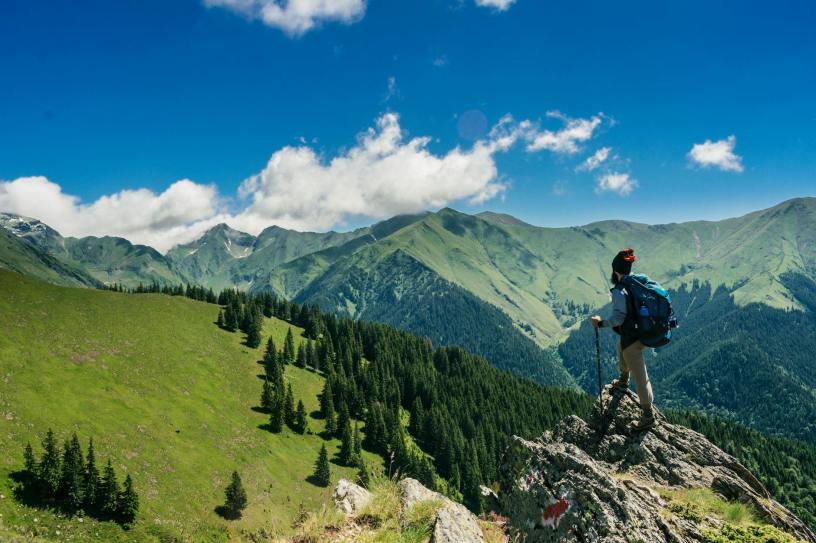
As I prepare to present at the upcoming Sunstone Symposium in Utah, I’m also readying myself for a chance to hike up into the Wasatch Mountains. While I spent my share of time on the benches of this mountain range as a Weber State University undergrad, I’ve often wished I’d invested more time and effort in the outdoors. I never did more than dabble as a young man. No longer.
This year, I have been hiking in earnest. Weekly if you count walks in and around town. Since creative writing is a big part of my life, I’ve inevitably begun trying to put my hiking excursions into words and Instagram reels. Here are two short pieces I’ve composed in recent days. They capture both hiking I have done here in Michigan, and my sentiments about heading back out West and into the high country of northern Utah.
The Demon Hiker’s Prayer
Chase me, sun of righteousness,
from nave to steeple,
from bench to belfry,
spy me siding
with Babel masons,
bake me on silicate beds
above a grand old lake
“Capisco! I know my fate.”
I will go up, for there is space
there, and I will take of me,
material, and make a man
who dwells. Yeah, buddy!
Amen.
360-Degree View
It’s off the beaten path, away
from the trendy road less traveled;
it asks for no donations,
you’ve already paid
with the rest of your life;
it neither wants nor needs
your presence,
but it will let you stay
Hushaby;
go,
don’t go;
you’re already there
Notes and Questions for Discussion
The Demon Hiker’s Prayer makes reference to Malachi 4:2 in the Old Testament (KJV). The quote that begins “Capisco…” comes from Salieri’s riveting speech in the Peter Shaffer play Amadeus, in which he rails against God for blessing Mozart and cursing him. The third stanza references Book of Abraham 3:24. This post’s featured image is by Andrei Tanase on Pexels.com.
What was your reaction to the above poems? In the poem 360-Degree View, what might “It” refer to? More generally, what effect does time spent outdoors have on you? Why?
 Wheat & Tares
I have had a generally negative experience with trying to embed Instagram reels in WordPress. So, for anyone who may be interested, here is a link to a reel which uses the poem 360-Degree View as voiceover in some footage I shot at Waterloo Recreation Area here in Michigan. As a lover of original film scores, I’m currently on a Marco Beltrami kick, including his score to the hit horror film A Quiet Place. The main theme is also featured. Enjoy!
@Jake C. What effect does time spent outdoors have on you? As a long distance trail runner I’d rather be outdoors than almost anywhere else. Two months ago just before my 50th birthday I did a solo run of Rim to Rim to Rim in the Grand Canyon. At 3:00 AM I passed a group of 10 hikers who murmured I should chill out because it’s dangerous running in the dark. If you step off trail you could fall hundreds of feet.
I’ve told my family that while I have no death wish, if I die in the wilderness it’s where I wanted to be. Perhaps counter-intuitively, since leaving the church and embracing agnosticism, death doesn’t really worry me. Dying does, but not death.
The “it” in your poem might be peace that comes from solitude in remote nature. Once on a freezing cold run in a winter desert I was listening to Beethoven and a musical climax hit me the exact moment I hit the edge of the shadow where the sun was peeking over the mountain. The sun warmed me and the music uplifted me. It was the most spiritual moment in my life and I remember thinking maybe Nature is God.
Toad,
I feel that with every fiber of my being.
Dang it, Jake! I had plans for tomorrow, lazy plans. Now I have to go into the mountains to find ‘it’ again, because it’s been too long. Both poems are beautiful. Thanks!
An ex-Mormon poet named Jake
Had free verse come out as he spake
The Q12 now dotes
On his Questions and Notes
But Jan Shipps considers it fake
farmerjosh2000, I’d say I’m sorry, but… enjoy the mountains!
Toad, I identify with your remarks in the same way lws329 describes. I bought myself a headlamp and have now hiked a couple of times in the dark. I’d say I was all alone, but we got BUGS. So, I was alone with regard to humans. Certainly some risk involved, though mostly manageable these days, but it has me wanting to go deeper into the woods, higher and farther… riskier, but with potential for even more peace of mind and sense of fulfillment. And a big YES on the music front. Hiking alone, I’m doing loop trails, and a lot of out-and-back trails. For the back/return portions of the hike, when the landscape is a repeat, I throw on the music and just try to settle in. It’s wonderful when the music and the vista coincide in some special way. Whatever “It” is, that’s a big component for me too
Thanks everyone for reading!
“It’s off the beaten path, away from the trendy road less traveled;”
I’m fascinated with the way the adjective ‘trendy’ contradicts the ‘road less traveled’. This line questions the non-conformist and asks if the non-conformist is simply conforming to something that has actually become the norm.
“it asks for no donations,you’ve already paid with the rest of your life;”
The contrast between donations (freely given) and paid (required). Yeah, I dunno how to finish that sentence. I was never great at poetry analysis. But paying the rest of your life. Like, the poem acknowledges that you’ve already paid the highest price possible. Is not asking for donations supposed to be a selling point? Or maybe it’s the rare acknowledgment that you have nothing left to give. That’s why you’re there, after all.
Also, I registered for the Sunstone Symposium today.
@JakeC I’ve been wanting to respond to your post but I’ve been travelling and doing so many errands. I’ve had a lot of thought swirling in my head regarding your question, what effect does time spent outdoors have on you? Why?
For me, outdoor time is where I go to destress, unplug, get balanced, and purge the noise, stress, and chaos of the world. I leave it all behind on my runs and I try to run as often as possible in nature. Granted, some of my runs are city runs for conveninence. But I cherish the nature runs (the more wild, the better). Like Toad, I am a distance runner. I feel closest to God when I am running or hiking in the wilderness and mountains. When I can feel my heart beating and my body working, striving is when I feel alive. It is a reminder of my mortality and the gift of a body I have been given, which has an expiration date.
A lot of times when I run I will queue up news articles, podcasts, and long-form journalism to have Siri read to me through my AirPods. I get through a surprising amount of content that way! But often I will take out my AirPods and just listen to the sounds of the neighborhood or nature around me. This is when I feel most at peace.
One of my favorite sports science journalists is Alex Hutchinson. He has a gift for parsing some of the most exciting scientific studies as it relates to human performance and health. In 2015 he wrote a piece in The New Yorker entitled How Trees Calm Us Down. In the article, he cites a University of Chicago study that found a strong correlation between the number of trees and health:
I used to think that expressing a fodness for nature was hippy-dippy stuff, but no longer. Aside from the increase in subjective well-being reported by so many from nature, there has been enough studies to show that spending time in wild nature with plentiful trees increases significantly the very healthy natural killer cells (this is a good thing). Translation: being in nature boosts your immunity. I probably also improves insulin sensitivity and perhaps reduces heart disease.
I’ll close this post with one of my favorite quotes by John Muir: “The mountains are calling, and I must go.”