
By the rivers of Babylon we sat and wept when we remembered Zion. There on the poplars we hung our harps, for there our captors asked us for songs, our tormentors demanded songs of joy; they said, “Sing us one of the songs of Zion!” How can we sing the songs of the LORD while in a foreign land?
Psalm 137:1-4 NRSV
It’s been about a week since the sale of historic assets by the Community of Christ (CofC) to The Church of Jesus Christ of Latter-day Saints (LDS). Many non-CofC people may be wondering just when we will get over it already and move on. Well, that’s a tougher task than you might imagine.
The $192.5 million (US) purchase price included quite a variety of items, from buildings in Nauvoo and Kirtland almost 200 years old to manuscripts, journals, portraits, and, oddly enough, even the original door from the Liberty, Missouri, jail where Joseph Smith, Jr., was once incarcerated. But the sadness, heartache, anguish, mourning, and anger that continue to roil the church are pretty much centered on the loss of the Kirtland Temple.
That’s because the Kirtland Temple (or more accurately titled, “The House of the Lord”) is more than simply a treasured historic asset. Ever since the Smith family and the Reorganization (and it’s always been hard to tell where one stopped and the other began) waged a legal battle in the late 19th century to secure title to the property, it’s taken on a somewhat mythic status for church members. In fact, I don’t think it’s much of a stretch to consider the Kirtland Temple the “spiritual home” of the Reorganization. And now it’s gone. But, then, so is the Reorganization. Let me explain.
Yes, the church, once it officially took on the new name of Community of Christ on April 6, 2001 (we do love that April 6 date in the Restoration movement, do we not?) still kept the old name, the Reorganized Church of Jesus Christ of Latter Day Saints, for legal purposes. So many documents would have to be changed and, perhaps more importantly, we didn’t want anybody else to start using the name. And there would certainly be groups trying to do just that. But at the very least, it must be admitted that the church has come a long, long way from its two founding moments: April 6, 1830, when the original church was organized; and April 6, 1860, when scattered remnants of the early church came together in Amboy, Illinois, with Joseph Smith III (the founder’s eldest son) as its prophet-president.
A key figure in both those events was Emma Smith. Interestingly, her famous portrait from September 1842 along with that of her husband Joseph, were included in the recent sale. The nature of portraiture, of course, is to make the subject look good rather than exactly how the individual looked in real life. That’s true for these two portraits. I have to admit that at first I was shocked and saddened the portraits would be removed from the Community of Christ history museum in Independence, Missouri. For the most part, Emma and Joseph’s descendants have been part of the Reorganization, often in pivotal leadership roles. That included the office of prophet-president from Joseph Smith III to three of his sons, Fred M. Smith, Israel A. Smith, and W. Wallace Smith, and the latter Smith’s son, Wallace B. Smith. Plus, it is well known that Emma and Brigham Young had a contentious relationship. Actually, they simply despised one another. That’s a story for another time, but it’s worth mentioning that it’s only in the last few decades that the LDS church has looked favorably on Emma.
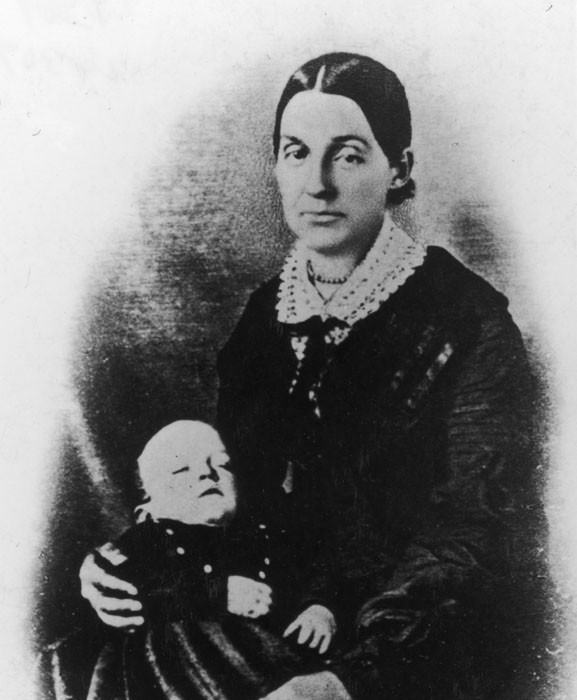
I can’t help comparing Emma’s 1842 portrait with the 1845 daguerreotype at the top of this post, which shows Emma with the youngest of her eleven children (most didn’t survive long, sadly), David Hyrum Smith, who was born in November 1844, five months after Joseph was killed at the Carthage, Illinois, jail. Notice, I use the word “killed” instead of “martyred”; we prefer the former term in Community of Christ. Once again, that’s a story for another time.
Look closely at that daguerreotype and you’ll see a woman who had been through a lot, enduring one hardship and crisis after another from Pennsylvania and New York to Kirtland, Ohio, to northern Missouri to Nauvoo, Illinois. And there she is, a widowed mother of young children, holding the youngest who’d never known his father. Behind Emma’s tired eyes I see pain and heartache, a history of hard choices.
This is the woman who, after the Missouri governor’s infamous Extermination Order, with Joseph in Liberty jail that winter, fled with her children across northern Missouri, crossing the frozen Mississippi River to an uncertain future in Quincy, Illinois. And, oh yes, under her skirt she carried the unfinished manuscript of Joseph’s biblical revision. What is known today by the CofC as the Inspired Version of the Holy Scriptures and by others as the Joseph Smith Translation (JST). That manuscript was part of last week’s sale, too.
There’s good reasons why the Reorganized Church has sometimes been referred to as Emma’s Church. This week I’ve been thinking about Emma as my faith community recovers from the shock of the Kirtland Temple’s sale and begins to deal with the hard choice CofC leaders faced as they completed negotiations to ensure those historic sites could continue to be maintained properly. We won’t own them anymore, but at least they go to a buyer who I think will treasure that stewardship as we have. Four CofC apostles and the presiding bishop offer their perspectives in short videos here. They’re worth watching, especially the one by Apostle Lachlan Mackay, who is not only the church’s director of historic sites but also is a great-grandson of President Frederick M. Smith and, therefore, a direct descendant of Joseph and Emma Smith.
So, what is this hard choice faced by the CofC leaders and members?
Today the CofC can be found in more than 130 nations, and most likely a majority of its active members are somewhere other than North America. That expanding mission field desperately needs the financial resources of the so-called Developed World. There’s the stark reality that we couldn’t maintain historic sites AND support the mission of the church. So a choice had to be made: maintenance or mission? And what is that mission?
We proclaim Jesus Christ and promote communities of joy, hope, love, and peace.
To go along with that mission statement is the church’s vision statement:
We will become a worldwide church dedicated to the pursuit of peace, reconciliation, and healing of the spirit.”
This appears to be quite different from the idea of restoring the One True Church and its divinely authorized holy priesthood. Allow me to speak here as an individual member of the Community of Christ and not as an official representative. Keep in mind that instead of correlation we have as one of our 9 Enduring Principles, “Unity in Diversity.” That’s a polite way of saying there’s no one right way to be Community of Christ.
I know of no reputable scholar who can identify anything resembling a pure, golden era of the early Christian Church. Instead there were a multitude of communities following the “Way of Jesus Christ.”. Eventually, the Roman Catholic Church in the West and the Orthodox Church in the East became predominate; the “losers” typically were branded as heretics. My point is: How can you restore something that never existed?
Several decades ago the RLDS Church began to back away from its One True Church position as well as the question of which church is the rightful successor to the one organized by Joseph Smith. I believe a better approach is to say none of the current churches in our wide religious movement are exactly like that 1830s organization. But we can all be true and faithful to its spirit while diverging in significant ways. Certainly one of those ways has to do with priesthood. The RLDS/CofC has been ordaining women since the mid-1980s, and more recently has specifically extended priesthood ordination and observance of sacraments (especially marriage) in many nations to the LGBTQ+ community.
All this is to say the leadership of CofC has, once again, been faced with a hard choice, perhaps its most difficult. We have been fond of saying, “Christ’s mission is our mission.” Now we have to live that, even if it means our long-cherished “spiritual home” is sold to somebody else who can physically take care of the building so we can more completely become the prophetic people we claim we are in our mission and vision statements. We can still visit Kirtland; it just won’t be “home.”
We have another temple, one dedicated in 1993 to the pursuit of peace. Its magnificent spiral shape signifies both the inward and outward movement of the Holy Spirit through contemplation and action. Our hymnal is filled with songs of justice, reconciliation, and peace as well as old favorites. Yes, we’ll continue to sing “The Spirit of God Like a Fire Is Burning” with gusto and passion (even if some of its theology makes us a bit uneasy).
Perhaps we’ll always be “Emma’s Church,” in one sense or another: a life filled with hard choices, joy, disappointments, and mountaintop highs. Most of all, a life that keeps moving forward, no matter what.
- What is your “spiritual home”? Why is it important to you?
- The Community of Christ and the LDS church continue to take divergent paths. Do you think the sale of these historic assets will further distance the two faith communities or perhaps bring them closer together in some way?
- Are “Correlation” in the LDS church and “Unity in Diversity” in the CofC true opposites, as the author implies?
- How might the choice between maintenance and mission be expressed within the LDS church? What other choices might the CofC and LDS churches face in the future?
 Wheat & Tares
Thank you for sharing and giving me an opportunity to ponder your beautiful thoughts.
Rich: I texted two friends in the C of Christ with the news last week. Neither had heard anything of it. Was an official statement issued to the congregations?
I was hoping that the copyright of the Inspired Version might be part of the sale, allowing the LDS church to publish it in full. Do you think that may happen in the future? Never say never!
I noted that the Smith Family cemetery in Nauvoo wasn’t included. Does it remain joint ownership?
Mark: As far as I’m aware the Smith Family Cemetery in Nauvoo is owned either by the Smith family or the Community of Christ. It is notably not part of the sale. Of course, had it been part of the sale to “Brigham’s church,” Emma would be violently spinning in her grave, I’m sure.
As for the copyright to the Inspired Version, I haven’t heard anything other than it remains with Herald Publishing House and the Community of Christ. Personally, I wouldn’t have a problem with that. It’s a steady moneymaker for the church, perhaps not quite as much now as in former days. I do recall during my years as a HH editor that the publishing house sold a LOT of copies of the IV to Deseret Publishing for sale in their bookstores. And I wouldn’t be surprised if that isn’t still the case.
I have a friend who’s a pastor, who tells me that he received a heads-up on the sale just before it was announced publicly. I do know the announcement was delayed until about a week or so after the church announced the Bridge of Hope retirement fund goal of $120 million had been reached, in hopes people wouldn’t think the asset sale was connected to Bridge of Hope.
One of the things that has fascinated me, even though I haven’t spent a lot of time doing a study on it, is the observation that Joseph Smith and even Brigham Young were New Englanders. Yet over time, the Utah Based LDS Church seemed to gravitate both religiously and politically to be more evangelical/southern based in its approach. The CoC seems to have gone in the opposite direction towards a more Unitarian/New England way of doing things. The LDS church with its correlation/maintenance/conservative rule adherence compared to the CoC embracing of diversity/female leadership/mission and vision in other words more liberal approach to religion. I think the sale entered into by both churches futhers both churches overall goals which appear to be as different as evangelical and Unitarian religious outlooks.
I didn’t know that so many other items were sold, along with the Kirtland Temple. It would be wrenching to part with so many items important to CofC’s heritage. I hope that the Brighamite Church will respect all heritages, and not turn the Kirtland Temple into an overt missionary opportunity. It would be wrong to gloat.
As for the choice between maintenance and mission, the choice the CofC made is forward-thinking. As I watch the LDS church build more and more temples, I start to wonder when the upkeep costs for temples that probably won’t be heavily used will start to weigh on the budget. The LDS church has a lot to maintain.
The spatial notion of holiness is something I think about from time to time. This comes up sometimes in discourse about Israel and Palestine. Catholicism has its holy places and pilgrimage sites and all that.
I considered the thought that protestant christians had “evolved” or moved away from the idea that some places are holier than others. The (initial) disassociation from established hierarchical priesthoods seemed and focus on one individual “relationship” with deity seemed to correlate the the notion of not needing especially holy places anymore.
But then we have mormonism, which compared to most other mainline protestant faiths does have some very specific stipulations about buildings that are holier than others (temples) and also places (like the Kirtland area).
I sympathize with, but can’t really contemplate how CoC members must be feeling about the loss of the temple. Even in my TBM days, I don’t think I would have felt very upset if something like this had happened to the Salt Lake temple. I’ve never been very attached to it, or the idea in general that there are specific places on the globe that are extra spiritually special in general.
Just thinking aloud.
Side note, I’m wondering if Nelson will take a victory lap in the upcoming GC. It might be in poor taste, but I can’t see him NOT bringing it up as a victory and part of the fulfillment of “last days” type prophecies.
Janey: The “maintenance or mission” question will continue to be a major issue in a lot of churches, including my own. Thanks to a church building boom back in the 1950s and ’60s, combined with aging demographics here in North America, we simply have too many buildings. Even if we keep them, furnaces and roofs and electrical systems will have to be replaced.
Janey: In realigning it mission, the C of Christ (and earlier RLDS) made covert/overt efforts to eliminate connections to Mormonism (the name change is an example). Kirtland “House of the Lord” is revered by the minority conservative members who remain, but the supernatural events of history are downplayed.
Mark: I just checked on the church’s website regarding the Smith Family Cemetery. It is owned by Community of Christ but the church is considering gifting it to the Smith Family Foundation.
There’s a lot of helpful background information at http://www.cofchrist.org/news/ under Frequently Asked Questions.
Thanks, Rich. I just remember that both church organizations worked together to restore the cemetery. Does the C of Christ still have a historic foundation like the RTF that accepts contributions?
While the shift away from conventional Mormon trappings and truth claims has been unmistakable—one of the first things I noticed when I began fellowshipping with CofC as a seeker in 2020—it would be inadequate to assume the current sorrow and outrage are limited to older conservative members. John Hamer’s remarks on Beyond the Walls demonstrate that. Younger, and progressive members (older and younger) can be counted among the shocked and grieving. Really anyone for whom the Kirtland Temple has been an interfaith gathering point is likely among those with mixed emotions to say the least.
Thank you for this post, Rich
Mark: https://www.historicsitesfoundation.org/about1.html#:~:text=The%20Community%20of%20Christ%20Historic,sites%20owned%20by%20the%20church.
Thanks, Jake.
Here’s a link to John Hamer’s remarks, in case others would like to hear them:
The sale of the Kirtland temple makes me think of the transition of many non-Islamic places of worship (e.g., monasteries, churches, cathedrals, etc.) to mosques. There is an entire Wikipedia page that catalogues these and it’s very interesting to look at the historical images. Probably the most famous holy site that is contested and shared would be the Dome of the Rock (Jews, Christians, Muslims). But the Hagia Sophia in Turkey is also an incredible and fascinating testament to the integration, modification, and adaptation of one faith’s holy site to another. It’s a form of religious imperialism in my view.
I appreciated listening to John Hamer’s thoughts and emotion. It gives me better perspective of how many faithful might have felt throughout the ages from the Crusades to the Reconquista and the emotions and mourning that might have occured at the loss of their holy sites, and perhaps how the conquerers might have gloated or felt triumphant.
When I was on my LDS mission in Montreal, we went to St. Joseph’s Oratory on our preparation day. Quebec is a Catholic province with very low church activity remaining. Part of the reason that participation has dwindled so much is because the Catholic Church took such an imposing and all-encompasing role in every facet of the Quebecois’s lives. I think there are a lot of ill-fated historical parallels between French Canada and Utah with regards to political dominance that is contributing to increasing secularization and counter-culture in the Mormon corridor. But that is a discussion for another time.
Anyway, I used to look at all these wonderfully ornate buildings all over the province that were largely empty and I used to think (and I admit that sharing this thought now is embarrassing), “Wow, these sure would make amazing LDS temples.” I don’t think this way anymore. On another preparation day we attended a Sikh temple. I was blown away by the practice of free meals. Free meals, or Langar, is a tenet of the Sikh religion and serves meals to all for free, regardless of religion, caste, gender, economic status, or ethnicity.
Now when I look at our LDS temples, I wish that instead of spending hours and hours in the same instructional video doing ordinances by proxy, I wish that our temples served as more interfaith sites where all were open and all could benefit temporally by finding food, peace, and shelter from the troubles of life.
Janey,
I was fascinated by an old LDS church building that was bought and renovated in Pocatello, Idaho and turned into a short-term rental ideal for family reunions or large gatherings:
https://www.ksl.com/article/50347552/pocatello-meetinghouse-converted-into-airbnb-that-sleeps-40-with-arcade-basketball-court
In Idaho Falls, the LDS church donated an old meetinghouse to become a food pantry for the community:
https://www.eastidahonews.com/2023/02/local-food-bank-takes-ownership-of-old-latter-day-saint-meetinghouse/