
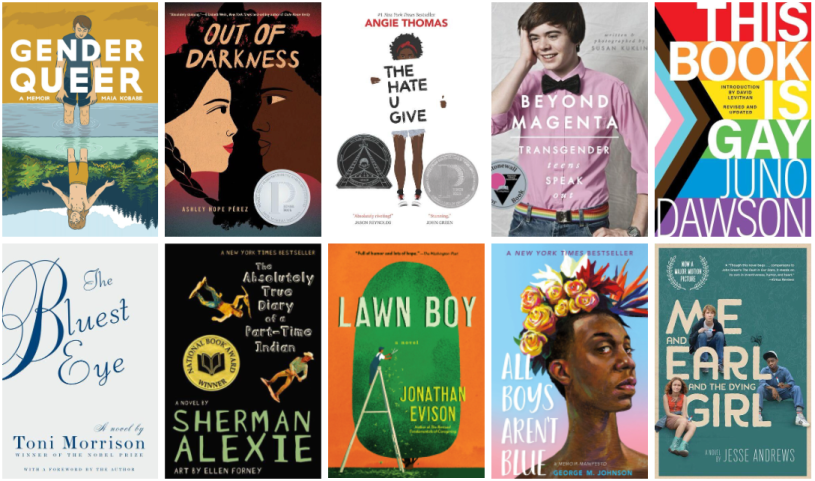
I was recently listening to a New York Times interview with Emily Drabinski, the president of the American Library Association, about the current rise in school book bannings. She made a few points that made me stop and think. I’ll put these into three categories:
Children’s rights to choose what they read. This is a very interesting core tension. There are extremes on both sides: parents’ rights groups like the questionably-named Moms for Liberty who want total control over all academic content their kids might access (to me it sounds like they want to dumb down public schools into Evangelical homeschooling), vs. authors of these books who want to recognize the importance of kids, particularly queer kids or racial minorities, to explore their identity and to read stories from their own unique perspective. Basically, the key question is who chooses what kids can read. Do kids have a right to choose their own reading, even if parents don’t like what they are reading?
This is one where I’m a little torn. When I was growing up, it was the norm that some books were flagged by the school as requiring parental consent for us to read, so that feels “normal” to me. However, I grew up in a household where my parents would just sign off on whatever the school was recommending; parental trust in institutions was high (as it was when my own kids were in school). Kids whose parents refused were viewed with some suspicion by classmates. We assumed their parents were controlling, infantilizing them, probably religious weirdos.
Something that wasn’t clear to me as a student was the process to approve these books. Now that I’m an adult, I’ve got a little more insight into this. I’ve shared here before that my daughter’s principal was fired over a book some parents objected to. The principal was near retirement and basically fell on the sword to protect the teacher (who escaped punishment). The book was on an optional AP summer reading list for juniors, so not required, but it didn’t have a parental consent form, and it hadn’t been cleared by the school board, which was the procedure.
One of my former classmates in my hometown is running to head up the school board on a platform of actually burning books. Another of my classmates (I went to school in a small college town in PA where these controversies are playing out right now) is tasked with personally reading 40K books to ensure there are no content problems. That strikes me as madness. There are also national readers that do this work and make these recommendations, so redoing it locally feels like unnecessary rework. AI programs have also been used to search books for objectionable content.
- Where is the line between parental control over their child’s mental life, and the child’s choice to read what they want without parental oversight?
- Should untrained, uncertified parents override academics on school content? Which parents?
- How does internet access figure into this discussion? As my daughter pointed out when we found out about her principal, every kid with a smart phone has instant access to actual porn and all kinds of content. Or as I countered, if kids want to hear profanity and sexual content, just go to high school. That’s where I heard it all.
Banning books = banning people. Drabinski’s main objection to the types of books the right has been banning is that they are books by and about marginalized people, specifically LGBTQ people and racial minorities. Her assessment is that the effort is not to ban content (“explicit” or “inappropriate” or “sexual” content), but to ban the individuals whose existence challenges a cishetero patriarchal supremacy. If we can shove queer people back in the closet, there will be fewer queer people. As Glennon Doyle said, “Being gay isn’t contagious; freedom is.”
One of the most banned books is called Genderqueer. It’s a graphic novel about someone finding out they are queer. It includes a cartoon illustration of a blow job. A friend of mine has been going out of her way to read the banned books, and she was concerned that the illustration made the book unfit for students. As I joked to her: “I agree! They should have to learn about blow jobs on the playground like we did!” She also had heard (erroneously) that this book was in elementary schools (due to it being a graphic novel). In reality, the book had been reviewed and deemed appropriate for ages 16+, and was intended for teachers and adults to read for their own education rather than for students. Should school libraries have this book? Should parents have to consent to their kids reading it? Does it depend on their age?
- Does banning the stories of queer people and people of color effectively ban their perspectives, giving preference to white, cishetero, patriarchal viewpoints?
- Should all sexual content be banned whether cishetero or queer? Where is the line drawn?
How books are classified. She talked about the example of how books about transgender people have been historically classified, and that this both reflects societal views and also reinforces those views. If you go back a few decades, those books were classified with books on abnormal psychology. Later they might have been classed with self-help. Now maybe they are in with either LGBTQ books or even just memoirs. These classification decisions shape our views and acceptance of people and concepts.
If you’ve ever watched old movies, you’ll see the way these attitudes pervade public thought. In the movie the Tender Trap, a character is talking to his therapist about his jealousy of his male friend’s success with women, but the therapist misunderstands and believes he is expressing homosexual feelings toward his friend. As a result, he treats him as abnormal, requiring extensive therapy. (This is played for comedy in the movie). Homosexuality was classified as a mental disorder at the time this movie was made. Books on homosexuality would have been in the abnormal psychology section.
Consider another possible classification. If there is a book on Mormons, it could be classified with religious books or if there is a section on conspiracy theories or cults, it could be classified there. Maybe it would depend on the type of book or the author’s intent. But where books on this topic are classified reflects how society views our minority religion. Is it sitting on a shelf next to books on Catholicism or next to books on Scientology? Who makes these decisions?
- Do you see how classification of books both reflects and reinforces societal attitudes about people?
Drabinski also made another fantastic (and I imagine, uncontroversial) point about the expansionist role libraries can play in society, providing more goods than just books. What a wonderful idea! She gave the example of a public library with a carpet shampooer. The waitlist was long, but being able to borrow it and return it was a huge benefit to locals.
My ears immediately perked up at this idea because on my recent trip to PA, an old classmate of mine mentioned (in response to my statement that I became one of those “pandemic puzzle people,” doing jigsaw puzzles) that there was one of those local free library boxes across from my Airbnb that also had a free puzzle box, a large cabinet where people could leave a puzzle they were done with and take one they hadn’t done yet. My first thought was what a wonderful idea (there is an accompanying FB page as well), and also that I wondered if public libraries also offer puzzles. If not, why not? Certainly puzzles are like books in that you could keep a book you love forever, but some books can be read once and returned. So it is with puzzles, and so it is with many many public goods. My hometown has also added a public piano in the town square. Anyone walking by can bring their own sheet music, sit down, and play. Nearby Lancaster, PA has 15 public pianos, decorated with artistic murals.
- Do you like this expansionist view of libraries? What other public goods do you think we should make available to all? What’s on your wish list?
- What if our wards had these types of locally available goods for signing out? Would this increase retention and the value of belonging to a ward? I have to think it might, unless they spoil it with a bunch of restrictions and rules [1].
I was also listening to the Velshi Book Banning podcast, an interview with Margaret Atwood (author of the Handmaid’s Tale). She was quick to point out that banning a book (which librarians hate) is not the same as restricting what books are available for school children based on age and content. However, as the interview unfolded, it was discussed that Shakespearean plays have been banned (due to “divisive” content), and Toni Morrison books (and books by other black authors) have been banned by some school boards due to portraying slavery in a bad light including some of the most disturbing aspects of enslavement.
The fact that some of these same schools are green lighting Praeger U. content shows the real agenda; it’s not protecting the children. It’s promoting simplistic and inaccurate narratives that paint conservative views and maintaining the status quo in a positive light, even when discussing slavery and recent civil rights abuses. They are claiming that schools are “indoctrinating” kids rather than teaching critical thinking, but their solutions all seem to be to . . . indoctrine kids. That’s fine if we want to raise a generation of dumb-as-rocks bigots whose worlds are rocked when they get to college and find out they’ve been lied to their whole lives. But then again, college attendance is also under fire, criticized as too expensive, unnecessary and “too woke.” Certainly these critiques have a kernel of truth that should be discussed, but throwing out the baby with the bathwater just leaves you with a lost generation.
Then again, there’s nothing that makes a kid more likely to read something than banning it. I doubt authors are going to deliberately seek notoriety to increase sales, but it seems to be a clear byproduct of banning that kids will be more interested in these books.
Discuss.
 Wheat & Tares
Not the major point of your post, but the local library where I live loans puzzles and random little gadgets like devices that let you check which electrical appliances in your house are using the most electricity. I’ve heard of libraries that loan out tools too. At least for someone non-handy like me, this seems like a great idea, as I’m only going to use them occasionally. Libraries are my favorite!
To your main point, I think you’re spot on about the book banning/”reclassification” being an awful trend that’s transparently about right-wing people trying to silence narratives about things like the horribleness of slavery or Jim Crow or American racism in general.
I homeschooled so I guess, I probably have to come down on the side of supporting parental control, if any control at all is possible. I wanted to control access to pornography and I still believe sexual pictures should be handled with care with children. I think factual sexual education should be offered that includes factual information about LGBTQ variables in the preteen years, or whenever the child asks about it. I think a parent would be misguided not to support this. They don’t know what their children may struggle with.
Good information can make all the difference.
However, if a parent wants their children to delay access to this information, I would delay access. But the reality is that ultimately they are choosing to have this information taught to their children by peers or Google, without the benefit of their parent’s values. The reality is that information is impossible to control with children and eventually they grow up to be adults and a parent has no control. A parent is wise to support and teach critical thinking. A child should be taught to consider the source of information and the motivation and context of that source. Today they need to be taught to compare sources and to always be open to the fact that they can be wrong, misinformed, or information can change.
My family loves libraries both in person and online. While I would object to a graphic novel with pornographic pics in a library, most other books are fine by me. I think any parent ought to be thrilled if their child wants to read any book. Honestly the best way to educate a child is to get them excited about books. Sometimes it can be challenging to find just the right book for a kid with reading disabilities. But the main point would be to find that book that motivates them to overcome their difficulties and read any way. Audio books are just as valuable for building vocabulary and love of reading. Trashy romantic novels and comic books are highly valuable in teaching vocabulary and love of reading. Classic books have their place once a person already loves reading.
I love libraries and teachers and it’s sad to think of people being fired for sharing any book. My library had a seed library for a while which I loved. (I am a gardener.) But eventually a new librarian who didn’t garden didn’t get it and threw it away
I’ve often wished for a neighborhood tool and yard maintenance library. The cost to rent a power washer or a chipper or a carpet cleaner is almost as much as purchasing the item, but those kinds of things are used infrequently so it would make sense to share them between neighbors. Paying to keep it organized and fair (don’t use the tools for your business) would be the tricky thing. Maybe a website that would let people know what they have that they’d be willing to lend and on what terms.
I wish our church libraries could be actual libraries about all ideas related to Mormonism or spirituality, not just correlated materials. I’ve got plenty of books that I’d love to share communally. Can you imagine if we could check out books like “The Book of Mormon for the Least of These” or “Women at Church” from the church library? I’m sure there would also be books I wouldn’t like as much, but I’d imagine we’d be able to have different conversations at church with easier access to wider ideas. Correlation and book bans seem closely related.
I think there is definitely a distinction between banning books and curating appropriate content for children, but they often get conflated…sometimes accidentally and other times intentionally. I think most librarians take great care in how they curate the libraries under their care, and I’d probably trust a well-read librarian’s view of a particular book sooner than I’d trust a firebrand helicopter parent. However, parents are definitely the ones who know their kids the best, so I have no problem with requiring parental consent for some types of books…now firing the principal because a questionable book fell through the cracks and was read by students? That’s absurd.
No, Books shouldn’t be banned, ever. Yes, we should be careful about what content is curated for kids. If some kid really wants to read a book they can’t find at the school library, then there’s the internet, there’s Amazon, there’s the public library…parents need to stop overblowing this school library thing. The school library fight has way more to do with control and power than it does with actual books.
High school kids should be challenged a bit more in the content curated for them. Sexual content (within reason) isn’t even necessarily something that should block a book from high school shelves, but US society seems to be hyper-focused on sex for some reason..being way too open and explicit on one hand and pretending it’s not real on the other. I wish people would just treat it like the normal part of life that it is.
I’m most interested in the expansionist idea of libraries – I would love to see this. Public libraries are one of civilization’s greatest achievements, can you imagine if we had to try to invent them today? “Hey government, we’d like to make this giant building and fill it with books, movies, and music. It’s going to be paid for using tax dollars, and will be staffed full-time by people also paid with tax dollars – their job will be to help people find cool stuff to read. Oh, and the general public can use this place for free and take the stuff home using the honor system…also we’re just hoping that people will magically be quiet and polite to each other while they’re here.”
Even when I was quite young, my mom would let me walk down to our local library branch where I would spend HOURS browsing and reading. Dinner was at 5 and the library closed at 9, so I’d eat as fast as possible then walk to the library and stay there until my mom picked me up at closing time. I was the oldest kid in a large Mormon family, so it gave me a safe, clean place to hang out read, listen to music, etc. while getting a break from the loud chaos of younger siblings. The library in my current city is truly awful, and it makes me sad – they close at 4 pm, it’s small and the book selection is poor. The librarians are great and they try to host good community events, but it’s obvious that it’s been starved for resources. We expect libraries to be this all-encompassing thing (e.g. the community carpet cleaner in the OP) – I’m all for it, but they need to be given the resources to do it.
Conservatives used to slam liberals for book bans. And not too long ago. Now it seems the majority of book ban requests are from conservatives. My how the roles have reversed. I always knew that conservatives claiming to be the true champions of free speech was one big charade.
I am going to vote for child control over what they choose to read. Parents can be woefully uninformed about what their child actually needs in the way of information, and often children do not have the words to even request the information they need. But when browsing at the library, they can often find something if it is available. All they might know is “something is off” whether the problem is parental alcoholism, gender dysphoria, sexual abuse, rejection by peers, bullying, being different or having different experience that they don’t understand.
I come by this opinion from my own childhood experience as well as experience as a social worker with many clients who needed information and had no way of finding that information. Parents want to protect their children, but seeing as the parent isn’t always with the child, the child needs information in order to protect themselves. They need information about sex to protect themselves from sexual predators, and “stranger danger” is not the biggest danger. Most children are sexually abused by someone the parent and child trusts. And sometimes the parent is the abuser, so getting “parental permission” to access the information just doesn’t help the child. Part of grooming the child is to keep them away from information and people who can prevent the abuse. So, guess which parents really want to keep their children away from knowledge about sex.
And if children don’t need information about a subject, chances are they will just put the book back as uninteresting because they just don’t relate to “feeling like a girl instead of a boy.” Children as young as 4 or 5 can start to recognize feelings of attraction to the same gender or feelings about being in the wrong kind of body. So, there is no “too young” to be needing to understand what is going on with them. Children as young as a few months can be sexually abused, so there is no “too young” there either. There is age appropriate though.
And children as young as kindergarten start to see that there are racial differences and that these differences can be “good” or “bad”. I picked up at 6 that my mother didn’t like “Mexicans” and she blamed it on their being Catholic, but next door, my blond cousin was Catholic and that was no problem. It was those dark skinned Catholics she disliked. Funny that she had no prejudice toward blacks. I knew not to tell my mother that my best friend at school was one of those dark skinned Catholics. Would it have helped me to fight my mother’s prejudice if there had been books at school about children with black hair, brown eyes, and darker skin. I have no idea because all the books available to me were about blond blue eyed children. I was in sixth grade before I found a book about a Porto Rican girl who lived in New York City. By then my Catholic friend from first grade had moved away. I asked the librarian about more books, only about dark Catholic girls who lived in Utah. The librarian just looked at me funny. I think I was trying to understand something about my friend and my mother that I didn’t have words for. So, not only do children of different races need stories about people who look like them, white kids need books about different people so they can learn that they are still people just like them.
So, I am in favor of the information being available in age appropriate words and concepts, and letting the children select the things they are interested in or the things they need to learn about. Let the children be guided by their own curiosity. If they are old enough to be curious, they are old enough for information. And like I said above, if they are not curious about that topic, they will find a book they want to read about something else. Children just plain learn better when we let them learn about the things they are curious about.
I never once saw a client that was harmed by too much information too soon. And the education experts say that if it is too much information too soon, the child simply cannot absorb it, so it is forgotten. I really don’t understand the panic, except that the Republican Party seems to want people panicking over guys dressed up as women reading stories to children, and not panicking about the 18 year old who goes down and purchases a AK47 and takes it into the nearest school and starts shooting.
If libraries loan out jigsaw puzzles, those puzzles will inevitably be returned with pieces missing.
An important part of the discussion that is often not mentioned is the distinction between book banning/burning and simply not purchasing that book for your library. Libraries have limited budgets and shelf space and cannot purchase all books, so decisions must occur. I have little sympathy for those who want to forbid or censor all access to a book (legally banning). I give much more leeway to a librarian or panel who has to curate what works to include in a collection. You can’t put all the books in. Someone has to make a decision along the line and someone will always be upset.
In 1981 the band Rush came out with a song “Witch Hunt.” Here are the last verse/chorus of the song:
They say there are strangers who threaten us
Our immigrants and infidels
They say there is strangeness too dangerous
In our theaters and bookstore shelves
Those who know what’s best for us
Must rise and save us from ourselves
Quick to judge, quick to anger
Slow to understand
Ignorance and prejudice
And fear walk hand in hand
Besides the music, you can hear a fire cracking in the quiet parts of the song. This song blew me away then and it still does now.
People talk about both the right and the left banning/burning books. I wonder where that idea comes from because virtually all of the calls for banning books have come from the right during my life. I’ve heard of those asking for Tom Sawyer or the Little House books to be banned but I never learned who was behind that only that they were on a list somewhere. Today though, it’s pretty apparent who is behind all the calls and actions in our country for banning books and it’s the right wing.
Maybe in other countries, the left wing has done it but then what’s really the difference between right-wing and left-wing authoritarianism? An authoritarian government suppresses freedom/liberty no matter if it’s left or right.
I think the crucial topic brought up was “Institutional Trust.” This is something we’ve been losing in our country for a long time. We’ve never had high trust in any government but it’s never stopped anyone from working really hard to get into the government to impose their own wills on others. But we’ve lost trust in Democracy as a principle, in communications, in compromise, is let people be people, in religion and churches. We seem to think the family is the only thing that can be trusted yet so many of our problems in society come from problems in the family so with declining marriage rates, do we really trust the family anymore? I think book banning/burning just shows that fear of basically all these institutions and the reasons for banning like LGBTQ, Racism, etc. are just excuses or justifications of the fear. People don’t want to even acknowledge a problem let alone try to solve one. Banning is just a way to ignore the problem.
Books I read in high school and the impact they had on me:
The Scarlet Letter. Still haven’t slept with a nun.
Huck Finn. Still haven’t sailed the Mississippi River with an escaped slave.
Lord of the Flies. Never desired to be marooned on an island with a bunch of dudes and a conch.
Brave New World. Still not interested in experiencing an orgy-porgy.
Of Mice and Men. Still don’t want to pet the bunnies George.
Farenheit 451: I guess I do own a flat TV that takes up a good chunk of the living room wall.
Catcher in the Rye: Hated this book and have never desired to be a Holden Caulfield-type though it seems he might have fit in more with the Gen Z crowd.
Crime and Punishment: Still not an axe murderer.
Pride and Prejudice: I suppose this novel has had an impact in helping me identify harmful attitudes.
The Great Gatsby: Hated this book. No desire to be a socialite.
Heart of Darkness: Africa is still on my bucket list.
King Lear (or any Shakespeare really): I don’t speak in iambic pentameter.
I’m pretty open to my kids reading anything. But my kids wanted to watch Squid Game so I watched it first and said no. Though they can watch the hunger games. Go figure.
There is a related question that I have pondered: what is the place for bad or dangerous ideas in a free society? I think people at the edges of the political spectrum often find dissenting views dangerous and worthy of suppressing. Is it safe to assume that good ideas eventually win out over bad ideas? Or do they? This is the kind of thing the social media platforms were wrestling with during the pandemic when misinformation was arguably costing some people their lives. Many platforms ended up taking measures to treat known misinformation differently than other posts, which led to people forming perceptions about the supposed biases of those platforms, fairly or not. I don’t claim to have answers, but anyone who thinks the answers to these questions are easy or simple hasn’t thought through all of the possibilities, in my opinion. Yes, Elon, I’m talking about you.
So, to the more specific question of book bans: I don’t think books should be banned from libraries that are meant to serve the full public. I do think that schools for children and their libraries are a special case, and it is reasonable to allow some limits on content. I think it’s OK for students to be allowed alternative reading if they object to something, and yes, there will be social consequences for that.
I like the idea of libraries being about more than books. One thing I’ve read about in the last decade or so is libraries constructing maker spaces. I personally would be interested in such a thing. I once tried using a community maker space and it was hard and inconvenient, with only very limited hours (it was used for university classes most of the time). If it were at my library and open any time the library was open, it would have been easier. Eventually I just used my class privilege to buy my own 3D printer, not an option available to everyone.
Chadwick: Hmmm. Squid Games was definitely very violent, to the point that I imagined an SNL low-budget knockoff skit where everytime someone gets hit with a bullet, a plate of spaghetti is thrown up in the air. It was just relentless and almost implausibly gory. But the series, IMO, had a lot of important things to say about poverty and the wealth gap. It wasn’t black & white either. I agree with your point that books don’t generally convince people to change who they are, but they can lead to social narratives and social acceptance that move the norms. For example, I heard a podcast interview with a person who currently identifies as non-binary who said that early on, they heard about someone who transitioned sex and that was immediately appealing, but then later they heard about non-binary (not transitioning, other than socially to a neutral) and that was even MORE appealing, so the possibilities were presented to them, not things they came up with on their own.
Instereo: I’ve had this same question about the left wing banning, and I don’t want to downplay it either, so here are a few possible examples if I dig deep: Song of the South has fallen out of favor and was yanked due to various factors including that the person who compiled the stories of former enslaved people did not compensate them at all. Some areas have dropped To Kill a Mockingbird (by the left) due to the white savior narrative and the fact that there are better narratives by actual people of color on this topic. There’s also the issue with politically correct culture that conservatives have derided on college campuses, and some students have protested certain books, professors, or visiting speakers because of an objection to their viewpoint. There is a 30 Rock episode that was memory-holed in which black face was used for comedic effect. Conservatives seem to want to ban books to preserve a specific narrative that feels like inaccurate white, cishetero-centrist propaganda to the left. Progressives seem to want to favor books that are, well, progressive.
Public education is a public good. I want your kids to be educated so that when they participate in our democracy, they do so in constructive, informed ways. That, I’m sorry, can’t happen if we don’t allow the professional educators to do the educating. The hubris of parents who feel so eminently qualified to silence the voices of professional educators infuriates me.
My friend is a pediatric surgeon. Imagine if some parent said to her, “No, we know our daughter best, and you can’t operate on her right leg, but we’re fine with your operating on the left one. In fact, we don’t want you operating on any child’s right leg. Ever. We’ll be speaking to the hospital board about this.”
Education and medicine aren’t equivalent fields, I hear some people just itching to argue. No, they’re not. But in large part that is because of our perceptions of educators, not because education is easier or better suited to novices or parents. Most parents can keep their kids healthy too; we still should defer to the professionals.
And if you really don’t want your kid to read a book, it’s not for me to stop you. But don’t you dare keep it from other kids’ hands.
Bert, our local library lends our puzzles and very few come back with missing pieces. It also has a toy library, which is great and just about every toy comes back whole. It is a great resource for the kiddies to see where their interests lie. I’m in Australia and we don’t seem to want to ban books either.
I want to brag about my library. I live in a small town of 8000. They have a Library of Things that you can check out. I went and looked and these are a few of the options: kill a watt electricity usage monitor, telescope, ice cream maker, electric fondue set, Zumba fitness kit, a huge selection of STEAM (Science, Technology, Engineering, Math & Arts) kits, kitchenware, board games, cultural passes, seed exchanges, a sewing machine, cordless 4-tool combo kit, tarot kit, musical instruments and my favorite – a micro light therapy lamp. I live in the PNW so with the 2 extra renewals I can use this for 9 weeks during the winter months for free. I tried an InstaPot and Air Fryer from there before I bought. There are many more items on the list.
And now to get back to the topic. They also had a table set up with a whole set of “banned books” for us to check out and read!
Re: this post and the comments that have followed.
I generally oppose attempts, whether from the right or the left, to ban books. However, SOME parental input is necessary vis-a-vis some books.
My grown children, and my older grandchildren, have formed a book club.
My 12 year-old granddaughter, a highly intelligent young woman, suggested that the book club read a certain book. Her aunt started reading the book, and found that it has a very graphic male-against-female rape scene. The aunt, my youngest daughter, alerted her older brother, my second son, of this, — who vetoed reading this book, in favor of another selection.
While children learn all too soon the unpleasant facts of life, I believe that such reading material is a bit much for a 12-year-old girl.
Thank you,
Taiwan Missionary
If we’re just talking about school libraries (or even minors at public libraries), I’ve always wondered why don’t libraries just give the vocal book banning parents what they *say* they want (which is quite different from what most of them actually want). What these parents typically *say* they want is to control which books *their* kids can access. It’s a parental control argument, and most people, myself included, have some sympathy for parental control/consent, in moderation, in schools. In order to give these people the parental control they say they desire, when a minor gets a library card at a school library or public library, their parent must choose one of 3 settings before the card is issued:
1. No restrictions. The kid can check out whatever book they want.
2. Fully restricted. All books must be pre-approved by parent before the kid can check them out. In order for the kid to check out any book, the parent must first give their approval (ideally, technology would be used for this, but it could just be a paper form).
3. Partially restricted. Only books with “controversial” content are restricted. In other words, the kid can check out most books without parental approval. However, if they want to check out a “controversial” book, then they need parental approval. Hopefully, some sort of national database could be used to determine which books are considered “controversial”. A more sophisticated approach would allow parents to preselect categories that they approve of: for example, they could say yes to books with depictions of grotesque violence and no to books with explicit sexuality, or vice versa.
Parents who like the way school libraries and public libraries have historically worked can choose #1. Parents who want more control can choose either #2 or #3. I can already foresee the vocal book banning parents still objecting to this scheme since their kids could still access all the books in the school library even though they can’t check them out. This could probably be addressed by cordoning off a section of the school library (this probably shouldn’t be done in public libraries because it would negatively affect adults) where the “controversial books” were contained that only kids with unrestricted library cards could access.
It seems like this sort of scheme would basically give the vocal book banning parents exactly what they *say* they want, so maybe it would shut them up??? I’m not really sure if it would shut them up, though, since what they really seem to want to do is use their kids to make a political statement by attempting to ban books containing ideas that they personally don’t agree with even if a large number of families would really like these books to be available to their kids. In other words, they are using book banning as a way to attempt to force their political views on an entire community. They say they just want to protect *their* own kids, so giving them the ability to control which books their kids can access *should* make them happy, but in reality, many of them seem to want to control the education of *all* kids by restricting the information available to them, so I doubt this would mollify them.
When I look at ratings on movies, the US system is harder on sex while the European is on violence. I guess that goes for books too. I didn’t remember the bj in Gender Queer (what stuck in my mind was the pap smear and how glad I’ve never had one) so I looked it up. On page 167 along with this caption, “But I can’t feel anything. This was MUCH HOTTER when it was only my imagination.”
Also in the book is this line, “At the library I began to discover more and more Queer books.” Kobabe, in the graphic novel, mentions many books and authors that that were impactful. And towards the end, “Looking around my class today: I wonder if any of these kids are trans or nonbinary, but don’t have words for it yet? How many of them have never seen a nonbinary adult? Is my silence a disservice to all of them?”
I think it is a disservice to ban books, to the kids trying to make sense of themselves, to those wanting to understand their friends and family and a disservice to the society in which they grow up
I don’t know where the line is drawn, or if there should be lines. But ignorance is not a virtue.
mountainclimber,
My kids’ English/Language Arts teacher did something similar for her classroom library, which seemed smart. She has her middle grade books separated from the teen books (she teaches 7th and 8th grade, so 11-14 year olds) and parents could either say their student can check out books from the teen section freely, or parent permission was needed for each book from the teen section (but the student would still have free choice for the middle grade level). I liked that all kids had free choices within certain boundaries. There’s a huge range of reading ability and maturity level at that age.
Parental consent is significantly important in my opinion. Our local school district had this terrible practice of providing material without parents’ knowledge and teachers who were recommending material that was clearly not age appropriate. So many of us parents raised a ruckus. Our proposal for a compromise was certain books (we all knew what they were) would require parental consent to be checked out if the child was under a certain age (16). Another proposal was that certain books on a VERY limited scale should not be in the library of the K-6 schools. Most people seemed to agree with that.
One parent tried to bring up the argument similar to what was noted above. That is, a phone or personal computer means you can pretty much see or read anything. I responded at a board meeting by saying that’s a cop out excuse and a parenting problem. My kids have access to technology but it is HEAVILY regulated and we have had no issues. I am not blind to the fact that they will see and hear things that are not appropriate elsewhere, but that does not mean we should allow them access willy-nilly simply because something creeps in elsewhere.
In the end, the proposed agreement above was the agreement that the district came up with and a parent/educator board convened to allow for discussion on certain books of questionable material and a compromise was struck. BUT….. we soon found out some teachers and librarians were willfully violating this agreement. To the point that they would hide the materials, tell kids not to disclose the information, purposely push the material, etc. A few parents and myself made a BIG stink out of it and I pursued legal action. Not to ban the books outright, but to adhere to the agreement we all agreed upon. And I admit, I pushed for the particular offending educator at my kids’ school to be tossed. She had multiple other issues and this was the last straw.
I for the life of me will never understand the thought process behind blind trust in educators and administrators. Their education and degrees mean very little to me when it comes down to morals and common sense. I think too many educators (not all, mind you) have an agenda to push and it seems pretty obvious to me when they do. And I think too many educators have very low opinions for parents who may not have degrees on their walls at home. I don’t see it that way. the smartest man I ever knew barely graduated high school, but I digress….
I would like to thank the current GOP for helping me find some really good reads. Here are some banned books I enjoyed:
Lawn Boy (I kept bracing for the alleged pedophilia; it never happened. I’d let a kid 16+ read it.)
Felix Ever After (13+)
Neanderthal Opens the Door to the Universe (13+)
All Boys Aren’t Blue (I may have enjoyed it more because the author was from Plainfield NJ 13+)
Call Me By Your Name (13+)
Ready Player One (was this really banned? 11+)
Some banned books I couldn’t get into:
Sarah J. Maas’ Court series
A Child Called It (seemed too far-fetched… sorry… I’m sure his life was hard but this seemed like hyperbole times 10)
Tricks (though reading a physical book might have been better than an audiobook)
I read a (probably apocryphal) story that a library started to require that a person who wanted to ban a book had to sit down and discuss the book in enough detail to prove they’d actually read it, and that once they put that policy in place, book banning practically disappeared. I’m betting a lot of book ban requests come from people who read some scary posts online, but didn’t read the actual book. And of course, the scary posts were hugely exaggerated.
The K-6 library is curated with kids that age in mind. Sometimes I read the book ban debate online and wonder if parents really think second-graders are being forced to read books written for 16+. If there’s a real problem, address the problem, but the conservative book banning wave is manufactured outrage and part of the culture war.
My son was supposed to read a particular book in sixth grade. I started reading it with him, and within a few chapters I decided we were just going to read the sparknotes online. The book had a strong focus on school bullying, and my son had just switched schools to get away from bullying. I was worried it would dig up a lot of trauma that he was still processing, and I didn’t want to read it either. I didn’t ask the school to ban the book; we just worked around it.
Our public libraries have educational toys to check out. When my kids were younger, we regularly checked out toy kits.
And one library had fine art to check out. I would bring home a new painting to hang in the living room every few months. The art checked out for three months, rather than the three weeks that you could keep books. That was really fun. I loved the fine art.
Nobody is “banning” any books. Limiting access by age is not “banning.” And, of course, parents should have say in the books their children read. But that does not mean that parents have an absolute right to compel a school library to remove a book. This will always be a “give-and-take” process where “compromise” must the order of the day.
No library can house all the books in the world. Curating is an ongoing process.
If you can’t find a book in your school or local library, you can get it on Amazon—unless the book is “When Harry Became Sally,” which Amazon refuses to carry for political reasons. You can get that book, however, online from Barnes and Noble, where it has been a top seller for many months.
You want to solve this problem once and for all? Support school choice. Then everybody can have pretty much what they want. This is called “liberty” and “freedom,” words, sadly, that have fallen out of disfavor in our society.
@Eric Facer, to be clear, schools are actually banning books right now. They are not just limiting access to books by age. It’s easy to google, but here’s one example: https://www.kuer.org/education/2022-11-29/these-are-the-22-books-removed-from-utahs-alpine-school-district. Sure, these books can be accessed in other ways, but there has actually been a big push to remove certain books, especially books dealing with racism and LGBTQ issues, from school libraries over the last few years.
Eric Facer: I don’t think that Liberty and Freedom have fallen out of “disfavor” in our society as much as they’ve been co-opted by a small group of people to mean what they want it to mean to them but not to others.
Technically you’re right about you can get banned books but when one parent can convince an entire school district like Alpine, Canyons, or Washington in Utah to remove a certain book or group of books from the entire school district, it’s that parent’s choice that is depriving other parents (and their children) the freedom to read what they may choose to read. Utah by the way has one of the most open school choice laws in the nation but like most “choice” programs, the more well-off you are the more choices you have. You’re also right about no school library can carry every book and they don’t but the problem comes when a book has been purchased, has gone through the school district process, and then is taken off the shelf because of one parent’s or even a few parent’s requests. This looks to me like the privileged few being able to dictate to everyone else their values.
Finally, back to Freedom and Liberty, we have a bill of rights that should apply to all of “We the people…” The real problem has always been it has never been realized in our society. There have always been groups that have been excluded from equal rights. It could be in housing, access to credit, education, or any number of other things. If the rights are universal, do they apply to everyone or just one group and how can we justify denying them to any group of people or even allowing for a path to obtain them? Public schools are called public because they are paid for by public dollars and operate in a public arena therefore the rights of all students/parents should be honored. If a group of parents doesn’t like that, they can choose, particularly in Utah, another option for their child’s school where they can have more say. It could be a private school or even a “charter” school that shares their value or finally a homeschool.
Eric Facer: I don’t think that Liberty and Freedom have fallen out of “disfavor” in our society as much as they’ve been co-opted by a small group of people to mean what they want it to mean to them but not to others.
Technically you’re right about you can get banned books but when one parent can convince an entire school district like Alpine, Canyons, or Washington in Utah to remove a certain book or group of books from the entire school district, it’s that parent’s choice that is depriving other parents (and their children) the freedom to read what they may choose to read. Utah by the way has one of the most open school choice laws in the nation but like most “choice” programs, the more well-off you are the more choices you have. You’re also right about no school library can carry every book and they don’t but the problem comes when a book has been purchased, has gone through the school district process, and then is taken off the shelf because of one parent’s or even a few parent’s requests. This looks to me like the privileged few being able to dictate to everyone else their values.
Finally, back to Freedom and Liberty, we have a bill of rights that should apply to all of “We the people…” The real problem has always been it has never been realized in our society. There have always been groups that have been excluded from equal rights. It could be in housing, access to credit, education, or any number of other things. If the rights are universal, do they apply to everyone or just one group and how can we justify denying them to any group of people or even allowing for a path to obtain them? Public schools are called public because they are paid for by public dollars and operate in a public arena therefore the rights of all students/parents should be honored. If a group of parents doesn’t like that, they can choose, particularly in Utah, another option for their child’s school where they can have more say. It could be a private school or even a “charter” school that shares their value or finally a homeschool.
As a homeschooler I agree with instereo. A parent shouldn’t expect to control an entire school. While I honor the rights of parents to homeschool I taught in a child led manner that honors the individual needs of the children. It’s important that a parent focus on what is actually possible instead of trying to achieve an idealistic vision of reality. If you can’t do it yourself at home, why do you expect the school to be able to do it when they don’t know your child as well as you do? Let go. You can’t control everything. Other people (including children) have agency whether you like it or not. Here’s a warning for those who think they have an obligation to control everything even as their kids get older: Try it and you will only damage the people around you and in the end, you will be alone (in this life regardless of any temple covenants).
Instero: You are wrong. A parent can only attempt to persuade a school district like Alpine, Canyons, or Washington in Utah, to remove a certain book from a library, but the school district—not the parent—is the decision maker. Other parents could oppose the request, if they like. But ultimately the decision is that of the school district.
To use your words, if a group of parents doesn’t like a school district’s decision to remove a book, there are other options where those parents can have more say.
You say that “public schools are called public because they are paid for by public dollars and operate in a public arena therefore the rights of all students/parents should be honored.” I agree.
But if a parent argues against an elementary school library placing “Gender Queer,” “Let’s Talk About It,” “Flamer,” or “This Book is Gay” on shelves and the school honors their request, are the rights of others compromised? On the other hand, if the school doesn’t honor their request, does that mean the rights of the objecting parents were compromised? This is why reasoned debate and compromise are essential.
By the way, if you were to read the aforementioned books aloud in a public school board meeting, you would be censured for your profane conduct. And if you were to hold up the graphic images they contain during a press conference, all TV coverage would immediately cease. Otherwise, the networks would be fined by the FCC. (Both of these things have happened on multiple occasions.)
You talk about “Freedom” and “Liberty” and groups excluded from equal rights. Tell me, then, how do you feel about Muslim elementary school children being force fed gender ideology by the public schools they attend? This is what is happening in Montgomery County, Maryland today.
Muslim law forbids believers from publicly discussing intimate acts. In prior years, the parents of these children were allowed to opt out of these classes. This year, however, the County is compelling attendance by all students in these classes, a decision it waited to make until the beginning of the school year. No one was forewarned.
What are the odds that someone at Wheat & Tares might stick up for these parents? (That’s a rhetorical question, by the way).
I realize this complex issue where passions can run high. And there is no simple solution. But too often those on the left are dismissive when the school to whom conservative parents have entrusted their children seems to be going out of its way to advertise that it views them, and their values, with utter contempt. And the right is also guilty, at times, of the same behavior. All I’m asking for is some nuance, humility and introspection when it comes casting stones at those who feel differently about this subject.
Eric Facer: There are elements of your comment with which I can agree, but then you steered into hyperbole with “Muslim elementary school children being force fed gender ideology” and you lost me. The school district’s policy is one of tolerance toward LGBTQ students, and books that refer to the existence of LGBTQ+ sexual identities are included in the curriculum. That’s not being “force fed gender ideology” unless you deny that LGBTQ people exist in society and have the same rights as other people. The problem some of these religious groups (including LDS) are facing is that they conflate exposure to queer people with queerness being contagious. To quote Glennon Doyle: “Being gay isn’t contagious; freedom is.” I disagree with the characterization that it’s force-feeding gender ideology to include 6-10% of the population, including some of these same (likely closeted) Muslim kids, in a description of who exists in society.
Eric Facer
Really Dude. Interesting choice of books (all non hetero), you are listing for an Elementary school library. How about discussing an actual children’s book like “and Tango makes three”. Or is the existence of penguins too insidious for innocent pure minds? Are all birds also subject to suspicion. Are mammals the only approved class(expecting the unnatural duck billed platypus). And yes this is me being dismissive, of straw men and false equivalencies. If you want to advocate nuance and introspection, then have some.
And yes I think Gender Queer is appropriate for a High school library.
And it’s not just school libraries and personnel under attack, this extends to Public libraries and librarians.
Eric:
In today’s society, we are all wrong. We find our news sources, gather our facts for those we agree with, blame the other side, and then ask for “nuance, humility, and introspection when it comes casting stones at those who feel differently about this subject.”
I’m sure you’ve heard of our country being called the “Grand Experiment” because it was such a departure from how European governments were at the time. It doesn’t matter if we call it a democracy, a democratic republic, or just a republic, we don’t really have a ruling class and are attempting as a country to be a “melting pot” for all people to come to. Instead of thinking of ourselves as German, Spanish, English, or Chinese, we think of ourselves as Americans. We’ve had people coming here from all over the world for hundreds of years, white, black, or brown. Looking at an individual, you can’t tell how long their family has been here and how much of a right they have to call themselves Americans. I just say this because I feel that once a person decides to come here, they really do want to look at themselves as Americans and have the opportunity we feel is our right here in this country.
The problem with the “Experiment” though is our country is an idea more than it’s anything else. It’s not really a location, a nationality, or a collection of people speaking the same language even though we speak English officially we communicate in many languages every day. Because our country is an idea, it’s hard to get people to remember that and get people on the same page. There are very few places where we can “gather” to learn what it is to be American. Schools are about the only place and I guess that’s why we have so many fights about them. Everyone wants their school to reflect their church, religion, neighborhood, politics, ideology, income level, or whatever it is they hold dear. People get discriminated against all the time by other students or neighbors and sadly sometimes even by the teachers and worse yet by the system. None of it is right. You’re right, it was the school districts that “banned” the books and not the parents who complained. But the school district capitulating says more about the tensions in our society than it does about the ideals of it.
I spent 43 years as a teacher and administrator in public education. If a person graduates in education today, half will be gone in 3 years, half of those leave by 10 years and half of those by 30 years or retirement. In other words, while there are a lot of teachers retiring at my age, those replacing us only 1 out of 8 will make it close to retirement. I have witnessed firsthand how schools have gone from an institution of trust to a battlefield. New teachers are overwhelmed by this atmosphere. People have become very territorial and tribal wanting their own institutions because they don’t trust anyone. This is really sad for our country, for our Grand Experiment, and for our children who really don’t even have a say in what’s going on now and will just inherit a world that we may have broken for them.
I also need to say that I’m the father/stepfather of 11 children. They have all gone to public schools. It hasn’t been all roses even when I was in the system. There are teachers some of my kids liked and others didn’t. Some were inspirational for some of my children and ho-hum for others. There were some conflicts with teachers and some with students that they had during school but they seemed to have grown up to be good productive citizens in spite of it. I never expected the school to be all things to them and made sure that I was a part of their lives and that our family values were expressed to them. The great thing that happened was as they grew they shared their new insights into life and expanded our family horizons.
It’s hard to have faith and trust in each other in our society today when we have so much division, name-calling, and expressions of hate. Is our country exploding or imploding or are we basing everything we do on fear instead of faith? It took a long time to get us here and it will probably take a long to change it to something better.
Angela C: When parents don’t have the option to shield their young children from an ideology that is wholly incompatible with their religious beliefs and their understanding of biological science, then their kids are being force fed. Or, they are being indoctrinated, if you prefer. The fact that Montgomery County had previously excused the children of these parents from gender ideology instruction and now compel their attendance proves my point.
These parents do not object to the school teaching gender ideology to others and—to respond to your straw man argument—they have never said anything contrary to the proposition “that LGBTQ people exist in society and have the same rights as other people.” And they have never requested that their children rather be shielded (not exposed) to LGBTQ people.
Instead, they simply don’t want their kids to be told by a teacher that it is “hurtful” when they express a religious and/or scientific view on the subject of gender ideology that is contrary to what Montgomery County is advocating. This, plain and simple, would be punishing and ostracizing a child for speaking her mind because she feels what she is being taught is wrong.
Montgomery County schools, as per the school district’s website, are teaching that “gender ideology” is true and that refusing to acquiesce is hurtful and wrong. Indeed, one school Board Member likened the Muslim, Catholic and LDS parents who disagree with this proposition to “white supremacists” and “xenophobes.” So Muslims are now white supremacists. That’s rich.
You’re right: The school district’s policy is one of tolerance toward LGBTQ students. But the district shows no tolerance for the parents of children who simply want their kids to be excused from classes that teach something contrary to biological science and their religious beliefs. Unlike Montgomery, they are not trying to force their views upon others.
Eric Facer: We’re going to have to agree to disagree about just who is being indoctrinated here, and who is doing the indoctrination. Religious indoctrination is allowed and protected, but so are the rights of ALL Americans, even queer people, to exist in the public sphere, and schools have anti-bullying policies for good reason. I honestly cannot imagine what you think “gender ideology” consists of that 1) schools are actually teaching, no excuse me, force-feeding innocent young children, and 2) is a threat to religious people holding their own opinions in their homes and heads, separately. Do you also object to evolution being taught to Evangelical kids? Do you object to black history month? It is hurtful to be intolerant of humans who happen to be queer, whether that’s a teacher or a fellow student, or a random person on the street. Let’s talk about strawman arguments: “punishing and ostracizing a child for speaking her mind because she feels what she is being taught is wrong.” Young children aren’t born bigots. To quote South Pacific, “you’ve got to be carefully taught” prejudice. There’s a reason that queer people “come out” but straight people don’t. Because there is already stigma heaped on them through social interactions and family prejudice (often but not exclusively religously motivated). Nobody is asking that children right the wrongs of society, just that schools protect marginalized people (and all kids) from bullying. Let’s not, in this process, confuse bullies for champions of free speech and religious liberty.
So hey, does anyone remember that scene from Indiana Jones and the Last Crusade? Where Indy somehow gets caught up in a Nazi rally, and he’s trying to get out of it but people keep pushing him forward, and all of a sudden he’s face to face with Adolf Hitler himself, sitting behind a table?
Indy sighs, realizing he’s been caught, and hands over the crusade diary. So Hitler takes it, autographs it, and hands it back.
Pretty silly, right?
Remember what was going on in the background of that scene? The pile of burning books?
Google the “Institut fur Sexualwissenschaft,” or “Institute for Sexual Research.” Berlin of the time was Germany’s cosmopolitan, metrosexual, “West Coast” city, and this place was their gender studies centre. Their LGBT+ centre. Their place for transsexuals to get medical care.
The Nazis and their many fans destroyed the place, burned all the research, and hunted down “sexual deviants” like the first trans woman to get vaginoplasty and killed them.
Why? The same reason they’re doing so now. Because we’re “sexual predators” who are trying to corrupt the children of good, honest, hardworking Aryan families. Children like me, who got the crap kicked out of them for so much as thinking about sex, let alone having it. Because existing in public while trans is grooming, R-rated, and sexual, but tossing your queer kids out to live in homeless camps under I-15 (and then having the police bulldoze them) is Parents’ Rights.
So is killing them when they grow up, killing them before they grow up, and destroying everything on the internet and in libraries and anywhere else that shows them that it doesn’t have to be like this. That someone like them can live, and grow up, and be happy and fulfilled and find love just like everyone else.
That’s gender ideology, ladies, gentlemen, and everyone in between.
That’s why people like me need to die.
And no, Angela C, we don’t have the right to exist in the public sphere, in a lot of places in the US. That’s being taken away from us, state by state. The bill mills have been putting out literal thousands of identical laws in state legislatures, that ban us from basically everything.
Which, speaking of laws, does anyone remember how people fought against bathrooms that weren’t segregated by race? How they went on about how Black people are perverts, and they’re going to corrupt and molest our pure, white and delightsome children?
No?
Okay, then.
Oh, and to the first person who wants to say this talk of killing the queers is hyperbolic:
I’ve seen your memes, I’ve read your Facebook walls, I’ve listened to how you talk with each other in person. At home, after church, during General Conference, when you think no outsiders are listening.
You’re lying to me.
And you’re possibly lying to yourself about the people you’re around. Because they really do mean it. Just ask their kids.
Where is the line drawn? There’s no perfect locale for The Line, but generally speaking a graphic depiction of sex, either in words or actual graphics, crosses a line. I’m tired of hearing that kids hear it all at school anyway from their peers. They can get also drugs from, be bullied by, or discriminated against by their peers. That’s not a logical reason for the administration to start passing out vapes and racial slurs.
I learned about BJs from friends, like everyone else, but seeing it depicted when I was a high schooler would have deeply disturbed me. Even regular ol’ sex as anything but the fade-to-cut of PG-13 movies would have been very troubling. So yes, I think some books need parental permission at least, or don’t belong in school libraries. There are probably plenty of teens mature enough to either not be disturbed by the images or not completely miss the point of a book as they giggle about the sexuality, but certainly not all.
I know far more ultra-conservative, Trump-won, homophobic, racist conservatives than I care to, but I’ve yet to hear one object to slavery being portrayed negatively. I’m not doubting that people like that exist, but to skirt around Toni Morrison’s bans having something to do with descriptions of rape and sawing a child’s head off (I assume this is what is euphemistically implied by “the most disturbing aspects of slavery”) is a disingenuous simplification of the issue. There are far too many books about slavery, the Holocaust, and minorities that go unchallenged in schools to keep regurgitating the same arguments about bigots (except with respect to homophobia, because I can easily imagine And Tango Makes Three being banned up and down the Jello and Bible Belts).
Lastly, I’m wondering if all the same arguments hold up when considering bans on Little House on the Prairie, Huck Finn, and Dr. Seuss.
Tamanari,
I believe you. It’s terrifying.
Laurel
“Where is the line drawn?” (every time I hear this, I hear the voice of Captain Picard in reply). They’re are people and legitimate organizations that study child development and literature. So I’m guessing some people have some expertise at determining age appropriateness based on a rational criteria.
Just because it’s a graphic novel does not mean (to use another meaning of the word) it’s graphic.
How does one have sex education in schools with out a wee bit of detail.
I know of a young boy in k through 8 school(okay, this was over twenty years ago but it is applicable) who wore a green tshirt with the text of the ERA on it. It was quickly disallowed because it had the word sex on it. Now this was a Waldorf method public school, and they fancied themselves an art school. So the very next morning, the boy was deliberately(and with his consent) placed in a tshirt with the Creation of Man by Michelangelo from the Sistine Chapel emblazoned om the front. He spent all day with a naked man full frontal on his chest, and no teacher or administrator said a word.
That’s my graphic story.
Tamanari: to be clear, I am very aware of the anti-trans bills, and it’s absolutely sickening.
Good questions, Quentin:
“There is a related question that I have pondered: what is the place for bad or dangerous ideas in a free society? I think people at the edges of the political spectrum often find dissenting views dangerous and worthy of suppressing. Is it safe to assume that good ideas eventually win out over bad ideas? Or do they?”
Best I can see, it’s all a mixed bag. I don’t think we truly recognize the effects many ideas will have. Like, *how* courts decided to selectively enforce antitrust laws, starting around the Reagan administration. Over the next forty-something years, we now have fewer corporations that own large swaths of business in our economy. One study estimates that the average family now pays ~$5000 more per year on goods because of the loss of competition.
Some persuasive people have convinced many people that so-called job creators (corporations & ultra wealthy people) should pay low-to-no taxes. Legislation that lowered their taxes didn’t actually tie it to job creation. Thus, venture capital firms that profited grossly by destroying profitable companies (such as Mervyns & Toys R Us) were included.
The low-to-no taxes have also facilitated our billionaire class. Last checked, there were <800 billionaires in the US. That's a lot of power misplaced on a few, sometimes ruthless, people.
There are good ideas, too. By good ideas here, I'm thinking of things that benefits most (with ideals of benefitting all) people:
Democracy. Free public education. Legislation like the FMLA (haha, I've heard avowed conservatives reminding people it is their right, clearly not recognizing the huge fight conservatives put up against its passage). Civil Rights The Voting Rights Act. ADA, the ACA, etc. So many.
It seems like it is easier to tear something good down, than to create good things.
To circle back to the OP a bit and where to draw the line: Awhile back there was another book banning post about people challenging the Bible being on school. The challenge was submitted on the same grounds of “violent and sexual content” to poke a finger in the eye of religious zealots challenging books they didn’t like. I think it was a fair point to make – same with the BoM. I still remember being a young kid and feeling physically ill enough to leave the room during family scripture study when we were reading about when Captain Moroni scalps Korihor and holds it up like a trophy…my parents felt bad and were more careful after that. Or how one of the first BoM stories kids learn is Nephi murdering Laban…but it’s ok because he didn’t really want to it, but God (the exact excuse of every murderous religious fanatic ever to live).
In short, there’s not a clear line that can be drawn…it’s messy gray blur, and it will always be that way.
I don’t think any loud parent should be able to pull any book they don’t like, no matter the reason. I also think it’s reasonable to exercise some caution, curate thoughtfully, and have parental gatekeeping for some content. There is a reasonable middle ground here, but the reasonable people are needed to find and implement it.
Suzanne Neilsen, I was curious what an ungraphic graphic of oral sex looks like, and after looking it up I’m not sure what’s left to be considered a truly graphic depiction. Pretty sure I can’t post it here. I’m also wondering why such images are a necessary part of learning to empathize with LGBTQ+.
I’m also curious what the experts have to say, if there’s agreement among them. I’m only aware that exposing children to porn can be considered sexual abuse, based on studies that written and visual depictions of sex “intended to cause sexual excitement” are damaging to children, including teens. I assume there was no such intention with the authors in question, but if the images are the same, but in cartoon or written form, is it such a stretch to worry that they’re also harmful?
For the record, I’m all for better graphics than I got in sex ed in the early 90s. They were so vague I couldn’t even figure out what part of me they were meant to represent.
I think we can both agree that that Montessori school was stupid, and admire the parents’ well-played reaction.
Laurel
Ah, the age old question when does art become pornographic.
What I will say is there could be a heck of a lot more explicit detail in various drawings in the book. The menstrual blood was a bit much. But I think that might be because I had the same reaction to me having a period.
But the book is a memoir of someone trying to my sense of their life. There is no prurient intent. It is not lascivious. It does not titillate. And even though it is clear what is going on regarding oral sex on a dildo, it could of been way more detailed.
We come to understand why Maia Kobabe identifies as non binary and on the ace spectrum.
I read the book to see what the fuss was about. Kids these days. I really don’t get the whole nonbinary thing, so for me it was educational.
As for why it should be available in High School libraries, here’s a quote from an article –Banned in the USA Spotlight: Maia Kobabe By Lisa Tolin
“What would it have meant to you to see a book like this on the shelves when you were younger?
I spent my teen years searching for queer stories … And I was so hungry for queer stories, and I was so hungry for stories that touched on gender. And I was able to find very, very few. But I think if I had been able to find a book like Gender Queer as a teenager, it would have meant the world to me… I would have probably read a copy of it until it fell to pieces. Because I was just so desperate to figure out who I was and to find the answers to the questions that I had. And I really couldn’t find them until I was much older. I think it just would have meant the world to me.”
As important as it is to learn about others, people need to see themselves. To connect, and be less alone in a world that wants you dead. So I will continue to advocate for all minors who need it, to be able to read it.
I’m late to the discussion, but I just completed my MLIS thesis on this very subject. I’d like to weigh in, and I’m trying to condense an 85-page thesis without going overboard.
1643: Printing Ordinance of 1643 – Meant to stop “abuses and frequent disorders in Printing many false, forged, scandalous, seditious, libellous, and unlicensed Papers, Pamphlets, and Books to the great defamation of Religion and Government.” Only Parliament’s licensed printers allowed to print and they could arrest printers and seize equipment and printed material.
1749: Memoir of A Woman of Pleasure (AKA Fanny Hill) – Printed in England and the colonies. Quite explicit for its time, and also fairly popular.
1765: Stamp Act – Meant to raise money to pay of war debt, but added bonus of controlling colonial presses.
1789: First Amendment of the Constitution – Religion, speech, press, assembly, and petition rights not to be infringed by government action. No more prior restraint on speech and the press.
1873: New York Society for the Suppression of Vice (NYSSV) and the Comstock Acts – Society formed by Anthony Comstock, and the laws were named for him. The NYSSV literally seized and burned what they considered immoral books and printing (including Fanny Hill). The Comstock Acts prohibited anything immoral (specifically mentioning sex); information and means (medical implements, medications, etc.) of abortion and birth control from being sent through the US mail.
Targeting the mail essential censors everything as it was the means of getting information out, neatly circumventing the First Amendment.
1886: Markland Letter – Published by Moses Harman in the Kansas newspaper Lucifer, the letter by Dr. Markland mentioned a husband forcing himself on his injured wife and likened the husband’s penis to a knife as an instrument of murder. Harman was convicted and sentenced to five years imprisonment and a $300 fine because he sent the newspaper through the mail. The word penis is as graphic as the letter got.
1896: Rosen v. United States – Supreme Court adopts the Hicklin test for determining obscenity, based on the English case Regina v. Hicklin (1868), which established banning a publication if it had a “tendency… to deprave and corrupt those whose minds are open to such immoral influences.” Supreme Court did not consider the First Amendment in this case.
1957: Roth v. United States – Supreme Court finally consider the First Amendment, and does away with the Hicklin test, for the Roth test, which established: 1) Obscenity is not protect by the First amendment. 2) Sex is not synonymous with obscene. 3) Obscenity appeals to prurient interest (it excites lustful thoughts). 4) The dominant theme of the whole work must appeal to prurient interest to be obscene. 5) “All ideas having the slightest redeeming social importance . . . have the protection” of the First Amendment.
1966: Memoirs v. Masschusetts – Lawsuit to unban Fanny Hill. Supreme Court revises Roth test to determine social value independently of the prurient interest. Fanny Hill determined not obscene, first time since 1873 when Comstock went into effect.
1968: Ginsburg v. New York – Obscenity depends on audience. What is not obscene for adults may be obscene to minors. Very vague, no real guidance, and still relies on Memoirs v. Mass for the obscenity definition, just now the jury needs to consider whether it’s obscene to minors.
1973: Miller v. California – the definition of obscenity that holds today. (a) whether “the average person, applying contemporary community standards” would find that the work, taken as a whole, appeals to the prurient interest, (b) whether the work depicts or describes, in a patently offensive way, sexual conduct specifically defined by the applicable state law, (c) whether the work, taken as a whole, lacks serious literary, artistic, political, or scientific value. All elements must be true or the work is not obscene.
1982: Island Trees School District v. Pico – Students sued to stop books from being removed from libraries and curriculum. Supreme Court Plurality (4 justices) opinion (because they couldn’t get a majority), determined schools/boards/districts cannot remove or censor material based on disagreeing with ideas or political motivation. Any other reason is okay.
Modern day stuff
2021: Spotsylvania Virginia School Board meeting – Spoken by two school board members, “I think we should throw those books in a fire,” and “see the books before we burn them so we can identify within our community that we are eradicating this bad stuff.”
2022: SB775 Missouri law – Makes illegal “providing explicit sexual material to a student” targeting those “affiliated with a public or private elementary or secondary school in an official capacity.” Class A misdemeanor punishable by up to 1 year in jail and up to $2,000 fine. Sexually explicit is not really defined, but is not the same thing as obscene by the Supreme Court’s definition.
2022: Jamestown Township, MI Patmos Library – Received a “complain[t] about Gender Queer: a Memoir, by Maia Kobabe,” which resulted in “dozens show[ing] up at library board meetings, demanding the institution drop the book.” The library knew that the book included “depictions of sex,” so they located the work “in the adult section of the library.” Because the librarians wouldn’t remove the book entirely, the township voted to defund the library. Twice.
2022: Virginia Beach Barnes & Noble – Tommy Altman, who ran for Virginia’s second Congressional district, sought a court order to restrict Barnes & Noble from selling works that “should be considered obscene for minors” like Gender Queer by Maia Kobabe and A Court of Mist and Fury by Sara J. Maas. The case is dismissed, but shows the book-banning trend is moving outside of libraries and to private sellers.
More laws have been passed since my thesis was published, too many to list, including in Utah. One of the books challenged in Utah was the bible (as previously mentioned on this blog). Yet it was reinstated, but not because it wasn’t sexually explicit (it is), but because it had value to the community (religiously inclined, mostly Mormons).
The parents’ rights argument is spin. No parent has lost the right to moderate what their children read and consume. They can always check backpacks and such for school library books. Most schools probably wouldn’t have a problem sequestering books in a special area so that parents who put in a request to stop certain books from being checked out by their child.
These bans are about making those parental choices for everyone. While I’m sure many parents would be offended by the LGBT-themed books, there are no doubt some parents who are fine with their children reading these books. If those books are removed, those parents no longer can have that choice for their children.
Certainly, it’s true that they can go to public libraries (except Patmos and any others facing defunding) to find works, but that only applies to urban and suburban areas. In many rural areas, the school library is the only library accessible to both parents and students. County libraries may be too far away for them to readily access.
The practice of banning books throughout history and the modern day is not about parents’ rights. It’s about societal control. Parents still have the absolute right to determine what books are read in their homes, what media is consumed, and what lessons are taught to their children in the home. They do not have the right to insist on making those decisions for all parents in their homes.
Banning “sexually explicit” books is an attempt to circumvent the Supreme Court’s definition of obscenity by relying on the presence of minor passages instead of the work as a whole. Sexually explicit or graphic could be used to refer to anything, such as Anne Frank’s use of the word clitoris or a confession that she would like to kiss a girl, both found in in the Definitive Edition of her book. O what of this line that appears in Andy Weir’s book The Martian: “Look! A pair of boobs! -> ( . Y . )”
I asked why the scene was important, not the book. If the author felt the book being in schools was so important, they wouldn’t have prized their “artistic expression” of oral sex over giving a reason to ban it.
There are some not particularly bigoted people who think explicit sex scenes are inappropriate for high schoolers. Why that is so appalling to other people is beyond me.
…over NOT giving a reason…
Laurel: the author of GenderQueer did NOT think the book should be in school libraries (for students). The author said the book was written for adults, and particularly of benefit to teachers. The national organization that assigns appropriate ages to books said it’s 16+.
Laurel
What I would ask is why are we treating High Schoolers as kindergartners.
The book is a memoir of a graphic artist trying to understand themselves as they reflect on their experiences. Maia Kobabe has stated many times she wrote this in response to trying to come out as nonbinary and asexual to family and friends. It marketed as a 16plus by the publisher. It was awarded an Alexa award by the American Library Association because they believed it was a book written for adults that had merit for young adults.
As for that page 167, while it is explicit for a high school library (oral sex on a dildo), it is NOT pornographic. The text reads “This is the visual I’d been picturing”, next frame “But I can’t feel anything. This was MUCH HOTTER when it was only in my imagination.”
From an interview with Kobabe in Slate “What to Do When Your Kid Is Reading a Book That Makes You Uncomfortable” by Dan Kios
“Does that just reflect the kind of art you wanted to make? What do you think caused you to not make it more explicit?
I mean, I put in everything that I thought was relevant to the story of gender, and there are mentions of masturbation, and period blood, and a very brief encounter with a sex toy. But they’re only lightly touched on because what’s important is how they helped me think about my gender identity and that’s what I was really trying to focus on. So I was like, “I’m going to include these as much as needed to explain how they shifted my of journey of self-discovery in regards to gender.”
And “What I’m learning is that a book challenge is like a community attacking itself. The people who are hurt in a challenge are the marginalized readers in the community where the challenge takes place…That is queer teens who might not feel comfortable bringing a book with such an obvious title into their home, if they have more conservative parents who would only feel safe reading the book secretly in the library without even checking it out. So yes, it upsets me because what I’m seeing is resources being taken away from queer marginalized youth, which does hurt. ”
And I will add that the age of consent in many states is 16.(I favor 26, after the prefrontal cortex is sufficiently developed) Utah is 18 but has a Romeo and Juliet exception. So Utah allows for the explicit sexual activity of minors, just as long as they don’t read a book about it.
Angela C — Then the author and I agree. However, given that the author has said this book would have been useful to them “specifically like when I was a freshman in high school,” it would’ve made more sense create content more appropriate to that age group.
Suzanne — I don’t think we’ll agree on the nature of the images. Re: the kindergartner comment, tho — per Angela C’s comment, it sounds like we’re treating them like 15-year-olds, but that doesn’t make for as good of hyperbole. And the “kids have sex so they might as well see sex” argument is very similar to “kids already hear it at school.” It doesn’t mean the school should be providing it, or requiring it for a grade.
Suzanne Nielson: Here’s a creepy little foray into the extremes of parents’ rights. This is an exchange between two Missouri state reps, Peter Meredith (D) and Mike Moon (R) about Moon refusing to raise the age of consent which is…TWELVE.
Moon: Do you know any kids who have been married at age 12?
Meredith: I don’t need to.
Moon: Do you know any kids who have been married at age 12? I do, and guess what, they’re still married.
When pressed, he defended his support of 12-year olds getting married stating “You clearly did not understand. Her parents consented–no force. Their marriage is thriving.” So, because the parents agreed to it, he’s claiming the 12 year old child was not coerced into marriage.
Angela C
That is creepy.
What I also find creepy, is that many of the people braying loudly about banning books, also want to force 10 year old rape victims to give birth. I wonder what the Venn diagram of that looks like.
On a more cheerful note, there’s a story my mom told about doing her duty trying to see her kids got cultured. She drug (dragged?) her little ones to the Prado. But all they did was run from painting to painting yelling, “Here’s another one with no clothes.” Geez, kindergartners.
I just complete my MLIS thesis on this very subject. I’d like to weigh in, and my first two attempts at joining the discussion were apparently too novel-length.
1873: New York Society for the Suppression of Vice (NYSSV) and the Comstock Acts – Society formed by Anthony Comstock, and the laws were named for him. The NYSSV literally seized and burned what they considered immoral books and printing (including Fanny Hill). The Comstock Acts prohibited anything immoral (specifically mentioning sex); information and means (medical implements, medications, etc.) of abortion and birth control from being sent through the US mail.
1968: Ginsburg v. New York – Obscenity depends on audience. What is not obscene for adults may be obscene to minors. Very vague, no real guidance, It relies on ad-adjusting the obscenity definition of adults (in Miller v. California, below).
1973: Miller v. California – the definition of obscenity that holds today. (a) whether “the average person, applying contemporary community standards” would find that the work, taken as a whole, appeals to the prurient interest, (b) whether the work depicts or describes, in a patently offensive way, sexual conduct specifically defined by the applicable state law, (c) whether the work, taken as a whole, lacks serious literary, artistic, political, or scientific value. All elements must be true or the work is not obscene.
1982: Island Trees School District v. Pico – Students sued to stop books from being removed from libraries and curriculum. Supreme Court Plurality (4 justices) opinion (because they couldn’t get a majority), determined schools/boards/districts cannot remove or censor material based on disagreeing with ideas or political motivation. Any other reason (by other people *cough* parents *cough*) is okay.