
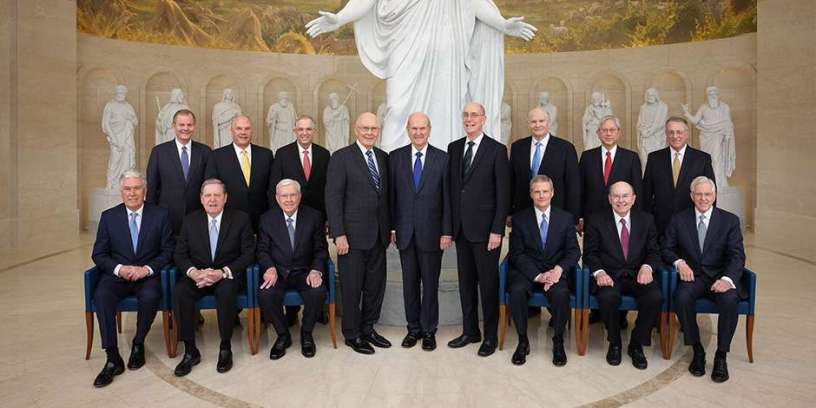
An article at the LDS home page caught my eye a week ago (dated June 1), with the headline A Latter-day First: Church has 4 nonagenerian apostles, including entire First Presidency. Let’s start off just talking about the article itself. There is zero discussion of the possibility that maybe running a worldwide organization with a budget in the tens of billions and with tens of thousands of employees and volunteer workers with senior executives in their nineties might not be a good idea. Not a hint that this might be a sign of organizational dysfunction. No, the article just babbles on listing several recent LDS leaders who, at some point in their service, also turned 90.
A rather disturbing table at the end of the article drives home the point that the article entirely ignores. It shows all LDS apostles who ever reached the age of 90, listing the date they turned 90, the date of their death, and their age at death. There are 20 apostles who have turned 90 while in office. Four of them are still living: Presidents Nelson, Oaks, and Eyring of the current First Presidency, along with M. Russell Ballard of the Twelve. The sixteen who have passed away all died in their nineties.
The article may not bring up the issue of organizational dysfunction due to aging leadership, but plainly the leaders themselves have considered this from time to time. That’s why Seventies are retired at age 70 and given emeritus status. But there is no formal retirement or emeritus status for apostles. However, I’m sure there is informal emeritus status for older apostles. They keep their full title and office, but no doubt perform a decreasing workload with less travel, until entirely sidelined by mental or physical decline, when workload and travel go to zero until they pass away. It would be entirely correct, I believe, to state that Seventies receive formal emeritus status at age 70 and Apostles receive informal emeritus status as loosely determined by physical and mental decline.
Another article was published the same day, June 1, 2023, by Elder Jeffrey R. Holland: The Blessings of Age: Elder Holland’s Essay on the First Presidency. Elder Holland acknowledges that some Church members have concerns:
Nevertheless, when the significance of the First Presidency’s responsibilities is considered and the demand on their health in fulfilling them is weighed, occasionally a questioning comment can be heard here or there about the vitality needed for such service. “Wouldn’t it be better to have younger men carrying that load?” we can hear in the conversation of some. “Wouldn’t younger men be more responsive to the times?” a few others may say.
Let’s be honest about those two questions. First, it is fairly obvious that younger men ARE carrying much of that load. The hundreds of Seventies that now serve do much of the work that, two generations ago, was performed by apostles. The Seventies run departments, visit local units for stake and area conferences, and so forth. The apostles make final decisions on most items and jealously guard control over finances, but let’s be honest: younger men *do* carry most of the load.
Second, yes it is likely that younger men would be more responsive to the times. If younger men led the Church, we might even be saying “younger men and women.” There is a tradeoff, of course, between extra years of experience and gradual loss of energy and sharpness. Based on real-world comparisons, such as CEOs of major corporations, there is no problem in your fifties and sixties, but things trail off rapidly in your seventies. There is no “blessing of age” after 75 or 80.
Here’s from a 2021 study: “There are significantly more sitting CEOs who are 70 or older (6 percent in the Russell 3000 and 4.8 percent in the S&P 500) than sitting CEOs who are under 40 (0.9 percent in the Russell 3000 and 0.4 percent in the S&P 500) ….” LDS leadership practices mirror corporate practices at the lower end: the vast majority of local leaders are 40 or older. You just don’t have enough life and leadership experience to lead a ward or stake before then. General Authorities are generally called in their fifties, having at least 30 years of adult experience. It’s at the top end, where few corporations retain executives into their seventies, that the Church takes a different path. Well, as noted earlier, it *does* follow peer practices for Seventies, just not for Apostles. What does that mean for the Church? What are the consequences of having really old apostles?
Maybe LDS apostles are supernaturally strengthened by God to not feel the effects of age so they can continue to provide energetic, focused leadership to the Church. I’m sure most Mormons believe this, but then most Mormons will believe almost anything. Or maybe, as noted above, much of the actual work is now performed by younger Seventies or others with experience and expertise who are appointed to run various departments or functions, so the negative effects of an aging leadership cadre are avoided because they aren’t actually doing the work or leading. A third option is that, despite claims to the contrary, the quality of LDS leadership is, in fact, declining as senior leaders get older and older.
Go ahead: pick one of those three options and defend it. What is surprising is that this issue, which seems of considerable import for the future of the Church and, I think, for the present difficulties of the Church — simply gets no attention in LDS discourse. There’s denial, not discussion.
Another peer comparison other than CEOs would be US federal judges. Here are the ages of the current sitting US Supreme Court justices, who are appointed for life and often serve until death:
- Four in their fifties: Barrett (51), Jackson (52), Gorsuch (55), Kavanaugh (58)
- Three in their sixties: Kagan (63), Roberts (68), Sotomayor (69)
- Two in their seventies: Alito (73), Thomas (75)
So for the current sitting US Supreme Court justices, the oldest is 75, the youngest is 51, and the average age is 62.6 years of age. By comparison, for the LDS Big 15, the oldest is 98, the youngest is 64, and the average age is 79.3 years of age. Even though Supreme Court justices are appointed for life and often serve until death, their age range compares with the LDS Seventies, not with LDS Apostles, who are on average roughly 17 years older. Supreme Court justices carry a heavy workload. That is why they don’t generally work into their eighties, supporting my suggestion that older LDS apostles don’t carry a full workload and are, in fact, de facto emeritus. Here are the recent justices who have retired and their ages: Breyer (84), Souter (70), Kennedy (82). Justice Scalia died while serving, at age 80. Justice Ginsburg died while serving, at age 87. The last justice to serve into his nineties was John Paul Stevens, who retired in 2010 at age 90. He died in 2019 at the age of 99.
Note: For a deeper analysis of this issue, go read Gregory A. Prince, Lester E. Bush, Jr., and Brent N. Rushforth, “Gerontocracy and the Future of Mormonism,” in the Fall 2016 issue of Dialogue. There is also a Radio West interview with Greg Prince about the article.
I look forward to comments, but I don’t have any great prompts. Maybe you had experience with a bishop who was too young or a stake president or patriarch who was too old. Maybe you had a visit with a grandparent, went home thinking “Wow, grandpa is getting really old and can’t remember things,” then later noticed that grandpa is actually younger than half of the Big 15. Maybe you are a medical professional with some insightful comments on the effects of aging. Maybe you are a real data nerd and will tell me I missed an age or two by one year plus or minus. Maybe you yourself are in your eighties or nineties, in which case you can tell us, take a bow, and receive honors and praise from other commenters.
 Wheat & Tares
Ironic that aging leadership is not just a reflection of how the Church chooses its leaders. And it’s also not just a reflection lifetime appointments. We are about to choose either Biden (80) or Trump (77) as the most powerful person in the world (again).
Good points, Dave. It’s sad but not surprising that the Church News article couldn’t bear to bring up the possibility of any problem being associated with having really old men lead the Church. Following josh h’s comparison, I think what we see is that people in power typically have a difficult time making rules that limit their own power. Aging Q15 members aren’t going to set a retirement age for themselves! Perish the thought! Similarly, US congresspeople, many of whom are quite old, aren’t interested in setting a maximum age for either themselves or presidents, which could quickly get them on their party’s naughty list for not supporting the candidate of the moment.
One of my heroes in life was Charlie Rick – a tomato geneticist and germplasm conservationist, that used to joke about this topic for plant breeders – when do plant breeders retire? They don’t he joked they die out in the field. It’s a plant joke. Maybe not so funny since I needed to explain. But anyway. He did pretty much work in the field until his stroke forced him to retire just months before he died.
I see no reason why we don’t have the option for leaders to retire. Some could continue if their health was good but why are the leaders of the church working until they die or continuing in office when they have significant cognitive decline.
I will be retiring from plant breeding before I die out in the field and I think the church would be better off if the leaders at the highest level did as well. Oddly there is some double standards here. My stake patriarch when I was a child was forced into emeritus status. Bishops and stake presidents all have a clock ticking for their release. Just the highest level feels like they are locked in till they die.
It’s funny to me that the “young” ones in Church Leadership are Baby Boomers, while in most every other organization Boomers are the old ones who are all now retiring.
To me is seems like the Church has been really lucky lately regarding the health (both physical and mental) of its top leadership. The Church has had other periods where a lot of the 12 and 1st presidency are incapacitated (Hinkley basically ran the Church in the 80’s due to this reason), and with the age of the 12 and 1st presidency that can happen pretty quickly. Wouldn’t be surprised if we get a 3rd Counselor in the 1st Presidency soon if all the current members are alive for a few more years. Either that or we see a massive change in the membership of 12 and 1st presidency due a bunch of deaths happening in a short period.
Perhaps one of the reasons why the apostles — the First Presidency in particular — are so advanced in age is because that’s precisely what the Kingdom needs at this time.
Although it is correct that aging Q15 do shed responsibilities, it is painfully obvious they prefer to remain the public personas of Mormon leadership. For new converts, members coming of age, etc., this is problematic. It appears to be purely ego and pride driven – all to the detriment of the Church’s image and reputation.
Think about it. Do we really need 90+ year old men to stand between God and us? I prefer to believe that no middlemen are required – I can maintain a direct relationship with God without old men intervening. It is an insult to common sense, free agency, and our collective intelligence.
Ziff made an interesting comment.
About how once in leadership power ( and in charge of multi billions of dollars ) humans do not usually leave voluntarily.
This includes our Apostles.
We are not allowed an opion of the quality of their work, we are told God put them there and we are not spirtually wise enough to know why so we must just sustain this choice.
Or something like that.
We have absolutley no choice what so ever about the 90 year old men who will not give up and retire.
Who pretend they are physically and mentally robust enough to run Christ’s church, not theirs, His.
Most of us know they probably only go into the office about 4 hours a week, maybe, and do little to no work.
This, according to Holland is a “blessing”.
Aren’t we lucky.
The real work is done by the drones buzzing and every busy in the Church office building.
We do not know who they are or what they do, again aren’t we lucky.
We get no information on anything anymore, if we ever really did.
How much is the stipend for the Apostles?
How much do we pay each year for their health care?
I will bet this amount of money is three times the stipend easy which probably includes their elderly wives.
I also bet none of them are on Medicare.
I doubt they will ever answer any of the queston that we have a right to ask and deserve answers to.
But I do hope these blog writers keep on asking.
I’ve mentioned in a few of my recent blog posts that I just read the book Another Country, a book that was published in the late 90s with advice to Boomers about their aging Greatest Gen parents. Something the book mentioned is that there are two types of “old” people: the young old and the old old. The young old are in their “golden” years, able to travel, physically OK, houses paid off, retired, and able to enjoy their grandkids and do paint by numbers and go on cruises, or whatever. They are mentally and physically vital, even if they aren’t in their peak condition.
By contrast, there are the “old old.” The biggest difference between these two groups is again, not age, but physical and mental fitness. You can be in your 60s and be old old. You can be in your 90s (although this is rare) and be young old, at least theoretically. As the book pointed out, sometimes aging feels like being tied to a dying animal (your aging body). Your mind is fit, your body is decaying around you. It can be very isolating.
If you have a top leader (arguably like Monson or Benson) who is “old old,” it leaves a vacuum for others to fill. It’s not just that we have a gerontocracy. We have an oligarchy. There are others waiting in the wings to insert their own agenda if they can convince the others it was the will of the big guy. But since that’s not always easy to do, it does check the power plays of the upstarts. In a weird way, the disastrous PoX of 2015 was a clever play. Nelson & Oaks who absolutely sought to wound the LGBTQ people and their allies were able to implement this policy under the cover of Monson’s absent leadership, and then distance themselves from it after he died.
The bigger problem I see is that being led by “young old” and “old old” are BOTH problematic. A vigorous “young old” person came of age in a completely different world (hence the book title “Another Country”). If you are 95 now, you were 45 when Nixon resigned. You were 40 when Martin Luther King, Jr was assassinated. You were 35 when JFK was killed. You do not live in the same world as someone who was born in the last 50 years. Sorry, but you don’t. Visiting my 95+ parents is like visiting the 1970s. It’s not contemporary reality. Old people have gifts to offer, but any advice they give has to be taken with a ginormous grain of salt. Allowing them to make binding policy decisions on any of us is madness.
In our stake, we had a very old patriarch, very out of touch with young people (and kind of a Fox News watcher/believer). Because of my calling, I reviewed every patriarchal blessing that he gave. His blessings were very . . . traditional, they were all very similar, they were full of Mormon cultural markers (females were all blessed to have lots of kids and find eternal companions; males were blessed to succeed in the workplace, go on missions, preside, etc.), over and over. It was really awful (young people often are familiar with their friends’ or siblings’ blessings and there was talk in our stake, even among my own children). The old patriarch was released and and two much younger men were called to replace him. What a difference it made! It felt like these patriarchs listened to the Spirit (and not the culture in their own brains), and the blessings were unique, modern, relevant, much shorter, much better received, and more meaningful to the recipients, and the cultural markers all but disappeared. When we think someone is wise or competent just because they have lived a long time, we risk serious negative impacts when are not willing to confront the reality of the damage they might be causing because they are (as Angela says) “old old.”
To me, there is a question that needs to be answered before deciding what to do about the gerontocracy. What is it that the Q15 actual do all day? 4 decades as an active member, and I’m not sure I know. I think we can break down their responsibilities into three categories:
1. Ceremonial tasks. The first one that pops to mind is dedicating temples. They’re essentially there as figureheads to break a bottle of sparkling cider on the new building. Talking at BYU graduation and various other things fall in this category, too. These responsibilities are relatively light (other than travel) and infrequent, and so long as they can still put their thoughts into complete sentences, they can probably do this to a very advanced age.
2. Prophetic tasks/Sage on the mountaintop. I reference the sage on the mountaintop, because that’s an idea of something we’re generally ok with someone doing while very old. Age and wisdom can be a benefit here, and really, the only qualification is whether God picked you. Prophetic tasks include GC talks and other messages that set the course for the church. Leaders need to be able to understand present issues and concerns within (and without) the church. Much of this can be done from SLC, and they can even use chairs in GC now.
3. Administrative tasks. This is the one that I don’t understand at all. The church is so conservative, that maybe the bureaucracy is just chugging along doing what they’ve always done. Or maybe Elder Christopherson is stamping “approved” on every ward boundary change worldwide. “The Church” is a major corporation. I found a website that says it has 72,000+ employees. I’m not sure if that number includes the 14,000+ employees at BYU. Do we expect the Q15 to be involved in the thousands of things the church is doing? Does church membership feel better assuming that a Prophet is guiding BYU conference affiliation negotiations? Keeping on top of all of these things is a potentially massive job, and where octogenarians might struggle the most. But from my seat, its very difficult to figure out what the apostles actually do in this area. (I work at a company with about 250 employees. I similarly have no clue what the CEO does.)
Depending on how you view the breakdown of their responsibilities will ultimately tell you to what extent their advanced age is a big problem. I don’t pay too much attention to the British monarchy, but I don’t sense that people were terribly worried about Elizabeth being “too old” to be queen. Her role was primarily those ceremonial tasks.
In my opinion, the retirement age for apostles should be 80 years old. (I’m “only” dropping it to 80 so the traditionalists won’t have such a heart attack at the suggestion.) In order to smoothly transition to the new plan, the oldest apostle would retire each year until there were no remaining apostles over the age of 80. As the youngest apostle right now is about to turn 65, this means we’d replace every single apostle in the next 15 years. They’d either be replaced with men in their early to mid 60s (the last 10 have been between 57 and 67 when called) in which case they’ll keep having turnover of about 1 per year, OR they’ll start calling some “young” men in the 45-55 age bracket. Currently, the Q15 have been in for an average of 21.1 years, and their average age is 79.4 years. This is not quite the record which we hit in 2015 just before the deaths of Packer, Perry and Scott when it hit 80.24 years. (Yes, I have a spreadsheet.) I’d consider it a kindness to them to let them retire and enjoy some time with their grandkids, or golf, or just a good nap.
Here’s a sentence that really illustrates the pure love of Christ Dave B. has for his fellow Mormons: “I’m sure most Mormons believe this, but then most Mormons will believe almost anything.”
I, for one, can definitely feel the love.
As a 79 year old I can look at my life and vigour through the years and compare it with the strength and enthusiasm I have now. I taught at a university level for 35 years and, after my retirement, joined the administrative board of my condominium association and served as chairman for 5 years. Last year I realized that my energy and enthusiasm for the work had waned and I decided to retire from the board.
In looking back on my life and the work I did, I realize that I had lost lots of my strength and my desire to serve and that I had made the right choice. I would feel trapped if I felt that God had ordained that I was to serve at the head of His corporation until I died. A retirement age should be determined for our general authorities and also allow them to retire honourably if they felt they had lost their strength or abilities.
The benefit of life experience kind of ends when people are 50. I just don’t think there is any life experience benefit between a 60 year old and a 90 year old. And there are the disadvantages old being behind the time and loss of energy and declining health. Let me explain.
For the first, say 25 years of my adult life I experienced a lot of different things. I lived in Berlin with the wall and saw Russian Tanks rattling down the street of the city. I had three difficult and life threatening pregnancies. I gave birth to three children, and raised those three children. I had four miscarriages. I lived in Germany. I moved house 20 times. I lived in eight states in the US. I was a stay at home mom. I worked outside the home. I worked at paid employment from home. I gardened in different climates. I traveled most of Europe. I got two college degrees and one graduate degree. I got my feet wet in the North Sea, the Mediterranean, the Atlantic, the Pacific, the Gulf of Mexico, and the Caribbean. I had three major surgeries. We sent a son on a mission to Brazil, and our second daughter came out as gay.
In the last twenty-five some years, I have traveled a little, not near as much as we did before. I didn’t learn near as much visiting a foreign country as I did living in one. I have more or less watch my grandchildren grow up and you don’t learn near as much watching as doing. I have had two major surgeries and complained a lot about growing old and being able to do less and less. I have pretty much lived the year over and over 25 times.
There is just no comparison between the experience I gained in the first 25 years of adulthood compared to the second 25 years of adulthood. So, I see it as about the time they are called, the general authorities they live the same year over and over without getting any new life experience. So, they could all retire at 70 and we would have no loss in all that life experience they are so proud of.
Thanks for the comments, everyone.
Angela C, that distinction between “young old” and “old old” is very insightful. I can see another post coming talking about how at both the local level and the senior leadership level, the Church is blind to that distinction — it makes apostles serve right through that “old old” phase until death, and at the local level tries to give callings to some of the “old old” members and send them out on temple missions or senior missions where they will sometimes work themselves to death (literally).
Dave W, it would make a lot of sense to give “old old” apostles emeritus status and let them attend/conduct ceremonial events and the like. We could make a new quorum, the Quorum of the Seven, for these retired apostles, with no particular responsibilities except to cut ribbons and testify of Christ, and populate it as needed.
Kent Gibb, honours and praise to you, sir! I’m going on my fourth year as president of my neighbourhood homeowners’ association — a thankless task. You give me hope I can exit after year five.
It’s so ironic that a church that was founded by 20-somethings now brags about being led by 90-somethings. As Kent points out above, maybe there are some of the brethren who feel trapped in their situations and, not wanting to set a precedent, remain when they would really like to be free of the responsibilities and want to just travel or play with their great-grandchildren. I’m retired, and when people say to me that since they retired they’ve never been busier, I say to them “you’re doing it the wrong way!” “Well, precedent be danged”, say me and Pope Benedict XVI.
Faith over Fear brings up a great point about Patriarchs, and I would absolutely add to that pool of callings that need to go to some younger bucks the calling of Sealer. Right now, we’ve got a whole lot of old codgers ruining people’s weddings with their archane, sexist, culture-war ramblings that have literally nothing to do with the couple or the family, and are essentially old man shaking cane at the sky. For the love of all that is holy, please retire these guys!
I think as with the potential solutions for SCOTUS, you could either pick a retirement age (72? 80?) OR you could pick a “term” limit of 15-20 years. Frankly, the term limit idea seems like a good option to me on a whole ‘nother front. We’ve got issues due to being led by the elderly, but we also have a stagnation in the church’s brain trust. If you had people moving in and out more, would you have had the SEC violations? Maybe, but at some point somebody’s going to start squawking, if not in public, in private meetings. This is more likely the less hierarchical things are.
Back in the late ’90s in that famous interview with Mike Wallace, Wallace asked Pres. Hinckley about the “gerontocracy.
“”There are those who say, ‘This is a gerontocracy. This is a church run by old men,'” Wallace remarked.
“Isn’t it wonderful to have a man of maturity at the head, a man of judgment who isn’t blown about by every wind of doctrine?” Hinckley replied.”
In some ways, this seems key to me. The church likes the stability — the inertia — that having older people at the head brings. I have recently begun to notice how many of our practices in the church seem to be in place to make sure we are “conservative” — not in the political sense, but in the sense that we prefer the status quo and tend to resist change — and this aspect of our leadership seems to reinforce that conservatism.
I recently read Let’s Talk About Race and Priesthood by Paul Reeves. One interesting observation that I noticed from Reeves outline of the events related to race in the church was how, once the priesthood and temple restriction was in place, later leaders were unwilling to challenge it. Even when Hugh B. Brown and David O. McKay began to challenge it, this idea of needing unanimity among the top quorums delayed change until Pres. Kimball could come along and create that kind of unity. Scott Woodward (who certainly is no critic of the church) made the observation in a youtube video that the very first time the top quorums asked God with enough unity to accept a positive answer, God responded that we should lift the ban. How much did having a mature man at the head who wasn’t blown about by every wind of doctrine contribute to the church’s resistance to desegregation?
To extend @AngelaC’s observations, someone who is in his 90s today was comfortably middle aged when the Stonewall riots happened in New York, and when the psychological/psychiatric community began to delist homosexuality as a mental illness. Someone in his 90s today was living a comfortable, middle aged life as a sole breadwinner in a workplace that was dominated by men. While I can appreciate the stability that comes from a conservative “let’s not get blown about by every wind of doctrine” approach to life and church and truth, as a progressive leaning member I find myself frequently asking myself if our stances on these issues is really rooted in God’s will and truth, or if our stances are rooted in the human traditions present while our oldest leaders were “coming of age” so to speak. I frequently find myself dissatisfied with our claims to “revelation” because I do not see any attempts by the top leadership to make sure they aren’t biased by the attitudes of the past they grew up in.
There was a patriarch in my Stake that was very old and had dementia but nobody realized how bad it was until he gave a blessing to the daughter of a member of the Stake Presidency, in which he ordained her to the Melchizedek Priesthood. That was the last blessing he ever gave.
Dangers to Aged Leadership:
-They are out of touch with the youth
-Their mental faculties are not optimal
-Their bodies are susceptible to disease, fatigue, which may distract from the work required in such service
-They are increasingly dependent upon others to identify problems and solutions
-They are easily manipulated by administrators, bureaucrats, lawyers, and advisors, etc.
That said, I think there is considerable value in the slowness-to-action, and wisdom that comes with age. I’d rather have more Nelsons than Bednars at the helm. Aged leadership isn’t as much of an issue than the pool of advisors, who influence them. Some of the biggest mistakes in the past decades are directly related to fear-mongering lawyers (Prop 8, prohibition of baptism to children of gay parents), greedy money managers (build more temples to reduce tax load), apologists (who “lie for the Lord”), and the panopticon surveillance teams that monitor and persecute fellow saints for speech (Strengthening Church Membership Committee pressing Stake Presidents to excommunicate good members).
@josh h, makes a good point about the same pattern at the POTUS level: clearly Dear Biden isn’t steering the ship of state. Who is running the country? Advisors. It’s a dangerous precedent because there is no accountability or recourse. It seems aged men are more impressionable in the face of fear or disaster: they tend to concede and defer, when what a good Constitutional Republic needs is an upright leader who is discerning and ready to pick a fight.
This past week I brought up a problem with the primary manual in gospel doctrine class. I got 100% shut down as the group “knew and testified that the prophet reads and approves every manual in the church and I needed to look inside myself if I thought there was a problem with one.”
I can myself almost guarantee that president Nelson has never cracked open the current primary manual, either I English or in another language and yet the majority of members firmly believe he has gone over every detail of every one of them with the Savior himself, despite that never being talked about by the 15.
I completely agree that we need younger people in charge at the top levels of the church, and that the top leaders don’t want to give up their power and privilege. However, it also occurs to me that if 75% of members between, say, 18 and 30 are leaving, the leadership pipeline is shrinking. I don’t know if it’s fixable.
It might be fun to tease my friends and family that are still in the LDS church that having 90 year old apostles must be a sure sign of apostasy. After all, the original founder of Christianity was executed in his 30s as an enemy of the state. If legend is to be believed, all of his original apostles, (except John if you accept that legend) were also executed or killed for preaching a radical form of religion. So real apostles seem to die young.
So perhaps not surprisingly, when Joseph Smith creates a new church based on his understanding of the bible stories, he does so in a way that gets him assassinated while in his 30s as do some other of his apostles. So there is no age limit put on apostles in either the NT or the D&C because, hey, if you are a real apostle shouldn’t you be enough of a thorn in the side of the status quo that you will never get to grow old?
I see the current LDS leadership as defenders of the status quo, so can they really be apostles of Jesus? I guess that is all in the eye of the beholder.
While faithful sources seem now to be reluctant to say there is a problem with the gerontocracy , one can be certain that when a retirement plan is put in place the same faithful sources will proclaim it as inspired.
I have it on good authority that there has been a proposal on the table several times to create an emeritus status for Q15. I understand that it had majority support but the Q12 operates on unanimity not majority. It will take a few people (I don’t know who, but could guess) to pass on before it becomes a reality.
Aren’t they supposed to be special witnesses of Jesus Christ? Maybe if they stuck to that and left all the other stuff to the Church bureaucracy we wouldn’t have a problem.
Lily, you hit on a question that I’ve wondered about. The FP can run the church w/o the 12. We need the 12 for preaching the gospel throughout the world (travelling witnesses), and for succession. I don’t know that they all need to be cloistered in SLC doing church admin all day (approving primary manuals, for example!). The FP and the staff can handle the day to day business and the 12 can travel and even live elsewhere. A couple of decades ago we sent Holland/Oaks to Chile/Philippines (I forget which one went where) to live for a year or thereabouts. I’d like to see them travel, and even live elsewhere for months or a year or so. They can still meet weekly virtually. Did the Chile/Philippines thing succeed, or was it failure? If a failure, is the because the apostle (or spouse) was miserable away from the center of power?
I agree with MrShorty’s comment, seems like having really, really, really old dudes in charge of things is by design, a feature, not a bug
it ensures that the church remains as conservative as possible, in that any kind of significant change requires a certain number of apostles to die before the change will actually happen
David O McKay considered lifting the priesthood ban as far back as the early 60s and appointed newest and youngest member of the Q12 at the time, Kimball to lead a special commission to find scriptural justification for the ban, Kimball reported that there was no justification and recommended overturning the ban, but McKay didn’t go for it because his immediate successors, Fielding Smith and Lee, (and probably others) were against it. So Kimball had to wait for about almost years for everyone senior to him to die before he was in charge, AND had a majority of anti-ban apostles on his side to overcome the remaining pro-ban faction (McConkie, Packer, and possibly Monson), and even with that, Kimball had to do some realpolitik to make it happen
so by having them serve until death, they’re guaranteed to change as slowly as possible, because the guys who get appointed as young-olds are not likely to have any significant alterations to their worldview, especially once they get ensconced at the top of the Church hierarchy and don’t have to deal with normal people that much anymore
So I think we’re not going to see the needle move on LGBTQ acceptance until someone like Elder Gong is in his 90s, (about 20 years from now). Gong’s son is gay and although they’ve had a kind of rocky relationship lately, the fact that he has a son that openly identifies as gay by necessity means that Gong’s worldview with regards to gays/lesbians (at least) is different than that of Nelson or Oaks, who’ve probably never even spoken to a gay person and probably would’ve disowned any child they might have had that came out as gay.
The comparison to corporate CEOs and the US Supreme Court is interesting. I’ll add another point of comparison: the US Senate. There are 5 senators over 80, and anther 29(!) who are in their 70s. Maybe that’s a reflection of the relative importance of individual senators compared to individual supreme court justices. What senators do can vary a lot. Some are active in leadership, writing legislation, or making TV appearances. Others seem to be pretty anonymous and as far as I can tell do little more than show up when their party needs them to. It makes you wonder how many of the senior apostles have settled into a “show up and vote” role.
A couple of year ago there was a much-publicized meeting in the UK featuring a couple of apostles who were traveling through. By all accounts that I’ve heard they gave talks that sounded pretty extemporaneous and not near the quality one would expect in general conference. After hearing about the that, it occurred to me that these guys don’t get to retire, and maybe all they really wanted to do is take their wives on a vacation, but feel obligated to hold church meetings everywhere they go. Let them have a retirement like the Seventies!
I support the idea of emeritus apostles, but there are some interesting side effects. Suppose the existing succession plan remains unchanged. That creates a situation where it is known far in advance who will become president of the church, when, and for how long. It would seemingly increase the stakes of every apostle call. Will the next new apostle be a future president or won’t he? It makes me wonder whether such a change would be accompanied by alterations to succession planning. Another potentially positive side effect would be a deflation of the mystique around God supposedly choosing president by deciding when apostles die.
For much of the 1980s and early 1990s the Church president and First Presidency was notably feeble. The last First Presidency of Spencer Kimball was so invalid Gordon B Hinckley was called as an Assistant to the First Presidency! Why not just release ailing counselors and call healthier ones as replacements?
Ezra Taft Benson had vigor for a few years and then he was incapacitated for the last several years of his life. His situation was so pathetic his grandson Steve publicly protested. Why did / does the church hide the physical & mental condition of its leadership? Why is it so reluctant to change policy? There is no doctrine that there can only be 12, or as it is now 15, living apostles.
The seventy are granted emeritus status. The same should be done for apostles, including the First Presidency. For a church that claims to be lead by revelation it sure seems timid to rely on it! The idea that God will make his will known by having people die is possible. But my goodness, shouldn’t we grant God the option of getting his will done in other ways?
I am 74 and find I am only good for about 4 hours a day. I can not understand why anyone over 70 would not retire and enjoy the rest of their life. Either 15 or politicians. I thought Biden would hand over to Kamala in time for the election. Do they really believe they are the best person for the job? Make way for some women. A retirement age for the 15 and women Apostles should be announced at the same time when there are some vacancies. But then I thought when gay marriage became legal in the US would be a good time to announce their sealing in the temple. That didn’t happen either.
We had our patriach speak at a funeral a few months ago, he assured us the dead woman was enjoying being reunited with her mother in the spirit world. The mother in question was sitting in the front row.
When I was much, much younger, a friend of the family was one of President McKay’s bodyguards. He told stories of President McKay’s reading Mosiah, how King Benjamin was able to hand the kingship to his son Mosiah and musing (wishing?) on whether that could be considered scriptural precedent for his retiring from the Presidency of the Church and passing the mantle to a younger, healthier man.
I have wondered in the years since if this could still be considered.
Bishop Bill, Maybe your elderly stake patriarch didn’t have dementia; maybe he was the most inspired he had ever been and knew we should be ordaining women. 😁
@ made_in_china
President Oaks has a very talented and accomplished grandson who is gay. Let’s put it this way, the relationship with President Oaks and his parents is not surprisingly fractured. He was recently a guest on Human Stories podcast with Jill Hazard Rowe. The geriatric leaders at the top refuse to accept the science of biology and treat LGBTQ+ people much in the same way they did the black population. It’s so uninspired an incredibly harmful. On the one side of their mouths they say we are all equal in the sight of the Lord. Evan as a woman I don’t feel equal in this church.
https://podcasts.apple.com/ca/podcast/human-stories-with-jill-hazard-rowe/id1468623842?i=1000619119938