


Ah, nostalgia. Remember the 1950s? When a man could get a full-time job without any student debt, buy a house and support a family? He worked until he retired, and then his job would pay him a pension. Economic security. Stable neighborhoods. Home ownership. A parent at home full-time. Enough energy to devote to Church membership and volunteer work. Glorious days. [fn 1]
The 1950s was the decade in which the middle-class boomed. The Gilded Age, with its filthy rich robber barons reigning over a poverty-stricken lower class, was far in the past. In the 1950s, everyone shared in America’s wealth.
Shall we talk about just a couple aspects of the economic situation that made it all possible?
Strong Unions
The history of labor rights in the USA is violent. From railway workers strikes in the 1880s to the coal miners’ strikes in the 1970s, laborers have had to fight for safety on the job and decent living conditions. In the 1950s, about 35% of Americans were in labor unions [source]. The rights won by labor unions spilled over into other workforces [source]. Unions are why we have 40-hour work weeks, weekends, paid holidays and sick days and overtime pay. Anyone who works full-time should be able to pay the bills and have a little extra to help out a neighbor or splurge on fun vacation.
Here’s a chart comparing the fall in union membership to the fall of wages in the general population.
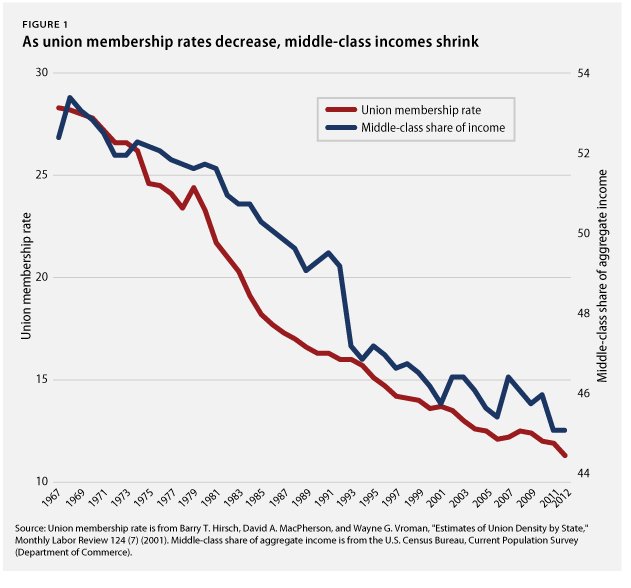
[Source: The Huffington Post article dated Sept 18, 2013.]
There has been a surge in interest in labor unions in 2023. Currently, about 14% of the population is in a labor union [source]. Strikes are popping up all over. This week, service workers in California started striking, and the VFX artists who work for Marvel voted to unionize with IATSE (International Alliance of Theater Stage Employees). The WGA strike and the SAG AFTRA strike continue (basically all of Hollywood is on strike). The Teamsters Union voted to authorize a strike, but then the employers conceded to the Teamsters’ most pressing demands and averted the strike. Last December, railway workers threatened to strike. Congress shut down that idea, and later, the railway workers got most of what they asked for in their threatened strike (sick days).
While Walmart posts huge profits, some of their employees qualify for food stamps and don’t have guaranteed hours or a set schedule. How can you arrange for childcare, or work a second job, when your employer refuses to tell you what shifts you’ll work? We could go through several industries. Take shipping. During the pandemic, Amazon and UPS raked in billions in profits. How much of that profit trickled down to their employees? Not much. Do you know anyone who works as a delivery driver? I do. They don’t hire enough employees. It’s cheaper to have one employee do the work of two. Overtime is just time and a half, rather than two full salaries. Paying benefits for one employee is half the cost of paying benefits for two employees. Short staffing saves company owners dollars upon dollars, but it destroys the quality of life for their employees. Back-filling all of those jobs and ending mandatory overtime was one of the Teamsters Union’s demands. Unions are insisting that companies spend a little less on stock buybacks [fn 2] and little more on employee wages and hiring enough people so that a delivery driver can go to a Parent-Teacher conference without getting fired.
Unions and collective bargaining agreements are the best way to end short-staffing and make sure anyone working full-time (yes, even the barista at Starbucks) earns enough to live on.
Record profits are unpaid wages.
The Maximum Wage
Did you know that in the 1950s, the USA had a maximum wage? Anything you earned over $150,000 in 1951 was taxed at 90%. $150,000 in 1951 is about the equivalent of $1,891,000 today. We’ll round up and say that’s $2 million in today’s money. Please note that due to progressive tax brackets, high earners did NOT pay 90% of their income in tax. They paid 90% of amounts over $150,000. Plus there were deductions and a few loopholes so the actual taxes paid were less than 90%. Still, it’s hard to imagine paying an athlete $50,000,000, or paying a CEO $56,000,000,000 if the income tax was 90% of amounts over $2,000,000.
Corporations get a tax deduction for wages they pay. Everyone loves tax deductions! In the 1950s, if a corporation wanted to pay lots and lots of wages to take all those lovely tax deductions, it hired 200 people and paid them all $50,000 each. That gave the corporation a tax deduction of $10,000,000. Now that the USA is not taxing exorbitant salaries at discouraging rates, a company can get the same tax deduction by paying the CEO $8,000,000 and paying its 200 employees $10,000. (Numbers vastly simplified for purposes of the example, obviously.) The point is that if one person can’t hog all the income (because taxes will take it anyway), then income is distributed more evenly.
Here’s a chart of the wage gap between the highest and lowest earners since 1950. Notice the lines beginning to diverge in the 1980s, when Ronald Reagan basically ended the cap on wages by lowering the highest tax brackets.
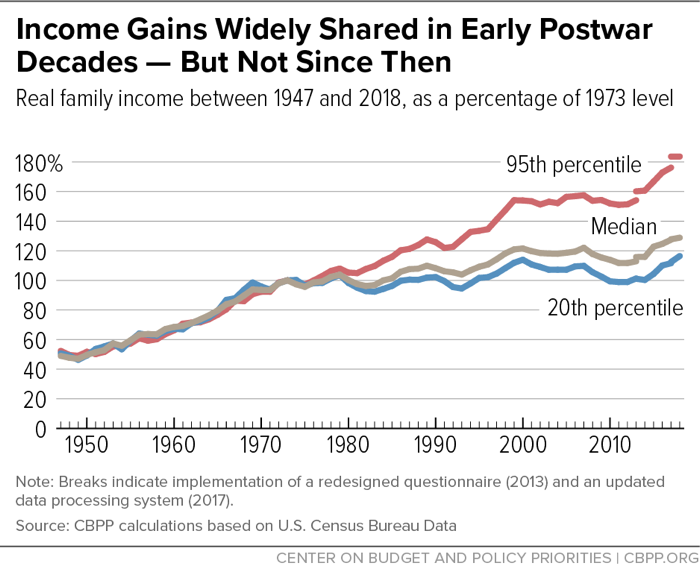
[source]
Support a strong middle-class. Bring back the maximum wage.
Laissez-Faire Capitalism
You’ve probably heard the phrase “late stage capitalism” used to describe bad economic circumstances. Income inequality, environmental injustice, poverty, people who can’t afford health care — all this is due to late stage capitalism.
I don’t believe the harm done by late-stage capitalism is inevitable, nor do I believe it’s irreversible. What we’ve got now is laissez-faire capitalism, in which the government (*cough* Republicans *cough*) is insisting the free market be unfettered by government constraints like safety regulations, making corporations clean up their messes rather than pollute air and water, and treating their workers like human beings. A totally free market produces a filthy rich ruling class [fn 3] and a poverty-stricken and suffering underclass. We’re seeing this develop before our eyes, as the United States slides back towards the Gilded Age dynamics.
Government constraints can save capitalism and return the middle-class to its former prosperity. It isn’t the hard work of laborers that will do this. It isn’t the voluntary generosity of business owners that will do this. Laws do this. Laws insist that business owners acknowledge the humanity of their workers and treat them like human beings. Laws refuse to allow wealth to accumulate through high taxes on excessive income and wealth transfers at death. Laws have to regulate the cost of life necessities – either by price caps (epipens and insulin should be dirt cheap), or by setting a minimum wage high enough that a worker can afford life necessities. Laws force companies to stop polluting air and water.
There’s only one political party willing to do this – the Democrats. Republican economic policies are sending us right back to the Gilded Age.
The LDS Application
But Janey! Why are you talking about politics and economics!? This is an LDS-themed blog! Stick to religion!
Jesus talked about economic matters a lot. Not just taking care of the poor, either. Jesus went on harangues about rich people. Rich people are headed for hell. It’s easier for a camel to go through the eye of a needle than for a rich man to get into heaven (Matthew 19:24). In Luke 16, Jesus tells the story of the beggar Lazarus going to heaven while the rich man who didn’t help him burned in the fires of hell. Jesus told a parable of a rich man who had to build bigger barns to have room for all his riches, and when he died that night, God called him a “fool” and said he was not rich towards God (Luke 12:16-21).
And who can forget this epic exhortation: “And I [the Lord] will be a swift witness against … those who oppress the hireling in his wages!” (3 Nephi 24:5).
Joseph Smith wasn’t a fan of rich people either. The United Order and law of consecration didn’t work out in practice, but his economic ideas were based on economic equality.
This is a religious issue. If we’re to save those unfortunate billionaires from burning in hell, churches absolutely must step in and start talking about economics. This isn’t just about economic policies that will create one-income families and stable neighborhoods again. No, this is also about giving billionaires a chance at heaven. Come to Jesus, help the rich repent, vote Democrat.
—-
[fn 1] It wasn’t idyllic for people of color, disabled people and LGBTQ+ people but we’ll let that slide for purposes of this discussion.
[fn 2] Stock buybacks. Do you know what stock buybacks are? Trump and Mitch McConnell passed a huge tax cut for businesses and wealthy people (middle-class people got a cut too, but the BIG BUCKS went to businesses and wealthy people). The idea is that businesses will take those tax cuts and make their businesses better. Ha! What actually happened is businesses took that money and spent it on stock buybacks, which means the money went to the wealthy business owners. So many companies did this after Trump’s tax cut that the SEC has now drafted new rules about reporting stock buybacks so we can all watch our tax cut go to the millionaires and billionaires.
Let’s talk about Bed, Bath and Beyond’s bankruptcy and how rich, selfish people screwed over their employees. BB&B took that tax cut and spent it on stock buybacks in 2021, which meant that the company owners pocketed millions of dollars. Then, oops, BB&B couldn’t pay its bills and declared bankruptcy in 2023, putting 30,000 employees out of work. Tax cuts go into the pockets of the already-wealthy; they don’t stimulate the economy.
Here’s a nifty little tidbit about stock buybacks by the railways: “a handful of major rail companies reported more than $10 billion in buybacks and dividends over the first six months of 2022. Meanwhile, workers who try to visit a doctor amid a global pandemic continue to be disciplined, leading to higher staff turnover and soaring injury rates.” [source] To restate that: the railway companies gave their owners $10 billion dollars within a six month period while also refusing to hire enough employees so that railway workers can take a sick day.
[fn 3] When I’m talking about rich people, I’m talking about the top 1%. I’m not talking about someone with $5 million in their retirement account and a vacation home by the seaside. I’m talking about the people who own multiple mansions, a private jet, have the authority to refuse to let employees take a sick day, and control entire sectors of the economy.
—
Questions:
- Are economic policies also moral policies?
- Why do Churches focus on sex and gender issues and ignore economic issues?
- Should churches speak out about economic issues?
- Jesus never said gay people go to hell, but he said rich people go to hell and he repeated that multiple times. Should we conclude that rich people are in more danger of eternal damnation than gay people?
 Wheat & Tares
👏🏻👏🏻👏🏻
We are seeing the same situation in the UK as well. Zero hour employment contracts.. people in full time employment not being paid enough to live.. strikes in rail transport, education and medical sectors.. everything being squeezed for profit.. because apparently we’re being pushed towards a US model by the current conservative government, and have been for some time.. it’s not good.
I was with you right up to your last sentence. I can’t figure out how voting democrat will help save the souls of billionaires. I was expecting the first chart to show me how wages have declined as adjusted for inflation, but that isn’t what it showed. Instead that first chart was just showing how the middle class has a shrinking share of all income. Yes, there is a wealthy upper class that has been growing. That might be a problem as the rest of your article shows. But the real religious problem is not taking care of the widows and orphans.
Voting democrat will mean more government spending programs, but the real problem is having people and churches focus on solving the needs of the poor. Having billions of dollars in a rainy-day fund and thinking that we are making progress to build more and more temples that cost millions of dollars, is ignoring the basic principles of the gospel.
“Pure religion and undefiled before God and the Father is this, To visit the fatherless and widows in their affliction, and to keep himself unspotted from the world.” (James 1:27)
My mom died last year. She was 102 at the time of her death. She was surely one of the last 50’s stay-at-home moms. She loved her role. And was great at it. I lived the dream growing up in the 50’s.
But on to the subject. Certainly universal health care is a critical social, economic, and religious issue. So is child care. Woman today are choosing to work. Why can’t the Church use their largely unused buildings to provide child care? Nutrition is also a growing concern. Why can’t the Church provide land for family gardens? Global warming is an issue. Put solar panels on the roofs of chapels and over parking lots. Shouldn’t Church leaders be leading the way?
A few years ago, my wife’s uncle (white, male, conservative, rural boomer) posted a MAGA-flavored screed on social media to rant about how much more wonderful society was during his 1950s childhood than it is today, laced with a lot of ignorant homophobic and transphobic commentary. My wife responded sharply for him to check his privilege, that the era was not idyllic and prosperous for all Americans, which didn’t seem to fully compute with him. She then reminded him that, despite his relative privilege, back then his southern Utah community was regularly subjected to the downwind effects of nuclear testing, the results of which would kill massive numbers of livestock and cause human cancer clusters years later–do you really want to go back to those times? No further response from him. We imagined him sitting in his home, in that same southern Utah town, mentally tallying up the long list of his childhood friends and acquaintances who eventually suffered and died from various cancers from radiation exposure.
Sometimes, it doesn’t sink in until you make it personal.
I don’t think anyone really paid the 90% income tax. The code was filled with loopholes.
But how many people actually paid 90% income tax? The code was full of loopholes, worse than now.
“Come to Jesus, help the rich repent, vote Democrat.” Last line in the OP. I get the first two, but why the third command? Janey, clearly you see all Republicans as the enemy. Some might be, but not all Democrats support the Democratic party’s positions, either. Unlike some, I can have a pleasant dinner with Republicans and Democrats, and I split tickets when I vote. But I tend to vote more Republican than Democrat, not because I love the Republicans, but because I don’t like the Democrats on the ticket. Janey, your post raised a lot of good points, but your last sentence kills your entire argument. Instead of voting Democratic, I’ll continue to evaluate each candidate and will vote accordingly. Please don’t hate me for not voting Democrat straight ticket! I am glad to talk issues, but some people cannot talk issues without bringing party politics into the discussion.
Janey writes: “There’s only one political party willing to do this – the Democrats. Republican economic policies are sending us right back to the Gilded Age.”
Janey, what you write about the economic policies of Democrats and Republicans was true in 1960. There was a time when Democrats represented the “working man” and Republicans the “country club executives”. That time was long ago and is no longer the case.
Please observe that as it concerns the interests of billionaires and financiers and the protection of the wealthy the Democrats and Republicans are the same. Both parties embrace crony capitalism. Both parties support outsourcing of American jobs. Both parties back the bail out of their banking friends.
In 2007 Wall Street crashed because their greed had lead financial firms to buy and sell worthless loans. The political answer was TARP – to bail out Goldman Sachs and other bankrupt banks. It was Republicans who initially objected to the bailout. The media and Big Government politicians cried and a revote passed.
With Covid the government printed more borrowed money to pay people to not work. This resulted in massive inflation that has greatly hurt the lower class. One person in all of Congress voted against this insane spending – Thomas Massie, a Republican. Massie was attacked by Trump , Republicans and Democrats and the media. And yet Thomas Massie was right. The Covid stimulus created an inflation that has massively increased financial inequality.
I guarantee you that whether you support the Democrats or you support the Republicans, financial inequality will increase, the federal debt and deficit will increase and the main beneficiaries of government policy will be the wealthy and politically connected interests. That is how similar the political parties are as it concerns money. They both love it and work to get more of it for themselves and their friends.
The terrible fifties, with women stuck at home and almost impossible to persue a higher profile career. Stuck to their husbands the could not divorce for that would mean destitute for them and their kids. Wonderful era.
The US system of capitalism is far from perfect. But I’m not sure what country I’d want to switch with. The US system is an employment machine. The levels of unemployment found in most EU countries would be scandalous here. The US system offers the most mobility. Why do you think so many folks want to live and work in the US? Like I said, our system is far from perfect (costly healthcare, huge wealth gap, etc.). But if you were coming here from Mars and had to choose a country in which to find prosperity and opportunity you’d want to land in the US.
note: people like to prop up the Scandinavian countries as the ultimate model in fairness but they don’t have the immigration and diversity of the US. and they don’t have the same international responsibilities…it’s really not an apples to apples comparison.
josh, I’m not sure where you get the idea that the US is some sort of leader in economic mobility. Most studies that I’ve found put the US middling at best in economic mobility when compared to other first world countries. The US does, however, score fabulously high when you ask Americans if they think we have a lot of economic mobility.
Click to access 02_economic_mobility_sawhill_ch3.pdf
Great Article:
Yes, economic issues are religious issues.
The church focuses on sex and gender issues because 1. It’s really rich and 2. So many of the leaders and members have bought into the GOP platform which doesn’t address economic issues unless it is a tax cut for the rich or a subsidy to help corporations.
Should the church speak out. YES, will they, not really or it will be in veiled terms which can be construed by either political side to support their side and it will continue to divide the church and cost it members, usually those that are not GOP.
As for who’s going to hell. I hope it’s the rich because I have a lot more in common with the LGBTQ community than I do the rich and I’m a straight, white, male. But really what I’d want is neither and just a lot more love, forgiveness, tolerance, sharing, and empathy today in the church without the manipulation of guilt.
Roger – my mom was a SAHM too. I think if a parent wants to stay home with their children, they should be able to. A household ought to be able to live on one income. I spent ten years home with my kids before going to back to work full-time. Those years cost me, but it was worth it. Mothers or fathers ought to have a real choice about staying home with kids or not.
Jack Hughes – great comment. I hope it was evident that my title, “Idyllic 1950s” was tongue in cheek. There were major challenges in that decade, especially for anyone outside of the mainstream. Also Aldanato – yes, I’m not really idealizing the 1950s.
Gordon Banks – if you’ll read my post a little more closely, you’ll see that I acknowledged that the 90% tax rate wasn’t paid. However, most industries didn’t even try to pay more than that highest tax rate. The high marginal tax rate discouraged the huge paychecks and that kept the wage gap relatively narrow.
About tax loopholes – I’ve always thought it strange that people think tax loopholes are so easy to find and exploit. The Tax Code is written by tax lawyers and tax experts. It’s as easy to close a loophole as it is to create a loophole. I used to be a tax lawyer. Most of the loopholes are there on purpose and there are policy reasons.
Georgis and cachemagic – I was raised Republican. I switched parties decades ago, back in the 1990s, when I noticed that the Republicans who dominate Utah politics consistently passed state laws that hurt poor people and disadvantaged the working poor. I have yet to see Republicans champion any laws or policies that actually help economic equality. I don’t apologize for bringing politics into this discussion. Republican policies create billionaires, cut social programs for the poor, reduce the rights of laborers and otherwise increase the wealth gap. Republicans cut taxes for the rich; Republicans whittle away at unions and labor rights; Republicans don’t want to help the poor and the working poor. If you’ve ever seen a Republican who didn’t do those things, let me know. Democrats support labor rights and are willing to tax the rich enough to help the poor and strengthen the middle class again. It’s a really clear divide right now. Republican economic policies are sending us back to the Gilded Age. If you’ve got the time, read the Republican Study Committee budget for 2023 (https://rsc-hern.house.gov/fy2023-budget). It made my toes curl, it’s so cruel.
cachemagic – I wasn’t talking about inflation, so I didn’t find a chart about inflation. Why wouldn’t religion need to talk about wealth? Jesus talked about riches and wealth frequently. It isn’t all about helping the widows and the orphans. Adults need help too; single adult men shouldn’t be excluded from help; two-parent families can struggle. Economic equality helps everyone. Church charity aimed only at widows and orphans leaves a lot of people out in the cold. It’s moral to want to help everyone who needs it, regardless of family status.
Disciple – your comments are so far off base and just plain wrong that I’d have to write 10,000 words to correct them all. Democrats and Republicans are SO FAR APART on economic policies.
josh h – I’m a capitalist, not a socialist. I think capitalism works, but it needs stricter protections for workers, and higher taxes on the wealthy. Check out the Donut Economic Model, there’s a summary on Wikipedia. https://en.wikipedia.org/wiki/Doughnut_(economic_model)
I think that model makes a lot of sense.
Janey, your Repubs bad, Demos good is very shallow. In your most recent post you do point out Utah Republicans as all bad, and maybe by extension Utah Democrats as all good. I don’t live in Utah, so I don’t know what your local politics are. Not all Republicans are Trumpist villains (many actually oppose Trump, at least in the other 49 states if not in Utah), and not all Democrats are angels. Some Democratic policies are absolutely socialist or worse, and I find those policies to be terrible. I also oppose some policies backed by some Republicans.
You asked for the name of a good Republican, and I’ll give you one: Ronald Reagan. Reagan is often quoted as calling the Earned Income Tax Credit (EITC) “the best anti-poverty, the best pro-family, the best job creation measure to come out of Congress.” Reagan proposed and supported the Tax Reform Act of 1986’s massive expansion of the EITC. In 1985, Reagan “submitted to Congress a proposal to phase in the credit more quickly as a worker’s income rises, expand the maximum EITC, phase the credit out more slowly so that more families would be eligible, and index these parameters for inflation.” President Reagan’s expansion of the EITC put real money in poor people’s pockets, more effectively than many Democratic poverty-fighting programs ever did. https://www.cbpp.org/blog/reagans-actions-made-him-a-true-eitc-champion. Did Reagan do some things that you don’t like? Probably. Blanket statements that all Republicans are bad and that all Democrats are good are problematic, because they aren’t true. Don’t paint with too wide a brush: it weakens your argument.
Josh H, the more the Republican Party helps the very rich, the closer I come to voting for socialists. If we can’t tax the supper rich to pay their fair share, then let’s just tax everybody so that people who are going hungry to pay the medical bills can at least have those medical bills covered. My daughter and disabled daughter in law are struggling because she makes barely too much to qualify for the wife to have her disability check, let alone for them to get Medicare. And if my daughter just quit her job, they would be homeless before any help became available. It takes YEARS for a disability claim to be processed and who supports those disabled while the disability claim is processed. And disabled people should not be punished by losing their disability coverage by getting married. We are forced to keep paying their bills now on our retirement income. Not fair to anyone.
My niece died because she could not pay her son’s medical bills and afford her insulin. So when her son’s doctor refused to see him again until she paid the bill, she started skipping insulin. It killed her and left the child orphaned.
This is just outrageous that the working poor are working three jobs to cover medical care. When I worked as a social worker, I had many clients who could not afford to get off welfare because f their income went up, they lost Medicare and they had children with pre-existing conditions who could not get insurance even through their job.
If you want to reduce welfare, make it possible for people to pay their medical bills. Stop killing people by supporting politicians who cut Medicaid. Stop killing people by supporting politicians who allow the working poor to have all their savings wiped out by medical bills.
The other thing Janey didn’t mention that was different in the 50 is that hospitals were run by churches as nonprofits. Big difference in hospital bills between what a non profit hospital charged and what for profit hospital now charge. Hospital are now making a killing off the backs of the poor and uninsured, and insurance companies who don’t care how much hospitals charge because they just up the rate they charge. It is a broken system.
And I don’t even have a dog in the fight because my husband is retired military and we have socialized medical already, and we are over 65 so we have Medicare, so we have socialized medical care. The fact that our care keep covering less and less is because Republicans keep voting to cut the spending on medical care for soldiers, but not cut the production of war machinery. Disabled vets often cannot get care because of cuts to the VA. People who sacrificed for our country and our country is breaking the promises it made to them. My son in law is a disabled vet and he has been waiting for surgery for years. Meanwhile he is on opioids for pain. Again, we have a broken system.
I used to vote a split ticket. Not ever again.
Ah, yes, Ronnie Reagan. The guy who flew WWII missions over Germany, closed hospitals for the mentally ill in CA, and lied repeatedly to the American people? “A few months ago I told the American people I did not trade arms for hostages. My heart and my best intentions tell me that’s true, but the facts and evidence tell me it is not.” So way back when, Republicans had a very tenuous grip on reality, probably because facts have a well-known liberal bias.
I certainly grew up believing what I was told, that the Republicans and Reagan were right about job creators and trickle down economics, but as an adult I can see a few things I didn’t see then (and things have continued to change as well). There’s far too much corporate money pouring into both parties and all politicians. Democrats are at least trying to help workers with better protections and programs, but every social program is flawed–some irredeemably so. Republicans are literally on the grift, stirring up grievances to get votes through emotional manipulation while enabling large corporations to destroy the environment, cut worker pay and benefits (gig work is insidious), and protect the investments of the C-suite decision-makers only so those political coffers will continue to be filled. We’ve got members of Congress on both sides engaging in what amounts to insider trading. We’ve got justices being bought and pretending it’s all normal. We’ve got partisans on both sides who can’t see the flaws of their own party. It’s extremely discouraging.
At this point, I’m far more willing to let Democrats at least try because Republicans aren’t trying at all, and are instead focused on short term things that will create all sorts of bigger problems downstream (like killing the planet). We need substantial reform to political money to prevent corporate interests from running everything. Germany doesn’t allow it; each candidate gets a set amount of money, and that’s the limit. Our democracy is literally for sale, and corporations have bought and sold us all.
Vajra2, I get it. That’s why I wrote: “Did Reagan do some things that you don’t like? Probably.” President Reagan did some things that I don’t like, either. You see, most people do some things that we like, and some things that we don’t like. That’s why Repubs bad, Demos good, is a poor argument. I agree that our medical system is broken and is in need of some work, but it also has some great qualities. I don’t think that all of the fault goes to the Republicans and all of the credit goes to the Democrats. But the echo chamber knows what it wants to hear. Out here, and good wishes to all.
I recently read an interesting book, whose author just happened to be featured on NPR a couple of weeks ago. Poverty, by Matthew Desmond. A couple of take-aways were painful for me and caused some introspection.
1. In the U.S. the wealthy are recipients of much more government welfare than the poor. While many of us would object to labeling it “welfare for the rich”, he argues that things like mortgage interest tax-write offs, 401k write offs, college education write offs, and large employer health benefit write offs behave exactly the same as food stamps and other government welfare programs from a financial perspective. From a dollar perspective they dwarf welfare for the poor. All of it comes from the federal government bottom line. Many of these started to gain popularity on about the same timeline as Janey’s graph. Getting rid of these would be incredibly painful for me personally as I’ve taken advantage of every single one, but would help reduce the difference wealth gap.
2. In the U.S. we’ve collectively concluded that public services are bad and private substitutes are superior. For example, in most U.S. cities it’s exceedingly difficult to get anywhere by public transit, instead we view car ownership and building highways as morally preferable. Same with public parks, so now we have expensive suburbs where only the relatively wealthy live (each home has its own “park” in the form of a back yard). This is a feedback loop where we’ve – intentionally or not – segregated the poor almost permanently into less desirable areas of large cities.
I’m a hypocrite when it comes to this. I like my retirement tax write-offs and my mortgage interest rate write-offs, and I think many on this forum do too. I like my McMansion. To make changes nobody wants individually, it would have to be mandated for everyone.
Bringing it home to the LDS church membership, we fancy ourselves self-made individualists whose wealth was hard-won by the fruits of our very own labor. Objectively, I’m not sure that’s true and is probably a symptom of the prosperity gospel.
Janey,
I provided you precise examples where the Republicans and Democrats joined together to bail out their corporate friends. You cannot dispute this happened as it is historical fact.
After Biden became president his signature legislation was the “Inflation Reduction Act”. Inflation promptly jumped to generation highs once the legislation became law. Nothing is more crushing to the lower class than inflation. Rents are higher. Home prices are out of reach of the majority of Americans. Interest rates are higher. Car prices are much higher. Food is much more expensive.
Who did this? Who supported the federal deficits, the government regulations and the monetary policy that has resulted in such high inflation? It was first Trump with support of both Democrats and Republicans and then Biden with almost exclusively Democrat votes.
There has been a Democrat president in office 10 of the past 14 years. How has that worked? Have any crooked CEOs gone to prison? Why not? Surely a Democratic president with a Democratic Attorney General could crack down on financial fraud and abuse. Why has that not happened? And just so you have no doubt, I rank George W Bush as one of the worst presidents ever. He, Obama, Trump and now Biden have each promoted policies that have been misguided at best and otherwise socially and economic destructive.
As for Utah, be happy. The state has had one of the best economies in the country the past ten years. The state has also provided some of the best upward mobility, allowing people of diverse education and skills economic opportunities they do not have in other states.
The judgment of economic policies needs to be based on results, and not on promises. One of the best measures of results is to see where people are choosing to live. Republican lead states are doing very well in this regard. Some Democrat lead states are also doing well. If Democrat policies were superior we would see a movement of people to Democrat run states. What does the data of interstate migration show? This source says Florida, Texas and the Carolinas have the most move-ins. New York, Illinois and California doing worst.
https://www.nar.realtor/blogs/economists-outlook/where-people-moved-in-2022
And as I already stated, all evidence of the Federal government is Republicans and Democrats are complicit in pursuing policies that favor their friends with less wealthy Americans bearing the cost. As you feel differently I welcome your explanation of the Democrat supported policies that people should favor. Just be certain in explaining those policies to identify the costs of them and the source of money to pay those costs.
Anna,
Obama and his namesake law that passed with 100% Democrat support was supposed to fix the cost of medical care. The law failed. Miserably failed. Who is accountable for this failure? Why can we not all agree that the law failed because it was a bad law? It seems odd to me to blame Republicans for the failure of a law unanimously pushed by Democrats.
Medical costs can only come down if the corporate medical cartel is busted. Neither Democrats nor Republicans support doing this. One reason why I say both political parties fail the American people.
Toad – I haven’t read that book, but I’ve read a few articles with that same point. Welfare for the well-off is hidden, while welfare for the poor is more obvious, and so people object to helping the poor while not noticing how much fiscal relief is built into the system for the middle and upper classes.
Angela’s line probably best summed up where I’m at: “At this point, I’m far more willing to let Democrats at least try because Republicans aren’t trying at all, and are instead focused on short term things that will create all sorts of bigger problems downstream.” Because of my job, I follow financial news closely, and the news sources I subscribe to are mostly free of bias. They’re just reporting facts. “Republicans are supporting this fiscal policy.” “Democrats are supporting that fiscal policy.” It’s pretty easy to see which party is trying to shore up the middle-class and help the working poor, and which party is catering to billionaires.
Georgis – Ronald Reagan? You had to go back 40 years to find a Republican who had done something to help the working poor? Okay, I’ll give that one to you. Forty years ago, Reagan beefed up the Earned Income Tax Credit.
Disciple – this post was about labor unions and high marginal tax rates. If I do a post about the 2008 financial crisis (I’m trying to think of a way to tie that into the scriptures or Mormonism and I just can’t find a way), we can talk about your issues. This post is about income inequality and the growing wealth gap. You’re off topic. But to answer your last question about what Democratic policies I favor and how to pay for them: I favor labor rights, lots and lots of rights for workers and employees. Paid sick days, no mandatory overtime due to short-staffing, maternity leave, raising the minimum wage. And we don’t even have to raise taxes! The money to treat workers as human beings can come from the exorbitant profits made by the companies who are denying workers these rights. No taxpayer funds at all.
Disciple, the Obama care failed because republicans refused to allow it to be mandatory. So all the young healthy people opted out and left older and sicker people on it. Duh, of course it failed. And who do I blame? The Republicans. Or as my brother calls them, the republicscum.
Janey, thank you for your well reasoned OP. Unlike some of those who’ve commented on it I agree with the last line too. My question for these posters is: Have you ever actually seen and personally experienced the effects of great wealth inequality and struggled to change it knowing that the city, state and national leaders as well as church leaders aren’t interested in changing the situation because they believe that the poor have brought their problems on themselves?
When I turned 18 I registered as a Republican because that was what my parents were and I knew no better. I became an elementary school teacher during Reagan’s eight years in office and taught for nine years. What I witnessed and experienced teaching in an area where about 2/3 of the population were economically struggling (an understatement) and the other 1/3 was middle class. My school district, which was in Salt Lake County, ran from the mountains on the east side of the Salt Lake Valley to the mountains on the west in the middle part of the valley. Interstate 15 was the dividing line between the middle class to ultra wealthy people on the east side and the middle and lower middle class to the poor population on the west side. As a result I got to see Reagan and the Republican Party’s notions of “compassionate conservatism” and “trickle down economics” in action because by then Utah had become a very, very Republican state. It was a mess. (This was also during Ezra Taft Benson’s tenure as the president of the church.)
In just one school district the attitude towards wealth and poverty were on full display. At my school we couldn’t afford up to date textbooks for my first three years when I taught 4th grade. The Utah history books I was supposed to use were printed in 1949! When my teaching team and I moved to the 5th grade we finally were able to afford them, but two students had to share one book in most cases. With US history books and dictionaries it was 3 students to a history book and six kids to a dictionary. Giving any kind of homework was impossible.
Schools on my side of the district were built according to the terrible education fad “open schools” where there were no permanent walls between classrooms and grades, just dividing panels that did little to stop the noise of the rest of the school or all of the visual stimuli of being able to see almost anywhere in the school. For students with ADHD it was pure hell. This was a cheap way to warehouse students. Class areas were structured to accommodate 25 students max. My average class size was 35 students with the largest class size being 42 until the district finally had mercy on us and sent us another teacher. That cut our class sizes down to 35 again. The state legislature and the district begrudged us just enough money to provide paper, pencils, and crayons to last us up until the end of January. Kids had to share rulers, scissors and glue bottles. Our principal, who’d been scarred by his experience living through the Great Depression, hoarded a massive amount of supplies in a special storeroom and made all of the faculty grovel for more supplies until my all female team discovered that if we dressed up in our best clothes, wore high heels (ridiculous when you’re teaching school!) and put on a dab of Chanel No. 5 he’d give us what we needed. We called it the “Queen Esther” effect, and it never failed us!
And then there were the behavior problems and scary parents/guardians! In my first three months teaching one student who was an exhibitionist at the tender age of 9 and who’d been flashing and terrorizing the students for a couple of years was only finally sent to the district behavior disorders unit because the superintendent of the district just happened to be walking through the library and saw this boy just after he’d taken off his clothes and stood up on a chair. (The rest of the class and I had learned to act like he was invisible in order carry on with our work. His mother told the principal that I and my other students and 4th grade teachers were liars and that I was never to call her again.). The superintendent was very angry to learn that the principal and our then ineffective guidance counselor had done nothing up to this point because his mother was the PTA president who ruled with a rod of iron and refused to believe that her precious angel was seriously sick.
Another student who’d moved in a month after school began was a serious danger to everyone because he tried to kill kids at recess and had physically assaulted me and two other teachers for trying to discipline him was diagnosed as psychotic and was sent to the state mental hospital children’s unit. My last serious situation happened when a sweet boy who’d been recently put in foster care because he’d experienced unspeakable trauma and abuse in his family was somehow triggered at recess and slipped into a catatonic state and literally had to be taken by the EMTs to Primary Children Hospital’s psychiatric unit. Those were just the very worst examples of what my colleagues and I put up with on a daily basis. Not every child was like this (thank goodness!), but more than enough had serious mental health issues.
On top of that, we had some rageaholic parents who tried to physically and/or verbally abuse us plus one father became fixated with me and another teacher and tried to sexually assault both of us late at night after we’d finally finished with parent teacher conferences. The district refused to help us out by giving us a couple of decent guidance counselors and dealing firmly with the problem parents. A father of one of my students was a lawyer who was extremely concerned by the lack of action taken by our principal and the district, and he helped us take out protective orders against the aggressive parents plus an anti stalking injunction on top of that for the pervert father.
I made a good friend in my YSA ward who taught the same grades as me but taught at a wealthy school in the same district. When comparing our stories I was outraged to think that my students were missing out on all of the perks and much nicer buildings that the students and teachers on other side of the district enjoyed. It was patently unfair. We took our concerns and legitimate complaints to the superintendent, the district’s school board and even testified before the state legislature. We even invited all of them to come spend a day at our school or other schools like ours in the district to see what we were dealing with. None of them took us up on our offer because, I believe, they already had an idea of how bad the situation in “west side” schools was but they were either too cowardly, indifferent or unwilling to face reality. The president of the school board told us that “those people” had brought on their own misfortunes and that the school board and district leaders (all LDS) refused to throw good money after bad. Our nearly all Republican and LDS state legislators took the same attitude. Granted, we did have some very scary parents plus many who couldn’t hold down a job because of mental health issues, substance abuse, a prison record and/or a lack of a good education themselves. But, was that any reason to treat innocent children as “less than” and therefore undeserving of not only a good education but training in how to properly interact and get along with other people in a healthy and respectful manner? ABSOLUTELY NOT!
When 1984’s election season was upon us I changed my political affiliation because I was tired of seeing the effects of the national, state and local Republican Party’s philosophies and policies wreak havoc on my dear students and gravely interfere with their growth and development. This was also going on at the same time when ETB was actively promoting his extreme political beliefs over the pulpit against any type of help for the poor, the homeless, mentally ill, immigrants, single parents and other marginalized and vulnerable groups in society. His baby, the Freeman Institute (now called The Center for Constitutional Studies) that he and his sons plus fellow Bircher Cleon Skousen founded was especially influential in convincing Utah Republican civic leaders and church leaders at all levels that the poor and marginalized were unworthy of better treatment. I know this personally because an acquaintance of mine was a member of this organization and invited me to attend a banquet where these men spoke. I accepted his offer out of curiosity. Truly, it was one of the most emotionally and spiritually traumatizing experiences of my life, and I lost all respect for ETB and his extremist cronies. After that I became adept at finding ways to avoid sustaining him in ward, stake and general conferences because I KNEW that a man who held those kinds of extreme and hateful beliefs could not be called of God to lead the church.
I apologize for the length of this post. There was a great deal to unpack, and this is the (believe it or not) abridged version of my personal experiences!
A Disciple: “Nothing is more crushing to the lower class than inflation.” Agreed that inflation is a huge problem for the poor and middle class (it’s not helping small businesses either), and unfortunately, driving up wages usually ends up driving up inflation. Is Inflation worse than medical debt (which you also mention)? Maybe collectively, but nothing ruins lives like medical debt (and its avoidance literally causes many many deaths as people refuse care they know they can’t afford). The status quo pre-ACA was terrible with many many of the working poor simply choosing to remain uninsured (as they still do). The ACA (Romney-designed for his Massachussetts issues) was at least doing *something* about a huge problem, but it was designed better for affluent, young MA than for the USA at large, and relied on mandates. Who keeps trying to declare mandates unconstitutional? Republicans. Who finally made sure pre-existing conditions had to be covedered? Democrats. “Medical costs can only come down if the corporate medical cartel is busted.” Yes, one reason I regret my vote for Kirsten Sinema who sold out constituents for Big Pharma then quit the Dems. Some people who grew up poor are eager to sell out their fellow citizens and enrich themselves; others try to improve the systems. She’s the former, not the latter. The better solution for universal healthcare (Sanders’ proposal) is to expand Medicaid for all. That’s the best route from our current privatized, corporate-run “healthcare” system toward one that really does cover everyone with at least a minimum. The problem with the ACA is that it didn’t curb the corporate medical and big pharma excesses. It didn’t go far enough. It allowed them to pull out of markets where old, sick people are too big a demographic. It didn’t force them to act in good faith. I disagree that no politicians are willing to fix this, only that they were unwilling to go far enough the first time.
As for people moving to Florida, the Carolinas and Texas, this seems to be largely a byproduct of the WFH shift during the pandemic, probably exacerbated by low taxes in these states (easier to keep taxes low when you don’t provide any social problems), a housing market that opened up in the wake of Covid deaths (all these states had a higher death rate than replacement rate, so there is a net of available housing), lower than avg cost of living, and for the Carolinas and Florida at least people associate these states with beach vacations and overlook the issues with climate change that are going to cause them problems down the line–hurricanes are a big problem in all 3 of these places, and they won’t be able to get insurance. Not all that glitters is gold.
I think another issue that hasn’t really been touched on directly that is implied in the 1950s post is that we went from a single-earner (men only usually) economy to a dual income economy in the 1970s, and yet the system was always designed to be for male workers. Companies penalized women entering the workforce (still do). Child care was still deemed to be “women’s work” in addition to the work they needed to do for pay to support families. The entire single male breadwinner system needed to be redesigned to succeed for a gender equitable workforce. Since that never happened, we now have forced a problem where family sizes are down (because people can’t afford to work and pay for child care), and companies can continue to underpay workers and try to weasel out of benefits through shady tactics like the ones Janey describes. It’s not an easy problem to solve, like most political and economic problems. The male-centric system was terrible for many people (ask any woman who was in an abusive marriage or who got divorced before the 80s), but it’s still largely the underlying system in place today, with some tinkering. A single breadwinner economy is not feasible if it ever was, but when changes occur, corporations always seem to come out the winners.
Georgis, please provide the citations for Republican legislation currently in effect that directly improves worker wages and working conditions, or insures that no one will be bankrupted because of medical bills, or provides nutritional support for infants and children, and/or provides income for individuals after retirement.
My personal story about getting hurt by the Republicans is about health care. Part of Obamacare was to offer states some federal funding to expand Medicaid. There was going to be a gap between current Medicaid eligibility and the new Obamacare, and if states wanted it, they could get federal funds to expand Medicaid eligibility. Utah’s elected leaders (Republicans) hate taking federal funds to help poor people. Ick. People who can’t work full time jobs with good health insurance deserve to suffer.
The issue about expanding Medicaid got put on a Utah ballot for a popular referendum vote. The people themselves would decide whether or not to expand Medicaid when Obamacare got put in place. The people voted yes! Yes, let’s accept federal funds which will allow the state to expand Medicaid eligibility and catch the poorer people who are caught between Medicaid and paying for Obamacare in the marketplace.
The Republican legislature wouldn’t do it. It didn’t matter that the voters said yes. The Republicans in the legislature refused to do it.
That’s right about the time I got divorced. With three tiny kids, I was unemployed and really didn’t want to try and hold a job at the time. My children were covered by their father’s health insurance. I was in the Medicaid gap.
So I didn’t have health insurance. Fortunately, nothing serious happened that year. Sure, I had my annual bout of bronchitis and just suffered through it without any medicine, but I was just relieved I didn’t get in a car accident or anything.
Republicans suck. Even when the voters WANT them to help out poor, sick people, they refuse to do it.
Thank you Wayfarer for teaching the children. You must have been a great, kindly, and caring teacher.
Janey,
I agree with you that workers are too often and too easily exploited. Yet having been an employee for over 40 years (starting with mowing lawns as an early teen) and having observed family and friends and the ups and downs of local, national and global economies I don’t know what labor policies are best.
The first challenge with labor rights is balancing the desire to require a good wage with the reality that the minimum wage is zero, no matter what the law says otherwise. Those without a job earn zero. Imposing a wage limit decreases the demand of employers for employees. Minimum wage laws are good for those who are employed. They are bad for those trying to be employed.
A related challenge is workers have different needs depending on their life circumstances. Labor policies that help older people with children can be harmful to young people who just want a part-time job. And young people getting a part-time job is socially important as this is a stepping stone for young people getting job experience.
There is larger issue as it concerns labor rights and job security. It is that people benefit as consumers from a competitive economy, but a competitive economy makes it difficult for companies to make long-term employment guarantees. This dynamic is clearly visible in comparing the USA to Europe. The USA economy is much more vibrant, much more creative and much wealthier than the economies in Europe. Europe provides job security. The USA creates jobs.
My father-in-law belonged to a union tending to gas wells in Appalachia. He had job security until technology made his job obsolete. Then the company bought out 30 of the 35 employees and my father-in-law had to find new employment.
In Europe the adoption of technology would have been delayed because workers could not be fired. In the USA, technology companies thrive because companies are able to adopt new technologies to replace workers.
We can wish for a better balance for worker rights but who knows what those are? Whose interests do unions represent? Consider teachers unions. The fight for more job security for teachers can result in students having a less quality education as bad teachers are protected from firing. Is that what society wants? Or we see companies made uncompetitive in the marketplace because their labor costs are so much higher than a competitor. Eventually the company goes bankrupt and everyone at the business loses their job.
So I don’t know what the best labor policies are. Labor mandates and government protections of workers yield negative consequences, and laissez-faire policies can be exploited to the harm of employees.
A Disciple, you’ve got to be kidding us all when you say “Europe provides job security. The USA creates jobs.”
Since 1950 where has the US created jobs? Mexico, China, India, or even Vietnam. You even mentioned Technology, so where are most computers, chips, TVs, etc manufactured? It’s not the United State for most of the jobs.
Was it the Unions that moved the jobs, NO!!! It was the greedy, rich, owners and corporations with their stockholders demanding for higher profit margins. Europe may have had job security but they also moved with technology, Finland with Cell phones, Denmark with Wind Technology, Germany with manufacturing innovations and at the same time they provided a living wage, better life balance, health environment, and people didn’t go bankrupt because industry moved or someone got sick or injured.
The US Economy is great for a few hundred super rich multi-billionaires but for the average worker it’s been stagnant at best. A minimum wage of $15 an hour is not enough for a single person living in Utah to afford an apartment, car, insurance, and food without help from parents, roommates, a church, or government. As for labor mandates / government protections 35 states are right to work states and every year more states are added to that list which means Unions don’t really have any power except the will of the workers because there is no government protection. As a matter of fact the power of government has been turned against unions taking away dues deductions, stikes, collective bargaining and even the right to organize.
So the bottom line is the person being left behind is you with your old ideas and outdated analogies.
Instereo,
I served my mission in France in the 1980s. I do not recall meeting any family who enjoyed a standard of living equal to or better than my family. And my family was quintessential suburban American – idyllic – with a dad working a white collar job and a stay home mom.
And guess what! That is the lifestyle I was able to enjoy as have my peers. Admittedly my kids face a steeper challenge due to the revival of inflation. Inflation is a destroyer of prosperity.
And yes, there is great income inequality in America. There is much that is wrong with the American system. But the comparison to what America offers to what most European countries offer is no contest. Many more Western Europeans migrate to the USA than Americans migrate to Western Europe.
I like how this Mises article explains the data:
“None of this, however, should be interpreted to mean the United States is a paradise or without blemish. After all, far from proving perfection, comparisons like these could merely be illustrating that the United States is only relatively less awful than other places — at least in the opinion of the people who actually migrate to the US. Those who don’t migrate, of course, have demonstrated a preference for staying where they are. Moreover, its also abundantly clear that some areas of the United States are far more pleasant to live in than others. And that reality certainly leaves plenty of room for improvement.
But if Americans are going to be lectured on how much more wonderful life outside the US is, these critics at least ought to be asked to comment on why it is that so many more Europeans are moving to the United States, compared to the other way around. ”
https://mises.org/wire/3-times-many-europeans-move-us-other-way-around
Disciple – your examples from 50 years ago don’t take into account that life has changed significantly since then. It isn’t just inflation. Student debt has skyrocketed. In the 1950s, all those returning soldiers attended college on the GI Bill. The government paid for it. Millions of soldiers got a taxpayer-funded education. Nowadays, tuition has gone up so much it’s virtually impossible to get a college degree unless you borrow heavily, or your family can pay for it. The GI bill is still there, but the military is a lot smaller now. Other things besides inflation have degraded Americans’ quality of life.
Your comments about labor rights do nothing but confuse the issue. If you read what striking workers are asking for, you can see that it isn’t all that confusing. Living wages, safer working conditions, an end to short staffing. You say teachers unions are keeping bad teachers in the classroom because of job security demands? Really? There’s a teacher shortage in Utah, because the pay is so bad. No, unions locking substandard teachers into jobs is not something we need to worry about. Substandard teachers stay in the job because the best teachers go elsewhere to be paid what they’re worth. It isn’t unions that keep them there, it’s low wages.
And I think I just realized what you were getting at with your earlier comments about the 2008 bailout. I’d said that Democrats were the ones supporting economic policies that are good for the working class, and I believe you were using the 2008 crisis and the pandemic stimulus to argue that Democrats and Republicans are the same. However, working together in response to an economic emergency does NOT make the parties the same in their approach to the everyday economic issues. The fact that the Democrats and Republicans cooperated in those unique circumstances doesn’t mean they see eye to eye on issues like labor rights, high marginal tax rates, and other economic issues. The parties are quite far apart on their approach to the economy.
Also a note on the argument that not all Republicans are bad and not all Democrats are good. Georgis and some others said they make decisions based on the individual candidates, rather than voting a straight party ticket, and implied that I am blindly loyal to the Democrats. My preference for Democrats is for their party platform. If there’s a bill in the legislature that is going to expand access to health care, Democrats will vote in favor of it and Republicans will vote against. If there’s a bill in the legislature that is going to hurt queer people, Democrats will vote against it and Republicans will vote in favor of it.
It’s a luxury to be able to base your vote on what you think of the candidate as an individual. It means you feel you will have a decent life under either party. My friends and I don’t have that luxury. The Democrats are the only ones looking out for our interests at this point in history. When votes fall along party lines, the Democrats are the ones who are working to give people like me and my friends a decent life. Republicans are making people like me and my friends afraid for our rights. If you want to push back against that, please use examples that aren’t 40 and 50 years old.
A Disciple: I served my mission in Southern California in the mid 70’s. I was blessed to be in the wealthiest areas of Orange County for most of my areas. A good friend from Ohio who also served in that mission served in the poorest areas, which had much more in common with where we were raised on the edge of Appalachia. I am a second-generation Norwegian and my extended family has lived on the same piece of land since 1400. My grandfather was the 5th son and therefore was not going to get the farm, so he came to America giving up his privilege. Yes, he had access to a lot there because the family not only had the farm but also years of accumulated wealth which was invested in small manufacturing, cafes, and shops and also provided a base for the extended family that stayed in Norway to get an education and start in businesses. As I’ve come to know my relatives through the years I’ve noticed that it’s not about the money but about happiness, family, and living a good life.
There are many reasons people come from other parts of the world. Sometimes it’s money, sometimes it’s safety, or maybe it’s just to start over. There are also places in the world where the land supports as many people as it can support and they leave to find new opportunities for a new life. The United States is a great place. It does not need to be made great again. We do not need policies that limit what we do but allow people to live and grow in prosperity without infringing on others. The protectionist policies of the MAGA right are the exact wrong policies that our country needs to provide a better life for all or to fulfill the promises of the Constitution for “we the people.”
So the bottom line is that the ’50s were a good time for “some” people. Unions helped in that process but society was not inclusive of all people. Many people started to recognize that and organize for change. Since then there have been push and pull struggles to include more and larger groups of people. In many ways, these struggles are all over the world in every country. There have been many successes and many failures along the way. The United States has a long way to go and there are many examples throughout the world that provide better examples of how to do things. To me, it’s not about being number one as a nation but about learning to be better and to improve to include all people and live up to the American Ideal of being a melting pot for the world where you have unlimited opportunity.
Janey,
You wrote “When votes fall along party lines, the Democrats are the ones who are working to give people like me and my friends a decent life. ”
There are a number of states that have a super-majority of Democratic power. In these states every law, every court decision, every executive decision represents the Democratic philosophy of governing. Are these states better places to live and raise a family? Have you chosen yourself to take advantage of the option to live in these states?
I have lived in a very Democratic, very high tax state the past twenty years. I have no regrets. But my experience was benefitted by me being lucky to be able to afford to move to a nice neighborhood with good schools – being poor in a Blue state is just as awful as being poor in a Red state.
But the problem of high cost, high tax states is young people struggle to afford the lifestyle. I do not expect my children to live where I live. I don’t expect to retire in my state given the high taxes and high costs.
Sure, home prices are expensive in Utah. They are even more so where I live. So I struggle to square your argument for the superiority of Democratic economic policies with what I observe and what I have experienced. As I explained earlier, a living wage is great for those who get it. But who decides who gets a living wage? Who pays for that living wage?
Why is it that in the most Progressive cities in America, there is so much crime, so much homelessness, so much public disorder? Shouldn’t the governments in these localities be so much more successful given they are 100% Democrats?
I’m confused, Working enough to make a living is bad because employers would be better off if they didn’t have to pay enough for their workers to live? Sounds like someone favors slavery. Interesting.
Ah, yes the Mises Institute. Libertarians with fascistic undertones. But I repeat myself.
The Earned Income Tax Credit was proposed by Russell Long, a Democrat and enacted by a Democratic House and Senate. Nixon was president at the time but becoming embroiled in Watergate.
I largely agree with this post, but I also have a quibble with portray the Democrats as the workers rights party.
That is only really true in the sense that the republicans are worse. As a whole, the democrats are just as huffed on neoliberal economics as the republicans are. Obama bailed out the bankers responsible for the 2008 crash. Just last year Biden signed the order to break the rail workers strike and the United Auto Workers union (UAW) is currently pretty upset with Biden for just handing money to auto makers to produce EVs without ensuring protections for auto workers. The UAW hsd refused to endorse Biden for the next election.
The Democrats, as a whole, are not friends of the working class, they’re just slightly less lethal to it.
Economically, the democrats are center-right, while the republicans are far right. There’s a reason why working class people in many countries are turning to the far right. Everyone is recognizing, albeit implicitly, that neoliberalism is failing, capitalism is failing, the status quo is failing, and in their mind, the only viable alternative is the far right. And that’s where we get goons like Trump, Bolsanaro, that fascist in Italy, and this new right wing goblin in Argentina who’s about to take power. People are looking for an alternative to the crumbling status quo.
Unfortunately for them, these right wing goons don’t actually fix anything, they just accelerate income inequality and the collapse of neoliberalism.
What is needed is an option on the left, but in much of the western world, the economic left has been so thoroughly repressed and delegitimized over the past century that many countries don’t even have a “left” at the political level (like the USA). If there actually was a political left in the USA, then workers might pivot towards that, rather than the far right.
That process is starting to happen in some parts of Latin America, Mexico, Colombia, Peru, and Chile all recently elected outwardly socialist presidents, and while they’re largely hamstrung by their overwhelmingly conservative political classes.
what we need in the USA is a new FDR, who would unashamedly use leftward economic policies to kick the rich in the teeth and bolster workers rights and move the democrats out of the right. Unfortunately that doesn’t appear to be happening any time soon.
Despite Janey’s impassioned narrative, I’ve come to believe that our Government is (sadly) totally saturated with corruption; and that it doesn’t really much matter which traditional political party one is aligned with. Our naive, shortsighted belief that we can just continue to print as much money as we’d like – without negative consequences – is infantile and oh, so dangerous. If the dollar loses it’s place as the World’s reserve currency (and we inch closer to that every day) we’re going to spin into financial collapse. At that point, all of our most precious “social justice” and fairness programs will be totally SOL.