
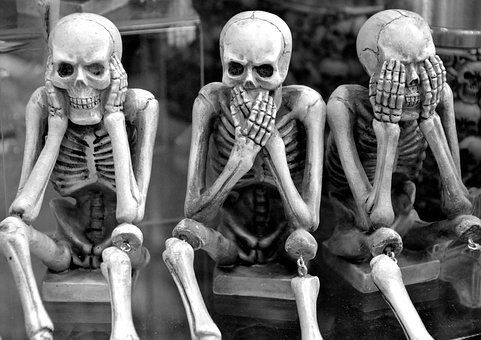
As an aside to last week’s post, here is an example of how getting the bible translation wrong can affect how we behave.
Thessalonians Chapter 5:22 (KJV)
Abstain from all appearance of evil.
I have seen this verse used to justify not drinking hot coco from Starbucks because somebody might think you are drinking coffee (which if black, would be much healthier for you, but I digress). It is used to justify not shopping in a liquor store for a candy bar, because somebody might think you are buying something else.
What about the BYU dress code? Men are not allowed to wear beards. This was enforced during a time of “hippy” rebellion, the counter culture. A beard gave the “appearance” of association with these hippies, the appearance of evil.
Let’s look at several modern translations of the same Greek phrase:
NIV: reject every kind of evil
ESV & NRSV: Abstain from every form of evil
CEV: don’t have anything to do with evil
ASV: abstain from every form of evil
It seems what this scripture means to say is “stay away from all evil no matter how it looks”, as opposed to what seems to be a common church member interpretation of “don’t do anything that could appear to be evil.”. The focus is not on avoiding anything that someone else might perceive to be bad, but rather to avoid that which truly is evil.
If I am a Minister to a person who is only “available” when he is in a bar, should I go into that bar to visit him? If a woman is walking home in the pouring rain and I have the ability to help her, should I refuse to do so simply because someone might see me and jump to an incorrect conclusion? When I was a kid, my mom was leaving the neighborhood grocery store with a hand full a groceries to walk the 6 blocks to our home when she saw our next door neighbor bishop in the parking lot. She asked for a ride home. The bishop became flustered, and you’d have thought my dear sweet mom had propositioned him. He did give her a ride, but was clearly uncomfortable being seen alone with my mother.
What if being Christ like causes people to judge us as we help the LGBT community, the homeless, immigrants, prisoners, drug addicts, and sex trafficked women?
Many years ago I was riding my bicycle to work. As I was riding up the street, I saw a “pornographic magazine” [1] ripped up and spread across the sidewalk. It was clearly obvious what is was even as I just glanced down as I sped past. As I looked up from the sidewalk I saw a group of elementary school kids walking towards the magazines, about 100 yards away. Without giving it a second thought, I turned around, rode back, got off my bike, and gathered up all the magazine pages and stuffed them in my backpack. I then rode off to work, passing the kids. I got rid of the pages in a dumpster outside my work building. I really didn’t think about if members of my ward were looking, or what they would have thought about “Brother Bill” (I was not bishop yet!) picking up pornography!
I soon forgot about the episode until about six months later when a member of the SP was speaking in our sacrament meeting. He was speaking about the evils of pornography, and told about driving down the street when he saw several pornographic magazines on the road. [2] He told about stopping at a traffic light, looking in his review mirror, and seeing a car slowdown by the magazines, the driver opened his door and scooped up the magazines. The SP counselor talked about what an evil world we lived in, and how this persons mind was now polluted with the things of the world. At that moment, me picking up the magazines six months earlier came back, and I was so thankful he had not seem me, or I would have been the subject of his talk! [3] I did not avoid the appearance of evil.
What ways have you seen the misapplication of this scripture by members due to its mistranslation? How can the proper translation help us to be a better person, and more Christ like?
[1] This was 30 years ago, and I think the magazine was either a Playboy or Penthouse.
[2] How he could tell from his drivers seat that the magazines were pornographic was not explained in his talk, but left me pondering how it happened.
[3] maybe if he had seen me, I would have never been called as bishop!
 Wheat & Tares
Interesting post BB. Thank you.
I have always struggled with the relationship between the concepts of obedience and “blessings”.
D&C 130: 20-21 has been quoted so many times to say “if you are obedient then you will be blessed”.
What it says is “when you are blessed you have been obedient”. That is a very different (actually opposite) understanding of that scripture.
The word translated appearance in the KJV is eidos. It is used in Plato’s theory of forms to refer to something’s true underlying nature. If an act only superficially appears evil to an ignorant observer, its eidos is not evil, and it is not prohibited.
When discussing the topic of obedience, I always think of the commandments Adam and Eve were given in the Garden of Eden. Everything isn’t always so black and white.
I also cringe when members refer to “the world” as a metaphor for everything evil.
Commenting on a previous post, I mentioned a mission experience I had. I served a stint in Mons, Belgium. A block away from the LDS church (and where we lived) was the town brothel. In the morning, the women would be out sunbathing. They would wave to us as we headed out tracting, and not wanting to be unfriendly, we always waved back. I guess we violated the rule to “avoid the appearance of evil.”
On the subject of questionable translations, I’ve always based my life on the commandment in Ecclesiastes of the OT (KJV) “to cast thy bread upon the water.” I assumed it meant to see and encounter the world. Be a wanderer or wonderer. So I’m a skeptic and a bum. But I recently found out from modern translations that the scripture is intended as financial advise, not a travel recommendation. Oh well, it’s too late to change.
Here’s what I wrote on this expression in my NT Footnotes:
OR every form of evil. This passage is commonly misunderstood to be saying that we should avoid things that might appear to others to be evil, even if they are in reality not. While perhaps a good principle, that is not what this v. is saying. This mistaken reading is based on a misapprehension of the import of the word “appearance,” which here means simply “occurrence,” not that which superficially seems to be real but is not.
Very interesting and thought provoking!
A good example of “wresting scripture”.
A more complete explanation is provided by Paul. You are invited by non-members to a feast perhaps at your friendly neighborhood Presbyterian church (they do put on a nice chili banquet now and then). Pauls says, “If you want to go to the feast, go!” (1 Cor 10:27-31)
But then he cautions that if the feast is specifically to honor some sort of pagan god or goddess, such that your presence isn’t just eating but is presumed an affirmation of loyalty to that idol or pagan deity, then you should not. “eat not for his sake that showed it”; in other words, how someone else reads or interprets your behavior matters.
Joe Biden is in hot water with some people, but not others, because his behavior while presumably innocent in his mind, is not innocent in other people’s minds. Does it matter? It does if you think it does!
1 Corinthians 10: 27 If any of them that believe not bid you to a feast, and ye be disposed to go; whatsoever is set before you, eat, asking no question for conscience sake. 28 But if any man say unto you, This is offered in sacrifice unto idols, eat not for his sake that shewed it, and for conscience sake: for the earth is the Lord’s, and the fulness thereof: 29 Conscience, I say, not thine own, but of the other: for why is my liberty judged of another man’s conscience? 30 For if I by grace be a partaker, why am I evil spoken of for that for which I give thanks? 31 Whether therefore ye eat, or drink, or whatsoever ye do, do all to the glory of God. 32 Give none offence, neither to the Jews, nor to the Gentiles, nor to the church of God:
Paul offers two variations of the same story. 1 Corinthians 8 7-9. The language is a bit cryptic. In this we talk about “liberty of yours”, ignoring the law of Moses on one hand and eating meat that has been offered (barbequed!) to idols. So here you are on a mission to some place, hungry, and there sizzling on an altar to Moloch is roast beast maybe with a sprinkling of teriyaki. You look around, see nobody, help yourself. That’s okay. But, look around, see a dozen acolytes kneeling facing Moloch, now suddenly it is not okay to eat that meat. The meat itself is inconsequential.
1 Corinthians 8: 7 Howbeit there is not in every man that knowledge: for some with conscience of the idol unto this hour eat it as a thing offered unto an idol; and their conscience being weak is defiled. 8 But meat commendeth us not to God: for neither, if we eat, are we the better; neither, if we eat not, are we the worse. 9 But take heed lest by any means this liberty of yours become a stumblingblock to them that are weak.
So what about modern times? People have tried to trap me or trick me into what they suppose is a violation of Mormon laws. One night we were playing Risk with a bunch of people in the barracks. One offered me a 7-up, saying, I know you are a Mormon and don’t drink liquor so here’s a 7-up. I am not sure why I refused since normally I try to be as sociable as circumstances permit. But maybe it was half a dozen sailors watching me closely, maybe it was the Holy Ghost, likely both. At any rate I refused, they persisted, finally one of the sailors said, “give it up, somehow he knows you spiked it.”
Would I have been a sinner to unknowingly drink liquor? No. Sin is, in my opinion, mostly intent and much less whatever you actually did.
But in the eyes of those men in that barracks I would have fallen from grace.
Things like playboy magazine are not evil or sinful of themselves, it is what you do with it (and WHERE!) that matters. I’ve seen a LOT of portrayals of nudity in my Navy career; some of it artful (praiseworthy and of good report) some of it depraved, without love, affection or mutual respect.
Some LDS are so stricken by a peculiar virtue disease that they proclaim from the pulpit “We conceived our children through our garments”. Say what? Never naked with your mate? That’s virtue? Yes, to that person. To me it’s just bizarre. Not even sure I believe that claim. But watch out, that person *might* be your judge at your custody evaluation, so keep your wines in their cabinet when strangers are visiting.
Participating on this blog is an example of a behavior which some LDS would consider forbidden while others encourage it. Both sides (all sides) are likely to claim Jesus as the authority; WWJD (What Would Jesus Do).
I had a roommate in the Navy, a Mormon and reasonably active, yet he was the barracks purveyor of Playboy magazines.
I made coffee for the sailors. Never drank the stuff. But it was appointed to me to do so and I did so with excellence, and demanded 10 cents a cup, and earned a nice little profit with which we purchased a VCR for the child care center and also painted its walls (with volunteer labor).
Before it was my job it was that of someone else, charged 25 cents a cup but seldom collected. I reduced the price but always collected and kept a little accounting book.
The bible has a story about a servant, a steward, about to be fired. He invited his master’s creditors to come and he reduced the amount they owed. Then when he was fired, he had many friends. It seems odd for Jesus to preach that parable; but it tells me there’s a “schedule” of good and evil, smart and stupid; situation ethics!
https://en.wikipedia.org/wiki/Parable_of_the_Unjust_Steward
The concept of being smart in the world is also told in the parable of doves and serpents Matt 10:16 Behold, I send you forth as sheep in the midst of wolves: be ye therefore wise as serpents, and harmless as doves.
Wise in this case, and in my opinion, means to consider the consequences of every action in particular when there’s witnesses of your action. Witnesses should see you harmless (stupid?) as doves; that you are cunning as serpents you keep to yourself.