

Recently I’ve seen more and more of the doctrine that the Church and Christ should not embrace sinners.

The teaching I see and question is the teaching that we should reject sinners and have no part with them.
Thinking about it led me to two verses that make a good scripture study, both in the New Testament.
https://biblehub.com/1_john/1-8.htm
And
What do you think?
 Wheat & Tares
The Church is for those who want to join in the community and fellowship of fellow Saints in worshipping our Savior, proclaiming the Gospel, perfecting the saints, redeeming the dead, receiving the Lord’s servants, and working together to estwblush Zion in our present world.
…establish…
It’s an invitation to come and see, and exercise faith.
It is an interesting paradox. I am once again reminded of the work of Armand Mauss that much in the church is a balancing act between ends of a spectrum. And that balancing act changes over time based on many factors. The church wants to say and BE different. Take that too far and we are a self-righteous clique and way too excluding. Back off that too much and we are just everyone and not distinct (peculiar) enough.
I do think the gospel teaches to by and large love everyone, which does go against human nature.
I addressed this in my mission book, The Legend of Hermana Plunge. The gospel is for everyone, but the church, not so much. Missionaries (and I hope God) sees potential in everyone, but too often the ward members and the institution only see whether someone is going to need more help than they can give, judging how sincere they think they are, determining how much they relate to this person and like them and want their kids to associate with them. I think it’s one reason that the more middle class converts stay with it, but those who are on the fringes or in poverty struggle much more to stay in the church because they are often rejected when the very real hardships they deal with in their lives come to the fore. But the missionaries often do really love them and hope for them.
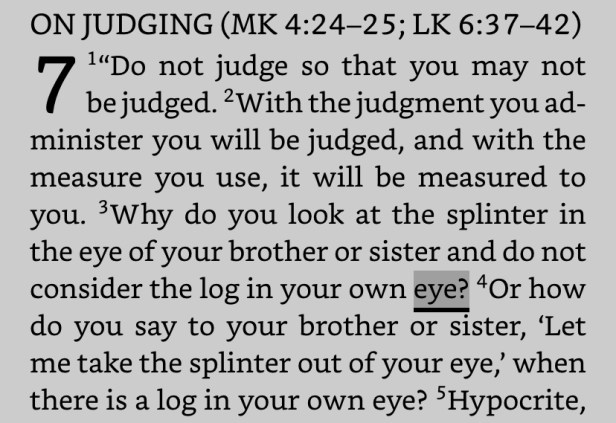
The next verse in Matthew is important: “Hypocrite, first take the log out of your own eye, and then you will see clearly the splinter in the eye of your brother or sister.”
See also Matthew 18:15-17 for other instructions on how to judge.
That’s not to take away from the notion that we should fellowship all, or that Jesus “did not come to call the righteous, but sinners.” But as Happy Hubby rightly points out, we have to strike a balance that welcomes everyone but offers to help everyone improve and does not let others define truth or right.
Stephen,
Trying to get clarity on what you are referring to before chiming in. Are you experiencing this teaching of the idea that the church should not embrace sinners locally among your ward members, or are you finding it on social media or in in church materials or in over-the-pulpit pronouncements by authority figures with “beyond my stake” influence? Other places?
I think you are right to be concerned. I am not defending any of them. Just trying to make sure that my response is based on a more accurate comprehension of what you are seeing and where.
Angela C.
I am very grateful to a sister in a ward in which I lived years ago who spoke in sacrament meeting and pointed out how often, when a person joins a ward, the ward members’ first thought is “how can this person help us with the myriad of things we are trying to do here” instead of “how can we welcome and embrace”.
Brought me up short and changed me. Good stuff.
First, we are all sinners. We all have different circumstances, experiences, abilities, genetics etc. We have little ability to judge ourselves, let alone to be involved in judging others.
Secondly, Jesus repeatedly placed himself with those deemed “unworthy or unclean.”
“They that be whole need not a physician, but they that are sick.”
If sinners do not feel welcome in our church, there is little hope they will hear/learn/experience the Gospel of Jesus Christ. He who was perfect and the only one qualified to pronounce judgments first extended love, then urged the sinner to repent.
Jesus’ harshest words were for the religious leaders of his day.
I concur with Angela, more or less. The gospel is extended to everyone; those who embrace it and enter into a covenant with other members constitute a church. You can certainly embrace the gospel without embracing the social contract (any of thousands of such things), and you can do the opposite, embrace the social contract while ignoring the gospel.
How to create a church from a gospel:
Mosiah 18
7 And it came to pass after many days there were a goodly number gathered together at the place of Mormon, to hear the words of Alma. Yea, all were gathered together that believed on his word, to hear him. And he did teach them, and did preach unto them repentance, and redemption, and faith on the Lord.
8 And it came to pass that he said unto them: Behold, here are the waters of Mormon (for thus were they called) and now, as ye are desirous to come into the fold of God, and to be called his people, and are willing to bear one another’s burdens, that they may be light;
9 Yea, and are willing to mourn with those that mourn; yea, and comfort those that stand in need of comfort, and to stand as witnesses of God at all times and in all things, and in all places that ye may be in, even until death, that ye may be redeemed of God, and be numbered with those of the first resurrection, that ye may have eternal life—
10 Now I say unto you, if this be the desire of your hearts, what have you against being baptized in the name of the Lord, as a witness before him that ye have entered into a covenant with him, that ye will serve him and keep his commandments, that he may pour out his Spirit more abundantly upon you?
11 And now when the people had heard these words, they clapped their hands for joy, and exclaimed: This is the desire of our hearts.
Ideally, the church is for the broken, for the outcasts, for all who seek to be whole and seek God’s love. In practice, as Angela C notes, that’s not the case. I’ve been a member of the church for more than 30 years and while I have found kind and loving people in the LDS Church regardless of where in the country I’ve lived, I have to say that for the most part, I’ve found much more fear, suspicion and self-righteousness than I have kindness, friendship and the bearing of each others’ burdens. Maybe that’s just me and maybe I, with my own innumerable flaws, bring those negative things to the surface of other people. But that’s been my experience. I think ultimately, carrying the gospel of Christ in our hearts and enacting it in our lives and the lives of others is what really matters. The church, like most others, is pretty flawed and aligns less and less (in my experience) with Christ’s gospel the longer I spend in it.
There is this alarming trend lately, and seemingly growing in the last 10 years or so (coincidentally, growing right along with the widening of the partisan political rift in the US) in which members decry the idea that you can feel the spirit if you are in a “bad” place like a bar or around “bad people,” and even argue with the idea that Jesus supped with prostitutes and other sinners. Personally, I think this is an extension of their political views that the poor and downtrodden have brought it on themselves and deserve what they get, that we’ll meet with them when they become pure (like we think we are). We mistake our personal comfort zones with “the spirit.” The church has much need to repent in this.
Concerning Angela C’s comment made on 28 March at 1:44 P.M.
Almost two years ago, my wife and I were taking a local trip in our car. My wife, who has experienced health problems in recent years, suddenly and urgently had to go to the bathroom. I was in a strange place, and did not know where to find a bathroom. Finally, I found a very rough-looking bar; the word “dive” came to mind, as I pulled into its crowded parking lot. We clearly did not belong there, and it was a place I never would have gone to, normally. As soon as I pulled up, a man who was standing outside the bar smoking a cigarette, came promptly to us and asked if we needed help. I explained the situation to him, and he took charge. He took my wife inside, showing me where to park. He called to the manager that we were not members of the bar, but needed help. A women in the bar jumped up and escorted my wife into the bathroom and stayed with her and helped her. Everyone was wonderful, and showed us extraordinary kindness — in a place where I would have never gone, on my own, the kind of place where one would be upset to find that one of his children had frequented. Well, when my wife was all okay, they helped us get to the car, and very nicely saw us off. A true attitude of Christian kindness and love. If one believes that the Holy Spirit cannot be felt in “bad places,” one needs to read “The Hiding Place,” which describes how Corrie Ten Boom was able to witness for Christ in Ravensbrück Concentration Camp, and experience the joy of helping people to accept the Savior.
The church is for God. We go to love, worship and praise God. God requires it and wants us to do it. See First Commandment.
I offer this answer for and in behalf of my wife and she learned this at an evangelical Protestant church. Notice, every response to this question so far describes a variation that the church is for us people. It is one of the reasons we Mormons are viewed as a fake religion or a cult or a cooperation. “. ….My work and My glory to bring to pass the immortality and eternal life of man… “” (PGP Moses 1:39) This a bold and rank heresy in conservative Protestantism. It is our work and glory to praise and worship the immortality and eternal life of God.
Secular humanists don’t believe in God in the same way. They think people are more important than God. Doing good to other people or the best for the most (including ourselves) is viewed as the highest ethical level.
Perhaps a real historian can chime in, but I contend that in the 19th century the answer to this question for far more people might be more along this love/worship/praise God idea than today (coincidentally, growing right along with the increasing sectarian doctrinal rift between conservative and progressive churches).
Jesus said to his disciples about the Pharisees: “Leave them alone” (Matthew 15:14). Sometimes I’ve felt like some church members and leaders are pharisees, but now I leave them alone. It’s been wonderful! Just following Jesus…
Our European GAs seem to exhibit the most compassion. I wonder why that is?
It is important for our meeting halls to be as inclusive as possible. And that we reach out to our neighbors near and far. Right now, the LDS Church seems lost in its top-down bureaucracy. Why couldn’t Wards have more resources to be inclusive and reach out to the world.
Our way to be more inclusive is the lose the suits, white shirts, and ties. And quit discouraging pants on women.
The Other Mike writes “We go to love, worship and praise God.”
If you were to substitute “I” for “we” there would be no argument. There isn’t going to be an argument anyway; this is a way of saying my purpose appears not to be your purpose.
rogerdhansen asks “Our European GAs seem to exhibit the most compassion. I wonder why that is?”
I have no idea whether a universal answer would be correct, but I will suggest the following:
1. Europe is still reconstructing from the effects of World War 2 including the collapse of the Berlin Wall and former Soviet Union. These events put the horror of war and poverty more immediately upon the public mind.
2. A separation took place with the advent of the United States. Persons with a sense of adventure and/or independence went to America, leaving behind DNA and cultural forces of assimilation, obedience to authority and sameness.
“It is important for our meeting halls to be as inclusive as possible.”
What does that mean, and why is it important?
How do you change human behavior? When I attended Oakton ward in Virginia, the people there would not give me the time of day because they were wealthy driving BMW’s and Mercedez-Benz, and I drove an UV (utility vehicle, before they became sporty). But in Poulsbo, Washington, they also would not give me the time of day but for an entirely different reason. Scandinavians can be unintentionally cold shouldered to strangers. In Iceland where I encountered this most conspicuously, it is actually the pinnacle of polite to NOT intrude on your private space and thoughts.
To answer my own question, I go to some effort to discover cultural norms so that I can introduce myself to others without stepping on cultural landmines. Some people like physicality, touching and being touched, other’s will file a criminal complaint for the same behavior, or strike you, or otherwise take offense.
“Why couldn’t Wards have more resources to be inclusive and reach out to the world.”
Wards have no resources that its members do not provide. No provision means no resources. The miracle of loaves and fishes is relevant. Someone must bring some loaves and fishes.
Having watched the movie “Sister Act” last night, I admire that demonstration of inviting riff-raff to the church; but I notice they are well behaved riff-raff. They made it entertaining which worked well enough for them and it works well enough for some protestant denominations. I would like to see a bit more enthusiasm in church singing and not the same 12 songs over and over until I want to scream! No more apricots popping or whatever it is. The hymnbook has some really good songs that rarely get sung.
https://www.lds.org/music/library/hymns/if-you-could-hie-to-kolob?lang=eng&_r=1
That’s to the tune of Kingsfold which you can find on Youtube. https://www.youtube.com/watch?v=6rr_4M5LQLo
Your collective silence strengthens my point by the minute.
We Mormons do not worship God. We do not keep the first commandment. Our religion is hollow. When we think God is one of us (As man now is, God once was…) He ceases to be God. I didn’t believe a pastor friend in Utah when he first told me this. We as a church collectively don’t even comprehend the words I write. This is far more disturbing than polygamy or fake translations or prophet worship. (Actually it explains prophet worship.)
I might as well write theses words in Japanese and you non-RMs to Japan will understand them no less..
Watakushi tachi wa Shin o suhai suru tame ni kyokai ni ikimasu.
(Hell, I had to look up how to say worship God after 2 years as a missionary there and over 40 years since then.)
Mike, Your generalizations point to a problem among some Mormons, but far from all. Are you suggesting that loving, worshiping and praising God must take the form of evangelical Protestant church services? I don’t think that is the case — though I find some Episcopal, Catholic, Lutheran, Methodist, Presbyterian, and some other church services more worshipful for me than many Mormon sacrament meetings. Still, the content of Mormon sacrament meetings does not prevent worship there, even when for some it fails as communal worship. There are also contexts for worship other than attending church meetings. See, e.g. the suggestions in Eric Huntsman’s “Worship — Adding Depth to Your Devotion”.
Incidentally, in my multiple visits to the other Christian churches I mentioned, it has become quite clear that there are people there for all the same variety of reasons some Mormons cite for going to church, and not only to love, worship and praise God.
The as-man-now-is-God-once-was trope does not require that we think God is “one of us.” Supposing that it did and that He then “ceases to be God” seems to be an unnecessary conclusion born of a definition of “god” as wholly other and an inability to imagine worshiping one with whom we have anything in common. It may even come close to denying the incarnation, though I doubt your Utah pastor friend has thought it through that way. But, yes, it may be that some Mormons fail at “worship” in part because they take an approach as superficial as your friend’s reported comment. At least at times (too many) my approach has also been too superficial, but, heck, I did not have to look up how to say “worship God” in German after 2 years as a missionary in a German speaking mission and nearly 50 years since then.
Thanks for prodding me to think about this.
Mike,
We worship God by loving and caring for his children, not by attending a church meeting.
See the second great commandment.
Anyone who preaches otherwise has missed the mark of Christ’s teachings, regardless of what religion they profess. Similarly, anyone who adheres to this principle will ultimately draw closer to God, regardless of the religion they profess.
See James 1:27, 1 John 3, and pretty much any of the Gospels for further evidence.
On that note, I would say we attend church meetings (and in general, join a church community) to learn how to worship God…in other words to learn how love our neighbors despite (and because of) our differences and all the messy situations that arise whenever people are forced to work closely together.
In other words, attending and serving in a church community gives us additional opportunities to learn how to love. And that’s really all God cares about, I believe.
Dr Cocoa expresses my thoughts more correctly and succinctly than I ever could. You don’t worship God in a *church*, you worship him where ever you are, and the act of worship is by doing what he asks; which is to love (serve) your neighbor. Church provides encouragement and a framework for actually doing that.
A church *can* provide an environment conducive to thinking about God and one’s relationship to God. A temple is a better place for that, and a cathedral works well also. Best of all for me is mountaintops.
I think Christ’s example is instructive in this question. Whenever he wanted to “be with God”, he went to the wilderness, the mountains, etc.
So what did he do when he went to the synagogue and Temple? Well, from the records we have, it appears he went to teach.
So it seems to me, based on Christ’s example, that we don’t need a church to worship God, so that therefore can’t be the primary reason we go. We must therefore go to teach and learn….and as I stated above, I believe the most important principle God wants us to learn is to love others.
I’m done now. I promise.
Joseph Smith in Teachings of the Prophet Joseph Smith explained the foundation of what would become “As man now is, God once was; as God now is, Man may become”. He was speaking specifically of Jesus Christ who, among other things, reportedly said, https://biblehub.com/john/5-19.htm
Then answered Jesus and said unto them, Verily, verily, I say unto you, The Son can do nothing of himself, but what he sees the Father do: for whatsoever things he does, these also does the Son likewise.
Joseph Smith then says “And what did the father do? Laid down his life and took it up again.”
It is less clear that you, me and everyone else is part of that heritance but it makes sense to me to so consider it. All life everywhere does one thing that is common; and that is to make more of its own kind. It would be trivial for God to create choirs that do nothing but sing praises to him; he has four fantastic beasts at his throne that do just that. So how is it that you and I have free will; even to be as cruel as Pol Pot, without interference from God? What thing is so precious that humans must prove themselves again and again, be tried by fire and brimstone, suffer much?
I believe we are not being *tested* for God presumably already knows the outcome. We are being *developed*, like children, and not like pets or companion animals.
I had a bishop once complain that we were “poor servants”. I took offense and wrote a letter; we are not *servants* at all, but *children* being taught. And what are we to learn? “Be ye therefore perfect, even as your Father in Heaven is perfect.” https://biblehub.com/matthew/5-48.htm
Notice Jesus does not include himself as the standard of perfection. Not yet anyway. We are commanded to be as perfect as God Almighty. What happens when we achieve that perfection? I do not say very many will achieve it, but it seems pretty clear to me that ONLY the Mormons have understood the plain meaning of these scriptures.
How about: “As man now is, Jesus once was; as Jesus now is, Man may become”. That’s Christianity.
Michael 2. You refer to testing. I assume you are refering to Abraham 3:25, no one I have heard quote this realises there is not a full stop after 25 but a semi colon, and it continues with that those who keep their second estate will have glory added on their heads for ever. So no no testing.
Your other quote is Matt 5:48 Be ye therefore perfect, even as your father in heaven is perfect. If you read the verses before it they are referring to loving our fellow man.
We are on this earth to learn to have joy by loving our fellow man.
I am not sure how the church helps with this as my ward and stake are still teaching the obedience gospel. Obedience is the first law of heaven. Which I think is wrong.
I think you have the reason European GAs are more compassionate is that they come from a more caring and compassionate culture than USA.
“ views that the poor and downtrodden have brought it on themselves and deserve what they get, that we’ll meet with them when they become pure (like we think we are). We mistake our personal comfort zones with “the spirit.” The church has much need to repent in this.”
I’ve seen that as well.
Sorry I’ve been late to chime in. I’ve been out of internet connection.
This did not come from my ward but from others.
BTW, my brother had a bishop basically reprise Mosiah —from the condemned heresy side.
The stake President had words with him.
An aside. I think our wards are too small in some ways and the same twenty people doing everything leads to them also feeling too burdened to take on the burdens of others.
I’ve no solution right now.
Thank you to everyone for the thoughts and comments.
Going to wilderness is a great way to experience the spirit. Another is to travel, particularly if it’s not part of an organized tour. It gets you out of your comfort zone. You have a chance to observe and interact with God’s (and humanity’s) creations. I’m not much of a tourist, but I do love engaging with the locals, particularly in developing countries. I help supply the resources and they provide the labor. This is my church. I try to be inclusive. I try not to be judgmental.
So many logical flaws people,
Just because you don’t need a church to worship God doesn’t mean that a church, properly ordered, doesn’t enhance worship of God. Consider pitching baseball.Some farm kid could throw rocks and snowballs and develop a strong pitching arm. Or he could take advantage of organized games and good coaching and do better. Or he could have lousy coaches and jerk team mates and do worse.
The first commandment is not a prelude to the second. It stands alone as first and has priority. I suggest that unless you are keeping the first, your efforts doing the second are going to be compromised. Severely in many cases.False religion vainly attempts and fails to exalt man and does not exalt God.
Teaching is important. But it is only one of many ways we love our neighbor. Knowing is one thing.Doing is far more important.
I came up with this on my own many years ago in a military ward and it probably is not original. I saw the three LDS meetings as having specific functions and we mix these functions around too much. Sacrament meeting is to worship God. This transcends stage of life and knowledge/experience background. Sunday school was school, a place to teach and be taught the gospel.different classes attempt to address different stages and knowledge levels. Priesthood/Relief Society were to be meetings centered on organizing service. We didn’t need a lesson. Implementation like doing is harder..
I don’t claim that worship of God must take the form of evangelical Protestant church services. I don’t believe many basic tenants of those churches. But in my half century of experience (in a small number of wards I can count on 2 hands with fingers to spare), they do far better than we do in praising and honoring God. I only point to them as an example of doing something better than we do in church. And they are not far away like in Tibet or Korea.
A couple of weeks ago I stood with a few hundred devote evangelicals at the end of an excellent service with great music and a pretty good sermon. We sang this song linked below. Listening to it on the computer pales in comparison to actually standing and singing with people who are almost overcome with emotions of love and gratitude, to the point of tears in some cases. Just as listening to a favorite song on the radio pales in comparison to going to a concert. I have never experienced anything like this in our services. The energy, the love and enthusiasm. Nothing I have done in our services can compare,
Here are the words of the first verse in case you don’t want to follow the link:
Who has held the ocean in His hands?
Who has numbered every grain of sand?
Kings and nations tremble at His voice.
All creation rises to rejoice.
Behold our God.
Come, let us adore Him.
Behold our King.
Nothing can compare.
Come, let us adore Him
He that hath ears ,let him hear.