
I have long wondered why we have Ward Conference. It seems like a wasted meeting to me. I don’t understand why we need to re-sustain General, Stake, and ward leadership. It seems like a mindless formality. What am I missing here?
We recently had ward conference again, and it’s the first time since the 2-hour block. There was one difference. After sacrament meeting, rather than go to Primary, Sunday School, etc., they asked all children 8 years and up to meet as families. They divided us up by last names. A-G met in RS room. H-M meet on gym stage, and N-Z met somewhere else.
The meeting I attended was by the stake president. He discussed parables in the New Testament, but to be honest, it wasn’t much different than a typical lesson on the New Testament. I’m sure this family-centered focus was probably part of Pres Nelson’s focus on the church supporting families, but I can’t say that it was a particularly inspiring meeting.
So again, what’s the purpose of ward conference? Is this format similar to other people’s experiences for ward conference?
 Wheat & Tares
I love it because it’s a chance to not have to be at church on Sunday. Take a break and do Church at home.
I think it fills the following purposes (slightly tongue in cheek but not really):
For the hardcore “follow the prophet people”, it gives them a chance to hear revelation.
For others, it’s a chance to hear what the leaders think are issues that pertain to the church and our modern life… even if it makes us cringe sometimes.
For those that dislike the church, it’s an opportunity to hear how out of touch the church is with modern life.
For those who left the church for other prophets etc, it’s a chance to hear how off course the church has apostatized.
I think ward conferences are an echo from an earlier era before phones and the internet when you had to visit groups of relatively isolated people to understand what was going on. It’s kind of the Mormon version of circuit riding preachers. And while that might have been valuable 100 years ago, in 2019 it doesn’t seem to have much of a purpose. Everyone I know who has a stake calling dreads ward conference time of year.
We just had our ward conference a couple of weeks ago. There was nothing like what you experienced second hour; that must have been a local thing.
The Stake Presidency met with the Bishopric during their meeting and with the EQ Presidency during what would have been Ward Council (which we cancelled). Stake auxiliary leaders met with their ward charges for some kind of training, I think. We had all the sustainings, and the bishop and SP spoke in sacrament.
All of which is to say I’m not really sure. I guess it’s supposed to be a time of training and checking in (or something).
We just had ours as well and it was nothing like yours, but more business-as-usual. Frankly, I have no idea what the point is other than to allow leadership to tell us that it is so important that we should invite all our neighbors and friends. Ditto to Stake Conference. Then both are generally just more meetings talking about the same things we always talk about.
Andy, we’re talking Ward Conference, not General Conference. Church at home isn’t an option for Ward Conference. If you’re a regular church attender, you likely forgot it was ward conference Sunday until you showed up and see all the stake leaders there.
I just realized that and am shaking my head in shame…
Otherwise those poor stake auxillary leaders would have absolutely no purpose. I really have never understood what their true purpose is. It all sounds more important then it really is.
I enjoy ward conference!
In stakes where there are a lot of wards, it is the one chance to have the stake president speak JUST to your ward, on issues that might be particular to your ward. Hopefully, this is different than the usual Sunday speakers. It feels more personal to hear of his experiences and struggles and insight into things. I enjoy that opportunity.
In the second hour of ward conferences in our stake, the stake presidency members teach separate lessons/lead discussions with the combined YM/YW (taught by a counselor in the stake presidency, often with the stake YM and YW presidents), to the Relief Society, and to the combined Melchizedek priesthood holding men (led by another counselor in the stake presidency). In our stake, the stake president usually meets with the RS sisters (along with the Stake RS President), and that is a nice opportunity for open discussion about current issues, etc. that might not be raised in a typical Sunday RS lesson. One year, he led a discussion on abuse and recovery, for example. Another year he led a kind, loving, and thoughtful discussion about how to love and support those who are going through faith crises (and those who have left the faith). He did that in every ward in the stake. These tend to be free-wheeling, well-prepared, yet open discussions where much information is shared, experiences are shared, and there is laughter and even some tears.
Also, ward conference is a chance to sustain all the leaders, from the General Church leaders down to YM and YW presidencies. I like the feeling and symbolism of offering a sustaining vote for everyone in the ward (once a year!). I know that some people don’t enjoy that, but I kind of like it.
Lastly, when we have ward conference in our stake, the stake presidency meets with the bishopric after the meeting, and the stake auxiliary leaders meet with their ward counterparts, for just a short time to catch up, to have questions answered, and to just connect. I like that opportunity.
I am sure people’s perceptions of ward conference are impacted heavily by their experiences. My experiences in my current stake have only been good, and I am glad we get the chance to have it once a year.
I don’t mind ward conference. As someone who has moved a lot, it gives a nice overview of who holds current callings in the ward. It’s also a time when you can see the stake leaders (presidency and auxiliary leaders) outside of stake conference. It’s usually more comfortable to do temple recommends with people you’ve actually seen before.
Also, now that they’ve limited which ward callings are sustained/released in sacrament meeting, it’s the only time many people are recognized for their service in their positions.
I admit it’s really difficult for stake leaders to do everything associated with ward conference, though. I don’t know that the visits the stake and ward leaders make to local families is all that useful, but I’ve never been in their position.
Agree with previous comments. The stake auxiliary leaders need to have a purpose. What would a Stake Primary presidency do without ward conference?
The purpose of ward conference is to give the ward members the opportunity of sustaining the bishop’s continued service. He serves by common consent, and the ward membership gets to decide whether to keep him or not for another year, if the stake president decides to present him. We use this oppportunity to sustain other ward positions as well. See D&C 20.
Stake president talks and so forth are not the purpose of the meeting.
Ward and stake conference are really just holdovers from the 1800s, where church was a major town event. Hearing from stake leaders who you may not see for months at a time would’ve been worthwhile, although that utility has diminished during the few decades though. Maybe those stake leaders of that time actually had some leadership qualities outside of the corporate office style of today’s church as well.
Where I am, ward conference is just hearing from local stake leaders, who are just regular people, and who frankly have no more spiritual insight than anyone else. Stake Conference usually has some low-level office administrator like an area 70 (or a temple president if you can’t book anyone else), who frankly has no more spiritual insight than anyone else. Sustaining leaders is a bit of a formality/joke these days, but it has some symbolic value.
The spiritual value of ward and stake conference is minimal. I mean, if you like hearing people talk at you, knock yourself out. I haven’t found that stake leaders, the stake presidency included, have anything great to say that I don’t hear from anyone else. The corporate business style of the church today, even at the local level, is just a facade that has unfortunately become confused with substance. But people like being told what to do, and hearing from people they like following, so it makes sense.
It gives the stake a reason to observe ward leadership and train them. Aka criticize lovingly.
To understand ward conference one must grasp the purpose of the correlation movement in the mid to later 20th century.
Correlation was a process to bring the entire conglomeration of church programs under direct priesthood supervision and simplify them. This begs the question of how did they happen to not be under this supervision? And this goes back to polygamy.
When the pioneers went west , they did subsistence farming and ranching in a difficult environment. There was little time for rest during 16 hour days of hard work required just to survive. Really basic church meetings were their only relaxation and entertainment. Then in the late 1800’s the farms began to mechanize and specialize in cash crops.Some industrialization began to happen. This gave people more money and free time, although the old timers continued to work like mules. At this time the federal government cracked down on polygamy and most of the priesthood leadership was forced to spent too much time in hiding.
At around this time, all the auxiliaries were either born or grew rapidly to fill the newfound leisure time. Many other organizations in society sprang up including the 3 major American sports (football, baseball basketball). But the priesthood was in hiding and so the auxiliaries developed their own vertical structure and began to function independently. Stake primary presidents called ward primary leaders. The general primary board called the stake leaders.they raises and spent their own money. There was little if any control by priesthood leaders.
During correlation the priesthood leaders were inserted into positions of control at every level. This made the vertical leadership structure of the auxiliaries obsolete. The primary president works under the direction of the bishop while the stake primary president now has only an ancillary role if any. But they did not want to ruffle too many feathers and flat-out eliminate these obsolete structures. So they gave them meaningless busy work which gradually dwindled down to what little we have today. Ward conference is the last remnant of subjugation of once independent auxiliaries. We sustain the priesthood leaders to remind us who is in control and who is to be submissive. The fact it is such a farce indicates just how completely the priesthood took over all control of everything.
At the Presbyterian church my family attends, there is an annual business meeting, that is basically a regular service but longer, where in addition to worship and a sermon, the pastor reviews the congregation’s budget and gives an overview of the church’s prior year and plans and goals for the upcoming year. They give out a pamphlet with some rough numbers (attendance, giving, expenditures, ministry and missions support). The congregation then also votes to approve new elders* and deacons** and the nominating committee for the next year. (Much like in the LDS church, I have never seen one of these votes be anything other than unanimous, so)
In theory, it seems like Ward Conference plays a similar role, except that sustaining votes happen a lot more often so it’s not clear why they *also* need to happen at a Ward Conference. And also, The LDS church holds numbers way closer to its chest. (And the fact that many other churches are far more transparent and manage to get along just fine really undermines the LDS church’s reasons for being so secretive but whatever.)
*”Elders” in a Presbyterian church are the members of the governing body of the congregation, which is a board of elders and the church’s pastors called the “session.”
**”Deacons” in a Presbyterian church are a body of ordained members who are primarily responsible for answering and meeting people’s temporal needs. People in emergencies can turn to the diaconate for financial and other help, etc.
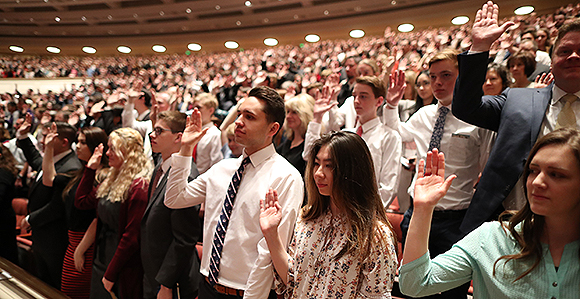
That is a really big ward having conference in the photo!
Conrad, I will suggest, without proof, that the experience of Mormons in the United States is very different than that of any other Christian denomination, except perhaps Catholicism.
“And the fact that many other churches are far more transparent and manage to get along just fine really undermines the LDS church’s reasons for being so secretive but whatever”
Mormons have been intensely persecuted in the past and continue to be persecuted somewhat less vigorously. The less ammunition you give to your opponents the better. If the only bullet they have is a complaint about transparency, well so be it.
These other churches do not seem to be getting along just fine, depending of course on what exactly you meant by that. Membership is dwindling in most Christian sects.
We share our ward goals at ward conference, which is inevitably some rewording of “Get more converts and increase activity.” When I was in Ward Council, we’d talk about the ward goals once or twice a year but never actually do anything concrete.
The instructions we receive in General Conference are often – well, general. In principle, stake and ward conferences should be more important for us since our stake leaders are entitled to receive revelation specifically for the stake.
Michael 2:
Persecution my ass. That dog don’t bark no more. We have dished out 10 times as much persecution as we have received in the last 100 years. I know it and I own it.
I grew up in a rural Utah and my high school was 90%+ Mormon. We made life hell for non-members who showed little sign of converting. Two little glimpses of examples among hundreds that come to mind:
A young, maybe college age, Protestant missionary came to our high school to call us to Jesus . Most ignored him. I engaged him in an argument and when sufficiently distracted, I led him back behind the school to the banks of the canal. Then I pushed him in and jumped on top of him and water-boarded him, while repeating the baptismal prayer. That learned him.
In college I went down to temple square, and was watching the rabble roosters at the south gate. One was wearing the bottoms of women’s garments with some red skid marks as a hat. I went up to him and in a quiet, firm voice stated: Don’t you remember me, from your dream last night? It is time. I have come for you. ” He asked belligerently, “Time for what?” I slowly replied, “For your blood atonement. The rest of these sheeple don’t believe in it. But we both know it is true and it is about to happen to YOU.” I grabbed his arm. He yanked it away and ran screaming down the street, “Get the f&$# away from me!”. He ran across west temple street against the light into traffic and almost got hit. I blinked my eyes. The driver was good, old Elder Boyd K. Packer cruising along, minding his own business. Tender mercy he didn’t run him down.
You want some good old fashion persecution? Give me a call. We always were our own worst enemies. Except actually I’m too old and my kids are too nice. Cousin Scooter is in prison and uncle Chucky got shot by the popo about 20 years ago and sleeps with his pioneer fathers up on the hill. 🙂