
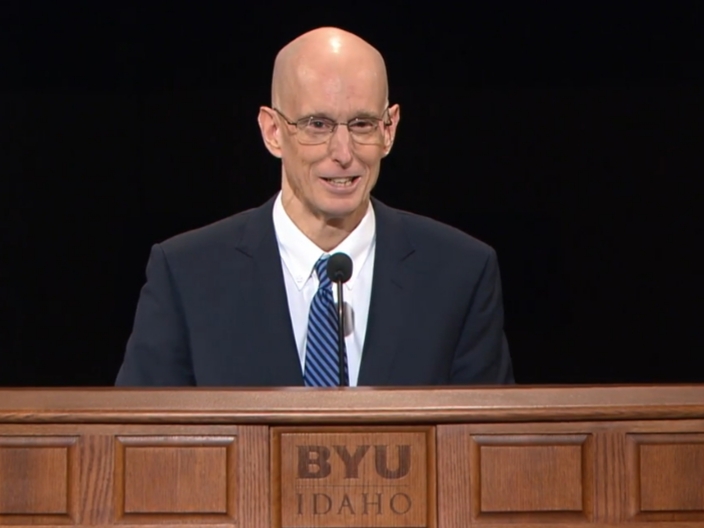
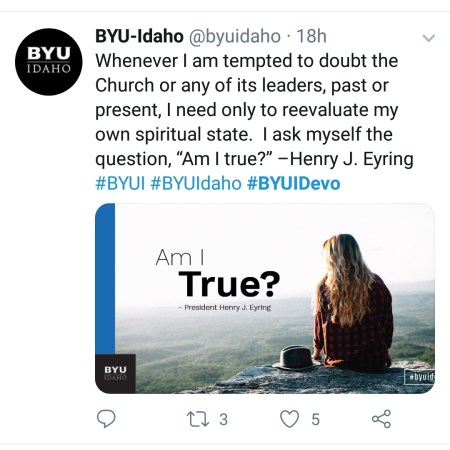
Two days ago BYU-Idaho President Henry J. Eyring (son of apostle and First Presidency counselor Henry B. Eyring) gave a devotional that has caused some stir on social media. A post shared by BYU-Idaho on its Facebook and Twitter feeds showed a quote from Eyring’s talk accompanying a meme of a girl sitting in the wilderness. The quote read, “Whenever I am tempted to doubt the Church or any of its leaders, past or present, I need only to reevaluate my own spiritual state. I ask myself the question, ‘Am I true?’” Both of those posts have subsequently been removed.[1]
A Church News article on the devotional suggested that Eyring’s solution to doubts was repentance, implying doubts themselves required repentance. Luckily, the devotional was posted this morning, so viewing it made clear that Eyring was going for something slightly different. For Eyring, repentance itself is an anchor to his testimony. Going through the process of repentance increases his testimony of the Church. Therefore, when doubts arise about the Church or its leaders, repentance is his guaranteed way to get back on track to trusting the Church again.
Two W&T permabloggers, Mary Ann and Kristine A, wanted to share further thoughts and concerns about ideas expressed in this devotional.
Mary Ann:
Eyring shared several personal experiences that helped solidify his testimony of scriptures and the Church. Here’s what Eyring said about his testimony of the Book of Mormon, derived from his experiences mirroring those of Enos and Alma the Younger:
As I grew older, I discovered another source of testimony that our latter-day scriptures are true. Thanks to Mother, I knew scripture stories about people who had repented and received forgiveness of their sins. The stories of Enos and Alma the Younger became precious to me in my teenage years when I recognized the need for heart-changing repentance. Responding to the Spirit’s prompting, I followed the examples of Enos and Alma, praying for forgiveness and peace. When those feelings came to me as they had to them, I knew in both my heart and my mind that those stories are true. I could not deny that Enos and Alma the Younger were real people, whose stories had been compiled by the prophet Mormon and revealed to the prophet Joseph Smith. [15:04]
Now I’m an active member of the Church who happens to believe in the historicity of the Book of Mormon, but I really dislike this argument. Having experiences that mirror those of figures in a book does not suddenly make that book nonfictional.
Then there’s the declaration that it’s unnecessary to “rethink” our beliefs.
[16:40] Because of these life-changing experiences, I can transcend the occasional temptation to doubt what I know. When rumors and supposed discoveries about the Church come up, I suspend judgment. I find it unnecessary to investigate or rethink my beliefs. I have a better way to renew my testimony.
Our missionaries are constantly asking individuals to rethink their beliefs, and I don’t think it’s a problem if we members of the Church occasionally do the same. Even for those with lifelong membership in the Church, beliefs often change over time. If we’re dealing with something flimsy like “rumors and supposed discoveries,” then sure. Ignore away. But there is legit challenging information about the Church’s history, such as that found in the Church-produced Saints Volume 1, that may force us to rethink our perceptions of the institutional Church. That’s not a bad thing.
Finally, there’s this true/false dichotomy:
[17:01] Whenever I am tempted to doubt the church or any of its leaders past or present I need only to reevaluate my own spiritual state. I ask myself the question, “Am I true?” I define the word “true” the way you may remember doing when assessing a true or false statement on a school test. To be true all parts of a statement must be true. Any falseness no matter how small makes the whole statement false. By that standard, my answer to the question, “Am I true?” is always “No.”
While it is noble to evaluate truth by the absence of “any falseness, no matter how small,” this is hard to apply to imperfect mortals. As stated, no human can be defined as “true.” If no human is “true,” why would we expect human-populated institutions to similarly be free from defect? And if there are defects, does this make them “false”? Can we still claim to know the Church is “true”? Because right now we’re trying to come to terms with sharing a more complete messy history, dotted with missteps and mistakes. For those who take this true/false idea literally, any perceived falseness in the affairs of the Church can start breaking proverbial shelves immediately.
Kristine A:
My largest objection to the devotional comes in the last half, that following examples in the scriptures of repentance and obeying . . . is a test that is a “repeatable cure for doubt and a prescription for unshakable faith.” He goes on,
“in my adulthood the Church has come under increasing scrutiny and attack, but I have felt well prepared largely, due to the teachings of my youth, by my testimony of repentance. It is a blessing to have my conscience pricked and pride revealed and personal shortcomings and need for repentance that repeatedly turn me to teaching of church and its leaders for comfort and guidance. in the process of repenting I receive assurance the Lord is leading the Church.”
His main thesis is that putting into practice a doctrine of the gospel, repentance, strengthens his testimony and thus dispels all doubt. But his main problem here is conflation with The Church and the doctrines of the Gospel of Jesus Christ.
The Mormon Church doesn’t have a corner on the doctrines of faith, baptism, repentance, and forgiveness. Many other faiths practice by these principles. If anything his advice would be strengthening testimonies of Christ. Due to his conflation, he goes on,
“my ability to transcend temptation increases. In paraphrasing Paul, ‘When I am spiritually weak my reliance on the CHURCH makes me strong.”
I know that setting up testimonies this way is a sure-fire way to create MORE faith crises, because I find this to be one of the roots of my own. The more we put The CHURCH and its LEADERS on the bottom of our foundation instead of CHRIST, the more trouble with doubts our members and youth will run into.
As a Primary Chorister I taught the song “The Wise Man Built His House Upon A Rock.” I brought in monopoly hotels, a big rock, a bunch of sand, and a water bottle sprayer. As the kids sang, we would spray the sand and rock and see which houses were standing at the end. I then explained that only Christ is THE ROCK. Not our leaders, teachers, parents, church, tithing, or even the pictures of the Q15 men in the back of the room. All of those things’ main purpose is to help us STAY ON THE ROCK, but they are NOT THE ROCK. My advice for people going through a faith crisis along the same path I trod is to make sure to separate, not conflate, the Church and the Gospel, the Leaders and Christ. Our leaders aren’t Jesus Zombies. You can rely on Christ and use the Church to help you live Christ’s Gospel in ways that it can (ie sacrament) and not have the troubling parts as part of your foundation.
My point being this is a poor excuse for advice on doubt. Especially since threaded through the whole talk he calls doubt a temptation from Satan, repeatedly. This is NOT the way to get members of the church to quit treating members with doubt like trash.
Discuss.
[1] The quote itself is still up on the BYU-Idaho Twitter feed, but without the girl meme. It’s farther down, buried in all the tweets of the devotional.
 Wheat & Tares
“To be true all parts of a statement must be true. Any falseness no matter how small makes the whole statement false. ”
By using that standard…I’d say they are setting up many people to come to the conclusion that the church is false.
I reject that standard. Instead I believe the church is true, with all it’s falseness, and with all my doubts.
Regarding repentance…I have no problem with repenting helping one to re-connect with the divine, and in having that experience, being able to resolve issues of doubt. Not because doubt is a sin, or that because I have sinned I have doubts, but because working with the divine helps me let go of doubts that are less important than the experience of feeling God’s love.
In other words, it is not a cause-effect relationship between sin and doubt. They just happen to be part of me at the same time, while I journey and search for God in my life.
Yikes to the whole thing. I *winced* when I read this. “It is a blessing to have my conscience pricked and pride revealed and personal shortcomings and need for repentance that repeatedly turn me to teaching of church and its leaders.” No. No. No. Our needs for repentance isn’t about the church or the leaders, it’s about Jesus. This makes me so mad because it is so basic! (and err…. No wonder we have such a hard time convincing others that we are Christians.)
The LDS Church News headlines the talk as “How to evaluate doubts about the Church”
Their article chose to include this part of the talk:
“President Eyring invited anyone battling doubts about the Church to try a spiritual experiment. “Assume that the Church is true, notwithstanding the human frailties of its members and leaders. Then look for at least one way in which you are not being true to the teachings of the Church”
This is rubbish. I have doubts about the veracity of D&C section 132 being from God but I’m supposed to write that off because I and everyone else unrepentantly speed on I-15?
Dave C. Good comment.
I wonder, if they want us to do the experiment….what would be the control or alternate hypothesis to test to compare results?
In 25 words or less, he’s saying that if you think there’s something wrong with the Church, there is something wrong with *you*. Which strongly invites the following judgment: If someone thinks there is something wrong with the Church, there is something wrong with *them.* Which also implies that there is nothing wrong with the Church, ever. Or perhaps a softer if rather Orwellian position: If, in fact, there is something wrong with the Church, don’t ever talk about it, just pretend there is nothing wrong, ever.
This seems to run entirely contrary to the new push by senior leadership to be more transparent, with the Gospel Topics Essays and the new Saints volume attempting to put that into practice. That positions seems to be: We can talk about issues (problems, things that are wrong) in Church history and doctrine. I like the transparency approach a lot better than the “pretend that all is well in Zion, all the time” approach the devotional seems to be recommending.
Sometime ago I was sharing my shifting faith journey with a church friend and expressed it isn’t very helpful when the response is “pray and read your scriptures.” Her response was to get very aggressive , attack me and tell me I needed to humble myself. Ouch
Hearing Pres Eyring’s talk is just super depressing. I thought there might be space for me in the church but maybe not. I long to hear, words like—“ for those of you struggling with unanswered questions and challenges. We’re glad you are here with us. Stay. We want you here. We are all still learning. We recognize we have different abilities, experiences and gifts to offer each other as we go through this mortal journey.
@Lois, why do you need someone else to say those words? why don’t you say them to yourself and stay in the Church? no need to get depressed!
Heber13 – thanks. Ironically the unfalsifiable hypothesis is proposed by an academic, one who leads a University. Your comment reminded me of Alma’s thought experiment (Alma 32). Imagine if Alma said instead “Therefore, if a seed groweth it is good, but if it groweth not, behold look for at least one way in which you are not being true to the teachings of the Church”
I agree, Lois. It would be nice to hear that.
I guess we have to take what they say with a grain of salt. They are in the business of proclaiming truth…and so they are doing their best to do that.
I would say…if you have no ideas on where to turn for answers, what they offer is something you can start with, and build on, and it is better than nothing.
Once you have had what the church offers, you realize it is not everything..it is not total complete truth.
So…take it for what it is. Continue seeking for more. A BYU devotional is for a particular audience on what they can use as a stepping stone in finding truth. It’s not everything you and I need to hear in our stage of life.
A part of me, just wants to ignore this and move on, but then, then, as Dave C points: This is the President of an Academic Institution. Pres. Eyring’s epistemological method is closed. It does not allow one to reach another conclusion. Everyday, the students are learning a critical method for learning truth in the classroom. But, once they apply those tools to understand the institution, itself, they are asked to shut their reasoning skills off.
I’m sympathetic to the view, that the spiritual is outside the scientific. But, the church operates within the physical realm. Asking questions will produce fruit, inasmuch as the church operates with mortal humans, doing mortal things. Eying’s talk condemns the followers to a stunted spiritual growth. It is the anti-thesis to becoming agents unto themselves. Not to mention it is classic victim-blaming. “Don’t worry about the church doing something wrong, for you are doing things wrong.”
I don’t want to sound too harsh (for I’m sure Eyring’s sentiments are sincere) but, I must say (through my eyes) his “thesis” is as much blathering nonsense as Elder Bednar’s talk in regards too “having the faith not to be healed”. In all of my years, this is the only time I’ve ever been tempted to throw my television out of the window! Sometimes, these ARE NOT just simple, little homilies…..but they can really “screw with someone’s head”.
So now we’ve progressed from “Doubt your doubts” to “repent of your doubts”?
I think there’s a credible charitable reading that I could make of this address.
If I were picking out a primary point, he seems to be recommending a specific relationship with gospel and the church, one which may work best when we are orienting *ourselves* on ideals (faith, especially in Christ) and reforming ourselves with that in mind (repentance).
When I have that orientation, I don’t find that disagreements or doubts necessarily go away. They may continue to be present, they may figure into what I think the best judgments I think I can make are, and may even inform what I choose to teach or tell people about what I believe. But they take on a different character — I’m less invested in a challenge over whose views have influence or authority, because that’s not what my views are for. They’re for focusing on challenges and opportunities of gospel living as they present themselves to *me*, most* of which probably turn out to be more crucial to working out my life and salvation than the inevitable places leadership falls short.
In other words, we could understand him as asking people to account for their own stewardships first and foremost. That’s pretty good advice, and echoes certain portions of the sermon-on-the-mount.
I agree with some of the criticisms, though. “Any falseness no matter how small makes the whole statement false.” That’s a standard the church has failed and will inevitably fail again. Asking people to orient on their own stewardships is one thing; setting up this impossible standard for either independent judgment or authority serves neither the membership nor the church.
And ChrisClarke’s comment about a closed epistemological method seems really key especially at a university address. I don’t expect every gospel truth to meet tests of falsifiability — there’s all kinds of facts of living life that can’t be falsifiable, a religion worth its salt is going to talk about guidance and decision making under conditions where scientific approaches can’t effectively be brought to bear. But in a church where growth, increased understanding, and progression are all part of divine inheritance, I would like to believe we could stay away from closed epistemologies.
The poor man must be miserable. He’s learned to bully himself into submission.
Chompers – Good one! I guess “doubt your doubts” didn’t stop people from doubting, so this was the next thing to try I guess.
I would tell you that you need to repent just because you made that comment, but I “doubt” you would listen.
I’m sorry, but this is just madness. I’m sure he’s a nice man and I don’t think he’s doing anything but trying to help folks who may be struggling, but this just sounds ridiculous and illogical. I almost feel like we’re criminalizing doubt which just strikes me as bizarre, since we know via scripture that we’re supposed to walk by faith, not knowledge and faith, at least as I define it, is in part a process of confronting doubts, beliefs, hopes and learned experience and trying to fit them all into some sort of workable framework. Where is the room for contemplation or questioning or the honest admission that it’s impossible to know so many things that so many Mormons seem to insist that they do know? SMH
And in another vein, as folks have mentioned, he’s the leader of an academic institution and, as someone who teaches in higher ed, I just find myself embarrassed for him. The lack of a thoughtful, reasonable approach from an academic leader is inexcusable. I’m writing a book on Mormon theories of art and creation and I have to say, it embarrasses me to run across so many articles from so-called “faithful scholars” who simply cannot employ reason and logic as the academy defines it. I just feel awful for the man, doubly so because he seems so sincere.
It’s interesting now that I have stopped attending church for the past 8 months, how clearly illogical these messages about doubt have become from church leaders. These same leaders in their professional lives would never dream of reasoning and making important decisions using the methods they implore members to follow.
I say it is interesting to me because for the past 5 years or so I was aware that messages like this seemed off but I felt so compelled to find something constructive in what the church leader was saying. I felt so obligated to give them the benefit of the doubt. “He’s a good person and appointed by the Lord. I’m sure he has good intentions and there is something of value in what he is saying. It’s on me to find that out.”
My friends, can I tell you how liberating it is to just own my own mind 100% and to be able to say, “ what that church leader is saying is absolutely bull crap (I still can’t swear) and I feel no obligation to privilege what they are saying over any other person on the face of the earth.” I’ll use my own mind, thank you, and find truth based on inquiry and observation. Truth doesn’t need any thing the church is serving up lately.
Chompers, more like going from “doubt your doubts” to “repenting will make you feel so good you’ll forget your doubts” ? i mean, i guess it works for him.
I actually kind of feel bad for him because if I approach it with a charitable readings he’s trying to say “when I stumble spiritually sometimes it helps to ask, Lord is it I?” which isn’t necessarily bad advice. And then the forgiveness thing I can ~kinda~ see being pulled from something like planted. If you want to be forgiven and receive grace you are required to forgive and give grace to all men – even our leaders (or organizations). I may still try to hold them accountable, or I may trust them less, but I can acknowledge we are all but dust in need or Christ.
I can agree with the above concepts. But if that’s what he’s doing it he’s phrasing it in a very unfortunate way.
I think Eyring’s comments hints at a significant mechanism that seriously curbs member’s abilities to fully grapple with faith and doubt. Eyring’s association of doubt and repentance points towards the underlying feeling that likely he and most members have, that doubting is morally wrong or dangerous. I think it’s that moral danger zone that stops many from fully thinking through and considering their doubts.
So what he’s saying, in effect, is, “Let he or she who is without falseness first cast a stone at the church.” That’s a ridiculous and depressing standard. Does he really think it’s impossible for us as fallible people to judge the truth of *anything* because of our fallibility? But of course he doesn’t. He’s only directing this special standard toward the church. Of course it’s fine for us to see the errors in any other statement or person or institution. Just not in the church or its leaders. Totally makes sense.
Also, I’m totally with Mary Ann and Heber13 on the black-and-whiteness being almost guaranteed to work more against the church than for it. Is he seriously setting perfection up as a standard? Divorced from context, I would have thought that his statement about any bit of falseness making something false would have come from an ex-Mormon, not from a believer. Because the church so obviously, thoroughly, completely falls short of the standard of being 100% completely true.
I agree with a lot of the comments pointing out how problematic this talk was. I think it’s weird because he takes some already weird Mormon language of truth (see the many “what does it mean to say the church is true” blog posts) and turns it up to 11. Not only does he take “truth” and frame it using propositional logic, but he applies that logic to yet another thing that it can’t apply to. In propositional terms neither a church nor a person can be true because propositional logic is about statements. So asking “Am I true?” has the same faux-deepness to it that stuff like “ponderize” does. Maybe we can talk about a person being true in whatever colloquial terms that we do with the church, but to make it explicitly propositional makes it nonsense. And , of course, as many have pointed out, just sets people up for failure when they inevitably turn this propositional logic to the church.
“in my adulthood the Church has come under increasing scrutiny and attack, but I have felt well prepared largely, due to the teachings of my youth…”
This is a troubling piece of advice to me.
It sounds as if, when plagued by difficult and significant challenges adults encounter as they accumulate experiences and grapple with Life, the remedy is to revert to the conditioning of childhood. To substitute naive credulity and over simplified bromides a child can grasp and remember for the tests of an inquiring mind.
When has a prophet dealt seriously with one of these stubborn issues? Then say they have the answers. But they don’t share them. Rather, they tell us to “doubt our doubts” or question whether we are “true” or should be repentant rather than unconvinced or flat out appalled by the church’s more recent anxious and flailing and even hateful policies and statements.
How would any of these strategies work for us as parents? Is that what we need to expect from leaders provided by Heavenly Father?
The church teaches a True or False dichotomy to their own peril. If I can find even one thing that’s not true it’s false. I want to believe in an imperfect church, under a constant state of restoration, continually improving and getting better.
Very few people believe the church is perfect. But since they are the most sure of themselves, they’re the ones getting promoted so they’re the most powerful. But they’re in the minority. It’s time to start preaching the gospel of an imperfect church. If I have to believe it’s perfect and I’m the problem then I’m out.
Eyring’s devotional talk is rife with intellectual laziness, the likes of which should be far beneath someone as brilliant and accomplished as he. Perhaps he is drinking too much of his own Kool-Aid.
“Whenever I am tempted to doubt the Church or any of its leaders, past or present, I need only to reevaluate my own spiritual state. I ask myself the question, ‘Am I true?’” The very suggestion that my doubts are my own fault is gaslighting. I want to believe that he is sincere and means well, but I also know he is better than this. The presidency of BYU-I can be a springboard to future GA positions, but I certainly hope Eyring is not representative of the next generation of senior Church leaders.
I think most who have posted here view the church as something to analyze and test as they continuously seek to prove its truthfulness or lack thereof. But I think some (like Eyring) have made a firm decision and commitment to belong and to believe and they are no longer desirous to be in the mode of seeking to know if it is true or not. Rather, they are experiencing significant benefits from it and want to do all they can to keep themselves committed to it. Maybe somewhat the way a person who becomes a runner strives to keep themselves committed to the sport and doesn’t care much if it is “the true sport” or if the supposed scientific benefits of running are really true. They just know that it is something they like and that makes them feel good so they use whatever internal mental tactics they can muster in an effort to keep themselves committed to it.
“I followed the examples of Enos and Alma, praying for forgiveness and peace.”
IMO, the secret sauce is humility, not repentance per se. Job was relatively innocent of offence to others or God, but in the end “repented in sackcloth and ashes”, which is to say, he humbled himself and that is what made him acceptable to God.
Repent simply means a change of heart; it has taken on a particularly meaning among Mormons and maybe all Christians, that you repent OF SOMETHING.
But God himself repented in Genesis 6:
7 And the Lord said, I will destroy man whom I have created from the face of the earth; both man, and beast, and the creeping thing, and the fowls of the air; for it repenteth me that I have made them.
Now there’s something to think about.
So what about humility resolves doubt? It doesn’t, but makes doubt less important. In other words, some questions will probably not be answered in this life. Choose a path and follow it even if you cannot see exactly where it goes, for that is the nature of paths. It is there because someone before you blazed the path and maybe it ends in a fiery furnace but you aren’t going to know it until the end. Your only other choice is to take no path at all; but that too is a choice and a path.
Consider “I doubt Joseph Smith was a prophet of God”. What is the consequence? To me, not much. Seems like a quibble, straining at gnats, depends on what exactly you mean by “prophet” and what you think a prophet is and ought to be. In the OT were some stubborn, disobedient prophets (Jonah comes to mind).
Consider “I doubt the Book of Mormon is a historical document”. Well, I’m not sure about that either way. However, when I read the words that reflect principles of God (rather than principles of war), I feel strongly influenced by what I believe is the Holy Ghost. It lays out many concepts with clarity: Atonement, freedom, knowledge, truth. I see truth in many books.
Consider “I doubt my leaders are inspired”. Some are, some aren’t. Those that are tend to be inspired from time to time on important or maybe trivial topics but not 100 percent of the time, maybe only 5 percent of the time. If a stake president is not inspired then there’s going to be many un-inspired stake and ward leaders except by lucky accident. That problem goes right to the top of course and is probably why in all my travels I typically name (only) two bishops that were to me unmistakeably inspired. Two is good enough!
alice asks “When has a prophet dealt seriously with one of these stubborn issues?”
The biography of Spencer W. Kimball, I think it was, deals with his own struggles with serious issues. It is remarkably personal. I think that in General Conference the speakers must be extremely careful; sanitized to the point where perhaps the General Conference serves no purpose. It is said they all have personal witness of Jesus Christ and yet I have not encountered where any of them describes how exactly this witness was obtained. It is surely sacred but someone has got to do the duty of bearing witness, to cast those pearls that *some* will trample but others desperately need to see.
I have recently run with my doubts right out of the church. Just 6 days ago I went into my bishop with my husband and told him that I could no longer believe what I have been taught for 40 years because as time goes on I have found that not only have they changed what they have taught but they keep changing it! We had a long discussion about Joseph Smith, (I do not feel he saw God), about the Book of Mormon (no longer believe it is a factual book) and many other things. I do not know what I was expecting, but I was not expecting kindness or compassion in any way. He amazed me. He said he didn’t care if I believed the church was true or not. I could come to church or not, participate or not, no big deal. He said that he had great respect for me for following my beliefs. I was stunned! I think because he was not born and raised in Utah it made a huge difference. He is from Europe. He has many in his family who are not members. I wish everybody could have my experience.
“But his main problem here is conflation with The Church and the doctrines of the Gospel of Jesus Christ.” This is the primary reason why I distance myself from the church. I would argue that this is the correct diagnosis for what is wrong with the Church in general.
Jenny – what a wonderful bishop. I think I have bishop envy. I can’t get ours to stop hounding my semi- active teen. I wish the entire church took your bishop’s approach.
This is cult talk. Plain and simple. Get out now. The LDS Church is radicalizing.
I have an idea for Eyring. Cancel next week’s devotional and instead give a sequel in which he apologizes for his wrong-headed comments. Imagine a devotional that included the line, “I apologize for teaching that we should place our faith in anyone other than Jesus Christ; I equated church leaders with our Lord and Savior and for that, I am sorry.” That’s a devotional I could upvote.
MTodd,
Eyring won’t do that because he meant exactly what he said. It’s time Mormons stop giving the benefit of the doubt (is there any?) to their leaders, recognize the message that is actually being preached for what it is, and act accordingly.
Faithless infidel.
One of the paradoxes of the Christian religion is faith without doubt is no faith at all.
This arrogant and misguided and broken man does not believe deeply in God, more than he believes in a deeply flawed and floundering institution he has set up as a false idol between himself and God and conveniently within which his father has considerable influence.
Bless his heart, may he repent.and not lead too many others astray.