
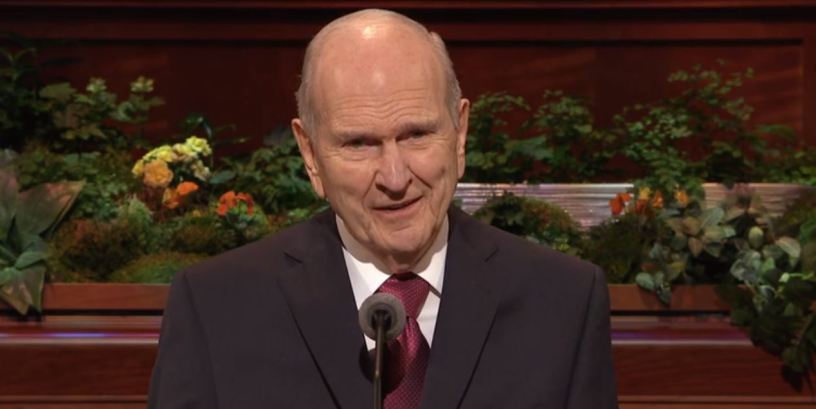
President Russell M. Nelson gave as his first talk addressing the body of the Church, a talk titled Revelation for the Church, Revelation for Our Lives.
Church members are talking about the changes made in conference as revelations. The changes to how priesthood quorums are managed and the change from home and visiting teaching to ministering, for example. These are being lauded as revelations by some church members. This seems to really irritate other members, especially many of my Progressive Mormon brothers and sisters.
Definition of Revelation
I like this definition of revelation from Blake Ostler.
Revelation is the synthesis of the creativity of man responding to divine persuasion.
D&C 1:24
24 Behold, I am God and have spoken it; these commandments are of me, and were given unto my servants in their weakness, after the manner of their language, that they might come to understanding.
Since humans produce revelation, and produce it through their weakness and in their language and understanding, human involvement is a given. We believe it to be a synthesis of the two, but the question could be how much is from man and how much is God.
If you believe revelation is very rare. Always 100% from God. Always perfect. And unchangeable. If you believe that about revelation, then I can understand why you’d be nervous about attaching the revelation label to all these things done at last conference.
But if you take this other definition of revelation, that I think the scriptures and our leaders are guiding us towards, we should have no issue calling things revelation. In this talk from Pres. Russell M. Nelson, he clarified this quite a bit, and I think by following him, we can come to a better understanding of what revelation is.
President Nelson on Revelation
From his talk.
Each of these blessings has come as a result of seeking and heeding the promptings of the Holy Ghost. Said President Lorenzo Snow, “This is the grand privilege of every Latter-day Saint … that it is our right to have the manifestations of the Spirit every day of our lives.”
One of the things the Spirit has repeatedly impressed upon my mind since my new calling as President of the Church is how willing the Lord is to reveal His mind and will. The privilege of receiving revelation is one of the greatest gifts of God to His children.
He is exhorting us to receive revelation on a daily basis. And he is saying God wants this gift for ALL his children.
Through the manifestations of the Holy Ghost, the Lord will assist us in all our righteous pursuits. I remember in an operating room, I have stood over a patient—unsure how to perform an unprecedented procedure—and experienced the Holy Ghost diagramming the technique in my mind.
Pres. Nelson received revelation in his daily life in his career that had nothing to do with leading the Church. This is to illustrate revelation from God can be quite ordinary.
To strengthen my proposal to Wendy, I said to her, “I know about revelation and how to receive it.” To her credit—and, as I have come to learn, typical of her—she had already sought and received her own revelation about us, which gave her the courage to say yes.
Pres. Nelson appeared to pull the classic returned missionary move, “I received revelation that you should marry me.” Sly. But as prophet of God, again he is explaining to to us how we should understand the word revelation.
As a member of the Quorum of the Twelve Apostles, I prayed daily for revelation and gave thanks to the Lord every time He spoke to my heart and mind.
He received revelation on a daily basis as an apostle. He then went on to explain a fairly ordinary, mundane process for how the Quorum of the Twelve and First Presidency receive revelation. They talk about the issue. There are differing opinions. They use logical arguments and understandings they each have through very humanistic, scientific processes. They seek to persuade each other. They pray together. Through this process, they reach consensus, and it is deemed a revelation. This happens over and over on a regular basis.
Some Progressive Mormons are worried about the overuse of the word revelation. I think this is the logic. They’re worried that if something is labeled as a revelation, members are bound to receive it as coming from God, and that it will be difficult to change in the future. So, it should only be used in rare occasion for very special revelations.
I actually think this is an anti-progressive view and has a little bit of a fundamentalistic side to it. Fundamentalistic religion is a view that prophets speak directly for God, and scripture is literal and perfect. If you don’t want to call these simple policy changes revelation because revelation is more rare and so much bigger and more important, then what you’re doing is defining revelation in a very “high view” kind of way, where revelation is a fundamentalistic, infallible, perfect channel to God. So, even though you call it rare, you’re giving it more absolute authority than it should have.
Revelation should be seen as somewhat ordinary. It’s humans attempt to interact with the divine and perceive the best course of action for ourselves, or those we have stewardship over. Do we trust it? Yes. Do we have responsibility to accept it when it comes for us from our Church leaders? Yes. Is it perfect? No. Can it be overridden later? Absolutely. Can it be wrong? Yes. Some might not agree it can be wrong, so I’ll modify that. Can it be right for the Church now, but not right for the Church later? Yes.
President Nelson is helping us understand there’s nothing magical about revelation. Something we need to break up and get rid of from our consciousness is this idea that revelation is perfect and special and rare. Revelation is a gift from God. But it should be understood as usually being somewhat mundane and ordinary. President Nelson is getting us prepared to expect a lot of it.
I could see fundamentalist types not pleased with this talk because they would call it another step of “liberalizing the church”. I have seen them criticize the Church for normalizing scholarly views like Richard Bushman who they think are describing Joseph’s translations and revelations as more of a humanistic, creative, contributory process than purely as a receptacle for divine input.
Revelation is needed to make changes in the church that many Progressive Mormons are hoping for. Changes in our LGBT policies and doctrines. Changes to make things more equitable for women. If we can reinterpret the concept of revelation the way I think Pres. Nelson is coaching us to do, then I think it becomes less dramatic to expect revelations. They’re not something that happen once every hundred years. They happen on a daily basis.
 Wheat & Tares
Only in today’s day and age do we need to slice and dice the term revelation because it is so rare.
In the days of Joseph Smith it was very evident what it was because Joseph received the mind and will of God through open vision.
God grant us to recognize his true servants who receive revelation not just through warm, fuzzy impressions but through open vision.
How, exactly, is this different than the ecumenical councils that supposedly led to the Great Apostasy and a need for restoration?
aurelius11 – we’ve been “slice and dice”ing the term revelation, and what it means to us, throughout the entire history of the Church. People didn’t believe Joseph because he said he saw visions, but because they had their own confirming revelations that he was a Prophet.
I never thought of revelation as being so constricting, needing to have a single person tell us everything we should be doing. That whole “sphere of influence” thing. I don’t know the exact delineation between direct, personal revelation and everyone just working it out for themselves, but I do my best to look for the former and believe most of those in Church leadership do the same.
Cody, there may not be a difference that can be explained that would satisfy a non-LDS. It’s probably a similar process. But the difference is in the authority. The LDS church has the authority to make those changes. Those councils didn’t. Then naturally the next question, is what is that authority and what does it mean, etc. My answers to that might be a little circular. We have the authority because we deem ourselves as having the authority.
I love Ostler’s definition of revelation. Of course a category this broad must include all scripture, including non-Christian scripture. Heck, it can even include “inspired” writings or speeches of any kind. My personal scripture is Eliot’s “Four Quartets.” Is this revelation as valid as that received by Pres. Nelson et. al.?
To me, it seems like we’re mixing the terms (as we’ve come to understand them) of revelation and inspiration.
To me, inspiration is what he’d talking about where you feel like your thought came from God as opposed to normal brain function.
Revelation on the other has seemed to be the “thus saith the Lord” moments where God speaks to the prophet gives a warning or some new doctrine like Section 76 and 88.
Doesn’t revelation also have the effect of actually « coming to pass »?
“[Some Progressive Mormons]… [worry] that if something is labeled as a revelation, members are bound to receive it as coming from God, and that it will be difficult to change in the future…
I actually think this is an anti-progressive view and has a little bit of a fundamentalistic side to it.”
I agree, when we look at the nature of revelation as inspiration with human components, such as life experiences of the one receiving revelation. When I was younger my concept of prophetic revelation was more toward a literal God speaks into a prophet’s mind. Over time, from my own experience and watching/listening to church leaders over the years, I’ve come to a concept of revelation more akin to what is described in this post. I’ve also become much more progressive as a result.
However, I don’t think becoming more progressive is necessarily the logical outcome for people who realize current leaders are not receiving revelation as dictation from the Lord. While I concluded “thus it always was” and modified my views about how the revelations must have been received by Joseph Smith, others, such as Denver Snuffer, take the reverse tack and conclude modern day leaders must have ceased receiving revelation instead.
Dave C. Exactly. That’s why I say that criticism feels a little fundamentalistic in nature. A realistic response to this view of revelation is that it feels weak and that the revelation tag should be reserved for when God speaks directly to prophets. But that is only a view held by those who think God speaks in a very direct way to prophets. And that’s a fundamentalistic view, in my opinion. I don’t think it’s irrational. But I don’t understand that argument coming from some of the Progressive types I hear it coming from the last couple weeks.
Couldn’t the criticism from “progressives” be in anticipation of and concern about others’ “fundamentalistic” definition and use of the label “revelation” rather than their own understanding of the reality of revelation?
There seems, for example, to have been a great deal of concern from progressives over the push by some members and leaders to categorize the The Family: A Proclamation to the World and the November 2015 POX” as “revelation” direct from God or as “doctrine” not readily susceptible to change in the future.
As President Nelson spoke, I wondered whether his conference talk was intended as a gentle way to begin backing off from his January 2016 “revelation” claim as to the POX, backing off, that is, from a fundamentalistic view of his January 2016 statements. [It would be potentially more problematic for the fundamentalistic members of the Church for any of the other participants in approving that Handbook change to make any statement that could be understood as backing off from or contradicting the claim that all of them felt “a spiritual confirmation” of that Handbook policy as “the Lord [having} inspired His prophet, President Thomas S. Monson, to declare the mind of the Lord and the will of the Lord… [as] revealed to President Monson.”] However, what he described in conference was a process similar to and not very different from the process he described in that January 2016 talk, though calling the result of that process “the mind and the will of the Lord” does seem to be a bit “fundamentalistic” — at least as the process is described in the OP.
I think Andy has it right.
Most members of my ward believe the Lord visits with the Prophet regularly to tell him what he wants done this week.
Not sure any of them will have noticed or be willing to accept that Nelson has redefined revelation to be a group of like minded men feeling good about agreeing on a subject.
If this redefinition makes it easier to bring about equality for women and gays, then OK.
I don’t think it is comparable to seeing God or angels. And I am not convinced it should be called revelation. I don’t think it carries the same weight as the Lord told me to tell you.
I think Andy is describing a traditional Mormon view. But at the core of it, I think it has a little bit of fundamentalist underpinnings. I think it’s been shown that there is no such thing as infallible, pure, perfect, 100% reliable big R Revelation. Like ever. All of it is little r revelation. All of it is subject to change, subject to recontextualization. So, by perpetuating the importance of the difference between little r and big R revelation, you’re perpetuating a false and bad idea that big R revelation is infallible. That’s a way bigger problem, in my mind, than the fear that a prophet’s going to get out of control with telling us everything is from God.
Churchistrue, I would agree “that there is no such thing as infallible, pure, perfect, 100% reliable big R Revelation.” But I wonder how the “little r” status of particular subject “revelations” can be effectively communicated to someone committed to the notion of “big R Revelation” without using that listener’s terms. Some cannot handle the “bigger problem” because they cannot (or it does not occur to them) to give up the idea that JS’ revelations written in the Lord’s first person language are literally the words of God accurately transcribed by JS acting as a mere stenographer. When you say “All of it is little r revelation” I think you mean there is always a human component but not that the extent of the human component is always the same. However, when little r revelations are explicitly given status as “the mind and will of the Lord” as in Elder Nelson’s January 2016 speech, it becomes difficult for some to distinguish that from “big R Revelation” and from “doctrine” believed to be unchangeable.
Maybe we need more than 2 categories. Have you considered “small caps revelation”? or maybe rating revelations by font size? Who should be in charge of the rating system?
No need for new categories. That’s the point, to collapse this all into one category. This is why I think this has the potential to be a great change. Consider this inoculation for the fundamentalists. What is a more likely outcome, for fundamentalist-literal thinking LDS to think interesting that God appeared to Pres. Nelson to tell him which type of jam to use with his toast or for fundamentalist-literal thinking LDS to think hmm Pres. Nelson is talking about revelation in a pretty mundane way, I wonder if this is the same method how it happened with Joseph Smith (and Paul and Isaiah).
I think the category change comes with how a revelation is implemented. Is it revealed to the body of the church in an off the cuff remark in a talk given in a non-conference setting? (see Nelson in Hawaii) Is it in General Conference? Is it rolled out as official policy in a letter to local leaders? Is it canonized?
CIT is historically right.
David Whitmer talked about how even though Joseph was essentially reading off his stone “When a man enquires of the Lord concerning a matter, if he is deceived by his own carnal desires, and is in error, he will receive an answer according to his erring heart, but it will not be a revelation from the Lord.” An Address to All Believers in Christ page 31
Ezekiel 14 is all about that too.
This tells me that the mind can greatly affect what is being received.
That shouldn’t be anything new. I’ve re-read numerous things (not just scripture) finding that the first time I read something, my mind completely added in it’s own words that were never there to begin with but my brain saw it because that’s the mindset I was in.
When has the church last had a revelation preceded by “thus saith the Lord”? Not in my life-time, and I’ve been a member since David O McKay was president. Even the revelation extending the priesthood to all worthy males was the result of the revelatory process described by President Nelson at the last conference:
“When we convene as a Council of the First Presidency and Quorum of the Twelve, our meeting rooms become rooms of revelation. The Spirit is palpably present. As we wrestle with complex matters, a thrilling process unfolds as each Apostle freely expresses his thoughts and point of view. Though we may differ in our initial perspectives, the love we feel for each other is constant. Our unity helps us to discern the Lord’s will for His Church.”
“Discern the Lord’s will”, instead of “Thus saith the Lord” appears to be the way revelation has been introduced by the nine prophets in my lifetime. Discerning the Lord’s will leaves leeway that they might not have gotten it all right, as Elder Bruce R. McConkie once stated:
“Forget everything that I have said, or what President Brigham Young or President George Q. Cannon or whomsoever has said in days past that is contrary to the present revelation. We spoke with a limited understanding and without the light and knowledge that now has come into the world.”
D&C 1:39 states “What I the Lord have spoken, I have spoken… whether by mine own voice or by the voice of my servants, it is the same”. It’s not hard for me to believe Joseph Smith, as the Lord’s servant, would feel he was speaking for the Lord whenever he received inspiration, even if that inspiration was received in the same manner the prophets of today are inspired. The difference is Joseph Smith’s use of “Thus saith the Lord” implied more certainty then the prophets are willing to imply today. That’s probably due to experience learned over the course of the church’s history with the revelatory process.
I agree with Randall and JR. Changing the way that members believe and think about the way prophets receive revelation is going to be a hard pill for some to swallow, but it is the only direction that can be taken at this point if the leaders are to maintain any credibility. It was a hard pill for me to swallow, but the end result has been much more liberating. I got in an argument with MH a couple years ago on here when he said that he thought Joseph Smith made up polygamy because that was so foreign to me at the time. In RSR Bushman used the words that Joseph surely was under the impression that he should start polygamy (leaving room for it to be a mistake), and that rubbed me wrong too. Either an angel showed up and commanded him or he did not was my line of thinking. I now view all prophets through a different lens and am just trying to appreciate any insight they can give me to the divine. I have lowered my expectations because the alternative was to run from Mormonism, the Bible, or any other person that has dared to speak for the Lord. My struggles have led me to study the Old Testament, Jewish faith, and Islam, and I now have a deeper appreciation of prophets than I ever did before. I would dare say the Lord revealed to me that is the direction I should take. I went to the Bible Musem in DC last year and have never felt such a spiritual connection in my life. I would call that revelation. The floor that has the Old Testament video is 10 times better than the endowment video. The clearest revelation I have ever had is when my first son was born and I looked in his eyes and felt a deep impression that his life did not start there and that there was a spirit inside of him. I call these revelations and I’ve never seen an angel, the Lord nor heard any voices. I am now an agent to act guided by prophets and personal revelation. They do not control me and I do not think they hold a special list of do and dont’s that is going to create a heaven here on earth for me or that will help me win my way back to heaven. In a lot of ways life was a little less stressful for me when I just had the list and I was doing a good job with the list. On a personal level, I sure have a lot more charity and compassion for women, different races, different religions and people in general than I did before I had the list so I wouldn’t go back.
All y’all should write a book, there are some looooooong comments.
I have, maintain, and will teach my children that “revelation” as we currently use the term (re:day to day communications from god) are most better defined as inspiration.
I may be more fundamentalist on the categorization of terms, but I hold fast that “revelation” ought to be reserved for visionary, cosmology, doctrine of Christ type information. Section 76, or 130 stuff. NOT day-to-day whisperings of the spirit to reflect managerial decisions.
My God is the All powerful God of the Universe, not the lord of common life skills & human management.
Sue me.
I wonder if my response to CIT and Dave C is stuck in moderation (I never understand why that happens) or if I somehow lost it myself.
JR, I did see your response, but it’s disappeared. Regarding your response, I think we are on the same page.
Zach: ” I now view all prophets through a different lens and am just trying to appreciate any insight they can give me to the divine.”
Long ago as a missionary in Europe I taught a Muslim family for a time. They belonged to an interesting sect I cannot now identify. Their sect of Islam was founded in 1830 by a “prophet” who “restored true Islam” and did not believe that Muhammed was the final prophet of God as do the main branches of Islam. They accepted multiple prophets. They had no difficulty accepting Joseph Smith as a prophet. They could not see any contradiction in their accepting Joseph Smith as a prophet and maintaining their belief and membership in their Islamic sect rather than joining the LDS Church. At the time, I could not grasp how they were able to do that. At least then, they and I had radically different understandings of what a prophet is and what the status of prophets’ sometimes contradictory revelations might be. As a young missionary, I had no grasp at all of “little r revelation.”
I remain grateful for such revelation as I have received for myself, whether little r, big R, small-caps R, or whatever. I have learned that receipt of and continuing belief in such revelation do not mean that I (or any other) always fully and accurately understand the scope and consequences of such revelation or the “mind and will of the Lord” as to such revelation. I have wondered whether learning to live with uncertainty, ambiguity, contradiction, change, and paradox is a part of becoming a responsible adult of God as well as a child of God. End of tangent.
I rather like Zach’s current approach, though its quoted formulation does not fully encompass mine. I really like the result for him expressed in the last sentence of his comment above.
Wonderful discussion.
My God is the god of the cosmos and the mundane, so I too am up for whatever I can learn, but that’s a definition that has changed through my lifetime as handed to me by the church. I received revelation today about asking my husband with help about an issue that is distressing me. We have always worked on the basis of what seems rational and in harmony with the truth that we hold dear, and that may change with time as we walk through a process., but it’s been an embattled position within the church. Glad that President Nelson seems to be validating the idea that we can all keep our heads as well as our hearts.
And I’m all with the idea of the arts speaking to our souls, I’ve long felt the spirit witness truth through poetry, and thought that many poets partake of prophetic gifts. I see Isaiah chiefly as a poet, and that joining together of ‘times past and times present’ being at work certainly in Eliot’s great christian works witnessing to me of God’s view outside of time.