
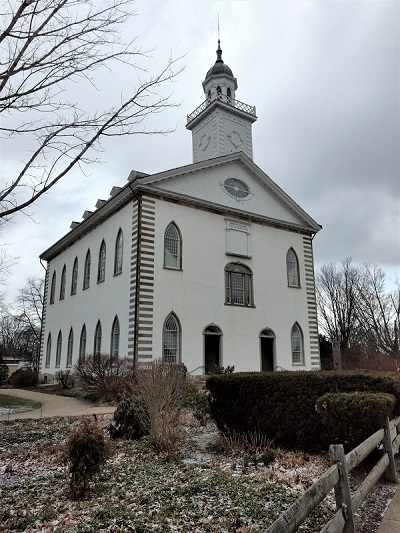
A House of Faith
I witnessed a miracle in the Kirtland Temple. It happened during a special tour for Sunstone conference attendees on April 7th. On this, my fourth tour of the temple, neither the guide nor any visitors mentioned the myth of early saints crushing up their best china to mix in the temple’s stucco (to make the building shine). Or maybe it wasn’t a miracle. After all, Sunstone folk have meatier things to debate.
“No two people belong to the same church.”
–Bill McGee, Chair of the Board of Directors, Sunstone
Sunstone Kirtland took place all Saturday and finished on Sunday morning with a devotional service in the temple. Over 40 years old, Sunstone now seeks to be inclusive of the full spectrum of people identifying as Mormon. Attendees described themselves as everything from Brighamite, to fundamentalist, to atheist. What better place to gather than the Kirtland Temple, the first built in the Restoration?
A House of Learning
Presenters included Devery Anderson, a historian on staff at Signature Books. He presented the history of LDS temple worship, including the struggle to standardize it. Next, scholars Paul and Margaret Toscano spoke candidly about the Endowment, especially significant changes in the ritual and the absence of a Heavenly Mother. A quartet of members from Christ’s Church – The Branch detailed their group’s avid temple worship in a fundamentalist context.
“Have a curious attitude about Mormonism.”
–Lindsay Hansen Park, Acting Director for Sunstone
As we watched these presentations, fervent and angsty feelings were evident. At least once, heated debate broke out during Q&A. The differing perspectives were each afforded their moment, yet afterward the questions remained. Are the LDS temple rituals in a state of corruption? Over the years, have they been altered too much or not enough?
A House of Reconciliation
That moments of discomfort were frequent did not mean Sunstone Kirtland was failing. Quite the contrary, from the moment we first gathered at the Community of Christ’s congregation for a pancake breakfast, fellowship and cooperation prevailed. People eagerly exchanged emails and social networking links. During lunch, Thomas Hatton brought much needed levity with an EFY song parody titled, “Modesty.”
The final presenters were Seth Bryant and Tom Kimball. Both are on staff at the Kirtland Temple. They shared their emotional journeys navigating the sometimes bitterly opposed cultures of “prairie saints” and “mountain saints.”
At the end of the day, the Visitor Center’s curtain opened. We all gazed out a large glass window at the temple. A spontaneous moment of silence occurred. I like to think in that moment we were one, united in our affection for the Kirtland Temple. Even for an agnostic like me, the moment seemed spiritual.

A House of Glory
“Do not be defined by the things that separate you but by the things that unite you in Jesus Christ.”
–D&C 162:5a, Community of Christ edition.
On Sunday morning, we returned to the temple. Standing in the main foyer, we listened as Tom Kimball rang the bell in the steeple. Then we entered the lower court and sat before the Melchizedek pulpits. Prelude music echoed with multiple faith traditions. Jenn Bryant, an Elder in the Community of Christ, conducted the service. She and Seth, spouses and fellow priesthood bearers, blessed and passed the sacrament. All were welcome to partake.
Lindsay Hansen Park gave the homily on a theme of reconciliation. As she described it, Restoration communities have wounds but can seek healing by reconciling with each other. This process does not require arriving at the same beliefs or rituals.
Following Lindsay’s remarks, the closing hymn was of course The Spirit of God. With hearty voices, we sang like it was 1836. The gentleman behind me was a fundamentalist. The couple in front of me were active mainstream LDS. An apostle of the Community of Christ stood nearby. There were grins and tears. And if a rushing mighty wind filled the room, it was made possible by our combined voices.
Questions:
What does the Kirtland Temple mean to you? Why?
Do you seek out interfaith fellowship opportunities? Why or why not?
 Wheat & Tares
The upper room of the Kirtland Temple was used for Hebrew study. Joseph Smith and others studied Hebrew grammar to aid their understanding of the Old Testament. Joshua Seixas, a Jew, was the instructor. I hope and pray that our temples will once again be used for Hebrew study, and that Jews will be welcome therein.
We’re going to party like it’s
19991836.You may find this interesting to explain the differences between LDS and RLDS temple worship practices.
I think you raise some important questions.
Attendees described themselves as everything from Brighamite
Is anyone who calls themselves that, a Brighamite in the academic sense?
Also, are there recordings to buy? Or bootlegs?
jpv, as I observed it used at Sunstone Kirtland, “Brighamite” was a quick way to identify oneself or others as coming from the Mormon group that followed Brigham Young out of Nauvoo. My sense is its usage is generally academic. At this Sunstone saying Brighamite was useful for distinguishing one’s Mormonism from Community of Christ (formerly RLDS), or people with ties to James Strang, or other groups which trace directly back to Nauvoo Mormonism but not Utah.
Sunstone did record the presentations. So I assume the audio may become available for purchase at a later date via https://www.sunstonemagazine.com/.
As I grew up in the RLDS I heard things like ” Brighamites won’t talk to Josephites for fear of learning the truth”. But I only encountered one such person ; in college. Now, being LDS, I have Community of Christ members refusing to discuss religion with me.
I talked about several schismatic groups with John Hamer, and the term Brighamite was a useful shorthand to distinguish.
Interesting post, thank you. In the LDS Church, we typically talk about the ordinances in Kirtland as “preparatory.” But, Joseph Smith did not present them that way. He presented it as the full endowment, what they had been waiting for since the beginning of the restoration and people felt an outpouring of the spirit. No such outpouring was documented in Nauvoo. It seems interesting to me that we have fully embraced the Nauvoo endowment and sidestepped what happened in Kirtland.
myth of early saints crushing up their best china to mix in the temple’s stucco
I asked about this on a tour of the Kirtland Temple and was told by the guide that analysis of the stucco did not find any evidence of broken china. Nevertheless, at a tour of the Church History Museum in SLC last month, I read a display that had a new take on the myth. It said that the myth that the early members broke their old china was incorrect and the fact was that children gathered broken china that community members were throwing out and the broken pieces were then used to make the stucco. So the myth lives on in different retellings.
Over the years, have they been altered too much or not enough?
I would say that the answer is obviously ‘not enough’. I have heard that there has been some backing away of the new films in favor of the one surviving older film because the newer films are longer and put the schedule behind. Anyone else? Perhaps the impact of these new films will effect a regrouping? The changes to the initiatory ceremony have rendered it excessively bland. Its akin to being set apart in a classroom in your ward building 3 plus times in a row. Do this for a dozen names for the deceased and it is mind-numbing. I won’t get started on Eve’s role and the alterations that could improve that segment of the endowment. Others have already blogged about this with compelling arguments.
The endowment really needs to lift members who make time in their schedule to go to the temple. Yes, for a husband and wife night away from the kids, that in and of itself can make the time uplifting. For those not fortunate to be with a love one that has passed or feeling troubled with the representation of Eve, it can feel like an exercise in being longsuffering.
I simply LOVE movies of all kinds and genres – and I certainly have my favorites; which I can watch now and then after a certain amount of time has passed in between. At this stage of my life the thought of going to the Temple to watch the same film over, and over, and over, and over again is anything but uplifting. Mindnumbing yes – uplifting no. In fact, when I would go to the Temple religiously once a week – it was common practice for many in the Endowment Room to immediately close their eyes and go to sleep as soon as the lights went down. This practice certainly represents a perfect example of “rote repetition” to me. I could simply go to the Celestial Room and sit quietly for two hours (if I were allowed to do so) and enjoy the peace and quiet more!