
In January 2018, the LDS Church was made aware that an audio recording existed of a former MTC Mission President confessing past sexual misconduct (while not admitting or denying a specific rape accusation). That same month, a Utah politican was approached by the Salt Lake Chamber of Commerce to create a two-party consent law making surreptitious recordings illegal, with the LDS Church volunteering heavy support. Were those events related?
For those not aware, MormonLeaks released a disturbing audio recording and transcript on Monday between a former MTC President and a former sister missionary who accused the octogenarian of rape during their time together at the MTC in January 1984. While he did not admit to or deny her accusation, the former president admitted to molesting a different sister missionary, among other infractions. Yesterday, the church released an official statement on the matter. For more on the contents of the tape and implications, check out Jana Reiss’ excellent article at Religion News Service or these other media outlets: Fox 13, ABC 4, and Provo’s Daily Herald.
I want to focus on the timeline shared in the Mormon Newsroom statement released yesterday.
This matter was brought to the attention of the Church in 2010, when this former Church member, who served briefly as a missionary in 1984, told leaders of the Pleasant Grove Utah West Stake that she had been sexually assaulted by the president of the Provo Missionary Training Center, Joseph Bishop, 25 years earlier…
The matter resurfaced in 2016 when the same individual contacted a stake president in Pueblo, Colorado, and then again a few weeks ago in January 2018, when the Church was contacted by a lawyer representing her. He provided a copy of a recording that she had made of a conversation between her and 85-year-old Joseph Bishop in December 2017.
The LDS Church was made aware of the existence of this audio recording “a few weeks ago in January 2018.” When I saw that, it got me thinking… wasn’t the church involved in a push to make recording and publishing these types of things illegal “a few weeks ago”?
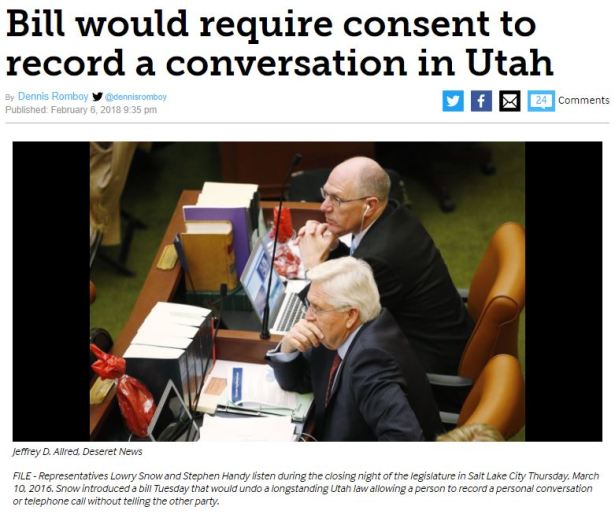
So, in what might have just been a very fortunate coincidence for the church, a state legislator from the southern Utah town of Santa Clara, Rep. V. Lowry Snow, was asked to develop a two-party consent bill in January 2018. From the St. George News,
Snow initially mentioned the bill in passing during a legislative preview breakfast held by the St. George Area Chamber of Commerce in January. At the time, he said he had been approached by the Salt Lake Chamber about creating a two-party recording law.
Utah’s legislative session began January 22nd, so the preview breakfast in St. George must’ve happened sometime before then. The Salt Lake Chamber of Commerce represents the business community throughout Utah, and Snow started drafting the bill after talking with them. Then he got contacted by LDS Church representatives.
The bill’s sponsor, Rep. V. Lowry Snow, R-St. George, said he heard from LDS Church representatives after he began working on the bill. (Salt Lake Tribune)
Snow said he also received a call from The Church of Jesus Christ of Latter-day Saints with interest in the bill and a possible desire to support it. (Deseret News)
The bill, HB 330, was formally introduced to the legislature on Tuesday, February 6th. Snow sponsored the bill in the House, and Sen. Todd Weiler of Woods Cross, Utah,agreed to do the same in the Senate. The same day the bill was presented, the church issued a statement formally backing the legislation.
“Church representatives have spoken with legislators to express support for (HB330), which is intended to protect the confidentiality of sensitive private conversations, including those between ecclesiastical leaders and their members,” according to LDS Church spokesman Eric Hawkins.
“In other states, business, legal, religious and law enforcement organizations have supported similar laws to safeguard confidential conversations for the same reasons.”
There was a problem, though. To put it mildly, this bill was not popular, and the public backlash was severe.
“It does appear that this original concept was universally hated,” said Sen. Todd Weiler, a Woods Cross Republican and Senate sponsor of the bill….
Weiler went so far as to express regret in agreeing to sign onto the bill. (He hadn’t read it when he agreed, he said.)
“I’ve rarely seen a bill that has had so much opposition so quickly,” Weiler said Thursday. “Obviously, this idea is hitting a nerve with the public, and not in a good way.”
Within 48 hours the bill was effectively dead. On February 13th, the Salt Lake Chamber of Commerce requested the bill be withdrawn.
The Salt Lake Chamber Executive Board formally voted today to ask the Legislature to remove H.B. 330, Communications Interception Amendments, from consideration.
Wilford Clyde, chairman and CEO of Clyde Companies, chairman of the Salt Lake Chamber Executive Board, said, “This morning, we voted to ask the Legislature to remove H.B. 330 from consideration during the 2018 General Legislative Session. We believe it should be studied during the upcoming interim session.”
Lane Beattie, president and CEO of the Salt Lake Chamber, said, “We want to express our deep appreciation for Representative Lowry Snow and Senator Todd Weiler for their sponsorship of this bill, at our request, and regret the unintended consequences and negative attention they received.”
So here’s the bloggernacle tie-in. On Monday, February 5th, the day before HB 330 was officially presented, a legislator with inside knowledge called a guy named Steve Urquhart, and Urquhart passed along what he said to John Dehlin.
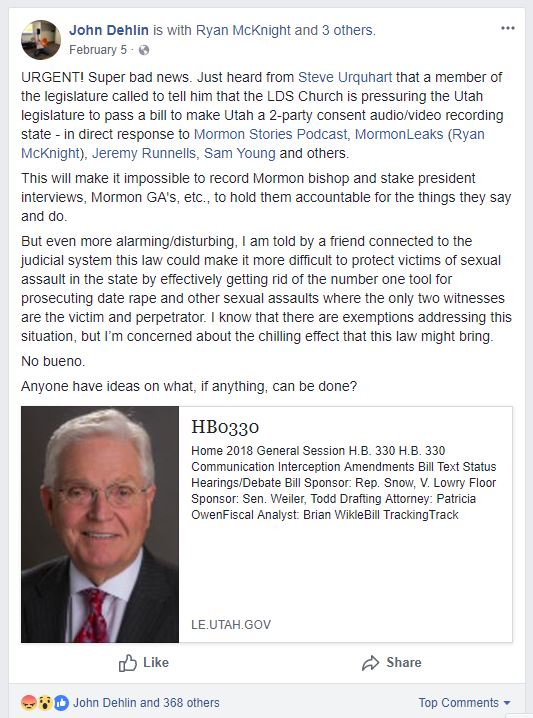
Dehlin was told “the LDS Church is pressuring the Utah legislature to pass a bill to make Utah a 2-party consent audio/video recording state – in direct response to Mormon Stories Podcast, MormonLeaks (Ryan McKnight), Jeremy Runnells, Sam Young, and others.”
So, if this is to be believed, the church was actively lobbying for HB 330 prior to its introduction. Which makes sense–Snow was open about the LDS Church expressing interest while he was drafting the bill. And we know the LDS Church hasn’t been happy with leaked recordings over the past several years, like video of disciplinary court proceedings, private meetings of high-level church leaders, or private conversations with general authorities and church historians on difficult church topics. But because of the Mormon Newsroom statement, we now know the church was likely concerned about this MTC Mission President recording as well during their lobbying for HB 330.
We don’t know what day in January the the audio and transcript were delivered to the church, and we don’t know what day in January the Salt Lake Chamber of Commerce contacted Snow for help on a two-party consent bill. But for people already suspicious that the church was behind the Salt Lake Chamber’s request, it is certainly an interesting coincidence.
Discuss.
Update (3/22/18-11:00am): The Wheat & Tares community has soundly debunked the idea that the recently leaked audio recording might have been part of the LDS Church’s support of HB 330. See the awesome comment thread below (this is why we love our commenters!). There have been many new developments on the recent MormonLeaks audio since the publishing of this post, and likely will be many more. Here are some more resources: MormonLeaks (3/21 statement), Deseret News (3/20 article, 3/21 article), Religion News Service (3/20 article, updated 3/21), and the Salt Lake Tribune (3/21 article, updated 3/22).
 Wheat & Tares
I think the timing and the logic don’t work for HB 330 to be about or prompted by the specific recording in question. I just don’t think there was enough knowledge at the right time to matter. On the other hand, it’ seems obvious (although I have no inside information) that that type of recording, and maybe even the specific circumstances that led to that particular recording, were concerns for the Church. Also reasons I opposed HB 330, like a large majority of Utahns.
I think I’m with christiankimball. I’m not sure if the timing of this specific event works out just right, but it’s been a concern of the church for years now about things being recorded. I remember specifically a few instances where folks who were getting excommunicated were asked repeatedly if they were recording the meeting. Of course, these concerns demonstrate the lack of faith the church leaders themselves have in the truth and in their own processes. For as long as I can remember, it’s been an assertion by the church that the confidentiality of the disciplinary councils, for example, was about protecting the member’s privacy, dignity, etc., when clearly, it’s about protecting the church. It’s simply a truth that institutions will always put their own well-being above an individual member of said organization, but it’s revealing that the church was willing to compromise fundamental individual personal liberties this much in order to protect itself. Things are really unraveling, I think, as layers of secrecy and privacy are being peeled away. This trend could actually be quite healthy for a church that really was about being “honest with your fellow man,” but the Mormon church isn’t really about that. It’s about both maintaining the status quo at any cost and about being willing to sacrifice its most vulnerable members in order to protect itself. Don’t believe me? Just read the transcript of the Bishop interview where it talks about Elder Packer advising AGAINST vulnerable, traumatized members seeking professional help and instead going to their bishop. SMH.
What a negative view? If I’m a church leader trying to counsel someone, I am going to just naturally act different if I know someone is recording me… it’s just natural to be concerned if someone is trying to set a trap for you with their linekof questioning to release to the public. When I am in a church meeting interview, I expect that what is said is confidential and not meant for the public. Now I have not problem with recordings like the one recently made that wasn’t a church meeting but outside in the past bloc sphere.
I understood she got consent. Representing it as an interview.
I don’t think we can know either way. It isn’t as if the issue of recordings wouldn’t have come up before, as as already been pointed out. Serendipitous certainly.
Well done, but I’m iffy on the timing as well. I don’t see the church bureaucracy as being able to work that fast.
What I am curious about is what else is out there that the church knows about that the general public doesn’t yet.
And with that, I feel deeply that the church has a moral obligation to contact the other women who were presided over by this man in the MTC and as a bishop. Molesters don’t just molest once or twice, so there must be other women. What has the church done to find and help them?
I’d like to know who that member of the Chamber of Commerce was who pitched the bill to Rep. Snow. I’d like to know if that person was put up to it by the LDS church.
Off topic, but re: “Elder Packer advising AGAINST vulnerable, traumatized members seeking professional help and instead going to their bishop.”
I have wondered whether such advice was a matter of being protective of the Church or a matter of BKP’s [misplaced] faith in the bishop’s “gift of discernment” and/or a lack of faith in behavioral studies, therapists or law enforcement. Since he was otherwise protective of the Church or the Brethren [among other things, quoting HBL telling him and championing the idea that “Either you represent the teachers and students and champion their causes or you represent the Brethren who appointed you.”], it is a fair inference that he was being protective of the Church in that advice to go to the bishop. But it may be no more than an inference.
According to the Deseret News, this particular conversation and the recording were done in Arizona. https://www.deseretnews.com/article/900013479/woman-levels-accusations-against-former-mtc-president.html
The issue at hand is the recording may have implications of a criminal act. And as far as I am concerned, the recording is evidence. Even if there is a no recording statute in the future of Utah, for non criminal events, so what, make the recording anyway. Use it to prove a criminal act. In AZ, only one party has to approve of the recording. You say it, you said it, you live by it in Arizona.
I’m no expert in this area but isn’t taping a telephone conversation between two people illegal unless both parties consent? Why the uproar over mandating the same thing for conversations in person?
And I agree with Stephen Marsh, I understand that the victim presented herself as a reporter doing a story. I would assume that the taping of the conversation was acknowledged and agreed to by both parties. How would this situation have any connection to the proposed law?
Dave, way to ruin a perfectly good post!
Stephen, yes, he initially gave permission for the recording under false pretenses, but then he kept talking even after he realized the true purpose of the interview. I think most people would agree he gave consent to being recorded, even though he told her he didn’t want the information public. BUT HB330 wasn’t just about who could record the private conversation. It was also about who could ACQUIRE the recording of a private conversation.
Current law:
(b) A person not acting under color of law may intercept a wire, electronic, or oral communication if that person is a party to the communication or one of the parties to the communication has given prior consent to the interception, unless the communication is intercepted for the purpose of committing any criminal or tortious act in violation of state or federal laws.
HB330:
(b) A person not acting under color of law may intercept a private wire, electronic, or oral communication if all of the parties to the communication give prior consent to the interception.
According to the U.S. Department of Justice, “The term “intercept” is defined in 18 U.S.C. § 2510(4) to mean the aural or other acquisition of the contents of any wire, electronic, or oral communication through the use of any electronic, mechanical, or other device.”
That’s why the bill was seen as targeting MormonLeaks. If HB330 was passed and it could be applied to this case (which I’m not sure it could with Dave pointing out the recording was made in AZ), the man’s family could take legal action against MormonLeaks for acquiring and releasing the contents of the private conversation to the public without the man’s permission. Maybe if the woman/interviewer lived in Utah and sent the communication to MormonLeaks from Utah would they have a case (if HB 330 had passed).
Edit: according to the Deseret News article, the interviewer lived in Colorado, so that doesn’t work, either.
I hate that the Church stattement’s main focus on sexual abuse is that “it’s a sin” and “how dare someone accuse a former mission president of not being worthy.” How about we try to focus on the victims for a second? Instead of trying to discredit the woman’s accusations by calling her a “former Church member,” how about we try to empathize with someone leaving the Church when their Church leaders molest them? How about we try to think of what life-shattering impact these accusations, ”if true,” had on the SEVERAL women he admitted to molesting?
Gah, I should stop typing. This whole thing makes me so angry.
KLC, I’m also not an expert on recording phone calls, though I did use in court a recording of a phone call made by one party without the other’s knowledge or consent. It was the best way to expose that other as a liar after he testified falsely about the content of the call. Under US federal law the consent of only one party is required. Several states, however, seem to require the consent of all parties.
And, according to the Deseret News article that Dave posted, “The woman told the Deseret News Monday that the tape was released without her permission.” If that’s true, then MormonLeaks just released the recording of a private conversation without EITHER party’s permission.
When I heard of the Church’s support for 2-party recording, I assumed it was a reaction to recording the temple ceremony and posting it on Youtube. Perhaps I was wrong.
Not a Cougar, I think those videos definitely tick them off, but NewNameNoah/Mike Norton has been releasing those since 2012. I think the other commenters are rightly skeptical of the MTC President tape factor, in which case it probably is a combo of all the leaked videos, documents, audio in the last decade. But I do think MormonLeaks is a particular thorn in their side. The church attempted legal action against the group last March, but they backed down after MormonLeaks hired a cuttthroat lawyer. Changing the law itself would be a logical next step.
Before this leak, I assumed that HB 330 was about the petition about interviews between bishops and children, along with the frustration over the last several years with disciplinary councils being recorded. The timing of the leak and Bill are suspect, but I bet it was already in the works.
https://www.gopetition.com/petitions/protect-the-children-stop-mormon-masturbation-interviews.html
It’s only a matter of time before someone records a bishop asking a teen for details about masturbatory practices.
Note: phone calls typically only require two party consent if one of the parties is in a two party consent state, but you can never be sure what state the other person is in, so it is not generally safe to record a call without permission.
Time will come when some will fight fire with fire.
I do not wish to embarrass the young woman who did this a few years ago. She was quite the tart. She was the center of a beehive revolt when age 12 and her parents insisted that a female chaperone be present during her first bishop’s interview. He refused and she was initially denied access to the temple for the upcoming baptism trip. That was fine by her parents and by the bishop too. But not fine with her. She got the other beehives to refuse to be interviewed and not attend the temple trip in support of her. The bishop capitulated and they were allowed to go to the temple.
Three years later the then 15 year old was going through a bratty, sassy stage. She got kicked out of school for prank phoning mothers of her rivals and telling them she was a worker at PP and their daughter was doing fine, after their elective abortion. Some of the international mothers believed her and took their daughters out of school and gave them a good beating after getting them home.
***
Most notable to this discussion: She went into a bishops interview without a chaperone after her phone privileges had been restored some months later. She had her phone turned on in her pocket and she dramatically confessed to several outrageous moral transgressions. Then she began to fake the bishop attacking her, screaming and briefly describing vile acts. Then she fled in crocodile tears. Outside the door her little posse of friends were listening to it and laughing themselves silly.
The trouble with this stunt was that it was recorded and played over and over for numerous friends at the high school which is less than 1% LDS. So what, everyone knew the Mormons are strange. But a school counselor heard of the recording and called the parents and the police. The bishop found himself under investigation. But for the immediate willingness of the sassy 15 year old to admit that it was all in fun (and the police quickly lost interest), he might have been arrested. Perhaps a good defense attorney would have gotten him off, regardless of the cooperation of the pranksters. Certainly a law like HB 330 would. But notice, there is nothing regulating the media in reporting every rumor and lie. The PR damage would still be enormous.
***
Bishops are nuts going into a room alone with a young person of either gender. In some states the age of consent is say 14 years old. Asking a person younger than that if they are morally clean is inviting confession to criminal acts. If the answer is affirmative, then the bishop is bringing himself into the center of a criminal investigation of which he has no training and in which another witness might be all that saves his bacon. i know of a high school boy in Utah who at age 18 had sex with a 16 year old girlfriend who confessed to the bishop. He called the police and the boy was charged and pled guilty and given probation.
Regulating the use of digital devices for recording is idiotic. It is impossible to enforce it. I have been told several times that more than 50% of my non-LDS boy scouts age 11-17 have nude selfies sent to them from girls of corresponding ages. They do this often even before holding hands or kissing. The act of taking a phone away from one of these rascals puts me in possess of child pornographic material and in violation of the law and probably could result in going to prison. And the LDS church thinks the short arm of the law is going to stop this problem of people recording the worst behavior of their leaders? HaHaHa!
I just finished Turners book Brigham Young and loved it. It is very evident that BY was very involved in most every decision being made. If he was not directly involved, he found out about it immediately. I would like to think, with the size of the organizatiom and the heavy responsibility they have, that the Q12 and FP today have some layers in between them and stuff like this to have some plausible deniability. I would like to know who hears about this kind of stuff and who decides what gets passed up the chain of command. I am still going to give the benefit of the doubt to the Q12, because I think they are genuinely good people, but I am glad stuff like this is coming out so they can address it and get it fixed. Some of them might be learning about this stuff the same way and at the same time we are finding out about it. Maybe I am wrong and they are still directly involved in deciding what gets swept under the rug and in that case I would have to reassess.
On the topic of being recorded there is a great joke that has a moral lesson to it. I was at a church activity and was trying to let the kids know how one bad decision could follow you through life and told this fine parable:
A backpacker is traveling through Ireland when it starts to rain. He decides to wait out the storm in a nearby pub. The only other person at the bar is an older man staring at his drink. After a few moments of silence the man turns to the backpacker and says in a thick Irish accent:
“You see this bar? I built this bar with my own bare hands. I cut down every tree and made the lumber myself. I toiled away through the wind and cold, but do they call me McGreggor the bar builder? No.”
He continued “Do you see that stone wall out there? I built that wall with my own bare hands. I found every stone and placed them just right through the rain and the mud, but do they call me McGreggor the wall builder? No.”
“Do ya see that pier out there on the lake? I built that pier with my own bare hands, driving each piling deep into ground so that it would last a lifetime. Do they call me McGreggor the pier builder? No.”
“But ya “hump” one goat..”
I of course did not say hump but I said a Mumford and Sons sounding foooook. It was at a mutual activity and one of the kids was recording it. I got a phone call that night. Luckily the parent thought it was funny and had his kid delete it. Be careful what you say. These kids all have phones and they are recording everything.
The bill as introduced in the Utah house had an exception that would express exempt the conversation in question, so I think the answer is clearly that this recording is not what was in mind:
“Notwithstanding Subsection (7)(b), a wire, electronic, or oral communication may be recorded with the consent of one party to the communication when the person making the recording reasonably believes that the communication: is likely to involve or convey threats of extortion, blackmail, bodily harm, injury, abuse, whether physical, psychological, or otherwise, other unlawful requests or demands, or evidence of a crime.”
http://symphonyofdissent.wordpress.com/
That is interesting.
Oops. I meant your comment was interesting not your blog (though I’m sure it is great too).
Symphonyofdissent, because the interviewer was thinking she might get him to admit to the alleged rape, and therefore it would be evidence of a crime? Okay, I could see that.
This is the current state of the law, as I understand it:
1. In many states, it is illegal to record a conversation unless all of the parties to the conversation consent. However, Utah is one of the states which require the consent of only one of the parties.
2. Contrary to Mary Ann’s understanding in her comment at 9:31 am, to “intercept” a communication means (in this context) to make a recording of it; “interception” does not include acquiring the recording after it has been made by someone else. The U. S. Supreme Court has ruled that even if a communication was illegally recorded, the First Amendment protects someone who acquires and disseminates that recording. A state can outlaw the creation of a recording without the consent of all of the parties, but it would be unconstitutional to outlaw what MormonLeaks did in this situation when it disseminated the recording.
Loursat, clearly, this is not my expertise. Thanks for the clarifications!
Update: MormonLeaks released a statement this morning confirming the accuser was not involved in the leak.
“MormonLeaks™ deeply values the privacy of victims of sexual assault. We prepared the recording of Joseph L. Bishop while coordinating information between multiple sources, none of whom were the accuser and it was received with no restrictions of publication.” https://mormonleaks.io/newsroom/2018/03/21/mormonleaks-statement-regarding-the-publication-of-joseph-l-bishop-audio-recording/
Feminist Mormon Housewives had a scathing post on the ethics of publicizing this recording without the accuser’s permission. http://www.feministmormonhousewives.org/2018/03/a-response-to-the-mormonleaks-statement-regarding-the-release-of-the-bishop-audio-recording/
I don’t think the exceptions listed by symphonyofdissent would have been adequate had the bill passed. But it’s true, I think the exception would have applied in this case.
My concern with the bill was that even with those exceptions carved out, it requires the victim to demonstrate they had a reason to record the conversation on the first place, and they do so at a risk that court would disagree.
Other updates: KUTV news provides a few more details of the case, including that the accuser now plans to sue both Bishop and the LDS Church, and may go public with her story. http://kutv.com/news/local/lds-church-responds-to-allegations-of-sexual-assault-by-former-mission-president
Update: Salt Lake Tribune has now released an article. Related to the leak, the accuser admits she shared the recording with several people, and someone passed it on to MormonLeaks without her permission. https://www.sltrib.com/news/2018/03/22/former-missionary-training-center-president-admits-to-asking-a-young-missionary-to-expose-her-breasts-in-the-80s-byu-police-say/
I’m sorry, but if you start sharing a recording of this nature with others and one of those individuals passes it on to the media or an organization such as MormonLeaks, your righteous indignation at it being released without your consent rings hollow. You were either naive or disingenuous to think otherwise.
FarSide,
What has the woman said to suggest that she is projecting righteous indignation?
What I remember of what I read indicated only that her concern was with the jeopardizing of her settlement.
I grant that the commentariat is brimming with righteous indignation. Many without feeling the need to arm themselves with knowledge of the full narrative and many of the same without any apparent acknowlegement of their inevitably vision clouding biases.