
Last Friday, I woke up to the first words of the new U2 Album.
There’s nothing to stop this from being the best day ever.
Bono had no idea how right he was for me, with my old favorite Mormon thinker Stephen Robinson and my new favorite Mormon thinker Adam Miller, both speaking at BYU on my favorite topic: grace.
I’m expecting the Wheatley Institute to publish the videos soon. But I got hold of audio of the Robinson presentation, and especially because I’ve heard some criticism recently of Robinson not fully believing in grace, I wanted to do a summary of his presentation here.
He first described the environment at BYU and in the church in the 60’s and 70’s when Paul and grace were rarely talked about.
He was told by one of the brethren this was due to:
- The pioneer experience. Brigham young couldn’t tell them to rely on grace. They’d die!
- The great depression. Similar to the pioneer experience.
- The Church’s major opponents in the missionary field were the Evangelicals, and we distinguished ourselves on the point of grace and works.
The environment began to change in the 80’s. Bruce R. McConkie gave a couple talks on grace. And then later Bruce R. Hafen and Robert Millett published important books.
But most of all, who was the one that changed the climate and got us ready? It was Ezra Taft Benson. Who told us to read the Book of Mormon. Enough members of the church followed his instructions and read the Book of Mormon carefully, that they started thinking about the doctrines of grace in the Book of Mormon which prepared the ground.
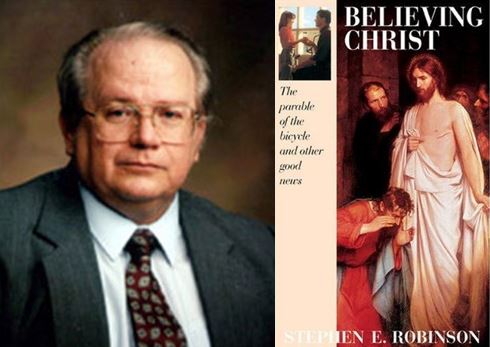
In the winter of 1992, I took Brother Robinson for a class at BYU covering the second half of the New Testament primarily Paul, and it changed my life. Later that year, he published the book Believing Christ, and it changed the Church.
He’s been asked a lot how the brethren received it. In 1994, Elder Dallin H. Oaks speaking at BYU and later republished in the Ensign said:
Recent LDS gospel scholarship clearly shows a greatly increased emphasis on the Savior and his atonement. Elder Bruce R. McConkie’s multivolume work on the Messiah1 and his earlier three-volume Doctrinal New Testament Commentary (Salt Lake City: Bookcraft, 1973) are landmarks in this effort. We have all benefited significantly from the BYU Religious Studies Center’s annual Book of Mormon symposia, which have placed appropriate emphasis on this scripture’s preeminent position as a witness of Christ. Individual LDS scholars, principally in religious education at BYU, have published brilliant and inspired books that have made important additions to our literature on the Savior and his atonement (see, for example, Stephen E. Robinson, Believing Christ, Salt Lake City: Deseret Book Co., 1992; Robert L. Millet, Life in Christ, Salt Lake City: Bookcraft, 1990; Bruce C. Hafen, The Broken Heart, Salt Lake City: Deseret Book Co., 1989). I hope such books are read and pondered, not just purchased and possessed.
Brother Robinson claims nearly all the general authorities he talked to received it warmly.
After it was published, I got letters from 2 of the 3 of the First Presidency and about half of the quorum of the 12 telling me what a great job I’ve done. We second guess them. We put words and ideas in their heads that they don’t have. When we do that, we get ourselves in trouble.
A question in the Q&A came about why there’s been lack of commentary from the brethren on the subject.
The ones I work closely with I won’t name them, a dozen or so, they believe in it. OK, Elder Packer. Let’s name a really nasty, hardcore, hell fire and damnation general authority who might not like grace. ELDER PACKER. He read my bike. Then he said, “Well it’s a good book. I like what you said. Now you need to write another one about works.” That’s how Following Christ came about. I can’t think of a general authority who would be upset about my teaching of grace.
He said the brethren gave him great support, but a lot of members gave him resistance. He was early in the process and had submitted a shorter version of the book to one of the church magazines. It was rejected and he was told “this is so bad it couldn’t even be published if someone else rewrote it.”
So I asked him, “What do YOU think grace is?” He’s an editor at one of the church magazines. He said, “grace is the reward God gives you when you keep his commandments.” I discussed that with one of the brethren. His response was “Well, Steve, sometimes we have to wait for people to die.”
Another time he gave a fireside for a stake. After finishing, the stake president stood up and said, “it’s my duty as your stake president to point out to you, you’ve been taught false doctrine.”
It isn’t the brethren, it’s the members! As Elder Maxwell said, “the church is like an aircraft carrier, and it takes a while to get it turned. If you turn too sharply, all the members fall off.”
This got me thinking about whether racism within the Church among some members might have prolonged things before the revelation was received by Spencer W. Kimball in 1978. Or on some of the issues the Church faces today, most notably on LGBT issues, if whether outdated viewpoints held by a segment of the membership could be holding up progress.
He mentioned a couple things he would have done differently in the book had he to do over.
After All We Can Do
The first was his handling of 2 Nephi 25:23.
23 For we labor diligently to write, to persuade our children, and also our brethren, to believe in Christ, and to be reconciled to God; for we know that it is by grace that we are saved, after all we can do.
In the book, he addressed it. But he felt he didn’t do it well enough. He believes the key to understanding this scripture is a companion verse that defines “all we could do”. Alma 24:11
11 And now behold, my brethren, since it has been all that we could do (as we were the most lost of all mankind) to repent of all our sins and the many murders which we have committed, and to get God to take them away from our hearts, for it was all we could do to repent sufficiently before God that he would take away our stain—
“All that we could do” was essentially nothing. All they could do was simply repent and ask God to take their sins away. Author tangent: you might be thinking right now, “well there probably was a long repentance period, where Alma and the sons of Mosiah spent a lot of time working, doing ‘their part’, doing ‘all they could do’, in order to attain repentance”. This is a current Mormon perspective, but it not a Book of Mormon perspective. Alma, Ammon, et al, immediately went from being the vilest sinners into official roles as missionaries. In another episode, Corianton, after slipping up with the harlot Isabel, wasn’t shamed and sent home early from his mission, but was told to repent and stay on his mission. End of tangent.
Dr. Robinson says he’s been trying to get the brethren to add a footnote to 2 Ne 25:23 referencing Alma 24:11 for years.
Instead we have a footnote to James. I think that’s the most egregious example in the scriptures of manipulating doctrine by footnote. (roar of laughter from the audience) I can say that, they can’t fire me.
Synergism
The next thing he wished he would have done better was how some people misunderstood him thinking he believed in a form of synergism. Synergism is the idea that we do some work and Jesus does the rest, and the combined results save us. He drew this diagram on the white board and explained it.
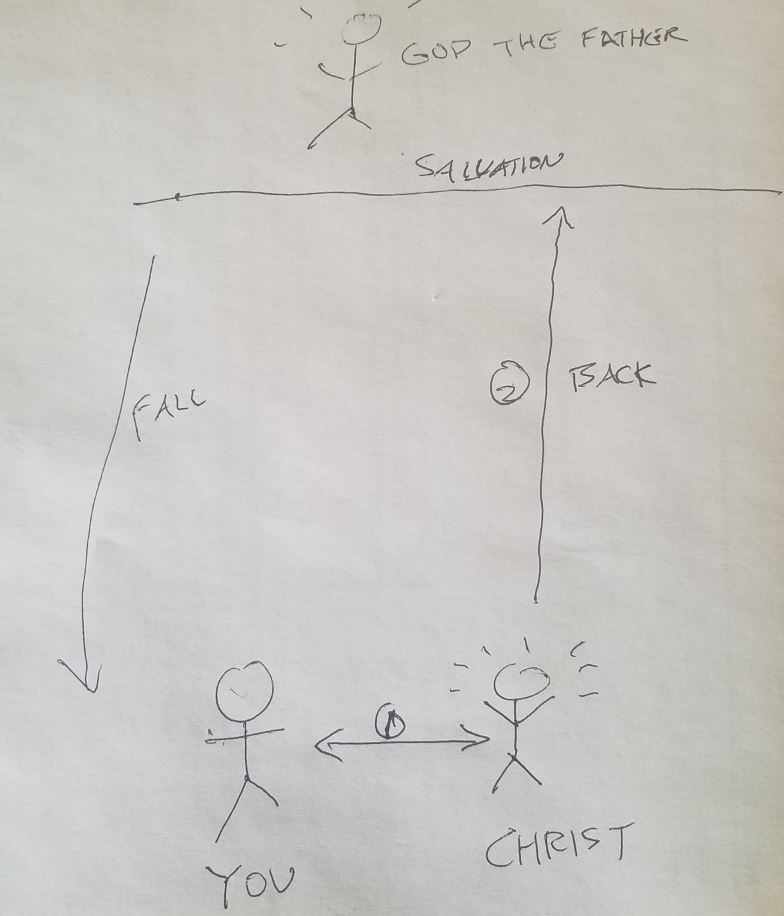
Due to the fall, we became separated from God. God is up there. We are down there. How are we going to get back? Christ and his grace is the answer. First, we come unto Christ. Then that becomes a new entity, which consists of us and Christ combined, and then he takes that unit back to heaven to live with God. He said “if you think you do part of it and Jesus does part of it, then you’ve committed the error of synergism”.
I’ve been sloppy in my language from time to time and given that impression. But going back to the book. Going back to the parable of the bicycle. There were two transactions. My daughter gave me all she had. I PAID KMART. I PAID THE WHOLE $101.99. There are two transactions. One is that we come unto Christ. That’s the horizontal one. That’s our job. We can do that. His job is to take this new creation, this thing that is no longer just him and just me, and take this to the kingdom of God. And he does 100% of it. That’s not synergism.
Before the Q & A, he ended his presentation with what he says is his best description of grace.
My students would ask me. What is your definition of grace? I answer with an analogy. Usually there’s a young mother in my class who’s recently had a baby. I ask her to stand up. I asked her what she felt the first time she held the baby in her arms.
Overwhelming love.
Why? What had that child done to earn that?
Nothing. It just was. It was just born. And it’s mine.
That’s grace.
Another question from the audience.
Question: Earlier today Adam Miller brought up a …
SR interrupting: Did he disagree with me?
Question: A little bit.
Stephen Robinson with his classic sarcastic smirk on his face: He’s wrong and I’m right.
Question: His criticism was in the role that Christ plays once it’s done. When you’ve been perfected. What role does Christ still play? Is Christ still there?
SR: Christ and his grace are the ground of being on which everything is built. The Father creates the Son. The Son does everything else. He does it through his grace and that has been there from the beginning. I would be unhappy with any definition that says Christ’s grace starts here or stops there. Grace is the ground of being on which everything rests.
Question came up about Pres. Uchtdorf’s talk on grace.
Hallelujah! I just danced in circles while I listened to him talk! (personal note: So did I. My son wrote me from his mission the next P-Day. “Dad it was like Pres. Uchtdorf gave one of your talks”. I have been preaching the gospel of Stephen Robinson the last 25 years.)
More of the question: “He said the ‘after all you can do’ in 2nd Nephi is not meant after in terms of a time series but after in terms of ‘apart from’ or ‘separate from’.”
Brother Robinson “I AGREE!” (laughter…the questioner might not have known that Robinson was the first to put forward this logic and Uchtdorf borrowed it from him)
There are some people that think that what they’re doing is building their kingdom, and they’re climbing a ladder, and somehow they’ll do 50% and Jesus will do the other 50%. That’s simply wrong. And anytime we think that our salvation in part or partially because of what I’ve done, then we’re wrong.
Question: what do you tell people that when you teach grace they’re thinking we are letting people off the hook and they can do whatever they want and still have salvation.
SR: I would emphasize this part of the relationship (pointing to the horizontal transaction on the diagram). It’s our job to come unto Christ. “Then we may say I’m a mess, but I’m his mess.” That’s where the works are, by the way. You stop loving him and stop responding to what he’s done, then no deal. If my daughter had said, “hey old man if you’re going to buy me the bike, buy me the bike, let me keep my 61 cents,” I wouldn’t have gotten it. She needed to come to me first.
Addressing the 2 NE 25 verse again:
I have seen too many people crushed by “all you can do”. I’ve seen people give up and leave the church. That phrase used incorrectly CRUSHES THE LIFE OUT OF SOME PEOPLE. That’s why I’d like to see that footnote to Alma 24:11…Grace means “a gift from God”. Sometimes we forget. It doesn’t sound fair that all I have to do is come unto Jesus and he’s going to do all that. IT ISN’T FAIR. That’s the glory of the gospel. The glory is unfairness that he could be punished for what you’ve done and you can be exalted and he doesn’t mind. And if that doesn’t make you love him, there’s something wrong with you.
Amen, Brother Robinson. John 4:19
19 We love him, because he first loved us.
 Wheat & Tares
I wonder what the two authors would do with Helaman 12:24: “And may God grant, in his great fulness, that men might be brought unto repentance and good works, that they might be restored unto grace for grace, according to their works.” Repentance and good works seems to be two different things and they seem to be the predicate of restoration and the restoration of grace for grace is “according to their works.” But their works seems to be something in addition to repentance: “repentance and good works.”
I enjoyed this post and Sam’s point.
I think we have a lot more thinking to do.
But l like how Robinson explains his real intent.
Sam, good example. I’d be curious to know Robinson’s take on that. My guess is he would say that is part of that first, horizontal transaction in the diagram, the action of one coming unto Christ. And not part of the second, vertical transaction which is Christ reconciling us with God. But take that out further, and you say how is that materially different than just saying your salvation is at least partly “earned”. I’m not sure. It doesn’t really seem different. But I think this equally applies to the traditional Christian understanding of grace. As Robinson pointed out in his lecture, when you talk to them, our criticism of “easy grace” doesn’t really apply. ie my understanding is that a Christian could read Helaman 12:24 and agree with it. It’s confusing…
Great post. While I have some quibbles with some of Robinson’s ideas, overall I really like his approach to grace and that he helped improve that discourse within the Church.
Wow! What a blast from the past. I took the first semester of Book of Mormon Fall 1992 from Brother Robinson at BYU before the book was published. The whole course most of what he did was teach us the doctrine of this book. For a recent seminary graduate, it was incredible. Maybe that’s why I’ve never been too hampered with guilt during my adult life? I was taught properly about grace at the perfect age. He was a dynamic teacher and I loved going to class. I lucked out since I had no clue who he was.
Great post and comments. I really like this sea change and hope it continues. I believe we’ve tangled ourselves into some theological knots around this issue and these are good steps to unravel some of the mess. The problem, as I see it, is that we are hyper-focused on obedience, and to paraphrase Patrick Mason, we’ve thrown a lot of things into that cart. Mormon theology essentially teaches that God wants us to become like him, we have a chance to come to earth and learn the good from the evil, make mistakes, repent and eventually return to God. If God is a loving father, this is what he would want, he wants us to get experience, learn from our mistakes and become mature, good people. That’s what I want for my kids. Part of what we talk about with obedience are good guidelines that help us on this path. Things will be difficult for you in life if you are an alcoholic or if you are constantly cheating on your spouse. But, there are a lot of other Church “commandments” that are well-meaning guidelines to get us to be respectable representatives of the Church in order to help the institution. We want clean-shaven, clean-living people who are models of conservative American behavior (or what that looked like in 1952). These are not bad things, they just need to be updated and revisited and adjusted as times change and they get outgrown (tea and coffee prohibition, white shirts, beards, etc.). All of these have been put on the same level of importance in the obedience cart. Obedience is pounded from the pulpit. The result is that we have a long list of things we should be doing and shouldn’t be doing that no one can keep up with and committed members live in a constant state of guilt. Instead of Christ’s grace being a glorious event that relieves us of some of this stress, it can be seen as something that only kicks in when we have given 110%. We were totally perfect, but didn’t have time to get to our family history or food storage, but we can still squeak into heaven. Sometimes our rhetoric around the atonement can add to the stress, i.e. “I wonder how many drops were shed for me.” That is the ultimate guilt trip and not what Christ is all about. We also need to answer the question that millenials are asking: “If God loves us, why doesn’t he just let us into heaven, why does he have all these strings attached?”
One of the best (and most uplifting) narratives – I’ve read in a LONG, LONG time. My sincere thanks. Personally, I’m so exhausted by what I call “Mormon Busy Work”….I simply can’t do it anymore; grace is all that is left of what little hope remaining in my life. Long, slow, deliberate clapping.
Fairchild, sounds like we had similar experience. My memory might fail me, but I think it was the Jan 1992 semester I had him. He has such a fun, irreverent style. So refreshing. I hadn’t seen him do anything in public for many years, so when I saw him on the program, I was kind of freaking out. This talk was a total blast from the past for me, too. He shaped me (and likewise my family) so much and it’s gone so deep that when people talk about the guilt of needing to do too much in Mormonism or that we don’t teach grace in the church, etc, it’s hard for me to relate. I say Adam Miller is my new favorite mind, because I’ve moved past much of the literalism and focus on the supernatural aspects of the gospel, and Adam Miller speaks to me more in that way. But the gospel that shaped me is Stephen Robinson Mormonism.
Moroni 10 pretty much sums it up.
32 Yea, come unto Christ, and be perfected in him, and deny yourselves of all ungodliness; and if ye shall deny yourselves of all ungodliness, and love God with all your might, mind and strength, then is his grace sufficient for you, that by his grace ye may be perfect in Christ; and if by the grace of God ye are perfect in Christ, ye can in nowise deny the power of God.
“Perfected” is a verb implying in process (not finished) and here, is associated with denying yourself of ungodliness.
So if you take it Christ and work with him on being better by denying yourself of ungodliness… bam! his grace is sufficient for you and that’s what will perfect you.
The Moroni 10:32 reference takes us back to the traditional understanding of “after all we can do.” Under that paradigm, “all” we need to do is deny ourselves of “all ungodliness” and “love God with all [our] might, mind and strength.” Only then is his grace sufficient for me. If I haven’t denied myself of all ungodliness and given all I’ve got, the Christ’s grace is too weak for me. Or I’m too weak. Either way, it all depends on me and my part of the horizontal bargain was, well, disappointingly less than “all.” After I’ve given it my all (whatever that means–God, what an amorphous and impossible standard!), then his grace is sufficient for me.
I really, really, want to believe the Robinson version of grace, but then there are troubling verses that take me right back to the original understanding of “after all you can do.” I’m afraid that Andy’s “bam!,” made me wince. I’m a life-long member and am committed to being a life-long member, serving constantly and doing my best. But my best sucks. There is no part of my life that would let me say, “bam! His grace (dependent on my all) is sufficient.] If instead the standard is believe and repent as often as I screw up, that I can handle. I hope God can too.
I think the church went off the rails when it started pushing obedience to General Authorities, instead of love of fellow man and love of God. If you look at the whole works/grace conflict from an obedience perspective, then saying you have to do it *all* is the logical conclusion. But if you go back to love, then you are only required to be a loving person. Love is not measured in a checklist fashion. But obedience to people can be measured in check list fashion. In fact obedience can kill love, because when you run yourself ragged trying to do it all, you start resenting the person causing you to run yourself ragged. So, if as the general leadership of the church claim, God is demanding raising 12 children, 11 visiting teaching sisters, 10 percent of income, 9 years as Relief Society president, 8 hours at the welfare cannery, 7 songs a singing, 6 MIA maids a milking, 5 missionaries supported, 4 callings at a time, 3 hours of church, weeks of scout camp, and only one peircing in each ear (..yeah it’s Christmas time) then God could not possibly love me because he is demanding more than I am capable of. Let me rephrase that, If God is demanding all this stuff, to the point that I am exhausted, resentful, and cannot take care of my own needs because I am too busy running around doing church stuff, then God doesn’t love me.
I have dropped out of church because the way the church demands more and more and more, and yet you are never good enough. That is abusive. My mother was a demanding perfectionist and it was emotionally abusive. Well, why is it different when it is the church doing it and claiming it is God? When I started hating Mormon God was when I decided I needed to reevaluate my participation in the church.
If we love God, then we want to care for his children. If we are not caring for God’s children, then that proves we really do not love God. This is why faith without works is dead. All we really have to do is keep loving.
But when we focus on obedience, especially obedience to men who claim to represent God, then there is no end to the list of all we have to do and love gets lost in the jumble.
Yes, Robinson’s books were a real gift to the Church. But I’m not sure why you are letting the Church leadership off the hook for not endorsing Robinson’s approach to grace and the Atonement (by adopting those themes in General Conference and in the LDS curriculum) but instead sticking with gospel of obedience and guilt that we are still saddled with. It is simply disingenuous for leaders or anyone else to suggest that, sure, that is what should be taught, but the members just aren’t ready for it. How lame. It is pretty clear they stick with obedience and guilt because it is good for the institution, at least until enough people get tired of it and leave.
Sorry Sam if the Bam! was unsettling.
I feel like we do need to be careful when talking about grace. In all reality this test we’re taking was never supposed to be a cake walk nor were we supposed to feel confident about our standing, believing at any given time that we’ve “made it” or that we’re too good to fail.
That’s why Paul says to work out your salvation with Fear and Trembling.
Having said that, the good news is that this verse teaches us: Take your sins and weakness to Christ and work with him through it. If you’re being honest and sincere with him and love him, we have no reason to doubt that we’ll be accepted. He never expected us to be perfect but at least work towards it.
I make mistakes all the time but I quickly try to turn around, beg the Lord for forgiveness, try to fix the mistake, and move on. The moving on requires faith in merciful God that doesn’t have the same standards as an angry person that wants to beat you until you’ve paid for your sin. He just wants the broken heart and contrite spirit.
And I also believe that “coming to Christ” requires ongoing communication with him. He reminds us of what we need to work on.
Tackle your issues one at time.
In the analogy of the bike, the child was never expected to pay the full amount but she was expected to contribute honestly and then she received her bike. That’s how I was looking at it when I wrote the Bam! part.
Thanks, Andy. I appreciate what you are trying to share. It is hard for me to imagine why a good, loving, heavenly parents would, by design create a plan of happiness wherein, “nor were we supposed to feel confident about our standing . . . .” I’m sure I stink as a parent in comparison to him, but why would it be a good thing that I might permit my loving, trying children to live with me, or maybe not, depending on whether they loved me enough, tried hard enough, denied themselves of all things that I’m against enough. If God is love, what is the advantage to making his beloved children doubt whether they will merit them manifestations of His love? Perhaps another construction (although one in which the scriptures both you and I volunteered may be problematic) is that my heavenly parents are love, that they love me all the time, no matter what I do, and have a home for me, no matter what I do, and have sent a Savior for me, no matter what I do. And perhaps these commandments are not measuring sticks by which they will decide whether I merit their eternal love and presence, but are instruments to aligning myself with that love now. If I act as the errant son in the prodigal story, my father loves and longs for me regardless of where I spend my time. That love is constant, but because I have removed myself from that love, I don’t feel it. By coming to myself and going back to live with Father, I am able to feel the love that was always there and never depended on my proximity to him or my adherence to his way of life. I have squandered all that I have, including my time and reputation and money, and if my brother is right, I squandered much of it with harlots. And yet, my Father clothes me in his finest graces as soon as I return. Did my Father in this story wish for me to be uncertain about His love? Or was the doubt that made me think I would have to go back in the lowliest station in my Father’s house a lying figment of my imagination?
Great post!
The Book of Mormon is our keystone scripture. Jesus reviewed it personally when he was with the Nephites in 3 Nephi 23:7. Then in D&C 17:6 after Joseph Smith translated it, he approved it. I don’t think the Book of Mormon is confusing on any subject, including the subject of grace. If we want to to acquire understanding we’re going to have to work at it diligently (1 Nephi 10:17). If we desire to receive a remission of sins and fulfill our baptism covenant, we need to do certain things as taught in the Book of Mormon.
I’ve read the Book of Mormon many times, it appears to me that each individual is treated differently. The Book of Mormon doesn’t stipulate a one size fits all. We’re all at different places on the gospel path. If we will stay on the path we will eventually arrive at the same destination. Staying on the gospel path is the hard part. The Lord decides when and how he will respond to each person as they come to him (D&C 88:68 “…he will unveil his face unto you, and it shall be in his own time, and in his own way, and according to his own will).”
I wrote part of my first comment, took a break for dinner, then finished my comment. I went back to read comments that were made during that time.. Anna’s comment in particular caused me to wince. Those who feel that the church demands too much and that they can never measure up don’t seem to understand the message of the scriptures.
This post is about grace. It is important to understand grace. However, grace isn’t emphasized in scripture as faith is. Faith in Jesus Christ is the first principle of the gospel, it allows us to access grace and to get answers to our prayers. Without faith on our part nothing happens. God by law, can’t help us as he would like, if we lack faith. “For if there be no faith among the children of men God can do no miracle among them…” (Ether 12:12).
Hi Sam,
I wish I could edit my comments. I’m saying things one way and rereading My comment while shaking my head. 😦
“Not sure of your standing” should have been more along the lines of don’t be complacent in thinking “I’m good I’ve done all I need to do”. I’m just trying advocate against the grace idea where I accepted Jesus and now I don’t have to worry about what I do.
For your parent comment, I wonder too about a loving parent that can only re-admit some of their kids. I can read my scriptures and come up with theories.
But I just don’t know.
All I can do is read my scriptures and try and take care of me and my families standing with the Lord.
Everyone has to account for the path that they’ve chosen. I firmly believe grace covers anyone doing their best to live a good life.
I also am tired of Mormon busy work! Home teaching, FHE, temple attendance, block meetings on Sunday, PPI;s, scripture reading, family councils, friends of scouting, tithing, presidency meetings, family history work, boring Sundays etc. etc. I want grace, grace alone. Totally surrender to God. “…not of works least any man should boast” As Lehi taught salvation is free. Free through the grace of God.
I am amazed to see how each person fits on this spectrum of grace and works and how that struggle determines and defines their relationship with God. I think it was in a Karen Armstrong book that I read that she pointed out that most of us view God much like we view the most influential figure of authority in our own life. Those who are raised by parents who are loving and accepting view God the same way and those that grew up like Anna view God as she views her mother. For the most part I have observed this is true. There are times when it does not apply and somebody bucks the trend. I am done worrying about if God is pleased with my every effort. I follow the commandments to the best of my ability and rationalize away other stupid ones (https://bycommonconsent.com/2006/02/24/a-brief-review-of-mormon-intimacy/). This has brought me joy in my life. I am happy that I was taught to control my sexual desires until I got married. I am thankful that I am not addicted to any harmful substances. I find joy in worshipping Christ and find joy when I treat others kindly, serve others, forgive others and try my best follow his example. If this is not enough for God, then I just don’t give a damn anymore.
Dear Censor person,
I really do believe in grace. I don’t give a damn if you don’t think my comment are “worthy”
I guess I see grace as raining onto us, around us, inside of us all the time. When we accept Christ, we fill ourselves with grace. But grace isn’t passive. It is incapable of being held in one place, so as we fill ourselves (accept Christ), we also radiate that grace. And thus the commandments are not obeyed, but full filled because when we are made of grace we are incapable of not living as did Christ.
My goal then is to not place anything between me and grace (no umbrellas or other obstacles). I find focusing on the commandments and obedience to be obstacles to grace (and totally relate to Anna’s experiences of the church’s more, more, more & checklist mentality). Meditation (letting go of the worldly things and cares and worry about obedience) has been the greatest way for me to open myself to grace.
I like this and I like “Believing Christ” but the problem lies in all of the things that the church requires of one who wishes to come unto Christ. Okay, so we come to Christ and then he takes that new creature 100% of the way to heaven. But if you’re telling me that coming to Christ means that in addition to the scripturally endorsed faith, repentance, and baptism, that I also have to go to the temple, don’t drink coffee, home or visit teach, get married, pay tithing, sustain the leaders of the church, and on and on and on then we’re aren’t talking about Biblical grace here. We’re talking about a laundry list of works that we need to do to approach Christ. I can’t accept that.
Troy:
You don’t accept that. When you experience the love and grace of Christ, you have automatically kindled within your heart the sincere desire to do MORE than all of that; but in ways that you internally are convinced better feed His sheep. Nothing can stop you. Lions in the Roman circus; gladiators lopping off their heads did not stop early Christians. The blood of martyrs was the fertilizer of the faith. OK, maybe not that extreme but sort of like that.
I think Stephen Robinson’s (SR) books are among the most insightful and pertinent to be written by a Mormon author in the last part of the 20th century. They helped change my life.
We first married decades ago and moved into a very dysfunctional military ward in MS. Bishopric members (2) having affairs, secret wife swapping club, incest (3 YW), youth getting arrested, all manner of mental illness and fraud and infighting and dissention. My wife then 22 years old was 1st counselor in the RS with an inactive RSP and taught early morning seminary. I was the EQP and defacto ward mission leader and we planned most of the ward activities. We were young, idealistic with endless energy, no children yet, better educated than most and making plenty of money. We gave our heart and soul to that ward and gathered more than a lifetime of memories of experiences, good and bad.
We developed a novel missionary tactic based not on the idea that we have something (better) to share with you, but honest respectful curiosity; inviting ourselves to our friend’s churches to learn about them with the unspoken hope they just might invite themselves to ours. (This actually has about a 50% success rate of visits- not conversions- if done sincerely.) My, oh my we learned a lot. My wife was raised by the manuals and for her Christ was about as significant as Abraham or Isaiah, and the Atonement/Grace of Christ was just like maybe half of the 3rd of 13 articles of faith, not really central. Exactly the situation SR describes in his early books. One Sunday at a Baptist meeting she experienced the love and grace of Christ descend upon her and forgiveness of her sins in a way that was unforgettable, powerful and life changing. She became a born again Christian. But how to express that in an LDS ward? For me it was more of a rational agreement than a powerful rebirth.
Rather than find a Christ centered, Bible teaching Christian church, we tried to ignite a revival in that ward using nothing less than the Book of Mormon. It is filled with great born-again passages which could be quoted without hesitation in the revivals held out in the piney woods on hot summer nights. Needless to say it was needed but did not work. Only created another layer of crazy.
We next lived in a ward in Cottonwood (Salt lake) with mostly early empty nesters and a few older children and 25 young men serving missions from it and large extended family networks with rampant overzealous legalism. We were lucky if anyone even knew our names and my wife was busy birthing children and almost dying in the process and taking care of them. We next lived in another rather weird ward in the Midwest that felt somewhere between the two previous ones (for only a year) before coming back South to probably a close to normal ward for this region.
By this time we had been roughed up a bit and grown more wise and skillful and had more modest goals, to bring maybe a few of our close friends into a greater understanding of the centrality of the grace of Christ. And the books by SR came out which bolstered our efforts. But honestly not more than 10 people in our ward ever internalized these ideas and they all moved away. Even fewer were ever aware of SR.
*****
What we experienced is that anytime you step out of the Mormon box, even if it is closer to Christ, you experience conflict. Over time social capital is consumed and eventually we were marginalized. I’m not saying I was always wise. I did make many tactical mistakes. We were fearless, impervious to criticism and ridicule. But when our children were primary age, those who opposed us discovered our vulnerable point. When children are socially embarrassed, verbally harassed and physically abused at church it is hard not to fight back. Some of my Danite blood began to boil.
My wife starved to death spiritually in our ward and took a vacation from Mormonism which has lasted now about 15 years. Leaders told me to divorce her, that would snap her testimony back in shape, otherwise I couldn’t get to the CK with her so maybe I could find someone else more faithful. And save my children, as if she wouldn’t get custody of them. But for one or two key leaders (both women), our children would have left the church with their mother as young teenagers. None of them is more than a marginal member at this point.
For the last 7 years we both attend LDS sacrament meeting and then a Protestant worship service every week. I prefer our theology; but their music, sermons, prayers, youth activities and community outreach. I think I have a unique view of both traditions. The weekly contrast is embarrassing over time.
*****
SR is only one person and he has done a lot, more than I have by far. I do not fault him for not doing more. I think he usually walks very close to the path to Christ. The problem, from my perspective is that his efforts (and the efforts of others like him) were too little and too late.
In a highly authoritarian organization, those at the top have enormous influence. Can you image what might have happened if one of the Q15 who are sustained as apostles of Christ would have done what SR has done with in his books? Not just a rare tip of the hat warmly to yet another of many useful teachings, but full-throttle zeal. Or what if all 15 of them had done this?
I believe this problem of us not being centered on the grace of Christ is far more than a matter of neglect, alternate focus, or historical accident. I believe that we have erected idols which we worship in place of Christ. We will never succeed until we identify these idols and pull them down. And so what are these idols? Think about it.
I could be wrong on this. The answer I think can be found in the words of the children who copy and simplify what they see adults doing. What is the most common statement that small children say in testimony meeting? “I know the church is true.” This complex assertion they are taught to claim to know before they know how to properly use a toilet. I believe the institution of the church with its celebrity prophets is the most lofty idol that stands between us and Christ. I have found that often it is those most devoted to prophet worship who are the most offended by any attempts to focus more on the grace of Christ.
Others must stand on the shoulders of SR et. al. and teach us and convince many more of us of this fault. Else the membership hemorrhage will continue and the LDS church will be tossed to and fro by every wind of culture. And is only nominally a truly Christian church regardless of what else is done.
Thank you for sharing, Mike. I am very touched by your story and somewhat envious of your wife’s spiritual experience.
No, people, I do not view God as the same as my emotionally abusive mother. I view the Mormon church as the same as my emotionally abusive mother. Why I left. I cannot tolerate the lack of love, the lack of grace that the church teaches. Why I moved on from Mormonism. I view God as loving, unlike leaders of the Mormon church who write books such as The Miracle of Forgiveness.
My whole point is that the way most Mormons view God is that of works, works, works. When you focus on obedience, instead of love, you end up with a twisted view of God. I reject that twisted view of God in favor of what the scriptures teach me about God.
But I also do not believe in cheap grace, that once you accept Jesus you are home free, no matter what your behavior. I see baptism sort of like the marriage ceremony. I love my husband. But if my behavior ever proves that my claim of love is empty, then he would be correct to divorce me. I have to continue in love. My behavior has to prove my love. Not just words, and not just faith or belief that my husband is my husband. But my behavior has to continually show my love for my husband or the marriage is empty, void, ended.
I think the people who want to believe we are saved by works have it mostly right. I have to continue to do things that show I love God.
But let’s go back to the marriage analogy. If my husband were to give me a check list, like the Mormon church does, then I would get this sneaking feeling that he does not love me. Does that make sense to anyone but me? If my husband started controlling my underwear, the way I wear jewelry (one ear peircing) what I eat and drink, who I can be friends with (never be alone with a member of the opposite sex) and if he was constantly telling me how I was not doing enough and criticizing my best efforts, then I would start to consider him abusive and controlling. I would feel that he does not love me, but just wants to control me as an abusive spouse does.
The church treats me that way, but God does not. People above are assuming that I view the church and God as one and the same, and that is way off of what I am saying. I am saying the CHURCH went off the rails when it focused too heavily on obedience and forgot that God is a God of love.
“When we are in tune with the Spirit, we will see many small miracles happen in our lives.” Ronald Halverson
Those who manage to connect with Christ experience many small, and not so small miracles. These miracle experiences steady them, ground and root them, allowing them to deal with all those things that beat on them in their church experience. See Helaman 5:12
Jared, so what you are saying is that if the church is beating on you and you’ve had it with that (can no longer deal), then that means you are not experiencing Christ’s miracles and any connection you feel with Him is fraudulent on your part. (general ‘you’ not specific – to be clear) Is that correct?
I have always enjoyed Bro Stephen Robinson’s books… really a pioneering work on grace and putting the Church on a more Christian footing…. away from the Utah fascination for business and thus work for reward concept…cultural problem.
I also liked Bro Robinson when he was at BYU I emailed him and he responded and set up a discussion… unlike a number of his colleagues who ignore your emails ( mind you over 30 years or so I think I sent 5)…a generous and thoughtful intelligent…I thank you again
ReTx, Good question. I hope I understand it. ReTx asked : if “you are not experiencing Christ’s miracles and any connection you feel with Him is fraudulent on your part?
No, I don’t they are fraudulent.
My experience and understanding teach me that there is a very wide variety of ways Christ connects with us. He knows us perfectly and is doing all that he can to give us eternal life (D&C 1:39). However, we don’t always respond, “how oft would I have gathered you as a hen gathereth her chickens, and ye would not (3 Nephi 10:5).”
His attempts to gather us are the miracles that occur in our lives. He measures the miracles he gives us because he doesn’t want to condemn us if we don’t receive them, “For of him unto whom much is given much is required; and he who sins against the greater light shall receive the greater condemnation (D&C 82:3), and “For what doth it profit a man if a gift is bestowed upon him, and he receive not the gift? Behold, he rejoices not in that which is given unto him, neither rejoices in him who is the giver of the gift (D&C 88:33 ).”
I guess that isn’t quite what I’m saying. More, why does experiencing Christ’s miracles (especially Christ’s peace and grace) and having a deep, loving, personal connection to him go hand in hand with how we accept/struggle/deal with all the negative behaviors from the organizational church. I’ll concede that living in Christ’s grace should make us more kind overall and toward the church in all its failings, but I don’t see that it should keep us loyal to a church that beats on us.
Although I suppose one answer from someone who is more orthodox than I, is that salvation requires the covenants so its in our benefit long term (eternal) to stay in the church regardless of the short-term (our lifetime) injuries.
I am late to this conversation, but I grew up in the LDS Church. I served as president of my Deacon’s Quorum, Teacher’s Quorum, and as the Bishop’s assistant in my Priest’s Quorum. I served a foreign mission. I came home and was immediately placed in high stake callings. I went on to marry in the temple and baptize my three daughters. I served as a Gospel Doctrine teacher and then as an EQ president.
Walking home from work one day I was struck by a very sad reality: I didn’t know Jesus. I was 38 years old and I didn’t know Jesus.
I began looking into things. I began studying Church history. I began reading the Bible. And finally, one evening, I got on my knees and gave up the fight. I accepted Jesus Christ into my life. I didn’t know where this was heading. I was still a faithful Mormon, garment-wearing, EQ Pres with a temple recommend. I got on my knees and basically said the sinner’s prayer I so often mocked as a missionary.
Only then did things start to change, but it was immediate. I instantly felt God in my life in a way I never had before. And it was persistent. God was answering. Finally, a few weeks later, God had me trapped in a car traveling to a job-related meeting a few hours away. In that car, the Christ, the Anointed One, the Messiah, was revealed to me, and I received the sacred commandment: love one another.
I understood all I needed to know about grace, and it was liberating. I no longer needed a Church, because what Church could’ve saved my soul like that? My Mormon upbringing had nothing to do with what I had just experienced, and indeed has served as a hindrance to it ever happening sooner. I arrived at my work meeting and I knew that my life was forever changed. My relationship with the church had ended. In the brief span of two hours. It was all over. I finally had the spiritual experience I had been taught to seek all my life. And the spiritual experience ended my testimony of the LDS Church.
April 26, 2014. That is the day of my conversion. I became a Christian.
ReTx, I like the answer you gave to your own question. One of the rewards of the miracle of grace is that the Christ will strengthen us when the situation requires.
3 …if it so be that the children of men keep the commandments of God he doth nourish them, and strengthen them, and provide means whereby they can accomplish the thing which he has commanded them… (Book of Mormon | 1 Nephi 17:3)
How do you define orthodox?
How do I define orthodox? That’s a good question and probably not as straight forward as I tend to make it out to be. It’s much easier to define un-orthodox, isn’t it? I’ll have to think about it.
What do you think of John’s very unorthodox experience? He found grace and it lead him out of the church. Which is the very opposite of having Grace strengthen us to put up with the church and where I also have been heading for a long time. Do you see his experience as fraudulent since Grace led him away from covenants rather than toward them?
ReTx
Grace didn’t lead me away from covenants. It led me to an authentic covenant. The first covenant of law was instituted through Moses. The second covenant was instituted through Christ. The ministry of the old covenant was a ministry of death. The ministry of the new covenant is a ministry of Spirit. 2 Corinthians 3:7.
It is essential for Mormonism to be able to clearly and articulating explain just how exactly the ministry of the “new and everlasting covenant” instituted through Joseph Smith is a true ministry of Spirit and not of death. Because frankly, the Mormon religion as it practically plays itself out in the real lives of the people who live it appears to be a ministry of death. The experience Anna describes above is not unique in Mormonism. It is surprisingly common.
Paul said the Old Covenant brings condemnation, but even so…it is still glorious. But the end is still the same: condemnation and death.
Now, remember what Paul and James also say about law: if we accept law, we are brought under a curse, because we must live the entirety of the law perfectly to avoid being deemed guilty of breaking the entirety of it. It is all or nothing with a law-based route to salvation.
With that in mind, what happens in the temple? You are brought under law, by covenant, and told by Lucifer himself that if you fail to live it all, you are under his power. The temple covenant is actually a curse. That it is so can be easily supported by the words of Paul and James. A curse is pronounced upon you by Lucifer himself in the so-called House of the Lord.
Galatians 3: 10-13 For all who rely on the works of the law are under a curse, as it is written: “Cursed is everyone who does not continue to do everything written in the Book of the Law.” Clearly no one who relies on the law is justified before God, because “the righteous will live by faith.” The law is not based on faith; on the contrary, it says, “The person who does these things will live by them.” Christ redeemed us from the curse of the law by becoming a curse for us…”
Like I said, Mormonism needs to do a much better job explaining exactly how it is not enslaving its members under the curse of a law in the temple. I don’t believe it can explain this, because I believe that is precisely what it is doing, and precisely what it intends to do.
Grace led me away from a false covenant. It led me to the true covenant.
Response to Anna;
People- pay attention to what she says. If and when our brothers and sisters experience what she suffered in our community, they will leave and who can blame them? This must change. It is not rare.
I would like to carry the analogy of her husband one step further. What happens when Anna does something that hacks her husband off. You know, one of the sort of little things. She has a bad day , maybe gets mad and shouts at him, unjustly blames him, then goes off and sulks a for a few hours. (Maybe she never does this.) Her husband loves her and on the balance this is rare and she is usually a really nice wife. So he FORGIVES her. They maybe have a discussion later and exchange apologies and come up with a plan to better handle similar problems. They learn and maybe grow from the experience.
The difference between the Lord and a spouse is that the Lord’s love and forgiveness and understanding of us is far greater. If a spouse has say, 10 units of forgiveness, the Lord has higher than the highest caliber which is set at 10 billion units.
Response to John;
Words are hard to find to adequately describe these experiences , especially when they happen to another person. What you describe is remarkably similar to what my wife describes. She had iron strong 8 generation kinship connections including apostles ( and also leaders of massacre) and loyalty to Mormonism. We tried to find some middle ground to make it work for about 15 year and she eventually gave up when it was damaging our children. But funny thing about children, they too have free moral choices and they wanted to stay. And so they did, but on their terms without parental compulsion. That church-related abuse which did not kill them only made them stronger and far less passively-accepting of the correlated horse biscuits served up so often, not true for everyone I admit.
What I am experiencing is different..For some I think (hope) this personal revelation of Christ can be more of a slow burn than an explosion. I have faith that Christ is gently refining my soul. I have offered a variety of the Sinner’s prayers in different circumstances over the years with variable responses and am still a work in progress. And a part-time agnostic sometimes in the middle of the night when discouraged and angry.
My wife, when confronted with the paradoxes of the deaths of beloved family members who lived a good life and had a good heart but were not a valiant Christians on her terms She believes at the moment of death or soon after, there is a definite fork in the path. We chose to follow either the light of Christ or to follow some other darker path. It is unorthodox doctrine. I am more of a universalist and believe that even the vilest sinner (say Hitler or Bundy who killed my cousin) is a beloved child of God who has done some good and will be blessed and punished to some degree, I judge it no further.
I see church (LDS or any other) as venue. The converted Christian is compelled into the sheep-feeding business, which is actually very broad. By myself I can do little good (and only a little more damage). Together in churches or similar groups we can accomplish more.I could never built a house for a homeless person; but a couple dozen marginally skilled people working a few weekends for Habitat For Humanity can do it quite efficiently. Right now I feel called to a non-LDS boy scout troop where I do little beyond showing up for camping trips and playing pranks and acting like I am about 13 years old. (That comes naturally for me). We have no shortage of disciplinarians and I appreciate the space their firm governance gives me. The scouts love me. Somehow the Lord uses us as a committed but flawed group to change some of these boys in remarkable ways and it is usually pretty amusing along the trail.
Consider the miracle in China. Without missionaries, without scriptures (mostly), without money or power, without doctrine, tradition, creeds or organization and with government opposition and persecution, it is estimated that over 100 million Chinese people have accepted Christ. He doesn’t need us but He allows us to help out when we can.
John, I have a question for you? You described your position clearly. You have a new covenant, then why hang out in Mormon gathering places? I am curious.
John – My apologies if I sounded critical of your experience. I didn’t mean that at all, if anything I am envious and see grace and covenants exactly as you do. Have you read Adam Miller’s The Future Mormon by chance? If not, you might take a look. He speaks of the law and grace from a Pauline perspective that goes hand-in-hand with your experiences.
I’m endlessy curious about the viewpoint of the more orthodox, especially about how they view experiences like yours. Probably because my own faith seedling began to struggle/sprout with questions on why God would direct people in ways directly contrary to the LDS narrative of the requirements for heaven. Which is why I phrased my comments to Jared the way I did. I don’t expect orthodox members to see your experience as valid, but at the same time, I just can’t grasp why they do not.
Jared,
For the most part, I do not hang out in these kinds of places. My brother saw this article, found it interesting, and sent me a link. So I visited. I never would’ve stumbled here otherwise.
ReTx,
I didn’t take anything you said as critical. Not at all. As for me, I know perfectly well why members can’t see my experience as valid. When I was in my twenties, I wouldn’t have seen my experience as valid. I know how “good Mormons” think. I tried hard to be one.
Mike,
About the slow burn vs explosion idea – I don’t know enough to say you are wrong. Who am I to say the way God works. I just know the way it worked for me. And I have heard other stories of conversion to Christ happening in the same way for others, both Mormons and non-Christians. I do believe that Christ refines the soul, as you say. But Christ does that, not us. Prior to my conversion, I was the one trying to do the refining. I was told Christ would help, but I was given no real practical way to know what that really meant. Honestly, either I was a really stupid person slow to pick up on things, or Mormonism did a terrible job teaching me the gospel. Either one or the other, because I really tried hard.
But now…I feel the process of sanctification working in my life. And frankly…it sucks. It is painful. Really painful. The Holy Spirit has a way of convicting the soul. My effort is simply allowing the process to happen. And that isn’t a cop out, either. There have been times when I have had to choose between walking further into the pain or turning around, but I knew that turning around would bring an evil into my life that would quickly overcome me. I never felt the reality of evil like that as a Mormon, strangely. Nor did I feel the sanctification process working itself out. Nor did I feel the promise of the glorious reward. The words of the author of Hebrews really meant something to me after my conversion: I had “tasted the powers of the age to come.” It was indescribably powerful.
I thank you all for entertaining my words. Safe journeys to all.
John, Some (I, at least) have had the same (or similar) experience within the LDS Church. I guess this is because we found there the same scriptural basis you seem to have found for seeking or being open to grace/conversion There are, however, so many problems and such misplaced (in my view) emphasis in both LDS teaching and temple, that I am not surprised to hear that Mormonism does a terrible job of teaching the gospel. That is even reflected in the way it sometimes uses its own unique definition of “gospel.” I have no reason to question the validity of your experience and good reason to value your story. Incidentally, re: “A curse is pronounced upon you by Lucifer himself in the so-called House of the Lord.” Since that “curse” comes from Lucifer, I have understood it as merely another of his lies. I wish that were a more common understanding.
JR.
It could become a common understanding. It wouldn’t take much.
But the entire film is crafted in such a way that we feel absolutely nothing for the stiff-as-a-board, skim-milk representations of God and Christ, with their cold, empty voices and their lavender-talcum-powdered fake beards and wigs. We feel nothing at all, certainly not any emotion or feeling or affection for or from them. The Father of us all. The merciful Son. And they walk around their crystal palaces inaccessible and aloof.
The Church knows how to make a good, warm Christ in the movies they used to rope in converts. So it isn’t like they haven’t figured this out.
But Lucifer…he is the star of the show. He is a tragic hero. The films are differentiated in the minds of the members by which version of Lucifer they saw. And the members put on their aprons at his command, and wear these symbols of shame all the way in the Celestial Kingdom.
There is symbolism indeed in the temple.
John,
I know of many with very different reactions to the temple films than the one(s) you describe. Any symbolism pressed too far can be made to mean something other than what was intended by the originator. Often the same symbols mean wildly different things to different people, cultures, sub-cultures, and at different times. I can’t even imagine how a “good, warm Christ” could be portrayed using the received 19th century and only slightly modified script. Of course, I wouldn’t mind significant changes to that script. But whatever its perceived failings, still there are those who are able to let LDS teaching and temple serve as catalysts to their receiving the same grace, testimony, and presence of God in their lives that you have found otherwise. Incidentally, there are more ways to understand D&C 1:30 than its common use. Blessings.
Jr: “But whatever its perceived failings, still there are those who are able to let LDS teaching and temple serve as catalysts to their receiving the same grace, testimony, and presence of God in their lives that you have found otherwise.”
No one can really know that, because we cannot objectively compare and contrast the quality of “grace, testimony, and presence of God in [our] lives.”
You can imagine or believe this to be so. I can imagine or believe it to be not so. At the end of the day, we can never know.
But what I, personally, can know, is that my experience as a Mormon Christian and my experience as a non-Mormon Christian are significantly different. And in that respect, I have a perspective that those who are born into the Church and never seriously consider any other alternative will never be able to gain.
They are very much like me, prior to my conversion. I, too, never seriously considered another alternative. (And by “seriously consider,” I mean actually give myself permission to up and walk out should I find something else to my liking. Walking out was not an option for me.)
It became an option for me, certainly. At a certain point in time.
When members of the Church listen to me talk about grace and Christ and salvation, they say things like, “Yes! I believe that, too!” But they are simply wrong. And I want to make sure they know that, otherwise the misrepresent my beliefs.
They can’t leave the church like I did, so they clearly don’t believe what I believe. My beliefs enabled me to walk away. I am not saying that my new beliefs REQUIRED me to do so, but they enabled me to do so.
If a Mormon believes what I believe, he/she, too, COULD walk away if he/she wanted to. But he/she often CAN’T because he/she believes memberships is necessary. And therefore, NO!…we don’t share a common belief about grace, Christ, and salvation.
Sorry for the CAPS. I can’t italicize….
John, You’re right that we can’t actually know that the subjective experiences are the same. I should have said they sometimes appear to be from all that is said about them and from their observable results. I expect your generalization about Mormons is accurate as to those you know. There are., however, those who have seriously considered walking away, and who COULD walk away and yet choose not to and those who do walk away and later choose to return. I suspect at least some, however few, of those have beliefs about grace, Christ, and salvation, very similar to yours (I know a few), though I was speaking more of the experience of grace and of the presence of God than I was about BELIEFS about grace and/or salvation. Sorry, I also cannot italicize here. Maybe I’m just more hesitant than some to say who else is “simply wrong.” I’m glad you found your way.
I loved Br. Robinson’s book. It made a huge difference to me at a time when I was struggling with some things, not too long after my mission, newly married, two young children, and just having trouble. I never met him personally, but for a brief time, his daughter and her husband were in our ward in Minneapolis while he was in grad school, and I did ask her to pass on my thanks.
This got me thinking about whether racism within the Church among some members might have prolonged things before the revelation was received by Spencer W. Kimball in 1978. Or on some of the issues the Church faces today, most notably on LGBT issues, if whether outdated viewpoints held by a segment of the membership could be holding up progress.
I have heard this theory before re. the 1978 change. It seems weaselly to me, but not necessarily untrue. (Frankly, if the brethren told the members to jump off a cliff, 30% would do it without hesitation, it seems, so why would we expect that much pushback? Still, it would have been an issue in many rural areas in Utah and in the American South.
About LGBTQ* issues, I’m not so sure. I do think/hope/believe that we will eventually experience a “1978 Moment” with this. However, the dial-up of anti-gay-marriage rhetoric in the last few years has been much louder in the eyes of church members on both sides of the issue than the calm voices for inclusion and “tolerance.” I think we’re going to have a lot more people who will change because someone in their family is directly, personally affected. Then common consent will, I hope, force the issue – but it could be a very destructive number of years. If there’s a secret opinion amongst the brethren that the time is coming but they’re hoping to avoid upheaval, they’d better open their eyes wider. It’s heaving now, especially among the young, and they’re the ones we can least afford to lose.
Could I get a copy of this audio? I can’t seem to find it on the website?