

In early 1965, Daniel Patrick Moynihan, then serving as the Assistant Secretary of Labor under President Lyndon B. Johnson (later a 4-term senator from New York), released a report under his own initiative called The Negro Family: The Case For National Action (known as the Moynihan Report, 1965). He asserted that the Civil Rights Act of 1964 was inadequate to improve the outlook for Negros, and rather than their opportunities expanding, their circumstances were destined to get even worse. The reason? Negros as a group were not prepared to compete in American life with other ethnic and regional groups on an equal playing field. Centuries of extreme mistreatment and continued racism had damaged the fundamental infrastructure essential for them to succeed: the Negro nuclear family was crumbling.
The report is lengthy and full of facts and figures, some of which I’ll get into later, but in essence, it stated that due to increasing illegitimate births, divorces, and paternal abandonment, Negro [1] children were growing up in female-headed households in rapidly increasing numbers. Evidence of this family collapse was found the increasing non-white welfare claims even as non-white unemployment was down. He cited estimates that only a minority of Negro children reach the age of 18 having lived all their lives with both parents. This breakdown of the family was having adverse effects on academic performance and juvenile delinquency of Negro minors, especially males.
In fact, Moynihan’s report had a great deal to say about the Negro male. When slavery was abolished, Negros were given liberty, not equality, and the Negro male especially was the continued subject of intense hostility. Moynihan proposed that the Jim Crowe laws humiliated the Negro male in particular:
“Keeping the Negro “in his place” can be translated as keeping the Negro male in his place: The female was not a threat to anyone. Unquestionably, these events worked against the emergence of a strong father figure. The very essence of the male animal, from the bantam rooster to the four star general, is to strut. Indeed, in 19th century America, a particular type of exaggerated male boastfulness became almost a national style. Not for the Negro male. The “sassy nigger [sic]” was lynched.”
He continued that the effects of urbanization, unemployment, and poverty resulted in the wife entering the labor force and becoming the main provider, or having case workers assigned who are normally women and deal directly with the housewife. Either way, the husband/father became acutely aware of his impotency and marginalization. Moynihan quotes Margaret Mead from Male and Female, 1962:
“In every known human society, everywhere in the world, the young male learns that when he grows up one of the things which he must do in order to be a full member of society is to provide food for some female and her young…Within the family, each new generation of young males learn the appropriate nurturing behavior and superimpose upon their biologically given maleness this learned parental role. When the family breaks down—as it does under slavery, under certain forms of indentured labor and serfdom, in periods of extreme social unrest during wars, revolutions, famines, and epidemics, or in periods of abrupt transition from one type of economy to another—this delicate line of transmission is broken. Men may founder badly in these periods, during which the primary unit may again become mother and child, the biologically given, and the special conditions under which man has held his social traditions in trust are violated and distorted.”
Moynihan describes a “tangle of pathologies” — including discrimination, poverty, unemployment, juvenile delinquency/adult crime (the criminal justice system being harder on Negroes), and family disintegration — that reinforce and perpetuate each other. He quotes E. Franklin Frazier, who’d been making similar observations about Negro families a decade earlier:
“As the result of family disorganization a large proportion of Negro children and youth have not undergone the socialization which only the family can provide. The disorganized families have failed to provide for their emotional needs and have not provided the discipline and habits which are necessary for personality development. Because the disorganized family has failed in its function as a socializing agency, it has handicapped the children in their relations to the institutions in the community. Moreover, family disorganization has been partially responsible for a large amount of juvenile delinquency and adult crime among Negroes. Since the widespread family disorganization among Negroes has resulted from the failure of the father to play the role in family life required by American society, the mitigation of this problem must await those changes in the Negro and American society which will enable the Negro father to play the role required of him.”
Moynihan concludes his report with a call to national (i.e., Federal Government) action, because without something changing, he saw the problem only becoming worse.
The Moynihan report was very controversial at the time (and remains so today), attacked mostly from the left by feminists [2] and those decrying the cover it gave conservatives to “blame the victim” [3] These critics rejected the idea that Negro promiscuity or matriarchal family arrangements had anything to do with the inequities they faced, and indeed some felt that the white middle-class nuclear family model was inferior to African American matriarchy for the socialization of children [4]. As far as I can tell, the only thing the report did was incite a furor (causing many white sociologists to find safer things to study) and it was never used in any substantive way.
A few years ago, the Urban Institute revisited the Moynihan report in anticipation of its 50th anniversary. Their data is stunning. In 1960, about 20% of black children were born to unmarried mothers, as opposed to 2-3% of white children. By 2010, it’s become nearly three quarters of black children and three tenths of white children. In 1960, about 20% of black children lived without their fathers, as compared to 6% of white children. In 2010, it had risen to 53% of black children and 20% of white children. In 1960, just over one half of black women were married and living with their husbands, as compared to two thirds of white and hispanic women. In 2010, only one quarter of black women, two fifths of Hispanic women, and one half of white women lived with their spouses. I would have loved to include the Urban Institutes graphs, but since they’re copyrighted, I’d really encourage you to look for yourselves. You don’t have to scroll down very far. I summarized a little of their data in the table, and I have included Jajhill’s graph on out-of-wedlock births from Wikipedia (which can be found here), but the Urban Institute’s charts are even more revealing.
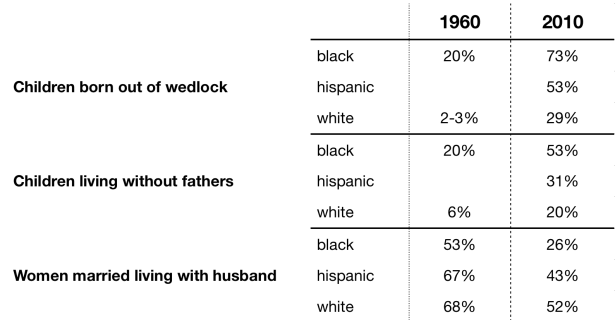
There are several things to note from the Urban Institute’s data. Clearly, Moynihan’s described patterns continued among blacks as predicted. But now, white families are in just as bad shape as black families were when Moynihan first sounded the alarm, and whatever “tangle of pathologies” affecting white families (collapse of manufacturing jobs?), it certainly doesn’t include the appalling racism that blacks have historically faced. Something else is happening. It is also interesting to note that by all these metrics of family disintegration, it appears the greatest changes occurred in the 1970s and 1980s, with things seeming to have leveled out a bit starting in 1990 and then getting worse again in the early 2000s.

The 1970s and 1980s were an interesting time in church history as well, as the conservative church leaders ran into an increasingly progressive society head-on. Conference talks are available at lds.org going clear back to 1971, not too long after the Moynihan report. It’s interesting to read what they were worried about. They were concerned that fathers lead their families (not likely a direct response to the Moynihan report, but still) [5]. They were concerned about fathers who felt that they were filling their roles simply by providing, and not by being loving, present, and involved. They were especially concerned about mothers leaving the home and seeking employment and fulfillment elsewhere [6], and either allowing others to raise their children or simply not having children. They were concerned about the increasing rates of divorce, which they were convinced was caused by selfishness and the enticements of the world. They spoke out against abortion and birth control and the associated attitudes of self-gratification without the desire to accept responsibility [7]. They were worried about the proposed ERA and the effect it would have on families [8]. One can see that the campaign to “defend the family” began long before the Proclamation on the Family [9].
Yes, some of the things they said we might find cringeworthy today, and some we outright reject. We pretty much all use birth control at this point, and working mothers are common enough to be unremarkable. Obviously, my personal worldview colors everything I read, but the impression I had wasn’t so much that birth control itself was bad or that women shouldn’t involve themselves in the world outside their homes, but rather that these church leaders felt the attitudes that accompanied these things threatened the primacy of the family in the minds of the people. Instead of accepting divinely ordained roles/duties of family and finding joy therein, church leaders felt people were seeking self-gratification and fulfillment in pursuits of the world and viewing the family as merely an accessory/option to a well-rounded life. Much of what they said could be seen as directed at women, but they were also speaking the words that have made Mormon men the most domesticated and family-oriented I know.
I remember several years ago being surprised at the hostility shown on LDS blogs towards the church’s preaching on the family. Paraphrased examples:
“Is it the gospel of families or the gospel of Jesus Christ? If the latter, why don’t we stick to it?”
“Why are they preaching against divorce? Nobody wants to get divorced unless the alternative is worse, and nobody does it without agonized deliberation and prayer. All preaching against divorce does is shame those who’ve gotten a divorce.”
“Why are we constantly preaching family, family, family? Everybody does the best they can in their families, and this preaching simply excludes those who are single or in non-traditional family arrangements from feeling fully part of the church.”
Clearly, the notes the church leaders were sounding were sour to many, but equally clearly, based on the data, they had had something to worry about. Whether you’d consider them prophetic or simply expressing the Christian views of the day (Moynihan was a practicing Catholic), much of what they feared would happen, actually happened.
Questions (let’s ignore LGBT concerns for now, as they’re a significant category of their own and have received a lot of discussion lately):
- How serious are the changes in the American family, really? Do they matter at a macroscopic scale?
- How much effect did the church leaders’ conservative preaching actually have on LDS families? If all it did was delay LDS acceptance of progressive attitudes/practices, by how much? A generation? A half generation?
- How much does the man’s self-perception affect the durability of the family structure? What attitudes (e.g., being expect to be head of house or primary provider) contribute to keeping him there, and what attitudes contribute to him deciding to leave? (or is the question even relevant in our more egalitarian society?)
- What can we foresee as consequences of the mainstream dissolution of the traditional family and the adoption of many more flexible arrangements (unmarried cohabitation parents, proliferation of step-parents, step-siblings, etc.)?
Any profound, or even just interesting, observations?
Next time, “The Calamities Foretold”!
[1] I’m using the term “Negro” because that was the term used at the time and in the report. By the way, much of Moynihan’s data was for “non-whites”, which included approximately 9% Chinese, Japanese, and East Indian
[2] For example, Joyce Ladner’s 1971 Tomorrow’s Tomorrow: The Black Woman, and Carol Stack’s All Our Kin, argued that African American women’s matriarchal and cooperative ethos was superior to the white middle class nuclear family
[3] William Ryan’s best-selling Blaming the Victim (1971), which popularized the phrase, decried Moynihan’s theories “as attempts to divert responsibility for poverty from social structural factors to the behaviors and cultural patterns of the poor.”
[4] Though Ladner apparently changed her mind later
[5] e.g., “It is the will of the Lord to strengthen and preserve the family unit. We plead with fathers to take their rightful place as the head of the house. We ask mothers to sustain and support their husbands and to be lights to their children.” – President Joseph Fielding Smith, opening address of Apr. 1972 conference
[6] e.g., “…we must never forget that one of woman’s greatest privileges, blessings, and opportunities is to be a co-partner with God in bringing his spirit children into the world.
It is of great concern to all who understand this glorious concept that Satan and his cohorts are using scientific arguments and nefarious propaganda to lure women away from their primary responsibilities as wives, mothers, and homemakers. We hear so much about emancipation, independence, sexual liberation, birth control, abortion, and other insidious propaganda belittling the role of motherhood, all of which is Satan’s way of destroying woman, the home, and the family—the basic unit of society.” – President N. Eldon Tanner, Oct. 1973 conference
[7] “We live in a culture which venerates the orgasm, streaking, trading wives, and similar crazes. How low can humans plunge!” – recently-minted President Kimball in October 1974. (Okay, so maybe not the most appropriate quote about self-gratification, but way too amazing not to squeeze in somewhere!)
[8] e.g., “While the motives of its supporters may be praiseworthy, ERA as a blanket attempt to help women could indeed bring them far more restraints and repressions. We fear it will even stifle many God-given feminine instincts. It would strike at the family, humankind’s basic institution. ERA would bring ambiguity and possibly invite extensive litigation. Passage of ERA, some legal authorities contend, could nullify many accumulated benefits to women in present statutes. We recognize men and women as equally important before the Lord, but with differences biologically, emotionally, and in other ways. ERA, we believe, does not recognize these differences. There are better means for giving women, and men, the rights they deserve.” — Boyd K. Packer, March 1977 Ensign
[9] And long before gay marriage was even considered a possibility
 Wheat & Tares
Here is the key, I think: “It is the will of the Lord to strengthen and preserve the family unit. We plead with fathers to take their rightful place as the head of the house. We ask mothers to sustain and support their husbands and to be lights to their children.”
There may be trouble all around, but certainly, the idea of a woman sustaining and supporting her husband is one that many openly mock. I hope men and women will pause and consider counsel.
Interesting topic with so many talking points that I’m going to have to limit myself!
Within the context of this discussion, the church seems to define the health of the world by the % of families in traditional set-ups. I wonder at that metric. In the graph on % of kids raised by both parents, I wonder how these numbers would correlate to middle-age income (so how does a person’s income at 40 y/o vary depending on whether they were raised by a nuclear family or a single mom) and how this works out across race. Same with college graduation statistics. Same with addiction. Same with mental health. Same with physical health. Same with general life satisfaction. Does growing up in a nuclear family actually equate to a happy/satisfied/culturally positive life? Are we as a society (US only here) truly worse off than we were 50 years ago?
I wouldn’t be surprised to find out that a lot of these metrics relate more to poverty/cultural standing in society (do black families measure the same across international boarders or are black children in single-mother homes in the US much worse off than black children in single-mother homes in other countries – and how does this related to how they have been taught to view themselves within the larger US culture) than nuclear families.
I run into problems with this statement: “Instead of accepting divinely ordained roles/duties of family and finding joy therein, church leaders felt people were seeking self-gratification and fulfillment in pursuits of the world and viewing the family as merely an accessory/option to a well-rounded life.”
It defines seeking joy in life outside church/family, seeking creative pursuits, seeking to better oneself, seeking Jesus outside the home/church as ‘seeking self-gratification and fulfillment of pursuits of the world.’ So then only a father presiding and a mother nurturing children are ‘divinely accepted & ordained’ roles. In some ways, the church set up a false standard. The fact that I’m an artist is just as much a gift to Jesus as raising my kids. I find just as much religion in quiet hours of ‘deep’ work as I do at church. I have learned compassion, tolerance, kindness, patience, etc. as much at work as when I’m at home with my kids. And I bring all that back TO my kids.
The moment the church set up an Only One Role/Path it was going to run into problems with lived experience. I reject the ‘mother’s must find fulfillment only in nurturing’ because my years as only a SAHM made me miserable. But balancing my commitment to my kids and my other activities solved all that. The church therefore has to prove my lived experience wrong to get me to buy into it’s narrative. And it’s going to be impossible to do that at this point.
Add on, because I can’t help myself…
“the idea of a woman sustaining and supporting her husband is one that many openly mock.”
Not mock. Disagree that it is ONLY a one directional thing.
I sustain and support my husband. He sustains and supports me. That’s what defines a partnership. How we work out the details of who handles which of the myriad of duties in our lives is based on our individual strengths and not predetermined roles of the church. Since God seems to be sustaining and supporting both of us, I’m not worried about disagreeing with the brethren.
One more add on (I’ll quit after this I swear) as I had another thought.
I wish instead of “limit yourself to you Divinely Appointed Roles’ the church said ‘Figure out what you need to do to make life work best for your marriage/family. Do what you need to in order to keep the people (especially children) in your life the priorities.’
“No power or influence can or ought to be maintained by virtue of the priesthood, only by persuasion, by long-suffering, by gentleness and meekness, and by love unfeigned;”
If I can’t convince my wife, by love, logic, and reasoning, to follow me and my council, then she shouldn’t be following me and my council.
ReTx, to be fair, I didn’t see any quotes to “limit yourself”, nor did I put that in my paraphrase. Though I do remember as a teen wondering about some of their statements, because if nothing was more important to a man than what he did in his family, what about Ammon? He was on a mission 17 years — didn’t seem very family-centric to me. I decided that what appeared to me to be blanket statements must not be as all-inclusive as they sounded. Though I did decided I wanted a stay-at-home mother for my kids.
Also, I admit this post is a really big chew — too big to know where to start.
I’d never actually read the words of the report before.
Interesting though it just causes me to think instead of reach conclusions.
Andy,
Ideally, you won’t have to convince your wife — from her own learning, testimony, and faith, she might already have a desire to sustain and support her husband. Your faithfulness will make it all the easier for her, and your family will be blessed.
I have a few thoughts. First, whenever I see stats like this I wonder how many of these intact marriages were happy ones. In the past, women had very few choices other than to stay with their husband, even if he was abusive. Those marriages would look like the “ideal” but would in fact be far from it. Just the other day I saw a FB post where a grown child was wishing her parents a happy anniversary and complimented them showing her what an eternal marriage could be. I am good friends with her mother, and she has confided in me that her marriage is loveless. They haven’t touched each other in years. She has stayed because she has no marketable skills, it is all she knows, and leaving would also have a huge social cost in her neighborhood/ward. Doesn’t sound ideal to me.
Secondly, I grew up in the 70s. I heard this counsel and followed it. I didn’t finish my own education before I married and had children. I have a wonderful husband and raised wonderful children. But now they are grown. I find myself in my mid 50s with (probably) 40 years left in my life, and an empty nest. I went back to college and graduated, but let me tell you, it isn’t all that fun to start a career at the bottom as a 50+ year-old woman. ( I hear men moan all the time about how horrible it is to be downsized in their 50s – imagine how it would be to send out a resume with no work experience at all.) Telling women their purpose in life is basically over halfway through their life expectancy is a dirty trick.
Past prophets and apostles were definitely right that thriving successful families lead to thriving successful societies. Earlier this year Bloomberg published an interesting article “How Utah keeps the American Dream Alive” which supports the idea that promoting families promotes a healthy society with less government involvement needed.
Unfortunately, western civilization has ignored the advice of prophets and is now a dying civilization, with Europe leading the way in decline. Society needs children to be sustainable, yet world leaders in the EU set a bad example by not having children. Women are now more successful in their working lives than men, and women have a hard time finding partners. Mostly because society has taught them to look down on men who work in the trades. Men then retreat into their own lives with video games, and porn.
Studies still show that married people are happier and have more sex than single people. People don’t get more satisfaction from careers and jobs.
It’s pretty easy to see why feminists would take issue with the report. It’s assigning a cause, “men not being allowed to be manly”, to the fall in births within marriage. Birth control and divorce laws didn’t exacerbate the problems; they exposed the problems. Unfortunately, it’s much easier and more popular to attack the symptoms rather than try and address the deeper issues.
First, a quick word about “sustain.” It means to support. It doesn’t mean “Do everything I say, no matter how ill conceived.” Both spouses should be sustaining one another. Any husband (or wife for that matter) who expects their spouse to take orders or revere their opinion as a superior being is not a good partner.
I expected this post to really address the racism problem with family disintegration in the black community, but instead you’ve pointed out that our Mormon community probably exacerbated that rather than relieving it at all. When I hear people justify the race ban by saying “People just weren’t ready to accept it yet,” I keep thinking “Which people? Certainly not the black people who were being disenfranchised. They were ready.” It’s just white privilege to talk about “people not being ready.” The emergence of the matriarchal African American family is a coping mechanism because of how targeted black men have been in this country, but what’s interesting is that we don’t see that same positive coping among disadvantaged whites–at least not on a sociological scale. Too many of the disadvantaged whites are in denial or angry about their circumstances and unable to deal with it, whereas many of the women in the black community stepped up and filled the void.
It’s very telling to see studies showing that accomplished women have trouble finding spouses. That is certainly worse in Mormonism, which isn’t a compliment to our men. “Men of sense do not want silly wives” as Jane Austen astutely observed. Trades or not, having a big difference of opinion about money, education and parenting with your spouse is not going to lead to a happy marriage.
Some of the prophetic statements in the OP sound too much like “Back in my day” to me. In those cases, it’s a superficial look at both how it was and how it is without understanding or caring what’s going on below the surface. As many have pointed out, the “ideal” is often just a facade. If we really want to strengthen families, we won’t limit ourselves to one statistic: number of nuclear families with X kids in the home and a SAHM. We’ll look at all families as they really are. We’ll work to eliminate domestic abuse, to help all individuals feel their contributions are valued (not just gender specific ones). We don’t even provide the basics many other faiths do: requisite pre-marital counseling to marry in the church or offering parenting classes regularly. Part of that is because we have no paid clergy (which unfortunately often means unqualified clergy–unqualified in counseling and pastoral care–clergy only able to do the administrative work of staffing callings, running meetings, and handling tithing).
Martin – My apologies. I didn’t mean to phrase that so that it seemed like I was attributing the ‘limited’ interpretation to you. It is totally mine.
Clearly, we as a people don’t historically object to mother’s raising children without father’s in the home. That was the situation for any number of BY’s wives (he had ~50 wives (half had children, I think…?) and ~50 children – how involved of a spouse/parent could he have been) and the families of all the early missionaries.
Well, as I observed, the idea of a woman sustaining and supporting her husband is indeed openly mocked.
Anyway, there was other noteworthy information in the original posting. I hope others will read it.
There’s dissolution of the family and then there’s evolution of the family into something more organic.
One of my friends who “discovered” that he was gay after a straight marriage and several children went on to have a “family” that spanned several states and a number of decades before he died. Neither he nor his wife ever married again after they divorced. But the genuine affection they had for one another and the love for their children that they shared never diminished. It got them through the difficult transition years and it was there for all of them as long as he was on the earth and whatever part of the country he was working in.
Not sure how that fits into a chart but I saw it to be true.
I served my mission in the south and as such interacted quite a bit with poor, disadvantaged African Americans. Needless to say, I saw a lot of broken families — single mothers with absent or barely present father/boyfriend figures were the norm. (This was not too long ago; the statistics mentioned in the post definitely apply.) The dissolution of the the family always bothered me, but over time I started to realize that it was just one of many problems all tied up together. There doesn’t seem to be a single cause: weak families swim in a self-propagating social soup with other ills such as lack of education, irresponsibility, an oppressed attitude, illegal drugs, smoking, alcohol, racial discrimination, promiscuity, crime, and overall a lack of perspective on what life really can be and how to achieve a better life. I guess what I’m trying to say is that the dissolution of the family is very significant because it exacerbates all sorts of other problems, but those same problems that it worsens are in a way causes themselves that further dissolve the family — there’s not one obvious cause for the whole mess. It really takes a massive cultural shift to start to get rid of these kinds of problems, and I just don’t see us moving as a culture in the direction that will actually make this kind of thing better. As long as a life-should-be-pleasure mindset persists, the poorest class of society will continue to suffer the most.
Curious about the down votes. I wouldn’t suggest that anyone isn’t entitled to their opinion, of course. But is it the mere mention that my gay friend was urged into a straight marriage by the pressure to marry worthily and be fruitful? It was what was expected and even demanded back in the 70s.
He did it with all good intentions at a time when anything else was simply unthinkable. The fact that he couldn’t continue OR subject his wife to a farce she didn’t deserve was really nothing more than honesty, decency and inevitability. I know that to be true by the kindness and affection they continued to share well after their necessary but amicable divorce and his adult kids would attest to it as well. …though there were years in which their hurt and confusion might have made it hard for them to see at first.
Whatever, It may not be according to the Proclamation, It may not suit some folks’ sensibilities. But it happened — to more families than my friend’s. And, happily, they worked it out despite the opinions they may have had to endure. .
Alice this post seems to have a higher than usual amount of up and down votes. Probably means it got linked to elsewhere more than the regulars not liking your posts.
Ji – I guess I don’t know what you mean by sustaining and supporting one’s spouse. Do you by chance mean what used to be called ‘submission?’
The other piece of this puzzle that hasn’t been mentioned yet is genetics. All the reading I’ve been doing lately has pointed to the number one factor in life paths as the lived paths of the biological parents. Apparently, nature is becoming understood as much more of an influence than nurture. Which makes me somewhat uncomfortable as that very line of thinking has been used to belittle groups of people for thousands of years. At the same time, if that is where science is pointing, it seems stupid not to continue to try to understand.
I understand that, ReTx. But, even so, I just have to wonder what the most faithful iron-rod-grabbing Mormons think a gay person is to do.
This is the conundrum that gay saints face as a consequence of the way they were born. They are “wrong” whatever they do and yet it’s impossible for them to simply vanish — as I suspect the hope is. Could this explain the number of suicides that occur?
I can only hope that someone somewhere will put aside their distaste for a freakin’ moment and contemplate what a life of loneliness and humiliation would be like and let the grace of compassion into their lives so they could stop pushing vulnerable young men into killing themselves as an alternative.
Alice, I agree with everything you wrote.
Alice
This life is but a small moment compared to what eternity is. Gay sex is extremely destructive to the body and the soul, I counsel anyone who is struggling with same-sex attraction to go to their LDS bishop and follow his counsel.
ReTx,
No, I don’t mean submission in the way you might be thinking of the word. No one has to grovel in the gospel of Jesus Christ, and no one is suzerain over another. But I believe our God wants husbands to love and cherish their wives, and wives to love and respect their husbands. I think a willingness to do this and to honor this general pattern is important for developing charity and becoming Christ-like, both for happiness in this life and in preparation for life in the celestial kingdom of our God. It wasn’t me, but a President of the Church who said, “It is the will of the Lord to strengthen and preserve the family unit. We plead with fathers to take their rightful place as the head of the house. We ask mothers to sustain and support their husbands and to be lights to their children.” I think there is truth here for anyone who is willing to accept it.
The talk from which this excerpt is taken is linked in the original posting.
” God wants husbands to love and cherish their wives, and wives to love and respect their husbands”
How about husbands do some respecting of wives and wives do some cherishing of husbands as well…
I’m short on time, so I’m going to first say that I’m really glad you brought up the topic. The facts are that there is a trend here that is definitely concerning. There are some real issues lurking behind the topic, but I’ll try to set some of that aside in order to engage with the honest attempt at discussion that the OP clearly expresses, and so do some of the comments.[1]
1. The collapse of family structures in America is legitimately concerning and has been under-addressed by our society across the board. [2]
2. The attempts of Church leaders to preserve family structures by propping up “traditional family” (read: patriarchal) structures was an understandable but deeply destructive misstep, given that there are many great and righteous blessings to families brought by parts of changes to our society since the 1950s.
Interestingly, the data suggest that the American family is strongest among upper-middle-class, college-educated Americans — who have made dramatic changes to their family structures to be very much more egalitarian and less “traditional.” Many of these families have two working parents. They are also very stable economically. What is the problem, then — insufficient fidelity to “traditional” patriarchy, or something else?
There is often a failure to disaggregate the good from the bad of the sexual revolution, which has left Mormons, as a people, suggesting there are only two choices: either that one spouse must subjugate (‘preside over”) the other — something I would never accept if someone tried it on me — or else we must accept the Harvey-Weinstein-Bill-O’Rieley sexual licentiousness of “the World” — which is of course ridiculous on its face.
Luckily, the idea that those are the only two choices is laughable, particularly when latter-day followers of Christ have been so beautifully instructed that all are alike unto God. Mormonism has always been good at (in vein of a common theme of Gordon Hinckley) “bring the truths you have and let us add to them.” Why wouldn’t we say, “Oh, good job society, you’ve made some progress there at treating God’s children fairly! But hey, watch out there, God has some things to say about the bad parts still hanging around…” If fact, that’s what we’ve done. As pointed out in the OP, the Church has backed off of banning birth control — because we, as leaders and as a community, realized that using birth control in a stable family setting has many blessings for righteous families. But the Church has never gotten weak about extramarital sex. See! It can be done!
So the issue is not just that families are coming apart — the issue is *why* they’re falling apart, and what can be done about it. The breakdown of family structures does indeed seem to come along with social problems worth warning us about, as the prophets have warned, but these structures have broken down rapidly even among communities where the “traditional family” (e.g. patriarchy) is strongly held. Lots of non-married families I know are plenty patriarchal. Perhaps, then, we are misidentifying the problem by suggesting the issue is insufficient fidelity to the traditional family — perhaps it’s more related to other issues what might those be? I have ideas, but I’m out of steam to make this reply any shorter and to make it longer would be just impolite.
Thanks, Martin, for bringing up an issue people often overlook.
[1] First, I’m not the best person to speak to the racism which floats around these discussions — it’s these whiffs of preference for whiteness that has lead people to consider Moynihan, who I think meant well, as a problematic source — but we should not be cavalier about how much this conversation privileges a white American culture that could only achieve the stability it had by exploiting other people in the first place. Angela C’s comments to this end are especially insightful. Second, and I will push this here a little harder, the “traditional family” sells half of humanity short. As a man, I wouldn’t just resent a system that tells me I should not ever work, that the only way I can be a loving parent is by staying within my home’s four walls and doing whatever my spouse suggested — I would laugh it to scorn. Seriously? I don’t know any father to whom that would apply — so why should it apply to mothers? I do not mean this to be divisive. I mean it to be frank.
[2] Without these trends, I don’t think we could have the current, corrosive, dismissive-of-American-ideals President we have. Things are so messed up that people were willing to vote for someone who might blow the whole republic to smithereens.
(Yes, Hedgehog…)
“I wouldn’t just resent a system that tells me I should not ever work, that the only way I can be a loving parent is by staying within my home’s four walls and doing whatever my spouse suggested — I would laugh it to scorn.”
This is so sad. This does not fairly represent the teachings of the Church of Jesus Christ of Latter-day Saints, but it makes a strawman for scorn and mockery.
Best wishes…
ji – You wrote, ” But I believe our God wants husbands to love and cherish their wives, and wives to love and respect their husbands.”
I guess I don’t understand why it wouldn’t be an even higher belief for husband’s to love, respect, and cherish their wives, and wives to love, respect and cherish their husbands. Why is it so incredibly important that the relationships be defined differently?
ji, I appreciate the feeling. I often feel straw-manned on the internet. If you have the patience to unstraw my man, I would be willing to listen.
To start that de-strawing process off, and to clarify, I don’t believe that’s the policy or doctrine of the Church — I believe that’s the belief of a pure “traditional” family mindset. The fact that you don’t agree with the characterization, by the way, seems to serve my point: we, as a people, don’t have to keep ALL the aspects of the “traditional” family (which would teach that) in order to fight some of the pernicious effects of modern family culture.
Father and mother are the rightful head of the family as equal partners. They support and sustain each other, and unitedly support and sustain their children, even as the children support and sustain their parents.
Single parent families follow the same supporting and sustaining roles. Gay families do likewise.
It is love that nurtures desire to support and sustain each other. Thus, families can be all shapes and sizes, and be healthy and strong. However, in real life most of us fall short of supporting and sustaining each other to one degree or another. Stresses of all kinds drive wedges, including within traditional families.
I’ve noticed in many younger families they want instant fixes to relationship issues. Working things out usually involves consistent effort over time, with setbacks along the way…..most don’t want to put up with that kind of sacrifice, patience, and “grind” in a point-and-click world.
I recently watched kids for a youngish couple who are splitting up cause neither one can, nor wants to, cook dinner—they eat out just about every meal on a budget that doesn’t allow for it. They go over on data usage on their cell phones, order on-demand movies, etc. etc. Neither wants to make adjustments or learn skills….. The mom is too depressed to watch the kids. Relief Society is providing meals. The dad hates his job. Both hate housework. Their home and family is in shambles, but they don’t want to do what needs to be done to heal it. When asked, “What did you think marriage and family life would be like?” they both answered that they hadn’t really thought about it except that he thought she’d cook and clean and take care of the kids. She took umbrage with that replying that she wasn’t going to be a slave.
No one is teaching HOW to support and sustain one another or their home and families any more. Sacrifice is a dirty word. Modesty is focused on relentlessly, but patience seldom gets even a brief mention. Duties are deemed to be near abusive.
We teach make-and-keep-sacred-covenants out the wazoo, but figuring out budgets, laundry, housekeeping, etc. is left to osmosis in the ever-dwindling ozone of real life. Then the ward family has to do the things the couple is supposed to do. And I see a growing attitude of entitlement that such help isn’t embarrassing at all; but rather, expected. This is happening in about 3-5 families in our ward at any given time. I’ve heard many times over the years, “I love my husband and kids, but I hate being a wife and mother.” Or from not-a-few fathers, “I hate my life.”
Yeah…..
“We teach make-and-keep-sacred-covenants out the wazoo, but figuring out budgets, laundry, housekeeping, etc. is left to osmosis” Yes, THIS. Exactly this. If we really want to work on families, why are we not addressing anything terribly useful? We just keep beating some old drum that sounds irrelevant and full of unstated assumptions. The words “preside” and “nurture” are incredibly unhelpful at solving any real family problems.
Rockies Grandma and Angela C, I’d agree that the general authorities in the 70s and 80s were concentrating more on values and priorities than on practical family skills. Are you suggesting the problem over the past 50 years wasn’t based in values and priorities, but that somehow succeeding generations became less skilled in practical family matters? Why would that be?
Certainly there’s room for more practical teaching in the church, but I wouldn’t say that the conference talks were entirely devoid of that either. They were telling people to stay out of debt, keep their houses and yards clean, speak kindly and gently, forgive, and not to judge. It wasn’t exactly Dr. Spock or Men are From Mars and Women from Venus, but it wouldn’t be fair to say they entirely ignored practical instructions to simply talk about presiding and nurturing.
By the way, Angela C., going back to your first comment, Moynihan didn’t propose any solutions to the problems. My understanding is that he was afraid that if he made any proposals, they would immediately become politicized and the crisis itself wouldn’t get the attention it needed. He wanted people to recognize and acknowledge the problem first, start talking, and then see what solutions got proposed. It was a nice try, but it didn’t work.
RockiesGma, your comment reminded me of several things.
On curriculum I was reminded of the time back in the 80s when I was in the 14-15 Sunday school class. We were assigned a new teacher for a few weeks who has an ancient manual (certainly not then current), which was actually meant to be for 17 yrs, but he felt we would benefit from it. It was very much a marriage prep manual, but not at all like the stuff we heard regularly in YW. No, this was practical nitty gritty stuff, like we should think about not being embarrassed to be using the toilet with ones spouse in the bathroom (for some reason that one stuck with me particularly), and other such things. We were paying attention like never before or since in youth Sunday school. Sadly it was discovered that this was the wrong manual and normal play resumed.
I seem to recall hearing too, that the old old RS curriculum was also very practical on the topics of running a household, rearing children etc.
None of these practical things exist in today’s curricula at church or school. Perhaps it’s assumed they should be passed down to children from parents, but that isn’t always the case.
The other thing I was reminded of growing up was what seemed to me at the time to be a near constant (it probably wasn’t but felt like it) telling by GAs of how wonderful their parents were and how they never argued and what a great example of a good relationship that was, and what a relationship should be. Er no, I don’t think so. My own parents disagreed and even rowed occasionally, and what that meant was that we children got see a) that to disagree is normal, and does not mean your relationship is over, and b) that these disagreements can be worked through, can be resolved, and that they are not the end of the world.
1.In the late 60s in German speaking countries the Church’s then magazine Der Stern (not the secular publication Der Stern) was openly denigrated as containing mostly Hausfrauentips (housewife tips). At least some of the Hausfrauentips seemed to be from general authorities. I guess it’s not possible to please everyone. 🙂
2. Angela C: At least some who claimed “people weren’t ready” did not mean Blacks were not ready for priesthood. They meant Whites church members were not ready to accept and respond appropriately to Blacks as priesthood leaders or full-fledged brothers and sisters. Your “Which people?” response to “people weren’t ready” is not new or unique, but also not widespread enough then or now. Maybe you’ve already seen, e.g. Eugene England’s “The Mormon Cross” from Dialogue, Spring 1973. now found at http://eugeneengland.org/wp-content/uploads/sbi/articles/1973_e_001.pdf I can’t say he got everything right, but I suspect his essay, like Lester Bush’s historical work, may have had something to do with getting some people ready to accept what happened in 1978..
Jstricklan-
I would have voted 1000 thumbs up if possible. It may be that we have an imperfect definition of “preside” but I don’t know anyone who would willingly sign up for a lifetime , let alone an eternity of being “presided over.” I trust in God, not man.
Hey, just a thought? Try asking some black commentators why black dads are locked in prison at a rate way out of proportion to crimes committed. Or how hard it is to get a job with a “felony” conviction for trying weed once, when the white hippies down the street have been living and breathing the stuff since the 60’s.
Hell, try asking them how much harder it is to get a job with a “black” name on your resume, as opposed to a Good Christian one. There’s studies about this, you know.
After that, let’s all get back to our nice conversation about what we can do to strengthen The Family, as opposed to any of the people in it, without mentioning LGBT+ people or their families at all. Kicking them out worked for my parents, so sure, let’s do it here too. That way you won’t have to ask what families are for, as opposed to treating them as an end in and of themselves.
PS It was legal to beat and rape your wife, in the States, until just a few decades ago. Wonder how that lines up with the timeline graph in the OP, along with “women being able to support themselves instead of marrying men being mandatory.”
(I am referring to the OP’s request to not address LGBT+ issues in this discussion, not to ReTx’s thoughts.)
Jewelfox, your words “ask what families are for, as opposed to treating them as an end in and of themselves” are just so insightful. I know you aren’t a fan of Mormons for good personal reasons, but thank you for your contributions to the conversations on this site. I also know that you’re an adult but you were hurt deeply by LDS people who should have been loving, supporting, and affirming you as a young person. I wish I could put my arms around that young Jewelfox.