
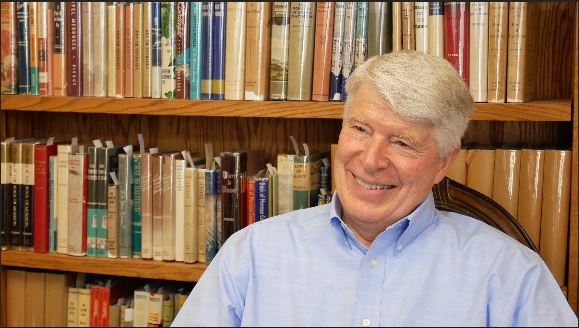
Let’s talk about the Mark Hofmann bombings & forgeries. There are some critics of the LDS Church who ask the question, why weren’t church leaders able to discern, using the spirit of prophecy the Hofmann fraud? (Check out Part 6.)
Curt Bench: I’ve heard that countless times.
GT: How do respond to that?
Curt: Well, the way I respond is that we’re all in good company, because we all got fooled. His family got fooled, his own wife and his parents, his friends and neighbors, other family, experts that tested his materials. He fooled everyone, including General Authorities. So I guess I’m prone to grant them, or give them a lot of slack because they’re human just like we are. As Dallin Oaks said later, unless we’re given a reason not to trust, we trust people.
Others note that it seems like Church bought anti-Mormon material, or material unflattering to the church’s narrative in order to hide them from the public and prevent discovery of them. Is that a fair characterization?
Curt: I mean that bothered people I think when that came to light. From President Hinckley’s perspective if I were in his shoes I would understand better the motivation I think but like I said, everything is 20/20 now in our vision. But I can understand why that would be a difficult thing for people because it does give people the impression of trying to hide things and put things in the best light possible so I can certainly understand that perspective.
In Part 7, we talked about how the Hofmann bombings and forgeries have had a lasting impact on Church history. In the 1970s Leonard Arrington was a trained historian and became Church Historian. He opened the Archives to many researchers and people interested in Mormon History. However, General Authorities were concerned about some of the controversial aspects that were being uncovered. Of course Mark Hofmann had a lot to do with some of those controversial documents. How big of an impact did he play in shutting down access to church records in the Church History Library?
He certainly made the church change its entire approach to security, and protecting its holdings. It severely restricted access.
I think there was a long period of time when they were trying to determine what they had in their own holdings that were genuine and weren’t genuine. Yeah he definitely had an impact on how things are done at the Church History Library. I know it was a lot harder for me to do business with the church after that. Before things were more—I don’t know what the right word is, but it was easier to do business. It was more informal. It became very formal. There were processes you had to go through and committees had to make decisions on acquisitions and things like that rather than just being left to an individual.
Curt Bench will tell us about Mark Hofmann’s impact. But have things improved?
I really think we are in a new era, and I can only hope that it will get even better. The Joseph Smith Papers Project is one of the biggest evidences of that whole new attitude and openness. I mean those scholars are not given a list of restrictions as to what they can research and what they can write about and publish. Talk about throwing the books open, they’re doing it. They’re making our history available and accessible. There’s some very impressive scholarship that’s gone into that project, for example. That’s had spinoffs.
We see a lot of other research and writing and publishing that’s being done as a result of that whole attitude. Rick [Turley] is no longer Assistant Church Historian. He’s over Public Affairs now. I think he’s one of the unsung heroes in my opinion. He has helped us get to the point we are now, and those others that I mentioned and many that we can’t take the time to name.
Have you considered the role Hofmann played in shutting down Mormon History? Do you think the leaders should have detected Hofmann’s forgeries?
 Wheat & Tares
Is this one of those things where I have to listen to your podcast to figure out what you’re trying to say? Kind of a preview? Because this essay is spotty and not terribly coherent.
I think openness is a good thing, but when it comes to professionalism in historical documents, if the Hofmann forgeries caused the curators of Church historical archives to look more critically at the collection and apply higher standards to determine authenticity, then it’s for the best. When Curt Bench speaks of difficulty in doing business with the Church, he’s speaking as a bookseller and purveyor of historical material. He should expect the things he is selling to come under scrutiny for authenticity.
Where I’d like to see more openness is when it comes to historians seeking access to materials and archives. Those folks, of course, have a very strong interest in seeing that there are controls in place to see that the documents and artifacts that the Church History department acquires are in fact genuine. There should be processes and committees of knowledgeable people. I can see where bench might want to only have a few people to deal with, to make it easier for him to sell, but that isn’t necessarily in the best interest of decent history.
That said, those processes and committees should be focused on authenticity and historic relevancy, not on the ability of a given document or artifact to support a particular Gospel narrative; and access shouldn’t be limited to those only willing to accept restrictions on what they write. (I have this oddball commitment to truth, and I think the Gospel can stand it.)
So, in this quick and unclear blurb of a post, OP is really dealing with two issues: how documents and artifacts are acquired, and how and by whom (and for what purpose) they are accessed. Having the Church hire professional historians and archivists to develop an acquisition philosophy, manage acquisitions, and provide open access consistent with document/artifact protection and preservation would be a great step, and it seems as if they’re moving in that direction.
I was RLDS at the time, and we were “taken in” by the Joseph Smith 3rd Blessing document. Even when the other materials presented by Hoffman caused alarm, church leaders said “the Blessing document has been authenticated, let’s stay focused on that”.
A new forensic technique was later developed that could determine, within a 50-year window, when ink was applied to paper; and that was the deciding test. I don’t know how expensive it may be, but it ‘s hopefully used in all controversial cases at least.
Hoffman’s motivation was partly money (he did produce non-mormon forgeries) but he was also motivated to discredit the LDS Church. If the leadership of either denomination had been aware of that, it might have made a difference. They used the best (earthly) sources available at the time. TIME Magazine said that Church leaders had “a much cooler reaction” than the RLDS concerning the JS3 document. In the end, the LDS were right.
Sorry New Iconoclast. Of course I would love you to listen; I’m sorry you thought this post didn’t make sense. The main points I was trying to bring up for conversation purposes was to ask the question of critics: If LDS leaders are prophets, seers, and revelators, why weren’t they able to use the Spirit of Discernment to know these were fraudulent? Critics also note that it seems the LDS Church was buying documents that disputed the LDS narrative in order to hide them. I asked Curt these questions, and wanted to get your reactions to his response. Do people think these are valid issues? Do you like Curt’s response?
Pres Packer in 1993 complained about intellectuals, feminists, and gays as a threat to the church, and didn’t like Arrington’s openness to church history. “That which is true is not always useful.” While many complain about the LDS Church’s lack of transparency in church history, I think Mark Hofmann’s “discoveries” had a larger impact on shutting down access than has previously been acknowledged. Curt said that the church shut down access to all researchers because the church went through a time period to re-authenticate everything, and look for Hofmann frauds. I think Mark Hofmann played a large role in shutting down access with his anti-Mormon findings that weren’t really true. Were people aware of Hofmann’s indirect role in shutting down access to historians?
I hope that helps explain what I was trying to get at. I’m sorry it was confusing.
So this is a common criticism, where the leaders of the church should have been able to use the spirit of discernment to know whether the documents were false.
I suppose that where my issue is that so many things in the church are done by the brethren under the guise of “inspiration” or the “whisperings of the spirit”. This is often interpreted by members and the leaders that the they do know the mind and will of the lord in so many matters. So if they can know what god is thinking on so many matters, why would he not let them know on such important documents that may impugn the veracity of church history or even the truthfulness of the gospel?
It seems clear to me that there was no communication with any heavenly beings when Dallin Oaks wrote his famous letter in regards to the Salamander letter, where he tries to make a palatable explanation for members regarding context and folklore, etc.
It should be equally concerning that “the precious funds of the church” were apparently used to procure certain (false) documents. With such large expenditures (in the many thousands of dollars), was no one asking god if this was right, and was this prayer just not answered? It appears that some documents were also procured mainly with the intent of burying them so they would never see the light of day.
So my point is that the rhetoric of the brethren is that god speaks to his prophets today, but on this large matter, there seemed to be no communication whatsoever. You can spin it how you will (as does Oaks) that you can’t be suspicious of everyone and you must be trusting until proven otherwise, but it still remains that the scriptures (and modern leaders) teach that all things should be done with prayer. If god cannot/does not answer on such highly visible and salient things, what confidence can a person have that the brethren can speak with any authority on so many of the topics they address?
Not long after it all went down, I took a class in document crimes from one of the document examiners on the case. His opinion was that the case would never have been solved without the documents the church had, and their willingness to let them be examined. No other document owners wanted to risk such a thing. I thought that was an interesting observation. Who’s to say that GBH want inspired to buy them?
Since when was “the spirit of prophecy” so foolproof? The Bible calls Abraham a prophet, but his experience in having children and in Egypt is real clear that he was not being given full information ahead of time on everyone and everything by God. Same with Moses. Same with the apostles. The thing is God did reveal the truth of the matter on Hoffman after he had deceived leaders and in a very big and dramatic way. So, maybe there is a lesson here to those who think they have successfully lied to God or His servants.
37 But as you cannot always judge the righteous, or as you cannot always tell the wicked from the righteous D&C 10:37
I understand the comments by scott and ThomasT to be hypothetical. I will respond to both of them with the following hypothetical:
If God allowed LDS leaders to be initially duped as a learning opportunity, or if President Hinckley was “inspired” to buy the forgeries for some greater good, why could not God (and his prophets) have orchestrated these outcomes before Mark Hofmann murdered two people?
Rick, thanks for the clarification. I often have similar issues – the whole thing laid out so neatly in my head doesn’t always make it on to paper. 🙂 And I think the podcast will be fascinating; I have it in queue for my daily commute.
I think you’re probably on to something – if Hofmann’s activities didn’t have a direct effect on the post-Arrington Church history world, the timing is certainly a large coincidence. I suspect that the forgeries gave the “control” faction more ammunition in their endeavor to shape the narrative, not that they needed the help. A bunch of other factors were in play, including a general swing of the American political pendulum to the right, the rise of Benson to the presidency of the Q12, and so on. )About the only “bright spot” in the whole period was the long-overdue demise of Ernest Wilkinson.) While I wouldn’t call Hofmann the only or even the major factor, he was most probably a contributing one.
That said, I’ve always had trouble understanding why people expect an angel to come down and ratify every decision an apostle or Church president makes. There are plenty of scriptural and real-life examples of them making “normal” human decisions, and even errors in things they thought were necessary and inspired. (Joseph and the 116 pages, Moroni’s letter to Pahoran, the late departure of the Willie and Martin companies, etc.) The idea that Church leaders were “inspired” to buy forged documents so that the Lord could uncover the forgeries by getting Hofmann in such a bind that he had to blow two people up seems wrong to me. Say, rather, that the Lord was able to salvage what was salvageable out of the whole miserable situation.
JakeC, are you asking why the Lord wouldn’t remove someone’s agency? I don’t recall many times (that we know of) that he’s done that.
Hi Scott. No I’m not particularly interested in agency ramifications, which presumably would lead us into a conventional discussion of why a purportedly loving God would allow suffering. That’s a well-worn debate I don’t think I have any questions on. Disclaimer, I’m an agnostic.
I guess I’m more curious if you really believe GBH was inspired to buy forgeries. If so, do you believe he knowingly bought forgeries under God’s direction? Or did God withhold the spirit of discernment, letting GBH be conned by Hofmann, as a means to get some of the forgeries locked away in a safe place?
Admittedly, I’m resisting, frankly finding unsettling, any hypothesis that effectively makes pawns out of two real people who were brutally killed. Please tell me if I missed your point.
To make come to a sound conclusion on this matter, one woul need to go back over all of the information available. At this point in time I see little value in rehashing the opinions on the inspiration of lack of it from the church leaders. Could someone correct me if I am wrong, but I was under the impression that the at least some of the church authorities wanted the documents authenticated before making official declarations.
Another poster already has pointed out historical (at least scripturally historical) accounts of prophets that were deceived or did not know. Most of that came because of a trust factor. Like Isaac, or the prophet sent to Israel that was deceived by another prophet.
As to why the lord did not warn the leadership, I amnot in the know. Just as I am not in the know with all of the other times prophets came up a bit short on the inspiration thing,