
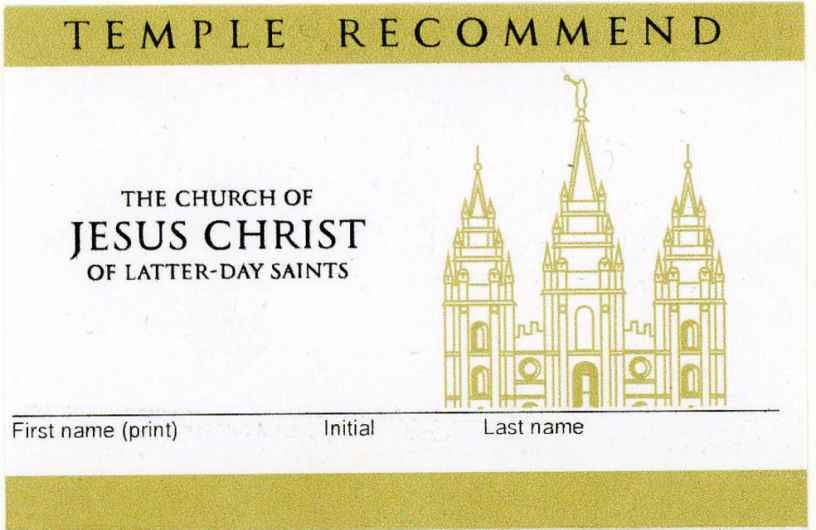
 Why does the church currently require that its employees have a current Temple Recommend? It’s a question I’ve often heard my friends who work for the church ask, and over my lifetime, we’ve continually ratcheted up the requirement for a Temple Recommend to callings and ordinances also, even when one has not been historically required. One of the recently leaked handbook documents detailed the church’s reasons. Some of these were surprising to me, as a person with decades of corporate leadership experience.
All work places have mission statements, values, and policies. But they are able to obtain buy in to those things without requiring a temple recommend. Employees choose to work there because they feel that the values and mission are things they can support, so those are already more or less a given. Things like dress code / appearance and work-related policies are more explicitly stated for employees as they are oriented to the company. They also don’t require a temple recommend to get compliance in any other workplace. The expectation (which is really just a hunch here, not a job requirement) that employees will seek divine inspiration is unique, but of course, people without a temple recommend may also do this, and people with a temple recommend may not.
To paraphrase the stated reasons:
- Temple Recommend is viewed as a heuristic for supporting the church’s mission. As mentioned, this is kind of silly since workers usually support the company mission statement or they don’t work there. It’s not a common problem for workers to revolt against the mission statement of their workplace.
- Church members in good standing spend enough time in church culture to speak the same lingo and have the same cultural norms. The second one seems a little odd to me; a workplace culture often forms around the type of work being done, the people hired, and the policies associated with the work done. Newsrooms feel a certain way, HR groups function another way, IT departments have a certain type of culture, etc. Substituting church culture (very bureaucratic, administrative, patriarchal, and hierarchical) for one that naturally emerges based on the workplace is a strange choice. It’s not like church culture is a universal ideal that should apply to every situation.
- Temple Recommend holders will do what they are told. Getting employees to support policies handed down is not always desirable. Policies should be created with input from those performing the tasks unless you want really terrible and inefficient policies. Policies should be flexible and adaptable. Leaders usually only have insight into a small percentage of the work-related problems that policies are designed to solve, which is why employee and consumer input is critical to their creation. Work processes aren’t for the benefit of leadership but to improve output and efficiency as well as customer experience.
- They will present a uniform appearance to outsiders. This can be even more effectively addressed with a simple dress code (or behavior code) policy statement. Temple Recommend holders can dress and groom in many ways that might not be what the company desires for the role they hold. What is considered professional demeanor also varies based on type of work performed–janitors dress differently than journalists. This isn’t a very important reason to require a temple recommend.
- They will take work problems to God to solve. While this is a potentially valid reason, it’s also not a trait that is exclusively held by temple recommend holders, nor can one assume that holding a temple recommend means they will seek divine inspiration in work matters. Certainly anyone who sincerely seeks divine inspiration, temple recommend or not, should have access to it.
 A more cynical view, or perhaps just looking at the underside of what these reasons signify, they could be restated another way:
- Workers won’t expect to provide input or question how we achieve our aims.
- They will do things the way they are done at church, not introducing pesky new ideas.
- They will execute our plans without question.
- Their appearance and mannerisms will be conservative and business-like.
- They won’t expect leaders to help solve their work issues. They will internalize problems rather than criticizing the environment or leaders.
This approach to leadership is optimal only under the following conditions:
- In life or death situations when obeying orders quickly without input is important or lives will be lost, such as in military operations.
- If leaders are truly the only people with great ideas. If this is true, check your hiring practices.
- If the consumers of the products or services provided are neither important to the process nor at all diverse from the make-up of the leadership (the source of the ideas).
- If the products and services are perfect with no alterations needed or would be diminished by any improvement efforts.
- If employee engagement is a defect rather than a feature. This might be the case if the employees hired are doing such unskilled work that their input could be automated by robots, but then their work should be automated by robots rather than performed by people.
Ultimately, the real problem with these stated reasons is that they assume that both the consumers of the goods and services and the workers are part of a one-way process only, not part of a competitive marketplace of consumers (a target audience, if you will) nor part of a work place of human beings that contribute to the output. I understand and agree with the concept that the gospel can be and often is diminished and diluted by human input (at all levels, not just the worker bees), but it isn’t as though the church is offering “the gospel” as its sole output / product through its various entities. For example, at BYU, the product is education (albeit an education compatible with gospel living). At Deseret News, the product is news. In the Church History Library, the product is historical research.
 Does it matter? Is it just some dumb list with no repercussions? Maybe. I don’t work for the church, so I don’t have personal experience with how this approach is manifest in the work environment. After all, it’s likely impossible that a workplace’s policies and culture and output don’t in fact take into account the uniquely relevant work-processes, the input of workers or the evaluation of how effective the output is at reaching “consumers.”
But there are some caveats to that observation:
- Why make a temple recommend required when it’s not directly relevant to the work being performed unless you want to reduce diversity of input? Input (from both employees and consumers) improves internal processes as well as consumer experience and products.
- Why have a workforce that deliberately doesn’t match your target audience? This approach only makes sense if your entire target market is temple recommend holders with the same demographic as your reduced workforce pool. Even then it doesn’t make perfect sense.
- Why do anything to limit or discourage input and engagement in setting policies and devising procedures from employees? The more involved they are, the more the policies and procedures will be effective. As Al Kelly, one of my former Amex leaders (now CEO at Visa) once said, strong leadership means making decisions at the lowest level possible in the organization.
As a leader, you should only make the decisions you have to because they affect the direction of the company. You should empower people at every level to make the decisions that are directly related to the work they do and remove obstacles and bureaucracy that slows down their ability to service customers or create and provide better products. If you don’t do that, you create a bureaucratic behemoth so locked in by bad policy, dead end feedback loops, and self-sustaining toadyism that you provide a sub-par product or experience to your consumers, and soon you are out of business.
And frankly, the gospel (as well as products and services provided by other church owned businesses) is supposed to be a growth industry, constantly improving how it is delivered, reaching new converts, and making it easier to come unto Christ. Isn’t that our stewardship?
When you are offering a product or service, having employees who understand the target market is valuable. If you are selling products to women and you only hire men, you will probably be less successful than if you had some women on board. If we want to grow the church, having employees who are converts and non-members will provide insights that can’t be obtained by only hiring those who have “drunk the kool-aid.” Preaching to the converted only gets you so far. Understanding how outsiders see things is critical to any growth effort. You want to have a mix of perspectives, ideally.
Lastly, another concern about inserting the Temple Recommend into any job requirements is that it also inserts a subjective evaluation from a non-employee into the employment process. Although they are instructed to stick to the questions and answers, local leaders can and sometimes do exercise subjective discretion in refusing to provide a temple recommend. Obviously, one would hope they would not abuse their privilege, but should they do so, they are in a position to inflict serious economic harm to a church member who happens to work for the church. At minimum, this conflict of interest renders local leaders largely useless at providing pastoral care to ward members who are employed by the church. Losing your job over a local leader’s subjective view of your worthiness has to weigh on the minds of any church employee renewing a recommend or simply wishing to discuss confidential matters with their bishop. It’s hardly a recipe for trust.
The church is comprised of flawed human beings, trying to overcome their petty jealousies, their envy and spite, their gossiping and back-biting, their criticism and flattery, their “natural man.” We have already seen ample evidence of the tattle tale culture at places like BYU and as reported in many local wards to know that where human beings congregate, spiritual brinksmanship rears its ugly head, and in a case where employment is conditioned on a current temple recommend, we’ve put people’s livelihoods at risk based on their fellow members’ human frailty.
What do you think? For those who do work at the church, is it valuable to require a temple recommend? Are these the right reasons to do so, in your view? If not, why not? Do you find that employee and consumer input is sought and valued?
Discuss.
*This post was originally discussed at By Common Consent in December 2016.
 Wheat & Tares
Doesn’t this policy also amount to a de facto 10% pay cut for church employees?
I think the explanation is much simpler. Most church employment is utah based. There is a plethora of Mormons there. It’s simply a way to weed out applicants and as Joni said, temple recommend holders are required to pay tithes so the church gets a 10% rebate when they hire temple recommend holders.
I don’t believe that in the world today one can assume that because a person applies to work for the Church, in any capacity, that they “want to be there” & that they share the mission of the Church. How many times has the news covered those from PETA who work on farms to take pictures? Those were the basis for new laws in multiple states. Given that at least one individual has paid for ad space to try to get dirt of the Church, I do not think it unreasonable for the Church to require a temple recommend for employment.
It is also a very fast way to remove any employee with sexual misbehavior, such as requiring a student to sleep with the professor in order to get an A in the class. I went to a different educational institution before BYU for one quarter. As a young woman, I was neither strikingly beautiful, nor ugly – middle of the road attractive. I was thus propositioned by 2 of my professors. I told them they were despicable, reported them to the Dean ( who did nothing), and I received a B from one & an A- from the other. I appreciate the protection in that area that this policy affords to the young women at Chrch universities. There still may be pervs out there, but if a girl reports it to the Dean, she will likely not be blown off.
Marivene: There are unfortunately still adulterers and perverts with a temple recommend. Sexually propositioning students wouldn’t be tolerated by BYU even if professors didn’t have a temple recommend. Two of my best professors at BYU were visiting faculty from other schools who weren’t Mormon and therefore didn’t have a temple recommend. They still had to follow the rules of conduct.
Having a temple recommend isn’t an accurate heuristic for alignment with a workplace’s mission statement. People who have temple recommends work for competing companies all the time.
One word: churchbroke
Creeping authoritarianism for authoritarianism’s sake. I don’t actually think there’s an ulterior motive beyond that.
Marivene has a point – there have been instances where church employees (even with temple recommends) have used their position to influence others out of the church (see this case: http://www.deseretnews.com/article/600106804/Court-upholds-firing-of-LDS-employee.html?pg=all). I can see the church even more paranoid of people who haven’t been through at least the preliminary vetting process of the recommend interview. Those who work at the Church History Library have easy access to materials concerning church disciplinary proceedings and temple ceremonies, which the church prefers to keep confidential among authorized churchmembers.
To be honest, it does seem to be a very top-down culture with little input from lower levels. Roger Terry over at Mormonomics talks about his experiences at the Ensign: “I recall having to get fourteen approvals for one particular article. And it wasn’t even controversial. If Correlation didn’t kill or eviscerate a perfectly good article, then any number of middle managers or General Authorities just might. What survived was usually so safe that it was totally benign. Reading Freedom, I couldn’t help but wonder why the LDS Church can’t tackle some serious current moral (or, heaven forbid, political) issues head-on. Well, I suppose there are lots of answers. But I do yearn for a church that can be more relevant in today’s modern world and less frightened of either offending or surprising someone.” (http://mormonomics.blogspot.com/2017/01/church-magazines-not-ones-you-think.html?m=1) We aren’t dealing with a “typical” business culture here.
In spite of recruiting efforts, my dad always refused to work for the church. He said he’d rather keep his testimony.
I suspect the “church-broke” comment hits the nail on the head, but obviously, there are plenty of TR holders who are not church-broke (but probably all those who are church-broke are TR holders). So it’s one filter. But Mary Ann probably hits the nail on the head. Working for the church isn’t like working for a Fortune 500 company. It’s very top-down. We don’t seek the best talent out there because we will under-utilize them anyway. Personally I think that’s a shame, but it is what it is.
My bigger concern is, as stated in the article, someone’s bishop has the ability to get him or her fired. There’s a reason we avoid paid clergy (except when we don’t) and that’s because when you mix religion with one’s livelihood you get lots of weird, undesirable outcomes. Bishops aren’t all wonderful. With 32,000 of them worldwide, some of them are bound to be lemons.
Perhaps a less pressing issue, but one nevertheless, occurs when a church employee commits a serious sin but can’t afford to lose his/her employment over it so does not go through the repentance process. Instead the person carries the heavy weight of unrepented sin for years just so he/she won’t be fired from a job that may have little need for a temple recommend.
scattran (auto-corrects to saccharin) is right on. There doesn’t even need to be a super serious sin. Your average guy with a porn problem who genuinely wants to repent and needs help will go to his bishop. The bishop can work with him, get him into church support groups or help him get counseling. Sure, he might lose his recommend for a while, but he can quietly and privately work through his personal challenges. Not so with a church employee. Whether worried about being able to support his family or about being fired for wickedness (which would be a least a little public), he’d be tempted to lie to his bishop, which would only make his spiritual misery worse. Sure, he should get a different job, but that’s not always so easy, and he might have a family to support. From the bishop’s perspective, he might know the guy’s not temple worthy at the moment, but doesn’t feel like it’s something he should be fired over. I wonder how many church employees carry recommends but have been admonished by their bishops not to attend the temple. I’ll bet that’s a thing.
I can see why having the temple recommend requirement would make it easy to get rid of employees who might embarrass the church or who might be antagonistic to the church or its leaders, but the conflict between spiritual and temporal well-being trumps that, at least in my opinion. I think the policy should be changed. But, I’ve never worked for the church or supervised its employees, so it’s possible there’s something I’m missing.
I’m not generally in favor of using the temple recommend as an employment requirement. I’m also not in favor of using it as a kind of baseline marker of faithfulness in the church. I think using the temple recommend in those ways is bad, on balance, for a lot of reasons, including the ones explained so well in the OP. But I don’t have time to go into all of those reasons.
I just want to say this: I think that the church is less draconian than many fear when it comes to the temple recommend requirement for employees. I personally know two people (one of them a church employee and the other a person at BYU) who got involved in some things that put their church membership in jeopardy. They were encouraged to work through the process with their bishops, and their employers did not take any action to fire them. Their personal issues were kept private. I know a couple of anecdotes don’t prove anything about how consistent the church is in dealing with this type of problem, but I’m certain that most people in the church’s operations have real compassion about it.
It’s rather common for any church, when making employment decisions, to choose to hire practicing or even devout members of that church. That is allowable in the U.S.
There are many in the church who do not understand why a faithful believer would not have a recommend nor would they see value in hiring an unbeliever. As such, requiring a recommend is a simple bright line loyalty test that would eliminate a lot of people that they don’t want. Ji’s comment is illustrative: the recommend is seen as a requirement to be “practicing” or “devout”
As to the negative aspects of the requirement, I agree they are problems, but I have no reason to think that the church leadership generally values diversity of thought or opinion. On the contrary, there is a lot of value placed on loyalty above all else.
That’s not the same thing as having a temple recommend.
Church Employment can and should be a wonderful experience but my experience was not a good one. In fact, it was the worst employment experience of my life.
I worked at The Church of Jesus Christ of Latter-day Saints full-time in the temples. Let me be clear that I believe in the church, I know it is the Church of Jesus Christ, and I think most church employment experiences are good. However, I would caution people to not get caught in the trap believing if they work for the church that employment will be blissful.
The pay for us was substandard. We lived paycheck to paycheck whereas the recorder I worked under was paid very well.
More importantly than the pay, however, is the manager you have. I had very abusive managers, who held temple recommends, and still worked daily in a hostile work environment. Abuse in LDS Church Employment is real, many people don’t think abuse can happen when employed by a church. I was forced out by my abusers and the abusers were protected by the legal team and still have their jobs and pensions. I had 8 years of “exceeds” and “greatly exceeds” (BYU + Church Employment) yet after 9 days at a new job at the Temple Department my job was threatened by an abusive manager and he made good on his threats to terminate me. This manager was offended because I asked to see a policy in writing because he had incorrectly interpreted the policy. When I asked he got red in the face, was visibly angry, and told me that “the brethren” may not keep me because I lacked judgement.
I was also a whistle blower and got forced out in part for bringing things to light that never should have happened in any temple. I can’t provide details here but use a search engine to search for “Abuse in LDS Employment” and you will find my blog where you can get full details and then make up your own mind. Most of the abuse happened under a temple recorder and the temple engineers. It has constant and it was brutal.
My employment in the church was the worst employment experience in my life and it should have been the best. I still believe the church is true despite what I went through.
I wrote the HR Department, Temple Department, and General Authorities and all ignored me multiple times. They won’t even respond to my letters despite the abuse I suffered and the evidence I presented. It was really shocking and incredibly unbelievable that they would ignore such damning facts about a temple department director and a temple recorder. After 10 years I am still in shock and have suffered greatly because of their actions. The abuse occurred as an employee of a temple and as an employee in the Temple Department. I learned the hard way that Church Employment does not care about their employees – I was used, abused, and then discarded. I resigned before they could fire me and the reason they gave me was that I was “not a good fit”. I pressed my manager hard when he came in to inform me that I was being let go and he said my work was excellent and there were no problems with me as an employee or my work – and I recorded it. Interestingly, when I appealed the director and his boss suddenly found reasons for my termination that I had never heard before. That shows a severe lack of integrity but it’s legal – they can fire you for no reason and get away with it. And, they did. The story is much more detailed that what I have described here. Suffice it to say that they had no justification but because the director had been offended by a very small issue he wanted me out and he forced me out.
Just be warned church employment is not always blissful. The managers should be the best in the world, and some are, but not all of them are. I went through years of hell under abusive and powerful men and Church Employment Human Resources refused to listen to my side of the story. They have shown they do not care it happened and just hope that by ignoring me the issue will go away. Nothing changed and the abusers still have jobs and full pensions.
When an employee comes forward and reveals their manager is hostile and abusive, and that illegal, unethical, immoral, and dishonest acts are occurring in the Holy Temples of the Lord, HR needs to deal with the issue head on rather than trying to bury and silence the victim who is being abused. It’s unbelievable this could happen in Church Employment, especially when the Church teaches us to care for one another, but it happened.
I will no longer be silenced and my last option now is to go public with the abuse with the hope that something will change in Church employment to protect the victims rather than the abusers. To Church Employment I plead, “Please, please, start listening to people who are being abused by overbearing managers.” High level managers and executives are not always right when they try to force someone out of Church employment. Sometimes they are the abusers and you are supporting them by forcing out the victims. Each situation should be carefully researched and when there is absolutely no evidence of wrongdoing on the victims part you should give them the benefit of the doubt.
As I have thought about this further, it’s interesting the Church requires recommends. I am not a psychologist but I can tell you that the people who ruled over me as my bosses in Church employment had characteristics of a narcissist . They were abusive, cruel, and without natural affections. And, they held a current temple recommend. They devastated my life and yet were considered “worthy” because they had a recommend. Just because a person has a recommend doesn’t make them a good person or a great worker. I found it especially didn’t mean there were a leader in the true sense.
Use a search engine to search for “Abuse in LDS Employment” and you will find my blog where you can get full details and then make up your own mind.