

It is interesting to compare brass serpents and golden calves and other things. By taking the two different images that were raised it, it lets me compare and contrast Moses, Aaron and Baalam, three prophets. (As an aside, I once had someone tell me that “it is a brazen serpent if I like it and you don’t understand it, if you like it, then it is a golden calf — not terribly useful as a way to address the topic, though it did illustrate to me just how flexible self-righteousness can be).
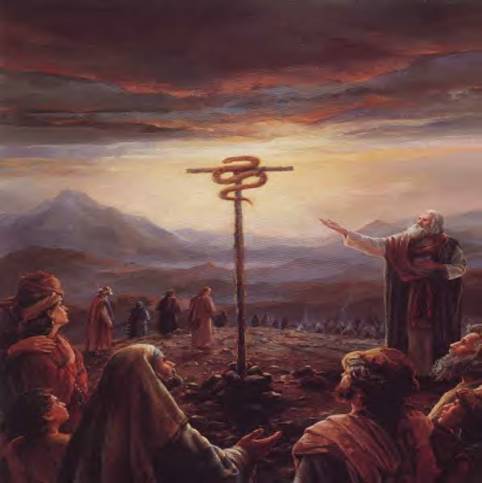
To refresh everyone on the story of the brass serpent, I’ll take the liberty of quoting from the Ensign.
Three Book of Mormon prophets used this story in their efforts to persuade their people to repent and believe in Christ. Nephi, son of Lehi, told his brothers that the Lord sent the serpents among the people to soften their hearts and that the only “labor which they had to perform was to look” (1 Ne. 17:41). Nephi also emphasized that while the labor was simple and easy, many still perished. The prophet Alma added several insights into this story: (1) many Israelites “did look and live” (Alma 33:19); (2) many would not even look because they did not believe, so they died; (3) among those who did look and were healed, some did not understand what the Lord was trying to teach them (seeAlma 33:20). Nephi, son of Helaman, explained the symbolism of the brass serpent when he testified: “As he [Moses] lifted up the brazen serpent in the wilderness, even so shall he [the Messiah] be lifted up. … And as many as should look upon the Son of God with faith, having a contrite spirit, might live, even unto that life which is eternal” (Hel. 8:14–15).
https://www.lds.org/ensign/2002/03/look-and-live?lang=eng
As for Aaron and the golden calf, I’ll quote from Wikipedia:
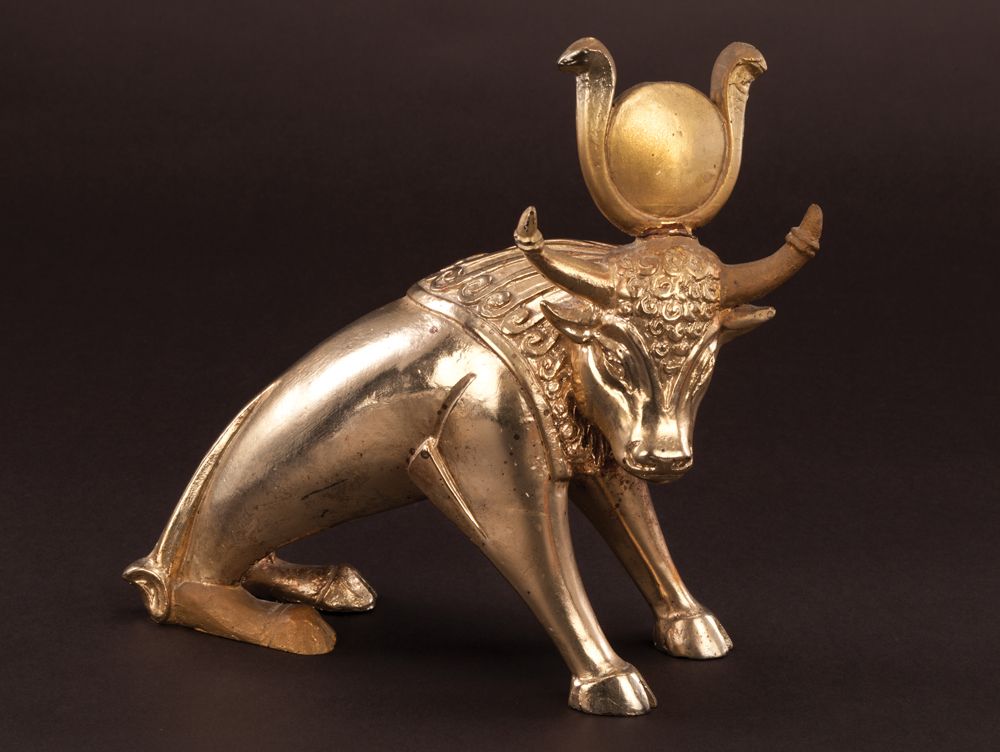
According to the Bible, the golden calf (עֵגֶּל הַזָהָב ‘ēggel hazāhāv) was an idol (a cult image) made by the Israelites during Moses‘ absence, when he went up to Mount Sinai. In Hebrew, the incident is known as ḥēṭ’ ha‘ēggel (חֵטְא הַעֵגֶּל) or “The Sin of the Calf”. It is first mentioned in Exodus 32:4.
https://en.wikipedia.org/wiki/Golden_calf
The fascinating thing about the stories is that they look so similar in some ways. In each story a prophet is asked to act. Balaam to bless, Moses to bless, and Aaron to bless. Two of them (Aaron in the one case, Moses in the other) made an image and raised it up in front of the people. The third, Balaam, taught the people how to act like their neighbors acted. In every case, the people felt like they needed something. Some followed the lead of the prophets, others held back. Two of the times there was serious trouble (the golden calf and Balaam with his later advice) for those who followed. One of the times only by following did the people escape death.
That leads me to three points to discuss the differences between the three incidents.
First, we get some differences between Moses and the other two. Moses was unique, what is referred to as sui generis or in a class by himself. With Moses “The LORD would speak to Moses face to face, the way a person speaks to a friend.” As it was put in broader context when two prophets criticized Moses:
To quote at length from Numbers 12: 6-8
6 God said,
“Hear now My words:
If there is a prophet among you,
I, the Lord, shall make Myself known to him in a vision.
I shall speak with him in a dream.
7 “Not so, with My servant Moses,
He is faithful in all My household;
8 With him I speak mouth to mouth,
Even openly, and not in dark sayings,
And he beholds the form of the Lord.
Why then were you not afraid
To speak against My servant, against Moses?”
In those verses God is saying that He generally communicates, through a glass, darkly (to use Paul’s language) with prophets, by dreams and visions and promptings, in “dark sayings;” that most prophets have to puzzle out and tease out the meaning of what God communicates to them.
In those verses, God says that to speak clearly and directly as He did with Moses is extremely rare and that the fact that God spoke directly with Moses should have been Miriam and Aaron pause when they went to criticize Moses, even though they too were prophets.
Second, both Aaron and Balaam were responding to social pressures and social norms. Most analysis of what Aaron did discusses the social norms he was following and the pressures and fears of the people. Balaam taught the people of Israel who were willing to follow him to act like the people already in the land. Moses was responding to pressure, but it was the pressure of disaster and outside events.
Third, Aaron and Balaam were trying to deliver what people wanted and understood, Moses delivered something that they did not understand, but that they needed. I’m not necessarily speaking in favor of prophetic obscurity, but anyone can get in front of a parade and lead the way people are already going. I think we need prophets to give us guidance that we are not expecting.
Now otherwise, prophets differ a great deal from each other. Elisha coordinated with an established school for prophets. Isaiah was an insider. Moses was a noble and the head of the people, as was Joshua. Jeremiah was a herdsman, though he was the son of a priest. Nehemiah was a cup bearer to the king of Persia. Samuel was adopted into the household of Eli and in many ways ruled Israel until the people rejected he and his corrupt sons for a king.
But the lesson I draw from viewing these three prophets against the context of other prophets is that when Brigham Young warned that blindly following leaders was potentially dangerous, he was probably right. The same is true of the danger of blindly rejecting prophets. When we blindly reject are we really any better than Miriam or Aaron?
I’m not sure what the answer is, so I will put it to our readers:
- How do you tell the difference between brazen serpents and golden calves in your own life?
- How do you avoid the arrogance of Aaron in rejecting Moses without falling for the cupidity of those who followed Balaam?
I’m curious what you think and why.
 Wheat & Tares
The OP asks, “When we blindly reject…” the prophet(s).
In what way are we “rejecters” (dissenters, questioners, doubters, et al) “blind?”
I have a simple litmus test. Are the fruits of the teaching charity? (as charity is the only thing not meant to fail. )
Not saying everyone blindly follows or rejects.
I was trying to create some contrast there, many people have what they feel are justified rejections or following.
But tha let me lead to my question of how do we avoid being blind in what we do.
RT — I like that. Does it draw me closer to the left be of Christ or does it push me away.
The modern meaning of charity, “voluntary giving”, or the KJV meaning “love” (gr. agape)?
“How do you tell the difference between brazen serpents and golden calves in your own life?”
I follow Justice Stewart’s test for porn. I can’t define it, but I know it when I see it.
How do you avoid the arrogance of Aaron in rejecting Moses without falling for the cupidity of those who followed Balaam?
This is easy. Use common sense.
The whole “follow the prophets” thing is a recent development in the LDS Church. Smith himself preached against it:
“We have heard men who hold the priesthood remark that they would do anything they were told to do by those who preside over them — even if they knew it was wrong. But such obedience as this is worse than folly to us. It is slavery in the extreme. The man who would thus willingly degrade himself should not claim a rank among intelligent beings until he turns from his folly.”
“When Elders [leaders] of Israel will so far indulge in these extreme notions of obedience as to teach them to the people, it is generally because they [the leaders] have it in their hearts to do wrong themselves.”
Charity as in “the pure love of Christ.”
Matthew 7:15-20 applies here. All things have a source, all things come down to 1 of 2 sources, GOD or the Adversary. Thus all things, in a way, come from a ‘Prophet’, or a ‘False Prophet’ of sorts.
So you will know them by the fruits they bear.
15 ¶Beware of false prophets, which come to you in sheep’s clothing, but inwardly they are ravening wolves.
16 Ye shall know them by their fruits. Do men gather grapes of thorns, or figs of thistles?
17 Even so every good tree bringeth forth good fruit; but a corrupt tree bringeth forth evil fruit.
18 A good tree cannot bring forth evil fruit, neither can a corrupt tree bring forth good fruit.
19 Every tree that bringeth not forth good fruit is hewn down, and cast into the fire.
20 Wherefore by their fruits ye shall know them.
Thane — good point, but Aaron was Moses’ spokesman and a prophet before and after he got involved with the golden calf, which is one of the reasons I used him as an example.
Until Balaam started teaching people to accept immorality, he was a prophet and famous for blessing Israel in spite of large offers to the contrary.
How do you tell the difference in the moment?
Charity, for me, comes down to kindness. To forgiveness. To building up my fellow men/women. To leaving stone-casting to the only one who really has that right. Which for me is also the pure love of Christ.
Yes. I was just pointing out to Rt that the meaning of the word “charity” has changed since the KJV was written. The archaic meaning was “love”, the modern meaning is “benevolence”.
http://www.etymonline.com/index.php?term=charity
You can tell a true prophet from a false one by their fruits. What are the fruits? Charity and love, but for who? A true prophet will love the Lord with all his heart, might, mind, and strength. He will truly live his neighbor as himself. He will not seek to get gain or praise of the people. He will speak boldly and not worry about whether it makes everyone feel good or not. Aaron should have stood bold against the people because he knew what they wanted was wrong. Moses didn’t cave to those pressures. He could have come down from the mountain and threw his hands in the air and said oh well, I guess as long as your all happy?
We should also have the Holy Ghost witness to us. If we don’t have this gift we need to get it. The israelites later learned to follow Joshua because they knew he followed God first and I believe they each had a personal real live voice of God tell them so. We should only ever follow a man who first follows God and teaches us to do the same and even then we should personally follow God and have a relationship that tells us who is right with Him and who we can listen to.