

Recently I got into a discussion about Elder Bednar’s “second earring story” in which an RM at Ricks College broke up with a young woman who didn’t remove her second pair after hearing Pres. Hinckley recommend it during a CES devotional. Someone commented, “Boy, she really dodged a bullet, eh?” I laughed and one of my friends shared that during the late 90s his mother had a second ear piercing done and she felt young and fun and sexy and really liked it. He remembers after hearing the one earring counsel watching his mother come downstairs sad and dejected after removing the second set. He said that eventually she came to be proud of her decision to follow and obey and felt spiritually strengthened.
What followed was an spirited discussion as some people discounted the spiritual experience of removing the second set of earrings and others supported her; essentially digging into the difference of
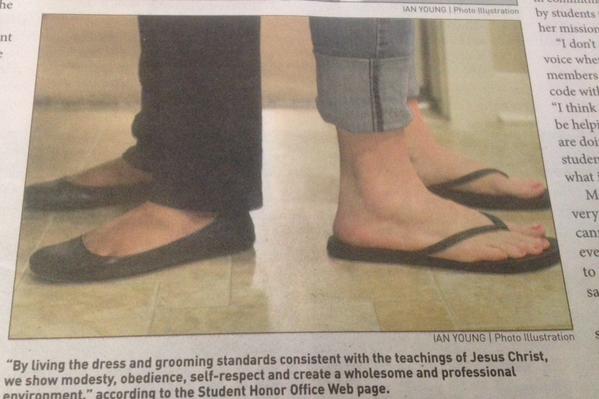
“obedience to gospel doctrines” and “obedience for the sake of obedience.” To me these hedges around the law (earrings, byui honor code ankles, beards, etc.) are not useful. I don’t think strictly trimming the hedges around the law bring us closer to Christ, especially when there are such negative social consequences to others in their life as a result of higher hedges.
Another friend decided to defend the mother – that we should be the last ones to discount what others testify is a spiritual experience and has strengthened them. If someone obeys a small counsel and says they were blessed spiritually, they should be believed and respected for it. The man had a point; how often have I heard that same sentiment expressed to me from others:
“Your spiritual experience is false, wrong, and invalid”
My own experiences have often been discounted and I’ve been told it’s impossible that I was led to my new beliefs by the Spirit. Am I doing the same to others who believe themselves to find spiritual strength in hedges? Back when I was at Ricks I became super orthodox, and I do feel that I drew closer to the spirit while there even though I believe I was misguided on a few things.
I think we have to judge things by their fruits – because it is true that small things that seem innocuous can have mixed effects and even negative unintended consequences. Your (or your leader’s) opinion or belief can be based on misinformation, confirmation bias, or just lack of information. Your belief could actually be a misconception (you can pray away the gay, “Miracle of Forgiveness”) that is harmful to others. Do we respect and embrace something (LGBTQ+ rhetoric) that comforts a lot of people but causes harm to others (LGBTQ+ suicides)?
I know this may seem like a knock against orthodox mormon beliefs because of my examples, but in general I don’t have problems with orthodoxy. I don’t think that everyone needs a faith transition to be a better person, a good Christian, or good Mormon. There are countless good orthodox mormons. I believe that God knew for me, that this is what I needed. I have a brother and sister in law who seem to have had a faith transition the opposite way, and God bless them for it if they are better disciples for it, you know? But can we respect each other, is the question of the day, I suppose.
Can I maintain my position of discarding harmful practices/beliefs and still respect the claims of spiritual experiences of others that differ from mine? Is this a divide that can be overcome? Does an opposite spiritual experience invalidate the other? If we’re both becoming better disciples on opposite paths – can we respect the spiritual experiences of others in things we believe are harmful for others (whether hedges/feminism etc.)?
 Wheat & Tares
Some great points Kristine. I think its related to Paul’s discussion among Gentile and Jewish converts who disagreed about eating meat offered to idols. Paul believed it was OK to eat the meat, but he didn’t want Gentiles offending the Jewish converts over the issue.
“But beware lest somehow this liberty of yours become a stumbling block to those who are weak. For if anyone sees you who have knowledge eating in an idol’s temple, will not the conscience of him who is weak be emboldened to eat those things offered to idols? And because of your knowledge shall the weak brother perish, for whom Christ died? But when you thus sin against the brethren, and wound their weak conscience, you sin against Christ. Therefore, if food makes my brother stumble, I will never again eat meat, lest I make my brother stumble.”
Lovely scripture Nate, but a flip flop?
Still, my husband stumbles in them, so I guess they’re out.
think, and have witnessed regularly, that part of conservative culture is to exclude those who differ, where as the culture of progressives is more inclusive and tolerant.
So it is more likely to be a one way process, with the less conservative, being seen as less worthy, and their spirituality less valued, at least until they become a majority, if that ever happens. It does in some areas.
Because we use spiritual experiences as evidence of the truth divinity of certain commandments/rules/advice, then we naturally will want to discount those experiences if we disagree with the commandment/rule/advice. One possibility is to do away with the universality of those prescritions. That way, it may be right for one person to follow Gordon B. Hinckley’s advice and remove their second set of earings, while it is also right for another person to ignore the same advice. That approach is very uncomfortable for a lot of Mormons, but to me it is the only way to make sense of people’s conflicting spiritual experiences.
There seem to be a lot of things going on with the earring restriction. On the one hand, it’s the continuation of a conservative cultural reaction against piercings, tattoos, and other physical signs that, to elderly white males in the United States, smack of rebellion and disrespect. It also functions as a symbol of a willingness to set aside a personal desire for your love and obedience to an authority figure. It functions as a test that we will be obedient in the small things. It provides people who are inclined to test the boundaries and rebel a relatively safe way to do so rather than having to rebel on more important, consequential things. It is a subtle identity marker that sets Mormons apart from the world and signals who is a faithful insider.
It also is the type of minor proscription that, once enacted, becomes nearly impossible to retract because it becomes a sign of obedience and belonging. It puts strain on the authority and credibility of the leadership because people view it as pharasaical and small minded, focused on outward appearance instead of Christlike attributes. But the people who feel that way are considered less faithful and obedient, have less social capitol, and are not going to win out with the leadership over the obedience-first Mormons.
My own view is that the restriction on earrings is silly and completely cultural, but continues to serve a useful religious purpose in the church and so is not going away anytime soon. But everyone had better keep their sexy ankles covered, because that one is totally from God!
That’s the thing, Nate, hedges cause a lot of people to stumble away from the Gospel. When I was a YW the bishop would send any girl home whose shorts didn’t reach their kneecaps. We were also told that we were supposed to do missionary work to help reactivate our one inactive laurel . . . . who mostly wore tank tops and shorts. Can you guess who didn’t want to show up to any activities?
I’m sorry, but what *is* Elder Bednar’s “second earring story”? Could you please link to something so that we can see what you are talking about?
I searched for “earrings” on this own blog and multiple posts showed up about it over the last 10 years since Bednar’s talk. I think this post here is the most recent (2011) and includes the story written out, I think
http://www.wheatandtares.org/3538/if-i-were-in-charge-stop-counting-earrings/
I was discussing this with a friend just yesterday at lunch and there is this notion that our outward actions and appearance are a symbol of our inward commitment, ala the temple garment speech.
However, this can be, as has been described, taken to an extreme. A second set of earrings on a young lady, who is doing everything else right by our standards, is in a far better position than another who, with a single set or no set of earrings, is doing things wrong.
That is the problem.
We can be so concerned about appearances, both physical and otherwise, that we hide our sins. A perfect outward appearance is no guarantee of an inward commitment.
I was telling my friend that I was in the Temple doing a session and sitting next to this guy who was heavily tattooed. Neck, hands, etc. My first thought was that it was great he was there, because chances are, he embraced the Gospel after having those done or at a time of lapsed activity.
Yet, because of my overall disdain for tattoos, I couldn’t help falling into the trap of judging. I had to really talk myself out of it.
And, so it goes. Appearances and actions do mean something, but we should really reserve our judgments for people’s overall actions and words. If we are to judge at all. Which we all usually do anyway.
There needs to be a balance. I thought the Bednar story was dumb, missed the overall point and I agreed that the young sister was the lucky one.
For me the earrings are easily to discount . . . but I guess my real question is how do I respect the “spiritual experience” of someone who said they were brought closer to Christ through obedience to that tiny thing. To me, it’s ridiculous. But other people think it’s ridiculous that I feel closer to Christ with feminism.
Both sides feel like that belief could be harmful to others – so we invalidate the spiritual experience that the person believes have made them a better disciple.
That’s my question – can other people respect my feminist faith if they think it’s a tool of satan? Can I respect others’ faith that seems rooted in hedges? Is it possible that both of us are better disciples from what we seem to think we’ve found that seems enlightening to us?
I frankly can’t judge “feminist faith” because I can’t define it for myself. I’m sure it can be explained, but that does not mean anyone would agree with it.
Love this seeming paradox—one person’s spiritual experience is another’s misguided imagination! Such vigorous discussion can come from these things, or too often, sadly, no discussion at all but rather, condescending judgment within the chambers of our souls.
The Q15 rigorously discuss and disagree, according to several leaders past and current. If they are so in tune with the Spirit and are the spokesmen for God on earth, how can they disagree? How can there be varying opinions among men so spiritual?? Yet, thus it is so. One Apostle’s spiritual experience on a topic is different from another at times. Elder Christofferson said at a stake conference in my area a few years ago that change does not happen until they are unanimous in their interpretation of the Spirit. He said this can take years, decades, or beyond. Hmmm……
So, if they can vary, but still be righteous, spiritually guided and faithful Brethren, can we not follow their examples?
Pres. Hinckley said many years ago that we needed to stop judging one another because “there are hundreds of ways to successfully live the gospel of Jesus Christ.” Love that guy…
So one set of earrings or arms full of tattoos, feminism or status quo, we can and must walk together and allow each and every person their autonomy, dignity, and personal intimacy with the Spirit. He is a God in every way–knowing all things and having all power to implement truth-to-power to me, to you, to our fellow members, to every. Single. Child. Of. God.
What a miracle to treasure among us…..He whispers to the individual according to their needs! Why would we ever, ever think this a paradox, after all? What a “privilege we live far, far beneath.” (Uchtdorf)
One of the reasons I enjoyed President Wixom’s talk in GC was because she talked about a woman who had an unorthodox path to greater faith in the church. There are definitely leaders out there who recognize that individual spiritual journeys may differ, even as they advocate general guidelines for all to follow. It is a bit of a paradox.
I had a RM roommate who thought long and hard about the 2-earring thing before eventually deciding to go ahead and take out her second set of earrings. I have no doubt that it was a big thing for her spiritually, so I have a hard time discounting others’ experiences. The Bednar story troubles me because it was a young man judging a girl’s spirituality and commitment to the prophets based on outward appearance. Did he ever even talk to her about the issue? Was she even aware that a stigma existed? I’ve met several women who had never heard that any prophet had mentioned anything about a second set of earrings. What some would have registered as a sign of rebellion was for them a sign of obedience – last they’d heard BYU still allowed two sets of earrings and they had purposefully refrained from peircing any more.
Pants to church, earrings, colored shirts, flip flops, sleeveless shirts/dresses, capris – so many things that so many people don’t think twice about are statements of unorthodoxy (or outright rebellion) to others. Being less judgmental of outward appearance/actions was a good message to hear from President Uchtdorf.
My question is when does a prophets opinion become “revelation”? It was never said the Lord has revealed that there are to be only one earring, no ankles,no flip flops or capris. Even garments have changed and continue to be modified. I’m sorry but I think that unless something is revealed as “thus said the Lord” it is all the personal opinion of the prophet at the time. There is zero reason to take such “standards” or outward markers and turn them into religious laws. I agree all tribes have a way to tell who is part of the club but it is damaging that so much of being lds is conforming to physical outward appearance.
This reminds me of Mr. Hinckley’s 2005 “invitation” to read The Book of Mormon. Before long, many were taking it as a commandment. My own bishop, near the end of the year, required every home teacher to obtain a report from every family, to determine whether every person in the ward had read the book in full that year.
I frankly didn’t, BECAUSE of how it was being turned into a bizarre, obsessive “commandment” by church members. I reported honestly that I had not done so at the end of the year. Of course, I resigned my membership in the LDS church in January of 2006. I’ve no doubt that bishop believes to this day that my apostasy was the result of failing to follow Hinckley’s supposed “commandment.”
Nick, “This reminds me of Mr. Hinckley’s 2005 “invitation” to read The Book of Mormon…”
Oh I’m with you on that one. I remember spending the remainder of that year wondering how the heck most of the members of my ward could possibly have interpreted Pres. Hinckley’s remarks as a request to have us all read the BoM by the years end, because I certainly hadn’t heard it that way. Like you, I also found the response truly bizarre and off-putting – it got mentioned frequently in every testimony meeting thereafter. In my family we simply continued with our normal pattern of daily scripture study.
Interesting post Kristine. Perhaps it has something to do with what we believe to be the right thing at any particular time, and how consistent we are being to our beliefs.
Without a doubt, there is this issue with “commandmentitis.” The need to turn everything into one.
We watched a talk in HP by Elder Nelson about the Sabbath Day where he talked about needing lists of do’s and don’t’s early in his life, but later had a better understanding and a different standard to measure his own observance.
Many people including some leaders, want to be told exactly where the line is on every little thing and it is nothing short of turning their agency over to someone or something else.
Which, in my opinion, is the greater sin.
Guilty Confession:
Out of spite, I read The Book of Mormon in full that year—-not the 500+ page Book of Mormon, but rather the individual Book of Mormon, comprising just a few pages. My then-spouse was highly irritated that I would say “Yes, I did read the Book of Mormon this year.” 😉