
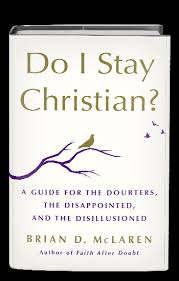
So I came across a book at the library: Do I Stay Christian? A Guide for the Doubters, the Disappointed, and the Disillusioned (St. Martin’s Essentials, 2022). It’s by Brian D. McLaren, who is described as “an American author, speaker, activist, public theologian and was a leading figure in the emerging church movement.” He’s a postmodern Christian, if you will, convinced the traditional Christian Church is, in some ways, failing Christians and arguing for a new and improved approach (the Emerging Church).
I’m not so much interested in the remedy as in the diagnosis. What does he (and those disappointed Christians he interacts with) think is wrong with the traditional Christian Church, whether Catholic, Protestant, or Evangelical? And does the same set of problems also concern disappointed or disillusioned LDS doubters? Maybe it’s not just we LDS but maybe all Christian churches that are suffering from (for lack of a better general term) a crisis of faith and confidence.
Recalling a dinner program where he heard a litany of complaints from various Christians, the author commented, “Latter-day Saints, Adventists, Unitarians, and many others have reached out to me about their similar spiritual frustrations in their unique contexts” (p. 3). So that’s a hint right up front that some LDS see the same sort of problems in our Church. Some specifics:
- At some point after college, McLaren said, “I discovered I had been given a whitewashed version of Christian history” (p. 5). Yup.
- Support for Trump: “No matter how many lies their candidate told, no matter how small-minded and vengeful he showed himself to be …” etc., “white Christians, especially Evangelicals, stood by him” (p. 6-7). Yup. And he wrote that in 2022. It’s gotten worse.
- “I was taught my religion’s historical upsides and few of its downsides, and I was taught about other religions’ historical downsides and few of their upsides. That’s a perfect recipe for creating ignorant and arrogant religious jerks” (p. 15).
I could go on, but let’s work with whitewashed history, Trumpism, and religious jerkism for now.
The author shifts to a more positive approach in the second half of the book, counseling repentance, which he describes as “soberly rethinking the past, facing it without minimizing it, … righting the wrongs, changing the systems that protected the wrongdoers,” and so forth. He concludes with: “We still have a chance at goodness and decency” (p. 126). There is hope. Try using that line in your next talk from the pulpit: “Brothers and sisters, we as a church have really screwed up the past few years. But we still have a chance at goodness and decency.”
But let’s get back to the original inquiry. Do the problems the author reviewed, at least the three I listed in the above bullet points, also compromise the LDS Church, at least for some members? Probably not the members sitting in the next pew, more likely the family that left five years ago, but still a relevant question.
So let’s kick it around.
- How much does correlated history (the Mormon term for whitewashed history) bother you? Of course, you don’t recognize that it’s whitewashed until you read some un-correlated history, so the question doesn’t even arise for most LDS. At this point, it doesn’t really bother cynical me as much. I expect all institutions (corporations, government, the military, churches) to lie about their history.
- How much does LDS Trumpism, aka the MAGAfication of about two-thirds of the American LDS Church active membership, bother you? It bothers me a lot. It’s a failure of LDS leadership (that just stood by and let it happen) and a failure of those individual members. It has made the Church a not very fun church to belong to. Can anyone, like anyone, still honestly say, “I’m proud to be a Mormon”?
- Does the phrase “ignorant and religious jerks” describe what has happened to any LDS you know who are under the spell of Trumpism? Honestly, there are a lot of really good people in the wards I have been familiar with. I’m sure it depends on what state or region you are in and what colored glasses you look at the world and the Church with. In the Age of Trump, is LDS religious jerkism on the rise on in decline?
- [Aside: It strikes that the past ten years and the next few will, collectively, be described as the Trump years rather than the Nelson and Oaks years in future LDS histories.]
Of course, you might take an entirely different view and say that it is edifying LDS history, not whitewashed history; that political views, even Trumpist ones, don’t really affect one’s religious faith and practice; and who is a religious jerk is a matter of perspective, maybe it’s just righteous people of faith trying to live thier religion who get called jerks.
.
 Wheat & Tares
Is it any wonder that people are leaving? While the world and our country are burning the church is concentrating on hair length at BYU and beards on temple workers. There appears to be little or no compassion emanating from the Q15, a situation I think would be different if we had women in authority. We are in need of less ‘Follow the Prophet and more ‘Jesus Loves Me’
David B.
Thanks for writing this and asking these questions. I don’t know where to start.
I quit attending church during COVID. We all did for a while and did Zoom, but when you could go back, I only did for a few meetings because the “lessons” I learned from COVID were not the lessons many members of my ward learned. I was actually pleased when Pres. Nelson talked about wearing masks and getting vaccines, but there was a faction in our ward that pushed back and said how it was taking away free agency, etc. Eventually, three “stalwart” members died of COVID, and a new Bishop was called, and he was one of the anti-maskers.
It was also frustrating because when there were lessons in Sunday School or Priesthood, if there was a question that could be answered in a way that opened up things to the wider world, I was “put” in my place with how it was either too political or what I pointed out didn’t apply to what they were talking about when it really did. It was just that I would mention Brown vs. Board of Education instead of the persecution of the saints in Missouri. History was not only watered down in the lesson, but it was also not applied to anything in the real world, even if the principles were the same.
Finally back to free agency. I thought that was one of the things the church was founded on, but more and more, whether from Leadership or LDS Politicians, a very authoritarian approach is pushed. In the Church, it’s about how many things seem top-down, with local leaders given very little latitude. It’s also because it’s so hard to push back or talk to someone who is higher than the ward or stake level. Then there is the what seems like the complete worship of Trump and his politics. He wants to restrict voting from a federal level, which is unconstitutional because it’s a state responsibility, and LDS Politicians jump in line to support him. Trump goes to war, lies about it, and LDS Politicians give him a pass. I could go on and on with examples from the State Legislature or how everyday common Mormons support these politicians, but it makes me sad to realize how much the church has changed from “The Glory of God is Intelligence,” or “Teach them correct principles and let them govern themselves,” to get in line and shut up.
Finally, all you have to do is drive the freeways in Utah to see the ignorant and religious jerks. It’s not only the excessive speeding (Utah has more speeders than every state except North Dakota), but also the number of gas-guzzling trucks jacked up to guzzle even more gas, and the sight of how many are parked in the church parking lots on Sunday. In a winter when Utah has had virtually no snow and record heat in March, we have a huge percentage of members who don’t believe there is a problem with climate change.
I miss the days in the church when there were road shows, or priesthood manuals where books like Gospel Doctrine or the Great Apostasy were the anchor of lessons instead of a curriculum written by an unseen and unknown pool of writers with set questions, quotes from LDS Prophets instead of the scriptures. I miss when you could go to the temple and not only do an endowment session, but also be able to eat with your friends inside the temple instead of going to some fast food place. Granted, change happens, but I don’t believe it’s always for the good and that sometimes we lose what we had at a cost.
I enjoyed this post. I too have Brian D. MacLaren’s book that you talked about. there is a lot more in that book than could be discussed here but I would encourage everyone to read that book.
“Correlated history” doesn’t bother me much, because I recognize it for its intended purpose. The analogy I like to give is the way that math and science are taught.
Consider physics. In middle school and high school level physics, they teach a version that is based on algebra, and you learn fairly simple formulas for motion. (For example, a falling object accelerates at -9.8m/s^2.) However, as you progress, if you keep studying physics, in college you learn calculus-based versions of the subject, where it’s more complicated, the equations are messier, and it’s a lot harder for people to handle. Under most circumstances, the calculus equations will simplify down the to algebra equations, but the calculus ones give a much fuller understanding of the subject.
Then, you continue studying even more, and you learn that not only are the calculus equations are themselves a simplification of the differential equation versions, but also that there are situations where the equations just don’t work (see also: Relativity), and you need a far more complicated version of the equations to describe and understand it. Again, those equations will simplify down to the calculus equations under most circumstances (which will then simplify to the algebra equations), but you lose a lot at each step along the way.