
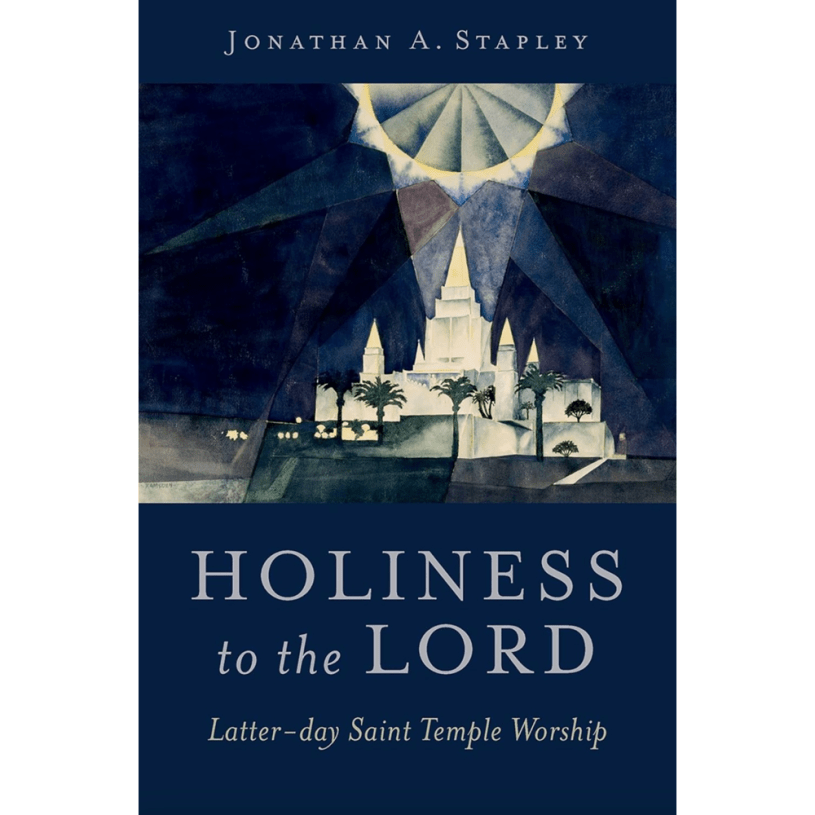
Let’s talk about Jonathon Stapley’s new book, Holiness to the Lord: Latter-day Saint Temple Worship (OUP, 2025). At the moment, it shows as 50% off at Amazon, but no guarantee that lasts. This book immediately becomes the most informative book available on LDS temples. It may be a little too much “info from a firehose” for a temple prep class participant, but the instructor definitely ought to read it, and so should you.
Here are some quick general comments, followed by a few quotations from the chapters.
The author relies on publicly available sources and various LDS documents for most of the material. Plus the author takes what you might call a friendly and supportive approach to the material, some of which will be new and sometimes rather surprising to the average LDS temple-goer. As a result, the book is going to be largely acceptable to the average LDS reader and even LDS leadership. Deseret Book carries the title. Here is one sentence from Deseret Book’s short blurb on the book: “While respecting the privacy of church members, Jonathan A. Stapley’s Holiness to the Lord provides an insightful, fresh overview of Latter-day Saints temple worship, including the initiatory washing and anointing rituals, the endowment ceremony, and relational sealings.“
Some W&T readers will, I suspect, think the author is too sympathetic to the material and the Church. For example, Stapley briefly discusses (p. 62-63) Joseph Smith’s appropriation of several features of Freemasonry rituals for his Nauvoo endowment presentation. The average reader is unlikely to grasp from the discussion how extensive and detailed the borrowings were.
Similarly, Stapley notes at several points the various revisions and changes to LDS temple rituals over the years, while also noting the Church’s reticence to acknowledge the changes and, when it does, to minimize them. This aspect of the LDS temple liturgy — making regular changes but also claiming nothing has really changed — really deserves a more detailed discussion. (See Chapter 5 for the longest discussion in the book.) A fair and accurate sentence would be this: “The LDS Church regularly changes features and details of the LDS temple presentation to make it more relevant and less offensive to modern LDS members who attend the temple while preserving the primary covenants associated with the temple rituals.” But you won’t ever get that statement from LDS officials. It’s too candid, even in the current moment when LDS leaders have warmed up to more open public discussion of most aspects of the LDS temple experience.
Let me emphasize, however, what a fine resource this book is. Not only does it give an accurate and relatively detailed discussion of most aspects of LDS temples and LDS temple worship as well as its history, it does so in a respectful manner that will not be off-putting to the average LDS reader. You can give this book to any LDS adult in your circle of family and friends and not worry about the response. To write such a book on any LDS topic is an accomplishment. To write such a book on LDS temples is almost unimaginable, but Stapley has pulled it off.
Here are a few quotations from the book.
The Introduction (p. 5) notes that during the first year of President McKay’s tenure, “the governing bodies of the church discussed the problem of people who had gone to the temple for the first time, had a disorienting experience, and in some cases left the church in consequence.” Even so, it took decades for the Church to produce [inadequate] temple prep materials. This is still a problem, but Stapley’s book fill that gap if used properly.
In Chapter One, “Walkthrough”: “Beginning in 2024 Church leaders also taught that garments were a ‘sacred symbol of Jesus Christ.'” (p. 23). Which highlights the difficulty LDS leaders have in talking about LDS temple changes. Did previous generations of LDS leaders not notice that LDS temple garments were a symbol of Jesus Christ? Or did LDS leaders in 2024 just decide to add more Jesus references to the LDS temple presentation? As I rather casually (but quite accurately) refer to the 2024 changes, “LDS Temples: Now with more Jesus!”
In Chapter Two, “Beginnings,” there is a discussion of the terms “seal” and “sealings.” In Christian usage from the Bible, a seal is a mark of authenticity. Think of the lawyerly phrase, “signed, sealed, and delivered.” LDS usage of the derivative term “sealing” has taken on a rather different meaning. As a noun, a “sealing” is an ordinance that ties people together, sort of a glue-like function. As a verb, to “seal” people is to perform that glue-like ordinance. Discussed at page 40 and elsewhere. It’s helpful for LDS to understand how LDS words mean different things to non-LDS folks. Understanding non-LDS meaning also helps inform the modified LDS meanings. See also, for example, the discussion of the changing meaning of the word “endowment” at page 51.
In Chapter Five, “Change,” at pages 76-78 is a discussion of how Brigham Young “systematized the endowment presentation,” sort of cleaning up and expanding what Joseph Smith first presented (“the Nauvoo endowment”). In particular, Brigham and his apostolic assistants “added the roles of Peter, James, and John.” They also modified the marriage sealing ceremony words to make women subordinate to men in the ordinance. This chapter makes very interesting reading.
A few quick ones in closing. Chapter Six talks about exaltation and the Second Anointing. Chapter Seven considers Race and the Temple, which emphasizes the temple restrictions and how they evolved, whereas most discussions of the topic focus on priesthood restrictions. Chapter Eight reviews funeral rites, which is a more interesting topic that you would first think and I suspect for most readers a more personal topic. Details surrounding preparation of the body, funeral arrangements, and burial can become tricky for LDS persons and families, the larger and more diverse the family, the trickier the decisions. This topic enters this book, of course, because Latter-day Saints who have gone through the temple are generally dressed in temple robes before burial. At the same time, as emotional as this process may be, it can be deeply meaningful and provide closure for family members whatever their relation to the Church. I have dedicated the graves of three family members in the last five years. That, and tossing flowers on the casket of the deceased as it is lowered into the grave, is the last service we can render them. Chapter Eight provides very helpful history and context for those involved with an LDS funeral and burial.
I have only scratched the surface of what is in the book. It deserves a careful reading.
As interesting as your comments would be, this is one of those rare occasions when I think I will let this post stand alone without comments. As always, I appreciate you taking the time to read my posts here at W&T and participate in discussions.
 Wheat & Tares