
Decades ago, my work group was involved with a company that did new-agey, borderline religious retreats designed to unblock our leadership skills by addressing things like emotional trauma, hard-coded beliefs and assumptions, and using activities like fasting and meditation to free our thinking. It was perhaps a little woo-woo, something that those outside of our work group might have raised an eyebrow about, but it was interesting and at times illuminating. In one session, we did a singing meditation that felt like endless torture to me. In another, we danced like whirling dervishes (turns out I had incredible dervish game and could switch direction and back without a misstep). We did a guided breathing meditation (kind of like doing math in a different base than ten, but with breathing) to experience rebirth (I think I fell asleep during this one). At one point, a participant at the seminar stood up and rebuked everyone as participating in Satanism and inviting demons into our bodies. He chose to leave rather than proceed. If some of the meditations seemed silly, they seemed far less silly than his declaration about demons, at least to me.
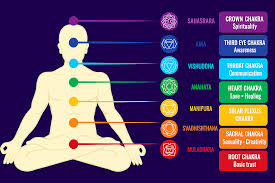
One activity that stuck with me was a Reiki massage. Reiki is a Japanese form of “energy” massage that is mostly scientifically debunked in which the practitioner’s hands hover over your body. Even though there was no physical contact during the massage, I experienced different physical sensations at different times. The “massage” was supposed to release the energy in the seven Chakras of the body:
- Root. This is located at the base of the spine and represents safety, security, family, material needs.
- Sacral. This is in the lower abdomen and is associated with pleasure, sexuality, creativity, and emotion.
- Solar Plexus. This is in the upper abdomen and represents personal power, boundaries, autonomy, confidence, will-power and control.
- Heart. Located in the center of the chest, it represents love, compassion, connection, forgiveness, empathy and grief.
- Throat. This is in the throat and is related to your ability to communicate, express yourself, speak your truth, be authentic and clear.
- Third Eye. This is in the space between the eyebrows, and represents insight, intuition, perceptiveness, imagination and discernment.
- Crown. This is the top of the head and is related to spirituality, meaning, transcendence, faith, higher awareness.
Now, if any of you has been to a yoga class, you are probably familiar with the ideas behind Chakras. These are ancient ideas in Indian spiritual traditions that reflect an embodied view of human life. It’s very common in Western culture to think of concept like spirituality and expression in a disembodied way, something that happens in the mind that is separate to the body. We think of the body as something to be mastered, not as an integral part of our lived experience. Chakras show how our feelings exist as energy in the body, that we feel in areas of the body. They are part of everything we experience, our thoughts, feelings, memories, desires, and processing.
Back to the Reiki massage. When the practitioner hovered over my heart, it suddenly felt like butterlies being released into the sky. At the throat, it felt like a blockage was gone and I could sing like a Patty LuPone (I didn’t, but I felt like I could, or like Alma when he said “O that I were an angel, and could have the wish of mine heart, that I might go forth and speak with the trump of God, with a voice to shake the earth”). On the third eye, it felt like a cool cloth had been lifted from my forehead and a prism was showing the world around me through all the different colors of the rainbow. On the crown, it was like when the skyscraper in Ghostbusters blows upward, leaving a big hole in the gathering clouds. So, whether it’s all BS or not, I at least imagined I felt those things, although my eyes were closed and covered, so I couldn’t even see what the practitioner was doing at a given time.
Here’s the weird part. When the massage ended, the practitioner and I discussed our shared experience. He said that the strangest thing was that on the solar plexus Chakra he felt nothing. No energy at all. It was like it was completely empty or blocked. There was nothing there. That kind of shook me a little bit, like I failed the test, but I also wasn’t really sure what that even meant. He asked me why I thought that might be, and I had to take it away to think about it. Was I dead inside? Did I literally have no idea what I wanted in life?
Later in life I learned that the Solar Plexus Chakra is the one most commonly associated with religious trauma. If you had said to me at that time, decades ago, that maybe I didn’t know what I wanted in life, how I personally felt about things, because I was in a high-demand religion, I would have said “No way. I make my own choices. Nobody is the boss of me.” But I might have also suspected deep down that it was a little more complicated than that.
These are the themes associated with the Solar Plexus Chakra that are linked to religious trauma:
- Loss of agency
- Fear of making independent decisions
- Shame about personal desires
- Obedience over self-trust
- Difficulty asserting boundaries
That’s because a high-demand religion (one that consists of rules and norms around behaviors and personal choice that are dictated by authority figures) emphasizes submissiveness, authority, and sin-consciousness. These are things that diminish your personal power and can be associated with conditioned feelings of shame as well as externalized moral authority. It’s moral, not because you believe it’s moral or because you know what your values are and live by them, but because the authority figure says it’s moral. Your job is to obey the authority figure and to justify their position to yourself and others, whether you believe it or not. In fact, that’s psychologically imperative particularly when you don’t believe it.
I have sometimes joked that menopause is particularly dangerous because as the hormones in your body shift, at some point this new radical idea pops into your head: “YOU matter.” Once that happens, you can’t go back to the way you were living before. That’s probably why the medical treatment for menopause up to a few hundred years ago was to burn her as a witch and marry a teenager.
I looked into the link between religious trauma and the other Chakras, and there are connections to several of them:
Throat. This could be fear of speaking doubts (doubt your doubts?), difficulty expressing anger, suppressing your authentic beliefs, fearing social rejection for questioning doctrine. People who experience this kind of religious trauma have learned silence, fear of confrontation, and social anxiety around dissent.
Heart. This can occur when someone has experienced conditional love (you are only good enough to be loved if you obey and/or believe), fear-based teachings about damnation, loss of community after leaving a religion, attachment wounds. They might experience difficulty trusting, guardedness around other people, confusion about unconditional love (due to lack of experience) or grief over lost relationships or social rejection.
Crown. This can manifest as existential dread or disorientation, loss of meaning in life, spiritual distrust, fear of divine retribution or identity collapse. People feel disconnected from a higher meaning, resulting in anxiety, cognitive stress as they restructure their understanding of their place in the universe, and identity reformation.
Root. This can occur if someone’s trauma is related to familial rejection, social shunning, financial instability or housing insecurity. A family that kicks out their LGBTQ child, for example, is creating this kind of trauma. A parent who withholds financial support based on the child’s remaining in the church is another example. The themes include survival instincts, fear of abandonment, loss of communal identity, and nervous system hypervigilance. This is extremely damaging to the individual.
To me the most interesting thing about Chakras is that they provide a contrast to the disembodied way we relate to the world in western culture, particularly western religions. Western culture either ignores the body or sees it as something to be tamed, disciplined or overcome. “The spirit is willing, but the flesh is weak.” This is a completely different approach from the Chakra framework. The body & spirit are working together to understand situations, other people, our own reactions, and our beliefs. In western culture, we sometimes imagine that beliefs reside outside of us and that we have to find the “right” ones and adopt them. It’s a completely different way of interpreting things. According to Chakras, authority is internal to you. The body not only keeps the score but it tells the truth. In Western thinking, authority usually resides outside of us or in institutions, clerical figures, or traditions. The body is not seen as a source of spiritual knowledge–it’s often viewed as unreliable, fallen, dangerous.
- Do you find that western religion feels disembodied or at odds with the physical body?
- Have you learned to understand your own physical reactions as a way to understand truth? Do you see this at odds with western culture or LDS teachings?
- Do you relate to any of these Chakras in terms of religious trauma?
Discuss.
 Wheat & Tares
The western medical establishment is finding more and more that trauma, especially childhood trauma, permanently changes people’s brain and body. It seems to even carry into the next few generations if the mother is severely stressed either as a child or while pregnant. The results of trauma showed up in the holocaust survivors in their grandchildren. Diabetes, miscarriages, polycystic ovaries, uterine fibroids, as well as a bunch of other diseases are much more common in child sexual abuse survivors.
Western religion puts all of its focus into healing those who go around causing trauma to others. Christianity’s primary focus is on sinners repenting and being forgiven. Whole point of the atonement Think about our own church’s reaction to the sinner, who must be redeemed, compared to the victims of sin, who gets ignored. The man who commits adultery is given all kinds of attention, sure there is some shame dumped in, but mostly he is given lots of love to help him through the repentance process. His wife is asked why she wasn’t good enough to satisfy her husband and told to forgive and forget or she is a worse sinner. Sweet, love the sinner and shame and shove the victim away. More shame is often dumped on the spouse than the sinner. Who was never forgiven for Bill Clinton’s inability to keep his pants zipped? Hillary. Former Prince Andrew’s daughters are banned from polite society and they did nothing wrong. Wonderful way of dealing with trauma. I had a friend once whose daughter was attacked in his home at night by a teen in the ward. The teen beat her and attempted to rape her. Well, the cops and an ambulance in the middle of the night, and this kid being taken away in handcuffs got the gossip in the ward going. But the kid was some important Republican’s son, and in two days they pleaded him down to breaking and entering. So, my friend’s bishop comes and tells him, “I need you to stand in fast and testimony meeting and say you forgive the teen.” His daughter suffered no *permanent physical* injuries, although she was treated in the hospital for injuries. So, everything was fine and the only problem is saving the teen’s father’s political career. My friend was essentially shamed into swallowing the trauma instead of dealing with it and pressured into a public display of “nothing happened” for the convenience of someone else in the ward. The bishop believed the kid would repent better if it was swept under the rug than if he was tried for the full crime. Well, gee, if the kid goes to prison then that bishop has no control of his repentance. There was of course no help from the ward for dealing with the trauma and nobody but him paid for the counseling his daughter needed. Victims sacrificed and abandoned for the comfort and well being of the sinner.
This form of retraumatizing victims of sin rather than supporting and comforting them is normal operating procedure for the church. And griping about it is a favorite soap box of mine.😉It isn’t the kind of religious trauma Hawkgirl was probably thinking about, but it is a common enough form of spiritual abuse that it kept coming up in support groups or individual counseling I was doing for battered women and adult victims of child sexual abuse that I ran as a social worker in Utah, where under half my clients were Mormon.
As far as chakras go, I am not much into new age woo-woo. It works on the placebo effect, and the fact that you can feel the slight warmth of their hands above you. I have been told it is a sugar pill, so it doesn’t much work for me. But I have a friend who is a trained reiki practitioner and I don’t tell her I think it is all woo-woo and placebo, because she believes.
This is really interesting. I had to relearn my connection to my body as part of my healing process, and also when I left the Church. Just something as simple as paying attention to when I was tired and allowing myself to rest was a new idea for me. Noticing how stress showed up in my body was educational.
For example, whenever I talked about taboo topics for the first time, I would get freezing cold and start trembling. Pretty sure my blood pressure was dropping during that stressful experience. I’d huddle into a coat and keep talking. Once I finished, I slowly warmed up again and could take the coat off. Also paying attention to anxiety attack symptoms — when I got breathless, I used to say it was because I was out of shape, even though I could get breathless while lying down. Now I know that’s the first indicator that I need to stop and pay attention to myself and my situation.
I’m largely unfamiliar with chakras. I have no problem with participating in woo-woo stuff and find it interesting. I don’t think it’s any more ridiculous than fasting and praying in hopes of getting guidance from the Holy Ghost. That’s gotten results for me too.
Makes me wonder if priesthood blessings have been scientifically debunked.
Chet: I mean, yes and no. There was a study done maybe 15 years ago about the efficacy of prayer (same vibes as your question) showing that the only way prayer / blessing / wishes made a difference was if the person knew about the prayer for them. If so, it had some slight benefits. If not, it had no benefit. Now, you could say that study shows the prayer roll is debunked (unless they know about being on it), or that it debunks all of it because it’s clearly a placebo effect.