
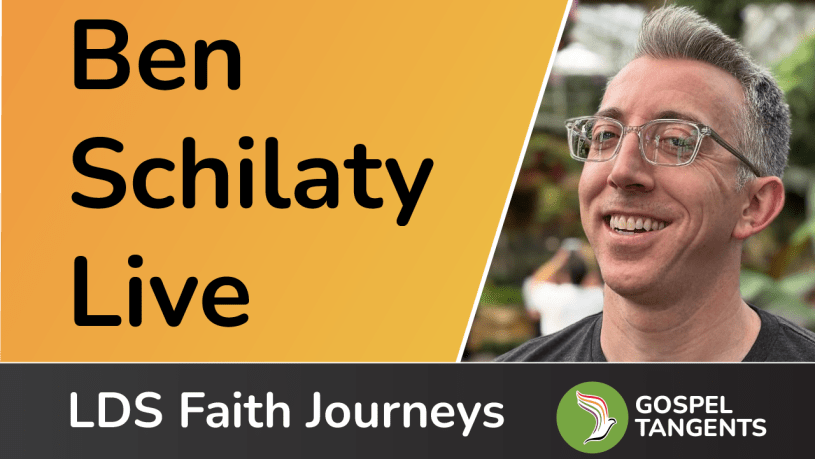
Ben Schilaty is a social work professor and author who discusses his life as a gay Latter-day Saint. He details his professional background, including his past role as a BYU Honor Code administrator and his current work with the Gather Conference. Schilaty shares his personal faith journey, explaining how he reconciles his sexual orientation with his commitment to the Church through prayer and personal revelation. He advocates for radical empathy and honoring the individual agency of LGBTQ members, whether they choose to stay in or leave the faith. Throughout the conversation, he emphasizes the importance of sincere listening and building supportive communities where diverse experiences are validated.
Ben Schilaty: Navigating Faith and Identity
Ben Schilaty is a professor of social work at Utah Valley University and author of A Walk in My Shoes. He shared a deeply personal look at his life as a gay Latter-day Saint. Schilaty, who humorously describes himself as “fame-ish” due to the parasocial relationships readers and listeners have formed with him, offers a unique perspective on the intersection of faith, identity, and belonging.
Journey of Three Stages
Ben describes his internal journey in three distinct phases. In his 20s, he felt “broken” and believed he needed to be “fixed” to fit the mold of a traditional Latter-day Saint marriage. In his early 30s, the pendulum swung, and he felt that if he couldn’t change, perhaps the Church had to change. Today, he focuses on “living in what is,” a practice of accepting reality as it is to find health and happiness.
A pivotal moment in this journey occurred when Ben nearly left the Church after a painful heartbreak. Despite his parents’ full support and their promise to honor his agency regardless of his choice, a prayerful encounter with Matthew 26 changed his path. Reflecting on Christ’s prayer in Gethsemane, Ben felt a “clear and very annoying prompting” that his “cup” was to live his life within the teachings of the Church—a choice that transformed his religious practice from a burden into something life-giving.
Behind the Scenes at BYU
Providing a rare look into his four years as an Honor Code administrator at BYU, Ben dispels common myths about the office. While many assume the office is preoccupied with “morality” or LGBTQ+ issues, Ben notes that same-sex romantic behavior reports were uncommon, occurring only about ten times a year. Instead, the vast majority of his work involved academic dishonesty, plagiarism, and timecard theft.
Building Bridges: The Gather Conference
Ben is a co-founder of the Gather conference, a Christ-centered support system for LGBTQ+ Latter-day Saints and their allies. He describes it as a “middle space” compared to other organizations like Affirmation or Northstar. Gather serves a diverse group—about 80-90% of whom are active in the Church—including those in same-sex marriages, those choosing celibacy, and parents or leaders seeking to understand their loved ones better.
Radical Acceptance and the Power of Story
A major theme of the discussion was radical acceptance and honoring the agency of others. Ben emphasizes that:
- Listening is a Christlike act: Allies should listen to and validate the pain of those who feel they must leave the Church for their mental health.
- Forgiveness brings peace: Ben shared a powerful story of inviting a former Stake President over for dinner to find personal peace after a disagreement regarding his temple recommend.
- Prescription for Revelation: He warns against using his story as a “blueprint” for others, noting that God speaks to us as individuals and we each have our own “prescription” for personal revelation.
Ben’s final invitation to the audience is simple: instead of just reading his book or listening to his podcast, invite the LGBTQ+ people in your own life to tell you their stories.
What do you think of Ben’s experience as an active, gay Latter-day Saint?
 Wheat & Tares
The simple fact that Mr. Schilaty no longer has a place at BYU tells you everything you need to know. With all due respect to UVU, Schilaty belongs at BYU. He has the faith and experience as a gay Latter-Day-Saint required to be a real asset to the Church’s flagship institution. And yet, BYU lost him to UVU. This is the equivalent of losing Jimmer to UVU’s basketball team.
Maybe the CES thinks there are no gay students at BYU (shout out to Bednar). Or maybe BYU admin thinks gay students at BYU are thriving. Who knows what they think? But BYU needs someone with Ben Schilaty’s background to accommodate real world issues that many students face in Provo. It’s crazy that they once had him but now he’s across town in Orem: UVU 1, BYU 0.
I think it is a PR loss for BYU.
Honestly, after talking with Ben, working in the Honor Code office was a bit of a dead-end job. He definitely needed something better career-wise. It’s a little sad BYU couldn’t find a place for him in the Social Work dept, and that is definitely a gain for UVU, but it would be a gain for any university to have him.
That’s so true! As a BYU alum I’m embarrassed at what BYU has become.
Having Schilaty in charge of the BYU Honor Code office was an untenable, no-win situation for him. To the BYU (and LDS Church) higher-ups, he was a token hire, chosen to show off the organization’s supposed tolerance and assuage their collective homophobic guilt, while still quietly “firing muskets”, targeting and punishing LGBTQ+ students, faculty and allies (and using Schilaty himself as the primary instrument of these policies, giving themselves a layer of deniability). To LGBTQ+ students and allies, he was viewed as the gay equivalent of an Uncle Tom, weaponizing his self-loathing against his own community, being complicit in upholding BYU’s reputation as one of the most queer-unfriendly post-secondary institutions in America. These are only perceptions, however, and I don’t think they are entirely true, but I’m not really sure what his motivations were when he accepted that job. BYU has long had an unwritten policy of dealing with gays by either kicking them out or stuffing them back into the closet, so maybe he was trying to change that, but it’s not clear. I haven’t watched the interview or read his book, so I also don’t know what his reasons were for leaving, but that could be telling.
Moreover, I would like to know how he reacted to the Holland “musket fire” speech, as well as the Clark Gilbert whiplash clampdown on public same-sex expressions of affection. Didn’t those events happen during Schilaty’s time at BYU?
Whatever the case, I wish him well and hope he’s living his best life now.
While the no alcohol, no sex policies at BYU get the most publicity, Ben said he spent most of his time the same as at most other universities: students cheating on tests, plagizing, improper use of ChatGPT, and time card theft, same as at most universities. He said most people last in the job 3-5 years, and he was there for 4 years. I would think working with students during their worst moments would be a drag after a while, and it was. He is much better at UVU teaching social work and providing therapy to a few students than the monotonous job of dealing with cheating, plagairism etc. He indicated that would be a rough, not fun job at any university. He said that was his main reason for leaving BYU.
Yes, it was a gift for BYU to have a gay person in such a high profile position, and it was likely his first job in academia (which are frankly hard to come by), his moving on was much better for his overall career.
We did talk about his reactions to Clark Gilbert, but not exactly the question you asked. He has mixed feelings.
@Jack Hughes: “Moreover, I would like to know how he reacted to the Holland “musket fire” speech,” — Season 2, Episode 4 of his Questions from the Closet/All Out in the Open podcast issued the day after said speech.
As for the 2020 shifts in policy, Ben and Charlie were just starting their podcast, and I don’t recall if they reacted in real time to those changes. I suspect that, if you browse their podcast, you can find some reaction to the questions around same sex romantic/dating type behaviors. Ben has talked about some of his decisions to date or not date as those decisions have come up, and I’m fairly sure that some of their guests have also talked about their experience with dating or not dating.
I appreciate Ben being willing to be so public about his experience. His is only one of the many different kinds of experiences that LGBTQ+ people have in the church, and there is value in recognizing that his experience is his alone and not some kind of hope that all LGBTQ+ LDS can have a similar experience. But it is nice to hear of his experience.