
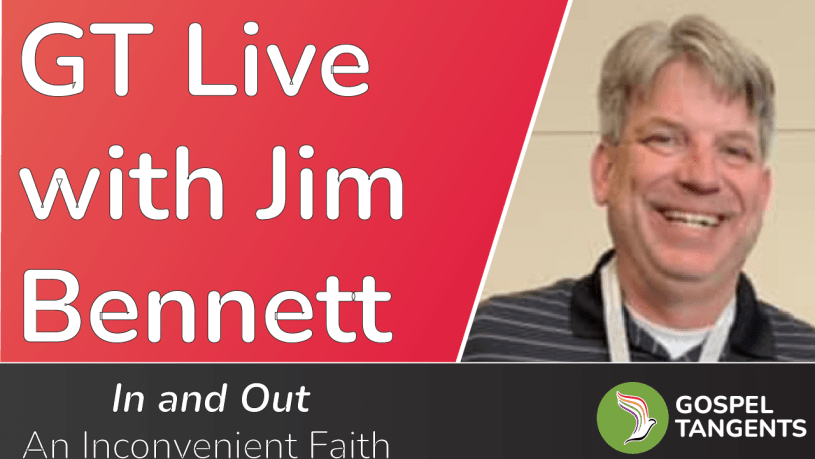
Jim Bennett’s idea for sustainable and honest faith includes a theological argument that recognizing the fallibility of religious leaders is not just a mistake to be acknowledged, but a central purpose of mortality and the plan of salvation. He suggests that a sustainable faith must be rooted in truth rather than the “demigod” status often assigned to prophets. Jim is the host of Inside Out where he discusses faith with Ian Wilks, someone on the outside of the LDS Church.
Jim Bennett is a podcast host, former political candidate, and descendant of prominent leaders in the Church of Jesus Christ of Latter-day Saints. His personal and family history is deeply intertwined with Utah’s religious and political landscape, which serves as the foundation for his current work in faith reconciliation and political centrism.
Family and Political Background
The Bennett family history in Utah began with Jim’s great-great-grandfather, Richard Bennett, who traveled to Utah but initially refused to join the Church. After a fire destroyed his savings, he famously clashed with Brigham Young and chose to settle in Salt Lake City rather than Bear Lake. His son, John F. Bennett, eventually joined the Church and founded the Bennett Glass and Paint Company.
Jim comes from a long line of Republican politicians; his grandfather, Wallace Bennett, and his father, Bob Bennett, both served as U.S. Senators from Utah. Jim ran his father’s final campaign in 2010, which was marked by controversy over the TARP vote and resulted in a loss. This experience, combined with a dissatisfaction with the changing Republican Party, led him to co-found the United Utah Party, a centrist third party. He later ran for Congress and for Mayor of Sandy as a centrist candidate.
Faith and Religious Work
Jim is widely known within the LDS community for his line-by-line reply to the “CES Letter,” a document outlining various criticisms of Church history and doctrine. His response, which has been downloaded over 200,000 times, focuses on building a “sustainable faith” by acknowledging difficult issues rather than dismissing them.
He hosts the “Inside Out” podcast with Ian Wilks, a former member of the Church. The podcast aims to facilitate productive dialogue between faithful members and those who have left, avoiding the polarization often found in religious discourse. Jim was also a producer for the docuseries “An Inconvenient Faith,” which explores how individuals maintain their faith while confronting challenging aspects of Church history.
Key Philosophies
A central theme of Jim’s work is the concept of prophetic fallibility. He argues that viewing prophets as infallible “demigods” creates an unsustainable faith; instead, he believes the “central purpose of mortality” is to learn from mistakes. He asserts that:
- Trust over certainty: The current “faith crisis” many experience is actually a trust crisis caused by the institution’s perceived lack of transparency regarding its history.
- Honesty as a solution: He believes the Church would be healthier if it publicly apologized for past mistakes, such as the priesthood ban, to build long-term trust.
- Inclusivity: He advocates for a broader “big tent” approach to Mormonism, arguing that members should not be excommunicated for holding unorthodox views, such as polygamy skepticism/revisionism, as long as they remain committed to their covenants.
Jim is also a member of the Tabernacle Choir at Temple Square and continues to engage in online discourse, despite facing significant harassment from both critics and orthodox members on social media platforms.
What are your thoughts on Jim’s perspective? Have you visited LDS Faith Journeys? Care to share your journey? What advice do you have for others to maintain their faith in a crisis? Is it really a trust crisis?
Don’t miss our other faith journeys: https://gospeltangents.com/tag/lds-faith-journeys/
 Wheat & Tares
I’ve listened to a few of Jim’s podcasts and he was on Mormon Stories. I applaud his efforts, but see them as basically “out of harmony with the brethren”, as they would term it, unless the LDS Church takes a turn towards being more like the Community of Christ, which I don’t see happening. I hope he doesn’t get excommunicated. Probably he won’t unless he takes a more strident tack because he comes from a prominent family.
A couple thoughts from reading the article and listening to the longer podcast:
1. While I agree with Jim that a church that is willing to be honest about its mistakes is more trustworthy than a church that hides its mistakes, presents a false and unsustainable veneer of perfection, demagoguery, etc., I think the problem is precisely that people were sold on a perfect institution. I get that Jim and other people have accepted for themselves that an imperfect institution is still worthwhile, but for people who were sold “one and only true…” etc., this is a let down.
The question is: how many conversions etc., could they get for “a problematic institution stumbling around together” vs “the one and only true…”
Secondly, and relatedly, I think most exmormons would accept that even if the church wasn’t true, they’d be OK if it were good…but the problem is a lot of the things in past and present just reveal that it’s not good. Like, Joseph Smith doesn’t have to be a perfect person. But the details of polygamy do not support that he even is a *good* person. I think most people want to have some sort of minimal threshold of goodness before they will follow someone. (I get the argument “isn’t it incredible that God can work with imperfect people” but…again…this isn’t just minor mistakes. These are huge flaws of character that then get promulgated as doctrines and practices that define the instituion.)
2. While I am inclined to agree with Jim that every person’s Mormonism is personalized (so the accusation that Jim is teaching “Jim Bennett Mormonism” can be met with, “Of course!”), I don’t think this captures the underlying thrust of the complaint. Mormonism is a religion where we are to live in community with other people. Part of living in community with others includes standards for communication, making sure we are seen and heard and understood by others.
If someone goes into a temple recommend interview, they may be OK answering the questions for themselves, but part of living in community is understanding one’s interlocutor, understanding how they would interpret a response, and understanding if that is congruent with what one intended to communicate. If someone answers “Yes” to a temple recommend question because of one’s personal understanding but knows the Bishop or Stake President had a very different interpretation in mind for themselves, then it’s easy to understand why people would feel that this is dishonest. At the very least, they are not been seen or heard or understood in their reactions.
These sorts of things can and often do come up in other ways.
Gebanks, I would be surprised if Jim was disciplined in any way. He does seem to know where the lines are and where not to cross them.
Andrew, I always love hearing your perspective. Would you be willing to be a guest sometime?
Andrew –
Pete Enns, in his book Curveball, describes the thousands of moments when life refuses to cooperate with the beliefs we were handed. He captures these moments in a simple phrase: “and then something happens.” These disruptions—if we are awake to them—are profoundly destabilizing. They invariably press a choice upon us:
Double down on the old beliefs, bury our heads in the sand, and treat life itself as the deceiver.
Let our previous beliefs be circumscribed by a story large enough to hold our actual experience.
Within franchised religion, the second path is often nearly impossible. The dilemmas people face are either not shared, not welcomed, or subtly treated as threats. Honest questioning is interpreted as disloyalty rather than growth.
It’s no surprise, then, that the rise of the “nones” over the past twenty years can be understood as a natural response—a collective correction to religion gone awry. If a religious tradition cannot repent, adapt, or evolve, it follows the same trajectory as any organism that refuses to change: extinction. It dies a quiet death of unawareness, clearing space for new forms of meaning and community to emerge.
This dynamic is especially evident in the Church of Jesus Christ of Latter-day Saints context. The tradition has painted itself into doctrinal and institutional corners—making claims that strain credibility, offering answers to questions it isn’t equipped to resolve, and promising things it cannot deliver. The result is a widening gap between lived reality and institutional narrative.
By contrast, the Twelve Steps of Alcoholics Anonymous begin with a much humbler premise: honesty. Whatever anyone thinks of AA, it recognizes that meaningful change starts with truth-telling—about ourselves, our limitations, and the gap between who we are and who we hope to be. Ironically, in religious communities that claim to seek truth above all else, truth-telling often becomes the hardest thing to do. Yet honesty is the foundation of trust, and trust is what holds community together.
If religion is to remain a living, life-giving force, it must rediscover this kind of honesty. Without it, the path toward irrelevance is already laid. With it, the possibility of renewal—and of a larger, truer faith—remains open.
Rick,
I’m pretty sure i would be of interest to 0 people and would get 0 views, but sure!
Todd,
While I haven’t read Peter Enns directly, everything I have heard *about* his books suggests that he’s on to something, so I probably should get around to one of them.
I was going to say, “Yes, there are opportunities for life events to break belief open into something more expansive, but religious institutions do not typically support this path”
Buuuuut then you already got there in your own comment. I completely agree that:
My fear — and I’ve heard this discussed by numerous people — is that religions always move from charismatic, honest beginnings to ossified, institution-preserving bureaucracies. Think “The routinization of charisma” from a sociological perspective. Another metaphor I’ve heard from William James is the “original eruption” or “living volcano” of religious experience and the second-hand “hardened rock” of the institutions that develop after. The key point in either of these metaphors is that the hardening of the rock, while lamentable in one sense, is *necessary*. Institutions need some form of stability and rigidity. It’s just doing something *different* than the original revelation is doing. Certainly, there is always room for another person to have another volcanic burst of revelation, but even then, the cycle will continue with the lava cooling to rock and an institution forming.
In past articles, I have discussed and hypothesized that the people who are able to “stay long term” with beliefs that differ from what the institution or community is trying to enforce must have an independent source of energy to fuel them (where the institution and community may or cannot) and a sense of calling to do so. That is to say, it’s one thing for Jim to practice “Jim Bennett Mormonism,” but he has to have the source of energy to be able to deal with people telling him every day that he is wrong, apostate, etc., and still be confident and comfortable within himself to continue persisting in such an environment. I got the sense from near the end of the podcast that when it comes to some of his hecklers on social media, he just doesn’t have the patience for that, and so he has blocked some people as a result.
My thought is that for many people, *the church itself* feels like that. *Their ward itself* feels like that. So, leaving or disengaging is their equivalent to blocking people on Twitter/X.
Andrew S.,
Re: William James quote: that pattern is found in the Book of Mormon–with the radical departure of Lehi from Jerusalem followed by a thousand years of the prophets trying to keep the people in the church.
Laconically perceptive.
“He suggests that a sustainable faith must be rooted in truth rather than the “demigod” status often assigned to prophets.”
As part of rooting our faith in the truth we must understand that light and truth–the Word–is a living thing. And that nothing is more important than receiving the portion of light and truth that is measured for the sacred now. And anything that is more or less than this is not from above.
Part of the Old Testament is just how fallible prophets and institutions are. That theme is interlaced throughout the entire collection of books.
Too bad we somehow seem to miss that message.
I enjoy the Inside Out podcast. I wish the livestreams would be uploaded onto the podcast as well. It’s the wrong time of the day (well night, on this side of the Atlantic), and would be easier listening as a podcast rather than having to sit down and watch on YouTube, so I only view the ones I have a very particular interest in seeing, once the livestream is over.
Andrew:
Charismatic beginnings of Mormonism- yes! But honest?? Not so much!
i.e. “Lying for the Lord”, which is still practiced!
And charismatic to ossified,
institution preserving bureaucracies- absolutely!