
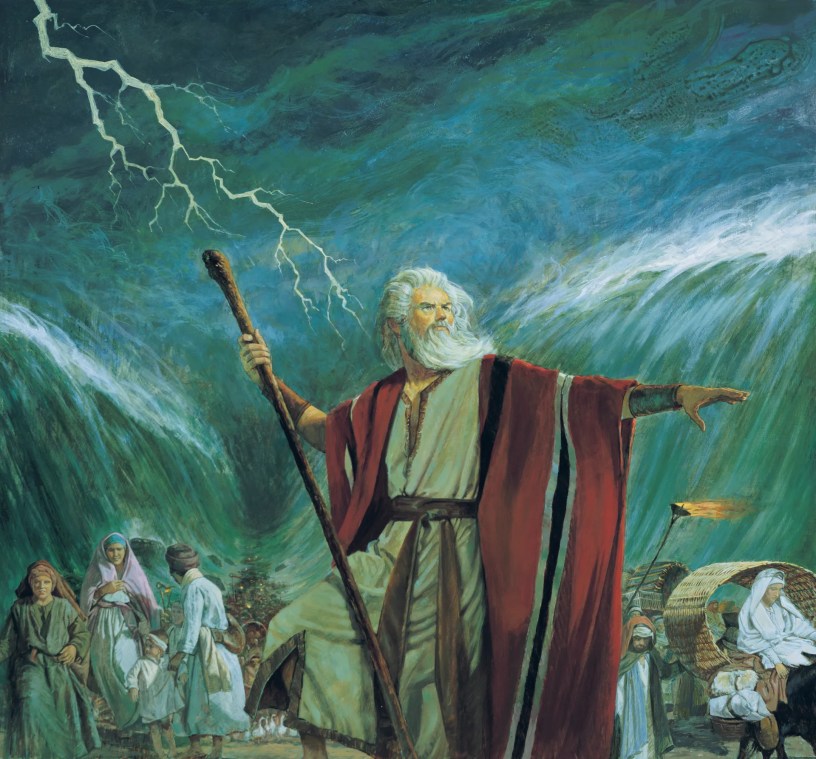
Following the pattern of my prior post LDS Genesis, let’s take a look at Exodus. I know, the LDS Come Follow Me curriculum won’t get to Exodus until March and April, but that’s not my fault. The lesson for March 23-29 covers the first six chapters of Exodus and devotes just two sentences to the actual material in those chapters: “The invitation to live in Egypt saved Jacob’s family. But after hundreds of years, their descendants were enslaved and terrorized by a new pharaoh who “knew not Joseph” (Exodus 1:8).”
The balance of the lesson applies “liken unto us” thinking to the material, such as asking: “You might wonder, “Does God know what I’m going through? Can He hear my pleas for help?”” There’s no real engagement with the text. What’s really funny (that is, not funny at all) is that the section titled “Ideas for Teaching Children” presents more or less the same discussion and prompts as the “Ideas for Learning at Home and Church” section does. In other words, LDS adults get basically the same lesson as Primary children. The LDS curriculum treats adults like children. That’s why anyone who really wants to learn anything about the Bible reads non-LDS scholarship. LDS Bible scholarship (at least what is presented in the LDS curriculum and from LDS leadership) is largely worthless.
So here’s some adult-level material, pulled from a few pages in the Alex Douglas book The Old Testament for Latter-day Saints (Signature Books, 2023).
Among the few authentic aspects of the [Exodus] story seem to be the fact that the names of Moses, Aaron, and Phineas are indeed Egyptian in origin, but evidence for the historicity of the narrative beyond these few indications is decidedly sparse. (p. 34)
The evidence that has led scholars to this conclusion (questioning the historicity of the Exodus narrative) is largely archeological.
Even more problematic is the lack of Egyptian influence in Israel’s culture. Archeologists can tell a lot about a people from their material culture …. When the evidence of Israelite settlements starts appearing in Canaan, their material culture shows no Egyptian influence whatsoever. It does, however, show extensive influence from Israel’s Canaanite neighbors. … Consider how improbable the claim is that a group of Israelites lived among the Egyptians for 400 years without any discernable impact on their language and culture. (p. 34-35)
For a longer discussion of how archeology has informed the study of Israelite origins, read Dever’s Who Were the Early Israelites and Where did they come from? (William B. Eerdmans, 2003) or similar books. The bottom line is this: there might have been a few stragglers, escaped slaves perhaps, that wandered from Egypt to Canaan and ended up in Israelite villages, but there was no mass exodus of a distinct Israelite nation or ethnic group from Egypt that then settled in the hill country that came to be later Israel (Samaria) and Judah. The Isrealites were basically just Canaanites who moved into the hills.
Now I wouldn’t argue for putting five paragraphs about the non-historicity of the biblical Exodus narrative in an LDS lesson. People don’t come to church for a graduate seminar on authentic biblical archeology. On the other hand, you can’t write a modern curriculum on the Bible or Exodus in complete ignorance of reliable scholarship, either, any more than you can write a modern astronomy curriculum quoting Ptolemy and taking the idea of the Sun and planets as embedded in crystalline spheres encircling the Earth as the basic model.
Maybe the best approach is to bring up the idea of genre when teaching this material. History in the sense of a factually accurate narrative using reliable sources is a modern genre, and to impose that genre on early biblical narratives is terribly misleading. Call it myth, legend, story, didactic narrative, whatever, but don’t call it history as if it is an inerrant factual recitation of actual events. We’re not Evangelicals. Mormons don’t take biblical inerrancy as an article of faith, despite what the LDS curriculum often implicitly implies.
So what do you think?
- Have you seen the movie? I mean The Ten Commandments with Charlton Heston, of course, which is where most people get their ideas about Exodus rather than from the actual text of the Book of Exodus.
- Have you ever spent more than a day or two in a desert? How about forty years?
- If we can learn moral lessons from parables while understanding and accepting that they are not historical accounts, why is it so difficult to take the same approach to early biblical narratives like the Exodus?
- Some people just don’t want to be bothered with archeology and serious history, call it the ignorance is bliss crowd. Then there is the smaller “I want the real history, warts and all” group. Which are you? Why do some people prefer the ugly facts of history to pleasant, reassuring fables?
 Wheat & Tares
I’m certainly not one for biblical inerrancy. I like the history aspects. My wife showed me a documentary – I’m not sure exactly what was called [but looking online for it it might be Pattern of Evidence] – that did bring up plausible explanations for Exodus. Timelines don’t line up perfectly, but it takes a similar approach to Book of Mormon archeological explanations. Similar to how we can talk about how Lehi’s decedents were really a small band in a larger population, it went over things like how Egypt went through a series of being unified vs ununified and a small kingdom ruler would have called himself pharoh, and how from the Israelites point of view they would have called that small kingdom Egypt, etc, etc. Stuff that made the story less grand. No one who has graduated from high school should be too surprised by the idea that the losers in the Exodus wouldn’t feel like documenting their loss, while the winners probably exaggerated their victory. Also, as you study more archeology you first appreciate how much has been found, but then realize how much is missing. So the lack of archeological evidence doesn’t actually prove much.
But I as much as I would like Gospel Doctrine to be a history class, I know that that is not what it is for.
Oh, oh oh, pet subject. Warning, I love stuff like this and tend to blab.
I like to know real history, then I can appreciate the national rah, rah, mythology as fable without being confused by facts. By separating history and archeology from nation building propaganda we can analyze the nation building myths for what they are. It is like I like pizza and I like ice cream, but I don’t like them stirred together.
So, first the nation building mythology, there is a purpose for it. America has its nation building mythology that we confuse as history too. Take our national hero Paul Revere. Nope. That poem of the midnight ride is not history. Fact check it and you find that the hero didn’t get far and it was actually some nobody who continued to warn the colonist. Paul Revere was the stupid who got himself anrrested, while somebody whose name I sure can’t remember anctually went on to warn people. And he didn’t yell, “the British are coming!” Because the colonists were British colonists. That is like warning people today that ICE is in the neighborhood by yelling, “the Americans are coming!” No, you yell something people would understand as an attack, maybe, “King Charles’ soldiers just landed.” Or, “an army is coming.” The colonists still considered themselves as British subjects so, at that point, the warning needed to be something else.
But when the poem was written, not too many years later we were telling ourselves we were no longer British. We needed a new identity, so we “us and them”ed things so the Americans were now us and the British were now them. It helped us establish a national identity. We were no longer British, but Americans. The poem helped by having our hero “other” the British fresh off the boat from colonists “us” by yelling something that was actually an acronym.
Understanding that poem as nation building propaganda helps you see it for what it is. We needed to pull together as United States by uniting into one identity. Before we were just a bunch of colonies, with separate identities and separate governments. To unite into one nation, we needed to change our thinking from “British colonists” to “American” and actually unite into states. That stupid poem we all had to memorize (at least boomers did) helped us do that.
The USSR failed to make up stories that united them into a nation. So, it didn’t survive a governmental crisis. As soon as the government weakened, the separate states split.
England’s nation building myth is King Arther who united the smaller kingdoms into one, but there is a lot in that story that is false too.
We barely survived our Civil war, because some people still felt loyal to their state rather than the nation. Robert E Lee being an example of loyal to state rather than nation.
So, the Israelites needed stories to form several tribes into one nation, probably under King David. That is the first of the Bible that is proven archaeologically. So, they used stories that maybe had some truth and turned them into nation building myths.
Not only is Gospel Doctrine not a history class, it also is not a scriptures class. I wish it were much more the latter. In my ward, there are too many Sundays where we read/discuss no verses of scripture, and too often we might quote only one, not to learn anything from the scriptures, but to launch into a sharing discussion. How do you feel when… When did the Spirit… Nothing meaningful, nothing substantive. The quality of instruction is terrible. If we can teach people how to read the scriptures, they can figure out the doctrine most of the time.
In reading the post and thinking about the themes being considered, I want to a theme a theme that new testament scholar Bart D. Ehrman pursued in his final lecture he gave upon retiring from UNC Chapel Hill in December. he posited that many of the stories in the bible, The two creation stores and the Jesus birth naratives for example tend to read and studied and fussed over in a vain attempt to harmonize these stories. what readers lose sight of is what was the story that the people who composed those stories was trying to tell. Many people, Latter-day Saints included tend to try to the prove the historicity of those stories Exodus included tend to lose sight of what those stories meant to the to people to whom the stories werr told and retold over the passage of time.
I agree that we should tell the stories, and engage more with the text. Sometimes, very short phrases, just one or a few words and little details, can be very meaningful. When a person learns the stories, he or she can often find real meaning (doctrine?) and the Holy Ghost has something to work with when inspiration is needed — but if a person never learns the underlying story, his or her understanding of the doctrine becomes rigid and well, dogmatic — then, the focus is on the dogma rather than the story, and the scripture is largely irrelevant, and there is little material for the Holy Ghost to work with.
I wish teachers would tell the stories rather than expound the doctrine.
My sister is currently in divinity school at Duke–for fun. She decided to go after a faith crisis to try and gain an understanding of all the questions peoples have had over the generations about God and how different peoples have understood God and his operation. It’s been interesting to listen to her experience because many of her fellow classmates come from religious traditions where their pastors would get very angry with them for learning the historical realities. It appears at Duke, they are able to meld historicity and faithful perspectives and make them all work together to enrich overall understanding more than they would be separately. That honestly makes one approach the text with a lot less fear, because you can explore meaning and understanding while also keeping in mind that this is just a story. My sister has been fascinated with levels of meaning available when allowing all perspectives and understanding in the door. I guess Job was particularly interesting.
That all being said, my sister related that one of the professors proclaimed that as these students went on to become pastoral leaders, they should never use scholarship to destroy faith (something like that)–that in a church setting, faith maintenance was the priority as that is why they are there. I have to admit, I was a little bugged by that, but I can possibly also understand it. Losing one’s faith framework is quite a difficult ordeal. But, having gone (still going) through a faith transition, I guess I care more about what is real while trying to maintain a posture of epistemic humility. If God is real and wants a relationship for me, he will present to me, not just through some middleman or text written to people so long ago I can’t even relate to them on mostly any level. I think what stops the LDS people from truly digging is that we are so focused on defending our restoration narrative. There is no allowance for anything else. Everything must tie back to the restoration, JS, true church or current prophets somehow. Just look at how CFM frames everything. Most of the posed questions in the curriculum aren’t getting you to seek real inspiration and meaning, they are just motivated to lead you to a certain conclusion. We’ve also enmeshed these literal interpretations into our history and narrative and to untangle that would risk destroying our story and justification for being. So rather than approaching the texts on their own terms, we have wrest them because we must for our story and continued existence to be justified in our own eyes. It enables that continued euphoria of feeling special, peculiar, chosen, etc. I think it would prove much more enriching to approach these texts on their own terms. It isn’t just about wanting real history, these texts are trying to say something and when we get the restoration out of way, what message did these authors mean to convey. Pete Enns has suggested that we treat the whole Bible as wisdom text–a text that is not authoritative on what is and isn’t (historically, morally, etc), but rather a voice in that conversation. I think there is a way to hold ugly facts and reassuring fables together in a way that is enriching as both have things to tell us.
However for me, I’m still in the distrusting phase. Ugly facts aren’t soul filling, but it’s all I’ve got right now.
Well, I wish teachers would spend a little more time telling the stories and a little less time expounding the doctrine. Like Georgis above, I have been in too many Sunday School classes where we don’t read even a single verse from the scripture during the entire lesson.
chrisdrobison, I appreciate your comment. A few thoughts–
“…they should never use scholarship to destroy faith…”
I agree with this.
“…If God is real and wants a relationship for me, he will present to me, not just through some middleman or text written to people so long ago I can’t even relate to them on mostly any level…”
I believe God is real, and that he uses scripture — the Holy Ghost works through scripture. That is why I treasure the scripture and the stories in the scripture. I also treasure my own learnings from the Holy Ghost as I engage with the scripture, knowing that my learning may differ from that of someone else in the class with me.
“…I think what stops the LDS people from truly digging is that we are so focused on defending our restoration narrative. There is no allowance for anything else. Everything must tie back to the restoration, JS, true church or current prophets somehow…”
Ding, ding, ding! And every time we prove or insist that we are right, we also prove or insist that everyone else is wrong. We don’t need to continually prove or insist that we are right. And, we can allow for the Holy Ghost to share somewhat different messages (nuanced messages?) with different persons in our classes.
“…I think it would prove much more enriching to approach these texts on their own terms…”
Amen.
Dr Freidman’s “The Exodus” does a great job of mixing archeology with a faithful reading. There’s ton about his thoughts on Youtube if you’re short on time.
I’ve always liked the idea that it’s basically the same as Thanksgiving where millions of Americans who had no direct lineage to the early pioneers still gather to celebrate an adopted national story.
It is interesting to compare Mormon superstitions about Moses and the book of Exodus with academic, evidence-based beliefs.
Despite Mormon claims that Moses was a real prophet and Israel was delivered by God, no clear evidence for a large-scale Exodus exists. Most scholars think the story is not literal.
Mormons cling to their claims that Moses was a real prophet who talked with God. Empirical evidence suggests Moses was either a composite or simply a Jewish legend.
Mormon ‘scholars’ stick to their worn-out arguments that absence of evidence does not equal evidence of absence. This even though extensive surveys show that there are no signs of millions of Israelites in the Sinai, and Canaanite culture developed internally, not via invasion.
Exodus is basically theology expressed through narrative. Contrary to the tenets of Mormonism, Exodus is not history interpreted through revelation.
When we were travelling in Egypt a few years ago, our guide in the Cairo Museum asked if we knew the story of the Israelites and the Exodus from Egypt. We said we did, and we clearly knew a lot more about it than she did. She took us to the upper level of this huge museum, past many displays, and wedged in between much larger, more impressive, more important artifacts, she stopped us in front of a black obsidian slab full of hieroglyphic writing. At the very bottom of these closely written, small characters was one word that scholars think *might* refer to Israel in a long list of other people that were enslaved by Egyptian warriors. That is the only Egyptian reference to the Israelites. (The Merneptah Stele)
To piggyback on Anna’s comment, I had a British roommate in college. I once teased her that they must have hated losing the US in the revolutionary war, because I was curious how they taught about it in schools there. She said they had so many colonies, that it was no big deal. There were many more, and the US was just one of many, or so she said. Obviously that’s not how we tell the tale. I guess from a British perspective, though, they still got the US as a key ally, so maybe it doesn’t really matter whether or not we were under British rule.
Hawkgrrrl:
They say that victors write history, but you brought up an important point. Maybe losers do too if they can escape or rebel and start over. It also reminds me that, even today, we are living history and choosing who will tell it.
I’ve felt that way for years. We should not teach historicity about the Bible, especially the Old Testament. The emphasis should be first part 8th Article of Faith and lessons to learn from stories. Dan McClellan has it right, among others. Good short analysis and thoughts. Thank you.
When you dig a little, it is really easy to see why Church leaders don’t encourage members to dig into biblical scholarship. Moses and the Exodus are a great case in point. Despite much modern scholarship which casts doubt on Moses and the Exodus are presented in the Bible, openly presenting this idea of Church members would produce a lot of cognitive dissonance. A quick search reveals a number of references to Moses and the Exodus from Mormon scripture:
1. D&C 110:11: “After this vision closed, the heavens were again opened unto us; and Moses appeared before us, and committed unto us the keys of the gathering of Israel from the four parts of the earth, and the leading of the ten tribes from the land of the north.” Joseph Smith claimed to have seen Moses in the Kirtland Temple in 1836. Furthermore, Moses is apparently the holder of certain important priesthood keys, which he transferred to Joseph Smith and Oliver Cowdery, and that presumably are now wielded by Dallin Oaks.
2. The Book of Moses (PoGP): The PoGP contains the “Book of Moses,” which is presented as a revelation given to Moses by God on a mountain. Everything in the Book of Moses — from the creation account to Adam and Eve to Enoch — is presented as what God showed Moses directly.
3. D&C 84: This section talks about how Moses held the Melchizedek Priesthood (tracing a lineage back through Jethro, Abraham, and Melchizedek himself) and references the Exodus, describing Moses teaching “the children of Israel in the wilderness.”
4. 1 Nephi 4:2: Nephi invokes Moses parting the Red Sea as a rallying cry to his brothers, including the detail that the armies of Pharaoh were drowned.
5. 1 Nephi 17:23–32: Nephi recounts the Exodus story at length to his brothers, including bondage in Egypt, the Red Sea crossing, manna, water from the rock, and the pillar of fire leading them through the wilderness.
6. Mosiah 7:19: King Limhi compares his people’s situation to Israel in Egypt, invoking the God who “brought the children of Israel out of the land of Egypt” and caused them to walk through the Red Sea on dry ground. The Exodus parallel is unmistakable.
7. Alma 36:28: Alma references God bringing “our fathers out of Egypt” and swallowing up the Egyptians in the Red Sea — a clear invocation of the Exodus deliverance.
8. Helaman 8:11: Nephi (not the OG Nephi, but the son of Helaman) explicitly cites “God gave power unto one man, even Moses” to part the Red Sea as evidence of God’s power.
9. 1 Nephi 17:41: References the Israelites being healed by looking upon the serpent raised in the wilderness. The verse attributes the act to God, but the connection to Moses raising the brazen serpent (Numbers 21) is implicit and made explicit in later BoM passages.
10. 2 Nephi 25:20: Nephi connects the brass serpent to Christ, referencing “the Lord God, who gave unto Moses power that he should heal the nations” by raising the serpent before them.
11. Alma 33:19–20: Alma teaches that Christ “was spoken of by Moses” and that “a type was raised up in the wilderness, that whosoever would look upon it might live” — explicitly calling the serpent a type of Christ.
12. Helaman 8:14–15: Moses lifting up the brazen serpent in the wilderness is explicitly tied to Christ being “lifted up.” This is the BoM’s clearest statement of the serpent-to-Christ typology: “as he lifted up the brazen serpent in the wilderness, even so shall he be lifted up who should come.”
13. 2 Nephi 3:9–17: And how could we forget how the BoM prophesies of the one and only Joseph Smith himself? This passage mentions a future “choice seer” who “shall be great like unto Moses,” including the detail that God will “make a spokesman for him” — paralleling Aaron serving as Moses’ spokesman. The seer’s name? Joseph, son of Joseph. Subtle.
There are many others. I’ll stop here.
I suppose that apologists trying to defend the Church in light of the current dominant theory that the Moses/Exodus stories likely aren’t historical could argue that the the Book of Mormon references to Moses and the Exodus are just teaching principles and not necessarily to be understood to be referring to historical events/persons. In other words, they can be interpreted the same way that many other Christians outside of Mormonism, who don’t cling to a literal Moses/Exodus, find value in these stories today.
However, it doesn’t really seem possible to make the same argument for the D&C and the PoGP references to Moses and the Exodus. Joseph and Oliver are depicted as literally seeing (or seeing in vision, at least) Moses, who literally gives them important priesthood keys. D&C 84 is supposedly a revelation to Joseph Smith where it clearly states that Moses is a real person who held the Melchidedek priesthood and led the Israel through the wilderness (which is pretty clearly an Exodus reference). The Book of Moses is quite clearly presented as a revelation received by a literal prophet named Moses. These aren’t stories from the past that were orally passed down and modified for centuries and finally written down. No, these are events and revelations that Joseph Smith is literally claiming he saw or received directly from God.
“Modern revelation” just doesn’t seem to allow much wiggle room here for Mormons who read their scriptures to accept the idea that Moses, the great prophet, and his Exodus story as presented in the Old Testament may not be very historical. If a Church member starts to believe that Moses isn’t historical, then (because of the sorts of scriptural references I listed above) that could bring them to seriously question the D&C, the PoGP, and possibly the BoM. Since Joseph is the source of all 3 of these works, some members would start to question Joseph’s prophetic accuracy. And, that is the last thing that Church leaders want happening inside the heads of their members!
Mountain climber:
You have laid out the problems very well, which took some time! Thankyou!
It’s not difficult to see these problems if one is open to truth and reality, and cares to look! Even reading a newer, more accurate translation is potentially risky- but certainly a step in the right direction! So, time will tell what the future holds!
This week’s data over dogma podcast discusses methods of introducing rigid believers to less dogmatic views on the Bible.
One of the ideas that stood out to me is understanding the genre of the books of the Bible, with an example that if you read a murder mystery as a cookbook, you might end up murdering someone instead of making a meal.
I’m not too worried about the absence of evidence for a literal exodus. I think it really happened–though I don’t know exactly what it looked like–and I won’t be surprised if supporting archaeological evidence emerges at some point in the not too distant future. But what interests me the most about the story is how it relates to our own personal exodus from the world–that’s when the story is at its highest and best usage, IMO. And I love the way it maps on to certain aspects of temple theology.
Hawkgrrrl: “..they still got the US as a key ally..”
I suppose that’s one interpretation. That’s not how it looks from this side of the Atlantic. I gather 20 century history is taught very differently in the US than it is in Britain.
While I understand that written history as we understand it today is something that was completely alien to ancient civilizations, I also have never felt a need to attack scriptural texts as ahistorical. These ancient texts are probably a mix of history, story-telling, and myth-building, using prose and poetry to help people understand their world. We see that in our society today. How many of us, as children, heard tell of George Washington cutting down the cherry tree? Some historians not only want to disprove the story, but passionately, almost religiously, insist that one must dismiss this story as fiction if one is to be seen as educated or serious. Whether Young George cutting down the cherry tree is not an article of my patriotism. It is a story that teaches a moral point to children. Similarly, how many good people tell their children about the first Thanksgiving in Massachusetts? Scholars insist that the story as told is mostly fiction, and maybe it is, but we do people really tell this story as history? We tell it as an edifying story, but I hope that no one makes the story as told an article of their American cultural history. We might tell it differently to smaller children than we tell it to older children, or even to other adults. I see no reason to announce in a Sunday school class that the Exodus story is pure fiction and never happened. A person who makes such a statement seems to be either (a) grandstanding and showing off his purported intelligence and superiority over his benighted classmates, (b) willfully working to destroy the faith of simple but good people in the room, or (c) both. In a Sunday school discussion, I would hope that the discussion would be on what we can learn from the text, as opposed to finding fault with the text. Instead of disproving (which we really can’t do anyway; all that we can is that the historical record as we have it doesn’t report these events), I’d prefer to see what wisdom is there. But we don’t really study texts anyway in LDS Sunday schools.
While the stories in Exodus are in no way historical, nor is their historicity remotely plausible, it is plausible that some of the ancestors of the post-exilic Israelites did come from Later Bronze Age Egypt. Some scholars maintain that Egyptian words pepper the Hebrew Exodus text. Some claim that Late Bronze Age papyri contain Hebrew names. The Book of Proverbs appears to contain part of the Instruction of Amenemope, an Egyptian text created 1300-1100 BC. We know with certainly that there was a Jewish community on Elephantine Island in the Nile River in southern Egypt in 500BC, who came from Hebrew mercenaries as part of a Persian garrison to guard the Achaemenid Persian empire against Nubia. Interestingly this Jewish community practiced a polytheistic religion that worshipped Yahweh alongside other gods, challenging the idea that Jewish migrants from the Levant circa 600BC would have by necessity carried with them a monotheistic Torah-based, Isaiah-based version of Judaism with them as is strongly suggested by the Book of Mormon.
The problem with Mormon teaching of Exodus is that it is treated as mostly happening historically and members are expected to suspend any historical assertions that may significantly challenge the notion of a historical Exodus. Sure, there are some stores that can be interpreted as metaphor, but they are few. The suggestion that Moses is completely fictional or the spending of 40 years in the Sinai Desert is fictional is heresy in Mormondom. And how dare we actually learn supplementary facts about the history of Egypt and the Canaan or the Israelites from archaeology that challenge historicity.
Honestly I love the Old Testament/Torah. I love learning about it. But from an archaeological critical literary perspective. From a comparative religion perspective. From an anthropological perspective. Not from a religious believer perspective which feels guilty for interpreting the stores as myths and non-historical and which feels obligated to treat actual scholarship on the books as inherently suspect. Suffice it to say, Mormon Sunday School classes fall far short of any instructional value in teaching and learning about the Torah. In fact, they offer no value to me whatsoever.
Jack: “I’m not too worried about the absence of evidence for a literal exodus. I think it really happened–though I don’t know exactly what it looked like–and I won’t be surprised if supporting archaeological evidence emerges at some point in the not too distant future.”
Someone else: “I’m not too worried about the absence of evidence that aliens from another world built the Egyptian pyramids. I think it really happened–though I don’t know exactly what it looked like–and I won’t be surprised if supporting archaeological evidence emerges at some point in the not too distant future.”
The problem with that kind of unsubstantiated “faith” or belief is that in the face of greater knowledge and understanding, it starts to become absurd and eventually detracts from the true meaning and benefit of faith, which is more about trust and affinity and less about claimed knowledge.
I’m fascinated by the real ancient history and where the stories come from, but generally I think those aren’t useful for Sunday School lessons, not because they contradict the narrative many might have in their heads (which they often do), but because scripture and history are completely different categories of text and should be read in different ways. As I’ve questioned many of the assumptions I started out with about my faith and scriptures, I find that treating most scriptural text as allegory, even when a story has a of evidence that it actually happened, is almost always far more meaningful and spiritually enlightening. In the LDS church we like to quote Nephi about “likening” the scriptures to ourselves, so how better to do that than to think more allegorically about the texts? In the case of Exodus, yeah, it probably didn’t happen, but it’s a great allegory. Why is that idea threatening to many Mormons or other Christians? I think a literalistic understanding of the origin stories presented in the Bible is foundational to a lot of fragile worldviews constructed thereon that are integral to peoples’ lives.
I really like chrisdrobison’s point here:
This is so spot on. It’s a problem underlying all kinds of issues with the Church, including also leaders being leery of fun activities (“but what does it do to keep people on the covenant path?”) and the use of utterly vapid and ridiculous commentary at Church history sites (“And when the WoW was revealed, everyone threw out their tobacco and alcohol the next day.”)
Bryce Cook,
I understand your point–and I think it’s a good one. But IMO the “aliens” analogy ends where the scriptures begin–so to speak. I believe the scriptures are a reliable source–at least with respect to there being a literal Moses and some kind of exodus. Anything beyond that, with respect to the details involved, is an open playing field, IMO. That said, there really isn’t a parallel to the scriptures for the “aliens” argument.
I thoroughly enjoyed this OP. A while back, I was listening to a podcast episode with Terryl Givens. At the end, the host asked him: “What one thing would you wish for the Latter-day Saints?” Terryl’s answer: that we were more literate.
These texts—and the people who produced them—belong to a time, culture, and worldview that share almost nothing with our modern era. Their value today lies in the possibility, as Ryan Holiday puts it, of having a conversation with the dead. Brian McLaren says reading lets us spend hours seeing the world through another person’s eyes. That, to me, is the real invitation of scripture.
The burden is not on the dead to convince us of their meaning. It’s on us, as readers, to seek, to explore, to understand what these texts meant in their own context. When we project our assumptions onto them, we do violence to the text. And it becomes impossible to treat scripture as some kind of owner’s manual for moral behavior. If we can’t negotiate with it, critique it, or ask real questions, then what power does it have to shape the future?
In my ward, we currently have two Gospel Doctrine teachers—one woman, one man. The woman consistently guides thoughtful, grounded discussions rooted in the text itself. The man, on the other hand, has perfected the art of Christ-centered boredom. Honestly, I sometimes think we’d be better off reading and analyzing The Three Little Pigs or The Little Red Hen. At least then we could focus on meaning, rather than getting trapped debating factual details we can’t possibly know.
Jack—As an American raised in a Western Christian culture, you grew up inside a powerful mythic tradition: Christmas. Until around age nine or ten, you likely accepted its stories as literal truth. Then one day the rug was pulled out from under you. You learned that Santa Claus is a character — an embodiment of generosity and giving—not a literal figure. And in that moment a fork in the road appeared: the revelation could either shatter your faith in the story, or it could expand it into something far richer and more meaningful than the literal ever allowed.
I think one of the most destructive things modern readers have done to scripture is to treat it as a set of historical documents. I once heard a phrase that captures this perfectly: “There are facts, and then there is what’s true.” The human condition is certainly shaped by objective facts, but empirical data alone never provide meaning. Meaning is something humans create—and ancient people expressed that meaning through stories, metaphors, and narratives about God and the world they inhabited.
Todd,
There’s a lot of truth in what you say–and I agree that we should be careful not to approach the scriptures with too much of a “literal” mindset. But on the other hand, I’d be careful not to go too far in the other direction either–and attribute everything to myth. I believe that the scriptures are a mix–and in some cases even a jumble–of the two.
I think a good example of what I’m trying to get at is an experience I had as a kid. I had heard lots of stories from other kids about Disneyland–and I developed a picture in my head of what the Matterhorn must’ve looked like. When I finally got to go to Disneyland for the first time (at the ripe old age of nine) I saw the Matterhorn–and it didn’t look anything like the ride I had imagined. But here’s the thing: I still knew that it was the Matterhorn–and the new picture replaced the old one that I had imagined.
It’s the same with certain elements of the scriptures. No one can talk me out of believing in a literal Jesus. But that doesn’t mean I’ve got the right picture in my head of exactly who and what he is and what his earthly mission was like. But even so, I’m confident enough in the scriptural account that when the whole of human history is finally revealed (with all of its gory details) I’ll be able to recognize key people and events–beginning with the Savior and his crucifixion–in spite of the incorrect assumptions I’ve made about those elements.
Jack,
I’m curious, why are you so confident in those accounts? What methodology are you using to assess the reliability of those accounts that gives you so much confidence?
Your Matterhorn analogy doesn’t parallel the same thing that Bryce is illustrating. In your example, there are thousands, even millions of first hand witness accounts of the Matterhorn–the kids you talked to had actually experienced it, been on it, saw it with their own eyes. I would say that high confidence in its existence is warranted even if you hadn’t constructed an accurate picture of it. The picture really isn’t the important part here, it’s the clinging to belief of aspects about the Matterhorn. You didn’t tie your identity to believing the Matterhorn was a certain way–you held that picture loosely as it didn’t really matter that much what it looked like when you got there, what mattered is that it was real and you got to experience it the same as your friends.
But now let’s compare that how many people approach scripture and Jesus. Let’s take Jesus–there are exactly 0 first hand accounts of Jesus (and no, the BoM is not a first hand account). Our earliest NT texts are Pauline letters and he wasn’t a witness of Jesus–never met the man. In fact, we have no idea how many hands these stories went through. But, it is obvious that the further away from Jesus they got, the more divine he was portrayed. If you were to take the same Jesus evidentiary scantness and apply it to the Matterhorn, you probably would have completely rejected its reality and just moved on without another thought. But, because Jesus (and not just any Jesus, but a very particularly curated LDS restoration Jesus) is enmeshed with personal and group identity, the belief is clinged to as identity maintenance is the priority, not evidence or truth. It’s the same with the Exodus account. This one is interesting because different religious groups would break down for different reasons on this one. For the Evangelicals, their core belief is scriptural inerrancy. For this to have never happened would undermine all of scripture. For us, we’d have a priesthood key crisis. This would mean Joseph lied about seeing Moses and getting keys from him. All of those things are part of identity so our brains do so much work to keep those things intact despite evidences to the contrary.
This is why I think the church will never receive another major revelation. We cling too tightly to the idea of being the ones that are right and true. There is no room or ability to replace anything we believe with anything better because it would mean having to let go of something we’ve wrapped our identities in. Until we learn to hold things more loosely, we will forever remain stuck.
Bryce Cook,
I like this quote by Philosopher Alan Watts:
“We must here make a clear distinction between belief and faith, because, in general practice, belief has come to mean a state of mind which is almost the opposite of faith. Belief, as I use the word here, is the insistence that the truth is what one would ‘lief’ or wish it to be. The believer will open his mind to the truth on the condition that it fits in with his preconceived ideas and wishes. Faith, on the other hand, is an unreserved opening of the mind to the truth, whatever it may turn out to be. Faith has no preconceptions; it is a plunge into the unknown. Belief clings, but faith lets go. In this sense of the word, faith is the essential virtue of science, and likewise of any religion that is not self-deception.”
I read that in Faith After Doubt. I can’t find the place in the book right now, but McLaren goes onto say in another part that faith, then, should be the relentless shedding of false belief. Belief, or wishful thinking, holds us back. I don’t think there is something fundamentally wrong with belief, but when we hold on to it too tightly, that is when it becomes problematic.
Chris — That distinction between belief and faith could be incredibly useful, yet the two have collapsed into one another. As a result, much of religious life is spent defending ideas rather than pursuing truth.
Belief, by nature, is provisional. It’s limited by what a person has experienced so far, and epistemic humility requires that we acknowledge those limits—our beliefs are bound by perception and always subject to new information. In that light, the word repent becomes surprisingly fitting: its literal meaning is “to change the mind.” To repent, then, is to move through life with humility rather than stubborn pride.
Faith, on the other hand, is not ideological at all. It is a commitment to pursue what is not yet known. Faithfulness is relational, not abstract: it is a pledge to remain oriented toward what is ultimately risky and uncertain—in sickness and in health, in good times and bad, until death do us part.
chrisdrobison,
To clarify: I tried to convey a sense of how I treat the scriptures. Todd, used the Santa analogy which is useful as far as it goes–but for me there are concrete elements in the scriptures that will not evaporate once I come of age, so to speak.
That said, I think you and I are talking past each other because of competing epistemologies. The scriptures teach that it is impossible to know that there is a Living God without revelation–at least at this stage of the game. And so relying on purely empirical evidence to learn that the gospel is true moves the argument into a playing field that doesn’t fit the game. We must do as the oracles of revelation that pertain to the restoration require in order to know these things.
Jack,
But the questions I asked are surrounding how you evaluate the reliability of your epistemological framework. Yes, we do differ. I used to see things like you, I’ve since had to re-evaluate my framework. I’m not asking you to reevaluate yours, but rather describe how you have arrived to the confidence you have in your framework and what keeps it there. I’m not saying that empirical evidence is the only way to see things, but historically dogmatic belief has most often not led anywhere good.
I’ve had several commenters here tell me that they used to see things the way I do. But you know what’s funny about that is–I can say the same thing about myself. I used to see things that way too. But then I went through a major life changing shift–and I had to chop my tree of faith down to the roots. It’s taken me 23 years to grow it back into a healthy configuration–and the gospel is now sweeter than ever.
That said, I want to backtrack to your previous comment: I agree that the account of the Savior’s visit to the Nephites is not a first hand telling of the event. But what is a first hand experience is the spiritual witness that we may receive that the account is true. And that’s the way revelation works–it’s a sort of two step process. First, we receive a second hand witness–and then, second, we go to the Lord directly and receive our own first hand witness. And then we go on strengthening our witness by exercising faith and adding evidence upon evidence until we have an undeniable hope in Christ.
Jack,
You’re ignoring my questions.
I’m probably wrong, but I wonder if I see some bullying behavior here, certainly unconscious. I can disagree with someone’s closely held opinions and still be friendly. But to demand that my friend give details on his epistemological framework, how or why he arrived to the confidence he has in his framework and what keeps it there, seems pretty close to a common bullying tactic. I deprive you of the dignity of speaking as a peer or as a person worthy of being heard until you answer my questions on my terms. That’s bullying behavior, although I am confident that it was unintended. I am willing to accord Jack the dignity of accepting his opinions as his own, and for having his own reasons for accepting them, and I would be wrong to demand that he respond on my terms. There are things that all of us believe that we might have a hard time explaining why, but that doesn’t make them of less value or of no value. I would hope that here we could respect people of various opinions and encourage their contribution, rather that suggest that they be quiet and unless they can perform act that another person demands of them.
* …rather than suggest that they be quiet unless they can perform an act that another person demands of them.
Gerogis,
I disagree that it’s bullying. And certainly not my intention. Additionally, I’ve never suggested Jack be quiet or make demands. I’ve asked he engage the questions posed and engage beyond the surface level. I think it is important to think about how we think. Asking someone’s thoughts on how they think and reasons for their confidence is not to bully them into thinking differently or to violate dignity, but to really share understanding of where someone is coming from. We’re talking about Exodus historicity. Jack has made his position clear, but shies away from further depth as to why and instead engages side quests. He is obviously free to do so, but it does make his comments more drive by testimony bearing than real participation what could otherwise be meaningful conversation on the topic.
Georgis,
Thanks for your concern about bullying. There are times when discussions on this site can get a little pointed–but I think Chris and I are OK. In fact, I don’t mind a little “sparing” — that is, so long as there’s no malice involved.
chrisdrobison,
Perhaps I haven’t understood your questions–but in the second paragraph of my last comment I tried to give you a sense of how the basic process of revelation works–that is, without delving into the “mechanical” aspects of the phenomenon.
Thanks for the comments, everyone.
I was travelling all day today (Thursday), so I missed the above interesting exchanges between some of my favorite commenters in real time. I’m thinking I will give the comments a careful reading and feature some of the ideas in next Tuesday’s post. Kind of like how Moses came back down the mountain with a second set of stone tablets. I’ll come back to the blog with a second set of issues (culled from the comments) to put together into a blog post.
So, until then — I wish you all a fun and relaxing President’s Day weekend. Even if George Washington didn’t chop down a cherry tree and Abe Lincoln didn’t read books by candlelight, we can still celebrate their memory and accomplishments.
Jack,
There is no malice intended here.
I’m aware of the process of revelation, having had the theory drilled into me for 40 years. My questions are more metaphysical—specifically, why revelation is a trustworthy knowledge source for you over the physical evidence before you.
I simply don’t trust feelings and emotions as a reliable source of truth, since revelation and inspiration are typically reduced down to exactly that. Feelings and emotions are too easily manipulated by environment, and in reality often are. Emotions play an important role in life—they propel and drive us into action—but truth discovery is not something they are remotely good at. Theoretically, revelation could give us answers on anything, but in reality it mostly doesn’t work that way. I hold this position based on personal experience and observation of this principle in others.
Take your Book of Mormon witness example. I assume—correct me if I’m wrong—that “witness” is simply a powerful feeling or emotion interpreted as “this is true.” For something like that to be reliable, it would have to be consistently reproducible across a large population of people across a wide variety of truth-discovery paths. I’ve witnessed people say they received this witness, but I’ve also heard people say they prayed and got a “no.” One man said he heard God laugh at the absurdity of the question, which he took to mean, “Of course it isn’t true.” The common thread across all these differing outcomes is that each person’s environment has shaped them differently, and their “revelation” is biased toward reinforcing their existing worldview. This was made painfully obvious during the COVID pandemic, when people were praying about the vaccine. Many people died following their personal conviction that it was evil—and that is far from the only example I have.
This is where I get confused about someone’s epistemological framework—how a person discovers knowledge and decides what is true. You’ve raised a few things that don’t mesh well together. First, the word “true”—what do you actually mean by it? This is where I see a great deal of fuzziness in the LDS church and in religion generally. The goal posts constantly get moved to maintain “eternal truths.” Second, some avenues seem better suited to discovering certain categories of truth. You say God cannot be discovered through science—I agree. Science is the study of the physical world, and since God is not part of the physical world, he cannot be observed or tested by scientific means. That leaves essentially two possible avenues for discovering God: someone stumbling upon a fully-stoned infinity gauntlet and tearing open an interdimensional gateway to wherever God resides, or God revealing himself directly to that person—the latter probably being easier. How does one decide which avenue is appropriate? I think that partly depends on what kind of “true” a person is seeking, and the motivation behind that search.
I think it’s safe to say that when people claim the Book of Mormon is “true,” they generally mean that the events in it actually happened. This is where things get muddled, because spiritual witnesses—feelings, impressions, emotions—say nothing reliable, transferable or reproducible about historicity. Can they be right sometimes? Sure, but in the same way that science isn’t the right methodology for discovering God, prayer isn’t the right tool for establishing historicity. The appropriate tool—or more precisely, the most reliable one—is the historical method, which is evidence-based. You mentioned that scripture is a mixture of myth and history, and I agree, but prayer isn’t how we distinguish between them; evidence and historical artifacts are.
So, bringing this back to Exodus: what motivates you to hold to the belief that those events actually happened, despite the historical evidence to the contrary? The same question applies to Jesus’s appearance to the Nephites in the Book of Mormon. Why does it matter so much to you that these things happened literally? And given that you’ve already acknowledged that some methods of discovery are ill-suited for certain truths—for example, science discovering God—why is prayer still a reliable path for historical discovery for you?
chrisdrobison,
With respect to revelation — while there are times when the spirit acts as a comforter more than anything else, giving us feelings of peace or assurance or resolve — feelings are typically part of a total experience that includes the mind. That said, I’m of the opinion that as we follow Adam’s example of continuously seeking further light and knowledge we will come to a knowledge of God. But what we’re talking about here is a twofold kind of knowledge–a knowledge of the things of God generally and, more specifically, actually knowing the Lord personally.
Now this is, of course, a non transferable subjective experience. But even so, it is the kind of knowledge that, over time, becomes as real as the knowledge that we have of ourselves–because, as Section 130 teaches, the Holy Ghost dwells within us. Now lest anyone argue that the recipient of such revelation might be suffering from DID let me assure you that there are ways of discerning that it comes from the “outside.” First, there are the “fruits of the spirit” that we experience in our lives. Second, there are the “signs that follow” the reception of the Holy Ghost. And third, and most importantly, there is an intimate knowledge of the Lord’s identity as we come to him–as experienced by Elijah in the cave.
All of that said, I think what we’re really talking about is a real relationship between people. We may not start off with that kind of understanding–but over time that’s where revelation will lead us. We will come to know God “in process of time” and somehow we will become a little more like him in the process.
“…there is an intimate knowledge of the Lord’s identity as we come to *know* him…”
I wrote above that I wish teachers would spend a little more time telling the stories and a little less time expounding the doctrine. I could also say that I wish teachers would spend a little more time telling the stories and a little less time expounding the historicity.
The stories matter far more than current doctrine or historicity. I think God works through stories. Lessons are learned through stories.
I love the stories in our scripture.
I am okay with historical insights being shared in our Sunday School lessons. I am okay with occasional sharing of testimony about some points of doctrine. But I wish we would read and discuss the stories.
I don’t think either chrisrobison or jack will persuade the other. Neither of them persuade me.
Frankly, I don’t know how much of Exodus is factually accurate and how much is embellishment or myth, and to me it really doesn’t matter. For me, it works better to accept that Moses was a real person and that an exodus actually occurred, but that acceptance is not based on either history (sorry, Chris) or revelation (sorry, Jack). For me, it is a matter of faith and my decision to be faithful. If I later learn something else one way or the other, I will adapt my faith according to my new insight.
For me, the value of Exodus is in the stories. I believe I can discern or distill some learning from God through the stories.
I am not persuaded that Exodus is a fraud by persons pointing to history and demanding facts, however sincere. I am also not persuaded that Exodus is historically accurate by persons pointing to revelation and prophets, however sincere. It works for me, for the time being, to work with the stories as if the occurrences and people have a basis in reality. I hope to learn from God through the stories, and I believe that is the reason the stories wee written. I do believe that God works though stories, and I wish we would learn the stories in our Sunday School classes. I want to hep strengthen faith. I suppose I could say I am bracketing the historicity question.
ji,
I think I agree with you. But I’d like to understand what focusing on the stories looks like to you? From my experience, that is all Sunday School and Gospel Doctrine have ever been for me. And it hasn’t been just any storytelling—it’s been motivated storytelling. Everything in our church has to lead to the Restoration to justify our existence and our following a prophet so we don’t go astray like the failed nations before us.
I highlight history so much because, in our case, it breaks the hold of this motivated, literal Restoration-dispensation Groundhog Day narrative loop we are stuck in. By understanding the history, we can let go of harmful beliefs we’ve held onto. In my case, I spent a significant amount of time as a TBM trying to understand the prophecies (predictions of the future) to know how to be ready for the future. Now, as I’ve learned the history, I’ve realized that pretty much all prophecy in the Bible we’ve relied on is ex eventu. I’ve let go of that kind of prophecy. I’ve stopped fearing the future because of the Book of Revelation (I’ve thrown that book out of my canon). I’ve recognized even Jesus’ failed prophecy of his own return in the NT, and I’m now kind of leaning towards the second coming not even being a thing—no one is coming to save us, now what?
If anything, all the change in perspective makes some of the OT even more poignant because they once thought they were the top of the food chain, and then they got taken out and scattered. Their temple was gone. All the things they thought they knew were obliterated, and they were now forced to move forward differently than they had before, trying to figure things out without their religious centerpiece. They had to invent new meaning and purpose.
So, I’m not saying history should be the focus. What I am saying is that it should humble and inform our discussions of the stories and where we put ourselves in them. It’s weird because I’m sort of arguing against myself now—I view our approach to scripture as pretty much the same as the evangelicals’: everything literally happened, there is only one way to interpret it, and there is only one lesson we can gain from it. But, in my mind, there is no value in that, and I also don’t think that is remotely doing history justice—in fact, I think that is more erasure than anything.
Chris,
Todd S’s comment (February 11, 2026 at 5:16 pm) seems apt here — an extract:
A while back, I was listening to a podcast episode with Terryl Givens. At the end, the host asked him: “What one thing would you wish for the Latter-day Saints?” Terryl’s answer: that we were more literate.
These texts—and the people who produced them—belong to a time, culture, and worldview that share almost nothing with our modern era. Their value today lies in the possibility, as Ryan Holiday puts it, of having a conversation with the dead. Brian McLaren says reading lets us spend hours seeing the world through another person’s eyes. That, to me, is the real invitation of scripture.
The burden is not on the dead to convince us of their meaning. It’s on us, as readers, to seek, to explore, to understand what these texts meant in their own context. When we project our assumptions onto them, we do violence to the text. And it becomes impossible to treat scripture as some kind of owner’s manual for moral behavior. If we can’t negotiate with it, critique it, or ask real questions, then what power does it have to shape the future?
In my ward’s recent Sunday School lesson on Adam and Eve, we never read a single verse from the scripture — we did not tell the story — indeed, the scripture story was irrelevant to the lesson which was a discussion, wholly unmoored from the scripture, on how to teach children and what it means for a man to rule over his wife. Four years ago, in another ward, when we were on Noah, we also didn’t read a single verse from the scripture — again, the scripture story was irrelevant to the lesson, which was a discussion on how we can keep our own arks from leaking.
I rang your bell, so to speak, in my early comment (February 10, 2026 at 11:23 am). I wish we could do better in our Sunday School classes, and I really hope that some classes in some wards are doing it better. I wish we were more literate (literate, not literal). However, teaching that Moses was not a real man and that the Exodus never happened (historicity?) goes too far in the other direction and, to me, seems inappropriate in a Sunday School setting — I agree with your sister’s Duke professor that we should not use scholarship to destroy faith.
ji,
While I understand that position and the idea of preserving faith in church, I guess faith that includes (and I’m not saying this list is you) othering, denigration, violence, supremacy, etc—as it appears a lot of Christian faith is right now and often in LDS discussion— I think that kind of faith should rightly be destroyed and reconstructed. Typically when faith is that way, scripture is weaponized and that is when history can rightly point out, “not so fast.”
In the end, I do think you and I largely agree, but are just coming at things from different starting points.
Focusing on the story is not agreeing that everything happened, or that there is only one way to interpret it, or that there is only one lesson we can get from it. That is focusing on the historicity, the interpretation, or the dogma. This is what we focus on in Sunday school, and I think that focus is wrong. To focus on the story is to simply teach the story, principally by reading it together, and once individuals know the stories, they can figure out the doctrine for themselves most of the time. A person who knows the story for himself or herself is a person who can apply a scriptural lesson in life, and who will resist deception when someone proclaims from a pulpit or in a classroom that x story teaches y lesson. Maybe x story means y to you, but it might mean z to me, and guess what? Both y and z might be right in each of our circumstances at that time.
Jeremiah foresaw the day when we wouldn’t need people to tell us about the Lord because we would already know the Lord. That should be our objective, to teach the stories well enough that each pupil has a foundation in scripture so that they can see how God acted formerly, which is the best indicator of how God will act with me today, and more importantly how i should act before God and people. Knowing the scripture’s stories for oneself is to know what God has given us to know him. As a people, we are scripturally illiterate. Knowing the stories is the best way to cure scriptural illiteracy. So in Gospel Docttine, teach me the story of how God used Moses to lead the people out of Egypt. Don’t tell me that this is or is not history, or this passage is or is not allegory. Please don’t lead a vapid discussion on how we might be in spiritual bondage in our day when, for example, we drink certain beverages. Only after we know the story of the Exodus can we discuss likening it to ourselves, but the likening should have little dogma in it. Sorry for the length, but I love the stories, even though I do not understand them all. I have faith enough to recognize them as scripture, and I choose to see God speaking through them. If that makes any sense.
Chris,
Please re-read the “ding, ding, ding” paragraph in my comment (February 10, 2026 at 11:23 am).
I agree with Ji about the value of reading, using, and living inside the scriptural stories—but I also think the back-and-forth between Chris and Jack matters. A lot of the tension they’re circling is baked into our LDS epistemology.
Sam Brown has pointed out that Latter-day Saints often approach the Holy Ghost in a surprisingly mechanistic way. We’ve reduced “the Spirit” to something like a divine fact-checker—an all-purpose tool for verifying propositions, sorting true claims from false ones. Part of the problem is that “spiritual truth” is almost always misheard. In modern discourse, truth tends to mean “factual accuracy,” so when we say spiritual truth, people assume the word spiritual describes the method for verifying facts rather than the kind of truth being named. That misunderstanding is what fuels so many pointless conflicts between science and faith. We try to answer empirical questions with tools designed for formation—not explanation.
And in a lot of LDS settings, this means “spiritual truth” ends up functioning as a verification method. Something is “spiritual” because the Spirit supposedly confirmed its historical or factual accuracy. Meaning gets collapsed into information.
But in the New Testament, the Spirit’s role is overwhelmingly relational and formative, not evidentiary:
teacher
witness
guide
companion
comforter
None of these describe a being whose primary job is “confirming historical claims.” They describe someone who orients, interprets, shapes, and transforms. Even Moroni 10—usually invoked as the Church’s universal truth-detector—never says the Spirit will tell you whether events literally happened. It says the Spirit will “manifest the truth of all things,” which is very different from manifesting the truth about all things. The former is meaning; the latter is data.
This distinction matters. In scripture, spiritual truth is teleological (what something is for), relational (how we stand in connection to God and others), and transformative (how it reshapes how we live). Jesus doesn’t say “I am the correct set of propositions.” He says, “I am the way, the truth, and the life.” Truth here is something you inhabit. That’s why parables work. They’re factually false and spiritually true—because they reveal meaning, not reportage.
The LDS tradition, though, inherits two impulses that strain against each other:
Modern literalism (truth = factual correspondence)
Restoration spirituality (truth = revealed meaning that draws us into covenantal life)
Instead of letting spiritual truth stand in its own domain, we often treat it as a competitor to empirical truth. The Spirit becomes the validator of historical claims, institutional authority, prophetic infallibility—things it was never designed to carry. And when facts shift, people experience a crisis, because meaning was tied to certainty.
A better way to frame it might be this:
Factual truth answers: What happened? What is the case?
Spiritual truth answers: What does this mean? Who does this make me? How should I live in response?
The Holy Spirit isn’t the Church’s fact-checking app. It’s the one who helps us live truly. It reveals meaning, not just information.
Or, more simply:
The Spirit doesn’t primarily tell us what is true; the Spirit teaches us how to live in truth. That shift preserves faith, makes room for intellectual honesty, and frees the spiritual life from the impossible expectation that it must function as a flawless information-validation system.
Jack, your latest comment actually lines up closely with what Michael Huston calls divine self-disclosure: the idea that the Spirit uses the text as a portal into encounter with God, rather than using God as a tool to verify the text.
My general sense is that LDS tradition has an order-of-operations problem. Instead of letting the Spirit awaken, shape, and transform us through the text, we often ask the Spirit to authenticate the text itself—its accuracy, its authors, its historicity. It’s like going to the gym and using the treadmill not to strengthen your body, but to confirm that the treadmill is well-constructed. The whole point of the machine gets missed.
Todd S,
I think we need both. While ji makes a good argument for the importance of stories–I believe the scriptures call us to anchor our testimonies in real events. And so while I agree wholeheartedly with the importance of storytelling–some of that “telling” at least must be grounded in historicity. Otherwise we’re left with nothing but myth–and that causes serious theological problems vis-a-vis the God we learn about in the scriptures–IMO.
Jack, I agree with you a lot. I am not sure that storytelling must be grounded in history all the time (and you don’t make that claim, but some people do). I believe that some version of the Exodus happened, and I believe there is some truth in most of our stories. The main purpose of the scriptures is not perhaps to be an accurate historical record by modern history standards. That standard didn’t exist in the past, and we should be careful about applying it to ancient texts. But there’s another issue. God’s ways are not our ways, and he uses parables (see Jesus in the gospels) to teach principles. He also has used scriptures to teach principles. When I study the book of Job, and I love that work, I do not read it for proof of a man called Job who suffered great loss. I study it because it tries to explain, in part, how God and man interact. It absolutely is scriptural, and it was created to help us understand God and man. I do not need for Job to ever have existed to accept that book as divine.
Let’s take Mosiah 4:2-3 as another example. The text says, in relevant part: “And they all cried aloud with one voice, saying: ‘O have mercy, and apply the atoning blood of Christ that we may receive forgiveness of our sins, and our hearts may be purified; for we believe in Jesus Christ, the Son of God, who created heaven and earth, and all things; who shall come down among the children of men.’ And it came to pass that after they had spoken these words…” If you were to make a movie of King Benjamin’s address, would you as the director have all of the people speak those 51 words in unison, as if they were reciting a creed? That wouldn’t be natural, would it? A whole group of people might be of one accord, but rarely will any two people, much less a lot of people, pronounce a long sentence in unison. They “cried aloud with one voice.” If we take that literally, then they all cried these words, and exactly these words, in unison and in order. Even though the text tells us that all the people there spoke these words aloud, I think that is this is figurative language. I agree that the people responded to Benjamin’s address in some fashion, but I can’t see them all saying the same words as if they were in a trance with an external power forcing them to speak a certain script. I don’t watch too many movies and I haven’t seen the BoM videos, so I don’t know how they portray this event. I hope that the director did not have all of the people reciting the same thing.
When a believer asserts that he knows that a scriptural text is historical, then he opens the door to the detractor like chrisdrobison to demand of him how he knows, using modern epistemological standards. I wince sometimes at what I hear people declaring that they know to be true in testimony meeting. I don’t think that they always know what they claim; I believe that often they believe what they claim, or they hope that what they claim will one day prove true. I claim to know very little, but I claim to believe a lot. One can ask me why I believe something, and I can share an answer, but ultimately my beliefs are my own space. A person who has any decency will respect another’s beliefs–he may not share them, but he will respect your right to have them. I experienced this at a respected graduate school with a professor who was dominant in her field. She was a practicing Catholic, and she asked me at dinner one evening if I really believed in an anthropomorphic God, and I replied that I did so believe. I did not claim that I was right and that she was wrong; I expressed that I believed, because I did believe it, not what I knew, because I don’t know lots of things.
I do not know for a certainty that Moses did anything. That has not been revealed to me, nor do I need to know anything about it to merit salvation. According to some experts here the archeological record also does not prove it, but the archeological record also does not prove that it did not happen. How long did people think that Troy did not exist because they had no archeological record, until one day there was an archeological record. While I know with epistemological certainty nothing about Moses, I absolutely accept the text as canon, and these stories have a lot to teach me if I will engage with the text, as ji and ToddS have explained above. I engage with the text for what I can learn from them, and not (a) for what historians must put in their history books, nor (b) for what my fellow Saints must believe to be accepted.
Thank you for your thoughtful response Georgis. I agree pretty-much with everything in your comment. One thing I do want to say for purposes of clarification is that I believe some–comparatively few–things must be grounded in history in order to make sense of the restored gospel. If the Savior didn’t come and walk this dusty planet and suffer in flesh with us–if he wasn’t crucified and didn’t rise on the third day–then we’ve got some intractable theological conundrums to deal with.
That said, I agree that Job’s historical reality is far less important than the Savior’s and that there’s much to be gained from the scriptures regardless of their historicity. Even so, I’m not sure that they would have enough power to call the Lord’s children to repentance weren’t grounded in history generally speaking–at least with respect to those events upon which the Lord has premised his covenants.
Todd S,
I would love for you to write more on those two variants, meaning and data. That could prove really interesting.
Jack,
I agree with you that things need to be anchored in reality, but wanting something to real because our faith needs it to be real is very different from something actually being real. The former is wishful thinking. Faith is a posture of uncertainty. Faith and certainty cannot coexist as I see it, yet for some reason the restoration seems to combine faith and “perfect knowledge” into an ultimate expression of faith. So tying our faith to a brittle chain of events will eventually result in its collapse because it only takes one thing in the chain for the whole thing to have not happened. I don’t think faith in Jesus is faith in historical events, or at least it can’t be. I don’t believe Adam and Eve existed anymore. I believe it is just another creation myth among many others. Just not believing that basically knocks down the fall narrative and the reasons WE GIVE for Jesus coming and frankly the whole plan of salvation. I do believe in God, but I do so based on personal experience and not because of literary works or history. He (or something) showed up for me profoundly at one particular time decades ago such that I can’t reject the notion. And other than showing 2, maybe 3 more times for me, God has been silent or absent–which is why I don’t believe (or just don’t know) the rest of the things we say about God, his love, his mercies, his constant pursuit of us, etc. To me, those have become just words we repeat to keep ourselves convinced. I’m with Georgis, I cringe when people say “I know” in testimony meeting. I wish that meeting was more a declaration of hope and belief rather than a meeting of unfounded certainty and cost signaling.
Georgis,
My entire growing up in the church was founded on the idea that the value in the restoration and the Book or Mormon (an other restoration scripture) came from these things all being historical. When you prayed to know the BoM was true, the question was essentially one of historicity. Job was valuable because Job was a historical account. I mean, we literally dedicate an entire year in Gospel Doctrine to the historicity of our own history. Our truth claims are ones are based on the historicity of a very specific chain of events. And I think we are seeing the church retreat from this position because some claims of historicity are just completely unfounded. And they are realizing that basing someone’s faith on that is probably not a good idea, yet they’ve spent generations doing it so change has to come slowly. But, doing it that way may be preserving the older generation, but it is not landing with the younger, who are leaving. I’m with you on the net value of *some* of the text regardless of its historicity. For example, I think we’d be losing a lot should King Benjamin’s sermon disappear or the book of Job. I keep hearing Greg Prince talk about how in the Weslian Seminary he’s attached to, that the scriptures come alive, not because of historicity, but because of many other factors. I wish he we could figure that out, but I fear we will forever remain stuck in the 4 year speed golf scripture study cycle we find ourselves in.
The root problem I see–and this can be perfectly highlighted in Pres Oak’s latest comments–is that we believe our religious certainties will be resolved with scientific understanding at some unknown future time. Implied in that statement is that we never cede religious ground (but maintain faith, better said dogmatic belief), but continue to question science–we are right and we will eventually be shown to be right despite the evidences around us. That is just not a tenable position. In my mind, science is actually exercising real faith in a way that religion has yet to remotely understand–it doesn’t hold it’s beliefs too strongly, in fact it is constantly trying to find issue with them as it explores for better things. Where as religion is trying to freeze in time some static, unchanging truth/understanding it can bet the farm on. So I guess I have no problem with you just believing God is anthropomorphic in nature. You seem to take a more “loosely held” position, but your life has been positively affects by the way the scriptures have shaped how you engage with the world and with God. I don’t begrudge you that at all.
Where I’d draw a distinction, though, is the point where loosely held belief starts making historical or scientific claims that conflict with methodologies clearly better suited to those questions. At that point, we’ve quietly left the territory of faith and entered something more like certainty maintenance — protecting the identity structures we’ve built around belief rather than actually pursuing truth. That’s where I think belief becomes problematic, and honestly, where a lot of the damage gets done.
You seem to have avoided that trap, and I respect it. But I’m not sure I can get to where you are — finding God’s voice through the stories while bracketing the historicity questions — because for me right now, the historicity questions aren’t bracketed, they’re the loudest thing in the room. Maybe that changes eventually. Maybe it doesn’t. But I think that’s the real distance between us: you’ve found a way to let the stories do their work despite the uncertainties, and I’m still stuck at the uncertainties themselves.
chrisrobison,
I’m happy for people to believe in God for the best reason they can come up with. And it pleases me to know that you’ve had experiences that serve as an anchor to your belief in God.
That said, when we’re talking about reality vis-a-vis the restored gospel it isn’t so much about what we need to be real as it is about the realities upon which the canon claims to be established–which are comparatively few. While much of the canon can be viewed through the lens of myth there are some claims in the scriptures that become untenable if they’re not anchored in reality–IMO. If it were “myth all the way down” (so to speak) we’d have difficulty anchoring our faith in the God of the canon–who claims that his works are manifested in the world. And so, while those “manifestations” may not always appear in the way we’ve imagined–they must actually appear in the real world for the canon to be true on its own terms.
Re: “I know” — IMO there are different ways of thinking about how we know things. I’ve used this example before–so bear with me: on the one hand, I know that I love my wife–and on the other hand, I know that she loves me. But even so, these two “knowings” are not identical. While there may be a little more room for equivocation in the latter–I still know it well enough that I could bet my life on it. And so there’s a range of knowing between “absolute” and “highly confident” that is acceptable when we’re talking about gnosis.
I just returned from church today, and my ward’s Sunday School lesson illustrated many of the problems being discussed here. Today’s lesson covered Noah and the Tower of Babel. Here’s a sampling of what was literally taught or raised in comments:
1. Joseph Smith literally saw Noah. Therefore, Noah is 100% a real person.
2. Joseph taught that Noah and Gabriel are the same being, so it must be so, and it’s important.
3. Joseph taught that Noah’s priesthood authority is second only to Adam’s. Whatever that means.
4. The earth needed to be literally baptized.
5. Because the earth was literally baptized, the flood was a global flood. Full immersion is super important, and even the earth can’t have a toe or hair poking out of the water for it to count.
6. All the animals were literally loaded onto the ark.
7. Rainbows literally didn’t exist prior to the flood—so basic physics and optics were apparently different before the flood.
8. Joseph taught that rainbows will literally not appear on the earth for a year before the Second Coming. The basic laws of physics and optics will be temporarily suspended again during this period, I guess?
9. The Tower of Babel story is to be taken literally. People really tried to build a tower to heaven, and that is literally the origin of the different languages of the earth.
10. Neal Maxwell was quoted as stating that it wasn’t fair for God to send anyone to earth given how evil everyone was, so the only fair thing to do was to literally kill everyone off except Noah’s family.
11. Joseph taught that the Tower of Babel was literally built to reach the City of Enoch, which was visible in the sky because “the veil was not yet so thick that it hid it from their sight.”
12. A commenter asked a sincere question about the confounding of languages at the Tower of Babel. He noted that the Book of Ether describes how the Jaredites prayed that their language would not be confounded, which implies they observed the confounding of other groups’ languages over a period of time rather than instantaneously. His question was whether prophets had taught more about how long the process of causing people to speak new languages took. He wanted actual details about the mechanics of the confounding rather than trying to derive meaning from why this might have been included in the story.
The teacher’s main purpose wasn’t necessarily to establish historicity, but she repeatedly taught the details as literal. She didn’t attempt to derive meaning from the stories beyond one takeaway: Follow the Living Prophet. The second half of the lesson was devoted to Ezra Taft Benson’s “Fourteen Fundamentals in Following the Prophet”—a talk that caused then-Church President Spencer Kimball to privately rebuke Benson, but which, because it was never publicly retracted, continues to circulate in Sunday School lessons today. As part of the lesson, we were reminded that Russell Nelson has taught the Second Coming is near, so we’d better prepare since it could happen any day now.
I’m totally on board with people gleaning meaning from biblical stories. But this lesson—which is not an outlier in today’s church—was hard to sit through. Here’s the pattern I see in these types of lessons:
1. OT stories are taught as historical events.
2. Joseph Smith is quoted to prove they’re historical. Some of his statements are canonized; many are not. But they carry enormous weight because they come from Joseph—and they directly conflict with the view that these stories are meaningful but probably not historical.
3. Other Q15 leaders are quoted to reinforce historicity. Historically, an awful lot of Q15 statements on OT stories either directly assert or strongly imply that the stories are literal.
4. The only meaning extracted from the stories is whatever the Q15 is currently emphasizing—in this case, “Follow the living prophet.”
5. Less orthodox perspectives are unwelcome. This didn’t happen overtly today, but it would have been frowned upon. Orthodox comments—even ones that go beyond official doctrine—are accepted, while less orthodox thoughts that might actually fit within official doctrine are not.
The teacher is a well-educated corporate lawyer. I think her lesson is a pretty good representation of where you end up if you are a life-long member, attend Church each week, go to seminary, attend BYU, stick to Church-approved sources, etc. (This teacher did all of those things.)
mountainclimber479,
I believe in a literal Noah–and that there was some kind of catastrophic event. To me, the telling of the event sounds like an allegory of the dissolution and re-creation of at least part of creation–by which the Lord removed the last vestiges of the Garden of Eden that he had graciously allowed to remain in the fallen world.
Now I can’t tell you what any of that really looked like. But even so, the themes remain consistent–that is, whether or not we believe in a literal flood or even in my goofy allegorical take on the story. If those people had listened to the Lord’s servants they would not have been destroyed. Or if those people hadn’t been so cocky as to believe that they could find ultimate meaning without the intervention of a Savior their civilization would not have been destroyed. (And Hugh Nibley is on record saying that the antediluvian folks actually believed that they could outsmart God and survive the flood.)
These are great themes–especially for our day!–and though sometimes we don’t delve into them as deeply as we’d like during Sunday school there are probably some members who go home with those themes working on their hearts and minds. And that in and of itself is a very, very good thing.
@Jack, I realize my comment was long, but I think you’re missing what I was trying to say.
I don’t really have a problem with people who choose to believe in a literal Noah or a literal Garden of Eden (that I guess needed to be washed away from the earth for some reason?). However, I really don’t like lessons that insist OT stories are historical and where comments suggesting otherwise would be unwelcome. There are a lot of Christians who are now able to engage with OT stories in meaningful ways without spending much time on historicity. Mormons seem to have a hard time doing this because Joseph said a bunch of stuff that requires a literal reading of the OT, his successors have followed suit, and Mormons generally distrust Bible scholarship because who needs it when you have “modern day revelation” anyway?
I don’t have a problem with discussing people ignoring God/prophets when talking about Noah. However, I do have a problem with that being the one and only thing we get out of the story. Unfortunately, pretty much any Mormon lesson on Noah is going to focus on “Follow the Current Prophet!” I’ll give you some other directions a Noah lesson might take:
1. Faith: Noah builds a boat with no rain in sight. People apply this to seasons of life where they’re investing effort—in a career change, recovery, a creative project—and have to keep going on faith before any evidence of payoff appears.
2. What is important? The ark has limited space. It could be viewed as a framework for thinking about what’s essential in life versus what can be eliminated. What relationships, habits, values, or commitments belong “on the boat”?
3. Doing what is right in the face of criticism. Noah looked foolish to his neighbors, but he persevered since he felt he was doing the right thing.
4. Patience. The period on the ark—stuck, uncertain, confined—maps onto experiences of difficult periods in life: waiting for a diagnosis, sitting with ambiguity, enduring a period where you can’t control the timeline.
5. Small signs of hope. The dove returning with a leaf has become one of the most widely used symbols for peace and the first signs that a difficult season is ending. People can look for their own “olive branches” during hard times.
If you take your Mormon lenses off, there really are a number of other meaningful ways to explore the story of Noah besides just “Follow the Currrent Prophet!”
I’d like for at least the next 10 lessons I have on Noah to completely avoid any talk of historicity and to focus on finding meaning in the story on anything *but* “Follow the Current Prophet.” As it was, today’s SS lesson was quite difficult for me to sit through.
Mountainclimber479’s teacher was way off base, and I regret that good people had to sit through such a lesson. The text in Genesis can speak for itself: bringing in the thoughts of LDS presidents and apostles adds little to the story. I wonder: did anyone who came to the class not knowing the story of Noah leave knowing it? Probably not. Once people have the story down, then Mountainclimber479’s proposed lesson suggestions become a rich field to harvest. Remember that Jesus taught to individuals, encouraging them to repent, to love one another, to follow God, to be kind, not to be evil. Whether Noah became Gabriel is positively irrelevant to the story of Noah as recounted in Genesis. It’s truth is irrelevant. What does matter is understanding the story, for then, as Mountainclimber479 shows, we can discuss our individual faith today in light of the story, or what is important to us, or facing criticism, or showing patience, or recognizing small signs of God’s love. Some or all of that would have made for an enriching lesson that builds on things that matter. Also irrelevant is any discussion about whether rainbows existed before the flood. The truth of the matter, however one defines it, simply does not matter. You or I can believe it, or you or I can not believe it, and our salvation doesn’t depend on it either way. The whole discussion is irrelevant to gospel doctrine, and is a distraction and a tangent, something to talk about to avoid actually helping people understand the story so that they can apply it themselves in their own lives. Mountainclimber479, I am sorry for your experience.
Those are some great ideas, mountainclimber. And I certainly know the feeling of disappointment when the lesson fails to touch on ideas that are important to me. But having been an adult Sunday school teacher myself–20+years ago–I also know that the “living” aspects of the class (e.g. the spirit, input from class members, etc.) can sometimes trump the best laid plans of the instructor. So who knows but what “follow the prophet” was the very thing your class needed to hear.
Of course, in saying that I’m not suggesting that I know for a fact that that’s what the outcome should have been–I don’t know. But what I can say is that sometimes the proper message comes through even when there is great weakness on the part of instructor–or even the members of the class. I’m of the opinion that when people are willing to take on a stewardship–even when they’re weak–the Lord finds a way to work with them so that the net outcome of their efforts lands within the scope of his will.
I teach the 9-10 year olds. In my lesson preparation, I noticed something interesting. Noah does not warn the people in the Genesis account. In fact, he stays silent and builds the ark. Warning the people is something we’ve added to the text via the PoGP. Now that would be an interesting SS discussion–a prophet just sitting there saying nothing while the world is burning down.