
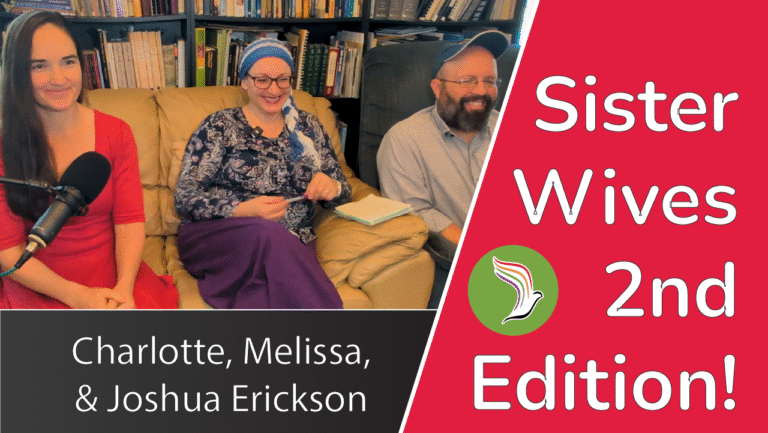
The largest group of Mormon polygamists don’t belong to a group! I’m talking to the Ericksons: Joshua, Charlotte, & Melissa who purchased the Sister Wives home from Kody Brown and his 4 wives from the TLC channel. We’ll talk about the resources independent Mormon fundamentalists can participate in, how they got their authority to do polygamy, and talk about priesthood in their family.
I sat down with the Erickson family—Joshua, Melissa, and Charlotte—independent Mormon fundamentalists who purchased the Lehi, Utah home formerly owned by Kody Brown of TLC’s Sister Wives. The Ericksons discuss their journey from mainstream LDS Church membership to independent polygamy, their blog Speaking of Polygamy, and their efforts to restore biblical feasts and practices. The Ericksons, who now live in the home designed for polygamy discuss the unique architecture, which includes connected apartments that facilitate communal living.
The family shares their transition out of the LDS Church. While they were excommunicated, they describe the experience as cordial and devoid of hard feelings. They soon found the Zarahemla Foundation, a non-denominational fellowship for restoration believers. Joshua explains that fundamentalism isn’t just about polygamy; it is about preserving original restoration principles. They discuss the misconception that leaving the church means losing opportunities to serve, arguing they have found even more ways to be “anxiously engaged”.
We did a deep dive into why the Ericksons celebrate ancient Israelite holidays like Passover, the Feast of Tabernacles, and Yom Kippur. Joshua provides scriptural justification from Zechariah 14 and the JST of Luke 22, arguing these feasts are for all of Israel, not just the Jews. The family discusses their wine-making classes. They adhere to D&C 89 and Section 27, believing wine should be “of your own make” for sacraments, rather than water.
The Ericksons recount their participation in the independent temple built near Humansville, Missouri, describing the celestial room’s fiber-optic star field and the dedication they felt among independent groups. They give an introduction to a broad coalition of independent fundamentalists who provide a “soft landing” and fellowship for those questioning mainstream changes.
Authority Without a Church
The Ericksons introduce a massive new scripture project for Independent Mormons and all Restorationists. We discuss the contentious issue of priesthood authority outside the LDS Church, and explain why they believe authority can exist in multiple branches of the Restoration simultaneously.
They discuss a new “triple combination” project spearheaded by Drew Briney. This edition includes the 1840 Book of Mormon text, formatted in paragraphs, and contains nearly 100 unpublished revelations from Joseph Smith and John Taylor. The new scriptures are annotated to show every substantial change in the text over history. It excludes “press releases” like the Manifestos but includes the Lectures on Faith and the full Wentworth Letter.
Rick asks how the Ericksons claim authority without belonging to an established group like the AUB or Kingstons. Joshua argues that authority is broadly distributed, citing the Book of Mormon where Lehi and Jeremiah held authority simultaneously without coordinating. A discussion ensues on the fundamentalist view that the priesthood exists independently of the corporate church structure. Joshua shares his experience of being rebaptized and reordained to align with scriptural requirements for married priesthood holders. They discuss why independents view rebaptism as a renewable covenant and a preparation for special events (like temple dedications), rather than a one-time event. The group discusses the difficulty of unifying the various Restoration branches, noting that polygamy is often the “third rail” that prevents full unity.
Women Bless the Sick? “I’ve Actually Done That”
Rick Bennett asks the hard questions about gender and race within independent fundamentalism. Do women bless the sick? The Erickson family—Joshua, Melissa, and Charlotte—discuss the reality of “patriarchal” polygamy, refuting the stereotype of oppressed, silent wives. Melissa Erickson opens up about her personal experience performing healing blessings by the laying on of hands. The group also tackles the controversial topic of Black priesthood holders in fundamentalism, their support for the inclusive “Missouri Temple” group, and Melissa’s unique scriptural interpretation of the “One Man” rule in D&C 132.
Debunking the “Silent Wife” Stereotype
Melissa and Charlotte push back against the idea that plural wives are “brainwashed, stupid, or oppressed.” Instead, they describe their marriage as a single “unit” that shifts and adapts. For example, when Melissa is in midwifery training or Joshua is editing scriptures, the other spouses pick up the slack. They emphasize that plural marriage should be cooperative, not competitive. Rick asks if women can perform ordinances if the husband is incapacitated. Melissa reveals that she has blessed the sick by the laying on of hands, noting there is historical precedent for it. She distinguishes this from the sacrament; she views healing as an emergency act of faith, whereas the sacrament is administrative and can wait for a priesthood holder. Interestingly, they would be more comfortable receiving the sacrament from a married woman than a 12-year-old deacon.
The Ericksons discuss their openness to Black polygamists, a stance that separates them from many other fundamentalist groups. They praise the independent temple in Missouri for allowing mixed-race individuals to enter, even though other groups claim this “desecrates” the temple. Joshua argues that while he believes priesthood is for Israelites, anyone can become an Israelite. The group discusses the nature of sin and racism. Melissa argues that how you act matters more than what you feel or think. She shares a story from a mainstream LDS ward where members gossiped about a South American sister making tamales with lard, using it as an example of cultural offense that bordered on racism. She concludes that “gossip is less kosher” than lard.
Reinterpreting the “One Man” Rule (D&C 132)
Melissa provides a unique exegesis of D&C 132:7, which states the keys are conferred on “never but one on the earth at a time.” She interprets this not as a dictatorship where only one man holds authority, but as a procedural instruction that ordination happens one person at a time—similar to how Jacob blessed his sons individually rather than as a group.
In the final segment, the Ericksons tackle the practical side of raising kids in polygamy. They discuss whether they expect their kids to be polygamists, the role of their ministry, and the lingering trauma that keeps many fundamentalist groups secretive.
Charlotte and Melissa explain that they do not force polygamy on their children. Their goal is to raise sons who are such good husbands that “more than one woman would want to be with them,” but the choice is ultimately theirs. Charlotte addresses why many fundamentalists remain secretive and insular. She highlights the history of government prosecution and the fear of having children taken away, noting that until 2020, polygamy was a felony in Utah.
Joshua rejects the idea that a miserable marriage now will magically become a happy polygamous one in heaven. He emphasizes that the “same sociality” exists there as here, so marriages must be happy now. The parents focus on instilling a love for biblical feasts and God rather than loyalty to a specific group. They hope their children avoid atheism and maintain a connection to their Israelite heritage.
Mormon Legacy Ministries:
Joshua details his role as a bishop for the ministry. They hold services on Saturdays and Thursdays via Zoom to accommodate people transitioning out of other groups. Joshua explains that he handles temporal needs (tithes/offerings) but does not perform ordinances or interviews for the ministry, acting more as a referral service for those seeking baptism or marriage.
 Wheat & Tares