
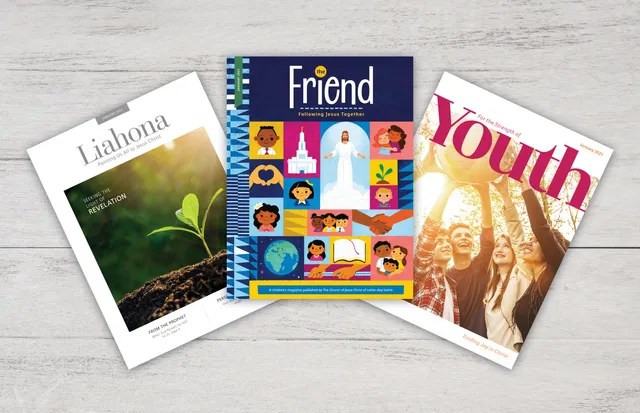
Once upon a time, there were three LDS magazine publications: The Ensign, the New Era, and the Friend. [Even earlier, there was something called the Improvement Era, but that predates me.] You are probably aware that the Ensign was replaced by the Liahona. That’s a bit confusing, because for many years the Liahona was the international LDS publication, in several languages, while the Ensign was the USA (and Canada?) English-language publication. The Ensign was replaced in January 2021. Here is the first of several questions for readers.
- Was this simply a name change, with the content and format largely unchanged? Or did the new Liahona adopt the somewhat more simplified and “gospel basics” approach of the earlier international Liahona?
I’m thinking (not having read the Liahona much) the transition struck a middle ground between the two prior publications. In my view, that simply continues a decades-long trend of making the content of LDS publications ever more simplified and oriented to gospel basics (notice how hard I am working to avoid the term “dumbed down”). If you go back to the Improvement Era issues of the 1960s and the Ensign issues of the 1970s, they often featured serious articles by authors with some expertise in a field. I just don’t see that anymore. A somewhat different example is the changing inventory of your local Deseret Book store. While it still has a section for books, a good part of the store is devoted to LDS art (not exactly real art, but images in frames) and LDS knick-knacks. And it’s tough to find a book worth buying. You could throw in curriculum materials as well if you want.
- Is the simplification (and emotification, I would argue) of LDS magazines just part of an overall shift in emphasis in the whole range of LDS publications (magazines, books, curriculum) away from substantive content to repetition of simple themes and a variety of personal stories?
Now let’s go to the LDS magazines page. Take a look. Any surprises? There is no New Era, that went away, too, and is replaced by For the Strength of Youth. I thought that was just a pamphlet. Now it’s a magazine. There’s also one called the YA Weekly, which appears to be just an online publication and is directed to Young Adults. I assume this is part of the increasing attention LDS leaders have directed to YSA over the last decade, trying to keep Josh and Sophie active in the Church. Honestly, I had never heard of the YA Weekly until 30 minutes ago when I came across an article and link while searching for current LDS news stories (looking for something to blog about).
- Here’s my sense: Part of the reason these changes have gone largely unnoticed is because LDS magazines have become less and less important (and less relevant?) to the average LDS of any age. These publications are sort of a legacy operation, with many adult members largely or totally unaware of them.
I suspect browsing LDS.org for news and helpful articles (as well as any curriculum pages a teacher might need) has largely replaced the need for print publications. At the same time, I’m intrigued by the YA Weekly, which, along with YSA branches and regional YSA conferences, signals a focus on that demographic.
So why not expand the range of LDS publications to include a variety of other LDS demographics? Your suggestions are welcome in the comments. Here are some of my ideas.
- I Hope They Call Me On A (Senior) Mission, an LDS publication directed to LDS seniors, including articles on missions and temple service, as well as general articles on retirement investment strategies, health concerns, and keeping track of all the grandkids.
- What About Me?, an LDS publication for LDS single adults who have aged out of YSA. Articles on depression and mental health as well as online dating strategies and cruising (like on ships).
- Mormon MAGA, an LDS publication catering to MAGA Mormons who are frustrated that so few Sunday talks or lessons feature direct discussion of right-wing politics. Featuring political news of the day and reprinted articles and speeches of Ezra Taft Benson.
- Living on the Edge, an LDS publication directed to doubters and lazy learners who, to the puzzlement of most LDS leaders, remain stubbornly or reluctantly attached to the Church in varying degrees. Featuring a healthy dose of name-redacted personal stories and reprinted articles and essays of Eugene England.
.
 Wheat & Tares
Mormon MAGA: Isn’t this just the Deseret News? 🙃
If we’re going this direction, then there has to be one for the preppers among us.
I can’t remember when I last looked at a church magazine, but I haven’t been the audience for that in a long time. I should probably ask my mom about church magazines to get a better sense of regular members’ relationship to it. Really, all print media is on the decline these days. I hear regular mention of church-oriented or church-produced podcasts in Sunday School lessons these days. I’ve never heard of most of them, and they probably don’t want to know the podcasts I listen to, but it’s interesting to realize that we’re all changing our habits, and the church is clearly trying to keep up and produce content for the ways people consume it now.
I assume your list isn’t meant too seriously given the MAGA suggestion, but really, producing content for those niche audiences is something the church should be, and possibly is, thinking about. Older members and middle aged single members are sizable groups that deserve some dedicated attention. I think they should be giving some attention to edgy members, but sadly I think they fear doing so in any official way. The best they can manage is to allow groups like Faith Matters to exist without harassing or excommunicating the people involved as they have with others in the past.
The Church News and Deseret News are already plenty MAGA. Regarding the magazine for senior missionaries, be sure to include a recurring feature encouraging them to leave their inheritance to the church rather than to their wayward or ungrateful relatives.
The church seemed to address the single adults all of a sudden when studies showed that singles were leaving the church at higher rates than married members. For years the church treated singles as if they were really uncommon and probably broken. They needed fixing by getting married. Or treating unmarried adults as children that needed to grow up and get married. It was insulting and singles started leaving. When the church noticed, they suddenly tried to fix the problems that were driving out adult singles.
Older adults (boomers and above) are the least likely to leave, so the church can continue ignoring them.
Right now women are leaving at higher rates than men, but for the last 50 years the church has moved more and more to giving the women the exact same stuff as the men, and yet insisting that men and women are SO inherently different. They give the women the exact same lessons as the men but are now moving toward making them the exact same lessons they give the primary, with zero regard to age level, just kind of averaging everything dow to the 8 year olds. If it isn’t treating adult women exactly like men, it is treating them exactly like 8-18 year old girls. Women just need to be lumped in with somebody more important so the church doesn’t need to even know that maybe women are not deformed men or overgrown children. Some day the leaders will get told there is a problem with women feeling disrespected and maybe they will try to fix it. But I am not holding my breath, because I think the church leaders still see women as a different species and they were not fixing the single adult problem because single women were leaving but it was the single MEN they worried about, and the single women just got lumped in.
As far as church magazines, my husband and I stopped getting them a few years after we stopped even opening them. There was just nothing at all worth the time to read it. So, yes they have been dumbed way down. The top Ensign editor 20 or so years ago told me that children read the Ensign, so since they are reading it, the articles can’t be too far over their heads or even hint at things like s-*-x. As if kids didn’t have a magazine aimed at them. So, we’ll make the kids magazine on the kids level and the adult magazine on the kids level too. Why should adults want anything above a third grade level?
David raises some great points. I join him in condemning the changing nature of church magazines.
I would, however, go further. The most abominable change in the nature of church magazines is the abandonment of the Mormon community.
Church magazines used to emphasize the fact that church members were part of a community. A community in which members worked, played, and worshiped together. Indeed, that was The Emphasis. The magazines focused on ideas to build that sense of community.
Sadly, the magazines abandoned that focus when we were all told to abandon use of the word Mormon. This was a double blow to the sense of community that held wards together.
And what is left in church magazines now? Material as bland and nourishing as a three-day-old truck stop hot dog.
If the Church is willing to publish a special magazine for single adults because they feel forgotten in the Church, then it seems like a magazine targeting LGBTQ members would be appropriate. In honor of David Bednar’s prophetic declaration that “there are no homosexual members of the Church,” I propose that the magazine be given the memorable title, “You Don’t Exist” (this title was nearly used for the single adult publication before they landed on “What About Me?”). Some ideas for content:
1. Three articles per issue on celibacy.
2. Two articles per issue on The Family Proclamation.
3. One article per issue providing different perspectives on how “your kind of people” can properly use the church bathrooms.
4. One “lifestyle” article per issue describing how being a great aunt or uncle is almost as good as having a lifetime companion and your own kids. This one can often just be a reprint from the excellent “What About Me?” magazine for single adults.
5. One flowchart per issue, titled “It’s So Confusing!” for determining whether to attend Relief Society or Elders Quorum.
6. A hopeful Easter article each year reminding LGBTQ members how the resurrection will “fix” them in the next life.
7. A “celebrity Mormon” article per issue featuring a well-known or prominent LGBTQ member testifying how wonderful it is to be a member. Thankfully, “You Don’t Exist” is an online-only publication, so these articles can be easily scrubbed from the magazine—George Orwell 1984 style—when the member inevitably leaves the Church.
@mountainclimber479
Might I suggest your magazine have the slogan “The plan is perfect even if it doesn’t include you.”?
I’m old enough to remember The Improvement Era and the Relief Society Magazine (which included paid advertising for various products such as Postum). I read the Ensign for years and noticed a distinct change when I opened one issue: everything was less dense. The content was different (less intellectual, written for a less experienced reader). The articles were much shorter, shallower. Even the content set-up changed from single-line spacing to 1.5 line spacing. Lots more white space. Soon after these changes, I stopped reading the magazine because it no longer engaged or enlightened me. I haven’t read much in the Liahona, but what I have viewed hasn’t taken the content back up a step to earlier Ensign standards. Perhaps it is meeting the needs of a different demographic; just not mine.
The only thing nice I can say about the Church publications (which probably had their heyday in either the 70s or during Hinckley’s regime in the 90s) is that they are head and shoulders above the Watchtower magazine, regardless which publication you’re talking about. The quality of printing & paper are significantly better (probably a rich church / poor church thing), and the content I have seen when I’ve occasionally looked at a Watchtower is just so completely nuts. The illustrations look like the cartoonists who did the Book of Mormon animated series (with the nipple-less Nephites) took an acid trip and went to town.
Read the Ensigns and Improvement Eras from decades past. Totally different narratives. Native Americans are Lamanites. Birth control is evil. Women shouldn’t work outside the home. Jesus is Satan’s brother. Blacks are called “negros” (of course MLK Jr. also called them “negros”). Rock and roll music is evil. The Women’s Movement is evil.
Interestingly there are articles that acknowledge the seer stone in the hat and the multiple accounts of the First Vision. There are articles that experiment more with trying to make history and science appear compatible with Mormonism. That seems to have faded now. The narratives of today are all about the covenant path and don’t focus so much on trying to make modern knowledge square with Mormon beliefs. You just believe. You know things are true from prayer and feeling the spirit. And you go through the motions.
Such a great revenue opportunity for LD$ Inc.:
Ask Fanny: Relationship advice written by 14-year-olds.
Finding Nephites: Monthly updates of independently confirmed BoM archeological findings. Each issue consists of 50 blank pages suitable for framing.
Bednar’s Bedtime: Children’s stories with a Mormon twang: Coriantumr and the 3 Nephites, Hiking with Ishmael, etc.
Where is the Church’s voice these days? Growing up in the twentieth century outside the Wasatch front it was the church magazines. We didn’t have internet (of course) and for most of that time didn’t listen to conference live. The magazines, which in my family included the Church News supplement to the Deseret News newspaper, were the voice of the church.
Now I suspect it’s a combination of General Conference live and churchofjesuschrist.org online, including the Newsroom. I have family members who would add the whole of the Deseret News newspaper but I refuse to go there. In any event, I don’t think the magazines make the list.
As for the specialty publications suggested at the end of the OP, I’d guess anything useful in those directions will be online social media groups or blogs, for two reasons. One is the challenge of print publications of all kinds. Even well-established legacy newspapers and journals are struggling and I see new niche publications fighting to find their audience off-line. Second is the challenge of publishing from the center with anything more well defined than a seventh-grade level text that’s been homogenized to be applicable to everyone. From the center there’s a very strong drive toward a common denominator.
There are also complicated dynamics of church support and church control where the editorial decisions are not made at the COB. But that’s probably a whole different entry in the discussion.
I nominate mountainclimber479’s comment for Ziff’s list of top comments of 2026.
Only two Ensign articles stand out in my memory. One, an article about a woman being emotionally abused by her grumpy, unsupportive husband. Through prayer, fasting, and communion with family, she realizes it was all her fault all along and she just needed to love him more.
The second, titled “a hole in my soul”, about a lesbian woman learning that, when she pretends to be straight, her soul doesn’t have a hole.
Needless to say, good riddance.
Thanks for the comments, everyone.
LHCA said: “I read the Ensign for years and noticed a distinct change when I opened one issue: everything was less dense. The content was different (less intellectual, written for a less experienced reader).” I don’t recall that shift ever being highlighted or explained. It just sort of happened.
christiankimball said: “Where is the Church’s voice these days?” Yes, that points to the related question of how the Church (Big Church, the COB) communicates or connects with the membership. It isn’t really through magazines much. General Conference is a good candidate, but there really isn’t much communication there either, mostly revisiting the usual set of topics, mingled with stories about travel to various countries and about the grandkids.
And the more I think about it, the less actual communication I see. What directives or explanations are directed to the membership are often not candid or transparent. That is, the reasons occasionally give for what changes are made or actions are taken are, it seems, PR driven and designed to keep the membership happy rather than being the actual reasons driving senior leadership decisions behind closed doors.
Firstly, the UK, Australia and presumably New Zealand also got the Ensign, New Era and Friend magazines, rather than the old Liahona, at least amongst all those I know. So it wasn’t just a US/Canada thing.
Initially the new Liahona also included youth and kids sections, presumably carried over from the old Liahona. Just looking at the December issue of the last year, it seems these sections have now been deemed superfluous. YA weekly seems to have significant overlap with the Liahona. The Liahona has a YA section, and the YA weekly includes all those articles, some from Liahona feature articles, and a few extra. However, at least in the library app weekly appears to be something of a misnomer. The magazine is accessed by month, and the contents has headings week 1, week 2 etc with articles divided between the weeks. Again this is comparing December 2025 issues. I suppose the articles could be released on a weekly basis and added to the month on a weekly basis, but since we’re in the last week of January I can’t check that, but it seems likely given week 4 is at the top of the contents, and week 1 at the bottom. Also, February isn’t up yet, though it is for the other magazines. Eager YAs can get a head start, by accessing the YA section in the Liahona, which is still there. I’m not sure that having to check the magazine every week for updates, is a bonus frankly. but hey, I’m not a YA…
@Former Nonbinary Sunbeam: I love that slogan, and I’m sure our 3 readers will love it, too!
@Dot: Thanks! I’m sure the prize you mention doesn’t come with a cash award, but…if there were, I’d definitely direct it all to a worthy nonprofit supporting LGBTQ rights.
Comment from Anna:
My daughter in law has her degree in journalism and the layout with more space around the article, more pictures, shorter articles is supposedly “more attractive” and “easier to read” and “catches the attention” so people “don’t thumb through looking at titles.” But, it also has more spacing between the lines, shorter articles, more pictures. So, it means your articles are not as long, which means they are not as intellectual because you just cannot put college level content in 500-1000 word articles. So, their “more attractive” layout is dumbing it down.
I know I was asked to submit an article after I wrote a nasty letter to the Ensign editor. And there was a very short word limit. I tried really hard, but when one is talking about child sexual abuse (trying to correct all the things the church get so wrong about it, and not blame the church for the ways its purity culture harmed me as a child, or how devastating Scott’s 1992 talk was to my sexual abuse clients, it is hard) Now, my master’s thesis was on child sexual abuse, and the university loved it so much they asked me to present a 5 minute version at some awards ceremony. So, I have experience writing a good quality paper on the topic. I am well researched on the topic, and I have experience editing something way down. But writing an article for the Ensign was a whole new difficult can of worms. Then their editor took out the parts that were most important to me and made it sound like my whole growing up being raped weekly was a happy inspirational walk in the park. Kind of how they try to make the Martin hand cart company inspirational. No, my ancestors were in a hand cart company two weeks ahead of them on the trail and it was hell for them and yes, they were the first group rescued that the church never talks about—maybe because too many people in that group were not as delusional with hunger that they hallucinated angels and pie. But, after that editor took the last of the hard stuff out and made the article so a third grader would not be bothered, because, ya’know, rape is a happy inspirational experience and you can’t call it rape because that might scare a five year old reading it. Yeah, I withdrew permission for them to put my name on their pablum. I had nightmares about what kind of happy art work they would put on it. And because a mere member cannot tell other members the dictionary definition of words in scripture- that is interpreting doctrine. And telling readers who had been abused that talking to their bishop might help was a lie, and because my own spiritual experiences in healing are too personal to really want to share, especially after their editor butchers it, and I can’t quote scripture with any kind of “this is what this means” the article was something that is too edited, too optimistic on time to heal, artificially no longer traumatic. The whole thing was not going to be helpful to anyone going through it because it was now worthless pablum.
OK, well, deciding to share that hit a raw nerve. My point is, that even back when it was the Ensign, they were so strict on what is allowed to be said because of who is allowed to say anything about scripture or doctrine, and the wording had to be 3rd grade-ish, and the whole article had to be very short, that all makes it impossible to say anything worthwhile for real human problems. Intellectual discussions are out because mere humans cannot comment on doctrine or “interpret” scripture by saying “this literally means”. Of course the magazine is worthless. I experienced exactly why their magazine is worthless by trying to write a worthwhile article.
I’ll goo pound my head against a wall now until I feel better.
We still get the Liahona in the mail monthly. The magazine isn’t doing much to engage me. Would it be unfair to say that it is vapid, fluff, and light? I understand writing for all audiences, which usually means writing to the lowest common denominator. But sometimes maybe we need to write so that some readers look up, wonder, consult a trusted dictionary (do most home have one these days?), ponder on a different way to look at something. I don’t want speculation on topics where we know almost nothing; we have to stay true to our doctrine–but do all members believe the same way on all topics? How do we stretch without breaking? Who would we trust to write those stretching articles? The Skousens, McConkies, et alia have done a lot of damage in the past in their explanations. I don’t want someone to write an article on chastity, for example, telling a young man that it is better for him to come home from a mission in a casket than to have erred. I don’t want Birchers writing articles telling me why social security and medicare are evil and come straight from the devil. (Of course, these are American terms, and the articles should be for the whole worldwide church). I also don’t want people writing on the far liberal side, telling me how I should think and what I should be doing about a host of social justice issues. I don’t want people like Chad and Lori Daybell writing anything. I confess that don’t know what a church magazine should look like. I haven’t put enough thought into it, and won’t because it won’t change anything.
The possibilities for new, targeted Church magazines are endless This include:
National Mormoneograpic, a magazine that appeals to BoM geography enthusiasts. Cover article: “Hills to Die On: Forget the one and two Cumorah theories. Why BYU scholars are now saying you can have as many Hill Cumors as your little heart desires.”
Leader’s Digest: A magazine catering to members of the Church who are on the leadership tract. It would include accessible summaries of scholarly articles previously published in trade publications for dentists, chiropractors, and lawyers. It would also include practical advice such as optimal placement of a copy of the Boof of Mormon in one’s waiting room. “You want them to easily find it, but not be scared away by it.”
Mormon Homes and Garden [s]: It is what it sounds like. It would feature articles such as: “Vinyl Lettering on your Walls?: In or Out,” followed a month later by “How to Safely Remove Vinly from your Wall,” and “No Seriously, Painting over your Unwanted Vinyl Scrpture Quote is going to Look Really Wierd.” Also, “Not Your Grandmother’s ‘Follow the Prophet Garden:’ How hydroponics is transforming the prophetic call to grow your own food.”
Sportsmormon Illustrated: Only BYU sports and former byu/lds athletes in every issue. It would also feature an swimsuit issue featuring male and female models in garment-friendly swimsuits
LAYBOY or GIRL: A magazine that everyone reads for the articles only , I swear, that features anonymous testimonials of the trials and tribulations of serving in unwanted callings or the “Lay Ministry.” It would include a centerfold of say, an executive secretary, tie loosened, sweating feverishly, while crossing out names on his tithing settlement sign-up sheet.
Mormon Business Weekly: A (weekly, I suppose) magazine for Mormon small business owners. It would feature such articles as, “How to remain ‘Honest with your Fellow Man’ compliant and still not lose your shirt during tax season,” and “It’s All in the Interpretation: How to underpay your employees, avoid those pesky state safety laws, get around overtime pay, and still qualify as a follower of Jesus according to the scriptures”
I could go on… but I won’t. I have things to do. 😆
Ok, ok, I thought of a few more:
Ms(lm): A magazine designed to guilt-trip young lds mothers into staying at home full-time with the kids while at the same time earning money through sketchy multi-level marketing (mlm) ventures, as well as online content creation – you know, with all that free time.
Momo’rider Magazine: A publication geared toward lds gearheads featuring articles, such as “The Great Restoration: How to turn that about school bus into a badass lowered land yacht for your family that will turn heads,” and “Every Needful Thing: how to rationalize buying that project muscle car your sketchy cousin has been trying to sell you for years.”
RollMormon-ing Stone: A magazine dedicated to the many contributions of LDS artists to the genre of Rock ‘n Roll….It’s a really thin magazine. More of a pamphlet really.
Mo’Hustler: No articles. Just pages and pages of glossy (garment compliant) smut. Now with “porn shoulders” for the first time.
(the bread of) LIFE: A rather niche publication designed to help bishops improve and streamline the administration of the Sacrament. Featured articles: “Paper or Plastic? How ’bout Neither: How one California bishop is helping to environment and promoting reverence with sturdy, quite hemp sacrament cups;” and “No one Likes That Gross Freezer Taste: how to encourage ward members to bring quality fesh bread for the Sacrament without offending them.”
The Latter-Day Evening Post: An old timey-styled magazine featuring idyllic illustrations of everyday lds life featuring the artwork of Norman Rockwell’s little-known brother, yes, Mormon Rockwell (my apologies).
Magazines of all types are dying or being reinvented. Church magazines are no different and don’t need to be saved in their previous form. I’d argue that all the proposed “magazines” are all present in various blogs, podcasts, youtube channels, etc.