
Second hour in LDS Sunday meetings for 2026 Come Follow Me covers the Old Testament or, as scholars generally refer to it, the Hebrew Bible. Between the sparse material in the manual, a teacher that often doesn’t know that much about the OT, and class members who know even less — well, the signal to noise ratio in class discussion is often distressingly low. The best advice one can give to an LDS teacher or class member is to buy and read a NRSV study bible.
And if you want a commentary to go with it, try the recently published The Old Testament for Latter-day Saints (Signature Books, 2023) by Alex Douglas, who has a PhD in Hebrew Bible from Harvard. The book is full of good context and commentary, the material is directed to LDS readers, and it’s less than 200 pages, so you’ll actually read it. Highly recommended.
So, based on the first couple of chapters, let’s pull a few observations about Genesis from the book.
First (not from the book) notice that the manual doesn’t get done with Genesis until the last week of March. So roughly one quarter of the class is devoted to Genesis! The Book of Genesis is the most important book in the OT in the view of LDS leadership. It’s practically the only OT book that matters. You could summarize the LDS OT curriculum as just Genesis, Exodus 20 (the 10 Commandments), Isaiah, and Malachi, and put everything else in a short appendix or something.
Second (again, not from the book) the curriculum doesn’t just cover Genesis. It throws in the LDS books of Moses and Abraham as well. Depending on the teacher and how they cover the material, some class members who think they are learning about Genesis are actually learning the LDS re-write of Genesis or, if you prefer, Joseph Smith’s (inspired?) commentary on Genesis, expressed via a re-write of the narratives. If you want a commentary, read the Douglas book or one of the dozens of good introductions to the Old Testament, such as the John Collins books, instead. I just think that when an Old Testament class studies Genesis, it should focus on Genesis.
Third, from the book. (1) The early Genesis narratives are foundational myths (“myth” used here in the positive sense of the word). “The opening books of the Old Testament certainly contain sections that read like history. But if we look at the function these stories serve, … it is hard to escape the conclusion that these stories work in much the same way that America’s founding myth does. If we read these chapters only as histories, we miss the primary purpose for which they were written” (p. 2).
Fourth, contra the hyper-literalist approach to Genesis narratives that is standard in current LDS discourse and teaching: “Despite this literalist bent in LDS tradition, there is nevertheless some room for understanding these stories as non-historical, even among orthodox believers. Bruce R. McConkie, for example, cites multiple pieces of the Garden of Eden story as being figurative, including the very existence of the Tree of Knowledge of Good and Evil” (p. 19, emphasis added).
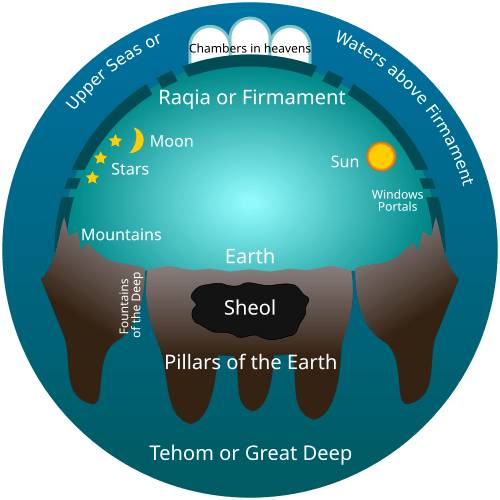
Fifth, let’s add one paragraph on some specific content, namely the word “firmament” in KJV Gen 1:6-8. What the heck is firmament, you might ask. Here’s a slightly edited (because I can’t do Hebrew characters here) version of footnote 1 on page 2: “The Hebrew word here is raqia, which translates to ‘dome,’ but the word is rare in Hebrew. Ancient Greek translators were not quite sure what to make of this word, so they translated it as stereoma, which literally means ‘a firm thing.’ [KJV translators] appear to have been equally perplexed, which is why they render the Hebrew as ‘firmament'” (p. 2). If you understand that the Bible view of the cosmos is just a big dome spread out above the land here below (the Earth) with God on his throne hovering somewhere above and beyond the dome, many biblical verses and narratives will make a lot more sense. The image at the top of this post is a rendering of the Hebrew view of the cosmos.
So I’ll do an Old Testament post maybe once a month.
- Share a good or bad experience as a teacher or student in an LDS Gospel Doctrine class.
- Do you find a mythic (in the positive sense) reading of Genesis enlightening or threatening?
- What’s your favorite OT translation?
- What OT commentary do you like and use?
- How old were you when you learned that the Hebrew view of the cosmos in Genesis 1, used throughout the OT and the NT, was just a big dome over the land of the Earth, plus a bunch of water under the Earth?
 Wheat & Tares
The grand and terrible day for members to be taught the documentary hypothesis will most likely never arrive. It’s a complicated story of how documents were crafted over time. The understanding of a representative author for each book of the Bible is easier to follow. And to hold a narrative that at creation each book was correct and perfect. But along came apostate and corrupt individuals who took an added along Satans’s inspiration. All that is for members to sit smugly in class each week with a superiority to all other Bible believers and churches.
For me seeing the complexity of each book and the multiple hands over the centuries that went into their creation is impairing. Someone wrote his story about his experience with the Divine and others came after to improve that story in the context of their place and time. Ultimately we have a very human Bible where we can discern many who struggled to make sense of God and their historical moment.
It’s a wonder and joy to work within that framework.
These days I’m all in on Robert Alter’s translation project. His Psalms I work over again and again. I’m constantly moved and inspired and drawing into the ever complex God the ancients worshiped.
I accidentally posted without fixing typos. That is for the person after me to continue the improvement of my content.
My favorite translation of the Bible is one called the Jerusalem Bible, and went to the original languages and started from there. I found that other modern translations seemed to start from the perspective of those doing the translating and trying to support their point of view. They seemed to have a slant to them, either a Protestant slant or Evangelical slant. And since I am starting over finding what I believe I wanted to get away from this kind of slant. I don’t bother reading Mormon footnotes for that same reason.
I also read lots of different scholars approach to things like how the Bible came about, comparisons to other mythology, Bible commentaries, then compare that to what is actually in the Bible and then I make up my own mind about what it says or means. Bart Ehrman is one author that I have read several his books. Then when I find ideas that fit, I take that into consideration. I am not even starting with the assumption of Christianity, but just studying the history and interaction between cultures to learn people’s ideas about God.
Just as a couple of wild examples, since we are talking about Genesis, the idea that Genesis chapter is one creation myth from one culture. And Genesis chapter 2 is a totally different creation myth from a different culture. Two totally different books, just stuck together into a collection of books that became our Bible. I don’t remember where that idea even came from, but it fit the evidence. Another theory that I don’t remember where it came from was that the Garden of Eden story is pagan as Zeus, just from an older culture and when the Monotheists tried to make it fit the one God narrative, they forgot to take all the symbols of the Goddess of Wisdom out of it. Tree of knowledge, snake, fig leaves, all very pagan. Probably depicting the Goddess of Wisdom wanting to give knowledge to mankind and some male pagan god wanted to keep his little human pets as pets, and did not want them to become as the Gods with wisdom, so he forbid them eating the fruit of the tree of knowledge. So, along comes the snake (symbol of the Goddess of Wisdom) to talk them into wanting knowledge. And the female pet human was smart enough to see the advantage of gaining wisdom, but the male pet human was content to sit, fat and happy as a pet. And while I tried to make my telling of the story kind of silly, it still fits what is actually in the Bible. Early depictions of the fruit of the tree of knowledge often showed a pomegranate which is another symbol of the Goddess of Wisdom. Seeing as how the “children of Abraham’ were pagan until half way through the Bible and the Goddess of Wisdom is the Mother Goddess, wife of the God of Abraham, it fits.
2. Mythic? Yes! A “realistic” interpretation is a misinterpretation. We need to read the Hebrew scriptures through an ancient Near Eastern lens.
3. Translation? NRSV, JPS, NIV when teaching kids
4. Any academic study bible works for me. Robert Alter’s work is amazing. As far as ancillary materials, I like John Walton’s stuff.
5. I learned the basics of the ancient Near Eastern worldview in college.
Genesis 1 and Genesis 2 being two different creation accounts is not an idea, it’s a fact, that usually gets ignored.
4 years ago, I also read Robert Alter’s translation & it was quite an eye opener, especially since I read the chapters Not assigned in CFM. Certainly not my Primary version of the Bible!
Also read the JPS & Jewish commentaries, as well as KJV for comparison and others. One important takeaway is to Not read Christianity into the Hebrew bible!!
The person I most love to hear expound on O.T. or any scripture, is David Bokovoy- listen to any of his podcast
interviews! Read his book:
Authoring the Old Testament: Genesis-Deuteronomy (Contemporary Studies
in Scripture).
Or Dan McClellen’s book & podcasts.
Isn’t it about time we brought biblical literacy out from under the limitations of the 16th-19th Centuries?
It’s great that church leadership has finally given permission to use the NRSVue, but I don’t need someone else’s permission to read good scholarship!
I teach the 9-10 year olds in primary. The first Sunday of the year we talked about how libraries contain books with many authors, many of whom don’t agree with one another. I highlighted that this year we were going to engage the Bible that way, a collection of books with many takes on things that don’t agree with one another. This last Sunday, I actually showed them that Israelite cosmology diagram and explained that the people of the Bible thought about the world completely differently from us. I showed that them when the Bible talking about the windows of heaven opening, this diagram made that phrase make way more sense to them. It’s fascinating because I could see in some of their faces the light coming on as they started thinking about the creation stories in Genesis–and how it makes so much more sense when you can understand how those people saw the world around them. I just don’t want this year to be yet another repeat of the same tired surface level, literal, restoration interpretation only look at the Bible. Kids just get so bored–they already know the stories. How about we get them in the minds of the people who wrote them or who these things were written for–which is not us by any stretch. And I’m sorry, but making the restoration narrative the only lens you look at things through, you’ve essentially erased all the history of the peoples and authors in the Bible.
Wow, Chrisdrobison,
That lesson sounds better than any adult O.T. class I’ve attended! Lucky children, and a wonderful age to teach! What a good foundation you’re giving them!
So roughly one quarter of the class is devoted to Genesis!
When we did the Old Testament in Seminary (1971-72), Genesis was a full 3/4 of the year. The Prophets got a week. So…progress.
Chris,
…they already know the stories…
No, I don’t think hey do. Some of them might know some small pieces of the stories from previous proof-texting exercises, but it seems to me that Latter-day Saints generally, adults and children, are largely illiterate on the Bible. You could perhaps donate great good by teaching the stories to the children.
Oh, my.
I don’t think [t]hey do.
You could perhaps [do a] great good…
I really love LoudlySublime’s idea that we do not need permission to study anything we want. If anything ever needed to be taught in Sunday School it that. I officially started studying outside of the itty bitty Mormon bubble when I was in college, at 18. Then it got interrupted by a few years of moving all over with the military and high risk pregnancies and life. When my husband finally got stationed at one place for more than 24 months, I got back in college and took it up again with a fun class called The Bible as Literature. With a university library at my fingertips again, I jumped into fun things like Encyclopedia of Judaism and books that looked at the Bible as this weird collection of ancient books.
Yes, I said that the first and second chapters of Genesis being two separate stories that are not even related as an idea, where really it is a fact because this being a Mormon forum, well, people have to be capable of accepting that Joseph Smith did not have a bat phone to God, and the Bible is no more the word of God than Roman mythology is. And some people here object to me stating as fact things they think are my evil corrupt opinion. I have to corrupt Jack one step at a time. 😉
Speaking of Roman mythology and facts, sometimes our “Christian Bible” *is* Roman mythology—take the story of Samson, his name literally means son of the sun God, and his story parallels the story of Hercules. He was born at a town named dawn and died at a town named sunset. I could explain more, but it is just a different version of an old pagan story. Fun fact to get Jack to downvote me.
ji, I probably should have qualified my statement by saying they know the selected stories as repeated in CFM and all previous LDS curriculum iterations as those have never really engaged any of the Bible accounts at anything other than a quick surface level summary of events before moving on.