


Logo from My Hometown website.
Frequently here at W&T, I’ve read comments decrying the lack of community in the Church. Roadshows are no longer. All Church gatherings have to have a spiritual purpose and not just for friendship and hanging out. Church buildings could be used as community gathering spots but instead they sit empty much of the time.
So when I heard about My Hometown Community Resource Center this week, I knew I had to tell all of you about it. At my exercise class, I mentioned signing my son up for guitar lessons and how much they cost. One of the other women told me about free guitar lessons at a stake center not far away. “What?” She called it a community resource center and said I could get free guitar lessons at a stake center. Also free piano lessons. And cooking lessons. And English as a Second Language. Also computer classes, and art classes, and dance lessons, and general mental health principles, and some sports and fitness stuff. If someone needs help with their yard, they go talk to them, have them sign a few waivers, and then take care of their yard for them. They do spring cleanup and fall cleanup.
I kept asking questions. I’ve never heard of anything like this. All of these community resources? At a STAKE CENTER? I followed her out, still asking questions to find out why all this was available at a stake center and she eventually admitted it was a service mission, “but we don’t proselyte! at all!” she hurriedly assured me. “Are you a service missionary?” I asked. Yes, she was a service missionary. How totally cool. She’s a retired woman who teaches watercolor painting for free at a stake center once a week as her service mission. She lives at home in the community she’s lived in for decades, sees her grandkids all the time, and teaches painting along with doing some administrative stuff to run this community resource center.
I hurried home and looked it up. MyHometown.com doesn’t say a word about the Church on its homepage. Notice the .com in the website. When my exercise buddy said they don’t proselyte, they don’t proselyte. The way you know this has some sort of connection to the Church is the address for the classes — they’re held at Church buildings.
MyHometown lists community centers in several cities in Utah. I clicked into the Salt Lake City option. They’re serious about helping people with home and yard maintenance. They’ve got contacts with city resources as well: “Salt Lake City actively supports by helping with dumpsters and call to haul for homeowners. They also partner with us in parks and other open spaces. We also refer homeowners to City and other non-profits who partner with the city to solve large issues with homes.”
Of course, much of this is volunteer labor. “Volunteers play a crucial role by staffing Community Resource Centers and organizing and participating in Days of Service. Community Resource Center volunteers teach classes. Days of service volunteers identify neighborhood needs and coordinate additional volunteers to complete neighborhood projects.” I’m sure the word ‘volunteers’ includes a lot of Church service missionaries. Senior missionaries, like my friend, but I bet teenagers who can’t serve proselyting missions get brought in to help.
Check out this list of classes you can take at one of the centers:
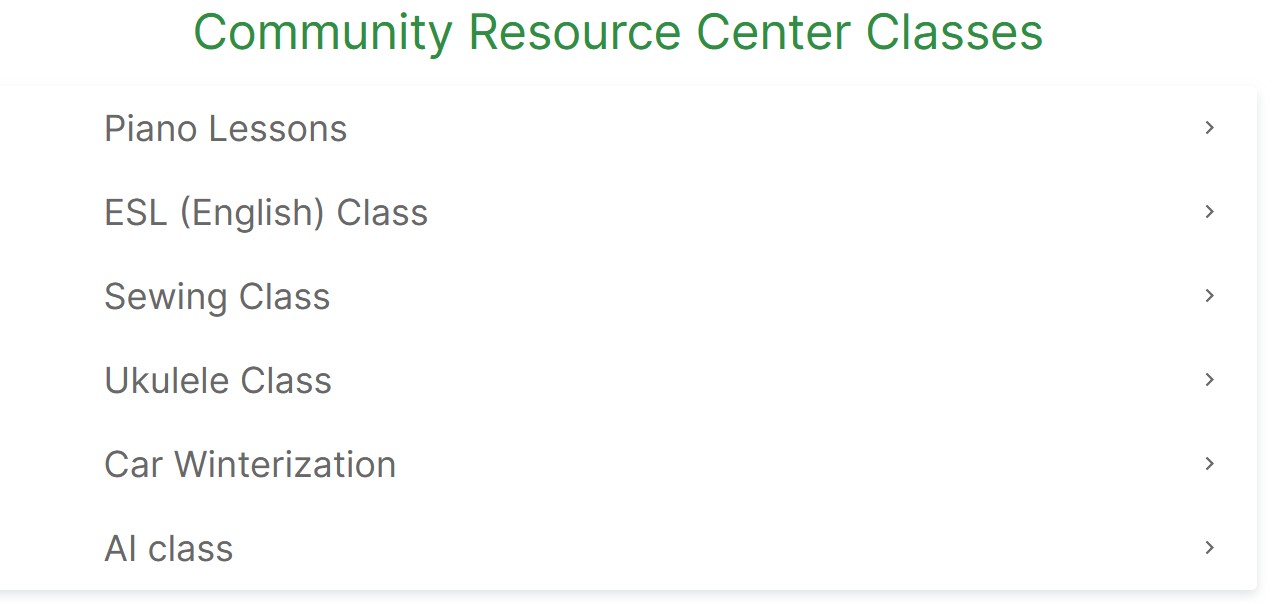
And then you click the arrow to see the details:

Is that cool or what?? If you learn to play the ukelele with a group of people, I bet you are friends forever. I mean, it’s not a roadshow, but close!
In the comments in Dave B.’s post about Autonomous Driving Units, several people suggested that the Church pay for piano lessons for anyone who wanted piano lessons. Naturally, the Church isn’t going to pay when they can get volunteers to do it, but check this out:

Hosting piano lessons at a Church building is a great idea. Lots of pianos! All those teachers are teaching on the same evening at the same location. The classes run in semesters of about eight weeks. They ask you to register, probably to make attendance somewhat of a commitment and also to balance class sizes. Running classes for eight weeks and then taking several weeks off keeps volunteers from burning out.
The classes vary by location. Here’s another snap so you can see the variety. I’m sure they customize class offerings based on what the volunteers can teach:
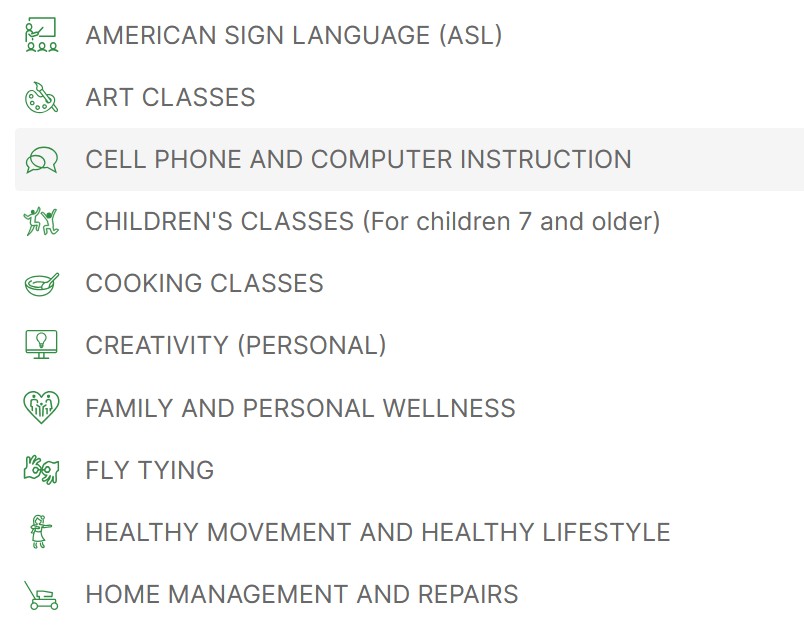
This appears to be just in Utah, and from what I could see, it’s based mostly in lower income communities like inner cities. I could be wrong about that. Since it’s likely staffed by non-proselyting service missionaries who live at home, these would have to be concentrated in LDS-heavy areas. I don’t know if these are pilot programs that will spread eventually. There’s enough LDS density in some nearby states that I would think a resource center like this would be feasible, but typing in hometownid.com into the search bar (for Idaho) brought up nothing.
Questions:
- If you lived close enough to one of these centers, would you volunteer one evening a week?
- My answer: At this point in my life, no. However, I’m looking at the scheduled Days of Service and thinking it might be fun to take my kids out for a service project once in a while.
- What would you teach?
- My answer: I could teach sewing. One location offered a class on the U.S. Constitution and I could teach that. While I know how to cook and garden, I wouldn’t enjoy teaching those as much.
- What classes would you attend?
- My answer: Painting. I would take the watercolor class taught by my exercise friend. I ought to take the home maintenance class but bleh.
- Are you surprised to learn that the Church offers these resources? And that they don’t proselyte? Based on how much effort it took for me to drag the information about these being run by Church service missionaries, I’m going to assume that part of their training emphasizes the “don’t proselyte” rule.
 Wheat & Tares
Janey – Thank you for sharing this. This seems to be the perfect answer to the many suggestions we have heard in the Mormon bloggosphere about ’empty-building syndrome’.
This is fascinating. I kept reading, waiting for the catch – that they are offered by the Community of Christ, but that didn’t happen. So yes, I’m very surprised, but still a bit wary.
My brother, who lives in MD and who officially resigned a couple of years ago, attended a service project sponsored by the United Way that was held at an LDS chapel near him. I guess he had to sign in, because Elders started showing up at his door weekly for months afterwards. He will never step into an LDS chapel voluntarily again.
I hope this is a pilot program that will expand because this is a great example of what being a Christian is about. I hope local leaders don’t get the “bright idea” to use it as a missionary tool, because bait and switch generally does the opposite of what you’re trying to accomplish.
As a ward and stake RS president, We asked about something similar 10 years ago and were told:
1) a Melchizedek priesthood holder has to be in the building, and
2) liability issues for the person who offers the class if someone gets injured and if the person offering the class gets injured.
3) what are the credentials of the person offering the class or service?
We couldn’t navigate beyond these issues and aren’t aware of anything new since then.
I always like to see the church trying new things, and I love this in particular. I hope it’s successful and spreads. I liked the justserve.org idea but I feel it hasn’t fully lived up to its potential.
I don’t see myself volunteering for something like this in the near future, but maybe later in life I could see myself doing it. I recently took a metalworking class through a local arts center, but that requires facilities that you’re not going to able to host in a church building.
Honestly the greatest obstacle to success for something like this is that staffing temples is going to take up so many members’ time going forward. As a matter of fact I work an occasional shift at my local temple because I was asked to years ago. I’ve never asked to be released because I don’t mind it too much, even though I don’t find it a peak spiritual experience like others do, nor do I think about the temple in nearly the same ways as most others there do. I’d gladly trade my occasional temple service for teaching a community class.
My husband helps with the financial side of the 3 My Home Town missions in Ogden. We have friends in the mission presidency for one of the three, as well as ward members who have been called as service missionaries.
https://www.myhometownut.com/utah/ogden
They teach much the same kind of classes. They have developed a trusted and effective partnership with Ogden City, which helps them legally provide the services. They also have an annual day of service where members of some broader area stakes are asked to show up en masse to help with various projects.
From everything I see, it’s a wonderful program! The people I know genuinely believe they are making a difference in people’s lives. I am delighted and grateful that the Church has stepped up to help fill a need in these communities.
Thanks for this write-up, Janey.
I was not aware of any of this but find it encouraging. And, in light of the Church’s recent change to the “kindoo” system in chapels across the United States and Canada, offering the chapel as a community center is a breath of fresh air.
The Kindoo system is a keyless entry system for external chapel doors. It utilizes a secure app on a smart phone, which then is associated only with certain callings within a Stake or Ward. I’m sure there are all sorts of reasons to upgrade and utilize technology, but I just find it amusing to juxtapose the “Visitors Welcome” sign posted outside with the Church making it increasingly difficult to get inside the building, and to fewer and fewer people.
I really hope this program finds traction and promotes members of our church to, at least, balance the “service” work they do for the “living” as is done for the “dead”.
That is really neat. Thanks for sharing this.
Todd S: I don’t see the “upgrade” to kindoo access to church buildings as making it increasingly difficult to get inside the building and for fewer and fewer people. My building made the switch last month. The initial setup was not as smooth as it could have been, but various people have access to the building by virtue of their calling. Same as always. Everyone else can request access and reserve the building (same as before) but without the need to get a physical key or fob. The trade off is the one-time setup of the app on a smart phone.
Having previously been an organist in a ward that took 6 months to get me a key, I can see the potential benefits. A few mouse clicks and someone can have access. One obvious downside is that I don’t know how anyone who doesn’t own a smart phone can get in the building now; we just take for granted that everyone has one. It also makes it much more difficult for teenagers to borrow their parents key to go play basketball, so I’m very grateful this didn’t happen when I was a kid.
Sounds like a good idea, with two concerns.
First, already mentioned, is a concern about using class registration information for missionary referrals.
Second is a concern that all instructors or laborers (volunteers to clean up and do yard work for others?) are real bona fide volunteers, and not over-pressured or arm-twisted or otherwise compelled members.
DaveW: Touche – Your point is an important clarification and I certainly go not believe the intent of the Kindoo system was to make access more difficult, even though in the short term it has had that effect.
On a slightly different note, one of the drawbacks to being a church with “No paid ministry”, at least at the local level, is that our Church’s don’t serve a general civic purpose as many do. Historically, church buildings were left open as:
– places of sanctuary and asylum
– for travelers
– Refuge for the needy
– Sacred spaces (not just Sunday or to members, but open to all, come pray on a bad day)
– As art, beauty and places of Awe (our buildings are built for function, not Awe)
If we had a local full time, paid leader, the doors could remain open and that “Visitors Welcome” sign could mean a lot more.
I looked at the MyHometown website and saw a center close to our community. I also just got an email about activities for five stakes, including ours, to be held with the same type of theme, so I’m sure this is what they are talking about. On the surface, it seems to be what religion is all about: helping others and reaching out. I worry, though, about how names will be used after registration. In other words, I don’t really trust that there won’t be some type of reaching out months following, and feel that “I’ll” be the project then. It’s also hard to work side by side with someone and not share who you are. This goes both ways, of course, but many of us have felt judged in times past, and I worry this will facilitate more judging.
Finally, I worry about how money will be reported. There will need to be some setup of events that may require funding. Who funds it? How is it accounted for? Also, how will things be reported and accounted? Will it truly be volunteer, or will hours be converted to “dollars” that would have been spent if people were hired? I worry about this because we are told that Utah is the number one charitable state in dollars given to charities, but we also know that most of those dollars go the the church in forms of tithing, fast offerings, or humanitarian outreach. We don’t really know what is counted and what isn’t because there is no transparency in anything financial in the church. So while I think good things could happen with the program, I also feel it will be misused and misrepresented in reporting.
While I think this is a good idea, I join others in not quite trusting it. And the more I think about this inherent distrust, the more I wonder just what kind of a reputation Mormons have. I might sign up for a class if they had one in my area, mostly to see if they can be trusted, but Janey already said there is nothing in Idaho and I wouldn’t want to travel to our stake center in Idaho anyway. Towns are just too far apart in rural areas, and while I know where the nearest temple is I don’t know where our stake center is, but I do know it is more than half an hour away, because it isn’t the nearest two buildings.
*IF* they can be trusted not to try to get me active, then I would be willing to teach, *IF* they would take inactive people as teachers. But I am just afraid those two “ifs” are too big.
But looking back at when I was active, I would much rather have had a calling teaching something useful than the icky callings I used to get. And the lessons have only gotten worse as far as intellectual level goes. And having something like this available as a calling might have saved me from tossing the church on the garbage heap. I went 15 years with no calling, and the stretch before that was 5 years with me practically begging for a calling because I felt like I wasn’t getting to know the women in the ward. But, with going from the old style of meetings during the week, to everything on Sunday has gradually left the church with too few callings for the number of active women. Especially in the Mormon corridor. So, after that 15 year stretch, I just felt no connection to the people and nothing to lose by leaving.
But I used to love the mini classes in RS where we could teach useful skills and I taught everything from cooking, sewing, gardening, to oil painting. I didn’t enjoy making trinkets, which is what “homemaking” turned into. But teaching real skills, I could teach everything from homesteading to candy making.
I like the general idea of stake centers becoming a sort of community hub, and getting the Church more connected to the local community, but I have problems with the model outlined in the OP. For me, the biggest issue is that it relies entirely on volunteer labor to fill skilled roles, which devalues and undermines the work of professional artists/musicians/craftspeople in the area, who deserve to be compensated fairly for their time and talent. For example, in my ward and stake, there are several SAHMs who teach private piano lessons to supplement their family incomes. A program like this will ruin them. As a classically trained sometimes-working musician myself, I find it insulting when someone from Church insists I perform in a Church setting with the expectation I’ll do it for free AND that I should be grateful for the opportunity (meanwhile, the Methodist church down the street was happy to have me play for their big Easter service and offered to pay me up front before I could even ask). The LDS Church has a proud tradition of devaluing certain professional arenas while expecting unpaid members to pick up the slack and call it “service”. These are usually creative or “soft” skills (janitorial, bookkeeping, music, social work, local administration, facilities management, counseling, etc). This culture goes all the way to the highest levels, considering Tabernacle Choir singers are unpaid volunteers.
Conversely, I should ask my stake president, a dentist, if he is willing to set aside one day a week to hold a free community dental clinic in the cultural hall for the many underserved people in our area, and run it at his own expense. But I’m not going to ask him, because I know what the answer will be. Which is the same answer I will give him the next time he asks for my professional services on the assumption of pro bono.
Jack Hughes: Thanks for giving me a completely different way to look at things. You’re exactly right, it devalues people and skills learned.
Okay but. This is about building community. Why are we assuming the people teaching the classes are at a professional level? And are displacing paid professionals? As I noted, these programs appear to be located in lower income areas. Sister Dottie’s piano students can’t afford to pay for a private teacher; those students simply won’t learn the piano at all. Teaching a couple piano lessons once a week gives Sister Dottie a reason to leave her house, socialize with others (including kids!), and feel like she’s contributing and is part of a community. These are important for the senior community. As for the students, they learn enough to find out if they want to make an investment into learning piano, or if it’s not for them.
I agree that Jack Hughes’ musical training puts him in a different class and he should be fairly compensated. But maybe Sister Dottie maxed out at playing at a couple of recitals, and accompanying in Relief Society and enjoys socializing with people who want to learn piano?
I’ve taught my skills to others without pay informally. I taught a friend’s daughter how to crochet. I’ve taught people who have never seen a sewing machine how to sew a pillowcase. I got a group of friends together and taught them two different types of pie crust. I’ve consulted on how to make quilts. Once, in a college ward, I taught the entire Relief Society how to make bread (with very poor results, but they got what they paid for). I’m not at a professional level on any of those skills and I would be very self-conscious about getting paid. As part of a community, though, I’m happy to volunteer once in a while.
I will have to ask my exercise class friend if she had a career as a professional artist and now has to donate her time, or if watercolor painting has just been a hobby her entire life and she enjoys sharing her hobby with others.
The classes on winterizing cars, home repairs, and beekeeping are one evening only. So three times a year. Is anyone being exploited to spend an hour three times a year talking about something they enjoy doing?
Yes, it would be awesome if everyone got paid. We know the Church doesn’t do that, though, and criticizing programs like this isn’t going to produce pay. For years, we’ve all been complaining about how volunteer as a janitor sucks and the Church still hasn’t hired janitors.
If the Church is taking advantage of your skills, by all means, turn them down. If your mother-in-law is being exploited for free labor and complains about it to you, encourage her to say no. But this community resource center is about building a community. Automatically assuming that the volunteers are being exploited, and the people attending the class would be paying someone else if this wasn’t available, is kind of a glass half-empty approach, wouldn’t you say?
Off topic for the OP, but responding with my experience of the Kindoo app.
My ward has been allotted 10 uses for the app. Only 10. (I have one because I’m an organist. Thank you, Bishop!)
Only one door will still have a physical key, and only the Bishop will have that key.
I’m so thrilled to hear the church is at last acting like a member of the community, something which has been dear to my heart throughout my life. We have eased in self reliance courses etc and opened family history libraries with staff which all seem like steps to use our buildings for connection with ordinary citizenship, but we have a moth balled chapel here and would love to see it play a part in this town rather than being a cause for mystification amongst my no mo neighbours. Difficult to monitor though with unpaid clergy and I guess would take up a lot of oversight. I think missionary programs could become irrelevant if we were more outward facing, even without proselyting.