
About 35 years ago, Robert Kirby, humor writer for the Slat Lake Tribune, published a column called the Five Kinds of Mormons, which was later published in Sunstone (You can read it here) Those five types were Liberal Mormons, Genuine Mormons, Conservative Mormons, Orthodox Mormons, and Nazi Mormons. Kirby’s list was obviously meant for humor, but also told a lot of truth in his words. Now it seems there are four.
Two months ago Tamarra Kimsley of the Salt Late Tribune had an article called “Active Latter-day Saints increasingly abandoning orthodox views” It is behind a paywall, but you can go to the report she was referencing called the “Mormon Typology Report; Mapping a Changing faith” by Alex Bass. The report is based on the Pew Religious Landscape Study (2007, 2014, 2024).
The Pew study questioned 1810 self identified “Mormons”. So these were not like you apostates that read Wheat&Tares, but people who actually held up their hand when asked if they were Mormon.
Alex was able to group the participants in four groups. From his study:
Devout Traditionalists
The faithful core of Mormonism, Devout Traditionalists appear highly committed to practice and belief. They typically attend church weekly, pray and study scripture regularly, and see Mormonism as the one true faith. Demographically, they tend to lean more male, white, and concentrated in Utah and the Mountain West.Adaptive Believers
Now the largest group, Adaptive Believers remain active in the church but seem to take a more flexible approach to both doctrine and politics. They attend services and maintain belief, yet often show more openness to science, pluralism, and social change than their devout counterparts. They appear somewhat more educated on average than the other groups and may represent a middle ground between orthodoxy and cultural identity. Their growth suggests a Mormonism that adapts to modern realities while holding onto core commitments.Cultural Mormons
For Cultural Mormons, identity seems to matter more than practice. They rarely attend services, pray, or read scripture, but still see “Mormon” as part of their identity. This group appears to have grown, and seems to be more prominent outside the Mormon heartland. Like cultural Catholics or Jews, they may represent a form of belonging that persists even when belief and observance fade.In-Betweeners
A smaller but distinct group, In-Betweeners occupy the gray space between faith and exit. Many express doubts about God’s existence or Mormon exclusivity, yet continue to identify as LDS. They may attend occasionally or remain socially connected, but they seem to live in tension with orthodox expectations. Some may eventually move toward cultural identity or disaffiliation altogether, making this group a suggestive bellwether of future change.
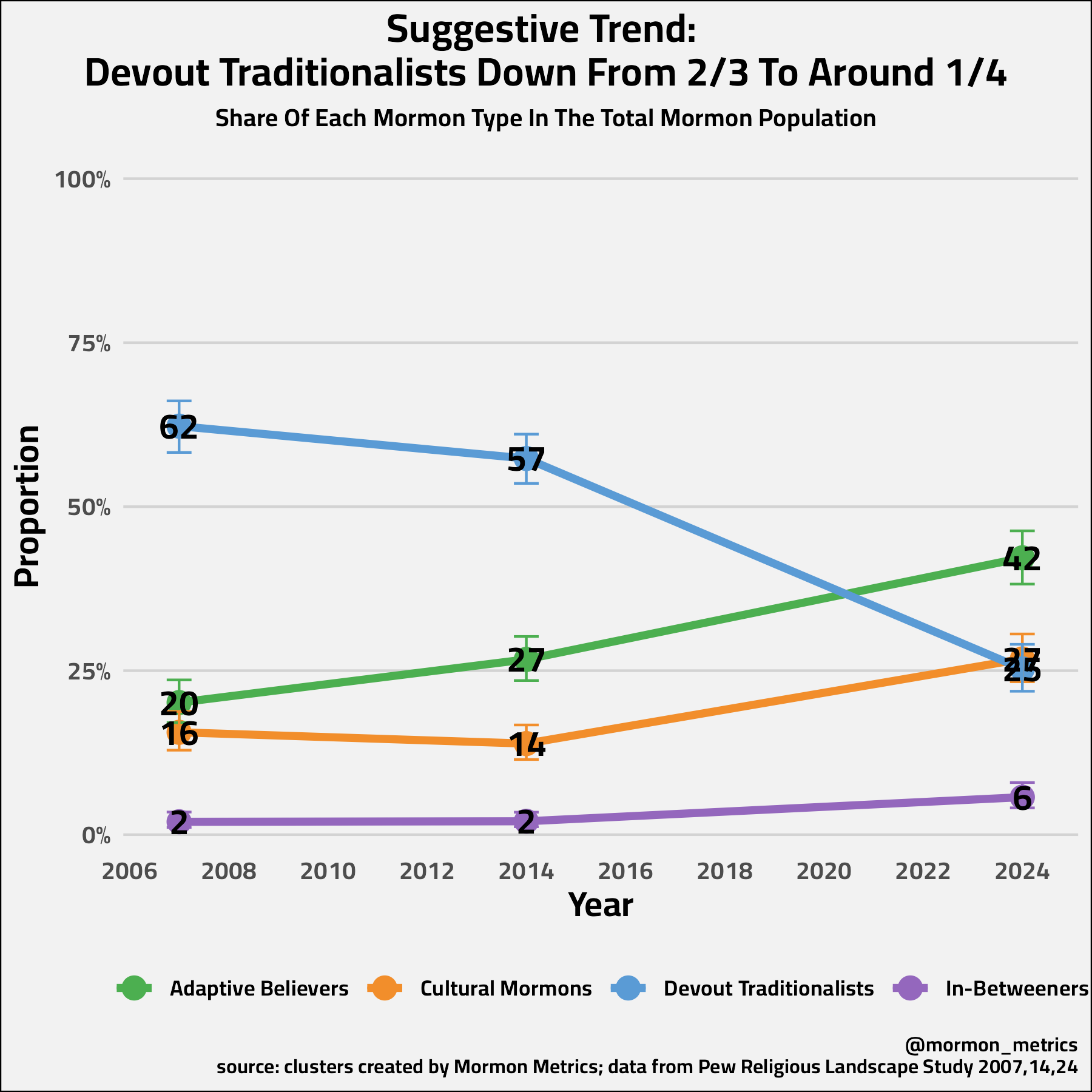
The big takeaway for me were how few was the number of devout traditionalists. In 2024 only 25% of the total numbered surveyed were classified as devout. It gets even crazier! In 2007 the number of devout was 62%, then dropped a little in 2014 to 57%. So what happened in the last 10 years to have a 55% decline in the faithful ? The adaptive and culture categories went up 20% to 42% and 16% to 27% respectively. See graph below:
More interesting facts, 73% of the devout members believe the LDS Church is the “Only True Faith”, but only 50% of the Adaptive believe the same, and only 12% of the culture Mormons. What this means is that there is good chance the person sitting next to you are sacrament meeting DOES NOT believe the Church is the only way to God.
Alex’s key takeaways were: Devout Mormons may no longer define Mormonism. The Adaptive group is the largest group attending and represent the new mainstream. Nearly one in three identify as culture Mormons, it’s their heritage but not necessarily their tradition.
What are your key takaways?
What do you think caused the big drop in devout members after 2014? (Nelson? Gospel Essays? policy of exclusion?)
What group are you in?
 Wheat & Tares