
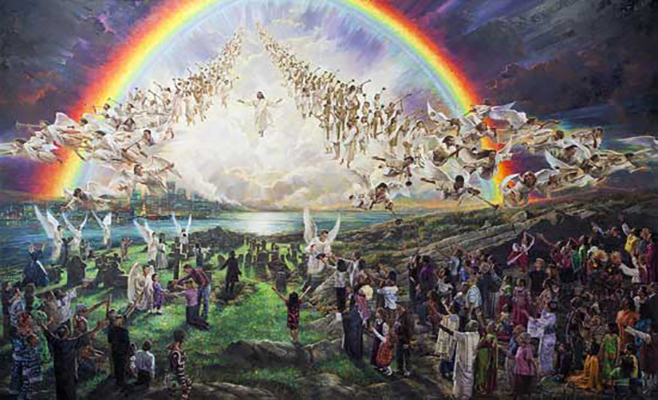
With all the rhetoric about the Second Coming resurfacing yet again, I found myself rereading the final, familiar verses of Matthew 11 with new eyes: “Come to me, all you who are weary and burdened, and I will give you rest… for my yoke is easy, and my burden is light.” These words (Matthew 11:28–30) are among the most beloved and frequently quoted in the Gospel, often lifted from their context and received as a gentle, individualized promise of comfort. Yet when read within the full sweep of Matthew 11, they become something far more unsettling.
The chapter raises a haunting question: if so many faithful, Scripture-saturated people missed the Messiah when he stood among them, what makes us so confident we would not do the same? Matthew suggests that Jesus was not rejected because he was unfamiliar, but because he failed to meet deeply entrenched expectations about how God should act and what salvation should look like. The same expectations that caused many to miss Jesus then may be the very ones that make us vulnerable to missing him again—or to discovering that we already have.
A few weeks ago, I sat down and reread Matthew 11 in its entirety, and what struck me immediately was how intentionally Matthew curates the narrative. The chapter is not a collection of disconnected teachings, but a carefully constructed meditation on expectation and disappointment. Matthew draws our attention to four distinct burdens, carried by four different groups of people—each heavy in its own way: the burden of a retributive Messiah, the burden of Spectacle (demonstrations of power), the burden of religious certainty, and the burden of control.
When these burdens are held together, the final verses of Matthew 11 become far more than a comforting invitation. They become a radical redefinition of salvation itself. Read alongside the opening of chapter 12, the tension sharpens even further. Matthew builds toward a dramatic contrast—one that Jesus resolves in the most unexpected way.
“My yoke is easy, and my burden is light.”
To the crowds, the disciples, and especially the religious authorities, these words must have landed as a profound disappointment. They were waiting for a Messiah who would overthrow oppressors, purge Israel with fire, and restore national glory. Instead, Jesus offers rest rather than retribution, mercy rather than sacrifice, peace rather than destruction.
This is salvation—not as cosmic payback, but as divine gentleness.
Everything Jesus does in these chapters presses against the weight of the status quo. Importantly, he does not do this by rejecting the law, but by restoring it to its original purpose. He insists that he has not come to abolish the law but to fulfill it. Yet to those in power, fulfillment sounds dangerously like rebellion. What they perceive as threat is, in reality, completion. What they call lawbreaking is actually healing. The more Jesus heals, the more exposed they feel; the more he relieves burdens, the more tightly they cling to theirs.
By the time we reach Jesus’s final words in the chapter, the irony is unmistakable:
the so-called Savior of the world saves it not by conquering enemies, but by lightening the human soul.
In his kingdom, salvation feels less like victory and more like relief. Not triumph, but rest. Not force, but freedom. Not separation, but restoration.
And to those who expected a warrior, a judge, a nationalist hero—this looks like failure of the highest order.
But to the weary,
it is the beginning of salvation itself.
Read in isolation, Jesus’s invitation— “Come to me… my yoke is easy, and my burden is light”—can sound like little more than a soothing spiritual slogan. But within the narrative Matthew constructs, it is intentionally disorienting. It is underwhelming to anyone who comes expecting a Messiah of violence and divine destruction.
Matthew 11 is, at its core, a chapter about misunderstanding—about how deeply held religious expectations can blind even the devout to the presence of God standing in their midst. The tension surfaces immediately with John the Baptist. From a prison cell, John sends messengers to Jesus with a startling question: “Are you the one who is to come, or should we look for another?”
The question is striking not because it is theologically complex, but because of who asks it. John dedicated his life to preparing the way for Jesus. He baptized him. He proclaimed him. And yet something in Jesus’s ministry does not align with the vision John carried in his heart.
John’s question cracks the chapter open: if the one who comes does not punish the wicked, bring fire, or execute judgment on the empire, is he really the Messiah? For many in John’s day—and in ours—the answer is not obvious.
It is not difficult to sympathize with John’s confusion. The long-anticipated Messiah was imagined as a figure of retribution—a political and spiritual revolutionary who would cleanse Israel, overthrow Rome, and vindicate the righteous. Against that backdrop, Jesus’s ministry appears almost disappointingly gentle. He heals the sick. He eats with the wrong people. He refuses the sword. His posture is mercy rather than might, restoration rather than retribution.
To someone formed by apocalyptic expectation, Jesus’s behavior provokes the very question John voices on behalf of us all: Is this really the one?
Modern readers are not exempt from this tension. Many Christians still anticipate a Messiah who will return in fury, destroy the wicked, and impose order by force.
Consider the familiar hymn, “Jesus Once of Humble Birth”:
Jesus, once of humble birth,
Now in glory comes to earth.
Once he suffered grief and pain;
Now he comes on earth to reign.
In such an imagination, Jesus’s gentle invitation to rest—his offer of an easy yoke and a light burden—can feel trivial, like a spiritual consolation prize rather than the arrival of divine justice. If the Messiah offers rest instead of retribution, healing instead of destruction, then perhaps, as John wondered, we too should keep looking.
Yet this is precisely where Matthew presses the point.
Jesus does not answer John by appealing to power. He appeals to a different kind of evidence: “The blind see, the lame walk, the lepers are cleansed… and the poor have good news preached to them.” In other words: I am the Messiah you did not expect—the one who heals rather than harms. And then comes the quiet warning: “Blessed is the one who is not scandalized by me.”
The scandal is that Jesus reveals a God who acts contrary to our religious imagination. A God who refuses to meet violence with violence. A God who chooses compassion over conquest. A God who transforms the world not through domination, but through presence.
The Messiah John expected—the one many still expect—would be instantly recognizable. But the Messiah who heals, restores, and widens the circle of belonging is easy to miss.
This is why Matthew 11 ends the way it does. After John’s doubt, after the crowds’ confusion, after entire cities fail to perceive the miracles before them, Jesus turns not to the powerful or the learned, but to the weary.
“Come to me,” he says. “Learn from me.”
His yoke is easy not because life becomes simple, but because he invites us to lay down the crushing weight of our inherited expectations—especially the belief that God must destroy in order to save.
Matthew 11 confronts every generation with the same question:
Would we recognize the Messiah if he came as healer rather than judge?
As one who restores rather than retaliates?
As one who embraces the very people we exclude?
Or would we, like John behind prison bars, peer through the confines of our expectations and ask, “Are you really the one?”
Have we already rejected him?
What Jesus offers in Matthew 11 is nothing less than a revelation of God in the flesh—one that dismantles the darker imaginations we project onto the divine. He is the Messiah who brings rest because he reveals a God whose deepest nature is mercy.
And unless we release the Messiah we expect, we may miss the Messiah who is already among us.
QUESTIONS To consider
- What expectations, created by supposed prophesy, are a set up for us to miss the messiah again?
- Why would Jesus come the second time exactly how the 1st century Jews expected him to the first time?
- In what ways have we already missed him?
 Wheat & Tares
Once upon a time, I heard a TV sermon by Billy Graham. The punchline was “Matthew 24 is knockin’ on the door.” Matthew 24 is the expanded version of Mark’s little apocalypse in Mark 13. Maybe it should have been, “Matthew 24 is knockin’ on the door, but no one will answer.”
The first thing this question made me think of is the rapture. So many evangelicals are expecting Jesus’s second coming to be announced by themselves as the righteous being floated up not the air. What if instead, Jesus shows up as a black woman, oh, say running for president.
Or apply it to us Mormons, and instead of coming down from the sky to the Salt Lake Temple, Jesus shows up as a chain smoking black woman holding a “never Trump” sign.
That should read “up into the air.” Missed hitting that “i” at the beginning and spellcheck can’t imagine missing a beginning letter, so it make the sentence totally unintelligible rather then just looking like a typo.
Anna –
I have found it increasingly difficult over the past few years to read the New Testament without being confronted by a persistent question posed by the religious leaders: “Why do you eat with sinners?” In other words, why are you spending time with the wrong people? That question lingers with me. If Jesus showed up today, who would be my—or our—Samaritans?
Again and again, Jesus makes it clear that the problem was not the law itself, but the way its intent and purpose had been corrupted. The law was no longer being used as a means to love, heal, and care for people. Instead, it had become a measuring stick—deciding who was in and who was out. Worthiness replaced compassion. For the religious leaders, and often for the LDS Church as well, the law becomes less an act of love and more a way to secure personal righteousness. So if Jesus showed up today, would we recognize him? Or would we dismiss him because of the people he chooses to be with—those our laws and traditions label as “unworthy”?
If Jesus were to come today, many of us as Latter-day Saints might expect him to go straight to the prophet’s home. But judging by his mortal ministry, it seems far more likely that he would be found with those we least expect. That reality should unsettle us. It should make us pause and wonder—not only whether we might miss him if he came, but whether, in some ways, we already have. I can’t shake the feeling that our leaders might treat Jesus the same way they treat others who challenge established power structures.
Jesus seems especially drawn to those on the margins. He eats with the unworthy, the overlooked, and the struggling. They are honest about their lives. They do not hide behind commandment-keeping or religious performance. They acknowledge their needs, their desires, and their brokenness—and Jesus repeatedly calls them more faithful than anyone he has encountered. That realization unsettles me. It makes me wonder whether I would recognize Jesus at all, or whether I might be standing among those asking the same old question: Why do you eat with sinners?
To expand on what Anna said; In his book “The Backslider”, Levi Peterson has the protagonist, a backsliding Mormon cowboy meeting Jesus out on the ranch. Jesus looks is a disheveled cowboy, riding a horse and smoking a cigarette.
As I get older, the more unappealing the endtimes stuff looks, the more unappealing a God who would perpetrate that looks. The belief that an infinite God who created everything in all its complexity can then only come up with the idea that destruction of the “other” is the answer is just mindboggling to me. It shows me that this version of God is not really that good at what he/she does.
I don’t think anyone has ever thought the burdens brought on by the expectations of the LDS church to be light. And I wonder if we don’t really understand what burdens we should take on, because I find when we talk about burdens, we really mean a laundry list of required performances. I’ve wondered the same thing about our ability to actually recognize Christ and what we feel is different this time that would enable us to recognize him this time. I don’t know that we would. I don’t know that our leaders would. I’m open to be surprised. The problem is, we exhibit the same behaviors as those anciently–we are just so certain of our understanding of things, there is no room or ability for further understanding. In essence, we are clutching our pearls so tightly, we aren’t in a position to receive anything better.
I don’t hope for a hell for people. I don’t hope for a destruction for people. I frankly hope for a 3 Ne 11 experience where Jesus descends and just helps everything be better. I hope blinders come off so that we can really see where we could do better. Because I think right now, our vision of the celestial kingdom seems more and more like a place I would rather not be–hardly anyone is going to be there. I can’t honestly bring myself to care about living in the presence of God when he is absent here most of the time and I can’t remember ever actually meeting or knowing him. Talking to a JW one time, he mentioned at being part of the 144K would be an honor, but he said he’d rather not be there, but with his family elsewhere. There is just so much about God and the way we view or understand him right now, that if we’d actually sit with it and interrogate it, we’d realize that we actually don’t like it–that perhaps it should be different.
Julian of Norwich believed in Hell because scripture had told her that it existed. But her belief in the goodness of god led her to doubt that there was anyone in it, other than the angels the Bible stated were there. She believed that love sustains all creation. Also that in the end, god would bring everything to good. I like that view.
I also think of a classic Star Trek episode, “Is There In Truth No Beauty?” where Miranda says to Spock, “Who is to say whether Kollos is too ugly to bear or too beautiful to bear”? Perhaps the Apocalypse will be a thing of love and beauty that we cannot comprehend so we transform it into a horror which we can comprehend.
Chris
A thoughtful reply. The very strange thing about those final verses in Matthew 11 is that we have chosen to pair “Yoke” with the image of the wooden beam connecting to Oxen, suggesting that the workload is made easier with two rather than one.
Although I understand the sentiment, this is not how a first century Jew would have understood the word “Yoke”.
A first-century Jewish audience would have understood “yoke” primarily as a metaphor for submission to God’s authority or to a teacher’s instruction, not as a piece of farming equipment. In this context, Jesus’ invitation to “take my yoke” signals a call to embrace his teaching and way of life, contrasting it with the heavy, burdensome interpretations of the Law imposed by other religious leaders. The “ease” and “lightness” of his yoke refer not to physical labor but to the spiritual rest and guidance found in following him, making the metaphor about discipleship rather than agricultural cooperation.
Jesus famously distilled the 613 written laws, along with the hundreds of additional interpretations, into two guiding principles: “Love God, Love Neighbor.” The purpose of the Law was never to prescribe every possible action but to serve as a guide for living in relationship with God and others. It could not anticipate every situation or dictate exactly how love should be expressed. By doing this, Jesus removed the heavy burden of trying to achieve perfect religious performance, offering instead a yoke that was simple, clear, and focused on the heart of God’s will.
When Jesus said, “Come follow me”, the implication was, don’t follow them, their interpretation is heavy and burdensome and consumed with managing your “persona”. He quietly suggests, there is a lighter way to live than that. And the powers that be killed him for it.
Todd S
Your post makes me think of Luke 24:16
16 But their eyes were holden that they should not know him.
It seems that many did not recognize The Mesiah even after his resurrection. Why? Because their eyes were “holden.” This is the KJV and the footnote says the Greek translation is “restrained.” Maybe the reason we might miss him is because we are looking with our natural eyes and not with our spiritual eyes. We need a paradigm shift.
Later in the chapter, we read:
31 And their eyes were opened, and they knew him; and he vanished out of their sight.
32 And they said one to another, Did not our heart burn within us, while he talked with us by the way, and while he opened to us the scriptures?
The disciples recognized him this time because their eyes were open. I don’t believe truth claims should be based on emotion or feeling, but I do believe the heart can be a powerful guide in helping us recognize and discern goodness and possibly recognize The Messiah. As Isaiah says, “He hath no form nor comeliness; and when we shall see him, there is no beauty that we should desire him.”
The Rise of a New Middle East. In 1948 post Shoah Jewry, compares to the mythical phoenix rising from the ashes.
At the heart of the Jewish State beats the pulse of Shabbat observance. Zionist Israel – a secular State. How to understand and correctly interpret the קידוש sanctification of Shabbat that forbids the types of work necessary to build the Mishkan — specifically מלאכה. Off the דרך Yeshiva institutions emphasize what Jews can’t do on Shabbat.
This tuma צר עין expressed by religious Orthodox Judaism rabbis has defined the cultural identity of g’lut Jewry following the Roman forced expulsion of Jews and the renaming of Judea unto Palestine by European aliens. Arabs cannot even pronounce the letter “P” as in Balestine! Arafat’s opportunistic propaganda declares the Balestinian people descended from the Philistine boat people who invaded Gaza from the Greek Islands. As if Arabs originated from ancient European civilizations.
The connection between מלאכה כנגד מלאכים. The shabbat קידוש by emphasizing איסר מלאכה therein defines עבודת השם on the 6 days of chol. This Torah commandment, עבודת השם, Jews dedicate their obedience to the Torah by sanctifying the חכמה של תורה – שנקרא מלאכה, throughout the 6 days of Chol. Shabbat serves as the logical דיוק which specifies the wisdom of the Torah throughout the Ages and generations.
On the day of Shabbat a person rests from doing the עבודת השם of מלאכה which creates מלאכים created through the מלאכה of טהור זמן גרמא מצוות. Shabbat as a time-oriented commandment dedicates not to sanctify time-oriented commandments on that one day of the week. Hence totally not relevant whether a person first squeezes the juice of a lemon onto sugar in a glass, and their after fills that glass with tea. Rabbi Yisrael Meir Kagan (the Chofetz Chaim), author of the Mishnah Berurah (1947), his commentary to the assimilated statute halachic code originally written by Yosef Karo – both men walked completely off the דרך.
The day of Shabbat Jews דוקא do not do the עבודת השם required to construct the Mishkan – establish a מקום קבוע for the Shekinah. Meaning, Jews do not do mitzvot which requires k’vanna on the time-oriented mitzva day of Shabbat. The logical דיוק instructs a powerful mussar. On this day Jews rests from sanctifying acts of מלאכה; to sanctify the dedication to do acts of tohor time-oriented commandments which require k’vanna on the 6 Days of Chol – the definition of the Torah commandment known as עבודת השם. During the 6 Days of Chol – like shabbat – Jews dedicate not to doing acts of theft, oppression, sexual perversion, and judicial injustice to our bnai brit allied Cohen people.
Shabbat as a day set apart from the שישה ימים של חול, serves primarily as a day of rest from creating מלאכים על ידי זמן גרמא מצוות. During these 6 days of “shabbat” (shabbat understood as inclusive of the entire week and not simply one day of that week.), Jews חכמה של תורה creates more “allies” on our side than the multitudes of Goyim enemies who seek another Shoah; like the Armies of Arabs in both the 1948 and 1967 Wars. Therefore, viewed from this perspective the mitzva of Shabbat simply crucial for spiritual rejuvenation. A purpose rest from doing time-oriented commandments with k’vanna, such that a Jew re-invigorates his dedication of doing עבודת השם time oriented commandment wisdom throughout the coming 6 days of Shabbat, based upon the Order of Creation of the Universe.
The Hebrew terms far clearer and more precise than translations or transliterations. מלאכה כנגד מלאכים, this Hebrew distinguishes “work” from “Angels”. The Hebrew of כנג means “contrasted by” something like מידה כנגד מידה translated as Measure for Measure, a method of judicial justice. The measure a person inflicts damages upon a person, that precise “measure” of damages the guilty respected to pay to the victim. Damages ways such thing as emotional humiliation and disgrace of ones’ honor in addition to simple physical damages.
With the AI cutting and pasting Hebrew with the command translate, permits non Jews to easily translate Hebrew words. The term איסר מלאכה — banned for forbidden work, specifically on the day of Shabbat. The טיפש פשט\bird brained literal translation of “not doing work” simply brain dead stupid because עבודה, another word for “work”. The Aramaic term: מאי נפקא מינא jumps straight into kabbalah – the concealed or hidden ideas; it translates as “What’s the difference”. In this case between the words מלאכה כנגד עבודה? Specifically to how it applies to doing עבודת השם – Divine service or worship as a Torah commandment. Herein the mitzva of Shabbat which דוקא-precisely explicitly forbids doing מלאכה on shabbat. Bird brained religious rabbis instruct in Yeshivot across the Planet since the Reshonim (950-1450 ce) ”forbidden to do all manner of work on shabbat!!!” A complete load of bull shit! מלאכה, a term employed in the Torah describing the building of the Mishkan/Tabernacle. This “work” – skilled craftsman labor – such as cutting and polishing gem stones etc. Why does shabbat forbid acts of skilled craftmanship labor on shabbat? This question the ignoramus Jesus and Muhammad did not know.
Why? Because both these “Protocols of the Elders of Zion” (the pre-Bolshevik revolution slander fraud wherein the Czar’s secret police justified the Russian pogroms of the 1880s based upon this fraud book. Both the New Testament and Koran, simply earlier examples of the Protocols of the Elders of Zion fraud.) had no knowledge of the fundamental basic building blocks upon which stand the P’rushim (They predated the rabbis of the Talmud during the Hanukkah war against the Syrian Greeks) defined Oral Torah Horev revelation expressed through the inductive logic known as פרדס.
(I realize that this seems like Moon made of green cheese nonsense. But to understand traditional Sanhedrin courtroom “faith” which defines justice as “fair compensation of damages inflicted” rather than belief in some theologically defined belief in Jesus or Allah as God.)
The fraudulent texts New Testament and Koran, their Greek rhetoric foundation of crowd control, immediately jumps into deep waters knowing that their Goyim reading audiences do not know how to swim. Hence people in desperation of drowning grasp anything “they believe” will save their lives! The Apostle Paul introduced, for example, the idea of “original sin”. All mankind doomed to burn in the flames of Hell for all eternity consequent to the fall of Adam and Eve in the Garden of Eden. Hence the need for Jesus the messiah who “SAVES”. The Koran defines prophet as a person who warns people. It declares that prophets, sent to all people – and these prophets – who warned their people of eternal death – spoke the language of the people that Allah sent them to warn. Arabs the last people on the Earth who received Allah’s prophetic warning of approaching eternal death. Hence Muhammad the last of the prophets!
Alas the Torah does not define a prophet as a having the primary purpose of warning their people. The Torah brit stands upon blessings כנגד curses; Life כנגד Death. The 5th Torah Book of D’varim states this quite plainly.
Greek rhetoric propaganda never defines its most basic and fundamental terms. It leaves these most essential building blocks of understanding floating as undefined terms in the air. It then proceeds to throw the reading audience into deep water without a life raft! In 2008 candidate Obama did this same stunt with his “CHANGE” political rhetoric. Never in the 8 years of his Presidency nor thereafter did he ever once define this term “CHANGE”, which got him elected into Office as an America messiah. Two weeks into Office as President the Nobel Peace Prize awarded to Obama!
Torah prophets do not foretell the future as the New Testament defines the term “prophet”. The Torah refers to av tuma avoda zara witchcraft as persons who declare future events! Both Greek rhetoric function as substitute theology and revisionist history. No different from the fraudulent “Protocols of the Elders of Zion” wherein the Czarist secret police justified the Russian pogroms against the Jews.
Greek rhetoric compares to a man who pulls a rabbit out of his hat. It appeals to emotions rather than rational thinking. During the Biden Administration the Trump derangement syndrome where democratic supporters threw all manner of hatred against Trump and his supporters. Hillery Clinton’s rhetoric called Maga – Deplorables!
The fraudulent books New Testament and Koran totally ignored the basics of Yiddishkeit! Rabbi Akiva taught as the basic of his understanding of פרדס inductive reasoning the middah of רבוי מיעט. A principle of textual interpretation that contrasts a general inclusion (רבוי) with a specific limitation (מיעט).
Impossible to read and understand the Torah while ignorant of the basic fundamentals, the building blocks which construct the Oral Torah inductive logic system revealed to Moshe at Horev which permits later generations to interpret the intent of the written words of the Torah.
The lights of Hanukkah dedicate the P’rushim commitment to only interpret the Written Torah and NaCH prophets through פרדס, as opposed to Greek syllogism deductive logic, reasoning. Herein defines the k’vanna/intent of lighting the lights of Hanukkah as a mitzva from the Torah throughout the generations!
Shabbat a מיעט, whereas the 6 days of the week a רבוי. The טיפש פשט Reshonim scholars of the Torah and Talmud, their religious rhetoric took a “literal” (Think fundamentalist Xtian reading of the Creation story in their silly bibles.) reading of מלאכה which the Reshonim deduced to mean: “Do not do work on shabbat”. Brain dead stupid religious rhetoric sucks rotten eggs!
The Reshonim scholars not well versed in the basics. The Rambam Civil War re-fought the P’rushim/Tzeddukim Civil War! Only g’lut Jewry accepted the assimilated Rambam Karaite theology which perverted Torah faith from the righteous pursuit of judicial justice to the Av tuma Xtian and Muslim belief into one God. Monotheism rapes the 2nd Sinai commandment; if only one God then no reason to command not to worship other Gods!
The Torah commandment לא תעשה מלאכה על יום שבת – forbidden to do work on shabbat – does not follow the Greek deductive logic which deduces that this commandment refers to shabbat. Rather had the Reshonim scholars understood the fundamental basics of Talmudic literature they would have understood that rabbi Akiva’s רבוי מיעט as a logical דיוק/inference. Forbidden to do מלאכה on the day of shabbat, to commanded רבוי, to raise תולדות/secondary positive and negative Torah commandments, as common law precedents (משנה תורה means common judicial law), to elevate these secondary Torah commandments which do not require k’vanna to av tohor Torah commandments, זמן גרמא מצוות, which do require k’vanna – throughout the 6 days of “Shabbat”. Shabbat like a pun means both one day AND the entire week!
The term מלאכה therein functions as a definition of rabbi Yishmael’s פרט כלל – specific/general classification of Oral Torah inductive reasoning logic. The Greek rhetoric employed by the converted Reshonim Karaites never developed anything more than a corrupt “fuzzy logic” understanding of Tannaim middot of logic and how one Tanna’s middot of logic amplified another Tanna’s middot of logic.
The post Karaite Rambam Civil War perverted faith as the righteous pursuit of judicial just compensation of damages inflicted …
Rambam’s song “אני מאמין” (Ani Ma’amin) prioritized faith into 13 principles of Jewish belief. An utter perversion of rabbi Yishmael’s 13 middot of logic. The Rambam’s song perverted faith as the righteous pursuit of judicial Sanhedrin court room justice which makes fair restitution of damages inflicted … changed through a Greek rhetoric substitute theology into pie in the sky core beliefs such as the unity of God, the coming of the Messiah, and the resurrection of the dead. The Torah anointed Aaron as Moshiach; the dedication of korbanot function as a משל\נמשל mussar prophetic instruction that Torah faith commands the righteous pursuit of fair judicial justice among the bnai brit people. Hence, based upon this Torah common law precedent the prophet Shemuel anointed both Shaul of the tribe of Binyamin and David of the tribe of Yechuda – moshiach. The Talmud teaches greater respect shown to the Talmud scholar than to the Moshiach because anyone can be worthy of being anointed as Moshiach whereas a Talmudic scholar 1 in ten thousand!
The Torah mitzva of Moshiach, like the mitzva of Shabbat – all bnai brit Israel can keep and sanctify. The mitzva of Moshiach anoints the dedication to pursue Torah faith – pursue justice and rule the land with righteous fair compensation of damages Jews inflict upon other Jews.