
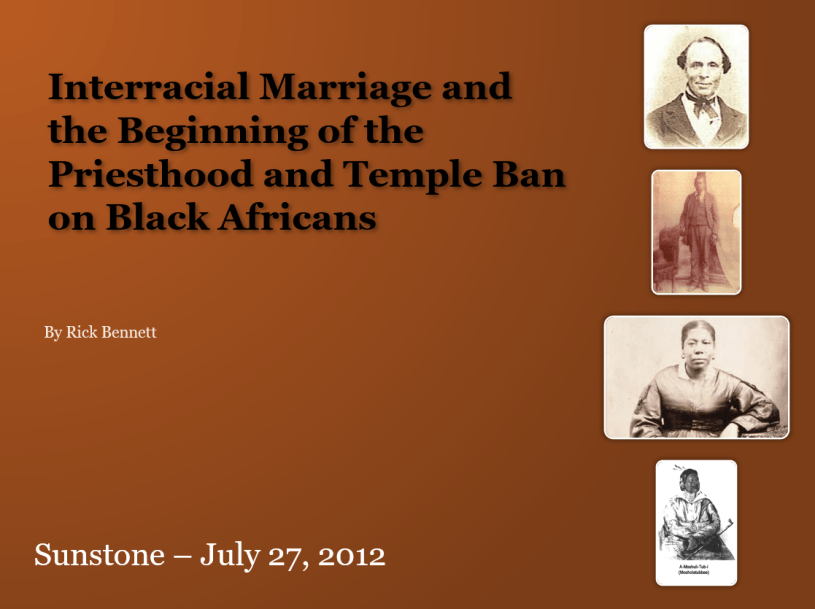
Interracial Marriage is critical to the reasons for a priesthood/temple ban on black LDS Church members. For many years, the official position of the Church of Jesus Christ of Latter-day Saints (LDS) was that “it is not known precisely why, how, or when this restriction [on the priesthood for male members of African descent] began in the church.” However, historical research utilizing early records suggests that the origins of the ban are quite specific, pointing to a confluence of events involving race and interracial sexual relations (often called “amalgamation” or “miscegenation” at the time) that served as the primary catalyst.
This was my first attempt at Mormon history scholarship and was a presentation I gave in 2012 at Sunstone outlining when, why, and how the ban began. Marguerite Driessen, former faculty at BYU was the respondent. Were you aware of this?
Priesthood Before the Prejudice (1830–1846)
Contradicting later restrictions, evidence shows that Black men held the priesthood and participated in temple ordinances during the earliest decades of the Church.
- Black Pete, the first Black convert, was baptized in 1830 and served a mission in Ohio, likely performing baptisms in January 1831.
- Elijah Abel, perhaps the most famous early Black Mormon, was ordained an Elder and then a Seventy in 1836, received his washing and anointing ordinance in the Kirtland Temple, and participated in baptisms for the dead in the 1840s.
- Joseph Ball was ordained a high priest and served as a branch president in Lowell, Massachusetts, after Joseph Smith’s death in 1844. Ball was also slated to receive his temple endowment in Nauvoo in 1845.
- Walker Lewis, baptized in 1843, was ordained an Elder by William Smith, and was later referred to by Brigham Young in 1847 as “one of the best elders an African in Lowell,” [Massachusetts.]
Furthermore, marriage between Black and white members was not automatically prohibitive; John Teague, a white Irishman, joined the church in 1842 with his Black wife, Evelyn Wilbur, and John was ordained a priest and then an elder. These facts confirm that no formal priesthood restrictions existed before 1847.
Interracial Marriage Crisis of 1847
The shift from granting the priesthood to prohibiting it appears to have been driven by the highly visible, controversial interracial relationships of two Black elders in 1846 and 1847.
- Warner McCary and Interracial Polygamy: McCary, a freed slave who claimed to be part Indian, was baptized by Apostle Orson Hyde in 1846. Some believe he was ordained an Elder, but this is disputed. In 1847, McCary married Lucy Stanton, a white woman, with Orson Hyde performing the wedding. McCary later caused outrage in Winter Quarters by engaging in “sealing ceremonies” with white women that included sexual intercourse witnessed by his wife. Church leaders quickly expelled McCary from the camp. Brigham Young expressed concern about “amalgamation,” or race mixing, during a meeting where McCary was discussed.
- Enoch Lewis and the Mixed-Race Child: Simultaneously, in Massachusetts, Enoch Lewis (son of Elder Q. Walker Lewis) married Matilda Webster, a white woman, in 1846, and they had a mixed-race infant girl in 1847. Mission president William Applebee was so disgusted upon meeting the couple and their child that he wrote a dismayed report to Brigham Young asking if it was “the order of God to be tolerated in this church to ordain negroes to the priesthood” and allow amalgamation.
When Brigham Young received Applebee’s report in October 1847, he responded strongly, stating that when Black and White people “mingle seed it is death to all” and that if they were far away from non-Mormons, they would “all be killed.” Following these cases, Brigham Young privately claimed that “black-white sexual relations were against the law of God and advocated death to all who participated.” This reaction was fueled by a desire to stop interracial marriage & led to the institutional restriction.
The ban was publicly affirmed on February 15, 1852, when Brigham Young addressed the Utah territorial legislature and espoused the Curse of Cain doctrine, stating that the mark of Cain “is seen in the face of every negro on the earth” and declaring that any man “having one drop of seed of Cain in him cannot hold the priesthood.”
Elephant in the Room: Racism
While interracial relationships may have been the catalyst that triggered the ban, many argue that this analysis ignores the underlying issue: pre-existing racial prejudice. Marguerite Driessen notes, “interracial marriage can cause no problems and it can result in no bad consequences at all unless there’s already racial prejudice to begin with.”
The underlying racism allowed church leaders to:
- Ignore precedents like Elijah Abel’s ordination.
- Contort accepted doctrine to justify exclusion. For example, the Second Article of Faith states that humans will be punished for their own sins, not Adam’s transgression, yet the priesthood ban relied on the “curse of Cain,” effectively punishing Black individuals for the sins of an ancestor.
- The notion of “accursed lineage” derived from the Book of Abraham’s account of Egyptus, which was used to justify denying saving ordinances based solely on lineage, a factor over which people have “no agency or control.”
Thus, the events of 1847-1852 did not create the prejudice, but rather offered a convenient, concrete focus for leaders to impose restrictions that many members and leaders were already culturally inclined to accept. The ban was the result of church policy, not doctrine, and was maintained because the congregation was unwilling to fully accept equality until the 1978 revelation ended the restriction.
Do you agree, disagree? Did you learn anything?
 Wheat & Tares
I was a teenager in the 1990s, raised in Utah County, where my stake president and many members of my ward were BYU professors. I distinctly remember a stake meeting in which the stake president held up a copy of the Ensign and spoke very negatively about interracial marriage. I specifically recall him saying that while it was not against God’s will to marry outside one’s race, it was discouraged. The framing was very similar to how a single mother might be discussed: the ideal is a husband-and-wife family, but sometimes circumstances fall short of that ideal. The clear subtext—taught explicitly and implicitly—was that marrying outside one’s race was wrong. And this was in the 1990s.
A core premise of the Church is that the living prophet reveals God’s will. That is precisely what Doctrine and Covenants 1:38 teaches: “Whether by mine own voice or by the voice of my servants, it is the same.” The endless debate over “policy versus doctrine” is a distinction without a difference. Brigham Young and many prophets after him taught and reinforced racist doctrine. This included influential leaders such as Bruce R. McConkie, whose Mormon Doctrine sat on the shelf of nearly every Mormon intellectual household of my era.
We would do well to state plainly that, at a certain point in Church history, doctrine became racist and policy reflected that institutional racism. That doctrine was not from God, but it was promulgated by the highest leaders of the Church. Quite frankly, they got it wrong. And eventually, they repented and got it right. And we continue to be haunted by that to this day. I see lots of evidence that things are getting better. But I get discouraged when we can’t admit the truth that it was racist. That feels like a major step backwards.
The longer we attempt to gaslight members by dancing around “speaking as a man” versus “speaking as a prophet,” the more credibility we lose. We need to own the mistake, acknowledge the harm, and move on. Repentance means changing one’s mind. We have changed our understanding of race, but we have not been honest about how deeply racist our doctrine and policy once were.
I didn’t realize how intertwined the evils of racism and the evils of polygamy were in the early church. I would strongly suspect that Brigham Young and other high ranking leaders’ disgust for interracial marriages stemmed from not wanting more competition in accumulating young wives for their eternal harems. They wanted to keep the pool of polygamist men small to their inner circle of ordained men. Opening up ordination to non-white men meant there would be more men eligible to practice polygamy. The easiest way to reserve more women for themselves was to restrict ordination and temple ordinances to white people. I would be curious to know if the same racist policies applied to Native American men. I was under the impression that some white male church members occasionally married native women, which doesn’t match up with their disavowal of interracial marriage. But the hypocrisy of a white man marrying a native woman falls perfectly in line with polygamy.
I do find myself inclined to agree with Marguerite’s response at the end: Interracial marriage is only a problem when you are already racist.
But oh, what a kaleidoscopic view that that the racism prism reveals of Mormonism!
It absolutely does strike me that a LOT of the biggest examples of racist violence in this country stemmed precisely from perceived transgressions of interactions between black men (and even teenagers…thinking about Emmett Till) and white women. It is sobering (but not surprising) to find out that the same dynamics came through with Mormonism and polygamy.
It is incredibly poignant that we can’t get people to fully acknowledge polygamy was a bad, wrong thing. And even back then, while there were supporters and detractors, it was clearly not something that everyone could agree was bad. Whether past or present, people aren’t really comfortable with saying whether Joseph Smith’s polygamous exploits disqualified him. And yet, somehow, when you have a black guy taking a white wife or multiple white wives, then all of a sudden, everyone can understand that it would only have been natural for them to want to do something about that. I don’t even know where to begin with that.
I am with Andrew on this. I don’t know where to even begin. Maybe if I write things down, it will begin to make sense.
In reading first the title that interracial marriage was the catalyst for the ban, then down in the history of black men being given the priesthood there was a white man ordained who had a black wife, but the leaders were all fine with that. Then the leaders freak out over a black man with a white wife. But but but, don’t you get interracial children when the father is white and the mother is black. But the leaders were fine with THOSE interracial children. The ban had nothing to do with mixed race children.
It isn’t about mixed race *children* at all. And it is not really about polygamy. It is about the purity and ownership and control of white women. White men really don’t care about who other white men have sex with. But boy howdy better not catch a black man with a white women. One is no problem what so ever, while the reverse is enough to give them apoplexy. It really is about controlling white women. Keeping ownership of white women. They could care less about interracial children, unless it is a white woman giving birth to that mixed race child. Then they freak out.
Andrew has it correct that this is exactly the same white male reaction that led to the worst racial violence. Exactly the same thing as got Emmitt Till killed. The plot of To Kill a Mocking Bird. Same old same old.
The priesthood ban had nothing to do with mixed race children. It had everything to do with ownership, control, and supposed purity of white women. That isn’t “protecting” women, just asserting ownership. I think I am just as offended and disgusted by Brigham Young’s thinking as Andrew has every right to be. The priesthood ban that hurt black people was all about ownership of white women. Ownership by white men. Bleh, I am not likening white men very much right now.
Anna, yes. My thoughts were heading in the same direction. Thank you for articulating it so well.
Among other things, racism means that an entire group of people are dehumanized and deemed unworthy of rights and privileges that white people take for granted. Top LDS leaders blamed the ban on God, but it was really caused of their lack of love, respect, and value for a subgroup of people. These folks were not considered worthy of having eternal families, participating in church leadership, or even passing the sacrament. Leaders adopted the racism of the culture and the racism found in the BofM and the PofGP to justify the priesthood ban and have never apologized for it, instead–as I mentioned earlier–blaming God for it, which is gaslighting, obfuscating, and pullsinamity at its worst. Until anti-racism teachings are incorporated into LDS curricula, the Church will continue to have a culture of benign racism.