
In my previous post “Do you feel lucky to be/have been LDS?“, one of the commenters replied:
Yes I feel lucky to be Mormon.
It gives me the highest perspective of life and universal truths.
The church will continue to become more liberal as Satan has captured Republicans hearts. Here in Ca. most all my ward has become Democrats.
As far as the churches stance on gays. They’ve accepted them as brothers and sisters but do not support their actions that go against the teachings of Jesus Christ. We all have our crosses to bear. Someone with anger doesn’t have a right to kill someone as someone with depression doesn’t have the right to kill themselves.
This sentiment did not go over fantastically with other comments. I think it raises a broader question: what counts as a cross to bear?
This person wants to compare homosexuality with anger or depression. The implication is that gay people should dislike their homosexuality as angry or depressed people dislike those emotional states. Further, actions downstream of those states should be suppressed. I see several problems with this comparison. First, not everyone feels bad about homosexuality as they do about being depressed. And (so?), not everyone sees same-sex relationships as something to be stifled. We don’t agree these are akin to “crimes of passion” committed out of anger.
Another commenter questioned why the first would discuss LGBTQ issues but not race, since my post touched on both. As they said:
It’s interesting that you focused on the LGBTQ issues in the OP instead of race. Let’s go back to the early 1970s when Church leaders repeatedly taught that it was the will of Jesus Christ that Black members not have the priesthood or enter the temple. If you were living at that time, would you have responded to the OP with something like “They’ve accepted them [Black people] as brothers and sisters but do not support their actions that go against the teachings of Jesus Christ. We all have our crosses to bear”? That stance seems consistent with your current position on LGBTQ people.
…But I think, if you’re ready to experience horrors beyond your comprehension, the reality is worse. This isn’t just something we left in the 1970s. Rather, some people in the LDS church have fraught opinions on race even in 2025.
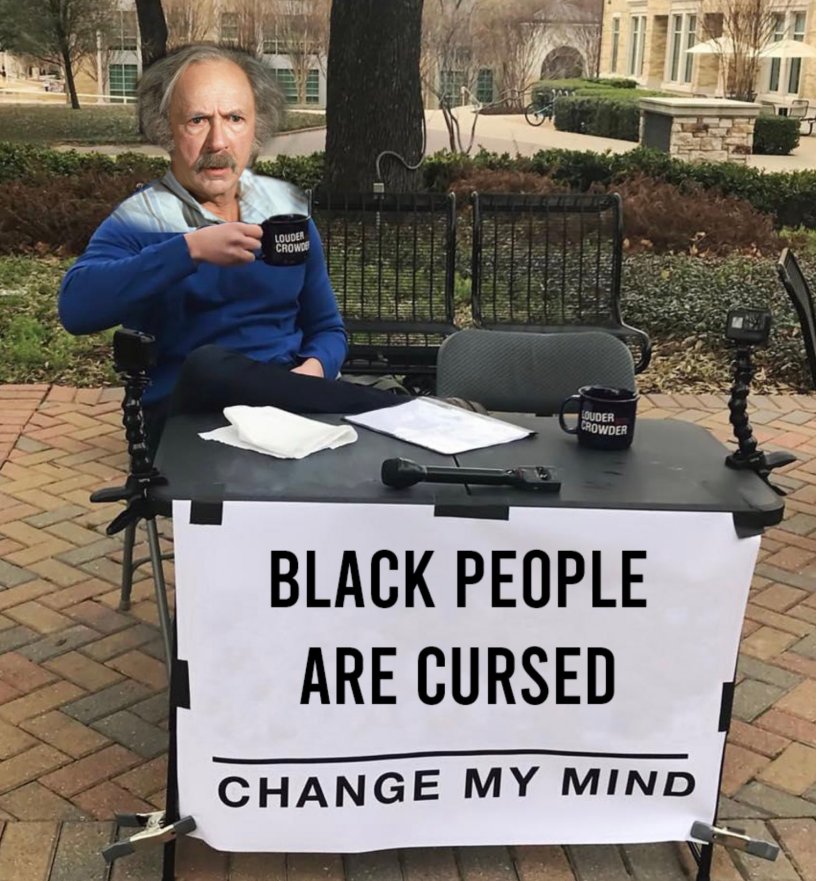
Allow me to introduce you to @GrandpaJoeSux:
and his followup:
Now, maybe I’m naive to take anything serious from a person who self-identifies as “Grandpa Joe Sux” on X. Especially one whose profile picture is of an old man who appears to be bewildered or confused. Everything about this screams “this is just satire.” But his post was quote tweeted by a faithful black LDS member disapprovingly. Grandpa Joe’s replies there seemed to maintain a degree of sincerity.
The Cross to Bear of Race
Let’s take the 2nd tweet from Grandpa Joe. He provides a litany of statistics that look worse for black people globally. Here, I’m not interested in debating whether the statistics are correct or not. I’ll just say a few things. First, people do the same thing with LGBTQ issues. They try to show that LGBTQ have worse mental or social outcomes, or that same-sex relationships are damaging. The implication is, “if there are these bad outcomes, then the thing itself must be bad!”
Second, I do not want to suggest that all LDS folks agree with Grandpa Joe. However, I also disagree with those who suggested that Grandpa Joe was just “crazy”. Or that his beliefs were unrepresentative of or incompatible with Mormonism.
I think that worldviews give a toolbox of lego blocks. We then choose which legos to pull out to build up castles in certain ways. Mormonism gives certain legos that other worldviews do not have.
I’ll give some non-LDS examples. As an atheist, I do not have “God did it,” as a lego in my toolbox. That’s not a go-to explanation I reach for in my worldview to explain things.
Since I am not a racist, I also do not have “This is because of biological differences” as a lego in my toolbox. It’s also not a go-to explanation I can reach for in my worldview to explain things.
Since I’m a leftist, my worldview does give me legos about “social constructs.” I believe that social constructs are still powerful. The way that we treat each other has enduring effects. My toolbox might refer to social constructs like “racism,” “colonialism,” and “imperialism”.
Overall, I might be right or wrong. But shaking me out of certain elements or lego blocks would generally also shake me out of my underlying worldview.
…I understand that I do not get these blocks from Mormonism. I don’t think Mormonism even has the explicitly racist “biological race realism” lego. Rather, Mormonism wanted me to have a thoroughgoing individualism where every agent “acts and is not acted upon.” So, I understand Grandpa Joe’s struggle — the lego that Mormonism gives him is individual responsibility. He recognizes that the lego castle he builds with this lego looks harsh and uninviting. Even he recognizes the cruelty of suggesting that all these negative social outcomes are due purely to individual choices.
So, he uses the other lego that Mormonism has: God did it, and it’s a mystery.
Neither hath this man sinned, nor his parents: but that the works of God should be made manifest in him. Indeed.
Worldviews are constantly in flux. In 2025, it’s unpalatable to most Mormons to use “God did it” for race. This is why Grandpa Joe does not get unanimous agreement. Many Mormons are aghast at the thinking when it comes to race.
But there’s a reason I don’t think his thinking is foreign to Mormonism. We are in a place where it’s still somewhat common to say being LGBT is up to individual responsibility. Some are beginning to accept that maybe the inclinations are unchosen. However, it’s extremely common to believe that regardless of inclinations, people must control their actions. It’s still relatively common to believe that the inclinations are undesirable. Those “afflicted” with same-sex attraction must rely upon God and the atonement for relief. Either in this world or the next.
Because of the way Mormonism is set up, it is so easy to acknowledge these things as crosses to bear. It’s easy for Mormonism to recognize overt individual, personal racism as a cross to bear. That’s like anger.
But systematic racism? Racism without Racists as Eduardo Bonilla-Silva described? Institutionalized homophobia? Benevolent sexism? It’s harder to even recognize these as real things, much less seriously grapple with them as crosses to bear. This is why I am skeptical that Mormonism actually can get over racism, homophobia, etc., From a system that only accepts individual choice, we do not have the ears to hear and we do not have the eyes to see the forest for the trees.
- How do you define “crosses to bear”?
- How do you think your worldview has affected what is considered a cross, and what to do about it?
- Do you think Mormonism can accept the idea of “collective” crosses to bear, or is everything an individual struggle?
 Wheat & Tares
Andrew,
I appreciate your enthusiasm for introducing and contributing to these divisive topics.
First thought I have is I think there is a huge difference between a person accepting they have a cross to bear and for others to assign a cross to a person. The assignment is a cop-out and a self-justification for one’s prejudice. To say that “blacks have a cross to bear” is blatantly racist. Why would a person say that other than to justify a prejudice linked to that race.
Alas, it is my observation that too many people fixate on race and they project their feelings about race because they believe it matters. And this projection is so thick that no one believes the person who says, “I don’t care about race.” Both the racists and the antiracists say one must notice skin color and have an opinion about that! I find that dogma reprehensible.
I grew up knowing almost no black people and the ones I knew were awesome people! Most popular kid in high school was black. There was a black family in my church ward and they were just like everyone else – I never had a thought that the parents or kids were any different than me and I spent a lot of time with them. All our favorite celebrities, save Phil Collins and Larry Bird, were black – I remember when the hip thing for my peers was playing the Reggae music of Bob Marley. So when the 1990s arrived and the Rodney King beating and then riots happened, I had NO IDEA such extreme racial animosity existed – I thought that was just something from the history books.
And today, my employer is a black man, a point that I never observe openly so my friends are surprised when this fact becomes known. To me, it doesn’t matter so why would I emphasize it! So I repulse at assigning to others they have a cross to bear. I am in no position to judge that!
But a person may cope with the unfairness of life, whether it be a personal limitation or a cultural bias, by accepting they have a cross to bear. And if I was intimately aware of the challenges a person faced I would agree with them that they had a cross to bear in handling that inequity.
I just wanted to compliment Andrew on his ability to ask provocative questions and maintain decorum and civility. I appreciate his tendency to overlook the faults of other commenters and to try to understand their meaning rather than taking offense. In doing so he makes me think. When I disagree with him, I start to be empathetic to his opinions. When I agree with him, I soften so that I see the other side. Thank you for the good example to me.
1. How do you define “crosses to bear”?
I personally define crosses to bear as poverty, hunger, abuse, war, disability, living in a polluted environment, and lack of education or opportunities. I don’t see skin color as anything related to bearing a cross. If someone were to suggest that, I would view it as old-school racism. Yes, this is still prevalent in the Church today with the older generation. I believe it will die out, but there is a group of young conservatives who are resurrecting race-based grievance politics and absorbing false, racist research and hypotheses. So I guess we could go backward, though I hope not. History is contingent, and a forward-progress arc is not guaranteed. Look at Charlie Kirk and the sane-washing of his blatantly racist attitudes and comments.
2. How do you think your worldview has affected what is considered a cross, and what to do about it?
I’m LDS and an American, so I grew up believing strongly in agency. I still believe that. I take the approach of, “You are dealt a hand in life that you cannot change, so play your cards the best you can.” And I think, from a morality perspective, working toward a “more perfect union,” and notions of social justice, meritocracy, and removing systemic systems of oppression, is a moral imperative. Everyone can do something, and I think they should.
3. Do you think Mormonism can accept the idea of “collective” crosses to bear, or is everything an individual struggle?
I don’t think Mormonism will be able to accept the idea of collective crosses to bear until it becomes okay for more people to admit that previous prophets were wrong about a number of things. That is dangerous territory, though, because it opens up more agency for members to selectively pick things they agree and disagree with under the premise that some current pronouncements and positions will simply turn out to be wrong—so why not disregard them now?
1-How do you define “crosses to bear”?
So that phrase, as I read it, is based on Christ’s statement in Matthew 16:24: “Then said Jesus unto his disciples, If any man will come after me, let him deny himself, and take up his cross, and follow me.”
When I read that, I read it more as our very nature and desires, NOT that so-and-so was born depressed, or LGBTQ, or black, or whatever. So, truth be told, I don’t think most people even use the phrase correctly to begin with! “We all have our crosses to bear” – yes, we are all mortal and should seek to truly embody the symbolism of baptism, in that our carnal self “dies” and we are alive in Christ. Or something like that.
2-How do you think your worldview has affected what is considered a cross, and what to do about it?
Based on my answer to #1, I would be led to see our shared human existence as the cross to bear.
3-Do you think Mormonism can accept the idea of “collective” crosses to bear, or is everything an individual struggle?
Yes, I actually do. Before we adopted the rabid individualism of western, and specifically American, culture, we started out with an overwhelmingly collective mindset. And if the “church” ever gets back to those roots, I think we will finally be coming out of the daze of de facto republican – really, christian nationalist now – attitudes and will be more ready to recognize the systemic barriers put into place that have marginalized whole groups of people and created the very conditions that then lead to the kind of statistics of the twitter guy.
It’s not like the Book of Mormon advocated every person to work out their own salvation in terms of what Zion is/could be…it was all about every person looking after their neighbor, after all. That sure sounds much more than leaving everyone to their individual struggles.
A cross to bear is a physical or emotional load that we are forced to carry, long-lasting and that the bearer doesn’t deserve. Christ did not merit death, and yet there is he was, beaten, whipped and forced to drag a cross through the streets.
LGBTQ people *do* have a cross to bear. But the cross isn’t being LGBTQ. The cross is the collective load of crap that society forces them to put up with just to exist. They don’t deserve to be treated poorly, but too often are, and that is a cross they must bear. Similarly, racial minorities often have crosses to bear. Adherents to certain religions, or those who wish to abstain from religion. Chronic health issues, including mental health issues, can be a cross to bear, as well as the additional cross that comes from the stigma around the health issues.
Not all crosses are equally weighty and not everyone has to carry the same number. It’s not fair, but we’re also limited in our ability to eliminate the crosses some people carry. Clearly we can still do better around many crosses being borne by minorities, women, LGBTQ, etc., but there are many diseases that we are unable to eliminate or even treat effectively.
My worldview has certainly impacted the crosses I see around me. As a straight white guy in America, I have not always seen the crap that other’s have to deal with. I undoubtedly still have blind spots, though I hope they are fewer with every passing year. I’ve also taken far too long to transition from seeing the crosses people have to bear, to accepting that I have a responsibility to do something about them. Just as Simon of Cyrene stepped in to help Jesus carry his cross, I can do that for others. It does not come naturally to me, and I don’t do as well as I should. I am also responsible for removing societal crosses, even ones that aren’t my fault. I didn’t make racism. (I promise guys, it wasn’t me.) But if my society has racism (it does), and I am part of that society, then I have a responsibility to dismantle that racism. I certainly can’t do it by myself, and probably can’t make that much of a difference, but I do need to actively do what I can to end racism. And the fact that I don’t have to face it myself means that I bear extra responsibility to speak up in spaces where others may not be able to.
Mormonism should absolutely be able to accept collective crosses. Expulsion from (waves vaguely to the east) and the march across the plains are an excellent example of a cross that was born collectively in many instances. While early saints weren’t entirely blameless for all the conflict they found themselves in, they didn’t deserve to be treated as they were, and faced many hardships as a result, and there are many wonderful stories of pulling together, literally, to get themselves to Utah. There is no reason that we can’t recognize collective hardships again and rally around one another to remove the crosses that can be removed and support each other in carrying the rest as best we can.
I have both a degree in psychology and in social work, so I have two perspectives from which to see the world. Psychology is individualistic. It looks at the individual pathology, any cause of that pathology, and behavior and how to change individual behavior. Social work is social environment based. So, it looks at family and societal dysfunction and possible fixes.
Thus, I have plenty of causes of problems to look at without blaming people’s problems on God. Nope, God didn’t curse black people, but society has. And individually, they can fix *some* problems. But other problems are built into our culture and it takes society to fix them.
So, society has “cursed” black people by many individuals being racist and passing laws and individually being racist. The individual acts of racism become a big problem because when most everybody is not hiring this one guy because they are personally more comfortable with someone like themselves. But when 80% of the bosses do that, it stops being individual racism or preference and becomes a society wide problem. This is why blacks can’t just fix all the issues by individual behavior like Grandpa Joe expects. You can’t pull your family out of poverty if you cannot get a job because too many individual bosses act on their personal preference to hire a white male because they are comfortable with a white male. So, not the kind of curse God would inflict, but a curse of how groups of people treat other groups of people. So, my reaction to Grandpa Joe is to tell him that yes, black people have issues and those issues are poverty, discrimination, lack of education and it is primarily white people who caused those problems for black people and so us white people need to solve some of the problems. Head start was a very successful attempt to solve some of the problem of education and give poor kids a fair chance in schools. Uneducated parents do not read stories to babies, because mostly they are poor and working multiple jobs to pay rent and food and there isn’t time or energy even if the parents do read well. DEI was an attempt to change some of the poverty by giving minorities a fair chance at jobs. It was specifically because all things being equal on a resume, most bosses would hire the white man over an equally qualified woman or racial minority. It was an attempt to level the playing field by giving employers an incentive to look at two equally qualified people and not automatically hire the white male. Of course white males didn’t like it, because it took away their unfair advantage.
In addition to societal changes, on an individual level black people can also work at solving some of these issues. Couples can wait until after marriage for sexual relations and stop so many out of wedlock births. Students can stay in school instead of dropping out. Fathers can step up and stay in touch with children and pay child support.
But society has to make those individual choices possible. There need to be good paying jobs that pay a living wage, but the supper rich don’t like that because paying a living wage cuts into profit. Laws can be changed so that a poor woman doesn’t have to be a single mother to get government aid. But Republicans don’t like that because they assume that poor people are poor because they are lazy instead of wages being so low it takes 3 full time incomes to bring a family up to poverty level. But this assumption of laziness actually causes divorce and fathers to abandon the family, so the mother and children can get help. If the government really felt that two parents are better than one, it would feed children even when needed by a two parent family if both parents are out of work. There are so many laws that work against solving generational poverty, but the rich like such laws because they like to stay supper rich, and the rich are the ones making the laws.
I don’t think Mormonism will be able to accept the idea of collective crosses to bear
Why should a church that washes us clean of the blood and sins of this generation in addition to washing us clean of our own sins (not Adam’s) have a problem with collective crosses to bear? (Answer: because we never ever talk about what it means to be cleansed of the blood and sins of this generation.)
Collective cross-bearing, to me, sums up the entire message of Jesus. Unfortunately, Christians on the whole have really excelled as cross-builders, and largely failed as cross-bearers (see…you know, history). I think the Restoration – if understood as a Zion-building endeavor – provides a robust framework for collective cross-bearing. Unfortunately, in order to assimilate into conservative, capitalist American Christianity, the Church heavily leaned into hyper-individualized cross bearing over the last century or so. And not to be outdone by mainstream Christians, Mormons – as laid out in the OP – have done their fair share of cross-building over the years. I’m hopeful that gen-z Mormons can shake of the dust of the “blood and sins” of the past and rise up as fearless, Zion-building, cross- bearers.
A Disciple,
I like the separation between issues that a person believe themselves to have vs issues that are assigned to them by others…but I worry that part of the value of so-called “objective” morality is precisely to assert that what is right or wrong exist independently of how an individual thinks about them.
I would have two comments about color blindness.
1. Color blindness in some cases ignores that there are some differences or distinctions that people would like to be noticed. E.g., there are some distinctions that may be seen as positive or cherished that one may want people to notice, and color blindness means ignoring these things.
2. Color blindness can often run afoul of treating everyone as if they were the dominant/majority. E.g., instead of “not seeing color,” it might look like, “treating everyone as if they were white”. (“treating everyone as if they were straight” “treating everyone as if they were a man.”)
Not judging or casting aspersions, but having no idea that racial animosity exists and thinking it was just something in history is not a luxury everyone can have. This is something that is possible in color blindness if you do not experience racial animosity — you don’t need to see it, so you don’t. But racialized people generally can’t just opt out of racial animosity. Just a thought!
squidloverfat,
Awww, shucks. 🙂
Jacob L,
I think that you’re probably right on the difficulty of the church to accept collective crosses. At the very least, it probably will struggle to accept collective crosses that implicate the church itself, as anything regarding the priesthood ban or polygamy absolutely do. The church condemns racism, but struggles to unequivocally say the priesthood ban itself was racist, because that raises uncomfortable questions about the nature of prophecy and revelation…
Adam F,
What are our very natures and desires? It’s hard to grapple with what this concretely means if it’s just “shared human existence” or “mortality”. I do think you have a point in that we do have some lego blocks for collective thinking….even if they do not get used a lot in contemporary Mormonism.
It’s almost like he is starting to understand systemic racism, almost but not quite, and he’s calling it “a cross to bear” or “being cursed by God.” It reminds me of my brother using my own hand to hit me, then asking me why I was hitting myself. There are a few trends with many church members: 1) inability to blame human beings for the shitty things they do, instead blaming God, 2) unwillingness to engage in any kind of societal change, instead relying on the charity of good individuals to hand out kindness to make up for the oppressive systems they also support, 3) blaming the ‘victim’ or anyone who lacks their privilege, 4) imagining that they are the first person who has ever recognized the injustice when they are literally the last one to the party (the late-comers to feminism certainly qualify, but that’s not the only oppression they seem to think they are the first ones to discover).
So, I think this guy’s epiphany is that any non-privileged group is effectively “cursed,” and he doesn’t know why, so I guess that’s how God wants it. *shrug*
tl;dr, GrandpaJoeSux is not that deep a thinker.
DaveW,
I like the twist on this, that a cross to bear is something the bearer doesn’t deserve. I do think that this is probably where some people are retreating to into trying to maintain their stances against certain topics. E.g., when people stop thinking that sexual orientation is a choice, but they still need to oppose same sex relationships, then they call homosexuality a mysterious affliction that the poor afflicted person does not deserve.
So, it’s still a challenge to try to determine how things can be differentiated.
Anna,
love the “legos” brought in from your backgrounds in psychology and social work!
I think a lot about the idea of individual choice and of what it means for society to make individual choices possible or probable. I read a lot of “success stories” that people like to raise up as great examples for others, and in a lot of cases, it feels like, “this person had superhuman levels of dedication, and I just don’t feel comfortable saying that a person only deserves to have a certain quality of life if they are superhuman”
I think you may be right if we limit the “legos” to the mundane. But Latter-day Saints believe in a greater reality–and if we can successfully tap into the powers (legos) of that reality it will ultimately cleanse the entire group. Zion is the goal. And so the work of the moment is to bring as many as will come to the Savior–and then to strive to build a community wherein our shared identity as the children of Christ supersedes all others.
On colorblindness:
There’s a saying in the autistic community that “If you don’t see my autism you don’t see me!” I don’t have the luxury of being able to opt out of living in a world not designed for people like me and where sometimes I’m treated harshly for things I never chose and can’t control.
What Jacob L and Anna said.
If “color blindness” is a type of ignorance and stereotyping is a type of ignorance then what is the intelligent observer to do?
lastlemming,
So, in other words, we have the language, we have the legos…we just…don’t do anything with them. Or maybe it is just interpreted in a particular way that categorically excludes certain things?
mat,
hopefully…but I’m not sure if the metrics show that younger generations are staying, much less staying to try to transform the institution.
Hawkgrrrl,
I will let you know that Grandpa Joe followed up with another tweet about how his mind was changed…let’s just say…uhh…still not great.
https://x.com/GrandpaJoeSux/status/1994223393437307234
probably don’t read the responses to that tweet if you don’t want to hear the beating heartbeat of a certain segment of faithful LDS folks.
A Disciple,
I think there are more options than “color blindness” and “stereotyping”. There’s listening, observing, talking to people, for one. People will often reveal (if they feel safe enough?) what they care about or what they want others to care about.
Even if we take the litany of adverse social consequences that Grandpa Joe had been bandying about, I think there are different options to addressing them than either “make it biological essentialism” or “ignore it entirely.” For example, if racism is a systemic social construction, its effects can be real, but we can’t dismantle those effects by simply ignoring it. we have to *see* the social construct to change or dismantle it
Andrew,
The great irony is that American society is much more racist today than it was 50 years ago. All the attention on race has created incentives that promote racism. This has led Chief Justice Roberts to observe: “The way to stop discrimination on the basis of race is to stop discriminating on the basis of race”.
I absolutely see “systemic racism” in America. It is obvious in those jurisdictions that utterly fail to provide to minorities basic social goods such as protection from crime and violence and access to a quality education. Yet these jurisdictions hold elections and the racial minorities – who are actually the political majority – vote for the same policies year after year!
So I can acknowledge there are minorities who have been dealt a tough hand. But their “cross to bear” is not their skin color but the circumstance of where they were born and the scarcity of “abundance” they experienced.
Yeah, so it turns out I’m not actually interested in having a discussion if the responses are just going to be unironic restatements of right-wing 101 talking points on race today, sorry. So I’ll let that particular sub thread drop
I think the discussion has been, um, illuminating. Even though I don’t know anything about crosses (are we talking soccer?)
I look at the world through certain lenses. I’m a boomer white woman raised in a Mormon military family. Those are my glasses. What I see is through those glasses. I live on a diverse suburban street. White neighbors, Black neighbors, Asian neighbors., Hispanic neighbors. My neighbors on the left have gone from Pakistani to Black to um, Filipino?– but did I see them? I saw whiteness.
I think my problem is not my glasses but cataracts. Not needing surgery yet, so hey, I see just fine.
@Adam F
Matthew 16:24: “Then said Jesus unto his disciples, If any man will come after me, let him deny himself, and take up his cross, and follow me.”
“When I read that, I read it more as our very nature and desires…Yes, we are all mortal and should seek to truly embody the symbolism of baptism, in that our carnal self ‘dies’ and we are alive in Christ. Or something like that.”
I like a lot of your thoughts in your post, but I don’t like the idea of equating taking up one’s cross as a version of “the natural man is an enemy to God, and has been, and will be, forever and ever” (Mosiah 3:19). The Biblical theme that would be analogous to this would be “If thy right hand offend thee, cut it off, and cast it from thee.”
I think what DaveW and Anna said about crosses being a form of external (undeserved) societal oppression as opposed to innate “natural man” challenges is a healthier way of viewing cross bearing. I think this is because some of the most harmful lessons that were ingrained in me were around how all of my natural desires (especially with regards to sexual urges) were wrong and sinful. I think the amount of thought control and really shamful, self-loathing I engaged in was really harmful. It’s a big reason why I don’t want my son to absorb the church’s version of purity culture. In extreme cases, this leads to scrupulosity and real psychological and mental health problems. Of course, this is all the more extreme in the case of Andrew S.’s sexuality. At least with heterosexual LDS norms there is an approved outlet for human desires. For LGBTQ members, the only sanctioned pathway is self-abnegation.
Andrew,
So you are with the progressives who want to have “Courageous Conversations” but only as long as they control the conversation. I don’t see much courage in that.
Discrimination is discrimination and when the discrimination is based on race there is no good discrimination. The receipts of the past decade of DEI based discrimination are being checked and they show how unfair the “Social Justice” ideology is. There is no fair way to correct the wrongs of the past. The people who committed those wrongs are dead. The people who primarily bore the cost of those wrongs are dead. So what solution can “Social Justice” offer?
Reading “The Lost Generation” article by Jacob Savage shows how immoral the “Social Justice” argument is. What we see is that to salve their conscience about societal inequality, white older Gen-X and Boomer managers chose to discriminate against young white males. What wrong did young white males commit? Why were their careers sacrificed to appease past wrongs?
We know why. They were convenient. It didn’t hurt the older generation white workers to make the younger generation pay. And so that is what they did.
And now what? We have had 12+ years of explicit anti-white discrimination in American universities and corporations. Does that satisfy “Social Justice”. For how long must innocent people be sacrificed to pay for wrongs they did not do?
If we use the analogy of spouses in a marriage, how do you want the marriage of racial division in America to be resolved? Divorce via irreconcilable differences? An unhappy union of constant fighting and bickering? Or can there be reconciliation? How do you believe reconciliation is realized? If there is no plan to end demands for “payback” for past wrongs then what are we doing? As Don Henley sung to us, Forgiveness is the heart of the matter. But if forgiveness is never offered, what then?
A Disciple,
I’m not going to get into it. It’s not a valuable conversation.
I will only say, in response to your last one, that the attempts to “resolve” the racial divisions in America by forcibly deporting people, by denaturalizing people, by stripping away rights and citizenship and disenfranchising people, by trying to “hide” racial minorities from view in the name of a meritocracy that only serves to put the absolute most bottom of the barrel white people in charge (I mean, really, c’mon, to misquote certain folks in this administration, when people get appointed in the current administration, they’re “not sending their best”) is not going to be taken sitting down.
You think this is about past wrongs. That the past and the present are two separate things. If you cannot and do not see that the same playbook of yesteryear has been and is continuously applied, then it’s really not worth my time to try to convince you otherwise.
Note: DEI is not discrimination. It widens the pool to include veterans, people with physical or other disabilities, women, people of color, and others. Most current statistics reveal that White women have benefited most from DEI. “Whatever women do they must do twice as well as men to be thought half as good. Luckily, this is not difficult.” Of course, first they must be included in the pool of people who are considered.
Meanwhile Whites make up 74% of Congress and 70% of State legislative bodies despite the fact that their share of the population has declined.