

I like reading posts from Faith Matters Foundation on Facebook. I am a sucker for any group that presents liberal, progressive, or nuanced visions of Mormonism.
However, as an exmormon, groups like these sometime grate against my sensibilities. I see progressive Mormonism as a vision of “what could have been,” a possibility that has mostly been unrealized. (Community of Christ seems great, but is not the same.) Yet, I understand that people within Faith Matters Foundations are committed to promulgating that this is simply what is. Part of me gets why this must be, but part of me is annoyed. Can we not be transparent about the gap between real and ideal?
Recently, I saw a post (in a series of images) talking about different models of revelation. This captures my internal conflict. The question the post asked was: “is it OK to try to fix the church?” The post had to square two realities. 1) the church would really prefer if members didn’t try to change it. Yet, 2) certain changes in the church absolutely seem to have been influenced by member agitation.
Overall, I liked the post. But I thought some ideas were LOL-worthy. For example, one of the slides about progress in the church, emphasis added by me:
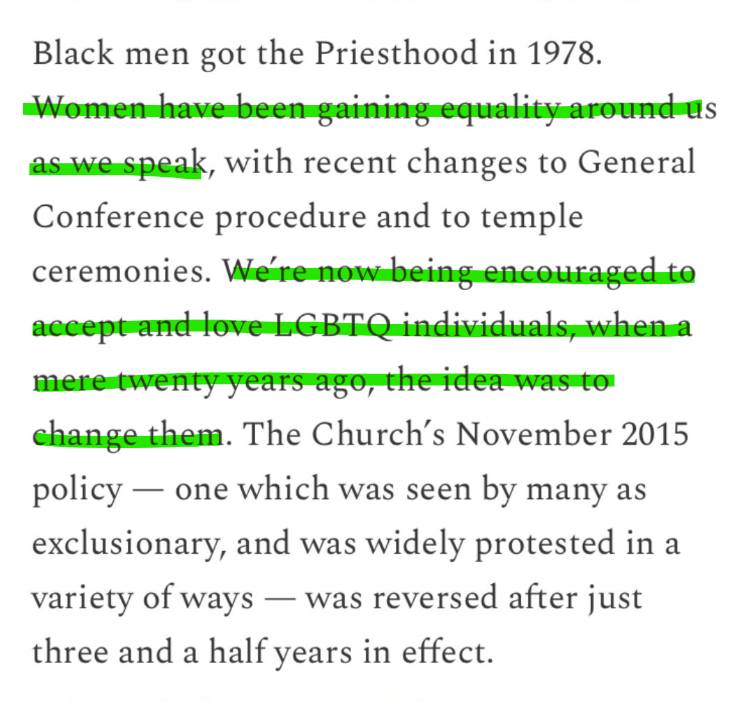
If I don’t laugh at this statement, then I must cry. Is this what we are celebrating?
Am I out of touch, though? I have been away for a very long time. (18 years now, woof!) Is there actually equality in the church? Is the church saying LGBTQ folks don’t need to change?
Or is it actually that the LDS church is still preaching a thoroughgoing separate-but-equal complementarianism? Is it actually that the LDS church is OK with LGBTQ people, but only conditionally? Namely: only as long as we don’t challenge heteronormativity and gender roles with our lives and relationships?
Believe it or not, but this slide actually isn’t the one I wanted to focus on today. Later in the series of images is this one:
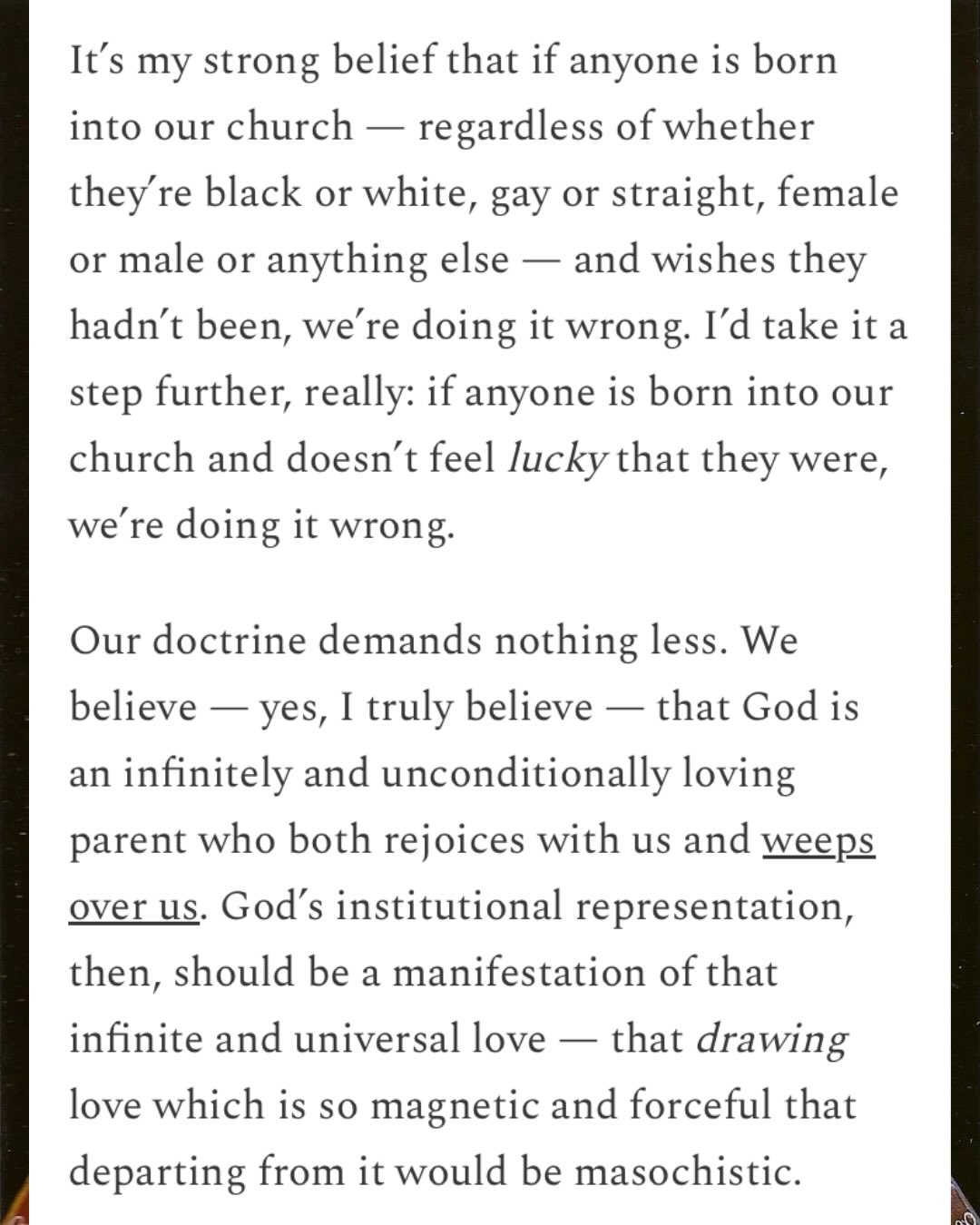
And I found THIS to be even more interesting. As I noted before, I have been out of the church for a while now. Even as I watch the progressive Mormons from a distance, I feel very comfortable with my decision. In hindsight, my departing does not feel masochistic in the slightest.
But I also think that I have had better experiences in the church than a lot of exmormons. Or maybe I have a more mellow temperament than a lot of exmos. The ability to just let a lot of things roll off my back, as it were. So, my answer to the question of whether I wish I hadn’t been LDS at all is…different. More complex.
I think I learned a lot from Mormonism. And there are things I’ve learned that are still core to me even now, outside the church.
What did I learn from Mormonism?
When I think about the sorts of things that endure, the story I would tell is secular and atheistic. I learned practical skills in Mormonism, like management and administration. I learned public speaking. I learned how to organize and complete projects. I am a better business person, better consultant, better working professional because of my Mormon upbringing.
But I didn’t just learn these things in a vacuum. I learned these things as a gay black kid. I started blissfully ignorant of the challenges of race and sexuality until — as it does for probably most minorities — it became impossible to continue in ignorance. So, for me, I learned these skills and habits as whiteness within Mormonism. In other words, yes, I learned how to be white and delightsome from Mormonism. Mormonism didn’t change my skin color, but I see all of the above as tinged with spiritual baggage. Well-meaning secular liberal white folks might (disastrously, let me advise you) compliment black people on being “articulate.” But for me, I got the Mormon equivalent. As a child, I was told that my righteousness was sure to make me white and delightsome.
I know how to travel and engage predominantly white spaces because of Mormonism. I don’t accept the spiritual underpinnings, but I can still process it within a secular framework. To say it differently, I learned respectability politics from Mormonism. But for me, it is all tied with the same impulses to the same racist doctrines of the past. For me, it is obvious why Mormonism still finds itself struggling with its racist past. I think it will continue to struggle with it in the future. No matter how much it tries to “disavow”.
Mormonism also taught me straightness. It did not make me straight, but it it taught me heteronormative ways of living manhood. I can pass if I need to.
These are probably not skills that the Faith Matters writer was thinking about. He probably would not be happy to hear these are what a gay black man learned from Mormonism. I imagine a lot of people are reading with this post with a sense of discomfort. Yes, be uncomfortable. Welcome to my life.
…But would I have wished for something different? …do I feel lucky for this?
I see people talk about how secure they feel in church. How they see it as a refuge from the world. Or how they see God as a refuge from the foibles of humanity. Mormonism was never that for me. And yet, because the world is cold and harsh, I think it was valuable to exposed to some of that coldness and harshness within Mormonism. It’s just that since the world is cold and harsh, I can experience it every day of the week. I don’t need to go to another place to experience it on Sundays too.
There are things I didn’t learn from Mormonism. If I have “holy envy” for anything, it would be these things. I did not learn the abiding spiritualized grounding of resistance and civil disobedience from the historic black church. I did not learn how to exist in community and acceptance with my LGBT brothers and sisters. These things feel like they would be important for times like these, but I don’t have those skills. It’s hard for me to even imagine religion serving this kind of role because of the complicity with whiteness that the LDS church has.
- Do you feel lucky to be Mormon?
- If so, what do you feel lucky for?
- If not, what would you say about what Mormonism has taught you?
 Wheat & Tares
1. Do you feel lucky to be Mormon?
I feel lucky that the strongly ingrained doctrine of the Word of Wisdom kept me from experimenting with drugs, alcohol, or other addictive behaviors, especially gambling. When I see what is happening to our society with Kalshi and the real despair and addictive, dopamine-driven asceticism (recommended essay by Derek Thompson: Monks in the Casino).
A major flaw that I see when many leave the Church is that they fling themselves into behaviors that are self-destructive and which were verboten. I find a lot of former LDS develop an unhealthy relationship with alcohol in particular.
I feel lucky that I got to spend 2 years enmeshed in a foreign country (Montreal, Canada) and learned French as a second language. That opened up my mind and worldview. I would be a completely different person had I not lived in a large, urban, cosmopolitan city. I consider that very fortunate. However, I could have just as easily been called stateside and experienced something less lucky.
I feel lucky that the church culture has such an affinity to art and music. While not particularly musically inclined, I grew up exposed to choir music. This was kind of a fluke and an outgrowth of a church peer group who came from families where voice lessons, piano lessons, and musical instrument training was expected. I have passed this on to my son and make it a point to insist he practice piano; I bought him what we could not afford when I was younger.
Some aspects I really regret about my childhood adolescence in LDS culture: pretty much everything around sexuality and physical intimacy. I feel like what I absorbed was particularly harmful and has taken a long time to unlearn. Also, having 2 lesbian sister-in-laws was a major reason why we don’t attend any longer and why we are not raising our son in the church, nor has he been baptized. We don’t want him to be submitted to retrograde gender roles, an increasingly MAGA congregation, or worthiness intereviews and what we feel are harmful views of about sex, bodies, intimacy, and pleasure.
Interesting post. Did I benefit from being born into the church in the UK? Overall, I think I did, and I am grateful for that.
My parents were teenage converts who met at church. I think the church benefited my father. He always said that it did. I am less sure of the benefit to my mother. She was bright, attended grammar school, could have gone to university but didn’t, and without heavy church directives that mothers needed to be at home caring for children, could have continued in computer programming, something she’d been doing before I, as the eldest, was born. A few years ago I heard about a software business run by women from their homes as they cared for their children during that time, but it wouldn’t have crossed her mind to search out that opportunity.
I was exposed to very different people in my home ward, it facilitated social mobility. I was the first in my family and extended family to go to university. There was a university Professor in my ward. It allowed me to see opportunities. And I grabbed them, even when I was at the same time going against the grain of the things I was being taught in YW classes about women and such. As a student in London it felt like the singles ward was on campus, the church building being literally right across the road, and was a ready-made social environment for someone like me who was not especially outgoing and I appreciated that. It was where I met my husband, we were both attending the same college but in different departments and our paths were unlikely to have crossed otherwise. At the same time, a lot of that was also the attitude of my parents to education. I’m aware of parents of my peers in other wards, who were perhaps converts when older than my parents, who were emphatically not in favour of higher education, and it is their grandchildren rather than their children (my peers) who have gone onto university.
But as Peter Bleakley often mentions in his lengthy Mormon Civil War podcast, the church today is not one we would recognise from our youth. (In his case, his grandparents were members, and his parents went to university at BYU, which gave him access to the more nuanced scholarly views lacking in my part of the UK).
Anyway, once this level of social mobility is achieved, from my observation, and with the utter lack of investment in age appropriate programmes for children and youth, and life itself being busier, I see no advantages for my children. My kids were raised in the church. But I don’t feel any great sense that they need to stay. I want them to follow their own paths in life, make their own decisions. One has resigned (they don’t feel lucky to have been born into the church, and experienced harm from programmes and policies), and the other participates very much on their own terms, and not the church’s terms.
How horrible to grow up in a church that teaches you that you are not acceptable to God “as is” and that if you *earn* God’s love by being righteous, you will be made different and acceptable. Of course, now that I think of it, the skin color problem only adds to the underlying message that we are all of us, not good enough “as is” and we need to *earn* God’s love by being righteous. President Nelson taught that God’s love for us is conditioned on our obedience. So, really, God doesn’t love any f us as is. The dark skinned children of God have to be righteous and then, when they earn God’s love, God will make them acceptable by making them white. The rest of us white people still have to earn God’s love, but at least we get to stay the color we were born. The gay children of God, if they are righteous, God will change them to make them straight. God has to change who his children really are to make them good enough.
You know, that is really kind of nauseating.
And it isn’t what love is.
Jacob,
I actually think there’s a lot to this. I think Mormonism is good at teaching tee-totalism, absolute abstinence. It is terrible at teaching moderation. Because it doesn’t actually teach healthy moderate relationship to things it forbids, people are not set up for healthy safe ways to experiment with those things. Which then produces disastrous consequences, that then feed back into the narrative, “See, it’s better just to totally abstain, because look what happens when you don’t…”
I’m not suggesting everyone should experiment with every drug on the planet, some probably do best fit as a “not even once” phenomenon, but the example of sex and sexuality seems extremely telling. The messaging of, “no, no, no, not ever, never, not ever” then you get married, and you’re just supposed to have a healthy attitude and have everything figured out is probably not great for a lot of people.
Andrew S.,
I was having lunch with my good friend from BYU about 2 months ago. We were friends in HS and I was the best man at his wedding and he was the best man at mine. He’s had a very productive career in law as a Gonzaga grad and has worked in a DA’s office in Nevada climbing the ranks.
Anyway, his daughter just returned from a mission in Argentina. I think he would describe himself as a PIMO, but he was strongly against her serving a mission. He was telling me this story of one of his daughter’s companions who had sex with another Elder on the mission. She confessed to the mission president and somehow he never did. She was assigned this companion after the incident and it was a huge drag on her mission experience because, according to him, she was semi suicidal due to intense shame and guilt.
It was such a salcious story full of intrigue to me and it kind of boggled my mind to hear that two missionaries engaged in full blown sex and neither of them were released or sent home. When I was serving my mission, I remember Elders getting called home for unresolved or unconfessed morality incidents that were disclosed by at-home girlfriends. I don’t know what to make of this, but it made me wonder if the purity culture I experienced growing up has lessened somewhat in the church, or if this was just a random one-off bonkers story.
Andrew, this post is true and very on point- it resonates with so many others lived experiences.
I have been in for 70+ years, but recently resigned. Being affiliated with any church or organization that has the reprehensible practices described in this post and comments, as well as other harmful practices, is what I cannot do, now that I am aware.
“I actually think there’s a lot to this. I think Mormonism is good at teaching tee-totalism, absolute abstinence. It is terrible at teaching moderation.”
My personal view about drugs is basically a scientific one: even moderate or low use of alcohol is damaging to health, shortens life, and harms health. This echo’s WHO’s position that “no level of alcohol consumption is safe for our health.” A lot of the past science about moderate drinking has some health benefits has been thorougly debunked. In a public policy arena, I advocate for abstinence from alcohol and marijuana because I think (and the science backs up) that there is no benefit at any level of use and significant harms. But I’m also not advocating for Prohibition 2.0. But I am extremely encouraged by the strong decline in alcohol usage among the young and with the rise of GLP-1 meds, a lot of individuals are cutting back and ceasing alcohol consumption altogether. I consider that a good thing. So as long as those drugs (and they are drugs) are legal, we should severly regulate them, especially the harms to other parties from rape, abuse, and DUIs.
Now, when it comes to other aspects of the WoW, it’s pretty clear that the science shows that black coffee is quite healthy, so full speed ahead! And anyone who is buying dirty sodas from Swig or other soda shops and skipping tea/coffee is not doing themselves any favors. Utahns have a terrible penchant for sugar, and it is probably because of the WoW that has substituted ice cream, soda, cookies as the social lubricant and food/beverage choice instead of coffee shops/bars.
No. I feel unlucky to be raised in an orthodox LDS family and community. Nothing that is good in Mormonism is unique and nothing in Mormonism that is unique is good.
I’m surrounded every day by talented people who are as skilled or more so than me, and virtually none of them are Mormon. There are less painful ways to experience the positive aspects of the church than the Mormon way. I question the assertions that LDS are over represented executive positions in business and other visible or respected positions.
My reasoning and hypothesis is this. I’ve heard assertions that Mormons live longer and are more happy than the population in general. I speculate that when people look at the benefits of the WofW for example or the more-difficult-to-quantify happiness that they are not accounting for the people who left early in life but who experienced lifelong effects of religious trauma at the hands of their parents or church leaders. It’s a bias of only selecting the successful Mormons and not random Mormons.
I was raised LDS by parents who converted when I was 4 or 5. Like all parents, there were good things and bad things, but overall, it was a good childhood. My mother was really religious but didn’t really understand the church, its history, or its doctrine. She would say things without really understanding what she was saying. My dad was not active, but was active in the John Birch Society, so I got what is now the MAGA BS except in the late 60s, early 70s. It took me years to unpack all that stuff.
I feel lucky to have been able to recognize the issues and change. I feel sad that so many others don’t understand how the church may talk a good talk, but most members have no clue about even the basic concepts of being a good human. I’d say Christian, but that’s a term that has been so maligned by people who call themselves Christian.
Things like empathy, justice, and equality should be things we embrace, but many Mormons now embrace MAGA ideas and work to ban books, get rid of DEI, support ICE, and want to push out immigrants. One thing I feel lucky for is that my parents did everything they could to teach their children to think for themselves.
Do you feel lucky to be Mormon? No. Growing up in Utah I thought it was peak cringe when members acted like we were so much better off than everyone else. Then going on a mission and leaving the Mormon corridor, I realized first hand how wrong and damaging this is. My experience is that Mormons limit themselves to each other’s company and it’s a huge disservice to themselves. People of other faith traditions, or no traditions, are incredible too. Living outside of Utah for 20 years, I was always embarrassed by my faith. I hated being asked about coffee vs Dr Pepper, garments, or the church’s confusing and ever changing stance on queer issues. It’s no longer my problem.
If so, what do you feel lucky for? N/A
If not, what would you say about what Mormonism has taught you? I am an above average public speaker. My mission to Hong Kong changed me and made me curious about the world.
With regards to the topic of the WoW at large, my personal experience is that I never had to “Just say no” because nobody has ever offered me drugs. My kids are growing up in a non-Mormon bubble in SoCal and I’m pretty sure they’ve never had to “Just say no” either. So my personal experience is that Mormonism didn’t have anything to do with me not being addicted to drugs. I’m probably as addicted to sugar as the next human but perhaps less so than the average Mormon. I know other people have their stories with drugs or lack thereof and their faith and I hear that. It’s just not part of my story (or I don’t think it is but who can really say?)
Hedgehog,
Definitely sitting with thinking about “what could have been” if the LDS church hadn’t advised women against careers.The change in the church over time (and not for the better, IMO) is a sad state. I used to think that the benefit of correlation was a consistent experience geographically, but it doesn’t help when they use it to remove creative experiences and make everything more dull.
Anna,
Maybe I just still have trauma I’m working through, but I saw things differently at the time. My parents often taught us that we needed to “work twice as hard to get half the credit.” I imagine a LOT of black kids (especially those in upwardly mobile families) are taught that. This isn’t because we aren’t acceptable as we are necessarily, but to deal with the reality that the world will not treat us fairly, so we have to compensate for this.
When I hear/read stories about strict immigrant parents, I can resonate partially with that. Not to say my parents were that strict, but I understand the mindset. I don’t think it makes sense to say that the parent who demands straight As and criticizes anything but that doesn’t love their kids. I think that they show their love by expecting the most of their kids.
So, I see that the LDS church — at its most ideal — is doing something like that. When the messaging is not necessarily about fear but about maximizing potential, I can see the value of that.
thaaaaaat being said, I agree that it’s really unacceptable that part of the vision of “maximizing potential” for Mormonism is compliance with a particular form of whiteness, heteronormativity, adherence to gender expectations, etc., It feels like a huge miss to meet people where and as they are and have a personalized vision for how they can be at their personal best, rather than just insisting that everyone mold to some sameness.
And I definitely still envy people who say that they have had spiritual experiences where they experienced God’s love as unconditional. But this just hasn’t been my experience.
Not only do I feel blessed for being a member of the church–I feel like the richest man in the world. I have a beautiful family–I married my dream girl and we’re happier than ever after 37 years of marriage. And I can feel the powers of the holy priesthood working upon my family–in ways that gather us, strengthen us, and bind us together. I’m so grateful that I’ve learned something about love by loving the people in my life. And on top of that I’m grateful for the cosmic perspective that the restored gospel opens of to us. It intensifies my appreciation for the value of every living soul–especially those nearest to me. Who can put a price tag on individual identity? It is precious beyond words. And it’s a wonderous thing to consider the notion that my children have come out of eternity–that they are ancient souls whom the Lord has been nurturing for a very, very long time. And I’m so grateful to know that the darling identities of my loved ones will continue–they’ll never be lost. Thanks be to God.
LoudlySublime,
I am thinking more about how to effectively protest and effect change, though. It seems that running away from flawed and problematic institutions isn’t always enough. (*waves around at US political situation.* it just doesn’t seem like we can just “resign” from that in every instance.)
Andrew,
Yes, trying to effect change in a flawed and sometimes abusive institution is ideal if possible. Kudos to those who can do it, and to those who really have effected change for the better, such as Sam Young, D. Michael Quinn, Robert Rees, etc. Many who have facilitated change have been excommunicated for their good work.
Even if I wasn’t too tired to keep trying, I know from experience that any “uncorrelated” conversation Is unwelcome at best.
I did enjoy my childhood in the church.
I feel lucky in some ways, unlucky in others. I’m now a PIMO Mormon, so I’ve pretty much left the church in all ways except physically.
Ways in which i feel lucky to have been a member:
Relationships/friendships: I made some great, lifelong friends in the church.
BYU/education: Yes, BYU has soooo many problems, many quite serious and significant. But also, I attended BYU in the 80s when tuition was insanely cheap and so I was able to get a better education than one would suspect for the grand total of about 7k in tuition. And BYU is where I made some of those lifelong friends. And many of the professors were remarkably good.
Good people: The church is full of judgmental twits, but I also met a lot of genuinely kind and loving people along the way. As someone who was a very angry young man, I was grateful to know people who practiced kindness daily. They taught me a lot.
Unlucky:
What Jacob L said about sex/intimacy really resonated. The church’s views on the topic are, IMHO, deeply harmful and actually prevent the achievement of the very kind of intimacy the church claims it champions. And it claims that that intimacy is reserved only for married couples. Another huge mistake.
Art/Music: For awhile, I bought what the church was selling about “appropriate” music/art. I’d feel guilty for listening to Queen and Led Zeppelin and because I found LDS hymns to be impossibly boring. It took a few years to work through that guilt and realize what a load of sh*t it was.
While I remain grateful for the friendships I have made, it’s also important to point out that a lot about Mormon culture actually prevents real friendships from forming. So much social coding, so many expectations regarding politics, views on marriage/family, etc. A lot of Mormon socializing is highly curated and in general, I found that really stifling. It’s like everyone only wants friends that think, believe, behave, etc. just like they do. Sorry, but I find that weird. And generally inhibiting when it comes to forming true friendships.
Again, I have love listening in on this conversation. I’m impressed by the ability to articulate the personal experience with the church, which span decades for most here.
Do I feel lucky to be Mormon? My short answer is both Yes and No. My longer answer struggles mightily to definitely answer. I feel like my memories are so colored by
a lens I currently have that doesn’t allow them to stand on their own. I was raised in Portland, Oregon, 2nd of six kids, 1 girl then 5 boys. Typical for many orthodox LDS
homes, I was a red pilled TBM, on board with thinking that Jesus was a republican. Although I have always had a temperament towards questioning, it was the air I breathed
and the water I swam in.
Today, I don’t believe the Church to be what it claims to or that I once imagined. It is however the place and community I choose to wrestle with the big questions of life: God,
(whatever that means), the meaning of life, suffering, death, values, morality, relationships, where I came from, why we’re here and where we are going when we leave here.
I no longer believe the church has answers to these questions, or that that was ever the point. I reject almost any statement of absolute certainty, especially the kind making
factual claims on the basis of a subjective (warm) feeling.
Human sexuality – as stated above, this one may be the biggest negative. Shame has followed me for most of my life on this subject and rather than helping me and others
to understand this very powerful desire and its potential goodness and harm, it was shamed, suppressed and made to be the devil’s workshop. Essentially the church’s way
of teaching sexuality was something like placing a very hungry 10-year-old in a candy store and telling him to eat none of what is here. But it gets worse, not only is all candy
forbidden, if you even feel like you want the candy, you are walking on thin ice. This is no way to relate to a biological fact that I didn’t ask for.
Oh, but I did do scouts, got my horsemanship badge like 3 times (scout camp), but didn’t make it to the holy grail. I was Todd the tenderfoot, the scout the stirred the fire
with a plastic spoon.
I really hope this isn’t considered a threadjump: I’ve never come across the facebook group you drew the quote (about whether people feel lucky that they were “born into the church”) from, but just reading it here I get the sense the slide was trying to convey something else. I thought that they were trying to say, however inartfully worded, that the conduct of people in the church should be so loving-so much in line with God’s nature-that by virtue of how such a person “born into the church” is treated by other, practicing members, they would feel lucky that they were born into such a loving environment.
In other words, I didn’t get the sense that whoever wrote the slide was trying to say, hey person leaving, you should actually feel lucky that were started here! Rather, I got the sense that it was really saying shame on us, practicing members of the church, if and when people want to leave. Of course, however nice that sentiment in a vacuum might be, it is itself unrealistic since every person marches to the beat of their own drum. One person’s vision of perfect love could be another person’s stifling nightmare (even just by virtue of different love languages, let alone different personalities)!
To the ultimate question of the post, though, I do feel lucky even just from the perspective of making the landing softer after any move to an unknown place. It is incredibly helpful to know that you have an almost immediate connection in any new place (even if some of them turn out to be judgmental twits!).
Adam F,
Definitely not a thread jump. I get that was the rhetorical purpose of the slide for sure. But my issue is that the definition of “love” is hotly contested (Anna’s comment hits on this well.)
It’s not just about whether LDS folks are failing to live up to their stated values. It’s about whether those values themselves are conducive to human flourishing.
My issue is that as long as LDS people believe the best way to love LGBT people is to, say, teach us to reject our sexuality because there is no valid expression of it within a Mormon paradigm (and the view of God precludes it), there’s no way that members can say this “nicely enough” and make LGBT people feel “lucky” to be told that. This is kinda what you get when you say, “One person’s vision of perfect love could be another person’s stifling nightmare” (as an aside I like the Eastern Orthodox definition of heaven and hell for this reason … The idea is that everyone will be in God’s presence, and God’s presence is like the sun. For the righteous, this will be like a pleasant warm, sunny, day. For the wicked. This will be burning, blinding, etc. It’s not separate places, but different responses to the same thing.)
But the thing I’m seeing from this comments and stories is precisely how the LDS definition of love is fundamental broken for a lot of people.
Do I feel lucky to be a Mormon today? Definitely not.
Do I feel lucky to have been raised Mormon? That’s a much trickier question for me.
First, I’m a straight, white male. I grew up in an upper-middle-class family, and I’m upper-middle-class myself now. As a result, I’ve always fit the demographics the Church has embraced throughout my lifetime. I feel awful for the experiences described in the OP, and I suspect I’d have very different feelings about my Mormon upbringing if I were in the same situation.
Right now I have no interest in being a Stage 3 (Fowler’s stages of faith) orthodox Mormon believer. It’s more than that, really. I simply don’t have the ability to be a Stage 3 believer. I can—and do—play one on Sundays, but I can never go back to that. I reject the Church’s positions on race, women, LGBTQ issues, sexuality, and many others. I’m highly skeptical that Church leaders have more access to revelation from God than I do. I have serious doubts about the fundamental truth claims of the Church (Book of Mormon origins/translation, priesthood authority from John the Baptist and Peter, James, and John, etc.). I moved on from orthodox Mormonism years ago, so no, I don’t feel lucky to be a Mormon today. Sure, if the Church were to change drastically and move toward what progressive Mormons want, I might feel differently. However, as the OP notes, we’re nowhere near that happening.
The trickier question is whether I feel lucky (or ought to feel lucky) for having been raised Mormon. Orthodox Mormonism made me feel good in many ways when I was a teen and young adult. It provided comforting answers to difficult questions about the purpose of life and what happens after we die. It provided rigid rules that potentially prevented me from engaging in some harmful behaviors. It provided a strong sense of community and belonging. It provided guidance for life that, while I now believe it’s seriously flawed, might have been superior to what my eighteen-year-old brain could have provided at the time.
Now that I’m middle-aged and have moved far outside orthodox Mormonism, the question is: Would I have been better off in this life if I’d never had a Mormon upbringing or been a young, orthodox Mormon? This is a very difficult question to answer. The only way to truly answer it is probably impossible: send a clone of myself back into the past who was not raised as an orthodox Mormon and compare that clone’s life to my own. Obviously, by avoiding Mormonism altogether, I could have avoided things like:
1. The racism, misogyny, bigotry against LGBTQ people, sexual shaming, etc.
2. Believing in truth claims that I now have serious doubts about, along with the confusion and disappointment involved in dropping those beliefs.
3. Spending two years of my life trying to convert people to something I no longer really believe in.
4. Feeling superior to everyone else because I belonged to the one true Church.
5. Spending a lot of time and mental energy resolving the conflicts between religion and science.
6. Allowing fifteen men to make life and moral decisions for me when I now believe that I’m better equipped to make those decisions myself.
Which path was better for me? It would be easy to say that it would have been better for me to miss out on all of the bad aspects of orthodox Mormonism. However, what really would have been the course of my life if I hadn’t had Mormon orthodoxy to rely on as a teen/young adult? I’ll never really know.
To take the question beyond Mormonism—to one that’s actually very timely given the current trend of people in developed countries quickly abandoning organized religion: For those who end up moving beyond Stage 3 orthodoxy (whether they abandon religion altogether or move to Stage 4, 5, or 6), how many of them are better off having been raised in an orthodox family or having been an orthodox believer earlier in life? I really don’t have a good answer to this question. It honestly concerns me that young people in developed countries seem to be abandoning organized religion at the rate they are (even though I’ve done so myself), but maybe the world will end up better off in the end if this trend continues.
Every night in my evening prayer I thank Heavenly Father for, among other things, my membership in the Church and me knowledge of the Gospel. But I am hedging and He knows it. Nelson talked about “strict obedience”. Yeah, can’t do it. I’ve tried. He also talked about “conditional love”. Again, not sure why that is happy. Repentance every night? Really, come home every night and catalog my mistakes?
Also, according to what I am taught, pretty much every week, my life is a failure, for exactly the reason Jack is so happy. I don’t have any of those blessings. Telling me I will have them in the next life isn’t comforting. Its just a reminder of what you have missed. Its like the Lord/Church is deliberately dangling blessing in front of me that I will never have.
So if the end, while I am a believer, I think being a member has made me unhappier. And . . . . cue the lightening strike.
Earlier in life I definitely felt lucky to have been born into the church. Now it’s a more nuanced answer for sure. Once you stop believing the church represents your only hope for a glorious afterlife, “lucky” feels like an overstatement, but there’s a lot that I’m thankful for from my church experience. I think the thing that matters most to me that I have got out of it is being pushed into interactions with people who are different from me in important ways, with whom I wouldn’t ordinarily seek out interactions. That includes the mission experience, certain home teaching assignments, and in the present day attending church with people who think Trump was a good idea. That has been a greater source of personal growth than anything else in life other than possibly marriage and parenthood. I am grateful for that, as I am grateful for an upbringing that taught me self discipline and a good work ethic. Am I “lucky”? I don’t fully know, because I don’t know what the alternative looks like. I remember conversations in my youth with fellow missionaries about the reckless lives of debauchery we were certain we would be leading if not for being born into the church, but I don’t think I believe that now. I actually think I’m pretty naturally self disciplined. It’s entirely possible I’d still be not drinking or using drugs even without the religious upbringing, simply based on personality type. And it’s possible there were alternate pathways of learning the good life lessons I got from my upbringing.
The one thing I will always feel lucky for is my marriage. Like so many things in my life, it also came out of a church context. In alternate versions of our lives, I hope there was still a way for us to meet each other.
The “Mormon formula” worked out extremely well for me so I have to say I am grateful for being raised in the church.
(1) The church was instrumental in me having as happy a childhood as I can imagine. My parents were extremely faithful members and we lived the religion in our homes and my parents supported me in the church program – especially primary. I have so many good memories from those years.
(2) My teenage years were nothing special but I avoided terrible mistakes and the church program was very helpful in providing me a healthy socialization. At the same time, being Mormon in an non-Mormon community contributed to my socially awkwardness and that was not helpful to my overall social development. But I have no idea if my social immaturity would have been any different without the church.
(3) The default of me going to BYU worked out very well. I seriously had no initiative about college. If BYU was not an option I suppose my parents would have guided me about my college choices. Personally, if I had not gone to BYU I would have sought out college in Arizona or Southern California as I so much wanted to go to college where the winters were warm (I was from the northeastern US).
(4) The church track got me on a mission where I finally gained self-confidence – both emotionally and spiritually (I finally matured) and set me up to come back to BYU with a sense of purpose. And yes, I got married soon after my mission. The marriage has been a successful one where my wife and I raised our kids in the church and only one so far has veered away from the “formula”.
As a social and religious experience, the benefits of the church and of being raised Mormon far outweigh the negatives. A key insight is the church provided a social experience that I don’t think my parents could have otherwise provided. It might be said that as a teenager, my parents used the church as a crutch and this allowed them the convenience to not parent as they should have otherwise done. But I don’t think my high school peers were getting much parenting time from their parents – we were parented by the silent generation – and we were expected to take care of ourselves.
Lastly, in terms of money, it is true that I have paid a lot of Tithing to the church. Have I gotten a fair deal? I think so. The church has done a lot of good for me and my family and three of my kids directly benefitted from a BYU education where they each graduated with zero college debt. Is the “Tithing Deal” as good now for families as it was 15 years ago? Perhaps not. The church program has been greatly reduced and BYU is ever more competitive. Plus Utah is no longer the affordable place to start a family, although it continues to be good place for young people to find employment.
The “Mormon formula” is not as strong as it once was. That concerns me. However, there was no “Mormon formula” for my parents! And that helps me put things into perspective. The American LDS youth of the 1960s – 2000 lived in a unique moment of church culture. That culture no longer exists – at least I don’t see it in my current ward & stake.
There are a lot of great comments here and I feel the answers many are giving are context sensitive to the time of their lives in which this question is being asked.
I grew up in Colorado, born and raised in the LDS church. We were probably lower middle-class if I could guess based on the tidbits my parents have shared with me. We were not rich by any means, but as a child, I never remember a time where we were without. The church was very formative in my life. I feel extremely lucky to have had a system that, for lack of a better term, imposed the WoW on us. Not only did it help me stay away from many of the problematic substances of the time, but I continue to value much of those principles as I still consider them really good things. I had a lot of support growing up in church. There was a planned path for me as a young man and hitting those milestones gave me a sense of accomplishment as I was growing up. It gave me an identity and a group identity. We would go help people who needed help or spend some time in a soup kitchen. My parents have always had a serving mentality and that is a direct result of our being in the church–and that I feel is a really good thing. I think Mormonism preached a much more expansive view of God and spirituality than traditional Christianity and I’m grateful for that. My mission was very formative for me. I’m lucky to have had only one set of mission leaders where both the husband and wife led together. They were truly partners in leading the mission and it wasn’t just the mission president. The wife was a tremendously strong leader and presence in the mission and I think we were all better because of that. The mission president was always really good at encouraging us in the most positive ways. I had mostly good companions and I learned a much better work ethic. My mission changed me more than it changed anyone else I taught. I am definitely better for having gone on it. My family has cherished lifelong friends we still continue to engage with as a result of our participating in the church. I met my wife while going to BYU. I had amazing professors at BYU. Do I regret being raised in the church? No. It provided a much needed structure that fit me in my growing up years really well. But, I also fit that demographic perfectly.
That all being said, here are the troubling parts. I regret that “certainty” was pounded into me. I regret that “infallibility” was pounded into me. All that just made it harder to connect with some other kids growing up because I was right and they were wrong–they just didn’t know it yet. Others have mentioned sexuality. I cannot begin to describe the shame I carried for decades. I got into porn and masturbation as a teen–and looking back, the church’s handling of that was just terrible. Frankly all the western Christianity was equally bad. So much shame. Spent a decade or more focusing on just this one problem which the church told me was next to murder in severity. I never could shake it after going to multiple 12 step groups and seeing a few counselors and that just made the shame and fear of afterlife more palpable. My wife and I spent so much time in the first part of our marriage on “my problem” at the expense of truly building our relationship. I feared sex with my wife because I thought it would just perpetuate my problem and salvific destiny. In fear, I gave up opportunities and other things because I thought those things would exacerbate the problem. If there is one thing the church was great at instilling–it is fear. Fear of those different from me, fear of conflicting information, fear of leaving, fear of thinking differently, etc. I regret that being the case. It has only been in the last 3-4 years I found a therapist that has truly helped me unpack on all that and realize just how much the way the church approached these issues actually drove the issues so much deeper. I regret that just like the rest of Christianity, the theology/doctrine of the church has become so dogmatic, static and brittle. I regret the church feels it can’t trust the members with the truth of things, whether that be the financial state or its own history. I regret how much I’ve been blind to others’ experience in the church because mine, as a straight white male, has been positive. I regret that the church of my childhood, one of connection and community, has not existed in any of the Utah wards my wife and I have attended. I regret that the church leaders fail to speak on what is truly important today, that they don’t take that risk. I saw the other day that over the last 5 years MacKenzie Scott has given $26 billion in charitable donations. She’s worth something like $40 billion–so she’s given over half of her worth away in charity. It truly makes me sad that the church gives less than $1 billion a year and yet are worth 5-10x, or more, what MacKenzie is.
I think one of the things, when asking these questions, to consider is where you’d be today if you were able to have a George Bailey experience and completely remove the church from your life (all the good and bad) and see what it would have been like. I don’t know that it is enough to recognize that there are other places where you can have just as equally good experiences or life-learning as the church. I think you have to assess the likelihood that, sans the church, you would have landed in one of those alternatives.
It’s hard for me to throw out the whole church because of the good it did. But I have a hard time with the church because of the harm it did too–especially when it doesn’t clearly own it or apologize. Like mountainclimber479, I cannot go back to black and white thinking. I can’t go back to a lot of dogmatic beliefs and truth claims. God would have to intervene and make it make sense for me. I could never go back and proselytize again as I don’t buy into the truth claims any more. However, I could do a service mission with the right kind of service focus, but as I no longer retain a temple recommend as I will no longer pretend to make some of the questions work in my mind, I doubt they’d let me.
I agree with chrisdrobison that it’s tricky to know how things might have been if I wasn’t raised Mormon.
Recently, I have gone through the process of identifying ways that Mormonism has been harmful to me (and there are a lot of them). I went through the grieving process of all the things that I missed out on in my youth because I was Mormon (and there was a lot of things). I recognized unhealthy thought patterns that I learned, unhealthy relationships I was part of, and unhealthy attitudes that I internalized (and there were a lot of them). I found myself thinking about how my life would have been better if I hadn’t been raised in Mormonism. Overall, I think this is a good activity, even though it is a bit painful.
Then… I noticed that what I was doing was comparing my Mormon upbringing (and all it’s flaws), to a perfect upbringing. A perfect upbringing wouldn’t have been harmful, and I wouldn’t have missed out on things, and I wouldn’t have learned unhealthy thought patterns, had unhealthy relationships, or internalized unhealthy attitudes.
And then I realized, “If I wasn’t raised Mormon, I probably wouldn’t have been raised perfectly either.”
I’ve been talking with friends who weren’t raised Mormon about their childhoods, and the problems they faced, and the things they thought, and the unhealthy situations that they were in. And I don’t mean to compare, but it did make me realize, “Oh, if I took away the harms of Mormonism from my life, they probably wouldn’t be replaced with perfection.” Looking back at my community, and the time and place that I was raised in, I can’t point to other friends that I had, or other families that I could have been a part of where I would have had significantly fewer harms or better thinking patterns, or a much better life than what I did. I can point to a number of families or situations that I could have been a part of where I would have had more harm, worse thinking patterns and attitudes, and worse outcomes.
So yeah, I acknowledge the harms of my Mormon upbringing. I think it’s healthy to examine that and to not perpetuate those harms. And I think it’s okay to be angry and sad about it. And at the same time, I am grateful that I had an upbringing as good as I did. There were also a lot of protective factors and good things that came from my Mormon upbringing, and I think it healthy to examine those, and acknowledge the good things as well. And I think it’s okay to be glad and grateful about those things. So my final answer is Yes, I’m glad I was raised Mormon.
I wasn’t born into the church — I’m a convert. I wouldn’t use the word “lucky” to describe myself, but I am overall glad for my decision. That said, I haven’t bought into some of what might be described as pathologies in Mormon culture, such as leader worship, unquestioning and perfect obedience to leaders, social standing based on present or past callings, every talk in general conference is scripture from God, certainty and dogmatism, and so forth. I sometimes think the church culture is overly-focused on certainty and dogmatism, and on having people conform to a pattern — but I wish there was greater emphasis on serving and strengthening individual members. I think God wants members who are individually empowered to make decisions in righteousness for themselves and their families rather than a mass or people professing exact obedience to the prophet and other leaders. I greatly value reading our scriptures and receiving personal guidance from scriptures and from the holy ghost – I agree that the doctrine of the priesthood can distill upon one’s soul as the dews from heaven. I generally care more about correct and simple principles than I do about theology and enforcing compliance. I wish we had more opportunities for honest dialogue in church settings. Thus, I often don’t fit the caricature of a TBM Latter-day Saint, although I consider myself as honest and true to the faith.
Yes, I am glad I joined the church. I think I could offer something of value to my ward and to the church generally if given the chance, but because of the above, I likely will never be given that chance. I cannot change the church, but I choose to live within the church. Somehow, I think God is still with me, and I want to stay with him.
And having said all this, I do appreciate this forum that allows for some expression that I really couldn’t share in a church setting right now.
What a tough set of questions and a thoughtful post. I definitely gained lots of things from my membership in the church: language skills, sales skills (seriously, I’ve never wanted to be in sales, but my mission really made me perfectly adequate at sales when I’ve had to be), an instinctual understanding of organizational dynamics (what we call politics at work), and a love for travel. On the downside, I definitely feel like a lot of what I got was wasted time and money with diminishing returns. As a parent, I’m horrified at the messages my kids heard, and I hope they didn’t truly seep in. The misogyny I heard at church gave me personal misgivings that I struggled to deal with, even though I ultimately disagreed and felt I knew better (protip: I did!), so it didn’t *mostly* stop me from doing what I thought was best, but I often felt I had to justify things that I absolutely did not. It also hurt me in terms of shutting off my critical thinking to get along, which I regret.
I can’t regret my lifelong friendships. Being a teen in the church was mostly great for me. Even though almost none of those friends remained in the church, we are still friends for life, which is something.
I agree with those who say the church seriously messes up your sexuality / ownership of your own body, although I might have gotten that shame from my mother anyway. Older generations often had that regardless of the church. In general, though, for whatever reason, I usually felt comfortable breaking the rules that seemed dumb to me, and there is something freeing in that. Maybe that means I’m a narcissist or maybe I just didn’t take certain things very seriously. I am heartily ashamed of some of the things I DID take too seriously, though, like bad apologetics. Woof.
I recall very vividly as a missionary having that feeling of envy when I realized that someone we approached wasn’t interested because of the theology that if you never hear the church’s version of the gospel, you don’t have to live it and you can instead just convert after you are dead. Who wouldn’t want that??
ji,
I’ve said this before–so I hope I’m not overdoing it: you are a gem, ji. I’m of the opinion that just you being there is a gift to your ward.
This is a good discussion. It’s something I’ve been thinking about lately as my oldest child is rapidly approaching adulthood. While I don’t expect or desire for him to be a part of the church if he doesn’t want to be–which, so far, he emphatically does not–there’s a part of me that (irrationally) wants him to know the church well before he rejects it, like I did.
Sometimes when we’re driving places together I’ll tell him some parts of church history (including old/new testament, he’s not very familiar even at that level) or general beliefs of the church from a fairly neutral perspective. He’s curious and inquisitive and generally finds these discussions interesting. I intentionally share the parts of my experience in the church that were genuinely positive. Many people find meaning in religion after a period of chaos in life, and while that hasn’t been my experience, I want to make sure he knows that it’s something to consider and be open to as he moves through life.
Like others have mentioned here, I realized that even if my upbringing had been outside the church, it wouldn’t have been perfect. Many of the parts of my childhood that I would change if I could were as much a product of the general state of the world in my parents’ time (and their parents’ time, who raised them, and continued to influence them well into adulthood) and would have been a part of my story regardless of where the stork dropped me. My parents were a pretty good mix of faithful to the church but flexible to meet the needs of the family, and I appreciate that, though things got much more complicated as they aged and the family grew.
I was miserable on my mission, despite being a staunch believer at the time. My patriarchal blessing said that my mission would be a ‘glorious time, if I would but make it so’ and that second clause caused all kinds of internal conflict. However, I did come out of my shell quite a lot during that difficult time. I learned how have civil and productive conversations even when there is uncomfortable tension.
One curious difference that I have noticed between myself and many others’ experience in the church is that I have never really had “church friends” that were an important part of my life. The friends I had as a child were mostly either cousins or people I met/befriended at school (all LDS, and some even in my ward, but our friendship was not based on the church.) That has continued into adulthood. I met my wife at work. I did not go to BYU, and, until just recently, had not had a single mormon co-worker for about 10 years, despite living in Utah County almost my entire life.
Even though I came to the church in my late teens, I do feel lucky to have known it. The Church led me to a God at that time- albeit a version of God that was not healthy. And though it took me years of struggle to untangle what was true and not true, it led me to where I am today. Right now. Firmly rooted in a personal relationship with a God of love, grace, compassion, and caring. Would I have arrived here without the mess? Probably not. So, I guess for that I am grateful. Not grateful for the damage it caused our kids, but perhaps it is leading them on a similar path. That is my hope.
Yes I feel lucky to be Mormon.
It gives me the highest perspective of life and universal truths.
The church will continue to become more liberal as Satan has captured Republicans hearts. Here in Ca. most all my ward has become Democrats.
As far as the churches stance on gays. They’ve accepted them as brothers and sisters but do not support their actions that go against the teachings of Jesus Christ. We all have our crosses to bear. Someone with anger doesn’t have a right to kill someone as someone with depression doesn’t have the right to kill themselves.
@Jareen, because the OP was written by a gay, Black man describing his difficulties growing up in the Church due to being gay and Black, your comments on LGBTQ people are pretty discouraging to me. Here are some questions I think you ought to carefully consider:
1. Do you feel any dissonance when you say that you “accept LGBTQ people as brothers and sisters” in one breath and then say “we all have our crosses to bear” in the next?
2. What records do we have of Jesus Christ personally teaching anything about LGBTQ people? (Hint: none.) If you’re going to argue that Church leaders speak for Christ, remember that today’s Church leaders hold the same positions of authority as the previous leaders who claimed Jesus Christ didn’t want Black people to enter the temple or hold the priesthood. Were those Church leaders speaking for Jesus Christ when they denied these blessings to Black people?
3. What does Church leaders’ shifting position on LGBTQ people imply about their understanding of their role in the Church? There was a time when Church leaders encouraged LGBTQ people to repent and “pray the gay away.” They later acknowledged they were wrong about this and have admitted that LGBTQ people can’t change. The current prophet once counseled Church members not to allow their gay children to stay in their homes and not to be seen with their gay children in public. Is that consistent with “accepting them as brothers and sisters”? It wasn’t very many years ago when Church leaders declared that the children of a gay parent could not be baptized (the POX), and then 3 years later took it all back. Do you think that God really directed Church leaders to do this? If Church leaders’ understanding of LGBTQ issues has been evolving significantly over the past few decades, is there a chance that their current position is also wrong and will continue to evolve?
4. It’s interesting that you focused on the LGBTQ issues in the OP instead of race. Let’s go back to the early 1970s when Church leaders repeatedly taught that it was the will of Jesus Christ that Black members not have the priesthood or enter the temple. If you were living at that time, would you have responded to the OP with something like “They’ve accepted them [Black people] as brothers and sisters but do not support their actions that go against the teachings of Jesus Christ. We all have our crosses to bear”? That stance seems consistent with your current position on LGBTQ people.
5. Do you see any problem with comparing being LGBTQ to being “angry” or “depressed”? Anger and depression are emotions that can be treated. If an angry or depressed person were to meet with their bishop, the bishop would likely direct them to medical professionals who could often help resolve much of their anger or depression. Does a bishop have any means at his disposal to “cure” an LGBTQ individual?
6. Do you see any problem with comparing what LGBTQ people do to what angry people do (murder) or what depressed people do (suicide)? You didn’t even name the problematic actions of LGBTQ people. Why is that? Could it be because LGBTQ people don’t want to murder people or commit suicide—they simply want to marry and live good lives just like everyone else?
7. Why is it that LGBTQ members of the Church leave at dramatically higher rates than other members? A 2023 survey by the B.H. Roberts Foundation found that only 4% of current Church members identified as LGBTQ, compared with 18% of former members—a 4.5x difference. Gary Watts, former president of Family Fellowship, estimated that only 10% of gay members stay active in the Church. Is the Church really doing all it can to “accept them as brothers and sisters” if roughly 90% of them ultimately leave? Does Christ want Church members to help bear the crosses of others? If so, are Church members really doing enough to bear the crosses of LGBTQ members when the overwhelming majority conclude that the Church is not a place they can remain?
8. Would you be happy with the status of LGBTQ people in the Church if you yourself were LGBTQ?
There was a tweet from an LDS person a few days/weeks ago talking about black people as if our race was a cross to bear. The person quoted all sorts of statistics about how globally, people of African descent seem to have worse outcomes on a wide number of social, economic, health, etc., outcomes.
Their conclusion was that to call the race cursed was a mercy. Because then there could be a “fix” with the atonement.
I thought about writing a post about it. Maybe it’s still worth a post?
Mountainclimber:
🎯1000% Thankyou for saying what needs to be said, and stating it so beautifully!
Claiming that scripture (especially Christ) says or teaches what it/he does not, is a favorite pastime among so many “Christians”.
My rainbow child’s queerness is not a cross to bear. Neither are her physical features, artistic creativity, love of animals, quiet demeanor, or any other attribute that are part of her is a cross to bear.
Maybe the real cross to bear is for those unable/unwilling to love someone who is different than they are. Because it truly is their loss to live with such judgment, which by the way, can be felt from miles away, which also limits your ability to build lasting relationships with people.
I feel incredibly, unbelievably lucky that I was born in the family I did, and church was not incidental to the way my family was. I’ve met a lot of people similar to me on the Internet, and none of them had childhoods as relatively happy as I did. The results of a scientific study I participated in said that only one autistic in the entire study reported that they always felt safe being themselves at home growing up. That person was me.
Some of the most important reasons I felt that way are specific to my parents, but not all of them. The Church definitely influenced the way my family thought, and I think we’re all better people because of it. I felt like I belonged in the ward I grew up in more than just about any other group I’ve ever been in. It is *hard* to feel like you belong when you’re autistic.
I feel like having bright lines, clear rules, and an expectation of going slow really helped me navigate dating as an autistic on the aromantic spectrum and was better for me than the vibes-based dating culture of wider society would have been. That said, there were rules in For The Strength Of The Youth that were hard to map onto the way teenagers behaved where I lived and probably kept me from having some beneficial experiences.
Being an aromantic allosexual is an inherently painful situation, especially as a teen, and the extremely amantonormative attitude of the Church was not helpful. On the other hand, it wasn’t as bad for me as it is for some other members on the A side of LGBTQIA because I always figured the “if you don’t find anyone to get married to you won’t be denied blessings” caveats applied to me too, even if the speakers often rather pointedly did not address then towards me. I had legitimate concerns too, even if they were invisible to the people giving the talks.
There are definitely things the Church teaches about sexuality that are toxic, and I’ve hated the sexism of the Church for as long as I can remember, both because of basic fairness and because I didn’t want to be shoved into a box myself.
I feel like the value proposition for Church membership is a lot worse for my children’s generation than it was when I was a kid, and that entirely is due to decisions made by the leadership. Like I wrote before, Church is not a healthy place for some of my children to be in, and I’m not going to try to convince them to put up with things they shouldn’t have to. My job is to be their advocate and protector.