
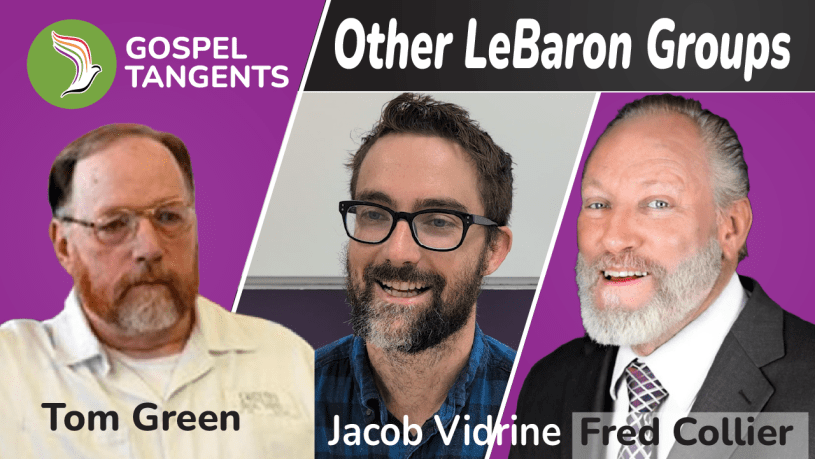
Ross Wesley LeBaron played the role of eccentric prophet. The second oldest son of patriarch Alma Dayer LeBaron Sr., carved a distinct path in Utah. Ross founded the Church of the Firstborn. His teachings presented a unique fundamentalist cosmology focused on distributing sacred authority rather than concentrating it, emphasizing that “the honor is in the work, not the title.”
Authority Above the Church: Dissemination vs. Concentration
Ross LeBaron’s theology centered on the concept of a higher order of priesthood existing “above the [LDS] Church” structure. This authority, which he called the Patriarchal Priesthood, originated with the keys restored by Moses, Elias, and Elijah in the Kirtland Temple (D&C 110).
This higher priesthood manifested in the Nauvoo period as the authority to make men “kings and priests” (and women “queens and priestesses”), often referred to as the fullness of the priesthood. Ross taught that this authority should be widely distributed among worthy men, acting as a check and balance against unrighteous leadership.
He contrasted this view sharply with the prevailing fundamentalist models (like the Woolley line, which later split into FLDS and AUB) that focused on concentrating supreme authority either in a single presiding figure (the “one man rule”) or a small “Council of Seven”. Ross felt the stability of the priesthood lay in this dissemination of authority, allowing many men to hold the highest keys for their own families.
Ross LeBaron’s Priesthood Claim
Ross’s authority traced back to his grandfather, Benjamin F. Johnson, a close confidant of Joseph Smith and the last living original member of the Council of Fifty. Johnson claimed that Joseph Smith had authorized him to teach the principles of plural marriage, endowments, garments, and the Second Anointing “when I’m led to do so”. This unique claim bypassed Ross’s father (Benjamin Franklin LeBaron) and passed to his grandfather, Alma Dayer LeBaron Sr. (“Dayer”.)
Ross received a patriarchal blessing and the “keys, rights, and authority of the patriarchal order of priesthood” from his father, Dayer, in 1950. Although Dayer died without naming a clear successor, leaving behind a succession crisis, Ross eventually received a revelation confirming that the patriarchal priesthood he held was the fullness of the Melchizedek Priesthood. He subsequently concluded that, as Joseph Smith’s birthright, he was the “one anointed and appointed” referenced in D&C 132:73.
Eccentric Prophet’s Ministry & the Second Anointing
Ross’s ministry in Utah often relied on eccentric methods to gain public notice. He spent over 20 years on radio shows (like KSXX) attempting to be controversial or “silly” (clowning around) to draw attention before sharing his message, mirroring unusual methods sometimes used by Old Testament prophets.
A crucial element of Ross’s authority was the belief that the patriarchal keys authorized him to perform temple ordinances, including the Second Anointing.
- Reviving the Second Anointing: Ross and his early follower, Robert Eaby (a former scribe for the AUB Council and participant in Musser’s School of the Prophets), became pioneers in researching and restoring the Second Anointing outside of the LDS Church. Robert Eaby, who had learned about the ordinance through connections to early prayer circles, was able to assist in administering the endowments and then the Second Anointing, making them the first fundamentalists known to perform the ordinance (circa 1967/1968).
- Historical Context: This revival occurred during a period when the ordinance was largely discontinued within the mainstream LDS Church, having been generally halted by Heber J. Grant in the late 1920s and not widely performed again until it was revived by Spencer W. Kimball in the 1970s.
Ross also stressed individual accountability and agency. When a follower sought revelatory guidance from him regarding a major life decision, Ross challenged him: “Why are you afraid of taking responsibility for yourself? Don’t your knees work? Go to God yourself and get revelation for yourself.” This focus on the individual patriarch holding authority for their own family underscored Ross’s belief that while leaders were fallible, the highest order of priesthood could and should be accessed by all worthy individuals.
While the core authority of the Utah-based Church of the Firstborn traced back through Ross Wesley LeBaron’s unique patriarchal lineage derived from Benjamin F. Johnson, the movement’s doctrines and missionary success were significantly shaped by one influential follower: Fred Collier.
Collier, who converted to fundamentalism in 1970, was described not as a professional historian but as a “self-trained historian” who dedicated his efforts to researching early Mormon history, ultimately providing the historical bedrock for Ross LeBaron’s claims.
The Partnership: History, Mysteries, and the Patriarchal Order
Collier joined a core group of “historian followers” drawn to Ross LeBaron because they felt there was something “solid to his claims.” Ross’s ministry focused less on concentrating authority (like other fundamentalist groups) and more on disseminating a “patriarchal order of priesthood.”
Ross liked to “delve into the mysteries.” This included embracing doctrines like plural marriage and the Adam-God doctrine. Collier expanded on these ideas, even writing a lengthy paper, The Adam God Doctrine in the Bible, attempting to find support for the concept in both the Old and New Testaments.
Collier used his historical skills not just for study but for effective missionary work. He was instrumental in helping the Church of the Firstborn articulate its beliefs and authority, serving as a contrast to Ross’s own unorthodox methods:
- Eccentric Ministry: Ross spent over 20 years on radio shows like KSXX, where he would “clown around” or be controversial and “silly” to attract attention before sharing his message, mirroring unusual methods sometimes used by Old Testament prophets.
- Historical Converts: Ross’s eccentric style generally did not attract serious religious followers. Collier, however, converted “quite a number of people” by gathering copious historical research and sharing it.
Collier also gained notoriety in historical circles for publishing works like Unpublished Revelations, which was valued because it stuck strictly to historical facts without conflating them with fundamentalist folklore or bias.
Restoration of the Law of Adoption
One of Collier’s most significant historical discoveries that shaped the Church of the Firstborn was the concept of the Law of Adoption.
Collier found the principle, common during the early Nauvoo/Utah pioneer periods (where men and families would be “sealed to men” in father-son relationships to establish a celestial family structure on Earth), through the published diaries of John D. Lee.
When Collier presented this to Ross, Ross embraced it fully. Thereafter, the Law of Adoption became a core aspect of the Church of the Firstborn’s structure, requiring anyone receiving patriarchal priesthood to enter into adoption covenants. The LeBaron-ites were likely the first fundamentalists to practice adoption since Wilford Woodruff officially discontinued it in the LDS Church in 1894.
Schism Over Celestial Love
The partnership between Ross (the innovative prophet) and Collier (the systematizing historian/writer) eventually fractured over a crucial doctrinal difference in 1983.
Collier had received a vision which convinced him that the essential principle distinguishing a celestial person was “celestial love”—a selfless love for others and a “total commitment” characterized by losing oneself in service. Collier believed that the lower terrestrial kingdom was populated by people who were honorable but were motivated by seeking their “own reward and aggrandizement.”
Collier wanted Ross to adopt this principle of selfless love, believing that the movement under Ross felt too loose and individualistic. However, Ross disagreed vehemently, holding the perspective that competition was a big driving force of the universe. In the ensuing debate, Ross allegedly stated that Christ died for his “own glory” for his own exaltation, which Collier felt was blasphemy against the Atonement.
Less than a month later, Ross changed his priesthood teachings entirely, leading Collier to conclude that Ross had fallen into doctrinal apostasy.
Fred Collier’s Enduring Legacy
Collier separated from Ross, going on to lead his own group (which peaked at several hundred followers in 1992.) Although Ross had never formally appointed a successor, he acknowledged that Collier was the most likely candidate, having “done more to build up our system and the work than anyone else.”
Collier continued his work as a prolific author, writing numerous pamphlets and books. His historical research, focusing on early temple doctrine, priesthood, and the Adam-God doctrine, has since “permeated fundamentalism,” with followers of different groups utilizing his historical scholarship.
Tom Green: Polygamy, Prison, & Quest for Community
Tom Green, a controversial figure in Mormon fundamentalism, was a key claimant to the succession of Ross LeBaron, leader of the Church of the Firstborn. Green stuck with LeBaron until his death in 1996. On his deathbed, LeBaron reportedly did not name a clear successor but charged both Tom Green and Jerry Barlow to carry on his work. Green leveraged this instruction, claiming he had received higher temple ordinances from Ross, thereby being “anointed and appointed”.
Green briefly formed a group spanning the late 1990s into the early 2000s, attempting to unite Ross’s followers under his leadership. Green achieved notoriety by making numerous radio and television appearances about polygamy, frequently showcasing his plural family.
Tom Green’s Prison Sentence
However, his public profile led to his downfall when it was discovered that one of his wives was underage. The state of Utah prosecuted him for child polygamy and welfare fraud, seemingly intending to “make an example of him,” particularly because of his media exposure.
Green was convicted in 2002 of child rape and served a prison sentence, which lasted five years. He was released on parole on August 7, 2007. After his incarceration, his group largely fell apart.
Attempts at Succession
Tom Green sought community, particularly as his children grew and needed partners for marriage. He decided to join the Kingston Group, viewing them as a successful example of a united order and plural marriage, noting their economic success in business despite negative press. He maintained, however, that he never recanted the authority he had received from Ross LeBaron. Green remained on parole for at least 14 years before dying from COVID-19 at age 72 on February 28, 2021.
Green represents one of several factions that emerged after LeBaron’s death, alongside the independents and the group led by Fred Collier. LeBaron’s mission centered on ordaining patriarchs and establishing a patriarchal pattern, an effort that continues today through independent groups and men who trace their authority back to Ross and Tom Green. Fred Collier, another key figure who worked closely with Ross (the religious innovator) as the one who “wrote it up” and added stability through systematization, also claimed succession after separating from Ross in 1983.
Tom was one of the best known polygamists in the early 2000’s due to his quest for publicity. It is likely the reason that other fundamentalists avoid publicity, as they see that it often brings more trouble than it is worth.
 Wheat & Tares
Tom Green lived with his wives in a compound of dilapidated trailers in our school district from around 1997 until he went to prison. He was in his early 50s. His wives were aged from 15-30. The “senior” wife was 30ish, mother of 6-7 children, and the stepdaughter of Tom’s first wife, who he was divorced from but who still lived in the compound. The youngest wife was nicknamed “Barbie” because of her good looks. When he was finally convicted and sent to prison, he had 21 children in our schools, a lot of little redheads. 8 other children were too young for school. His moving his family had a devastating effect on our West Desert School because his conviction caused fear among the other polygamists who lived in that area under the radar, who followed different leaders around the state, and many of them left the area as well. The combined schools went from about 120 students to 30, and 3 teachers had to be laid off. One of the groups started a private school that had about 20 students, and one of the laid-off teachers was their teacher. The groups knew each other because the community was small, but they didn’t really interact except around the school. After Green left, the trailers were left and became even more dilapidated. When the leader of another polygamist group was killed in a rollover accident on the dirt roads, it had a devastating effect on the community, much more than Tom Green ever had there at any time.
Wow, that’s that interesting. Thanks!
Av tuma Goyim avoda zara – simply ewwwwwwwwwwww. The idea of Hell Fire & Brimstone goes hand in glove with the Pauline propaganda of “original sin” and the need of Man for JeZeus the false messiah.
In the Torah and the rest of the Hebrew Bible, Sheol (שאול) – not “Hell,” nor “Heaven.” Sheol a poetic, neutral term for: the grave. The Greek notions of an underworld or the Egyptian mythology of “the realm of the dead” – the place where all humans go when they die, righteous or wicked – not a subject of Torah common law. Why? The revelation of the Torah at Sinai for the living and not the dead. The aggadah located in mesechta ברכות explicitly teaches this mussar through the story of a Man after having a fight with his wife going out and sleeping in a graveyard. The halacha likewise instructs this exact same mussar when ever a Jew enters a graveyard he first tucks his tzitzit inside his pants because mitzvot only apply to the living and not the dead.
The Torah does not present a dualistic afterlife system. No eternal Heaven for the righteous. No eternal Hell for the wicked. Moshe cut an oath brit of either Blessing/Curse – rule the land with justice vs endure Egyptian slavery injustice. The latter called g’lut/exile.
The Talmudic reference of “gehinnom” refers to the T’NaCH geographic valley south of Jerusalem wherein assimilated and intermarried Jews sacrificed their sons and daughters to other Gods, specifically Molech in Gê Ben‑Hinnom. The Baal worship completely apart and different from the worship of Molech.
The aggadic portions which address this subject have no halachic applications – despite the Rambam who erroneously ruled otherwise in the matter of the 7 mitzvot gere toshav. Talmudic Aggada mussar “limits” the metaphor משל “gehinnom” to 12 months duration, for simple Jews who treat Torah as religion rather than common law. Talmudic mussar addresses the concept of purification.
For example: The practice of placing a dead body in the Mikveh (a ritual bath) prior to burial for ritual purification. The abstract concept of tohor vs tuma middot stands on the foundation of Moshe warning Israel not to approach their wives three days before the revelation of the Torah at Sinai. Rabbi Meir taught 48 “degrees” of tuma. This subject based upon making a דיוק upon the 13 tohor spirits revealed to Moshe at Horev 40 days after the sin of the av tuma avoda zara Golden Calf wherein the ערב רב-assimilated and intermarried Israelites-translated the revelation of HaShem permanently living within the Yatzir Ha-Tov hearts of the chosen Cohen people – the definition of the revelation of the Torah at Sinai; instead the ערב רב worshipped word-name translations. Specifically they translated the word אלהים in the place of the 1st commandment שם השם לשמה. Therein they rejected the revelation of the Torah that tohor middot לשמה — as taught in mesechta Baba Metzia — לא בשמים היא.
Immersing the body in the Mikveh showcases the community’s respect for the deceased. This act, ideally performed by the chevra kadisha, (a sacred burial society dedicated to the preparation of the body), adhering to specific halachic rituals and maintaining the dignity of the deceased. The practice of placing a deceased body in the Mikveh prior to burial emphasizes purification, respect, and adherence to Jewish law – as the last act, akin to saying kre’a shma before dying. Engaging in these halachic rituals – a show of respect for the living family survivors who mourn for their dead as an opening expression of their mourning.