
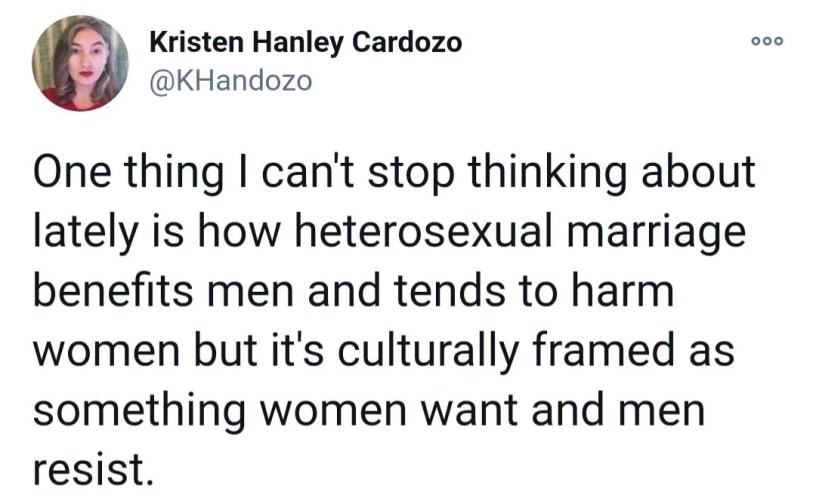
A lot of Gen Z women are concluding that heterosexual marriage is not great, and basically, for women, it’s kind of not. I’m going to keep today’s post a little more brief than usual because I’m mostly interested in hearing from readers about your own life and also about how your adult kids may feel differently.
First, it’s a pretty well documented fact that men benefit more than women from heterosexual marriage across a variety of factors. In fact, the difference is so great that 70% of divorces are initiated by women. Traditional marriage (based on gender roles) is often of great benefit to men at women’s expense in terms of:
- Longevity. Married men live longer. Married women have negative health impacts from marriage.
- Stress. Marriage reduces stress for men by providing emotional support and human connections they often lack. Marriage increases stress for women through expectations of providing emotional labor for the entire family, less leisure time, and the need to manage others’ mental health (e.g. anger, sadness or stress) and not just their own.
- Income. Married men get an income boost; married women often see their income reduced as a result of marriage, particularly if there are children. In non-egalitarian marriages, for example, the couple may view the woman’s earnings as supplementary or “fun money,” not worth moving the family for, but the man’s job may result in relocations that put the woman’s earning potential at a disadvantage.
- Childcare & Housework. In traditional marriage, women are often expected to take on the majority of housework and childcare and men are allowed to be the “helper” who is happy to “pitch in” if told what to do. Even in self-described egalitarian marriages, women report doing 2.5 hours more per week of housework and 3.2 more hours of childcare.
Divorced or widowed men are far more likely to die sooner, whereas women in “low quality” heterosexual marriages may actually have an increase in life expectancy when the marriage ends. Even when a couple starts out egalitarian, it’s very common for heterosexual marriage to trigger a reversion to stereotypes, particularly repeating the patterns of the homes they grew up in.
In short, are women better offer unmarried?
- Statistically? Often yes.
- Emotionally and socially? Sometimes yes.
- In a healthy, equitable partnership? Not always. (Which is not a “no,” by the way).
There are things that used to anchor women to heterosexual marriage that are no longer sufficient to make women marry men:
- Survival. Women don’t need men to physically protect them–because a domestic partner is often the most physically threatening presence in a woman’s life.
- Social respectability. Particularly as society becomes more secular and religious devotion wanes, women don’t feel like pariahs if they choose not to marry, including if they have children as a single parent.
- Income. Women can earn more as singles than they can if they marry, and male-controlled access to a man’s income is usually of less value than direct access to one’s own income.
- Legal legitimacy. Common law “marriages” don’t require a ceremony to confer many of the same spousal benefits in most states. Additionally, there is no longer the same stigma for children whose parents are not married.
Here are the red flags women can see that tell them they are not in a truly egalitarian heterosexual marriage:
- She does most of the invisible labor (tracking birthdays, chores, meal planning, appointments). He offers to help if she will tell him what to do.
- Unequal housework. He offers to help instead of co-owning what needs to be done.
- Unequal caregiving. She handles the school, doctors, discipline, and logistics. He gets to be the fun parent.
- Her career takes a backseat. The family will move for his career, but not hers. His job is the “real” priority. Her job or education is treated dismissively or as a “nice to have.”
- He needs emotional support but does not give it. If she is unavailable or insufficiently validating, he may lash out, putting her in the role of emotional parent.
- He can’t tolerate her saying no.
- He interprets feedback as criticism or disrespect.
- He mocks or minimizes her feelings.
- He uses gender roles to justify his unequal efforts. For example, “You just care more about having a clean house.”
- He believes he deserves comfort more than she deserves rest. He relaxes while she continues to do domestic work around him.
- He describes himself as “helping out.”
- His mother did everything around the house, and he expects his wife to do the same.
- He sees himself as the “final” say in decision making.
- She feels like a mother, therapist, assistant or maid, not an equal partner.
Given that Gen Z women are seeing these things, and also seeing that they have better alternatives (a cat is less needy than some husbands), it’s no wonder many of them are holding out for something better or willing to go it alone. Older generations didn’t have as many options as women do now. Women were less educated and faced harsher treatment in the workplace. Social pressures against single parenthood were often extremely harsh. In short, older generations didn’t exactly have a lot of better alternatives. As I pointed out in a previous post, according to author Andrea Dworkin, right-wing women made a devil’s bargain with heterosexual men, putting themselves in the “protection” of (and at risk from) ONE man, instead of being at risk from ALL men. And in fact, a woman without the protection of a man (and the status he conferred) might be considered “fair game” from other men for all forms of mistreatment. Thankfully, those are no longer the norms.
Given all that, it doesn’t seem to me like the church is making the best arguments in favor of heterosexual marriage, mostly because it is arguing from a male perspective (how men benefit) and making assumptions about the pressures that used to cause women to marry (social and financial penalties and rewards). Nowadays, if you want more women to get married, you probably have to improve the men and teach them how to be equal partners in marriage–not by treating their wives with “respect” (which is a given), not by dictating outdated gender roles (especially in a dual income economy like ours), but by actually participating as full partners in the domestic sphere and fully sharing financial ownership and decision-making for the family. Dividing labor into gendered “nurture” vs. “preside” camps is not going with hearts among women. At best, Gen Z women will ignore or roll their eyes at such antiquated thinking, or they will conclude that Mormon men in particular are not good marriage material.
I assume most of our readers are older than Gen Z, but some might be in the younger cohort. Many will have Gen Z kids.
- Do you see kids raised in the church still marrying at the same rates or is there a delay and decline similar to societal trends?
- Have you heard these types of discussions among Gen Z young adults you know?
- Did your own relationships contain some of the red flags identified above?
- If you are in a long-term relationship, did it become more or less egalitarian over time?
- Are men in the church less likely to treat their wives as equal or about the same as men outside the church? What about the women in terms of expectations? How does the church impact marriages?
Discuss.
 Wheat & Tares
Thanks for something that in the US is much needed to be discussed. The US is not the only culture where this needs to be said, but there are cultures where the stereotypes are practically opposite. I say this as a former Peace Corps volunteer who served in Iran. There are also large generational differences. I am 76 years old. As a member of Community of Christ, I can also say that with men and women with the same Priesthood rolls, the expectations over all of the rolls have changed. I spent 12 years travelling around the world every 6 weeks.
I learned to speak 3 additional languages besides English well enough to do public speaking, and even the language gives insight on what “normal” thinking entails.
I encourage everyone to take advantage of the opportunities you have in the Mormon church to experience the value you have to provide ministry in other cultures. I think most of you discover that that value exchange goes both ways.
I
Should women get married? Wouldn’t that depend a lot on the particular circumstances of the woman (her own personal preferences) and the person she is considering marrying?
Anyway, my comment is about the use of the term emotional labor. I want to nitpick a bit, because the way it’s often used today differs from how it was originally defined. Sociologist Arlie Hochschild coined emotional labor specifically to describe emotional management performed in a job setting, not within personal relationships like marriage. It referred to the requirement to manage or produce certain feelings in order to meet professional expectations.
I’m a male RN, and we talked about this a lot in nursing school. Nursing isn’t just hanging IV fluids, giving medications, doing assessments, repositioning patients, or completing other task-based duties. It also involves a significant amount of listening, empathizing, asking questions, talking through concerns, and conveying genuine care. Doing this consistently—especially when you’re dealing with your own personal stressors—can be extremely challenging. It is often why jobs and professions which have high emotional labor demands leads to burnout. The well can be depleted on both sides.
The extension of emotional labor into interpersonal relationships—such as listening, counseling, or providing emotional support to a partner or child—has been described by Hochschild as a form of concept creep. There’s certainly a valid argument that men, in particular, could benefit from strengthening their friendships and support networks. But I don’t think we should apply the term emotional labor to the normal give-and-take of a marriage. That’s simply part of being in a committed relationship in my opinion.
It is not only that nowadays women are generally higher educated then men (at least on my side of the pond….Europe), thus often the higher earners. My experience is that men tend to get really intimidated by that. Most mormon man are not good marriage material, not in my time (f53) and for sure not today. The antguated ideas in the famiily proclamation are still taught today.
So marriage in this world is not very attractive for women. And marriage in a celestial eternity seems more like hell for women. Sharing your husband with multiple women, popping out spirit babies all the time? No thanks! In my youth this was not taught, by the way. Spirit babies were formed, not birthed. I alway envisioned myself flying through universes creating worlds withou end…now that is a lot more enticing as an eternal occupation! But no need for an eternal partner for that.
Jacob L, why does it always seem to be men telling us what our lives are like? If you want to nitpick about what to call emotional labor, go for it, but it does not change that fact that in most households the women are planning/cooking meals/buying groceries, planning/ taking children to appointments, planning vacations, planning, planning, planning. If you want to call it something else, do so. It is SO much more than normal give and take in marriage.
This discussion doesn’t include children. It requires a woman to carry a developing human body, to then birth, nurse and care for that child is an important part of family life. But it does require a man. A man is also essential for the healthy development of children in their growth and development. Marriage isn’t a discussion about just living together and fighting over the chores. Although that might be involved in family life as well. Marriages are a foundation of society because they bring up the next generation.
Emotional labor is about nurturing the relationship between partners- If neither person does this, it won’t work at all. If only one partner does it, like a lot of women do, they feel neglected, unseen, unheard, and will be looking for friendship elsewhere. They may stay in the marriage, and mostly be emotionally unconnected rather than divorce. This is what I have seen repeatedly happen with boomers, especially in the church. I also know this from personal experience.
My children? No, they don’t stay if they’re emotionally neglected.
“Divorced or widowed men are far more likely to die sooner, whereas women in “low quality” heterosexual marriages may actually have an increase in life expectancy.”
Is that written correctly? Just curious, because it is saying that women in low-quality marriages, where the prior paragraphs had explained that comes with increased stress, leads to longer life expectancy? With that stress, I would have assumed the opposite.
And just to piss some people off, because I’ve earnestly wondered about this for a long time, regarding “She does most of the invisible labor (tracking birthdays, chores, meal planning, appointments). He offers to help if she will tell him what to do.”
And this is a serious question! Is it possible that some of that time, that invisible labor is unnecessary for either party to assume? E.g., what would happen if she did NOT track birthdays? And it so happens that he does not either? Then someone might be disappointed (the person with the birthday). I use that as just a simple example – in general, the thing I’ve been pondering is how a spouse can insist that a certain thing has to be done, a thing that the other spouse does NOT believe has to be done. If the spouse that insists it has to be done, then assumes that burden, does that translate into this idea of unfair assumption of invisible labor? Again, if that birthday isn’t tracked, then the outcome is one of preference, not need.
Do many men cast the burden of invisible labor on their spouses? Absolutely. My question is more one of framing – if the man doesn’t think something is necessary (and, let’s assume, it is for something that is not life-threatening or health-threatening), but the woman DOES see it as necessary (e.g., because of expectations, such as the simple tracking birthdays example), and the woman then takes on that labor to meet her own expectation, can that fairly be characterized as the man forcing the invisible labor onto the woman, when in fact they could both not assume it and deal with it? Again, NOT talking about things like picking up kids, or simple chores to keep a home from being a cesspool of ill health.
Adam F, it depends on the social consequences. If the man doesn’t remember his mother’s birthday and celebrate it to the degree that his mother is expecting/would like AND his wife stops sending presents and doing the acts of kin-work to keep the relationship a good relationship – what are the consequences to the wife? Is the man’s mother going to complain to her son or to her daughter-in-law? Is an inheritance now less likely to be available for the son, his wife and family? NOTE: Most men do not properly forecast the social consequences of their choices – and they have the privilege enough to avoid it under gender-based cultural expectations (Mormon ones too).
Adam F: I reworded that to be more clear that a woman in a low quality relationship may have increased longevity when the marriage ends (not during the marriage).
Your questions are a great turn in the discussion. Amy makes the point I was about to make, and I’ll add another example. How often do older men avoid going to the doctor until their wives nag them, shame them, or even make the appointment for them? How often is the reverse true? There are some aspects to masculine socialization that lead to these adverse outcomes: deferred medical treatment, not asking for help, not cleaning or cooking, not having a robust network of supportive friends, not maintaining family ties. Simply saying the spouses disagree on the importance of the task is only half the problem. It sounds like it’s just an opinion, and sure, there are some elements to these things that might be performative, too cautious or unnecessary.
Do we need to eat a prepared meal or can we just forage? Sometimes you go to the doctor and your symptoms are dismissed or downplayed or worse you catch something in the waiting room. You don’t have to stay in touch with your friends, but it will be much harder to reach out to them when you need them. If the house is messy, the bathroom is dirty, the kids are unkempt, or the fridge is empty, it is disproportionately the woman who is judged harshly, so she will be more likely to care. That’s how patriarchy and gender roles work. So it may be that the wife is going overboard about these things or it may be that both are playing into the stereotypes and responding to social incentives as they’ve been trained their whole lives to do.
All evidence shows that Mormons have been marrying progressively later for decades now, tracking with but lagging somewhat behind broader societal trends. I don’t doubt that the trend continues with Gen Z. Probably they are marrying later than ever, probably still a bit younger than everyone else. Yet that is apparently worrisome enough for President Oaks to preach about marriage and childbearing in general conference. I wonder how effective that actually is. Undoubtedly many young members feel a sense of religious obligation to marry have have a family, and such talks will reinforce that. I was once single at BYU; I remember how it was. But does merely adding to that pressure make the actual marriages any better? Will it make marriage more attractive to young women who have correctly realized that their lives are likely better single than in a bad or even a mediocre marriage? I think the church would be well advised to focus on showing young men how to be the right type of prospective husband. I think they do a decent job of reinforcing values of duty toward spouse and family, and there’s even lip service toward equal partnerships in documents such as the family proclamation, but it’s all negated when it gets paired with nonsense about “presiding”. Having said that, I will credit President Hinckley, back around the time I got married, with once speaking about the importance in marriage of prioritizing the wellbeing of one’s spouse. My interpretation of that particular advice led me to strive for an egalitarian marriage and support my wife’s career ambitions.
Does it seem to anyone else that one political party these days is actively trying to re-create the conditions such that is more advantageous for women to get married? Who knows how explicit it is with certain people, but it does seem like some are saying, “Women aren’t marrying us. Let’s make it way harder in the workplace, in healthcare, online, everywhere…and force them to run back to men!”
I might just be over-extrapolating, though.
Emotional labor is much more than just taking care of birthdays. It is who do you talk to when you have a bad day, to who do you depend on when you are sick, to who you feel loves you. Most men talk to their wife when they have a bad day. Most women talk to a female friend. For the question of is this emotional labor necessary, if the woman is the one taking care of all the family’s emotional needs, she is more likely to divorce the guy when she realizes that she just can’t talk to him about things. So, how necessary, only the survival of the marriage itself.
I have heard so many women say that marriage is just like having another child, only one who will never grow up. That is what happens when that emotional labor doesn’t get shared equally. And if nobody is doing it, both the husband and wife feel neglected and the children are neglected, and pretty soon the family falls apart. Emotional labor is the glue that holds families together, and if it does not get done, the family has no emotional connection.
My family of origin is a good example. My mother was doing it all, until she got sick of it and abdicated, then it fell to me as the oldest girl and the emotional support person in the family. It didn’t happen all at once, just gradually my parents both started leaning on me for emotional support. Both my mother and father told me that I was the child they felt the most love from. Both of them whined to me about feeling unloved in the marriage They were not giving me love, but depending on me so that they felt loved. My survival depended on it because children with totally dysfunctional parents don’t survive, so I had to keep them slightly functioning. Then I got married. My parents didn’t divorce, but neither was there any emotional connection. It was just six people living in the same house and hardly interacting at all. My older brothers could handle that because they had support from outside the family. My two younger siblings were the most damaged. 55 years later, they are still very emotionally crippled. They grew up with me as the person who took care of them, then I and got married, leaving them in a house where nobody connected with anybody else, because nobody was doing the emotional labor.
As to my personal experience in my own marriage. Well, I just wasn’t willing to do all the emotional labor because I did it all as a kid. I needed to heal my own emotional damage from abuse and the emotional needs of the whole family being dumped on me. I burned out long ago and just can’t carry people that way. He had to step up and do an equal share. Now he carries much of it with our adult children because I still have two emotionally crippled siblings that I need to “mother” and I do it very reluctantly and have told medical people that, no my brother cannot rehabilitate at my home because I just cannot do it. He goes into a care facility because I draw the line at my house. He and his needs do not invade my house. Too bad he has no other family, no friends either. But I am “next of kin” to both of them, and that brings some emotional care, some financial care, and making sure they are not alone on holidays, even if I don’t want them. One cannot divorce siblings who have nobody else at all.
About those red flags that you might not be in an egalitarian relationship, I had 10 out of the 14 that was not a red flag up until he retired, so 40 of our 50 years together. But I suspect that is probably typical for baby boomers.
It can be hard not to take columns like this a little bit personally as a man. I try to remind myself that many of the men I know are truly just not full participants in their marriage, and the stats prove out that this is more common than not. I certainly try to be a full participant in my marriage, and I believe that I generally am, but there is always room for improvement.
I have wondered if many of our cultural standards of housekeeping, meal preparation, beauty, and hospitality can be traced back to a time when a household had servants/slaves in addition to a full-time housewife to take the blame for any lapse in cleanliness or etiquette. Perhaps many of these standards are due to be entirely discarded and rewritten. We aren’t living in a Dickens novel, after all.
It is entirely unfair that in 2025 women are still being shamed for an unkempt household or for their husband forgetting his mother’s birthday. The husband should remember his mother’s birthday, if for no other reason than to show his sons how to respect their mother throughout her life. Often, the shame is coming from other women. The mother-in-law should not be placing blame on her daughter-in-law for something her son did or didn’t do, as my own mother has sometimes done.
If men fixed ourselves and became fully participating partners in most marriages, would this fix the situation? It seems like many women just don’t need marriage with men, especially later in life, and even if heterosexual marriages were not actively harmful to women they still might not be beneficial or desirable. While men can, and should, build networks of friends for support outside of marriage, we are cursed by an undying sexual drive that leaves us feeling empty and unfulfilled without an intimate partner (this is, of course, not a woman’s responsibility to fix.)
In case anyone doesn’t realize it, I’m a life-long feminist and about as far left as anyone is allowed to be. That said, I am also sorta the poster girl of a tradwife and here to say that when it works, it works.
I’ll freely confess that reflags 1-4 are valid issues but in 57 years of marriage to an equally and genuinely feminist man I’ve found them a tolerable cost of being available to be the glue and the lubricant that makes other people’s lives work.
I’m NOT saying that any woman has any obligation to choose this way of life. I’m NOT saying that any woman who’s in a traditional hetero marriage and doesn’t feel genuinely and fundamentally valued for her contribution needs to consent to any degree at all of dismissal. But I am saying that an equal partnership and division of labors is highly functional when there is NO mistaking that whether or not society considers a SAHW a valuable contributing member of society the partners involved do. I’m also not talking about the obviously flower-on-Mothers-Day doublespeak the church engages in. I’m talking about a boots-on-the-ground relationship between two cooperative adults who recognize that “equal” does not mean “same”, “voluntary” does not mean “submission” and “unrecognized” does not mean “worthless”.
It took work. It took confidence. It took humility. It took empathy. It took one generously remunerated career — there’s no dismissing that part. But I wouldn’t trade my life with my husband for anything anyone could offer. It’s an alternative but in this black-or-white world someone’s got to propose that there are useful and viable alternatives.
Here’s something a bit counterintuitive:
https://www.deseret.com/opinion/2025/09/08/motherhood-not-a-transition-of-loss/
There is talk in our USA society about the equality of women, but it’s not really equal. There are dangers to giving up her life for the lives of her children or husband. In Utah, there have been too many murders/suicides with the children killed because the man doesn’t like the “independent” thoughts his wife is expressing. But even if it doesn’t go to that extreme, there are still problems in the equality dynamic between men and women in marriage. There’s a wage gap between men and women, housing affordability, care of children, getting healthcare, and the burden of different expectations of women and men. There’s no remedy in society to protect women from getting a bum deal if they get married and want out of the marriage because the house, healthcare, income, children, education, or opportunity are tied up in the marriage. So I’m sure that Gen Z and, to a lesser extent, Millennials, and Gen X women have been increasingly weighing the benefits of marriage and if it works for them. I also think this is manifest in our society by the discussion in the past few years of the problems men are having getting and holding on to relationships with women, and their retreat deep into virtual, angry Internet communities.
Are men in the church better or worse than other men in how they treat women? Of course, some are and some aren’t. They do have support, though, in “being the priesthood holder” and imposing their will. They need to recognize that this attitude doesn’t build a marriage. If the “red flags” are pointed out to them by their wife, they need to seriously reconsider how they approach marriage as well.
It seems to me that Gen Z women are just more honest about the rewards vs obstacles in marriage. I think they are looking at marriage as just one of many opportunities and not a primary responsibility.
I think culturally, a much higher value is placed on male time than female time. I can’t remember which At Last She Said It episode I was listening to, but the female guest was also a therapist and had this activity she’s lead couples through that assumed that all time was valuable regardless of gender, each couple would write on cards the domestic duties they take care of to see how time is allocated between the two halves. The exercise is mostly to help the male half (it seemed to me) realize maybe how little they participate in taking care of the shared home and family and what a more shared workload would look like. Growing up, my dad worked a lot, but he definitely took ownership of household things that needed to be done. I feel like my parents partnered on things pretty well.
I think it was one article on Exponent II and also a recent Emma Watson interview that both highlighted something that I think women are waking up to—marriage should be (and I’m going to botch this description) something where being with that person is a value-add, a compliment to an already fulfilling purpose and life. It shouldn’t be done to fill a hole. I find this so interesting as I’m seeing an increasing number of white Christian men come onto social media saying that a good Christian woman is submissive and never disagrees with their husband and a bunch of other garbage. I think these men are taking their last gasps of control and realizing that they are the ones that actually have to change now rather than blaming everyone around them. They actually have to learn what “relationship” really means. I’ll be honest, the more I watch these kinds of men speak, the more I think women are way better off single.
I don’t think “equal” looks the same for every relationship. I’d say my wife and I coasted on our relationship for the first 14 years and then things came to a head. And we’re better than we’ve ever been. I can see some of those red flags in me. It’s taken constant work and communication on everything. I’ve had to do a lot of growing up when it comes to being emotionally available for her. That’s not something I learned at home or at church growing up. Marriage was something we did because that is what the church told us was the most important thing and I wish there would have been a better approach to that, but we’ve figured it out.
Jack,
I don’t know if you looked into any of those studies, but that article leaves out some important things.
1. That article is advocacy research promoted by its own authors and is not objective science journalism.
2. One of the cited studies has a grand total of population size of 55 women and a couple children.
3. None of their research has been peer reviewed
4. This is classic correlation/causation, that happiness is a result of marriage + kids
5. Their research overstates implications, understates limitations, hides conflicts of interest, and uses causal language unsupported by cross-sectional designs.
6. It fails to give the whole picture of what ALL the research says.
The truth is that marriage/motherhood can be both fulfilling AND that structural inequalities, unequal burdens, and career penalties are real problems deserving attention and policy solutions. And that article does not surface these real issues.
chrisdrobison,
The only study I see there is “In Pursuit: Marriage, Motherhood, and Women’s Well-Being.” Maybe they piggybacked on some other studies to get their results–I don’t know. The only weakness I see–and I admit that I haven’t looked deeply into their methodologies–is that it isn’t peer reviewed by a reputable group.
That said, the quick perusal that I gave the study signals (to me) that it’s quite robust. 3000+ respondents is a good sample size–and it looks like they put a *lot* of effort into making sure that the sample itself was representative of the American populace.
And with that–I’m going to give them the benefit of the doubt–that is until someone proves them wrong with better information.
Hawkgrrrl – that makes a lot more sense!
Anna – just in case I wasn’t clear before, I was using birthdays just as a silly example (and the first listed example from the OP).
All I can do is speak from my own experience. And in that experience, I strive to share all household labors; but we still get at odds when she insists something MUST be done, and it is NOT necessary from my view. Is it because of societal expectations that she feels? I’m sure that is a part of it! Some of it is also, undoubtedly, based on things she experienced in her childhood, and the traumas from that.
I agree with Charles that “[i]t is entirely unfair that in 2025 women are still being shamed for an unkempt household or for their husband forgetting his mother’s birthday. The husband should remember his mother’s birthday, if for no other reason than to show his sons how to respect their mother throughout her life.” If I forgot my mother’s birthday, if she raised that at all with my wife (which my mother wouldn’t, she’d instead “suffer” in silence because not communicating is so healthy …), my next step would be to talk directly to my mother and tell her that’s on me, not my wife. I recognize that that does not remove the initial problem if my wife is approached first.
And to Hawkgrrrl’s comment – “How often do older men avoid going to the doctor until their wives nag them, shame them, or even make the appointment for them? How often is the reverse true?” Again, all I can do is speak from my own experience, and in mine I’d say my wife and I are 50/50. I have nagged her to go to the doctor (she grew up with parents who refused to take her to the doctor for all but the most dire circumstances, aka “you’d better have something wrong with you” when they went), and she has nagged me. But she has never scheduled an appointment for me for any delayed care, nor I for her. Honestly, I’d find it strange if she scheduled something for me with MY doctor. Almost an invasion of my autonomy. Conversely, I trust her to handle scheduling for our kids, while she trusts me for scheduling maintenance for our vehicles and home. Is that patriarchy or is it just division of labor? Is she doing the family part because she has to due to patriarchy or because she wants to? Or because she agreed to? I think it’s most likely a confusing mix of all of the above.
And to be clear, my last comment was not in the vein of “women are making this all up” – it is more along the lines of, is it possible that some of the emotional labor that women assume is not actually something the spouse is expecting her to assume, but which she is assuming out of misplaced societal expectations and/or messed up childhood training? If so, can that be attributed to the patriarchy? Quite possibly. How do we change that, though? Is it enough for me to just shout into the ether that women don’t have to assume these things any more? What will my wife need so that she will give herself permission not to care anymore about something that is truly an optional emotional labor (or, in more direct terms, not care anymore if/when someone makes a callous and/or intentionally hurtful comment about her capability of keeping our home)?
And on a personal rant, who are all these people downvoting? Seriously, I still don’t understand that. I don’t even know WHY a downvote occurs, so I can’t even explain myself in case that person is just misunderstanding what I’m saying. It’s annoying. What am I supposed to glean from downvotes from my prior comment? Because my first reaction to that is that most of those downvotes are from people misreading my comment, willfully or unknowingly. Do they think I’m advocating for a callous, patriarchal attitude of “it’s their own problem”? I struggled with how to formulate my thought on this, but come on. The voting thing just strikes me as something that pushes for an echo chamber; unless the commenter says exactly what the readership wants to hear – presumably, here, NOT what I asked – downvotes galore. I’d almost venture to say that it fosters a culture just like one or more other posts have criticized about the church, of saying what we think others want to hear instead of how we really feel. To me, that is deeply ironic.
It’s hard to feel welcome here, to participate in truly sounding out ideas, when that is occurring so frequently. It’s doubly maddening because I really do think that there is often overlap between our goals and intent.
I don’t think it’s that men don’t do emotional labor, we just tend to do it differently.
Women tend to build connections through communication, shared openness and expressions of caretaking, such as sending the birthday cards every year, keeping the house presentable for company, calling the friend who is going through a hard time, gossiping together (not in the negative sense), gathering around a piano to sing the latest big broadway songs, fussing over the hair of their children, etc.
Men tend to build connections through play and problem solving. Playing golf with their buddies, video games playing (online with friends or solo problem solving), house projects, watching or playing sports, craftsmanship, etc.
Both paths to connection are valuable. Both sexes utilize both type of connection building activities, there is a tendency for each sex to value one type over the other.
A good, healthy sexual relationship includes elements of caretaking, openness, vulnerability, and play, and greatly strengthens the emotional bonds between committed partners. Marriage is merely an ritual to formally recognize the partnership of two individuals so that social and state benefits may be conferred upon the couple to help them succeed.
Good men are willing to give up some of their playtime to help meet the needs of the woman they choose to be connected with. This often comes at a loss of connectiveness with other men, but men are willing to make that sacrifice for an even better connection with the woman the love. Women make the same sacrifice with their girlfriends as well.
Marriage relationships don’t have to be a zero sum game. It’s an opportunity to build a deep, meaningful connection and to build a partnership that is greater than the sum of its parts.
“A lot of Gen Z women are concluding that heterosexual marriage is not great, and basically, for women, it’s kind of not.”
Many men will read this and reply, “Welcome to the party, gals.” For it has been openly discussed among men for decades that marriage is the dumbest thing a man can do (especially due to the financial cost of a failed marriage).
So now women have figured out that marriage is dumb. Men think likewise. And so it is no surprise that marriage, and especially fertility, are at rock bottom.
And yet, marriage still is a thing that invites great investment and celebration – with the “bridezilla” often the one pushing for a big party. So we see women are not all in agreement on the marriage is dumb argument. And neither are men.
What we have is a cultural division. Where once, especially in religious groups, marriage was the universal “next step” of maturation, now there is open argument against the marriage & family step.
What I find fascinating is the how the arguments against marriage are gender specific. For men, the argument is that divorce favors women and makes it possible for a women to split on her whim, making the man’s “marriage investment” worthless.
The female argument is that marriage and especially children disrespects women and puts her at a social and financial disadvantage.
The only solution I see to these arguments and perspectives is Faith. One marries because one wants to be married – and have the benefits of marriage and family – and one hopes it works out.
I believe that a person who makes himself the primary focus of his efforts and pursuits can be extremely successful in this world. And I suspect it is this idea that women are wrestling with – for society has demolished so many barriers of prejudice that women can with confidence pursue material success.
But life is more than selfish pursuit. And marriage and family have long been the simplest way for people to create something larger than themselves.
Furthermore, the pursuit of financial success is not a sure thing and often comes with high personal cost. Observe that as much as women may lament the disloyalty and headaches of husbands, corporations and business partners and volatile financial markets are no more kind or trustworthy.
My one pushback to the female anti-marriage argument is that adulthood is very long, and the biological clock is very real. Delay and deferment of children comes with a biological deadline. The longer a women waits the fewer her options for marriage become as she is unselected by men who want a wife who will also be mother. Plus, there is the reality that younger women tend to be more physically attractive. Society / biology are extremely cruel in this regard.
Jack,
Here are the surveys linked in that article you sent:
– https://www.pewresearch.org/short-reads/2024/02/15/among-young-adults-without-children-men-are-more-likely-than-women-to-say-they-want-to-be-parents-someday/
– https://www.pewresearch.org/social-trends/2023/09/14/what-makes-for-a-fulfilling-life/
– https://www.americansurveycenter.org/newsletter/is-marriage-better-for-men/
– https://ifstudies.org/report-brief/in-pursuit-marriage-motherhood-and-womens-well-being
+ this the author’s survey, which they don’t disclose in the article)
– https://www.regnery.com/9781684514571/hannahs-children/
+ this is the one that has a sample size of 55 women
You can tell they are being deceptive with their numbers here because in that article when they say: “nearly twice as many married mothers say they are “very happy” compared to single childless women, married childless women and unmarried mothers.” You’d probably think from that statement, “wow, those are awesome numbers.” But, look at the concrete ones: 19% of married mothers reported being “very happy” compared to just 10% of unmarried childless women. That means a whooping 81% of married mothers weren’t “very happy”. The “nearly twice as many” bit way over states significance when you look at the real data. Their language implies causal relationships–this is a big no-no. In addition, the author’s study isn’t even measuring the same thing as some of the other studies cited. I think if you’re going to cite a study as a way of enriching this conversation, please at least spend a little more time digesting it yourself and learning what it actually is AND isn’t telling us. Good science is NEVER accepted on face value, it is always trying to be disproved–that is what good scientists do, look for the flaws in a study and then try to replicate findings before accepting anything from it. It is the stuff the sticks around after all that, that we feel pretty good about–but never 100% certain. If the authors don’t clearly disclose conflicts of interest (as in they are the lead researchers) and have to report data behind relative statistics to make it look much better than it actually is, that is not the sign of “put[ting] in a *lot* of effort”. They are highlighting one dimension and making it seem like the whole picture–which makes sense on a site like DN, as this is the kind of narrative that site likes push at the expense of the rest of the picture. And the picture is so much more nuanced and complex than the single dimensional approach that article took.
I’m puzzled. How is watching sports building connection? Golf? how is playing a video gam “connecting” in the same way as “calling the friend who is going through a hard time’? Was I connecting with the people at the ballpark the last time I went to MLB game? I guess I need to know what you mean by “connection.”
I think we are misunderstanding “emotional labor”, so let’s try again. We are not talking about emotional work – or connecting on an emotional level. We are talking about the MENTAL work of running a family. Someone has to THINK of what to feed the kids everyday. Someone has to realize the little johnny needs to be picked up from school. I just watched my 63 year old, perfectly capable family member ask his WIFE to make the doctor’s appointment FOR HIM. Are you kidding me? She has to remember it, take him to the doctor, schedule the follow up, etc. He is using her mental capabilities for something he could to himself. He’s using her as a secretary, taxi and nurse. That’s what we mean by “emotional labor”. So unless you are meal planning and preparing, picking the kids without being asked, and making your own damn doctor’s appointments, you aren’t doing your share.
And just to add my two cents to the discussion, I am Gen X and never married. I would love to have gotten married and had a family but at this age? I am financial secure, own my own house, like my job and have total control of my time and resources. I also have plenty of friends go on lots of activities. So if your not going to add anything to my life, why in the world would I want to take on the burden (read, making your doctor appointments) of marriage?
My husband is my best friend–and that doesn’t even begin to do it justice. We might have started out as separate beings, but we’ve grown into the same tree. The comfort in that, the strength, greater-than-the-sum-of-our-parts-ness, I’m not sure that would happen for us outside of a marriage. I am a fan: of his and of good marriage generally.
Aaaaaaand…
There is no question, none at all, that I do more of the work that makes daily life run for our family. And lots of that is because of legacy patriarchy and gender reasons, and it sucks. And we both see it, and we talk a good game about a more equal division of labor, and then it doesn’t happen. Teaching him to do what I do takes too much work. Watching him struggle for an hour with a job that would take me five minutes sucks. It just works better if I do it. I’ve looked at what it would take to get him up to speed, what it has taken when we’ve suggested making X his responsibility and have concluded this is the way it’s gonna be for the duration.
To the young (or not-young) women who look at that and go, “Ew. No thanks,” I feel you. But for me, a geriatric millennial married 20+ years, this isn’t a balance-sheet kind of an equation.
Adam F. I did understand that was just a silly example. And I for one liked that comment because there are women who do unnecessary emotional labor. They have ulterior motives, like playing martyr or needing to feel needed, and they would be terribly insulted if you told them their martyrdom was not appreciated. Possibly you insulted a martyr or two to get down votes. Don’t worry too much about down votes. We have a few people who just like to downvote people for no apparent reason.
Vajra2, no going to the ball game is not the kind of connection we are talking about, which is why most men depend too much on their wife for emotional connection. Men friends tend to do “bro” activities together. Women get together and analyze their love lives. So after a day spent with friends, who has made a serious emotional connection and who has just spent fun, but emotionally distant time together. So, women come home from that day with same sex friends, feeling understood. Men come home from the time with same sex friends and ask their wife what is wrong with his guy friend that he can’t keep a job. The women friends would be busy figuring it out if one of them couldn’t keep a job. Guy friends leave their friend clueless and just wonder why guy friend is so clueless.
There is a reason so many men are blind sided by divorce. They are emotionally distant and don’t even realize it, or they depend so heavy on their wife for all their emotional connection that wife burns out and feels it is one sided, with her taking care of him and her going to her friends for her emotional connection. The guy in either case is clueless that his wife feels alone in the world.
I mentioned above how many of the red flags my own marriage had, before hubby retired. Well, the marriage still worked great because my hubby is my best friend. He does his share of the emotional labor of the relationship. At the times when I was still wounded by my childhood, he probably did more than his fair share. Being a military spouse is hard, because his employer assumes the spouse has the only career and drags their spouse behind without allowing for that spouse to have any semblance of a say in their own career. It automatically adds about 10 red flags. The active duty spouse is called the sponsor and the spouse is the dependent, so are children. So, see the automatic assumption that one spouse matters and one doesn’t. So, it has to be balanced in other ways or the relationship doesn’t work.
Even as close as combat vets are to each other, that is still not the kind of connection we are talking about. They may depend on each other and trust each other with their lives, but unless they talk feelings, there is no emotional labor being done.
There was one scene in the old NCIS where Abby talks at Gibbs about a problem she is having and all Gibbs does is listen. Doesn’t say a word. But after Abby analyzes her problem, she hugs Gibbs and tells him that he always knows exactly what to say. But he said nothing just listened. But real listening is emotional work. Abby talked feelings and Gibbs listened. So, Gibbs was doing emotional labor for Abby.
A Disciple: “My one pushback to the female anti-marriage argument is that adulthood is very long, and the biological clock is very real.” Sure, but lots of women have kids without marriage in the rising generation. They want a kid who will eventually grow to adulthood, not two children dependent on them.
Personally, I feel like I have a great marriage. It works for us. But there are some inequities in division of labor and there’s some blindness to things I’ve been taught my whole life are priorities. However, I’m Gen X, not Gen Z. I think Margie’s onto something. I will also say that in my personal experience, I found the majority of Mormon men I met at BYU or on my mission to be completely unmarriageable. They weren’t even trying to talk to me as an equal, and they were incredibly entitled. To me, that was a huge turnoff.
Hawkgrrrl,
The question I have is: do those guys from BYU have happy marriages and families?
Jack, I don’t know how you meant that last comment, but it came across as pretty mean and condescending.
In marriages where women are college educated; they account for 90% of divorces.
Fascinating! My favorite part of this discussion is the comments from men who are trying, acknowledging the issues, and doing their best. The men (most of them anyway) who comment at W&T really restore my faith in men and humanity. And I’m glad to hear from the women who commented about how their husbands are their best friends. Good marriages are possible and many of them exist.
I was not in a good marriage. My XH was definitely just one of the kids and he was exhausting. My kids are a lot like their dad, and while that isn’t ideal, it is much easier to deal with those attitudes and issues in a kid than in a husband. I filed for divorce and have never regretted it. I joke that I had a bad marriage and a great divorce. We were good friends up until recently. My earning power is greater than his; he’s struggled financially since the divorce and I’m at the peak of my career.
About emotional labor — it sounds like different people have different definitions. My definition of emotional labor was dysfunctional, which I learned from my parents. The woman is responsible for handling the husband’s emotions. My mom was always laboring to calm my father down or anticipate his every need to head off explosions. My emotional labor was also to anticipate my husband’s every need so he wouldn’t sulk or get passive aggressive. I put 200% into that relationship and he put it in maybe 10%, sometimes 12% if someone was watching. Dysfunctional, red flag, emotional labor.
On the topic of the other type of emotional labor, I admit to thinking that the men questioning if all the tasks really need to be done are bringing up good points. When we were dating, my future XH bought birthday cards and handled stuff like that. Once we got married, he just quit. He expected me to take it over. I didn’t. It offended people. I didn’t care. He would drop hints about how I should create traditions and do special things to make memories and I’d tell him to do it himself if he cared enough. I started out with a ton of Christmas traditions. It got exhausting, so I dropped every Christmas tradition that no one wanted to help with. Christmas got vastly simplified and I ignored my husband complaining about traditions he missed. He wasn’t willing to help; I wasn’t going to do it.
I got married because I wanted kids. Disciple mentioned that – women have a biological clock. I rushed into marriage to have kids. Mission accomplished. Being a single mom is a whole lot easier than raising kids while wrangling an immature and selfish husband.
I’ve seen the articles about fewer Gen Z women wanting to marry, and I understand and support their decisions. If Gen Z men are worried about divorce disasters, then that’s fine if they don’t marry either. I don’t see dropping marriage rates and dropping birth rates as a crisis that must be averted. It’s a population swing and it will eventually swing back. If the population of the world decreases by a billion people, we can adapt to that. Then it goes back up and we can adapt to that too.
Jack: A) How would I know? and B) I hope so. But I’m just glad it wasn’t to me.
rhholland:
“In marriages where women are college educated; they account for 90% of divorces.”
I think that stat has to do with women who *initiate* the divorce process. 70% of divorces are initiated by the wife–and it goes up to 90% among those who’ve been to college.
But as it has to do with overall divorce rates, graduating from college correlates with *less* divorce–not more.
Hawkgrrrl,
Maybe PWS is right–I think my comment is a little heavy handed. Still, that was my way of saying that that demographic can’t be all that bad if they’re doing OK in the marriage and family department. Is there anything more important or fulfilling than good family life?
“I’m puzzled. How is watching sports building connection? Golf? how is playing a video gam “connecting” in the same way as “calling the friend who is going through a hard time’? Was I connecting with the people at the ballpark the last time I went to MLB game? I guess I need to know what you mean by “connection.””
I have an old friend who lives 100 miles away. We are both busy with our careers and families, but we carve out time every year to attend an MLB game together to cheer for our favorite visiting team and catch up on things. We reconnect.
When my favorite team made the playoffs this year, I texted back and forth with my family and friends talking about the games, connecting over a common interest.
My son loves to golf. I’m less enthusiastic about the game, but I play with him to support him and show I care. As we walk the course, he opens up about his thoughts and we share words of encouragement about each each other’s game. We connect.
Some of my long distance friends are gamers, and occasionally we’ll play against each other in online games, reconnecting in a similar way we used to play together decades ago.
Men tend to connect differently to each other differently than women do. That connection is often through play and friendly competition, and that’s ok.
Having recently been surprise divorced and upon reflecting on events over the past several years and speaking with other male friends and with a couple of LMFT’s, when men go to marriage counseling to try to better support their spouses, women often think the purpose of marriage counseling is to fix the men and when it comes time for the men to speak (usually 3 or 4 sessions into counseling), the women are shocked that the men have complaints (not criticisms). And when the therapist starts asking tough questions to the women, the women shut down because the therapist is “on the side of the men”. Soon thereafter, the women cancel marriage counseling because it is “useless” and the men are told that they need to fix themselves before going back to marriage counseling. The therapist is on the side of the marriage. I’m sure it goes the other way as well, but I have been told by more than a couple of LMFTs that this is very common.
rhholland:
Your statement is a bit reversed. Better said, it would be: among college-educated couples who do divorce, women file the paperwork in 90% of cases–that is according to Michael Rosenfeld’s 2015 study presented at the American Sociological Association.
JLM:
I think you’re hitting on what vajra2 laying down. You aren’t just playing, you are intentionally connecting during those activities and that is commendable. Men need to do more of that. Just being in the presence of other men whacking a ball is not connective. If men are just engaged in “bro” activities, but do not actually connect, that is really just escape.
PassTheChips:
That’s a hard one. Sorry you had to experience that. I think for women when they go for so long feeling like they aren’t being heard, the only recourse becomes to “fix the man” or get out. And that is a hard ship to turn. And I think, as a man, it takes a ton of humility and patience to learn to operate completely differently so that trust can be restored. I’ve had many a conversations/arguments over the years with my wife about this topic and how I thought “listening” should be was not how she needed listening to be. I think one of the hard things we’ve both had to learn is that we can both be right about something–it doesn’t have to be a “whose right, whose wrong” all the time. I’ve also had to keep the “fixer” side quiet until invited into the conversation by my wife.
Jack: While it may be true that those men are happy in marriage, given my expectations for being treated as a real partner, that means they likely succeeded in finding a woman who wasn’t set on being treated equally or hadn’t yet realized how it feels to be dismissed constantly or treated as an afterthought. There are plenty of women (as I pointed out in previous OPs) who make the ‘devil’s bargain’ with patriarchy, but it’s one of those things that can’t be unseen. Women generally don’t go from being a feminist to being a tradwife. I know a lot, a shockingly high number of Mormon women, who ended up in marriages like this. They work at the marriage, they do what they can to get their husband to see them as a real person (not an appendage–which is literally how the church refers to women as “auxilliaries”). These marriages often succeed, but it takes a lot of time, patience, and often unhappiness on her part. The men, on the other hand, are not generally aware that we see that they don’t see us, so they aren’t at all unhappy about it. Their worst unhappiness might come from an erosion of privilege, but that’s after they already got a better deal in the first place.
Count me in the camp of people who think male friendships are great, even though they often look different than female friendships. Men engaging in play and light competition can be good. And female friendships aren’t always positive (although most of them are in my experience). We’ve all seen the “mean girls” stereotype. Women can be bad friends as well. Real friendships are extremely important to all people. The way relationship skills are taught is often very gendered, though. As the mom of a non-binary adult (AMAB) I sometimes think they lost out on the deeper friendship skills that women are taught, which of course include some negative skills like manipulation and slander. Women are often just more attuned to what’s happening between people than men are.
@Linda You wrote:
”
“It does not change that fact that in most households the women are planning/cooking meals/buying groceries, planning/ taking children to appointments, planning vacations, planning, planning, planning.”
While that is true in the aggregate, it is not true in our household with my wife and I. I do a lot more of all of the above and would typically be referred to as “the primary parent” when it comes to caregiving responsibilities. I also supported her by being a stay-at-home-dad when she went back to get her masters. Blanket gender stereotypes are as bad as blanket racial stereotypes.
I don’t see how “all men are bad” or “marriage is just a raw deal for women” really advances the goal of true egalitarian relationships. If we want to move forward, maybe steering women towards men who have different values and who are willing to shoulder more of domestic labor or supporting womens’ professional ambitions is the wiser, more harmonious solution. Relationships can be very fulfilling when they work for both partners.
Regarding “emotional labor,” I’m going to quote Inigo Montoya: “You keep using that word. I do not think it means what you think it means.” Emotional labor is not emotional connection between a spouse or partner. Emotional labor is not the division of labor or caregiving responsibilities in a household. Emotional labor is not household management or enacting traditional gender roles tied to cultural expectations. Emotional labor isn’t about who writes the Christmas cards. Emotional labor is not filling in as the parent role for one’s siblings (that is parentification).
Emotional labor has a very specific sociological definition. It is the type of labor in paid employment that requires managing your own emotions to meet the requirements of a job or social role. An example of a job (paid employment) that requires emotional labor might be a customer service rep who must listen to customer complaints and react with empathy and understanding even when the customer is rude, belligerent, or just plain wrong. A UPS driver who simply drops off packages has a job that requires very little (if any) emotional labor.
Where the concept of emotional labor intersects with gender is that women have historically been more likely to take paid employment where emotional labor is required (teachers, nurses, social workers, servers, flight attendants, etc.). These jobs typically pay less, even when the actual demands of the job are roughly equivalent to stereotypically male jobs (construction, engineering, trades, tech).
I think a better word to use is the recently created term “mankeeping,” which describes the burden that is often disproportionately placed on married women to become the sole social and emotional outlet for men as their male friendship circles shrink. Women seem to do a better job of maintaining female friendships.
Emotional labor was always about paid employment. I believe we should keep it this way, and I think the concept creep mirrors how many mental health professionals believe psychological terms are being misused:
https://www.apa.org/monitor/2024/09/therapy-misspeak
One last comment I’ll make is about my own marriage. I am significantly cleaner than my wife. It has been a source of marital friction. My clean is not the same as her clean. I am likely to clean four times longer than her for a similar space. I suppose this is because my mom inculcated this value in me. We had “deep clean” nights on Fridays, and I would clean for hours, then we would celebrate being done by watching a movie from Blockbuster and eating pizza and a 2-liter soda.
My wife takes offense at my cleaning and desire to clean because the amount of cleaning that I naturally want to do makes her feel inadequate as a wife. On a similar note, I volunteered a lot in my son’s classroom when he was in elementary school. While she was glad that I was an involved dad, it only contributed to her guilt as a mom because she felt this was her role and that she should be doing more in this area than I did.
We’ve talked about it, and even though she is highly educated, she has a hard time culturally letting go of these rigid gender roles because of how the patriarchy was deeply ingrained in her.
Invisible/emotional labor is so complex. Every time I think I have a handle on it, I learn something new that uncovers an entire other set of labor that I missed. When you know better, you do better, and all that. When my family has these conversations, I try to just listen.
In my marriage, which is far from perfect, we first tried to divide the labor based on interests. Next we move onto the stuff neither of us enjoys and determine if we still have to do it anyway or can simply ignore it. I think it’s a good place to start.
With regards to the example of a birthday, while I understand that maybe giving gifts to an extended relative who is old and has everything may seem like an easy item to remove from the list to free up your life, it’s not that simple. The actual gift might be irrelevant but it’s the labor of reminding the people in your life that you see them that matters. Same with a whole list of things that may seem silly from holiday traditions to simply checking in with someone. Relationships are worth fighting for and love languages matter.
I will say, getting my kids, who range ages 9-18, simply do not see invisible labor. We are constantly leading them to water but we cannot force them to drink.
As to whether a trad wife or a queer woman is happier, I have no clue. I will say though, never underestimate a religious person’s ability to tell you quite loudly how happy they are. I guess if each faith tradition has a version of a plan of happiness, if you will, then you have to be happy otherwise what’s the point? Watching the actions of the self-proclaimed shiny happy people leaves me unconvinced. Case in point: My social media feed is still jammed with Christians who are unhappy with pretty much everything notwithstanding they control everything right now. YMMV.
Reading the denigration of how men bond is depressing. Women gathering to kibbitz on their love life is a “serious emotional connection”. Men going to a ball game is “fun, but emotionally distant”. It reeks of “the things I like to do are good because I like to do them. The things you like to do are bad because I don’t like to do them.”
I think the arguments over who does more labor and which labor is more important are tiresome. They strike me the same way as the above comment “this job is important because I have to do it.”
I did enjoy Adam’s point about what happens when one party considers a role as necessary while the other sees it as unnecessary. I’d venture that 75% of the “extra” work falls into this category.
is observation the same as denigration?
Interesting note from my marriage: my wife and I were talking about division of labor around the house and I brought up yard work (of which I do more). Her response was essentially “that’s doesn’t matter as much”. It was the category of work I stress most about! Maybe because that is the culturally male work space?
Jacob L – that was an insightful comment about the meaning of emotional labor. After I left my prior comment, it occurred to me that what I was describing in my marriage was more codependency than what anyone would call emotional labor! The term ’emotional labor’ makes sense in the context of the professions you describe. I’m not on facebook, and your comment was the first time I’ve heard the word “mankeeping.” I like it; that’s a good term that is more specifically describes the marital issue than emotional labor.
Jack: the key question isn’t whether the BYU guys referenced are happy in their marriages…. The entire point of this OP and discussion is to ask: yeah but are those BYU guys’ SPOUSES happy?
SMH
You’re illustrating the very problem/challenge.
chrisdrobison,
I missed your comment with the links to the studies–sorry about that. It must’ve been stuck in moderation for a bit because of the number links–I think that’s probably why I didn’t see it.
I’m kind of slow when it comes to surveys–sometimes it’s hard for me to see past the intricacies and find the bottom line. Even so, the way I see it is: the “In Pursuit: Marriage, Motherhood, and Women’s Well-Being” doesn’t rely on any of those other studies vis-a-vis getting their numbers. So far as I can tell they reference them for the purpose of identifying various trends and attitudes that the study addresses–however counterintuitively.
And so what we have to do is look at the study itself–it’s methodologies and claims and so forth–to see what they’re really saying. And early on in the study they show (what looks like to me) this robust fact sheet:
BlueRidgeMormon,
“Jack: the key question isn’t whether the BYU guys referenced are happy in their marriages….”
Just to clarify, my initial question was whether or not they have happy marriages and families–which implies happy spouses and children.