
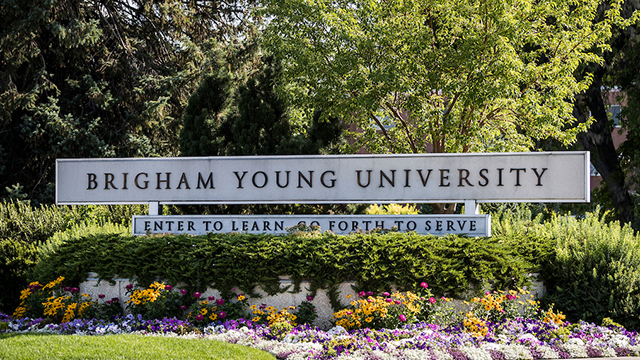
Here is a headline from yesterday’s Daily Universe: “More education leads to less religion but not for members of The Church of Jesus Christ of Latter-day Saints.” The story goes on to emphasize how different it is for the LDS Church and its members, with the added suggestion that BYU’s effort to bring LDS belief into the teaching of every subject supports this apparently exceptional outcome. Here is a direct quote:
[S]tudies have shown that the more educated a person is, the less involved in religion they become. “Among all U.S. adults, college graduates are considerably less likely than those who have less education to say religion is ‘very important’ in their lives,” according to a Pew Research study. However this is not true among Christians, specifically members of The Church of Jesus Christ of Latter-day Saints. In the case of members of the Church, the more educated they are the more religious they are.
The problem is that the cited Pew Research study doesn’t really say what the article claims it says. I’ll give the Universe and its student writer/reporter some leeway here, and there is some ambiguity in what exactly the story is claiming regarding other Christian denominations. Let’s just look a little more carefully at what the Pew study is showing with its data.
The study is titled “In America, Does More Education Equal Less Religion?” The big question here is going to be how you define or measure more or less religion, but I’ll get to that later. The subtitle claims “Overall, US adults with college degrees are less religious than others, but this pattern does not hold among Christians.” Since non-Christians are naturally less religious than Christians, the subtitle is rather confusing, but one claim they are making is fairly straightforward. The Pew study suggests education makes Christians more religious. The Universe story suggested the study said education makes Mormons more religious.
Here’s a paragraph from the study:
The idea that highly educated people are less religious, on average, than those with less education has been a part of the public discourse for decades, but some scholars of religion have called this notion into question. And a new analysis of Pew Research Center surveys shows that the relationship between religion and education in the United States is not so simple.
I’m going to go with the statement that the relation between education and religious belief or activity “is not so simple” and invite you to peruse the data presented in the Pew article. One chart shows that education gives a small decrease in certain belief measures (whether religion is “very important” or whether they pray daily), while the next chart shows almost no effect of education on religious affiliation and activity. So overall, the data is fairly mixed. It’s not clear there is any strong claim you can make from this data.
They do, however, break out “Mormon” data from four other groups, Evangelical Protestant, Mainline Protestant, Historically Black Protestant, and Catholic. Without looking at the data, which group do you think Mormons would most resemble? If you guess Evangelicals and Historically Black Protestants, you would be right. On certain metrics (attend services weekly, pray daily) the Mormons score somewhat higher than those two groups and significantly higher than Mainline Protestants and Catholics.
Two or three prompts for readers. First, I’m summarizing results of the Pew article. You can dig into it and see if there is any specific data that jumps out at you. Here’s one: In the group breakouts, in responses to “Believe in God with absolute certainty,” Mormons and Historically Black Protestants scored 88%, with Evangelicals close behind at 84%, whereas Catholics and Mainline Protestants scored 61% and 55%, respectively. That’s a pretty clear break. Honestly, I’m surprised Mainliners even hit 61%.
Second, what’s your gut feeling or your personal experience about the relation between education and belief? It’s complicated. Even granting the claim (not particularly supported by the Pew data) that more education means less religion, there are lots of reasons people stop believing or stop attending and this is likely to muddy the data. You see, I don’t really trust survey data. Some people give a convenient answer (well, I read Christian history and I lost my belief) rather than a truthful one (boring church, no friends there, want to do other things on Sunday). And I think it is the case that some people are simply not very self-aware and are not capable of giving an accurate answer to why they lost faith or left activity. I’ll bet a lot of us can’t really explain why we do (or don’t) the things we do (or don’t). Why do you cheat on your diet? Why do your New Year’s resolutions never go anywhere? You have probably been saying “We need to clean up the garage next week” for about five years. There’s a reason people go to psychiatrists to figure out what’s going on inside their heads. Often we just don’t understand ourselves. It makes you wonder about LDS testimonies.
Third, a quibble about responses across denominational groups. For an Evangelical, “being less religious” might mean not reading the Bible anymore or losing those warm feelings for Jesus. For a Mormon, “being less religious” means not attending church every week or losing those warm feelings for the LDS Church as an institution or the Book of Mormon. So much of Mormon religious concern is directed at attendance (sacrament meeting, the temple) rather than belief or anything else (okay, except paying tithing, which trumps attendance). So you can tabulate responses by denominational grouping, but to some degree respondents from different denominations are answering different questions, even though the wording is identical. You don’t have to read many religion books outside the Mormon bubble to recognize that other Christians in other denominations approach religious topics and practices rather differently than Mormons do. I just don’t think most survey designers fully grasp this problem. Even at the simplest level of vocabulary, Mormons use words differently.
What do you think?
.
 Wheat & Tares
I have been hearing this tired trope for over a decade. Allow me to debunk it.
In a centuries-long time frame, increased education has exploded traditional religion. Atheism has grown considerable throughout the developed world. Traditional religions have been struggling for quite some time to keep membership. Acceptance of beliefs and practices once considered taboo by traditional religions, such as abortion, LGBTQs, premarital sex, women’s equality, etc. has grown considerably in the developed world.
Across a larger space, the most religious countries are the poorest and least educated and the least religious countries are the wealthiest and most educated.
The idea that the more educated Mormons are the more religious they are would suggest that Mormonism would have its greatest appeal among more educated populations. That is simply not true. The wealthy and educated are not the source of converts to Mormonism. It is the poor and less educated who tend to be.
What is curious is why this statistic is appearing. Here’s why: 1) Mormons managed to concentrate their space in the mountain west, acquire a bunch of land that they just assumed possession of without anything more than faux purchases from Native Americans, build a base of political and community power, and leverage that power and wealth into population expansion. Mormonism thrives best within the already established community, not from converts to the religion. The central Mormon community strongly pushes education. It connects its members with education and career advancement opportunities. But it has high expectations upon those who take advantage of these opportunities. If you’re born within the community, whether it be in Utah or a family with roots from Utah, you’re simply more likely to be educated. As you pursue your education you are strongly expected to marry someone who is active Mormon and educated. Once you tie the knot and have kids, the harder it is to leave the church. Your dependency on it grows and you build your whole life around it.
One more thing, if you look at all Mormons, both converts and born in the community, you’re clearly going to find that the more educated Mormons stay in the religion longer. What I would like to see is statistics that look at only those who were born into Mormonism in Mormon belt or in families with ties to the Mormon belt. I think what we would find is that education is having more of a negative impact on commitment to Mormonism than a positive one.
But the church leaders and faithfuls love to manipulate statistics and that is what they will continue to do.
In addition to defining what it means to be “religious,” I think we have to define what it means to be “educated.” Is it simply completing the requirements to receive a bachelor’s degree? There are a lot of “educated” adults running around who cruised through their degree programs without encountering any significant challenges to their worldview. This is especially true at CES universities where the general ed classes are specifically designed to reinforce a correlated orthodox Mormon perspective ( I should know. I attended BYU-I). If college didn’t challenge you to question your assumptions, promote critical thinking, while also expanding your horizons, than I would argue you are an uneducated person with a college degree. How many believing Mormons fall under this category, I really don’t know.
Studies like this can be super interesting, but this is a classic case of correlation versus causation. You see this in the Daily Herald article where says, “…studies have shown that the more educated a person is, the less involved in religion they BECOME.” They’re making the assumption that education is what’s CAUSING the differences…but the causation arrow could just as easily point the other direction for certain demographic groups.
For example, the LDS church has a long history of promoting higher education, and huge numbers of Mormons end up at Mormon-owned schools, where their beliefs tend to be reinforced. There’s also a large number of LDS students who served missions right before entering college. Plus, the types of people who decide to pursue higher education may share some other common trait that happens to correlate with religious beliefs. There’s geographic location, the type of degrees being pursued, family income, political tendencies, and hundreds of other of potential explanations.
Observational studies are super interesting for observing patterns, but they don’t explain what caused it.
I was literally about to say the same thing as Pirate Priest: correlation =/= causation. This information has been around for a long time, and I think the problem is that the Church would like people to infer that being educated leads you to conclude that Mormonism is right (and by implication, leads you to conclude that other Christian faiths are for uneducated rubes, which is frankly not that hard to believe from inside the Church). Funny how everyone wants it both ways. We want science / education / empirical evidence to “prove” the Church is true, but whenever those things cast doubt on the church’s narrative, then it’s “spiritual” stuff that trumps science. I mean, that’s all churches, but still.
I do think that in general, there’s a strong social pressure toward higher education in the church, but it’s definitely possible if not a foregone conclusion to graduate from a church-owned university without gaining much in the way of critical thinking skills. BYU-I is probably worse than BYU Provo, but there is literally a part of the evaluation of your professors that requires them to weave the church’s spiritual narrative into the lesson plans, which means.. you’re not exactly going to be taught anything that contradicts the church, or if it does, that professor’s going to be short-lived. If you decide to leave the church or admit to a bishop that you no longer believe, you’ll be expelled. If you don’t attend church regularly, you’ll fail to get the required endorsement and you’ll also have to leave the school. So, there is no freedom of belief and thought while you attend a church-owned university, and that’s where people tend to find their spouse and marry. I was just listening to the interview with one of the Studio C people (she’s still very active LDS), and she talked about the toxic work environment on the set because people could not really speak freely and there was always oversight, and that’s literally not unique to Studio C. That’s church culture, mixed with having a job.
Real learning requires reflection, pondering, thinking, and change, much like genuine repentance. It also depends on where you are from, what you bring to the learning, and your attitude towards change. Are you excited for something new or afraid? While the church may promote learning, it also appears to lack a commitment to promoting change.
It is hard to figure out with a survey because every person and religion is different. Whether a person says in the church after “learning” depends on their ability to self-reflect and change, and also on their ability to rationalize or justify or the lies we tell ourselves.
Good post. Full disclosure, I work in higher ed and I work in a region of the country where I regularly see in my classroom both quite left-leaning, secular, liberal students and relatively devout evangelical, conservative students, and their range of responses to texts like Milton’s Paradise Lost, for example, confirm that this is a complicated question. I’m with you in that I don’t trust survey data, but here are a few of my entirely subjective observations:
1. I think education, if one takes it seriously, causes one to re-examine one’s life/beliefs/ideas and to learn more about themselves and the world around them. That’s just sort of what education is supposed to do (though I’m with mat that a lot of folks seem to get through college without their beliefs being challenged significantly. That’s especially the case if one attends, I would imagine, places like Liberty University or one of the BYUs). Of course, if one holds relatively rigid views about religion, or gravity, or history, or science, then education will naturally put pressure on those views because while facts are relatively easily obtained, knowledge (and especially wisdom) is far more nuanced and difficult to achieve than many suspect. And if a person feels challenged, frightened, or intimidated by complexity, nuance, and intellectual rigor, it’s often just as easy (perhaps even easier) to retreat to what they feel they already “know” (their beliefs, really, not knowledge per se) than to dive in and embrace all of the wonderfully messy processes of learning. So in that sense, I can certainly see why at least folks with a certain religious bent might really have problems with education (especially higher ed). Note: I’m not just picking on religious folks. We all hold on to beliefs that have more to do with emotion than with logic and reason, despite what some of us might say.
2. Part of the tension between especially Mormonism/Christianity and secular education is that many Christians don’t seem to understand their own religion’s teachings. There is no such thing as certainty when it comes to belief in god’s existence (that question is worded strangely: how can you “believe” in something with absolute certainty?) because the scriptures are pretty clear that faith in god and Jesus, not absolute metaphysical certainty in their existence (which absolutely CANNOT be achieved), is what believers should be focused on, the whole talk about absolute knowledge or absolute belief is simply not part of the scriptural equation; it’s FAITH that makes people whole in the scriptures, not knowledge. It’s always seemed bizarre to me that during testimony meeting we perform a kind of certainty that the scriptures themselves (and science!) say is not possible to achieve. I just don’t know why this has become the standard. I think intellectual humility, no matter who practices it (Mormon, Christian, Buddhist, atheist, etc.) is an admirable quality. That’s especially the case because there are only two certainties in this life: 1) Nixon was, indeed, a crook, and 2) the Eagles were a really good band. The rest is all subjective.
Kidding aside, though, in my own case, I can definitely say that the more educated I’ve become, the more skeptical I’ve grown of religion. And I think Mormonism (and BYU in particular) makes a mistake when it claims to be able to reconcile religious faith and reason/science. We can’t, and we shouldn’t try; one of the gloriously messy paradoxes of life is that we sometimes mistake feelings for facts and there are many things that we simply don’t have the answer to. It’s okay to admit that, and just keep learning and exploring. The rush towards religious certainty, as well as the Mormon culture that inculcates it, is part of the problem, not part of the solution.
It would be interesting to see a breakdown of the type of education Mormons are getting. To be clear I have no data but I’d hypothesize the following:
Mormons are more likely to acquire practical degrees like business, teaching, engineering, law, medicine that financially support a family. Many of those fields require a degree of orthodoxy within the field. Non Mormon may be more likely to study history, anthropology, literature, languages, women’s studies, race studies, which almost by definition require more challenging the status quo. In other words I wonder if the Mormon education teaches more compliance than non Mormon. Just a theory.
One thing that historically differentiated the LDS church from Evangelical peers who otherwise had a lot in common culturally was implicit and explicit encouragement to pursue higher education. (The church hasn’t changed its position, but I’ve heard anecdotally that right wing politics turn against higher education has started to affect attitudes in some parts of Utah.) In addition, the lay ministry system in the church tends to give the most responsibilities to those who are both committed believers and have some financial stability and capability to handle aministrative responsibilities. The latter two attributes tend to correlate strongly with having some higher education. Beyond those effects, I think for graduate level education it might matter what type of degrees people get. They fall into two general catgories: research degrees that require a lot of critical thinking skills and professional degrees (law, business, medicine) that put more emphasis on gaining a lot of domain-specific knowledge. Guess which category of advanced degree pervades Mormon leadership? I’ll bet if you separated those two categories you’d find a divergence: research degrees correlates with less faith and professional degrees correlates with more faith.
Fascinating post and great comments!
Instead of adding to the discussion, I’m going to propose a Ph.D topic for research if anyone is looking for one. Compare the correlation between education and religion with the correlation between education and what Americans would call superstition (rather than religion). For example, how many highly educated people consult their horoscope every day? Which group of people is more likely to believe that their star sign and their partner’s star sign predicts the health of their relationship — the more or less educated? Do highly educated people tend to believe more or less in paganism? Participate more or less in pagan rituals?
The sample size might be small in the USA. A Ph.D student might need to gather data from India, for example, or focus on Hindu expatriates living in the USA, or another group that traditionally places a lot of emphasis on the zodiac or pagan beliefs.
Perhaps whatever gap exists between the religious Christians and the educated also exists in other belief systems and the educated. That would be fascinating to study. My hypothesis is that science and secularism could be a more universal belief system that could carry across religions and cultures worldwide. And while it may mute or soften the cultures that depend on religious/pagan/zodiac beliefs, it may also provide a framework for human rights and progress worldwide.
Fun fun fun with data!
Here’s the problem (as others have said):
1. There is a folk belief that education is incompatible with faith. That more education means you’ll “think yourself right out of the church.” LDS leaders have at times reinforced this folk belief. BKP crackdown in the 90s etc. And this of course lines up with a current larger socio-cultural narrative: that simple folk are religious and faithful (and skew rural), while “educated” people who vaunt their expertise are godless atheists (and skew urban). Lots of people believe this. Lots of people do handwringing about it. It maps neatly onto popular narratives about fault lines in society. Etc etc. And sometimes it’s enacted ore reinforced in a way that makes life aggravating – e.g. church policies or norms that frown on open debate or denigrate “worldly learning” and all of that. This belief on the part of church leaders — both central and local — can create a hostility to higher education and intellectualism that’s palpable in your typical ward’s second hour. People believe that this is the way the world works.
2. The Pew data (along with other religious life survey data of various kinds) empirically demonstrates, over and over, that this simply isn’t true in the Christian world. Instead, more education is correlated with more religiosity. Full stop.
If that second point confuses you, all that means is that you’re confused with the dominant cultural narrative. But the data is the data.
So of course the problem with the Daily Universe article is that it presupposes the erroneous premise (that education and religiosity are incompatible) and “discovers” that LDS people “buck that trend”! Wow! (The problem is that we don’t buck that trend, we’re consistent with a trend throughout Christianity. Education and religiosity are correlated, not opposed.) Yawn. People simply want to believe that we’re different in a good/remarkable way. There appears to be an insatiable appetite for that, even when it’s patently not true.
Jana Reiss just gave a phenomenal data-driven talk at the University of Virginia about the new “Next Mormons” survey wave that was particularly erudite on a number of empirical insights, including ones regarding education and religiosity. But the underlying Pew data is pretty clear, and the “finding” about LDS folks isn’t the exception the Daily Universe writer thinks it is.